 Скачать презентацию Spectrum Transformation Acceleration Badri Younes Do D Director
44faecbee92866780e7f13278fffbafa.ppt
- Количество слайдов: 18



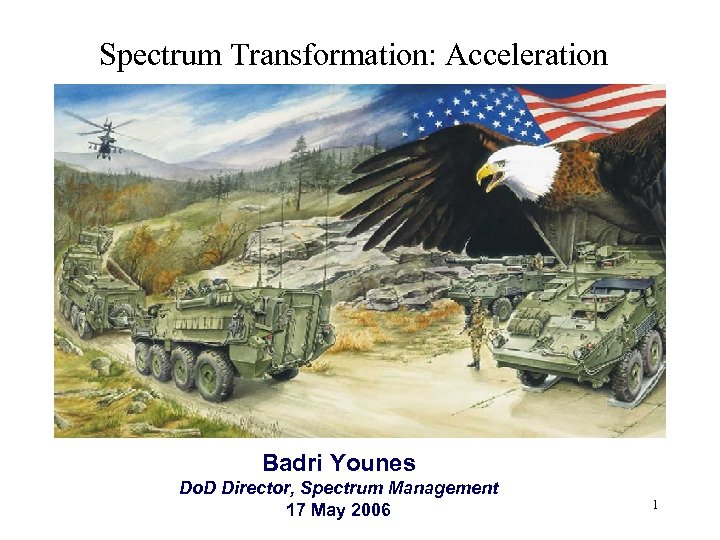
Spectrum Transformation: Acceleration Badri Younes Do. D Director, Spectrum Management 17 May 2006 1
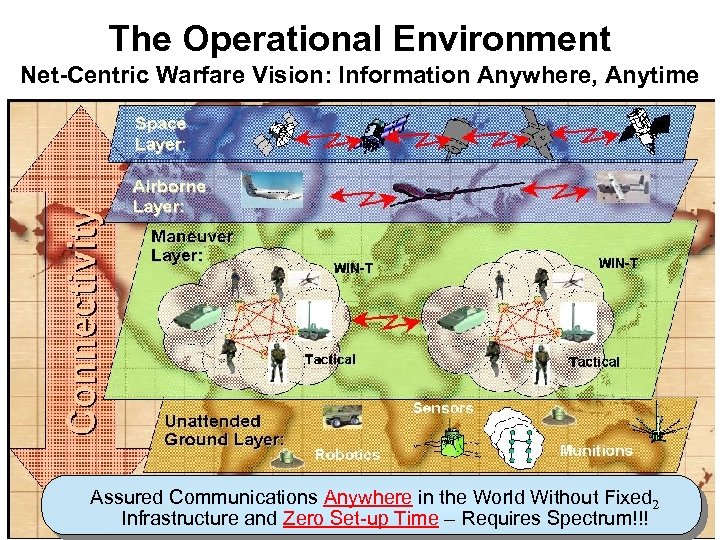
The Operational Environment Net-Centric Warfare Vision: Information Anywhere, Anytime Assured Communications Anywhere in the World Without Fixed 2 Infrastructure and Zero Set-up Time – Requires Spectrum!!!
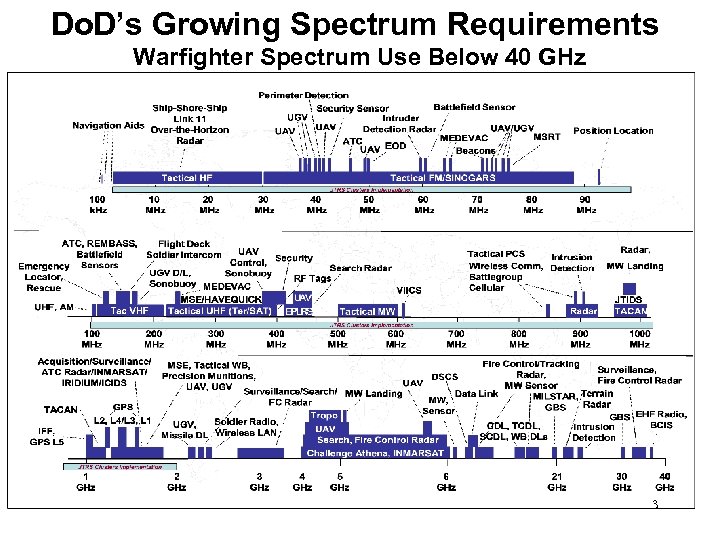
Do. D’s Growing Spectrum Requirements Warfighter Spectrum Use Below 40 GHz 3
KEY FRAMEWORK: DSMA • Instrumental in the new DSO and in implementing the President’s Initiative: The Defense Spectrum Management Architecture (DSMA), the Department’s enterprise architecture for Spectrum Management, will be developed: – To address how the Department manages and uses the electromagnetic Spectrum today and in the future in order to ensure continued DOD access to required spectrum. – The DSMA will include a robust, common set of architecture products which will provide decision makers and their supporting staff with operational, systems and technical elements involved with conducting spectrum management for net-centric 4 operations.
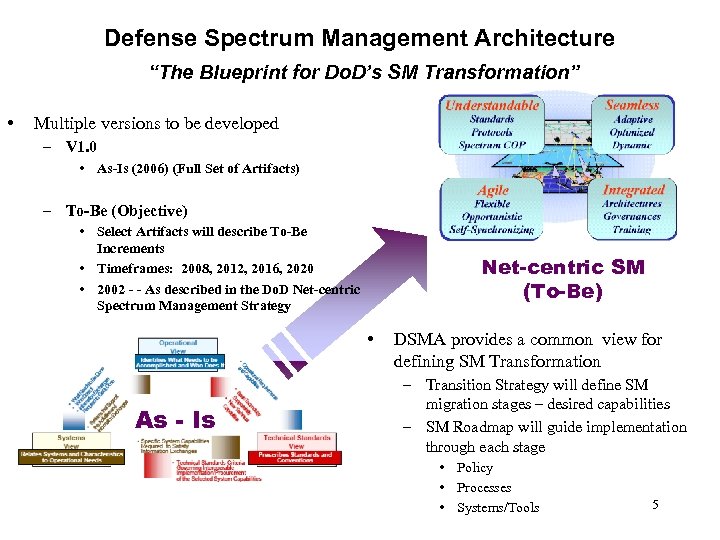
Defense Spectrum Management Architecture “The Blueprint for Do. D’s SM Transformation” • Multiple versions to be developed – V 1. 0 • As-Is (2006) (Full Set of Artifacts) – To-Be (Objective) • Select Artifacts will describe To-Be Increments • Timeframes: 2008, 2012, 2016, 2020 • 2002 - - As described in the Do. D Net-centric Spectrum Management Strategy Net-centric SM (To-Be) • As - Is DSMA provides a common view for defining SM Transformation – Transition Strategy will define SM migration stages – desired capabilities – SM Roadmap will guide implementation through each stage • Policy • Processes • Systems/Tools 5
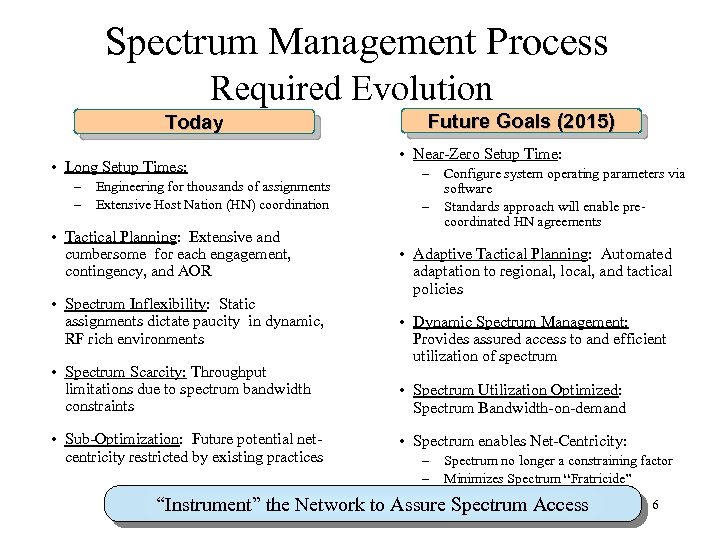
Spectrum Management Process Required Evolution Today • Long Setup Times: – – Engineering for thousands of assignments Extensive Host Nation (HN) coordination • Tactical Planning: Extensive and cumbersome for each engagement, contingency, and AOR • Spectrum Inflexibility: Static assignments dictate paucity in dynamic, RF rich environments • Spectrum Scarcity: Throughput limitations due to spectrum bandwidth constraints • Sub-Optimization: Future potential netcentricity restricted by existing practices Future Goals (2015) • Near-Zero Setup Time: – – Configure system operating parameters via software Standards approach will enable precoordinated HN agreements • Adaptive Tactical Planning: Automated adaptation to regional, local, and tactical policies • Dynamic Spectrum Management: Provides assured access to and efficient utilization of spectrum • Spectrum Utilization Optimized: Spectrum Bandwidth-on-demand • Spectrum enables Net-Centricity: – – Spectrum no longer a constraining factor Minimizes Spectrum “Fratricide” “Instrument” the Network to Assure Spectrum Access 6
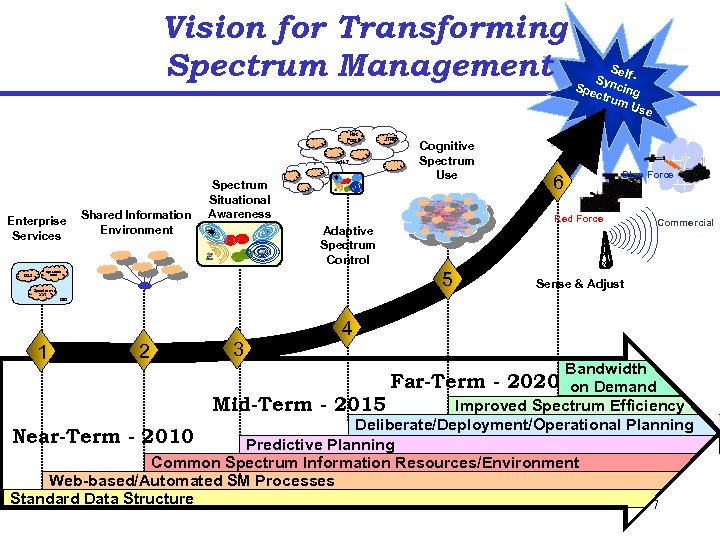
Vision for Transforming Spectrum Management Net Force WIN-T Enterprise Services DS 3 Shared Information Environment Spectrum Situational Awareness JTRS Cognitive Spectrum Use 5 Spectrum XXI 6 Blue Force Red Force Adaptive Spectrum Control Spectrum M&S Se Syn lfc Spe ctru ing m. U se Commercial Sense & Adjust GIG 1 2 3 4 Bandwidth on Demand Mid-Term - 2015 Improved Spectrum Efficiency Deliberate/Deployment/Operational Planning Near-Term - 2010 Predictive Planning Common Spectrum Information Resources/Environment Web-based/Automated SM Processes Standard Data Structure 7 Far-Term - 2020
REORGANIZATION: 2006 Do. D transformation in spectrum management: • The Defense Spectrum Office (strategic planning) and the Joint Spectrum Center (engineering) will merge in mid-year to form the new DEFENSE SPECTRUM ORGANIZATION • This new DSO will combine both previous entities’ core competencies into a one-stop shop for enabling Net-Centric strategy within the spectrum management community. + = …Power to the Edge for the Warfighter! 8
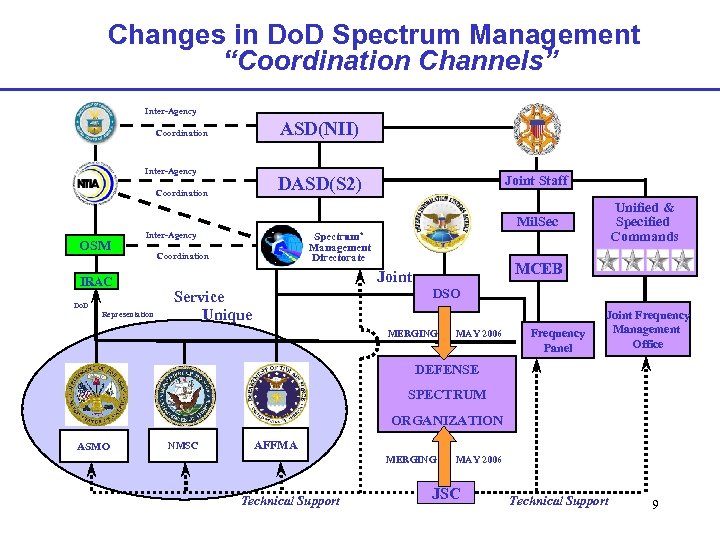
Changes in Do. D Spectrum Management “Coordination Channels” Inter-Agency ASD(NII) Coordination Inter-Agency Joint Staff DASD(S 2) Coordination Unified & Specified Commands Mil. Sec OSM Inter-Agency IRAC Do. D Representation Spectrum* Management Directorate Coordination MCEB Joint DSO Service Unique MERGING MAY 2006 Frequency Panel Joint Frequency Management Office DEFENSE SPECTRUM ORGANIZATION ASMO NMSC AFFMA MERGING Technical Support MAY 2006 JSC Technical Support 9
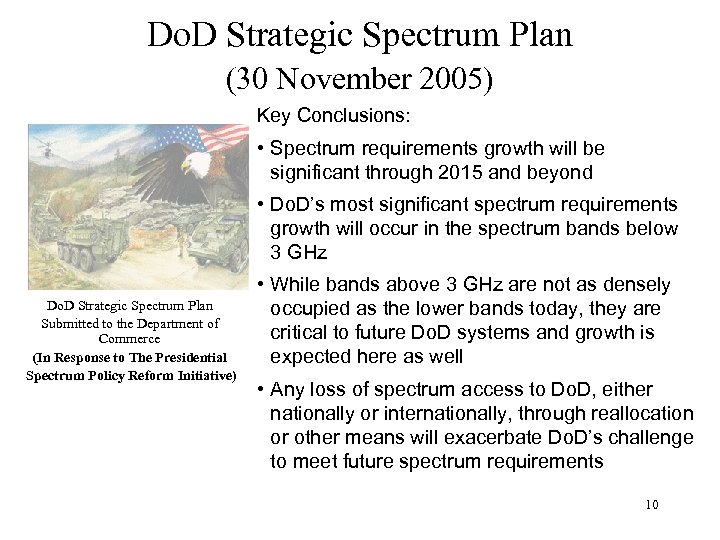
Do. D Strategic Spectrum Plan (30 November 2005) Key Conclusions: • Spectrum requirements growth will be significant through 2015 and beyond • Do. D’s most significant spectrum requirements growth will occur in the spectrum bands below 3 GHz Do. D Strategic Spectrum Plan Submitted to the Department of Commerce (In Response to The Presidential Spectrum Policy Reform Initiative) • While bands above 3 GHz are not as densely occupied as the lower bands today, they are critical to future Do. D systems and growth is expected here as well • Any loss of spectrum access to Do. D, either nationally or internationally, through reallocation or other means will exacerbate Do. D’s challenge to meet future spectrum requirements 10
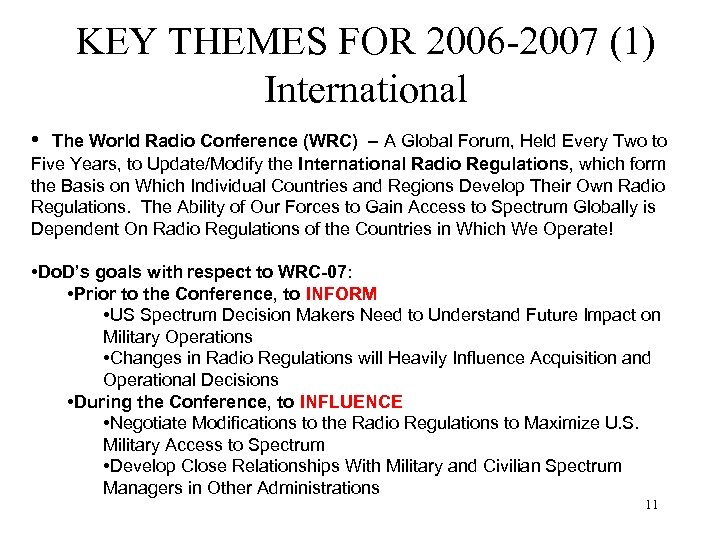
KEY THEMES FOR 2006 -2007 (1) International • The World Radio Conference (WRC) – A Global Forum, Held Every Two to Five Years, to Update/Modify the International Radio Regulations, which form the Basis on Which Individual Countries and Regions Develop Their Own Radio Regulations. The Ability of Our Forces to Gain Access to Spectrum Globally is Dependent On Radio Regulations of the Countries in Which We Operate! • Do. D’s goals with respect to WRC-07: • Prior to the Conference, to INFORM • US Spectrum Decision Makers Need to Understand Future Impact on Military Operations • Changes in Radio Regulations will Heavily Influence Acquisition and Operational Decisions • During the Conference, to INFLUENCE • Negotiate Modifications to the Radio Regulations to Maximize U. S. Military Access to Spectrum • Develop Close Relationships With Military and Civilian Spectrum Managers in Other Administrations 11
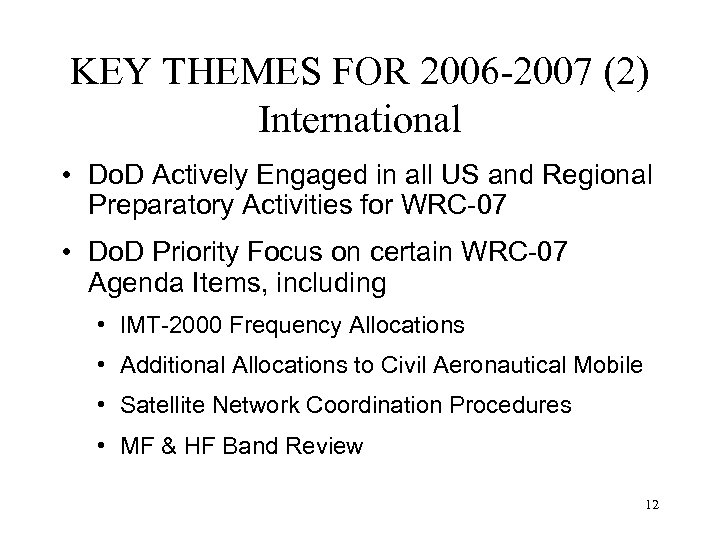
KEY THEMES FOR 2006 -2007 (2) International • Do. D Actively Engaged in all US and Regional Preparatory Activities for WRC-07 • Do. D Priority Focus on certain WRC-07 Agenda Items, including • IMT-2000 Frequency Allocations • Additional Allocations to Civil Aeronautical Mobile • Satellite Network Coordination Procedures • MF & HF Band Review 12
KEY THEMES FOR 2006 -2007 (3) Emerging Spectrum Technologies • Initiative: Spectrum Scorecards – Purpose: To develop a system engineering methodology to promote consideration of spectrum efficiency, effectiveness, and supportability – Key Objectives: • To provide a spectrum efficiency and effectiveness tradeoff analysis methodology for program managers. • To meet policy and regulatory challenges of spectrum valuation, efficiency, and effectiveness. 13
KEY THEMES FOR 2006 -2007 (4) Emerging Spectrum Technologies • Initiative: Spectrum Test Beds – Purpose: To establish wireless and spectrum testbed capabilities to assess and measure performance of spectrum access methods, systems, and components in a networked environment. – Key Objectives: • To evaluate emerging technologies under realistic scenarios to provide foundation for new policy and doctrine for future wireless systems and spectrum access. • To address bandwidth limitation of dense wireless networks and the relationships and dependencies between emerging wireless operational concepts and emerging spectrum management approaches. • To develop foundation for operational management of wireless network devices to support dynamic spectrum operations and realization of bandwidth-on-demand. 14
Spectrum Testbed Initiative Objective & Goals To promote wireless and spectrum testbed initiatives that provide simulation and hardware facilities to assess and measure performance of innovative spectrum access methods, systems, and components • Evaluate emerging technologies under realistic scenarios • To identify and mitigate spectrum-related issues • To provide foundation for new policy and doctrine for future spectrum access and management • Assess the relationships and dependencies between emerging Do. D operational concepts and emerging spectrum management approaches • Monitor Advances So New Capabilities Are Integrated Into Operations Without Delay 15 • Develop Partnerships Between Industry and Government
KEY THEMES FOR 2006 -2007 (5) National • The President’s Spectrum Initiative: Current economic analysis reflects a view of defense-use spectrum as merely a commercial commodity, and overwhelmingly reflects a narrow “property rights” view of spectrum usage – as the Initiative moves towards concrete policy prescriptions this year, industry and the academy must be made aware of • the impact on taxpayers • on U. S. payments for access to spectrum overseas • the impact of loss of military budget assets to pay for existing and future spectrum needs for military defense; and • potential economic losses from the consequences of eroded defense capabilities. 16
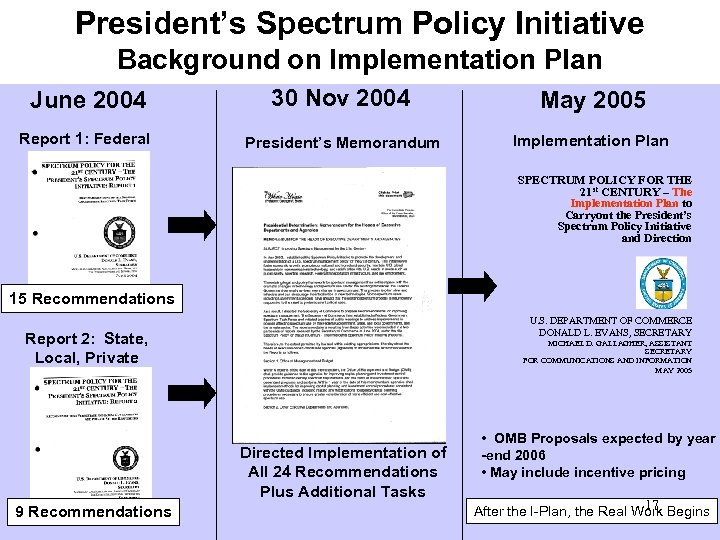
President’s Spectrum Policy Initiative Background on Implementation Plan June 2004 30 Nov 2004 May 2005 Report 1: Federal President’s Memorandum Implementation Plan SPECTRUM POLICY FOR THE 21 st CENTURY – The Implementation Plan to Carryout the President’s Spectrum Policy Initiative and Direction 15 Recommendations U. S. DEPARTMENT OF COMMERCE DONALD L. EVANS, SECRETARY Report 2: State, Local, Private MICHAEL D. GALLAGHER, ASSISTANT SECRETARY FOR COMMUNICATIONS AND INFORMATION MAY 2005 Directed Implementation of All 24 Recommendations Plus Additional Tasks 9 Recommendations • OMB Proposals expected by year -end 2006 • May include incentive pricing 17 After the I-Plan, the Real Work Begins
Key Points • Do. D Network-Centric Operations Requires Assured Seamless and Autonomous Spectrum Access • New technologies are fundamental to resolving future spectrum shortfalls • Do. D Spectrum Management community participating in various adaptive spectrum access programs to ensure parallel technology/policy development Making Spectrum Access Transparent to the Users 18
Скачать презентацию Spectrum Transformation Acceleration Badri Younes Do D Director
44faecbee92866780e7f13278fffbafa.ppt