


 Скачать презентацию Spectrum Sensing in Emergency Cognitive Radio Ad Hoc
01447ee773c11150a85802f4099ad3fc.ppt
- Количество слайдов: 16
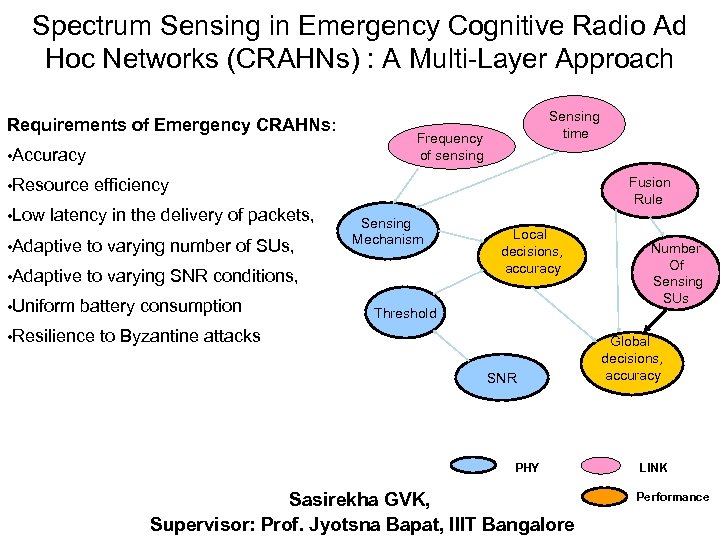 Spectrum Sensing in Emergency Cognitive Radio Ad Hoc Networks (CRAHNs) : A Multi-Layer Approach Requirements of Emergency CRAHNs: • Accuracy • Resource • Low Frequency of sensing Fusion Rule efficiency latency in the delivery of packets, • Adaptive to varying number of SUs, • Adaptive Sensing Mechanism to varying SNR conditions, • Uniform Sensing time battery consumption • Resilience Local decisions, accuracy Number Of Sensing SUs , Threshold to Byzantine attacks SNR Global decisions, accuracy , PHY Sasirekha GVK, , Supervisor: Prof. Jyotsna Bapat, IIIT Bangalore LINK Performance
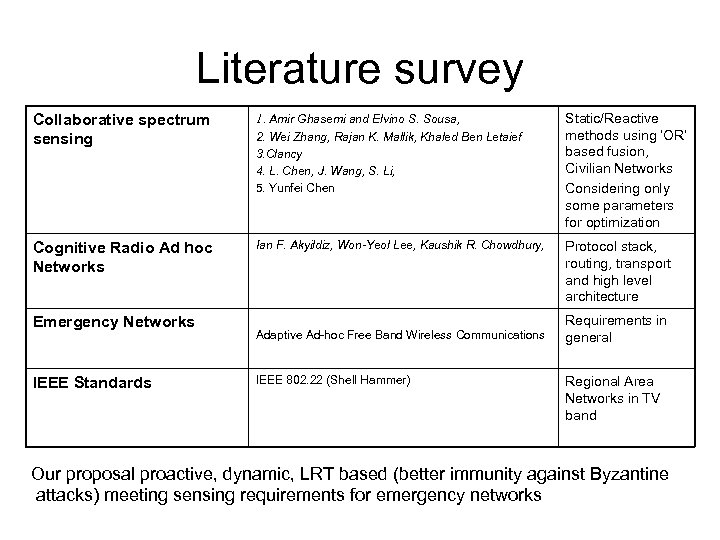 Literature survey Collaborative spectrum sensing 1. Amir Ghasemi and Elvino S. Sousa, Cognitive Radio Ad hoc Networks Ian F. Akyildiz, Won-Yeol Lee, Kaushik R. Chowdhury, Emergency Networks IEEE Standards 2. Wei Zhang, Rajan K. Mallik, Khaled Ben Letaief 3. Clancy 4. L. Chen, J. Wang, S. Li, 5. Yunfei Chen Adaptive Ad-hoc Free Band Wireless Communications IEEE 802. 22 (Shell Hammer) Static/Reactive methods using ‘OR’ based fusion, Civilian Networks Considering only some parameters for optimization Protocol stack, routing, transport and high level architecture Requirements in general Regional Area Networks in TV band Our proposal proactive, dynamic, LRT based (better immunity against Byzantine attacks) meeting sensing requirements for emergency networks
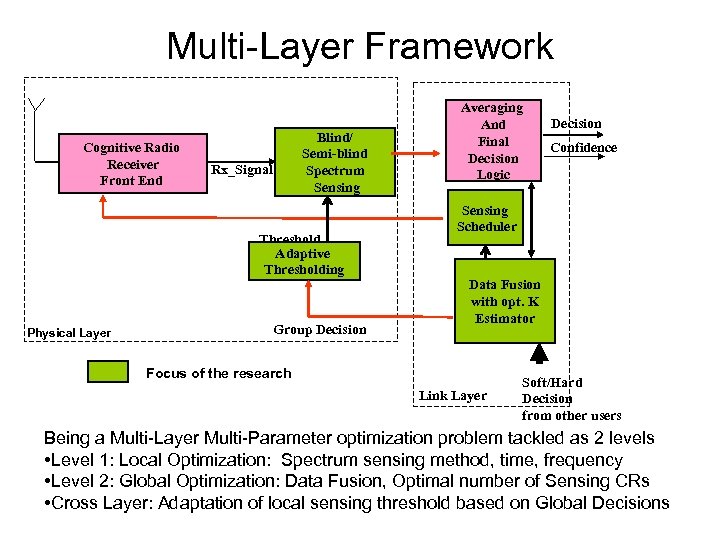 Multi-Layer Framework Cognitive Radio Receiver Front End Blind/ Semi-blind Spectrum Sensing Rx_Signal Threshold Adaptive Thresholding Physical Layer Group Decision Averaging And Final Decision Logic Decision Confidence Sensing Scheduler Data Fusion with opt. K Estimator Focus of the research Link Layer Soft/Hard Decision from other users Being a Multi-Layer Multi-Parameter optimization problem tackled as 2 levels • Level 1: Local Optimization: Spectrum sensing method, time, frequency • Level 2: Global Optimization: Data Fusion, Optimal number of Sensing CRs • Cross Layer: Adaptation of local sensing threshold based on Global Decisions
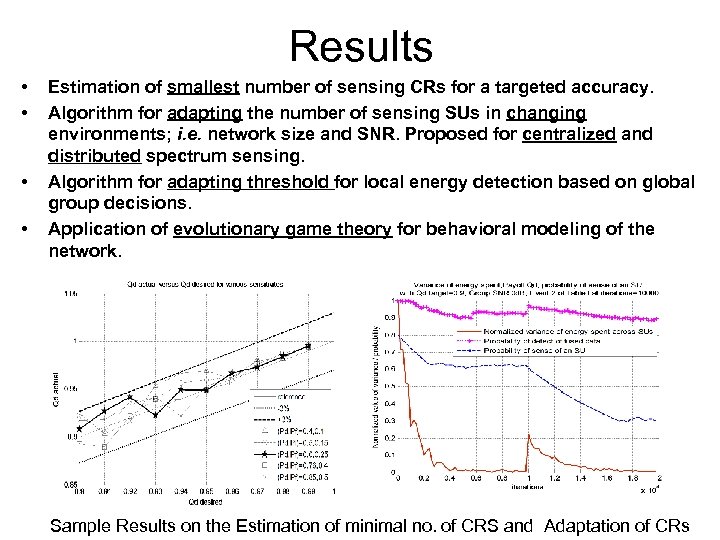 Results • • Estimation of smallest number of sensing CRs for a targeted accuracy. Algorithm for adapting the number of sensing SUs in changing environments; i. e. network size and SNR. Proposed for centralized and distributed spectrum sensing. Algorithm for adapting threshold for local energy detection based on global group decisions. Application of evolutionary game theory for behavioral modeling of the network. Sample Results on the Estimation of minimal no. of CRS and Adaptation of CRs
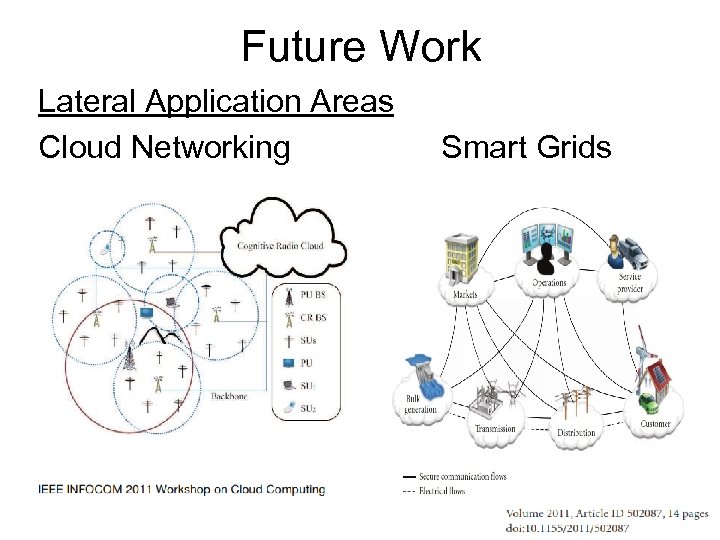 Future Work Lateral Application Areas Cloud Networking Smart Grids
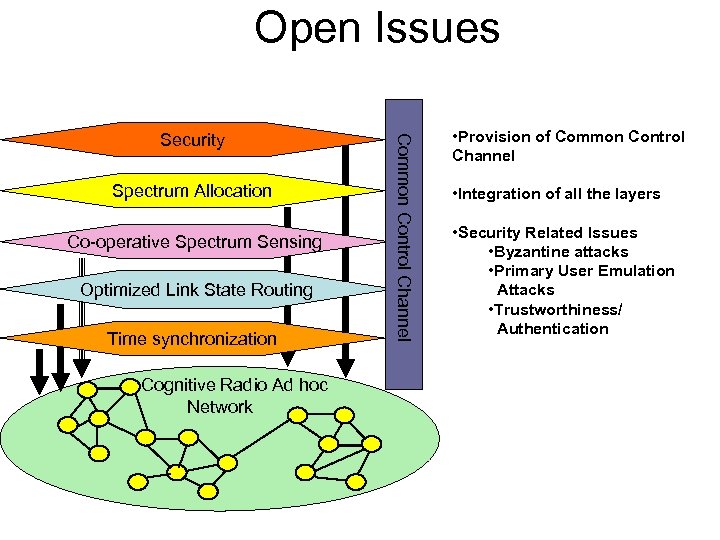 Open Issues Spectrum Allocation Co-operative Spectrum Sensing Optimized Link State Routing Time synchronization Cognitive Radio Ad hoc Network Common Control Channel Security • Provision of Common Control Channel • Integration of all the layers • Security Related Issues • Byzantine attacks • Primary User Emulation Attacks • Trustworthiness/ Authentication
 Back up slides
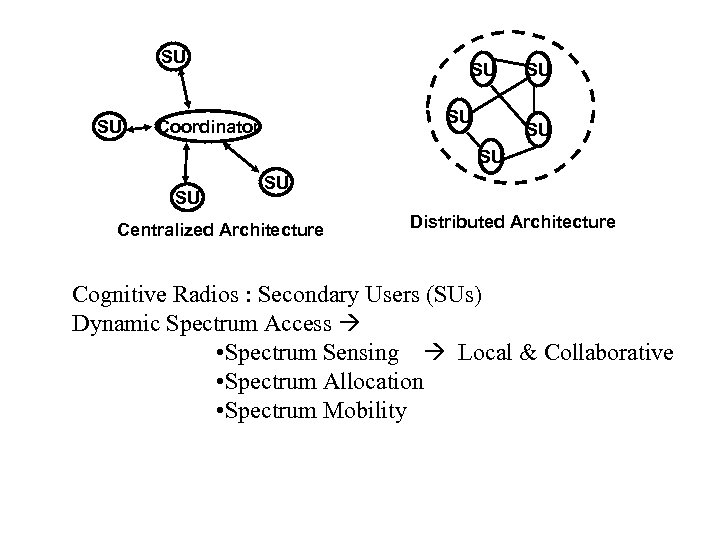 SU SU Coordinator SU SU SU Centralized Architecture Distributed Architecture Cognitive Radios : Secondary Users (SUs) Dynamic Spectrum Access • Spectrum Sensing Local & Collaborative • Spectrum Allocation • Spectrum Mobility
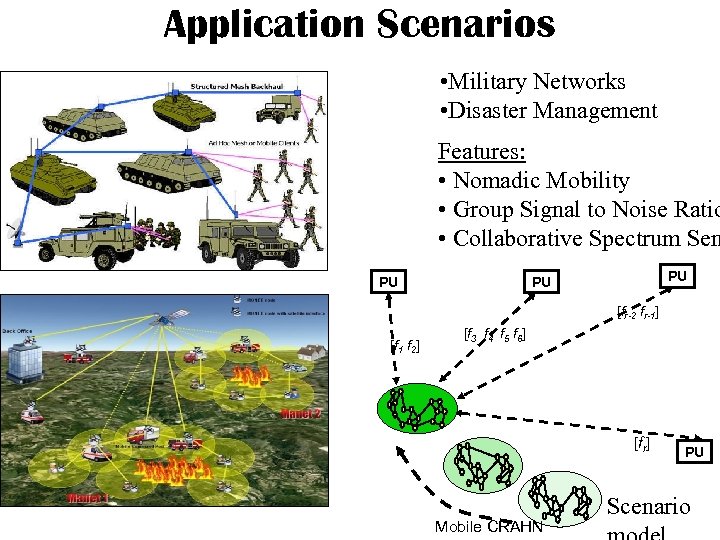 Application Scenarios • Military Networks • Disaster Management Features: • Nomadic Mobility • Group Signal to Noise Ratio • Collaborative Spectrum Sen PU PU PU [fr-2 fr-1] [f 1 f 2] [f 3 f 4 f 5 f 6] [fr] Mobile CRAHN PU Scenario
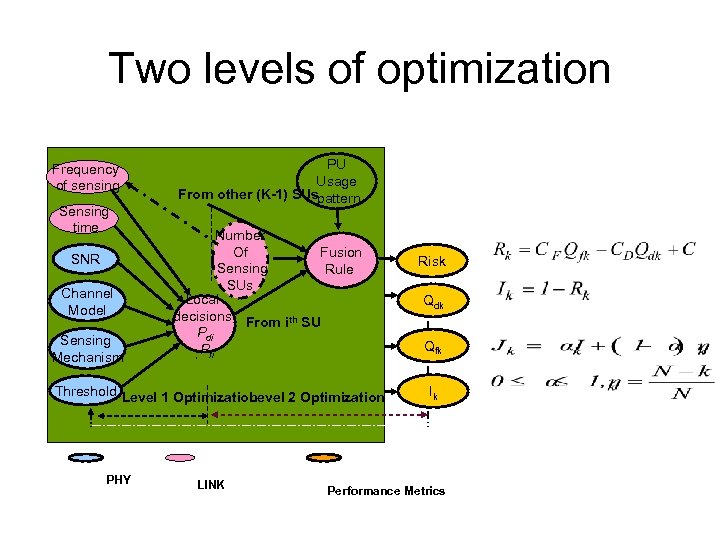 Two levels of optimization Frequency of sensing Sensing time SNR Channel Model Sensing Mechanism PU Usage From other (K-1) SUspattern Number Of Fusion Sensing Rule SUs Local decisions, From ith SU Pdi , Pfi Threshold Level 1 Optimizationevel 2 Optimization L PHY LINK Risk Qdk Qfk Ik Performance Metrics
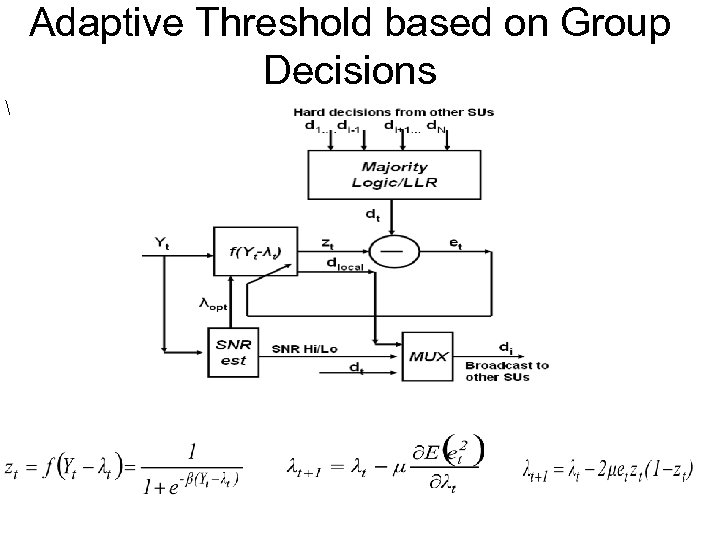 Adaptive Threshold based on Group Decisions Adaptive Threshold Confidence
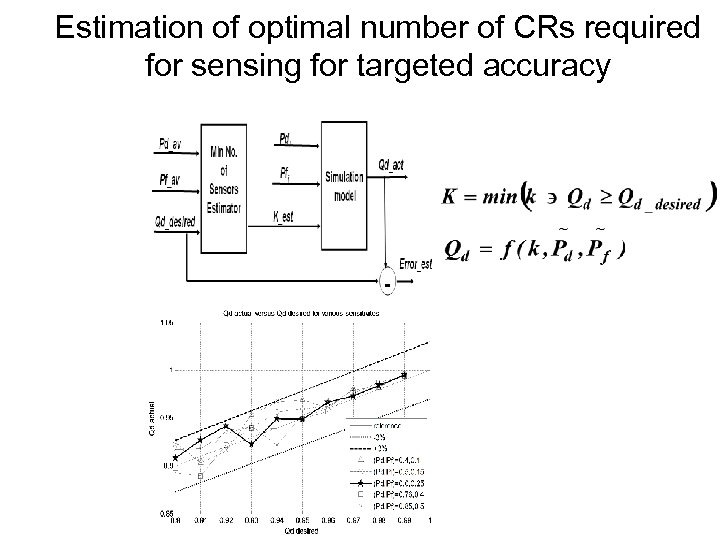 Estimation of optimal number of CRs required for sensing for targeted accuracy Group SNR-> Pd_av, Pf_av-> K
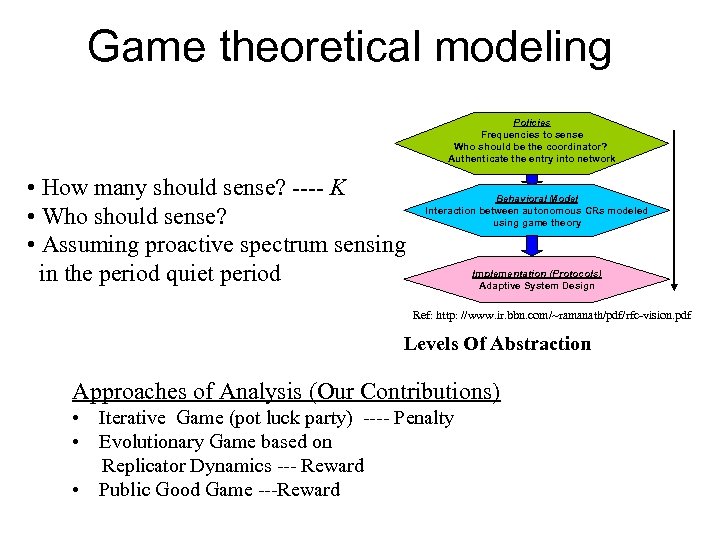 Game theoretical modeling Policies Frequencies to sense Who should be the coordinator? Authenticate the entry into network • How many should sense? ---- K • Who should sense? • Assuming proactive spectrum sensing in the period quiet period Behavioral Model Interaction between autonomous CRs modeled using game theory Implementation (Protocols) Adaptive System Design Ref: http: //www. ir. bbn. com/~ramanath/pdf/rfc-vision. pdf Levels Of Abstraction Approaches of Analysis (Our Contributions) • Iterative Game (pot luck party) ---- Penalty • Evolutionary Game based on Replicator Dynamics --- Reward • Public Good Game ---Reward
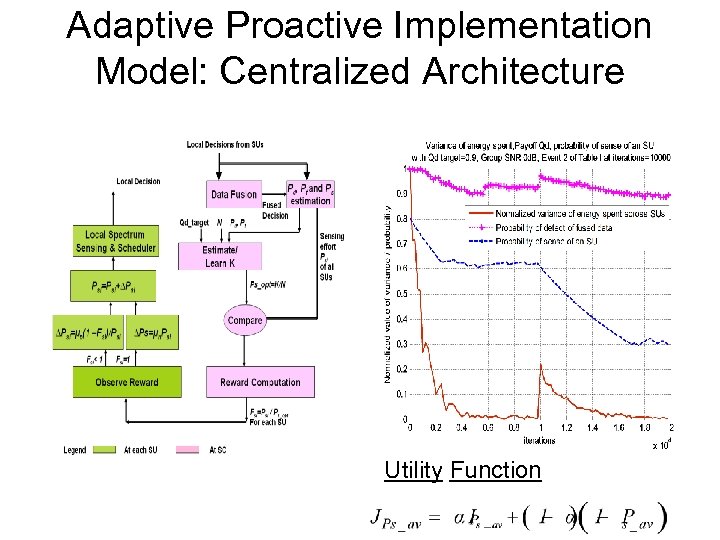 Adaptive Proactive Implementation Model: Centralized Architecture Utility Function
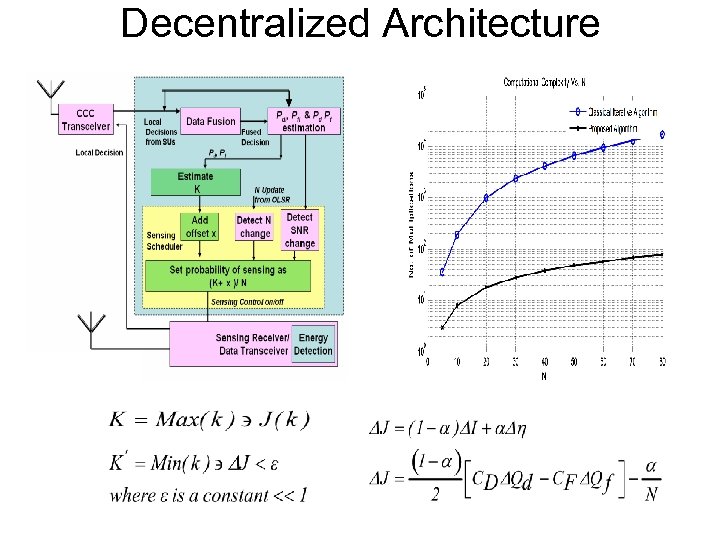 Decentralized Architecture
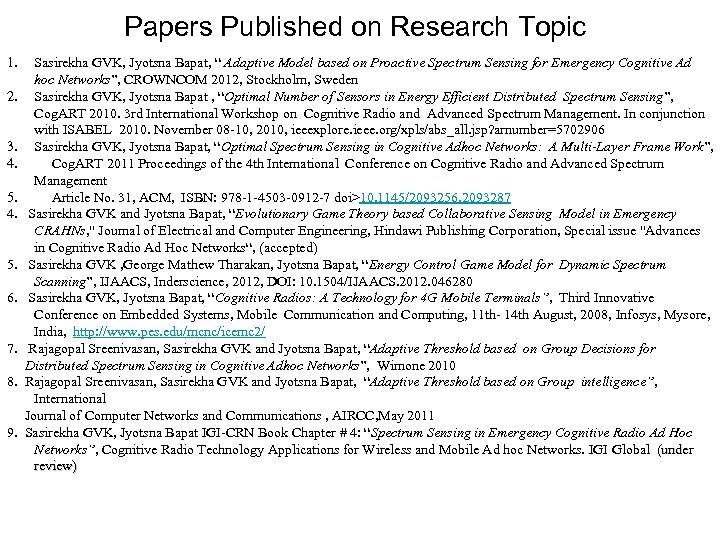 Papers Published on Research Topic 1. Sasirekha GVK, Jyotsna Bapat, “ Adaptive Model based on Proactive Spectrum Sensing for Emergency Cognitive Ad hoc Networks”, CROWNCOM 2012, Stockholm, Sweden 2. Sasirekha GVK, Jyotsna Bapat , “Optimal Number of Sensors in Energy Efficient Distributed Spectrum Sensing”, Cog. ART 2010. 3 rd International Workshop on Cognitive Radio and Advanced Spectrum Management. In conjunction with ISABEL 2010. November 08 -10, 2010, ieeexplore. ieee. org/xpls/abs_all. jsp? arnumber=5702906 3. Sasirekha GVK, Jyotsna Bapat, “Optimal Spectrum Sensing in Cognitive Adhoc Networks: A Multi-Layer Frame Work”, 4. Cog. ART 2011 Proceedings of the 4 th International Conference on Cognitive Radio and Advanced Spectrum Management 5. Article No. 31, ACM, ISBN: 978 -1 -4503 -0912 -7 doi>10. 1145/2093256. 2093287 4. Sasirekha GVK and Jyotsna Bapat, “Evolutionary Game Theory based Collaborative Sensing Model in Emergency CRAHNs, " Journal of Electrical and Computer Engineering, Hindawi Publishing Corporation, Special issue "Advances in Cognitive Radio Ad Hoc Networks“, (accepted) 5. Sasirekha GVK , George Mathew Tharakan, Jyotsna Bapat, “Energy Control Game Model for Dynamic Spectrum Scanning”, IJAACS, Inderscience, 2012, DOI: 10. 1504/IJAACS. 2012. 046280 6. Sasirekha GVK, Jyotsna Bapat, “Cognitive Radios: A Technology for 4 G Mobile Terminals”, Third Innovative Conference on Embedded Systems, Mobile Communication and Computing, 11 th- 14 th August, 2008, Infosys, Mysore, India, http: //www. pes. edu/mcnc/icemc 2/ 7. Rajagopal Sreenivasan, Sasirekha GVK and Jyotsna Bapat, “Adaptive Threshold based on Group Decisions for Distributed Spectrum Sensing in Cognitive Adhoc Networks”, Wimone 2010 8. Rajagopal Sreenivasan, Sasirekha GVK and Jyotsna Bapat, “Adaptive Threshold based on Group intelligence”, International Journal of Computer Networks and Communications , AIRCC, May 2011 9. Sasirekha GVK, Jyotsna Bapat IGI-CRN Book Chapter # 4: “Spectrum Sensing in Emergency Cognitive Radio Ad Hoc Networks”, Cognitive Radio Technology Applications for Wireless and Mobile Ad hoc Networks. IGI Global (under review)