


 Скачать презентацию Spectrum Monitoring and Interference Analysis James West Senior
333aa20662b188f1ac6edbd601a0961b.ppt
- Количество слайдов: 35
 Spectrum Monitoring and Interference Analysis James West Senior Software Engineer Summitek Instruments
 Spectrum Monitoring and Interference Analysis Summitek Instruments • Formed in July 1996 • Became a part of Smiths Group November 2001 • Products – Passive IM Measurement Solutions • Bench top – Engineering design – Manufacturing QA • Portable – Site certification – Ongoing maintenance – OASIS Spectrum Monitoring – Spartan Automated Test & Data Management NSMA Conference May, 2007
 Spectrum Monitoring and Interference Analysis Presentation Overview – The Interference Problem – Sources of Interference – Spectrum Monitoring Process NSMA Conference May, 2007
 Spectrum Monitoring and Interference Analysis The Interference Problem • Increasing numbers of transmitters create an environment where interference is more prevalent. • Compliant signals in the licensed and unlicensed spectrum are potential components of an interfering signal. • Spectrum analyzers can only show the spectrum; the user must determine the source of the interference. NSMA Conference May, 2007
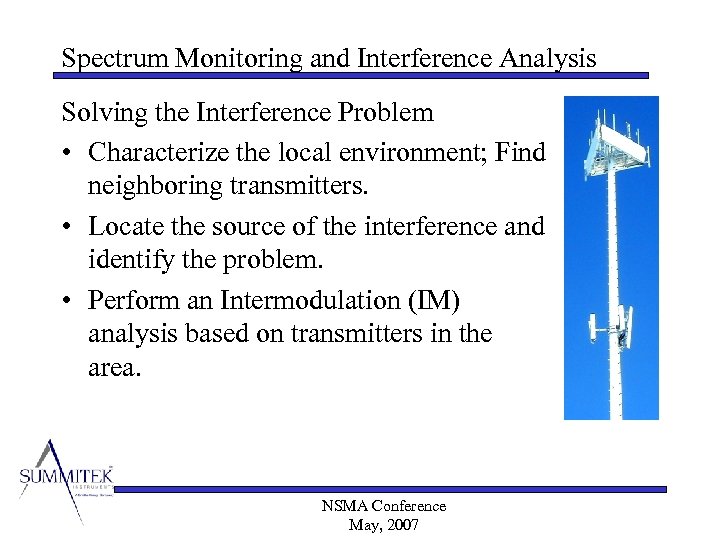 Spectrum Monitoring and Interference Analysis Solving the Interference Problem • Characterize the local environment; Find neighboring transmitters. • Locate the source of the interference and identify the problem. • Perform an Intermodulation (IM) analysis based on transmitters in the area. NSMA Conference May, 2007
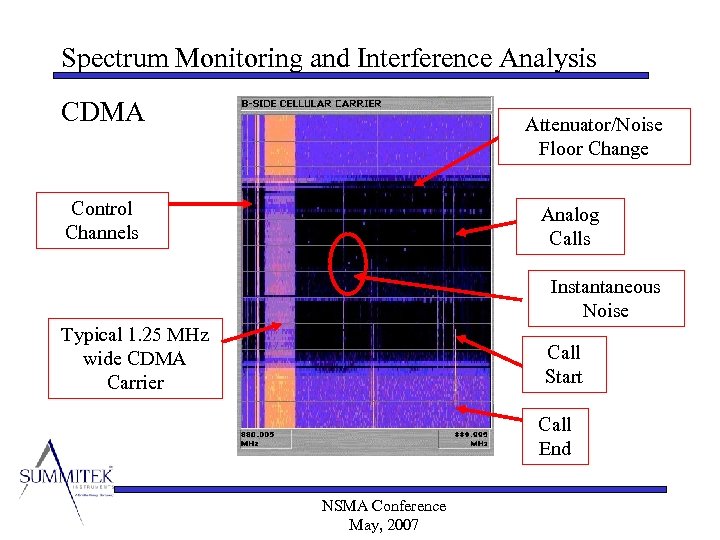 Spectrum Monitoring and Interference Analysis CDMA Attenuator/Noise Floor Change Control Channels Analog Calls Instantaneous Noise Typical 1. 25 MHz wide CDMA Carrier Call Start Call End NSMA Conference May, 2007
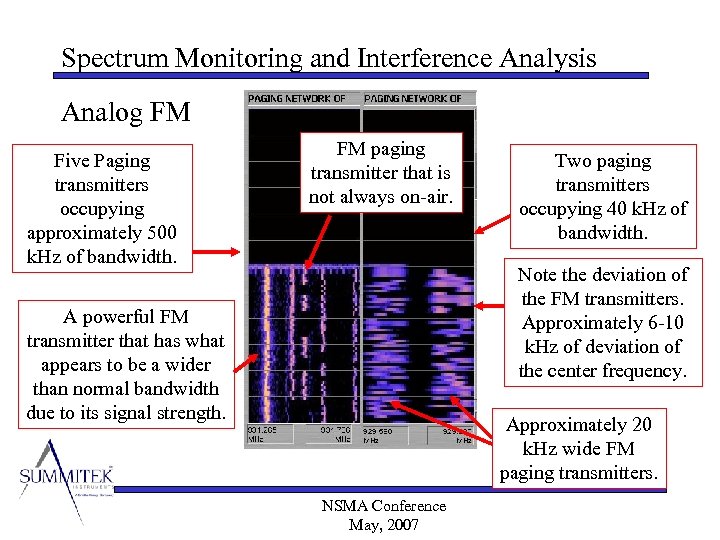 Spectrum Monitoring and Interference Analysis Analog FM Five Paging transmitters occupying approximately 500 k. Hz of bandwidth. FM paging transmitter that is not always on-air. Two paging transmitters occupying 40 k. Hz of bandwidth. Note the deviation of the FM transmitters. Approximately 6 -10 k. Hz of deviation of the center frequency. A powerful FM transmitter that has what appears to be a wider than normal bandwidth due to its signal strength. Approximately 20 k. Hz wide FM paging transmitters. NSMA Conference May, 2007
 Spectrum Monitoring and Interference Analysis Indications of Interference Switch Data Customer Complaints • Idle Channel Squelch Opening • Noise floor data • Dropped calls • Access/Setup failures • Reverse Power Control • Noise • Dropped Calls • Poor Voice Quality NSMA Conference May, 2007
 Spectrum Monitoring and Interference Analysis Non-IM Interference – Fundamental Transmitters A fundamental transmitter is a signal that is not mixed with another signal. Some examples: – – – Off frequency transmitters Improperly tuned transmitters Defective transmitters Abandoned transmitters that drift Illegal transmitters NSMA Conference May, 2007
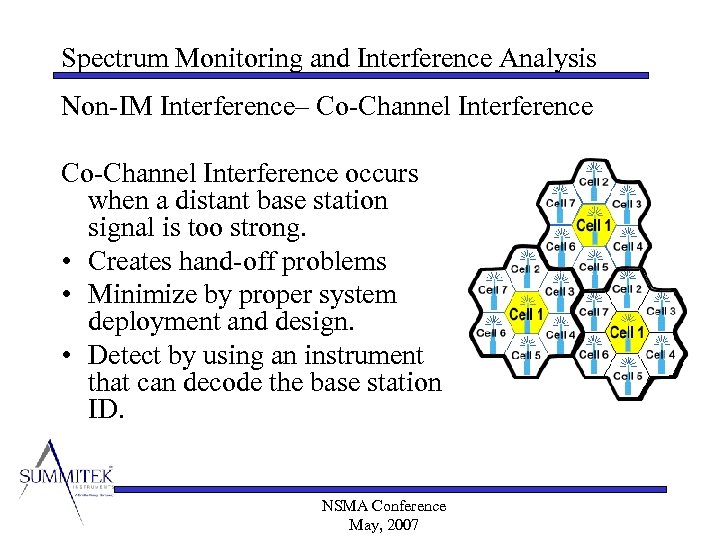 Spectrum Monitoring and Interference Analysis Non-IM Interference– Co-Channel Interference occurs when a distant base station signal is too strong. • Creates hand-off problems • Minimize by proper system deployment and design. • Detect by using an instrument that can decode the base station ID. NSMA Conference May, 2007
 Spectrum Monitoring and Interference Analysis Non-IM Interference – Equipment Issues • • Spectral re-growth (excessive sideband lobes) Broadband noise Power fluctuations Sub-carrier signals NSMA Conference May, 2007
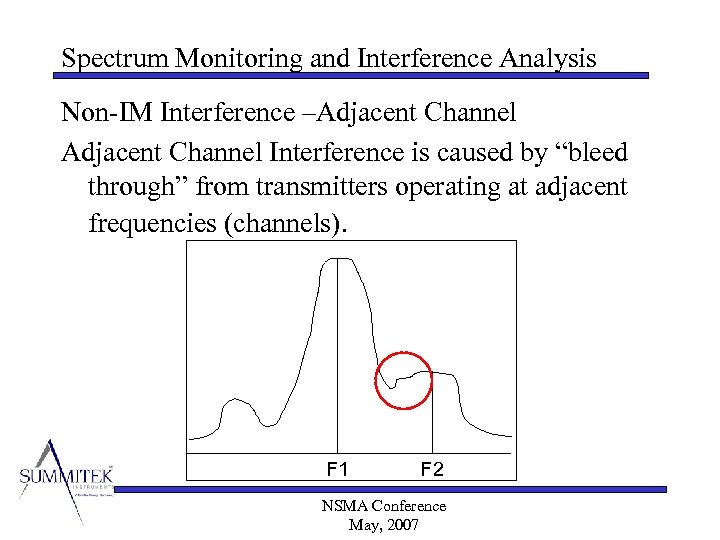 Spectrum Monitoring and Interference Analysis Non-IM Interference –Adjacent Channel Interference is caused by “bleed through” from transmitters operating at adjacent frequencies (channels). F 1 F 2 NSMA Conference May, 2007
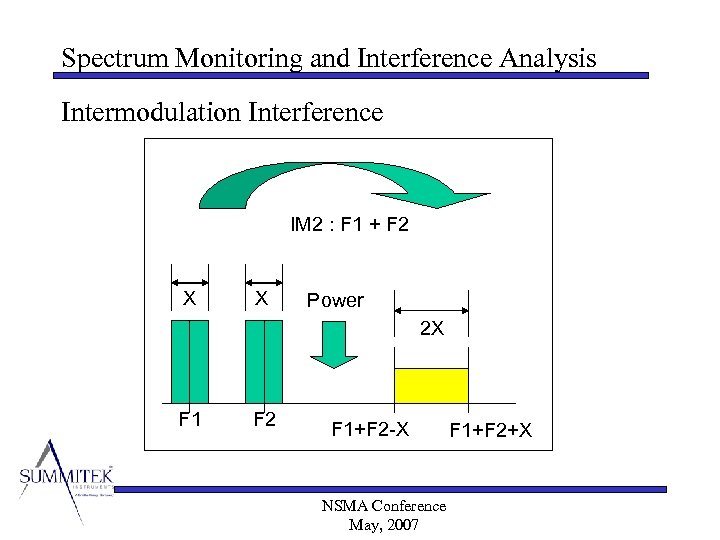 Spectrum Monitoring and Interference Analysis Intermodulation Interference IM 2 : F 1 + F 2 X X Power 2 X F 1 F 2 F 1+F 2 -X NSMA Conference May, 2007 F 1+F 2+X
 Spectrum Monitoring and Interference Analysis Intermodulation Interference • Not a clearly defined bandwidth, may have “fuzzy” RF envelope • Bandwidth may shift as the fundamental transmitters deviate • May be intermittent as one or more of the contributing transmitters turns on and off • May cover up entire protected band if IM product is of higher order or protected band is narrow NSMA Conference May, 2007
 Spectrum Monitoring and Interference Analysis Passive Intermodulation Any passive component may serve as the mechanism of IM interference. • Semi-Conducting Junctions • Poor alignment of parts • Inadequately torqued screws and fasteners • Bad solder joints • Plating related problems • Any Ferrite Material • Degradation Due to Environment: • Contaminated conductors and interfaces (Dirt, Dust, Moisture) • Wind induced vibrations • Temperature cycles NSMA Conference May, 2007
 Spectrum Monitoring and Interference Analysis Troubleshooting Process – Evaluation • Monitor the Protected Band determine if the interference is present. • Examine 3 -10 times the bandwidth of the protected band. • Identify Adjacent Channel Interference • Examine the site for changes. • Inspect the antenna system. NSMA Conference May, 2007
 Spectrum Monitoring and Interference Analysis Troubleshooting Process – Evaluation • Characterize the Interference: – Duration – Bandwidth – Strength – Sub-carriers – Time of occurrence • Characterization of the signal will help begin the process of eliminating interference suspects in the area. NSMA Conference May, 2007
 Spectrum Monitoring and Interference Analysis Troubleshooting Process – Monitor • Make a broadband peak hold measurement of the local RF spectrum. • Use a broadband antenna. • Use a fine resolution bandwidth (RBW). 30 k. Hz or smaller is recommended. • Conduct the survey when the interference occurs! NSMA Conference May, 2007
 Spectrum Monitoring and Interference Analysis Troubleshooting Process – Identification • Examine each peak detected by the monitoring. – Compare each peak to the characteristics of the interfering signal. – Verify that each peak is compliant with the license and/or applicable standard. High priority in the process will be given to: – Peaks that are similar to the interference. – Peaks that are unknown or non-compliant. NSMA Conference May, 2007
 Spectrum Monitoring and Interference Analysis Troubleshooting Process – IM Suspect Calculation • Calculate the IM frequency ranges. • Calculation of low order IM products is recommended. (up to IM 3). Note that high power broadcast transmitters may cause IM products of the 13 th order or higher to be present. NSMA Conference May, 2007
 Spectrum Monitoring and Interference Analysis Troubleshooting Process – Categorization Demodulation • It is more likely that you can demodulate a fundamental transmitter. • IM interference mixing may prevent demodulation. NSMA Conference May, 2007
 Spectrum Monitoring and Interference Analysis Troubleshooting Process – Categorization Bandwidth • The bandwidth of a fundamental transmitter will match the bandwidth of the interference • IM interference mixing will change the bandwidth to reflect the results of the calculation. • IM interference cannot be created by component with a bandwidth larger than the bandwidth of the interference. NSMA Conference May, 2007
 Spectrum Monitoring and Interference Analysis Troubleshooting Process – Categorization Duration • Interference that is continuous implies that all components are continuous. • Interference that is intermittent implies that at least one component is intermittent. Strength • The power level of an IM interference cannot be higher than any component signal. NSMA Conference May, 2007
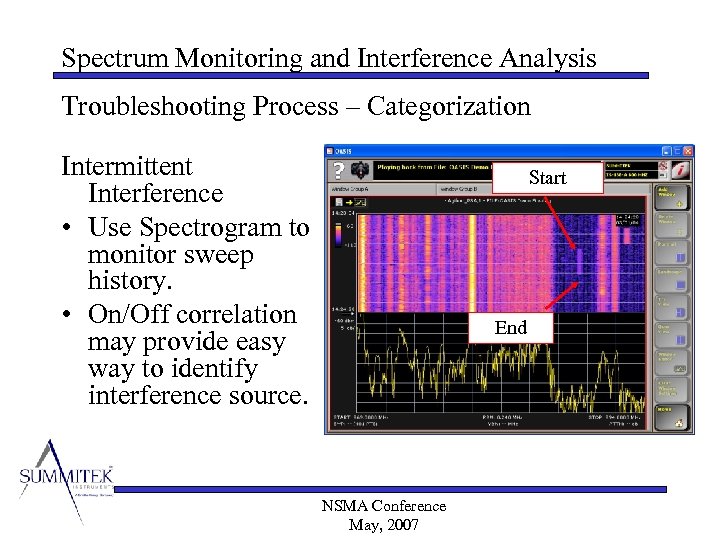 Spectrum Monitoring and Interference Analysis Troubleshooting Process – Categorization Intermittent Interference • Use Spectrogram to monitor sweep history. • On/Off correlation may provide easy way to identify interference source. Start End NSMA Conference May, 2007
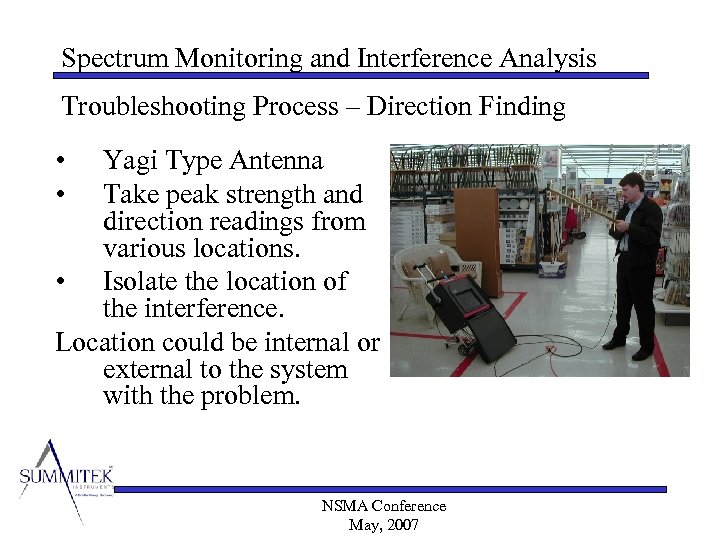 Spectrum Monitoring and Interference Analysis Troubleshooting Process – Direction Finding • • Yagi Type Antenna Take peak strength and direction readings from various locations. • Isolate the location of the interference. Location could be internal or external to the system with the problem. NSMA Conference May, 2007
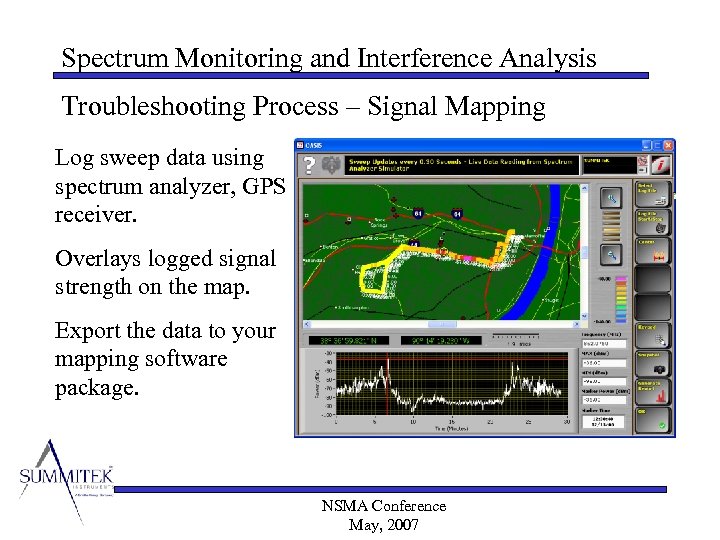 Spectrum Monitoring and Interference Analysis Troubleshooting Process – Signal Mapping Log sweep data using spectrum analyzer, GPS receiver. Overlays logged signal strength on the map. Export the data to your mapping software package. NSMA Conference May, 2007
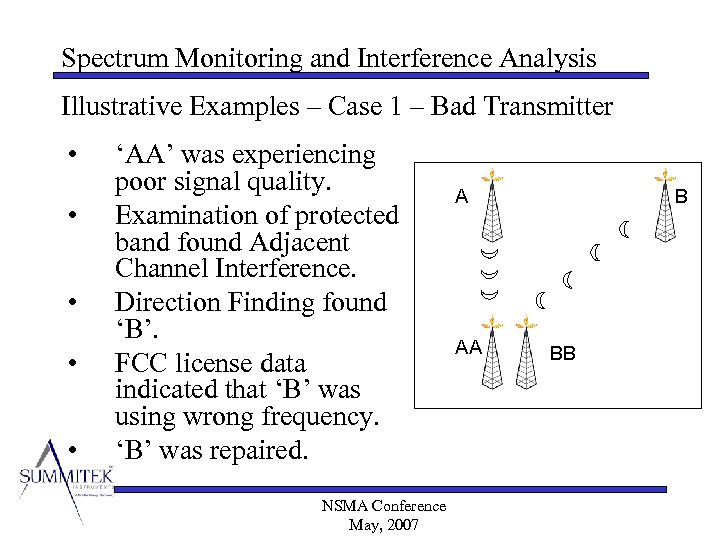 Spectrum Monitoring and Interference Analysis Illustrative Examples – Case 1 – Bad Transmitter • • • ‘AA’ was experiencing poor signal quality. Examination of protected band found Adjacent Channel Interference. Direction Finding found ‘B’. FCC license data indicated that ‘B’ was using wrong frequency. ‘B’ was repaired. NSMA Conference May, 2007 A AA B BB
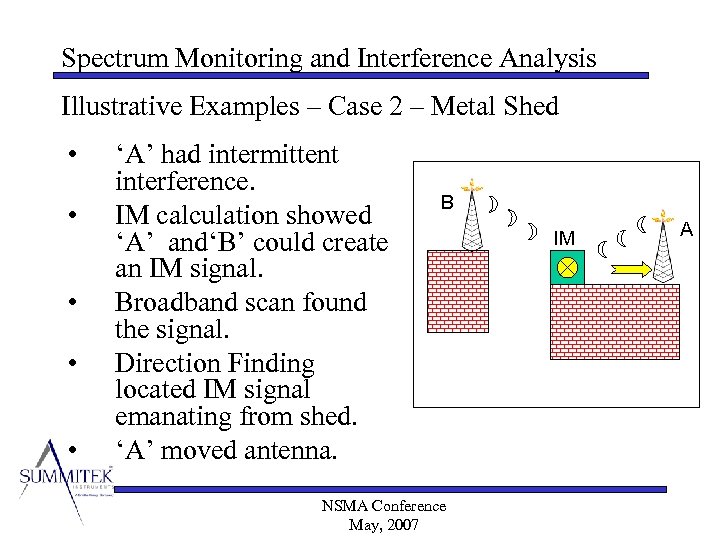 Spectrum Monitoring and Interference Analysis Illustrative Examples – Case 2 – Metal Shed • • • ‘A’ had intermittent interference. IM calculation showed ‘A’ and‘B’ could create an IM signal. Broadband scan found the signal. Direction Finding located IM signal emanating from shed. ‘A’ moved antenna. B NSMA Conference May, 2007 IM A
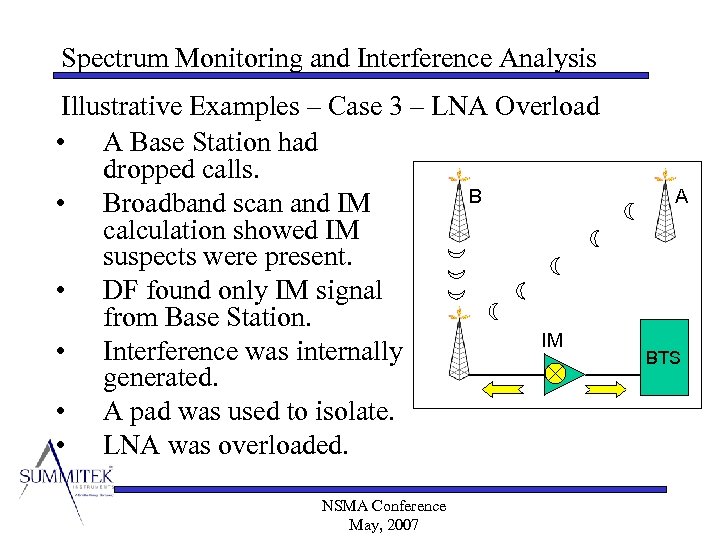 Spectrum Monitoring and Interference Analysis Illustrative Examples – Case 3 – LNA Overload • A Base Station had dropped calls. B • Broadband scan and IM calculation showed IM suspects were present. • DF found only IM signal from Base Station. IM • Interference was internally generated. • A pad was used to isolate. • LNA was overloaded. NSMA Conference May, 2007 A BTS
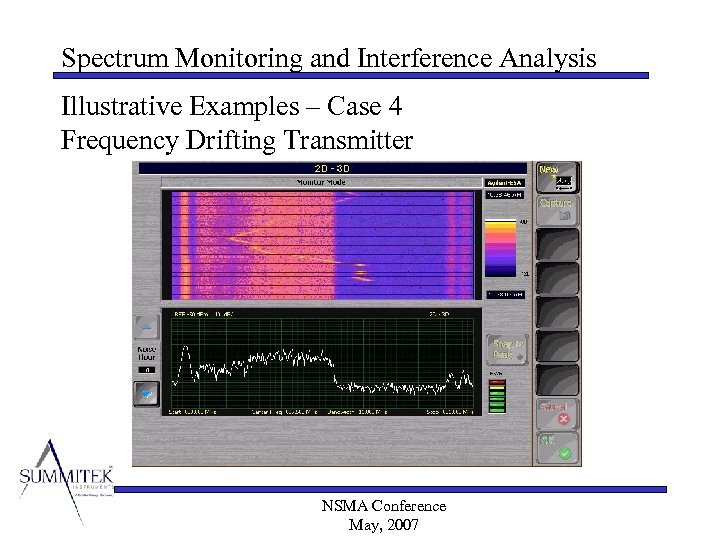 Spectrum Monitoring and Interference Analysis Illustrative Examples – Case 4 Frequency Drifting Transmitter NSMA Conference May, 2007
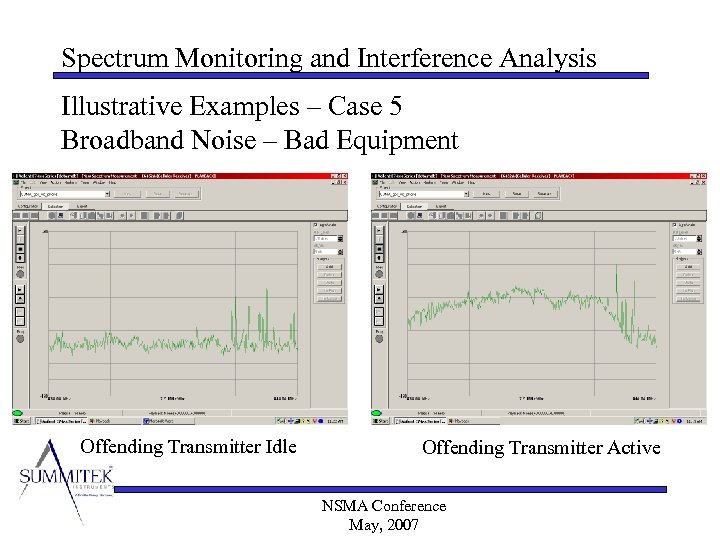 Spectrum Monitoring and Interference Analysis Illustrative Examples – Case 5 Broadband Noise – Bad Equipment Offending Transmitter Idle Offending Transmitter Active NSMA Conference May, 2007
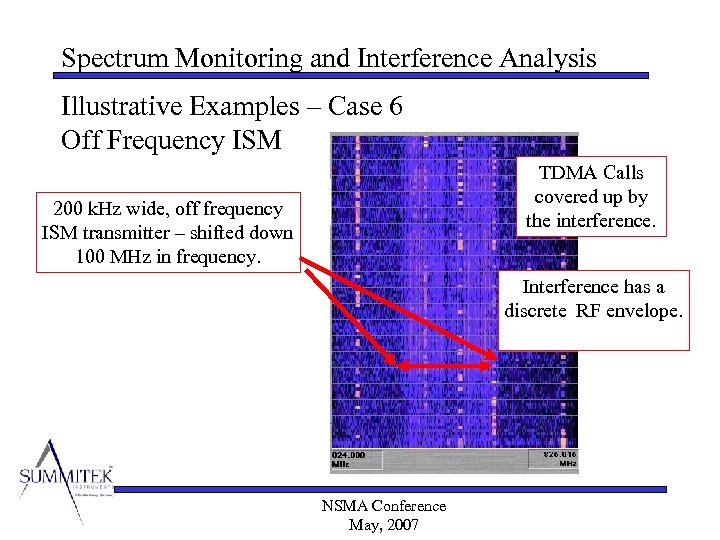 Spectrum Monitoring and Interference Analysis Illustrative Examples – Case 6 Off Frequency ISM TDMA Calls covered up by the interference. 200 k. Hz wide, off frequency ISM transmitter – shifted down 100 MHz in frequency. Interference has a discrete RF envelope. NSMA Conference May, 2007
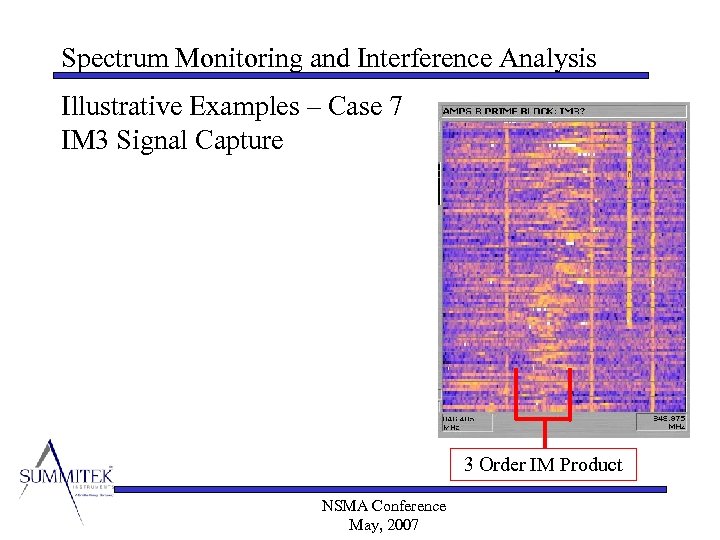 Spectrum Monitoring and Interference Analysis Illustrative Examples – Case 7 IM 3 Signal Capture 3 Order IM Product NSMA Conference May, 2007
 Spectrum Monitoring and Interference Analysis Summary • Interference can be located using a process. • Searching for interference requires an understanding of wireless standards and the operating environment. • Characteristics of the interference signal offer the best way to isolate the signal. • Use Direction Finding to locate the signal. • Elimination of interference requires knowledge of wireless systems and how IM is created. NSMA Conference May, 2007
 Spectrum Monitoring and Interference Analysis Thank you for coming to my presentation! Jim West Contact Information – Email - jwest@summitekinstruments. com – Phone - 303 -768 -8080 – www. summitekinstruments. com NSMA Conference May, 2007