Скачать презентацию Spectroscopic Research Projects on Heavy Elements at NIST
8d522b85d26221de938af892d54364d3.ppt
- Количество слайдов: 40
 Spectroscopic Research Projects on Heavy Elements at NIST Wolfgang L. Wiese National Institute of Standards and Technology (NIST), USA
 Participants Experimental Research: Theoretical Approaches: Data Assessment and Compilations: Database Development: J. Reader, G. Nave, J. Gillaspy, M. Bridges, * W. Wiese* Ch. Froese-Fischer, * Y. Ralchenko, * Y. -K. Kim , P. Stone* J. Reader, E. Saloman, * J. Fuhr, * D. Kelleher, * L. Podobedova, * A. Kramida, * W. Wiese* Y. Ralchenko, * A. Kramida* R. Ibacache *indicates Contractors or Guest Researchers
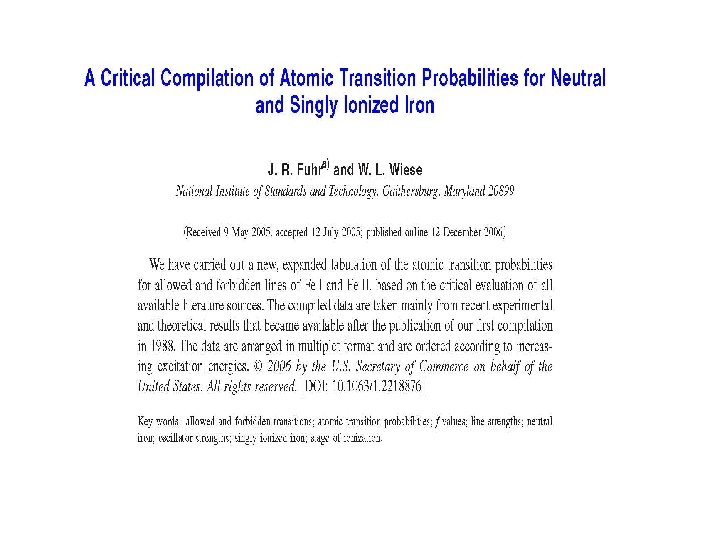
 Three On-going Spectroscopic Research Projects on Heavy Elements at NIST 1. An updated and expanded critical compilation of spectroscopic reference data for Fe I and Fe II, focusing on better transition probabilities. 2. Calculations of ionization and excitation crosssections of neutral and singly ionized Mo and W with the Binary-Encounter-Bethe (BEB) model. 3. Experimental observations of the spectra of highly charged tungsten ions, in the range from W+35 to W+63, with an Electron Beam Ion Trap (EBIT) and their analysis. .
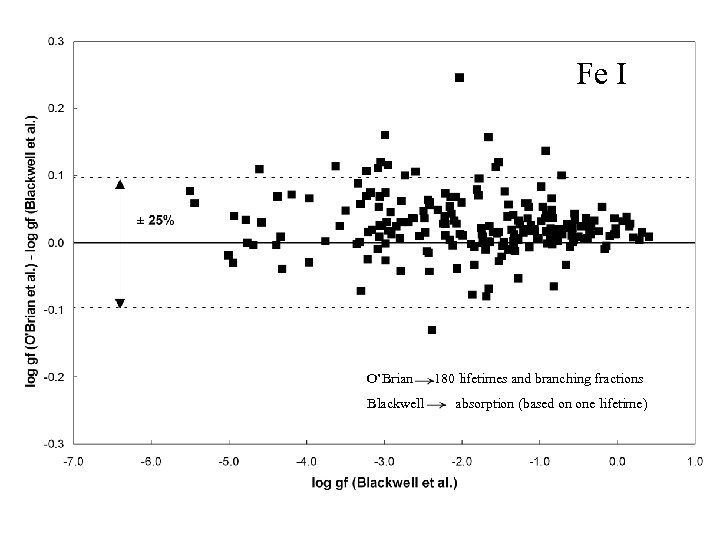 Fe I O’Brian Blackwell 180 lifetimes and branching fractions absorption (based on one lifetime)
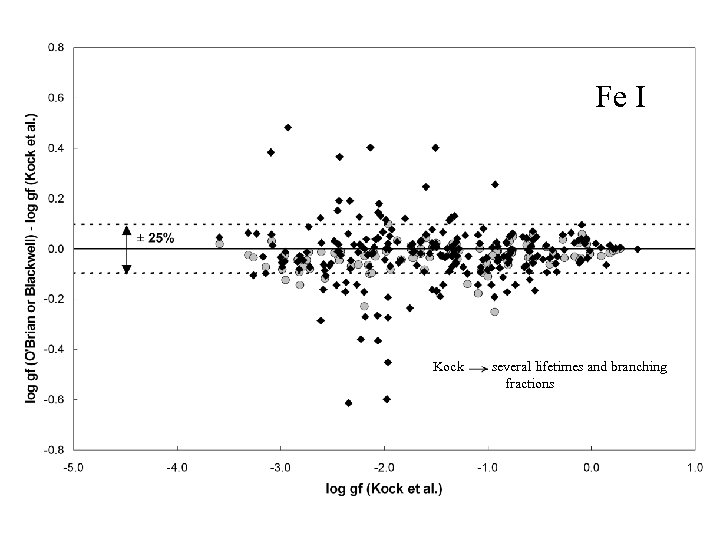 Fe I Kock several lifetimes and branching fractions
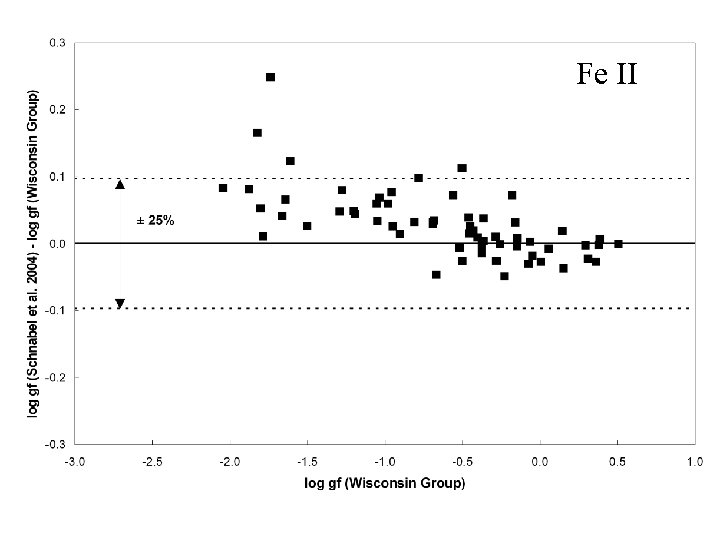 Fe II
Fe II
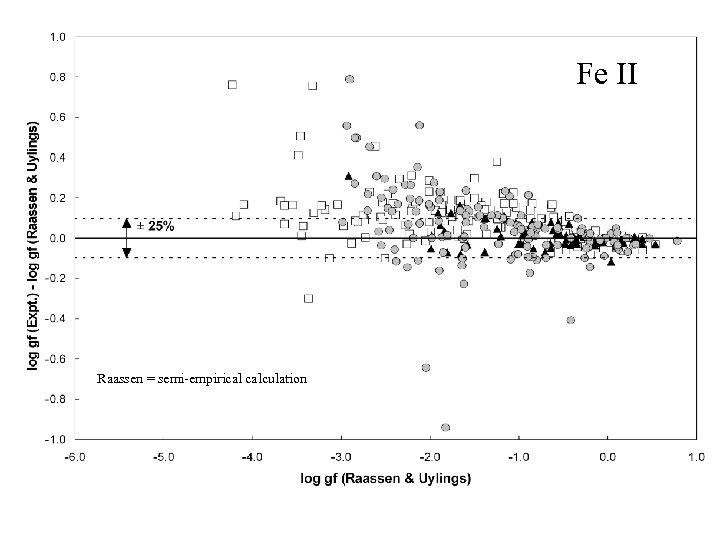 Fe II Raassen = semi-empirical calculation
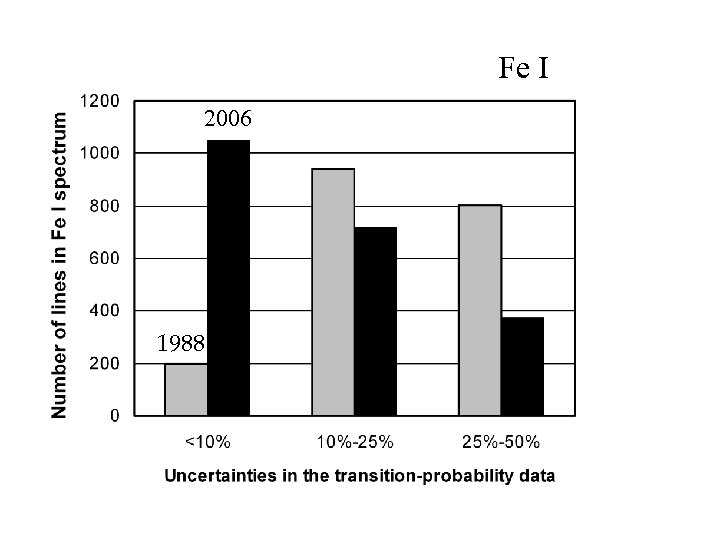 Fe I 2006 1988
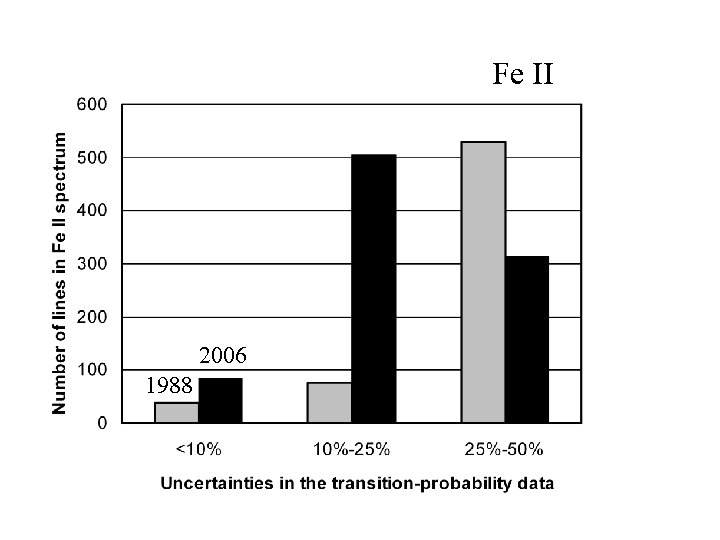 Fe II 2006 1988
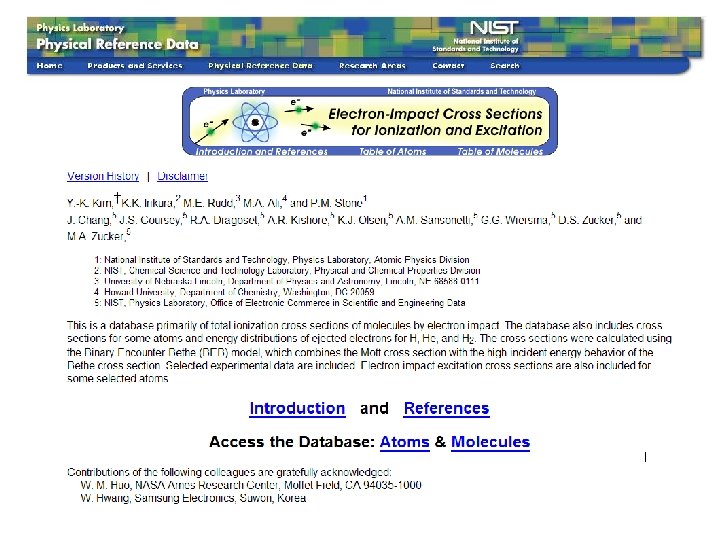
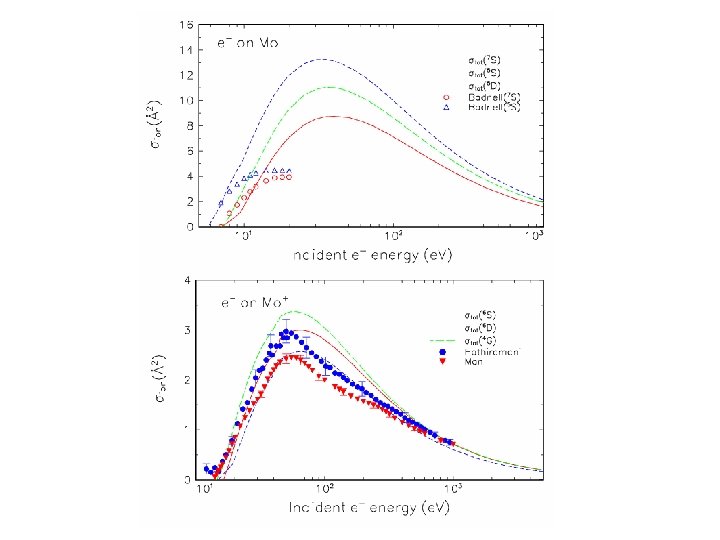
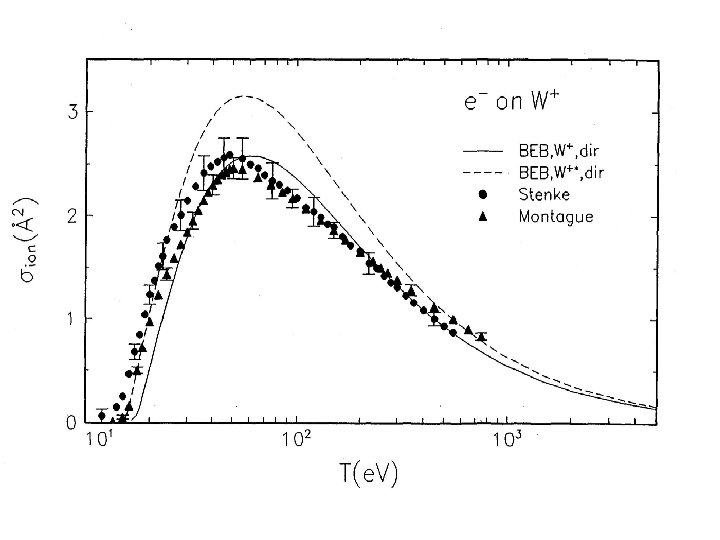
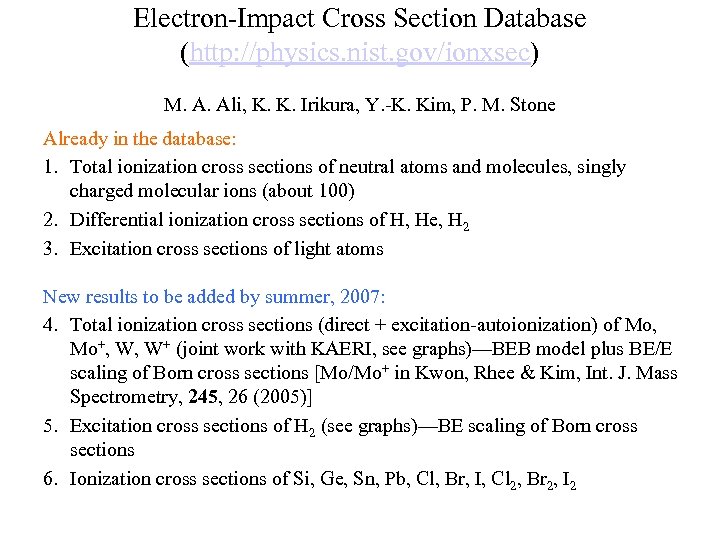 Electron-Impact Cross Section Database (http: //physics. nist. gov/ionxsec) M. A. Ali, K. K. Irikura, Y. -K. Kim, P. M. Stone Already in the database: 1. Total ionization cross sections of neutral atoms and molecules, singly charged molecular ions (about 100) 2. Differential ionization cross sections of H, He, H 2 3. Excitation cross sections of light atoms New results to be added by summer, 2007: 4. Total ionization cross sections (direct + excitation-autoionization) of Mo, Mo+, W, W+ (joint work with KAERI, see graphs)—BEB model plus BE/E scaling of Born cross sections [Mo/Mo+ in Kwon, Rhee & Kim, Int. J. Mass Spectrometry, 245, 26 (2005)] 5. Excitation cross sections of H 2 (see graphs)—BE scaling of Born cross sections 6. Ionization cross sections of Si, Ge, Sn, Pb, Cl, Br, I, Cl 2, Br 2, I 2
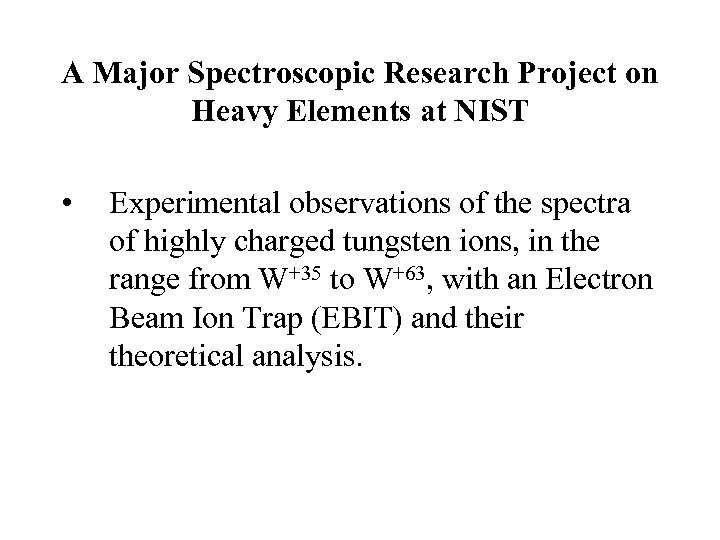 A Major Spectroscopic Research Project on Heavy Elements at NIST • Experimental observations of the spectra of highly charged tungsten ions, in the range from W+35 to W+63, with an Electron Beam Ion Trap (EBIT) and their theoretical analysis.
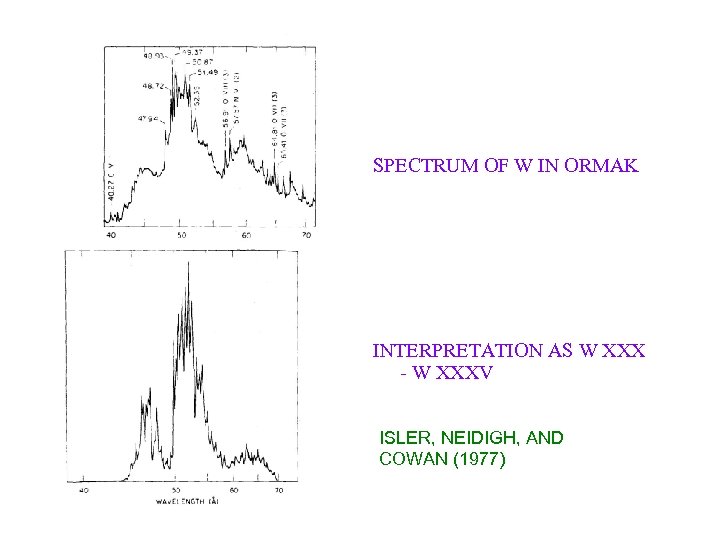 SPECTRUM OF W IN ORMAK INTERPRETATION AS W XXX - W XXXV ISLER, NEIDIGH, AND COWAN (1977)
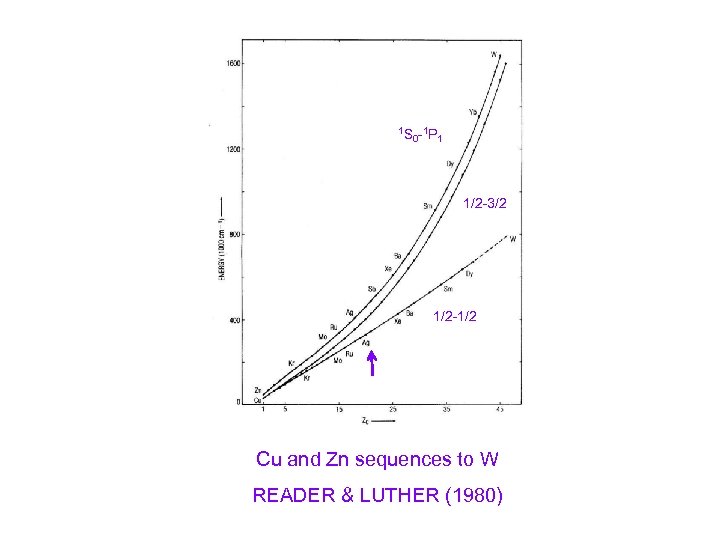 1 S 0 - 1 P 1 1/2 -3/2 1/2 -1/2 Cu and Zn sequences to W READER & LUTHER (1980)
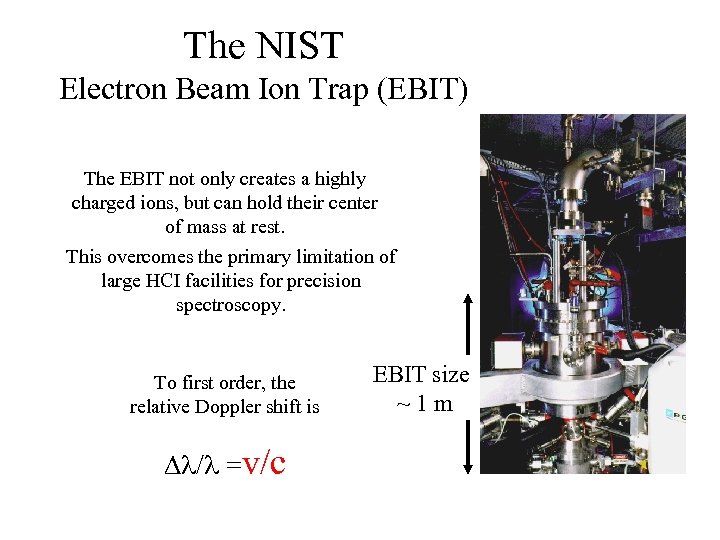 The NIST Electron Beam Ion Trap (EBIT) The EBIT not only creates a highly charged ions, but can hold their center of mass at rest. This overcomes the primary limitation of large HCI facilities for precision spectroscopy. To first order, the relative Doppler shift is Dl/l =v/c EBIT size ~1 m
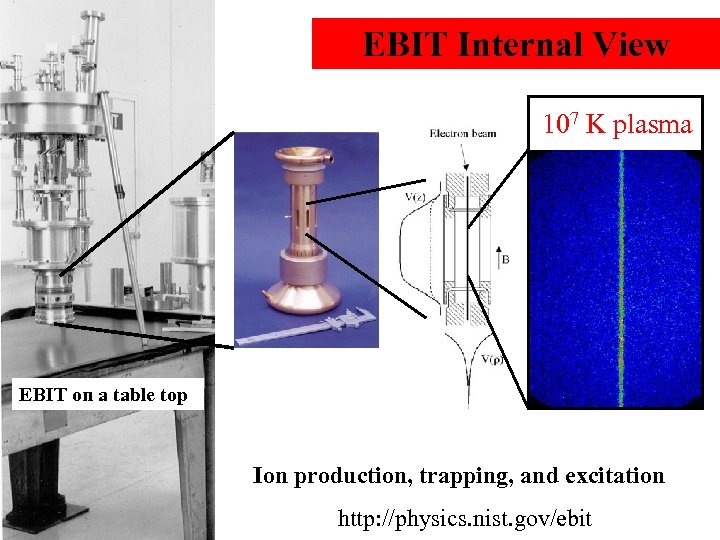 EBIT Internal View 107 K plasma EBIT on a table top Ion production, trapping, and excitation http: //physics. nist. gov/ebit
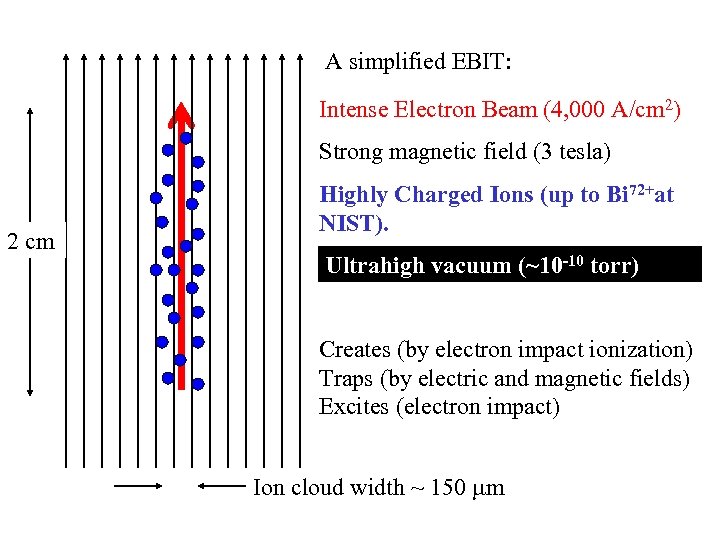 A simplified EBIT: Intense Electron Beam (4, 000 A/cm 2) Strong magnetic field (3 tesla) 2 cm Highly Charged Ions (up to Bi 72+at NIST). Ultrahigh vacuum (~10 -10 torr) Creates (by electron impact ionization) Traps (by electric and magnetic fields) Excites (electron impact) Ion cloud width ~ 150 mm
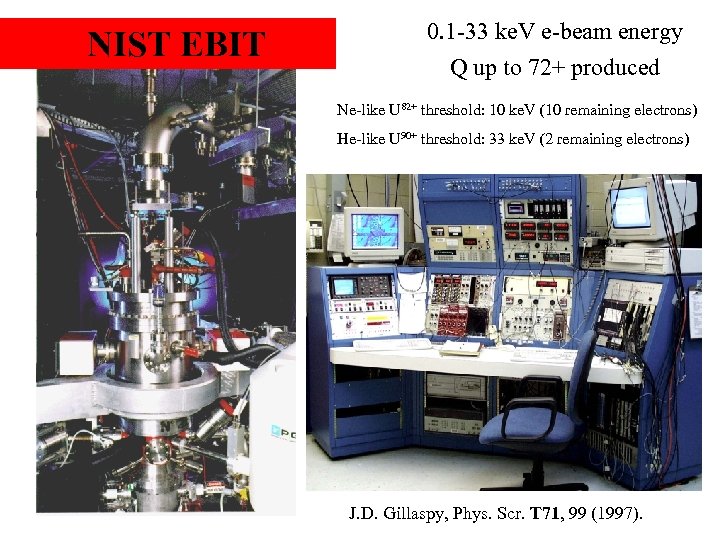 NIST EBIT 0. 1 -33 ke. V e-beam energy Q up to 72+ produced Ne-like U 82+ threshold: 10 ke. V (10 remaining electrons) He-like U 90+ threshold: 33 ke. V (2 remaining electrons) J. D. Gillaspy, Phys. Scr. T 71, 99 (1997).
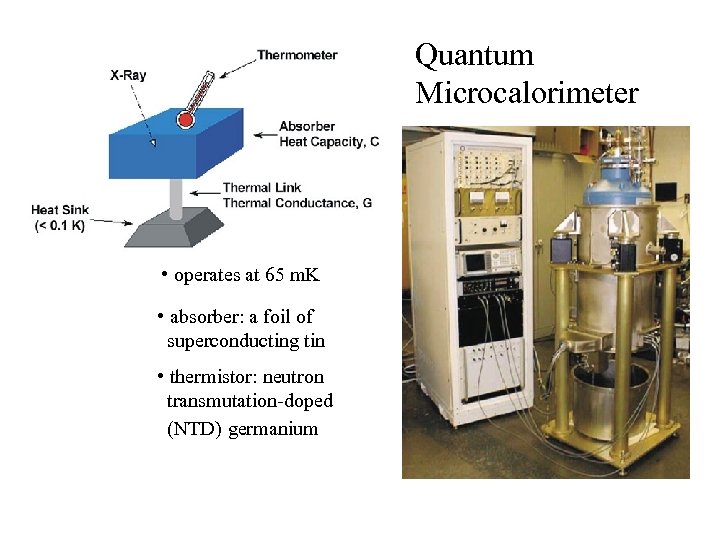 Quantum Microcalorimeter • operates at 65 m. K • absorber: a foil of superconducting tin • thermistor: neutron transmutation-doped (NTD) germanium
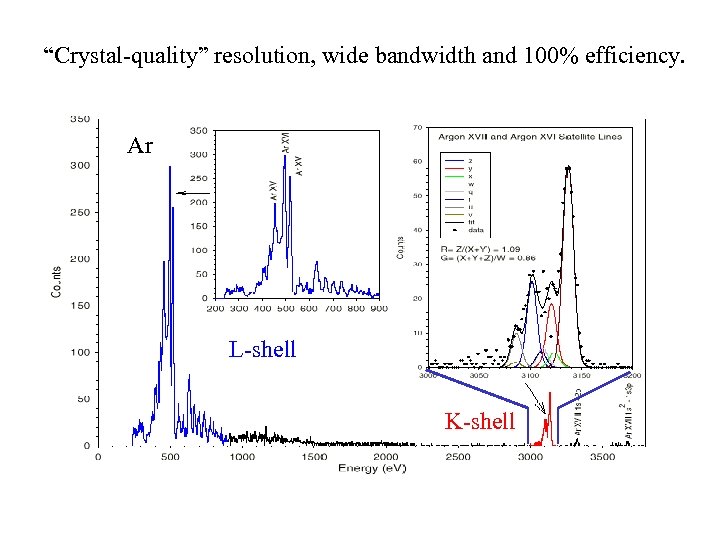 “Crystal-quality” resolution, wide bandwidth and 100% efficiency. Ar L-shell K-shell
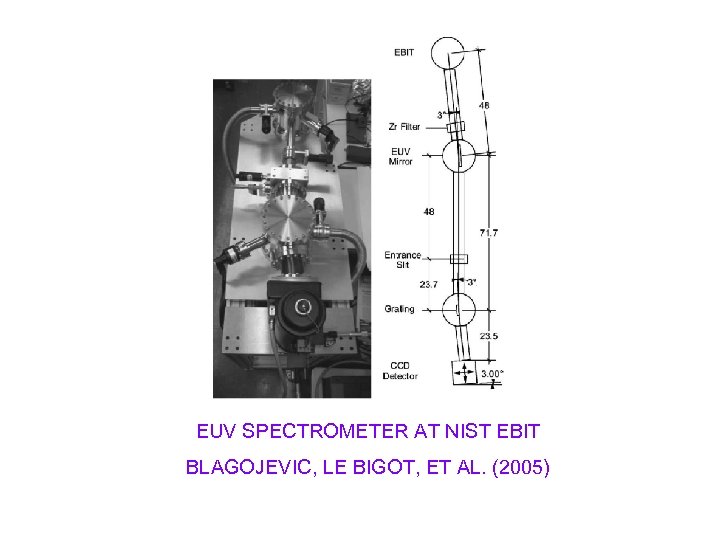 EUV SPECTROMETER AT NIST EBIT BLAGOJEVIC, LE BIGOT, ET AL. (2005)
 IONIZATION ENERGIES FOR W IN ALL STAGES KRAMIDA & READER (2006)
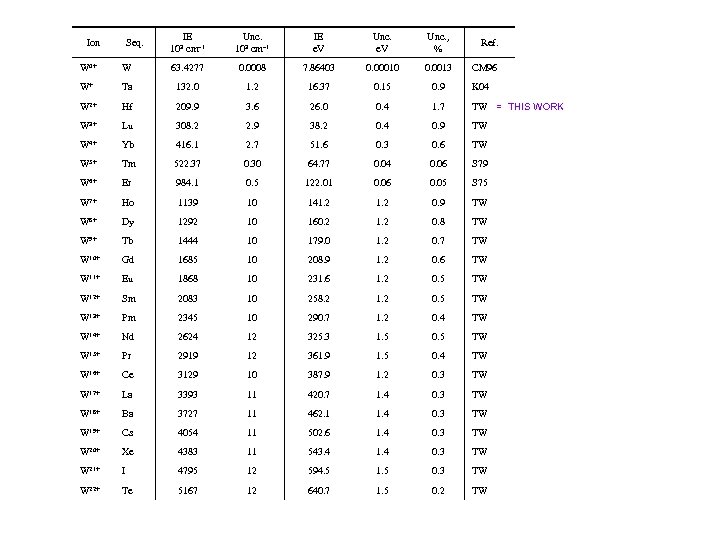 Ion Seq. IE 103 cm– 1 Unc. 103 cm– 1 IE e. V Unc. , % Ref. CM 96 W 0+ W 63. 4277 0. 0008 7. 86403 0. 00010 0. 0013 W+ Ta 132. 0 1. 2 16. 37 0. 15 0. 9 K 04 W 2+ Hf 209. 9 3. 6 26. 0 0. 4 1. 7 TW = THIS WORK W 3+ Lu 308. 2 2. 9 38. 2 0. 4 0. 9 TW W 4+ Yb 416. 1 2. 7 51. 6 0. 3 0. 6 TW W 5+ Tm 522. 37 0. 30 64. 77 0. 04 0. 06 S 79 W 6+ Er 984. 1 0. 5 122. 01 0. 06 0. 05 S 75 W 7+ Ho 1139 10 141. 2 0. 9 TW W 8+ Dy 1292 10 160. 2 1. 2 0. 8 TW W 9+ Tb 1444 10 179. 0 1. 2 0. 7 TW W 10+ Gd 1685 10 208. 9 1. 2 0. 6 TW W 11+ Eu 1868 10 231. 6 1. 2 0. 5 TW W 12+ Sm 2083 10 258. 2 1. 2 0. 5 TW W 13+ Pm 2345 10 290. 7 1. 2 0. 4 TW W 14+ Nd 2624 12 325. 3 1. 5 0. 5 TW W 15+ Pr 2919 12 361. 9 1. 5 0. 4 TW W 16+ Ce 3129 10 387. 9 1. 2 0. 3 TW W 17+ La 3393 11 420. 7 1. 4 0. 3 TW W 18+ Ba 3727 11 462. 1 1. 4 0. 3 TW W 19+ Cs 4054 11 502. 6 1. 4 0. 3 TW W 20+ Xe 4383 11 543. 4 1. 4 0. 3 TW W 21+ I 4795 12 594. 5 1. 5 0. 3 TW W 22+ Te 5167 12 640. 7 1. 5 0. 2 TW
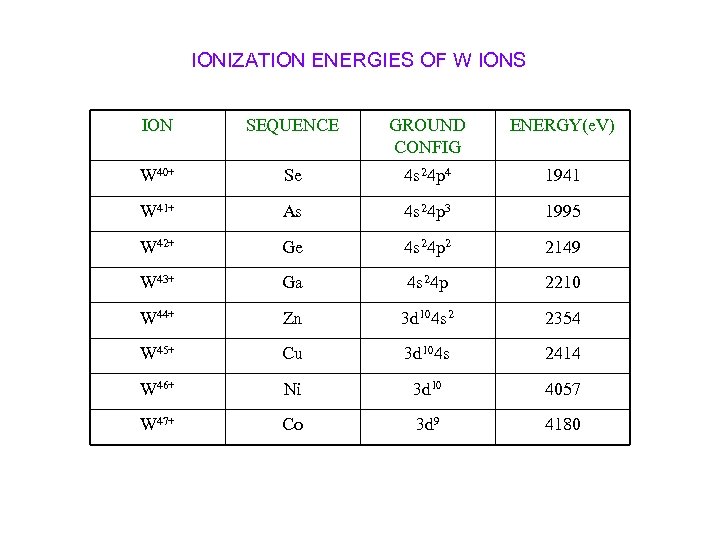 IONIZATION ENERGIES OF W IONS ION SEQUENCE GROUND CONFIG ENERGY(e. V) W 40+ Se 4 s 24 p 4 1941 W 41+ As 4 s 24 p 3 1995 W 42+ Ge 4 s 24 p 2 2149 W 43+ Ga 4 s 24 p 2210 W 44+ Zn 3 d 104 s 2 2354 W 45+ Cu 3 d 104 s 2414 W 46+ Ni 3 d 10 4057 W 47+ Co 3 d 9 4180
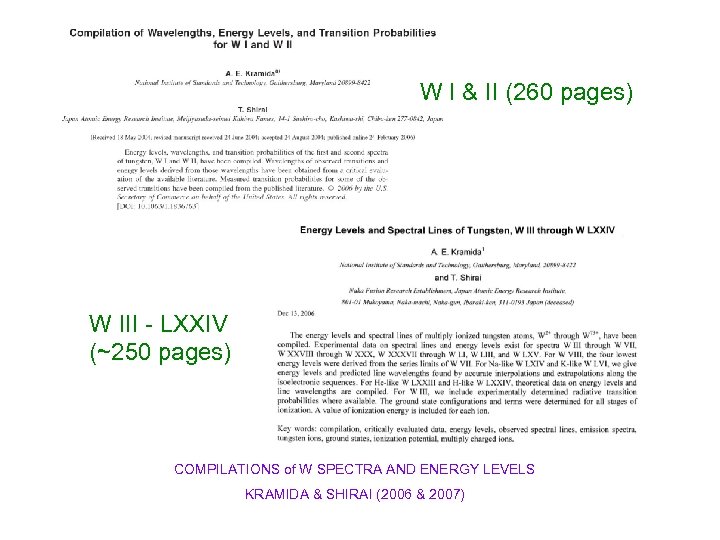 W I & II (260 pages) W III - LXXIV (~250 pages) COMPILATIONS of W SPECTRA AND ENERGY LEVELS KRAMIDA & SHIRAI (2006 & 2007)
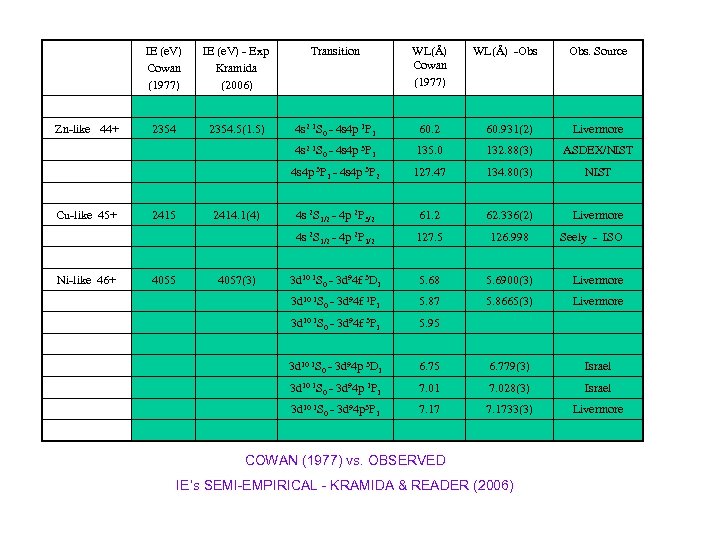 IE (e. V) Cowan (1977) 2354. 5(1. 5) 4 s 2 1 S 0 - 4 s 4 p 1 P 1 60. 2 60. 931(2) Livermore 135. 0 132. 88(3) ASDEX/NIST 127. 47 134. 80(3) NIST 4 s 2 S 1/2 - 4 p 2 P 3/2 61. 2 62. 336(2) Livermore 4 s 2 S 1/2 - 4 p 2 P 1/2 Ni-like 46+ WL(Å) Cowan (1977) 4 s 4 p 3 P 1 - 4 s 4 p 3 P 2 Cu-like 45+ Transition 4 s 2 1 S 0 - 4 s 4 p 3 P 1 Zn-like 44+ IE (e. V) - Exp Kramida (2006) 127. 5 126. 998 3 d 10 1 S 0 - 3 d 94 f 3 D 1 5. 68 5. 6900(3) Livermore 3 d 10 1 S 0 - 3 d 94 f 1 P 1 5. 87 5. 8665(3) Livermore 3 d 10 1 S 0 - 3 d 94 f 3 P 1 5. 95 3 d 10 1 S 0 - 3 d 94 p 3 D 1 6. 75 6. 779(3) Israel 3 d 10 1 S 0 - 3 d 94 p 1 P 1 7. 028(3) Israel 3 d 10 1 S 0 - 3 d 94 p 3 P 1 7. 1733(3) Livermore 2415 4055 2414. 1(4) 4057(3) WL(Å) -Obs COWAN (1977) vs. OBSERVED IE’s SEMI-EMPIRICAL - KRAMIDA & READER (2006) Obs. Source Seely - ISO
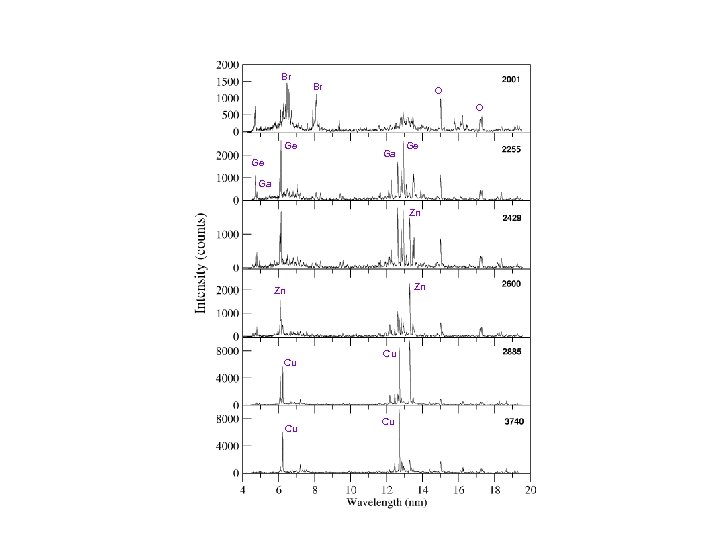 Br Br O O Ge Ge Ga Zn Zn Zn Cu Cu
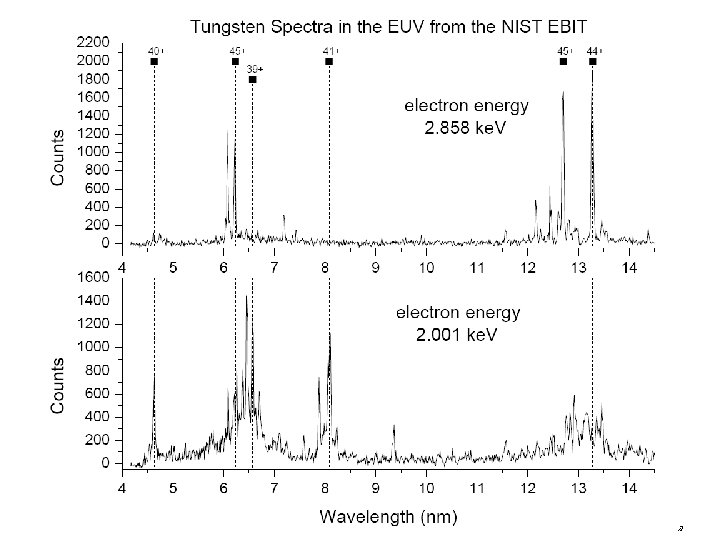
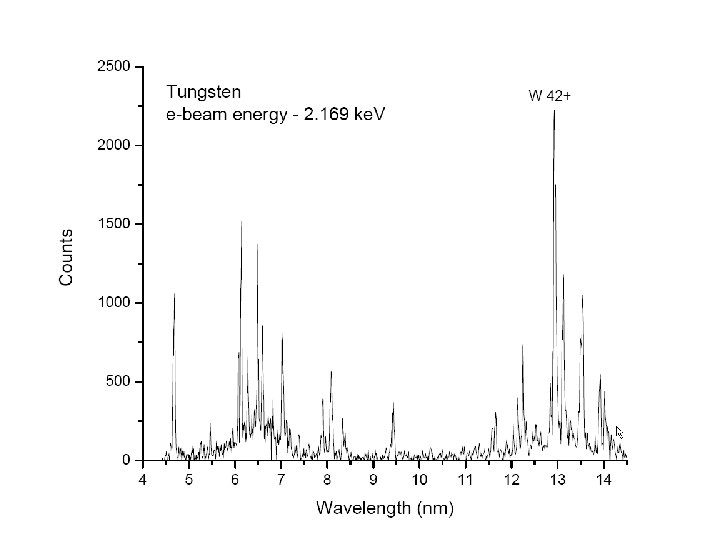
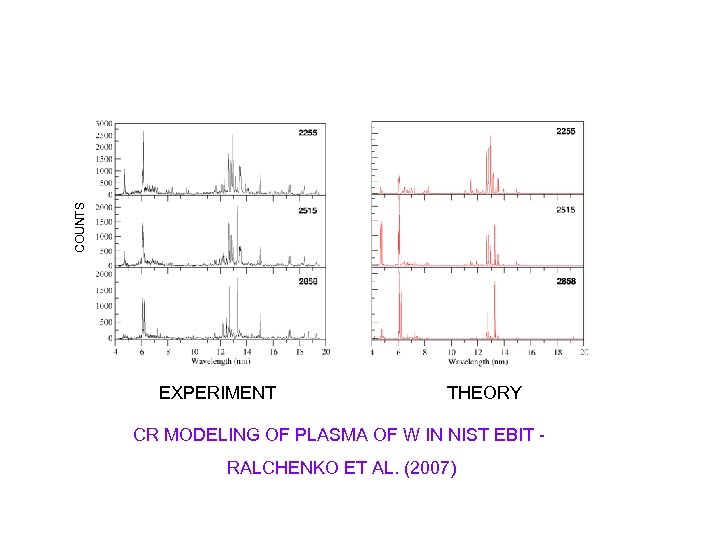 COUNTS EXPERIMENT THEORY CR MODELING OF PLASMA OF W IN NIST EBIT RALCHENKO ET AL. (2007)
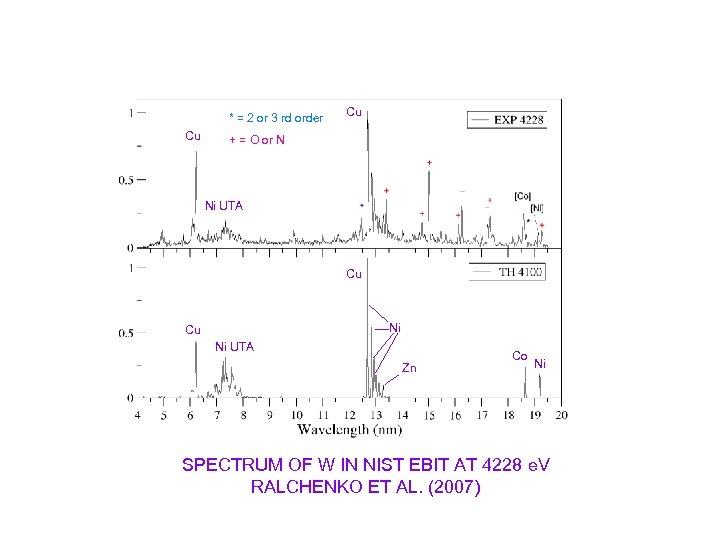 * = 2 or 3 rd order Cu Cu + = O or N Ni UTA Cu Ni UTA Zn Co Ni SPECTRUM OF W IN NIST EBIT AT 4228 e. V RALCHENKO ET AL. (2007)
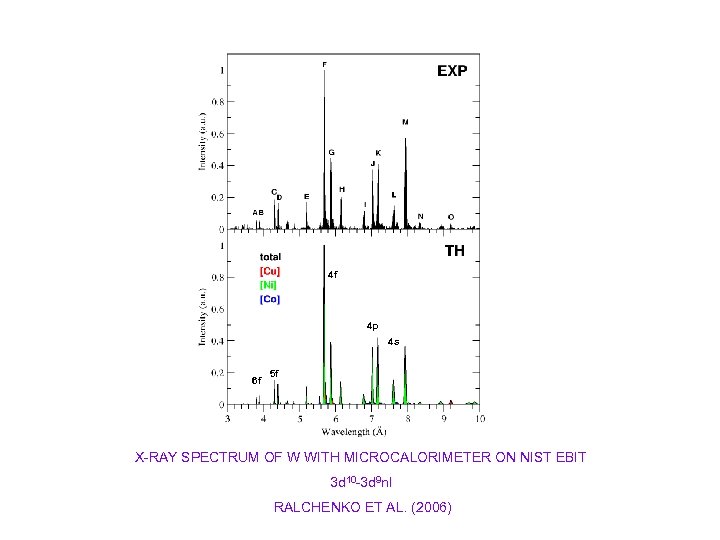 4 f 4 p 4 s 6 f 5 f X-RAY SPECTRUM OF W WITH MICROCALORIMETER ON NIST EBIT 3 d 10 -3 d 9 nl RALCHENKO ET AL. (2006)
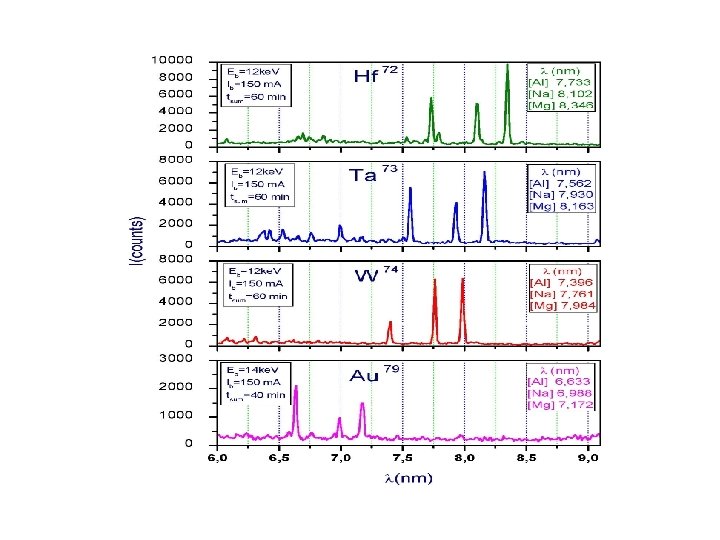
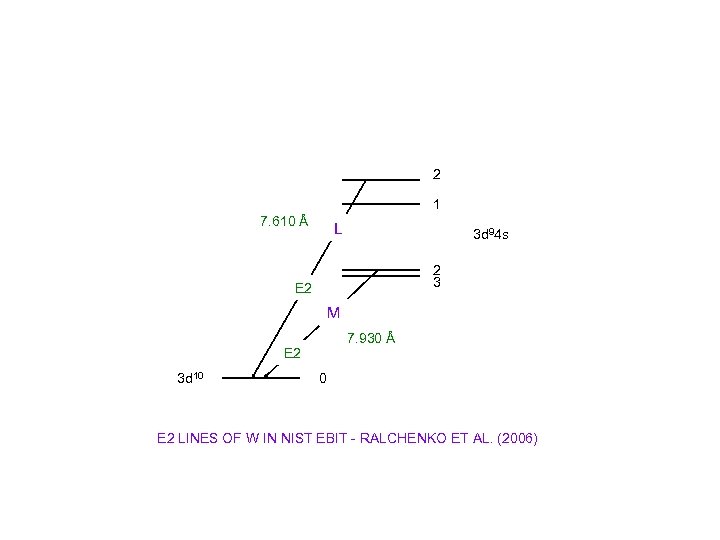 2 1 7. 610 Å L 3 d 94 s 2 3 E 2 M 7. 930 Å E 2 3 d 10 0 E 2 LINES OF W IN NIST EBIT - RALCHENKO ET AL. (2006)
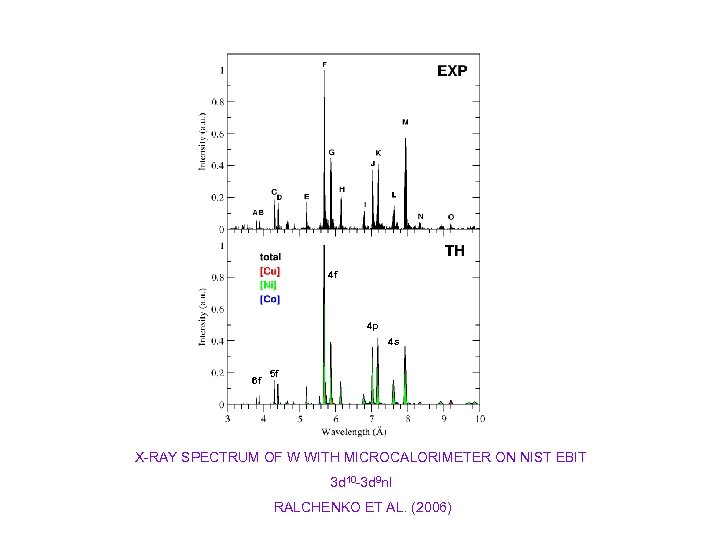 4 f 4 p 4 s 6 f 5 f X-RAY SPECTRUM OF W WITH MICROCALORIMETER ON NIST EBIT 3 d 10 -3 d 9 nl RALCHENKO ET AL. (2006)
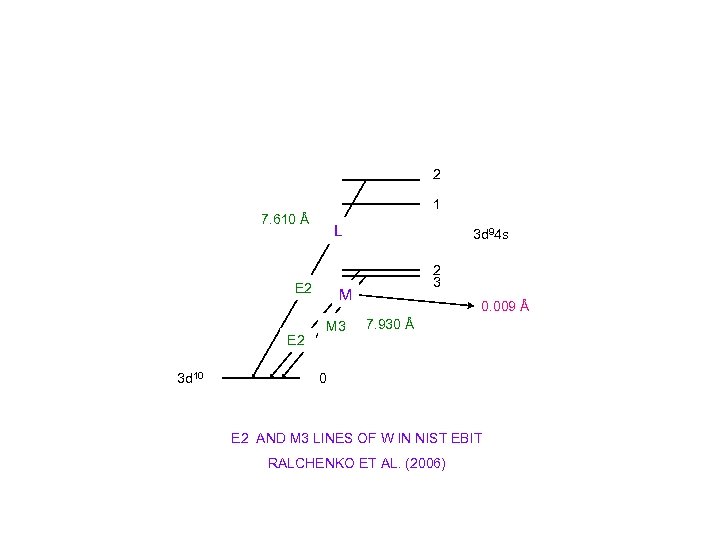 2 1 7. 610 Å L E 2 3 d 10 3 d 94 s 2 3 M M 3 0. 009 Å 7. 930 Å 0 E 2 AND M 3 LINES OF W IN NIST EBIT RALCHENKO ET AL. (2006)
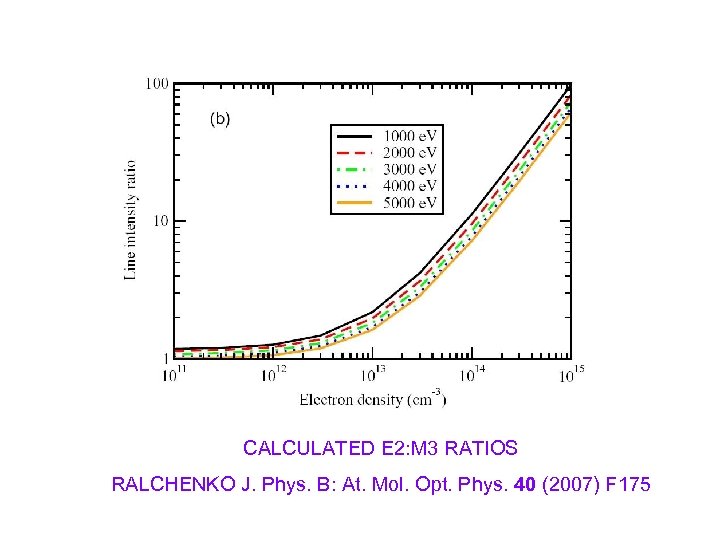 CALCULATED E 2: M 3 RATIOS RALCHENKO J. Phys. B: At. Mol. Opt. Phys. 40 (2007) F 175