


 Скачать презентацию Spectrophotometer Definition A spectrophotometer is
09595499b436d33d38332ad61df6054e.ppt
- Количество слайдов: 29
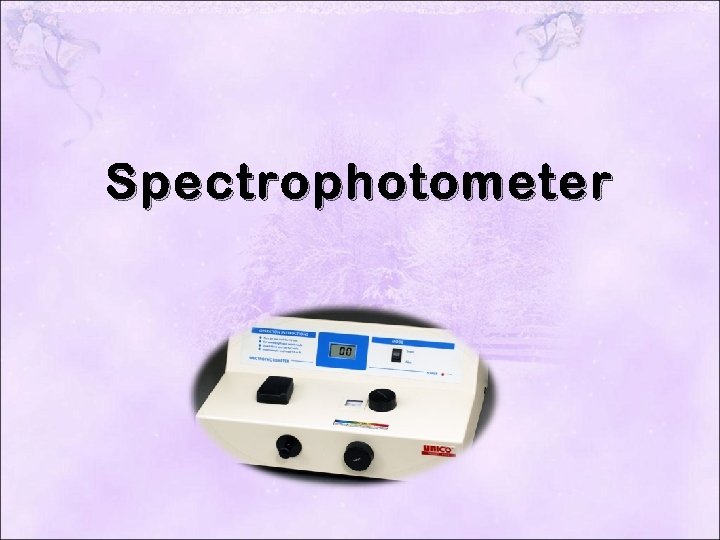 Spectrophotometer
 Definition : • A spectrophotometer is an instrument that measure the amount of light absorbed or transmitted by the sample.
 Purpose : • Spectrophotometer is used to: 1)measure the concentration of the solution. 2)identify organic compounds by determining the absorption maximum.
 Principle: • Spectrophotometer consists of two instruments: 1 -spectrometer to produce light for any selected wave length. 2 -photometer to measure the intensity of light, and the analyte is put between them.
 Single and double beams : • In the early days of spectroscopy, double beam spectrophotometers were popular but now it is thought that the single beam spectrophotometer is more advantageous.
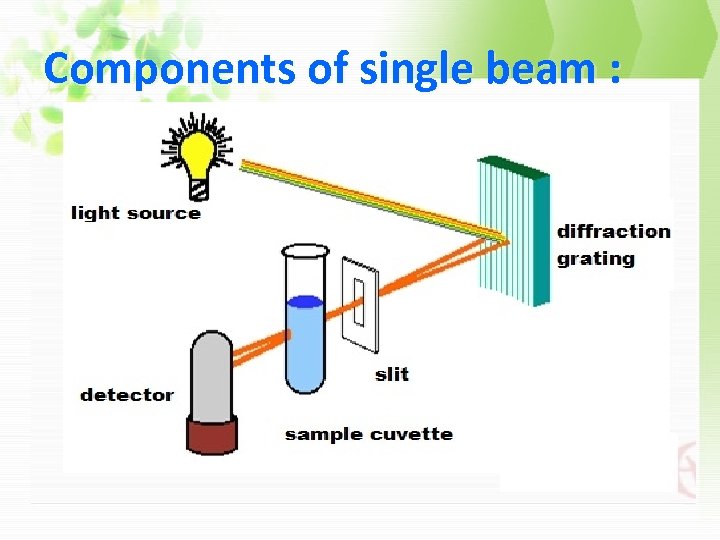 Components of single beam :
 1 - Light source. • For ultraviolet absorption spectrophotometer • for visible absorption spectrophotometer
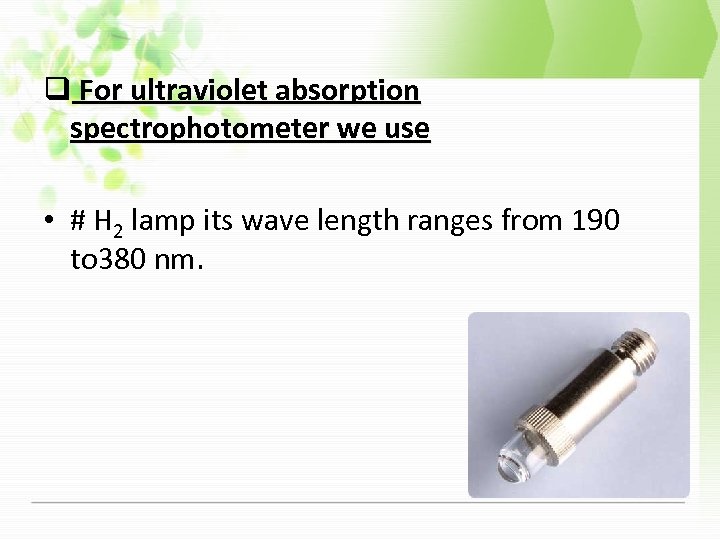 q For ultraviolet absorption spectrophotometer we use • # H 2 lamp its wave length ranges from 190 to 380 nm.
 • #D 2 (deuterium) lamp its wave length ranges from 185 to 400 nm. We prefer D 2 lamp because of its higher stability & it emits continuous radiation.
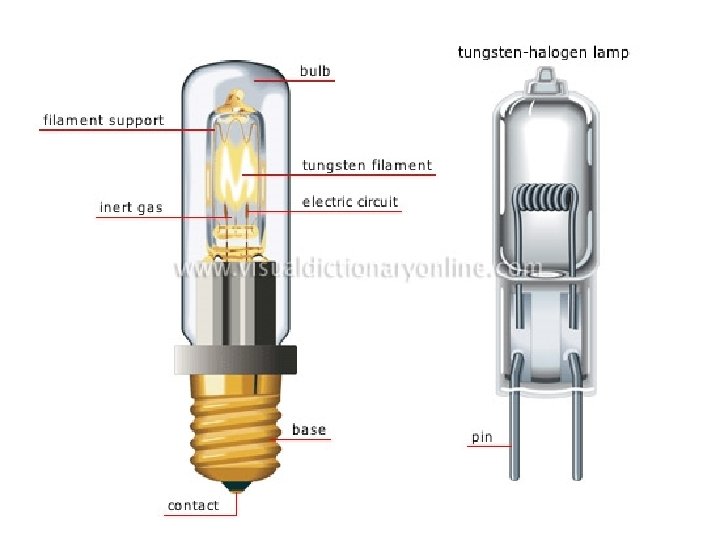
 q for visible absorption spectrophotometer we use • #tungsten lamp (350~2200 nm) • #tungsten halogen lamp (240~2500 nm) We prefer tungsten halogen lamp because it has longer life, can be used at lower wave length.
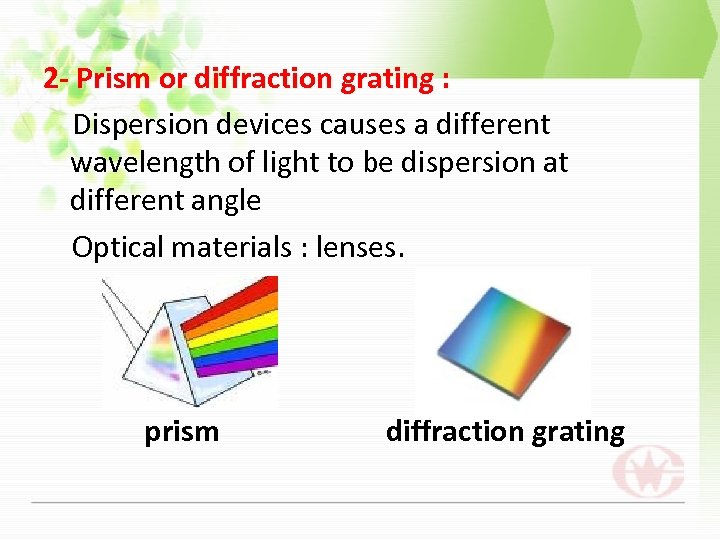 2 - Prism or diffraction grating : Dispersion devices causes a different wavelength of light to be dispersion at different angle Optical materials : lenses. prism diffraction grating
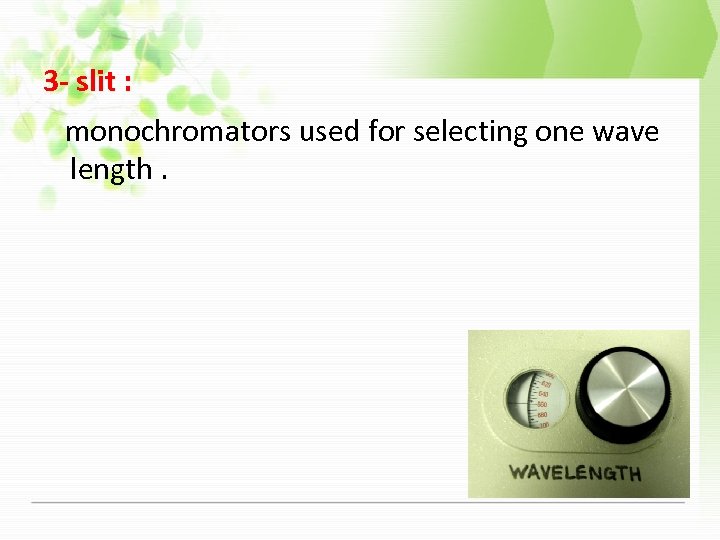 3 - slit : monochromators used for selecting one wave length.
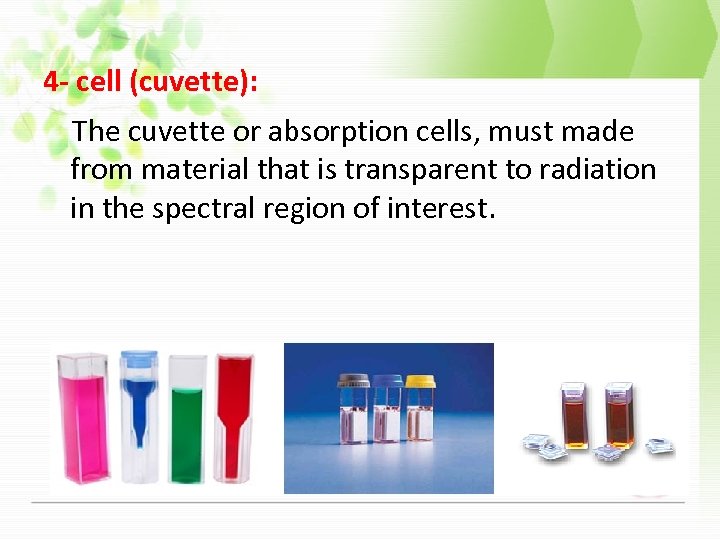 4 - cell (cuvette): The cuvette or absorption cells, must made from material that is transparent to radiation in the spectral region of interest.
 5 - Detector (photometer): a device used to convert the radiant energy to electrical signal.
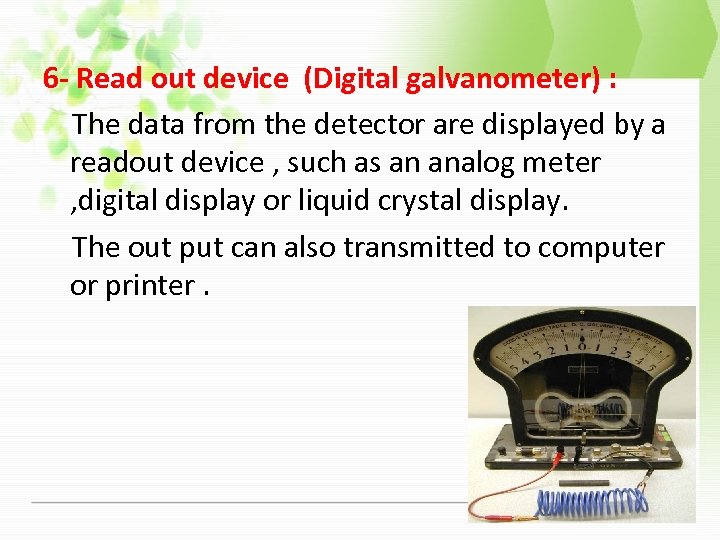 6 - Read out device (Digital galvanometer) : The data from the detector are displayed by a readout device , such as an analog meter , digital display or liquid crystal display. The out put can also transmitted to computer or printer.
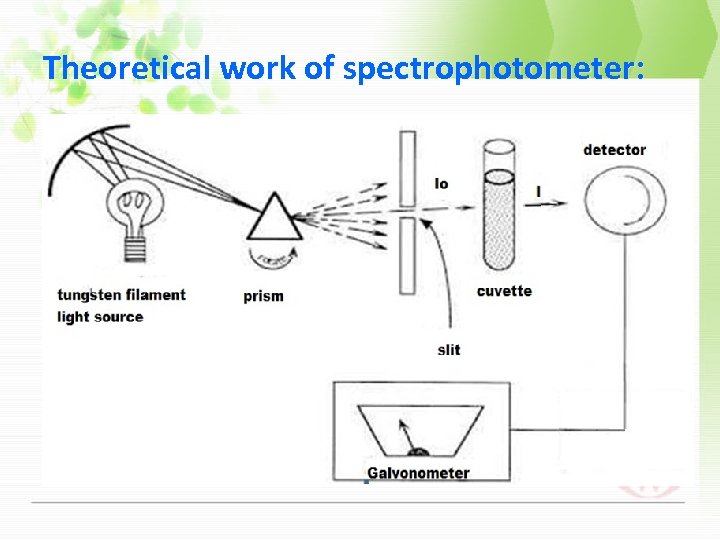 Theoretical work of spectrophotometer:

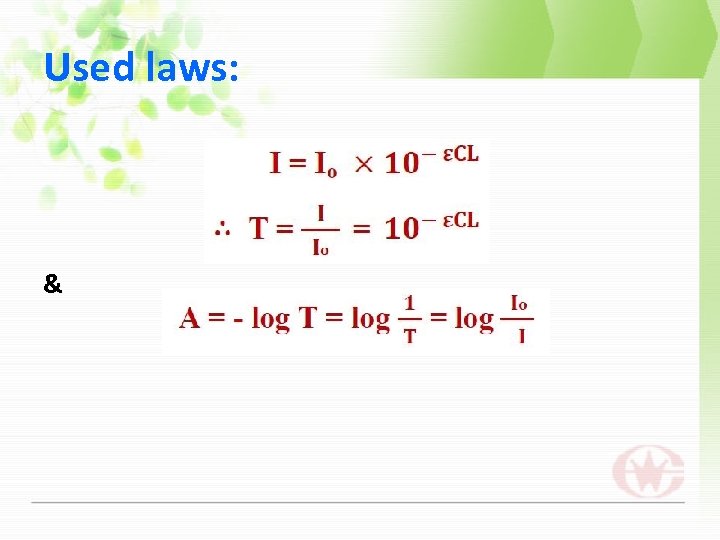 Used laws: &
 Where T: transmittance of solution. I: intensity of transmitted light. (Watt/cm 2) Io: intensity of incident light. (watt/cm 2) : Coefficient absorptivity. (L/mole. cm) : Concentration of solution. (Mole/L) : Thickness of cuvette. (cm) A: the absorption of light by the sample
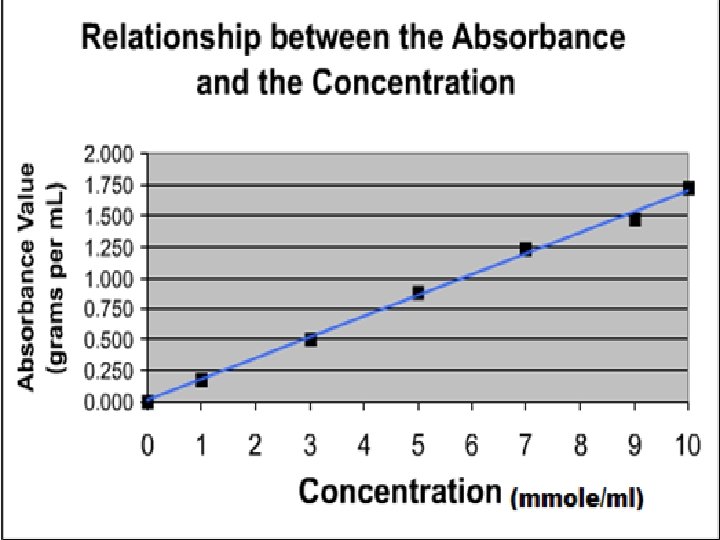
 Beer's Law: • Beer's Law explains the relationship between absorbance, at a given wavelength and concentration. A = CL Where: A = absorbance. = molar absorptivity coefficient. (L/mole. cm) L = length of the light path. (cm) C = concentration of the solute. (mole/L)
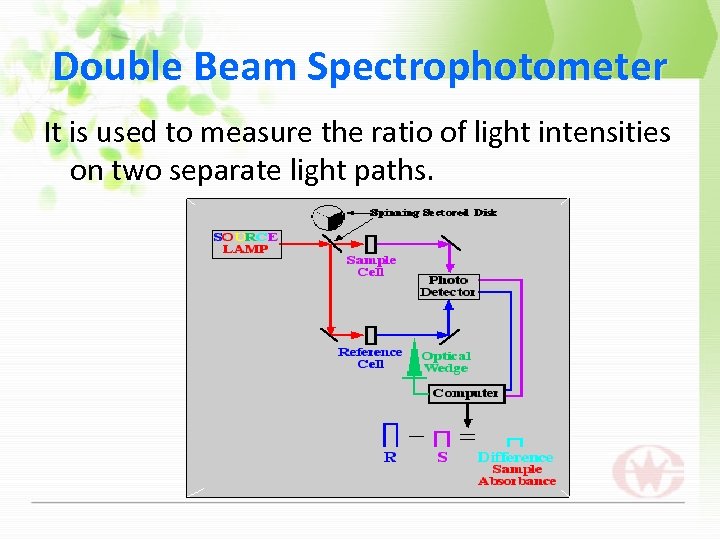 Double Beam Spectrophotometer It is used to measure the ratio of light intensities on two separate light paths.
 Advantages : 1) Wide applicability. 2) High sensitivity. 3) Good accuracy. 4) Ease and convenience.
 Disadvantages : 1. Error in reading due to » the change in temperature » nature of solution. 2. It is subject to false wavelength setting
 3. an error in wavelength setting of ± 0. 3 nm results in an error. 4. The equipment is generally expensive.
 Applications in our life • • Clinical Food and Drink Industrial / Pharmaceutical Life Sciences
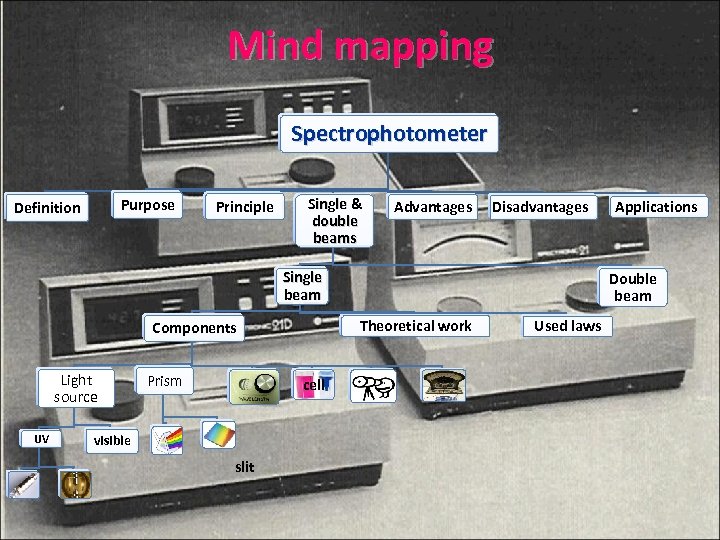 Mind mapping Spectrophotometer Purpose Definition Principle Single & double beams Advantages Disadvantages Single beam Light source UV Prism cell visible slit Double beam Theoretical work Components Applications Used laws
 The End ‘‘ best wishes ’’