


 Скачать презентацию Specimen preparation part 1 IFW Universität Hannover
TEM_Specimen praparation_Part 1.ppt
- Количество слайдов: 24
 Specimen preparation – part 1 IFW, Universität Hannover © Leibniz Universität Hannover, IW Mo. Ko Sommersemester 2004, K. Tracht Seite 1
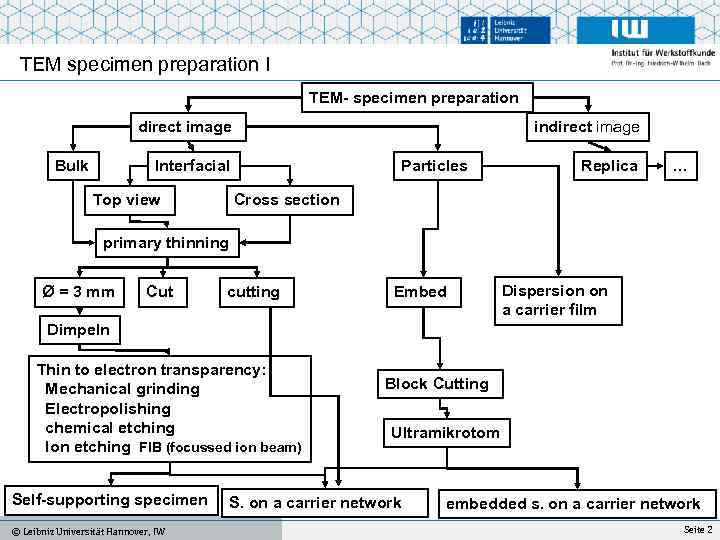 TEM specimen preparation I TEM- specimen preparation direct image Bulk indirect image Interfacial Top view Particles Replica … Cross section primary thinning Ø = 3 mm Cut cutting Embed Dispersion on a carrier film Dimpeln Thin to electron transparency: Mechanical grinding Electropolishing chemical etching Ion etching FIB (focussed ion beam) Self-supporting specimen IFW, Universität Hannover © Leibniz Universität Hannover, IW Block Cutting Ultramikrotom S. on a carrier network Mo. Ko Sommersemester 2004, K. Tracht embedded s. on a carrier network Seite 2
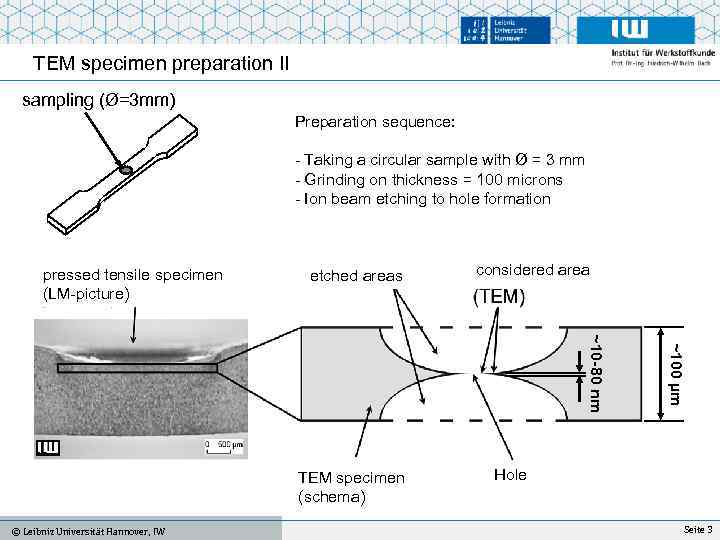 TEM specimen preparation II sampling (Ø=3 mm) Preparation sequence: - Taking a circular sample with Ø = 3 mm - Grinding on thickness = 100 microns - Ion beam etching to hole formation pressed tensile specimen (LM-picture) etched areas considered area IFW, Universität Hannover © Leibniz Universität Hannover, IW Mo. Ko Sommersemester 2004, K. Tracht ~100 µm ~10 -80 nm TEM specimen (schema) Hole Seite 3
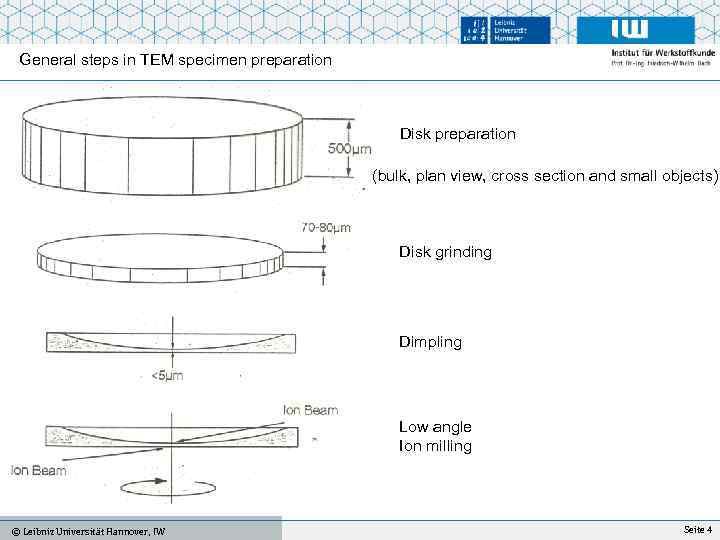 General steps in TEM specimen preparation Disk preparation (bulk, plan view, cross section and small objects) Disk grinding Dimpling Low angle Ion milling IFW, Universität Hannover © Leibniz Universität Hannover, IW Mo. Ko Sommersemester 2004, K. Tracht Seite 4
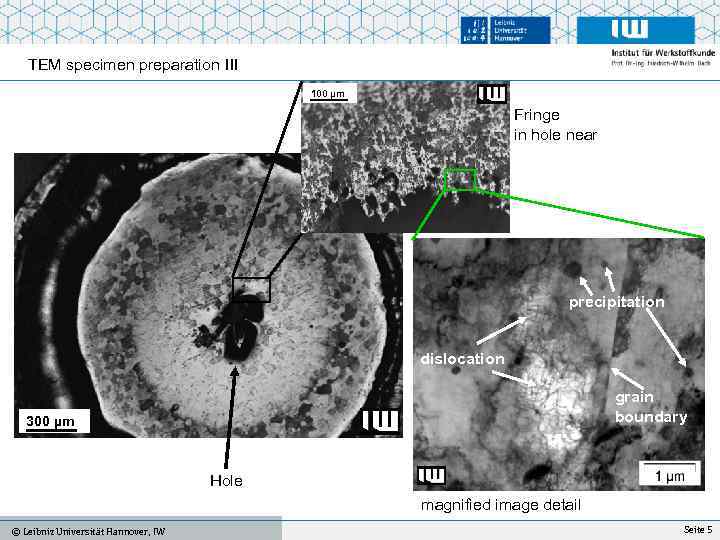 TEM specimen preparation III 100 µm Fringe in hole near precipitation dislocation grain boundary 300 µm Hole magnified image detail IFW, Universität Hannover © Leibniz Universität Hannover, IW Mo. Ko Sommersemester 2004, K. Tracht Seite 5
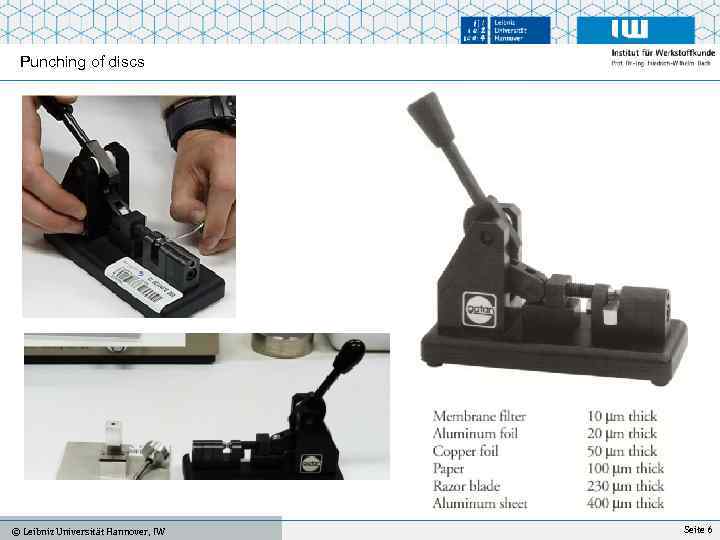 Punching of discs IFW, Universität Hannover © Leibniz Universität Hannover, IW Mo. Ko Sommersemester 2004, K. Tracht Seite 6
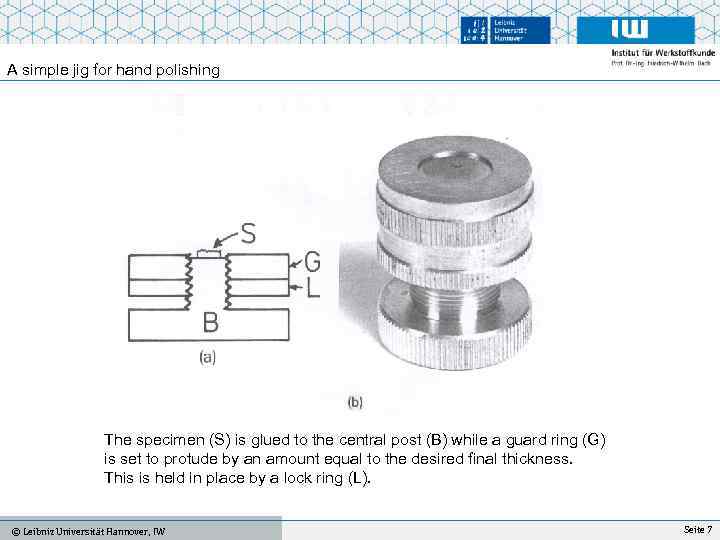 A simple jig for hand polishing The specimen (S) is glued to the central post (B) while a guard ring (G) is set to protude by an amount equal to the desired final thickness. This is held in place by a lock ring (L). IFW, Universität Hannover © Leibniz Universität Hannover, IW Mo. Ko Sommersemester 2004, K. Tracht Seite 7
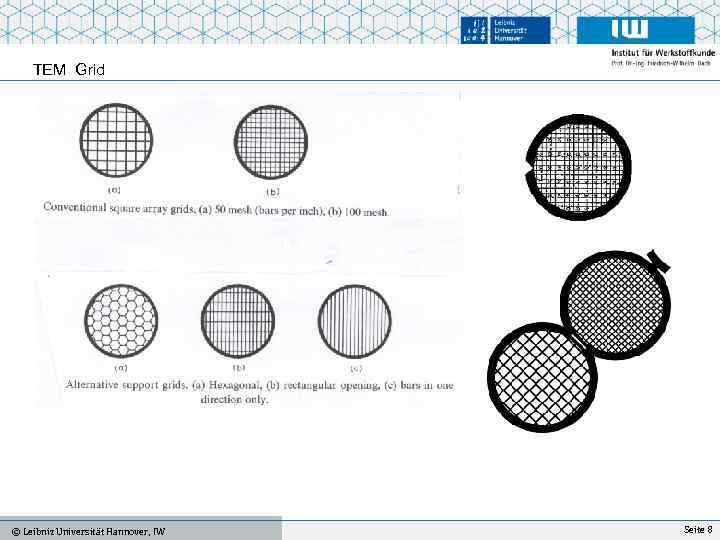 TEM Grid IFW, Universität Hannover © Leibniz Universität Hannover, IW Mo. Ko Sommersemester 2004, K. Tracht Seite 8
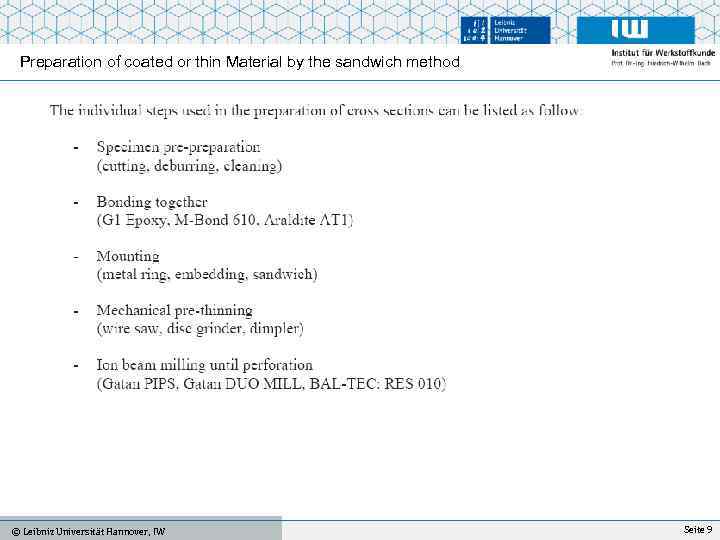 Preparation of coated or thin Material by the sandwich method IFW, Universität Hannover © Leibniz Universität Hannover, IW Mo. Ko Sommersemester 2004, K. Tracht Seite 9
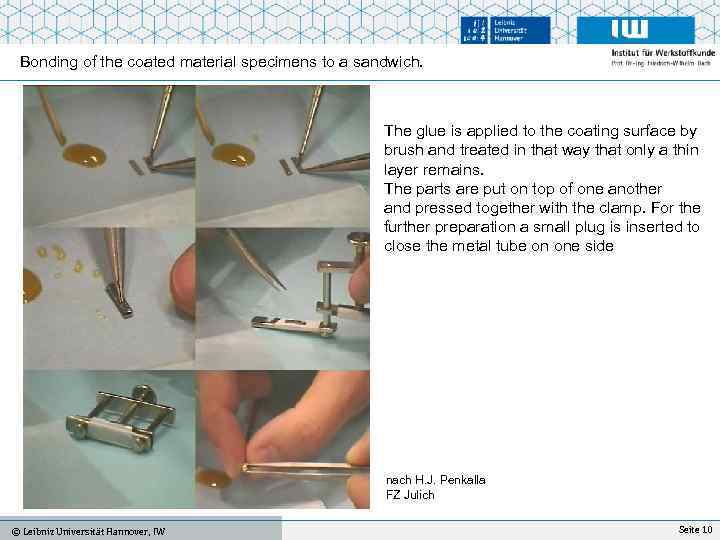 Bonding of the coated material specimens to a sandwich. The glue is applied to the coating surface by brush and treated in that way that only a thin layer remains. The parts are put on top of one another and pressed together with the clamp. For the further preparation a small plug is inserted to close the metal tube on one side nach H. J. Penkalla FZ Julich IFW, Universität Hannover © Leibniz Universität Hannover, IW Mo. Ko Sommersemester 2004, K. Tracht Seite 10
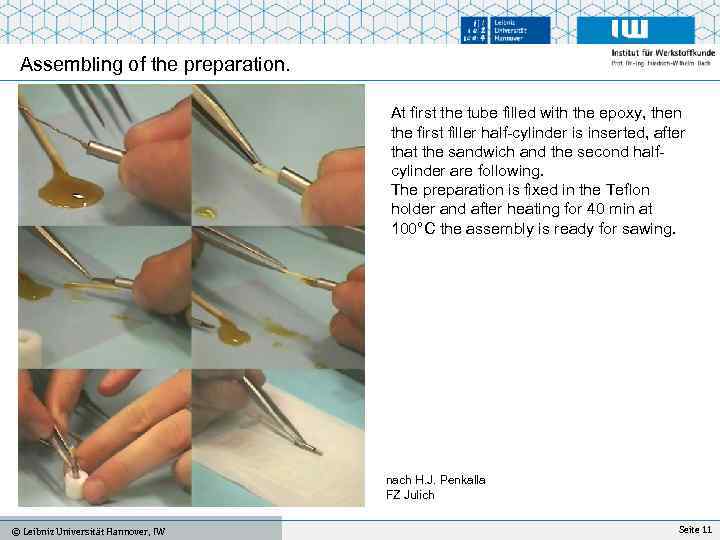 Assembling of the preparation. At first the tube filled with the epoxy, then the first filler half-cylinder is inserted, after that the sandwich and the second halfcylinder are following. The preparation is fixed in the Teflon holder and after heating for 40 min at 100°C the assembly is ready for sawing. nach H. J. Penkalla FZ Julich IFW, Universität Hannover © Leibniz Universität Hannover, IW Mo. Ko Sommersemester 2004, K. Tracht Seite 11
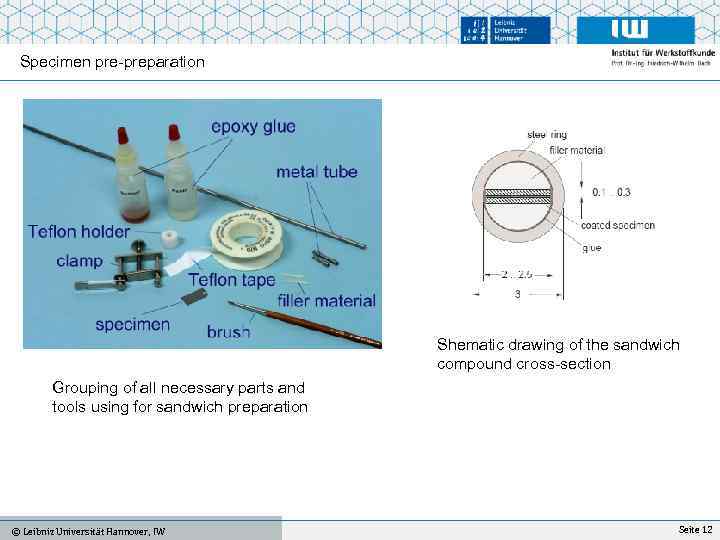 Specimen pre-preparation Shematic drawing of the sandwich compound cross-section Grouping of all necessary parts and tools using for sandwich preparation IFW, Universität Hannover © Leibniz Universität Hannover, IW Mo. Ko Sommersemester 2004, K. Tracht Seite 12
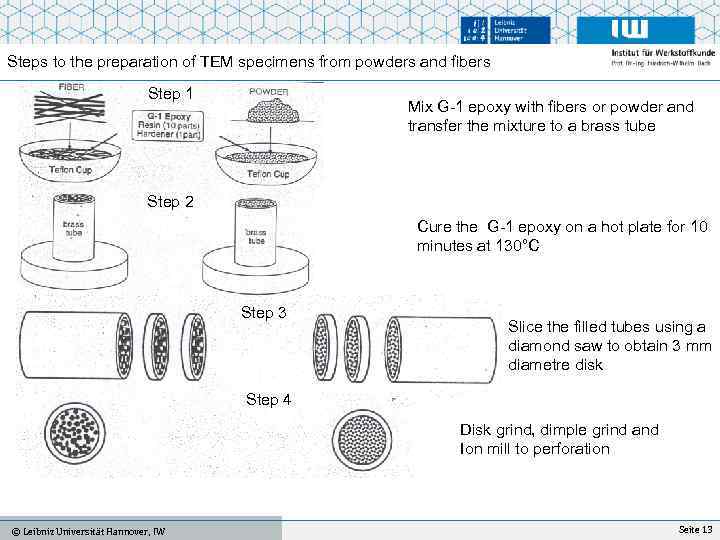 Steps to the preparation of TEM specimens from powders and fibers Step 1 Mix G-1 epoxy with fibers or powder and transfer the mixture to a brass tube Step 2 Cure the G-1 epoxy on a hot plate for 10 minutes at 130°C Step 3 Slice the filled tubes using a diamond saw to obtain 3 mm diametre disk Step 4 Disk grind, dimple grind and Ion mill to perforation IFW, Universität Hannover © Leibniz Universität Hannover, IW Mo. Ko Sommersemester 2004, K. Tracht Seite 13
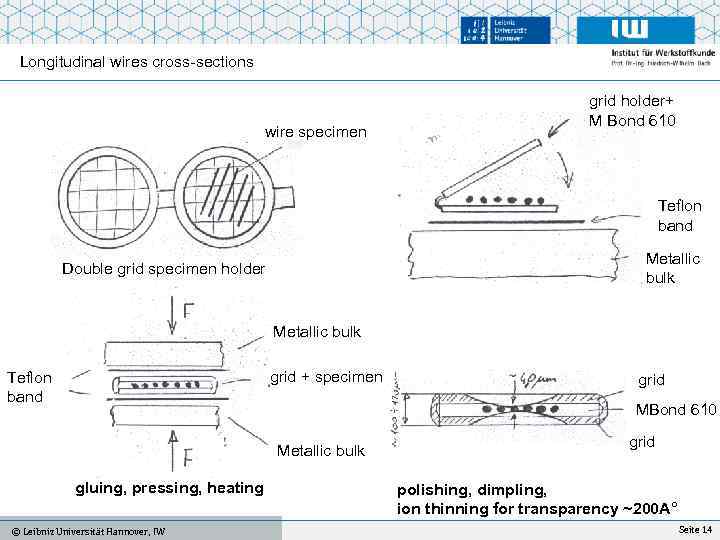 Longitudinal wires cross-sections grid holder+ M Bond 610 wire specimen Teflon band Metallic bulk Double grid specimen holder Metallic bulk grid + specimen Teflon band grid MBond 610 grid Metallic bulk gluing, pressing, heating IFW, Universität Hannover © Leibniz Universität Hannover, IW polishing, dimpling, ion thinning for transparency ~200 A° Mo. Ko Sommersemester 2004, K. Tracht Seite 14
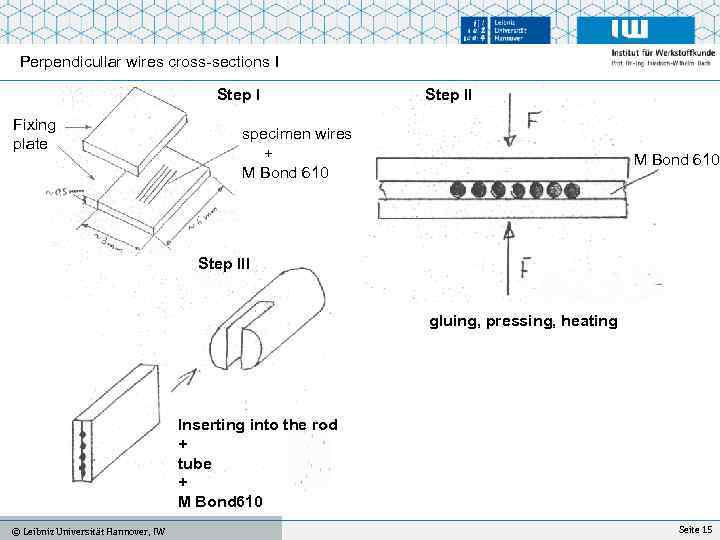 Perpendicullar wires cross-sections I Step I Fixing plate specimen wires + M Bond 610 Step III gluing, pressing, heating Inserting into the rod + tube + M Bond 610 IFW, Universität Hannover © Leibniz Universität Hannover, IW Mo. Ko Sommersemester 2004, K. Tracht Seite 15
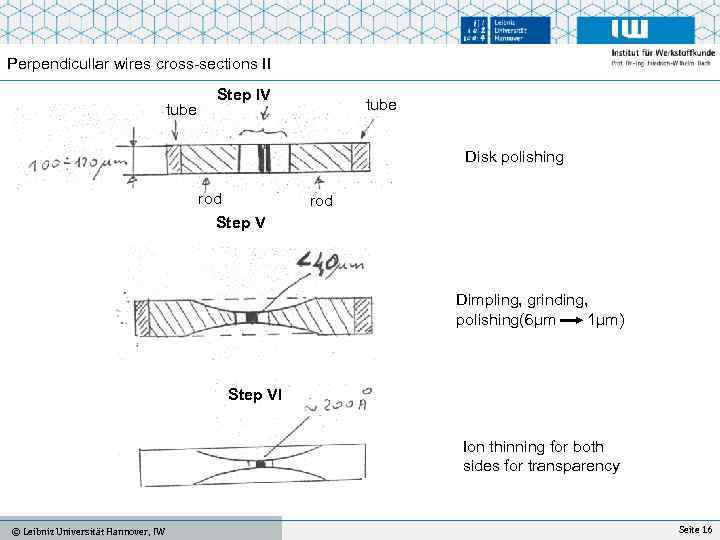 Perpendicullar wires cross-sections II tube Step IV tube Disk polishing rod Step V rod Dimpling, grinding, polishing(6µm 1µm) Step VI Ion thinning for both sides for transparency IFW, Universität Hannover © Leibniz Universität Hannover, IW Mo. Ko Sommersemester 2004, K. Tracht Seite 16
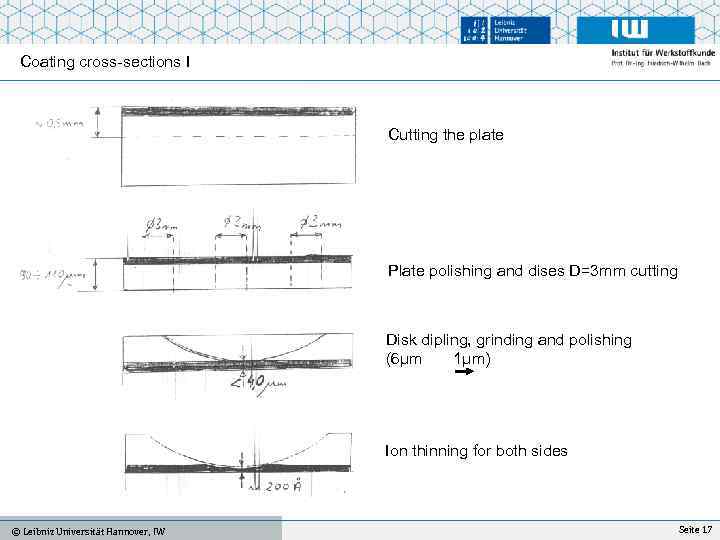 Coating cross-sections I Cutting the plate Plate polishing and dises D=3 mm cutting Disk dipling, grinding and polishing (6µm 1µm) Ion thinning for both sides IFW, Universität Hannover © Leibniz Universität Hannover, IW Mo. Ko Sommersemester 2004, K. Tracht Seite 17
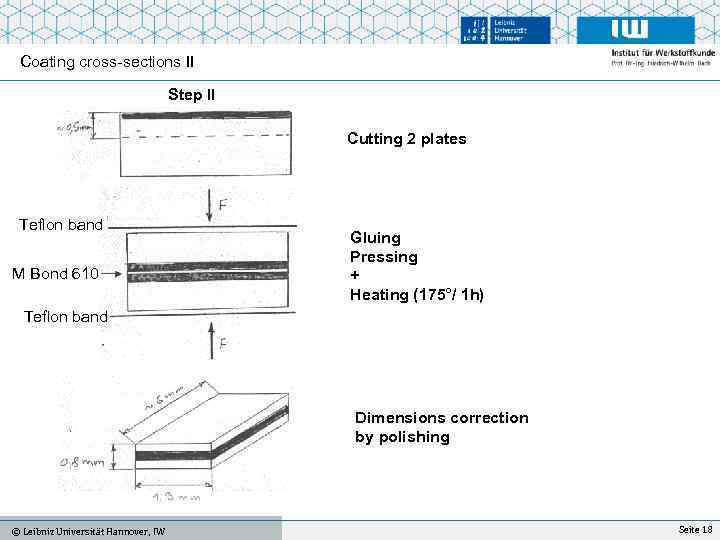 Coating cross-sections II Step II Cutting 2 plates Teflon band M Bond 610 Gluing Pressing + Heating (175°/ 1 h) Teflon band Dimensions correction by polishing IFW, Universität Hannover © Leibniz Universität Hannover, IW Mo. Ko Sommersemester 2004, K. Tracht Seite 18
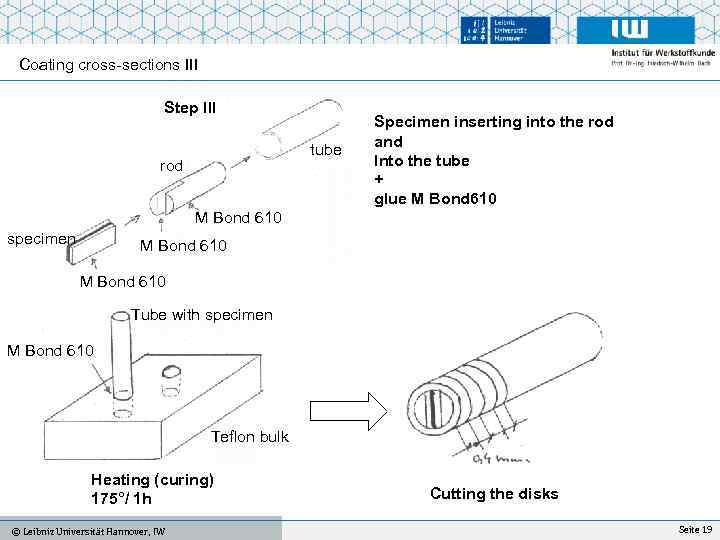 Coating cross-sections III Step III tube rod Specimen inserting into the rod and Into the tube + glue M Bond 610 specimen M Bond 610 Tube with specimen M Bond 610 Teflon bulk Heating (curing) 175°/ 1 h IFW, Universität Hannover © Leibniz Universität Hannover, IW Cutting the disks Mo. Ko Sommersemester 2004, K. Tracht Seite 19
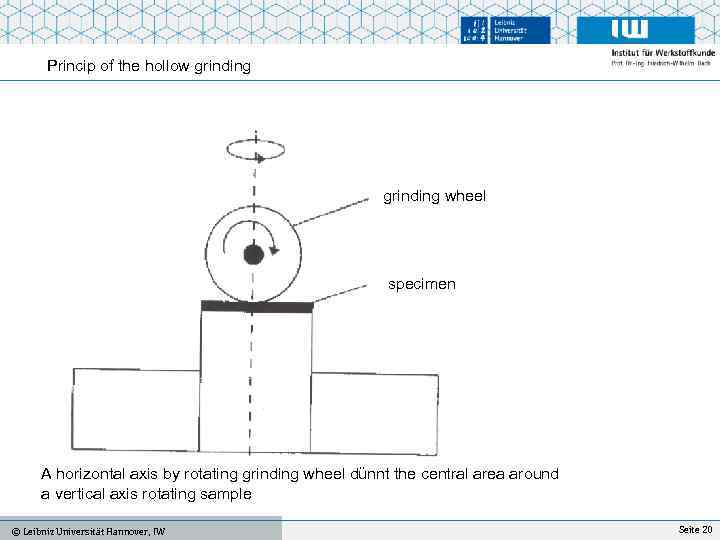 Princip of the hollow grinding wheel specimen A horizontal axis by rotating grinding wheel dünnt the central area around a vertical axis rotating sample IFW, Universität Hannover © Leibniz Universität Hannover, IW Mo. Ko Sommersemester 2004, K. Tracht Seite 20
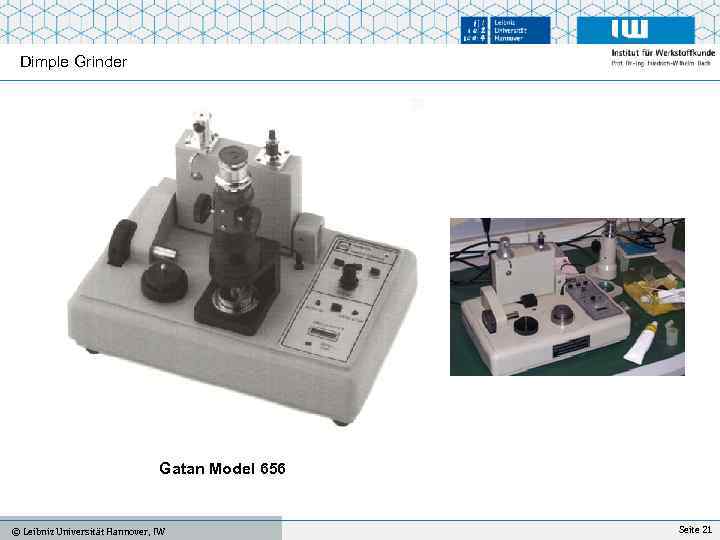 Dimple Grinder Gatan Model 656 IFW, Universität Hannover © Leibniz Universität Hannover, IW Mo. Ko Sommersemester 2004, K. Tracht Seite 21
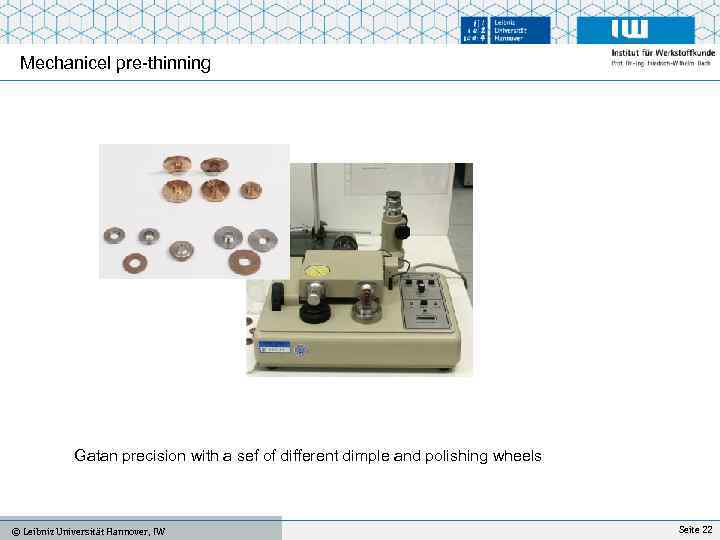 Mechanicel pre-thinning Gatan precision with a sef of different dimple and polishing wheels IFW, Universität Hannover © Leibniz Universität Hannover, IW Mo. Ko Sommersemester 2004, K. Tracht Seite 22
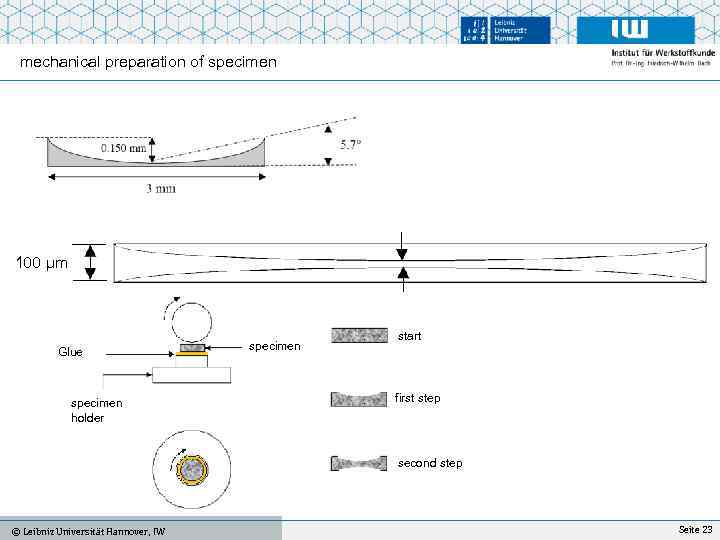 mechanical preparation of specimen 100 µm Glue specimen holder specimen start first step second step IFW, Universität Hannover © Leibniz Universität Hannover, IW Mo. Ko Sommersemester 2004, K. Tracht Seite 23
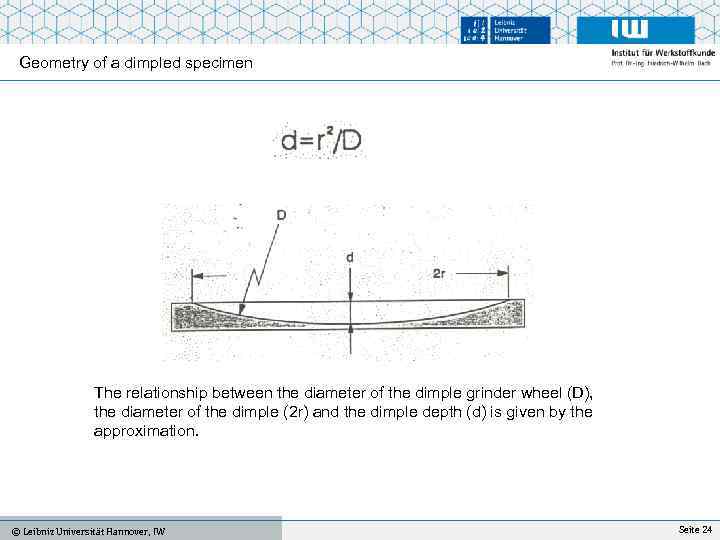 Geometry of a dimpled specimen The relationship between the diameter of the dimple grinder wheel (D), the diameter of the dimple (2 r) and the dimple depth (d) is given by the approximation. IFW, Universität Hannover © Leibniz Universität Hannover, IW Mo. Ko Sommersemester 2004, K. Tracht Seite 24