


 Скачать презентацию Specifying and Verifying Hardware Support for Copy and
6dc36ad5fec1f7348e7620b839a15fba.ppt
- Количество слайдов: 21
 Specifying and Verifying Hardware Support for Copy and Tamper-Resistant Software David Lie, John Mitchell, Chandramohan Thekkath and Mark Horowitz Computer Systems Lab Stanford University 1
 How Secure is Something? • After building a system, how do you know it’s secure? – Try to reason about security – Think about existing attacks – Think, think… • Computers never get tired of thinking: – Model checkers exhaustively check the state space of a state machine – Prove correctness for explored states • Model checkers combine the advantages of formal methods with automated brute-force abilities of computers 2
 Problems with Model Checking • Computers aren’t very smart: – Need to model the system as a state-machine – A set of logical statements define: • State vector for the machine • Next State functions • Correctness properties • Models must be abstracted: – Model Checkers can only check a finite state space – State space of models must be reduced 3
 Checking Systems • Previous work on automatically checking security. – D. Wagner, J. S. Foster, E. A. Brewer, and A. Aiken. A first step towards automated detection of buffer overrun vulnerabilities. – K. Ashcraft and D. Engler. Using programmer-written compiler extensions to catch security holes. • Previous work on formally verifying security: – J. Mitchell, M. Mitchell, and U. Stern. Automated analysis of cryptographic protocols using Murphi – S. Smith, R. Perez, S. Weingart, and V. Austel. Validating a highperformance, programmable secure coprocessor. 4
 Verifying Secure Processors • Present a methodology for verifying security processors: – Show that an adversary executing on the system as the operating system cannot attack other users on the system • Reduce complexity of the system: – Less logic means a simpler system – Remove actions that are not necessary for security • Show liveness in the system: – Despite the restrictions imposed by security, the system is still usable and can guarantee forward progress 5
 XOM • Our solution: e. Xecute Only Memory or “XOM” – Programs in this memory can only be executed, they cannot be read or modified – Provides isolation between programs so that even the operating system cannot attack a user process • XOM combines cryptographic and architectural techniques – Access Control tags are fast but not necessarily secure • Only used on the trusted hardware of the processor – Cryptography is slow but offers more guarantees • Used to protect data that has to be stored off the processor 6
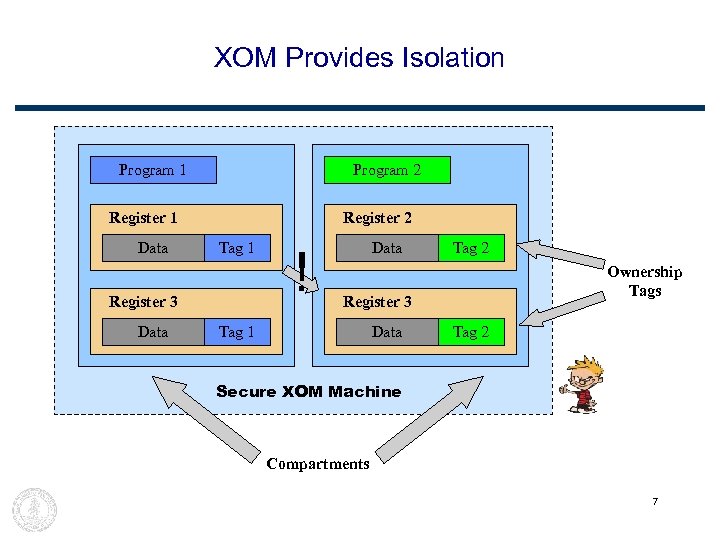 XOM Provides Isolation Program 1 Program 2 Register 1 Data Register 2 Tag 1 Register 3 Data ! Data Tag 2 Ownership Tags Register 3 Tag 1 ? ? ? Data Tag 2 Secure XOM Machine Compartments 7
 Cryptography • Cryptography is used to protect data and code when it is off-chip in memory or on disk: – Values in memory are encrypted and hashed with a MAC • Operating system must be able to virtualize resources – Memory is encrypted so OS simply copies ciphertext and MAC’s – During an interrupt, OS asks hardware to encrypt registers first so that it can save the state – To restore, the OS presents the encrypted registers and the hardware restores them 8
 Model Checking XOM • XOM Model is a state machine: – State Vector • A set of all things on the chip that can hold state • Based on the Processor Hardware – Next-State Functions • A set of state transitions that the hardware can have • Derived from the instructions that can be executed on the processor – Invariants • Define the correct operation of the XOM processor • Two Goals: Prevent observation and modification 9
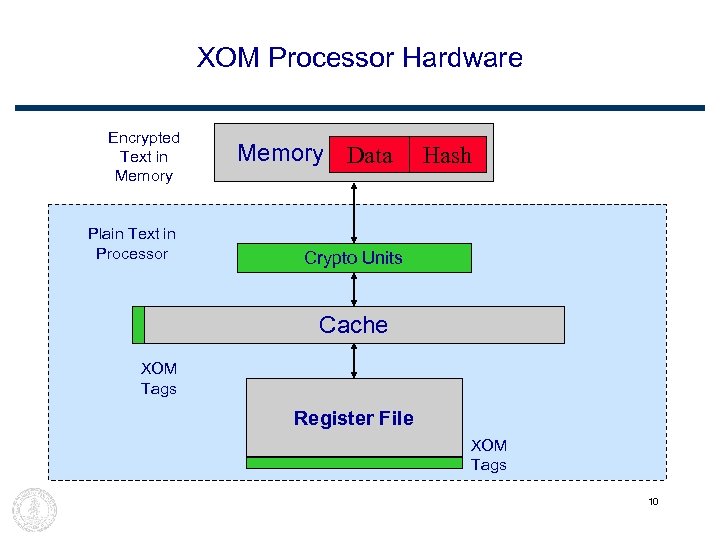 XOM Processor Hardware Encrypted Text in Memory Plain Text in Processor Memory Data Hash Crypto Units Cache XOM Tags Register File XOM Tags 10
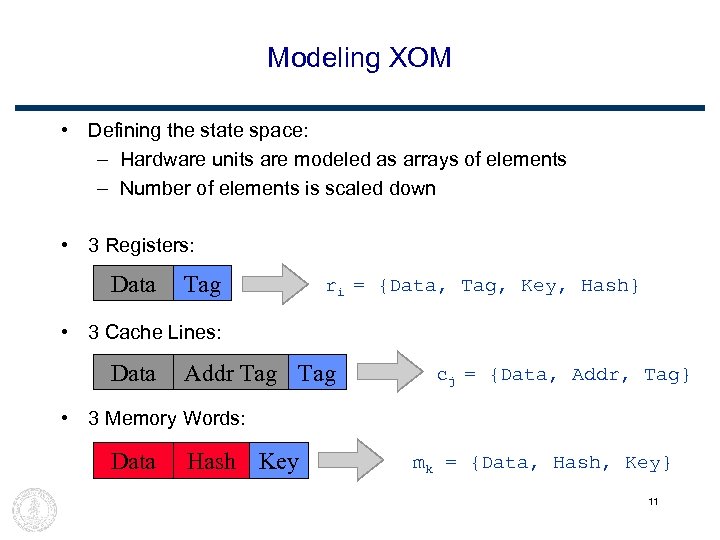 Modeling XOM • Defining the state space: – Hardware units are modeled as arrays of elements – Number of elements is scaled down • 3 Registers: Data Tag ri = {Data, Tag, Key, Hash} • 3 Cache Lines: Data Addr Tag cj = {Data, Addr, Tag} • 3 Memory Words: Data Hash Key mk = {Data, Hash, Key} 11
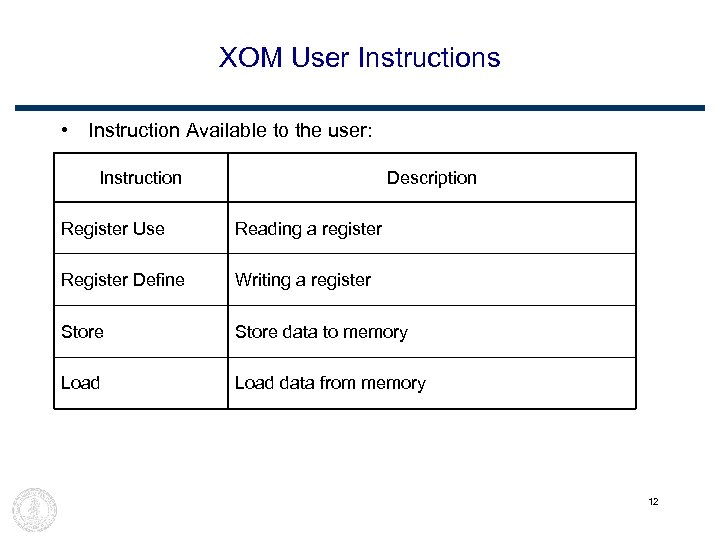 XOM User Instructions • Instruction Available to the user: Instruction Description Register Use Reading a register Register Define Writing a register Store data to memory Load data from memory 12
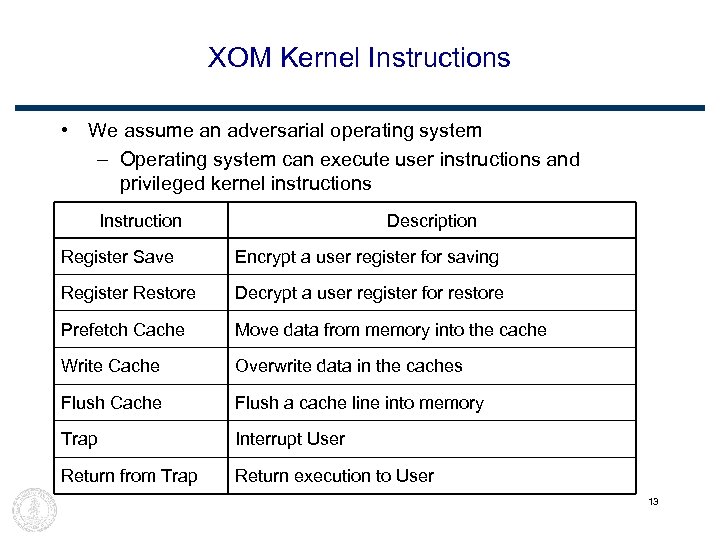 XOM Kernel Instructions • We assume an adversarial operating system – Operating system can execute user instructions and privileged kernel instructions Instruction Description Register Save Encrypt a user register for saving Register Restore Decrypt a user register for restore Prefetch Cache Move data from memory into the cache Write Cache Overwrite data in the caches Flush Cache Flush a cache line into memory Trap Interrupt User Return from Trap Return execution to User 13
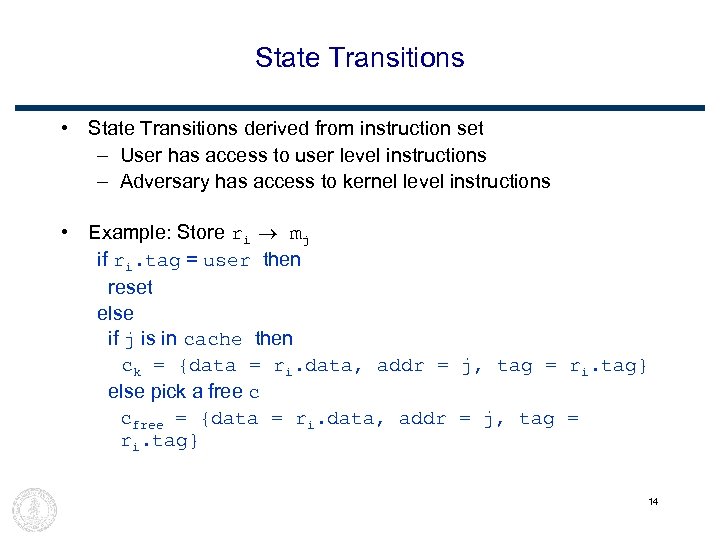 State Transitions • State Transitions derived from instruction set – User has access to user level instructions – Adversary has access to kernel level instructions • Example: Store ri mj if ri. tag = user then reset else if j is in cache then ck = {data = ri. data, addr = j, tag = ri. tag} else pick a free c cfree = {data = ri. data, addr = j, tag = ri. tag} 14
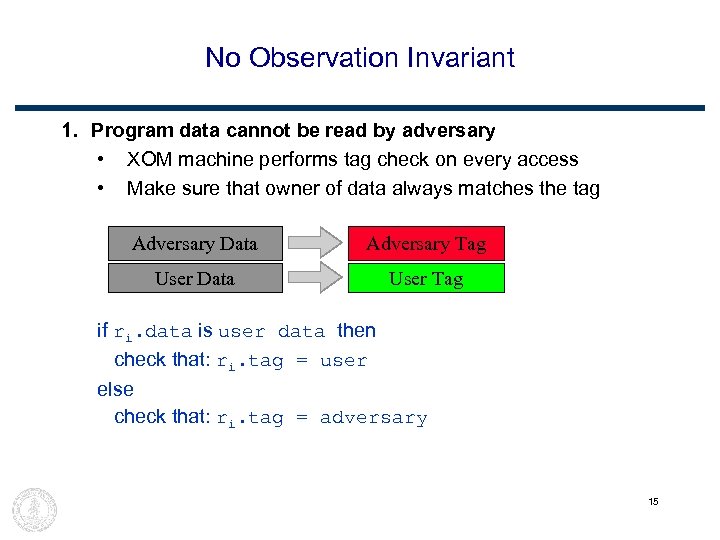 No Observation Invariant 1. Program data cannot be read by adversary • XOM machine performs tag check on every access • Make sure that owner of data always matches the tag Adversary Data Adversary Tag User Data User Tag if ri. data is user data then check that: ri. tag = user else check that: ri. tag = adversary 15
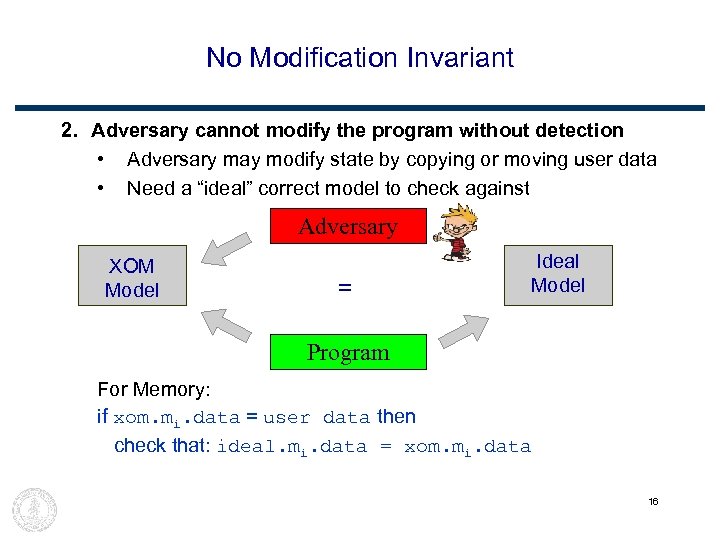 No Modification Invariant 2. Adversary cannot modify the program without detection • Adversary may modify state by copying or moving user data • Need a “ideal” correct model to check against Adversary XOM Model = Ideal Model Program For Memory: if xom. mi. data = user data then check that: ideal. mi. data = xom. mi. data 16
 Checking for Correctness • Model checker helped us find bugs and correct them – 2 old errors were found – 2 new errors were found and corrected • Example: – Case where it’s possible to replay a memory location – This was due to the write to memory and hash of the memory location not being atomic 17
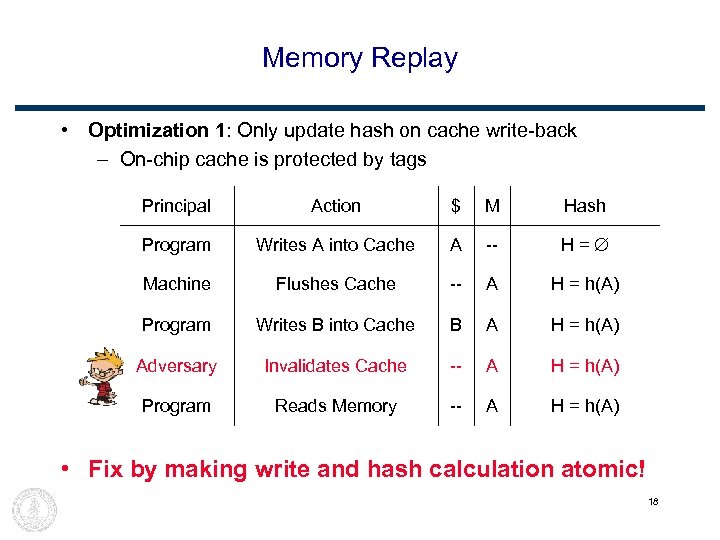 Memory Replay • Optimization 1: Only update hash on cache write-back – On-chip cache is protected by tags Principal Action $ M Hash Program Writes A into Cache A -- H= Machine Flushes Cache -- A H = h(A) Program Writes B into Cache B A H = h(A) Adversary Invalidates Cache -- A H = h(A) Program Reads Memory -- A H = h(A) • Fix by making write and hash calculation atomic! 18
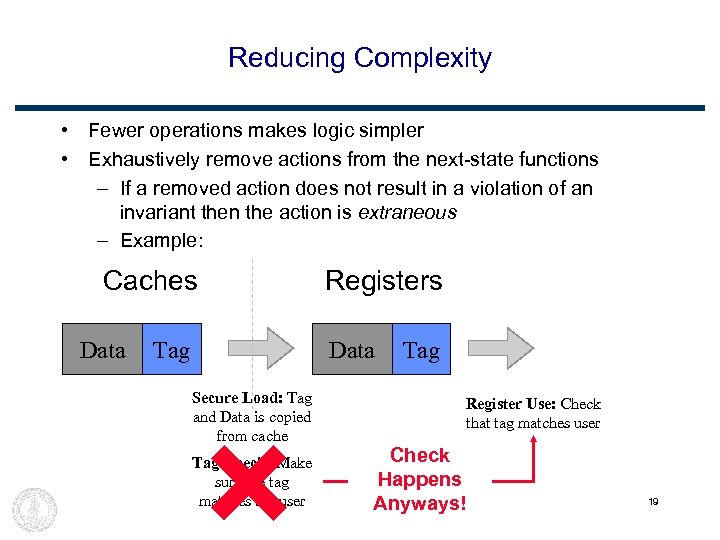 Reducing Complexity • Fewer operations makes logic simpler • Exhaustively remove actions from the next-state functions – If a removed action does not result in a violation of an invariant then the action is extraneous – Example: Caches Data Tag Registers Data Secure Load: Tag and Data is copied from cache Tag Check: Make sure the tag matches the user Tag Register Use: Check that tag matches user Check Happens Anyways! 19
 Liveness • A weak form of forward progress guarantee: – At all times operating system or user can always execute an instruction – All instructions can be executed somewhere in the state space • Constrain the operating system so that: 1. Operating system always restores user state 2. Operating system does not overwrite user data • Check that within the state-space: 1. User is never halted due to access violation 2. User and operating system are able to execute every instruction 20
 Conclusions • Model Checkers are an effective tool for verifying security of processors – Hardware blocks define state vector – Instructions define next-state functions • Can be used to verify: – Tamper-resistance by checking consistency between an “ideal” model and “actual” model – Minimal Complexity by checking that every action is necessary for correctness – Liveness by making the adversary cooperative and showing that both are always able to execute actions 21