


 Скачать презентацию Special RNC adaptation of Communications Directory Role lookup
a6f6dfb1ab963ecb5f00544055394c7f.ppt
- Количество слайдов: 21
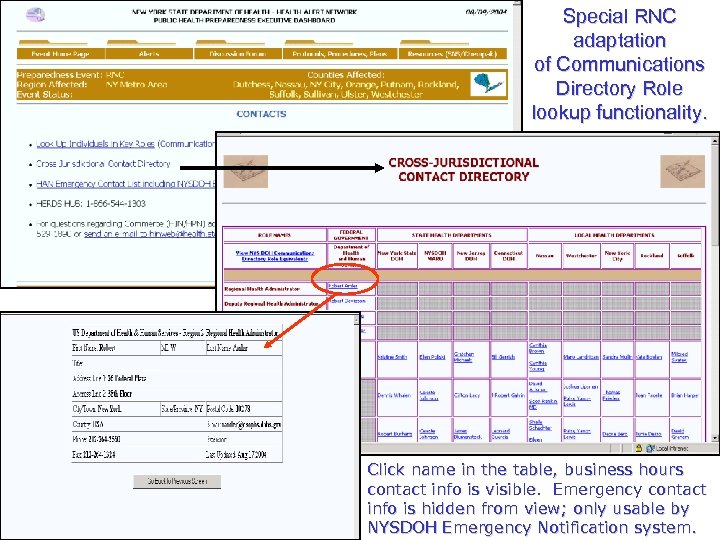 Special RNC adaptation of Communications Directory Role lookup functionality. Click name in the table, business hours contact info is visible. Emergency contact info is hidden from view; only usable by NYSDOH Emergency Notification system.
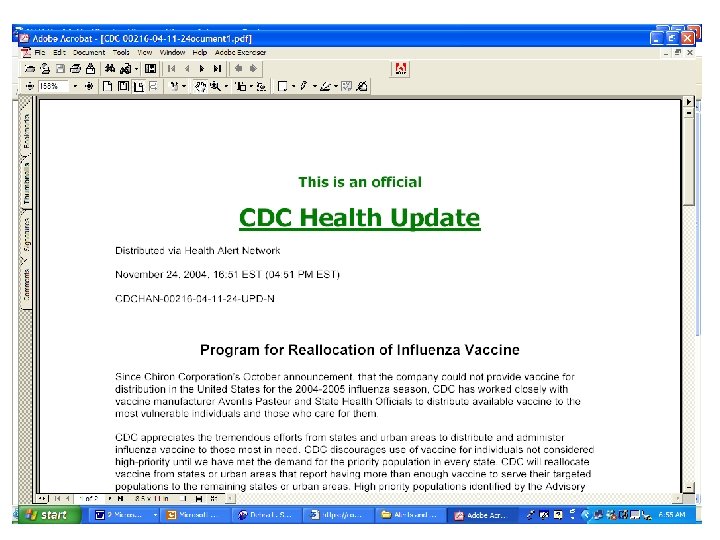
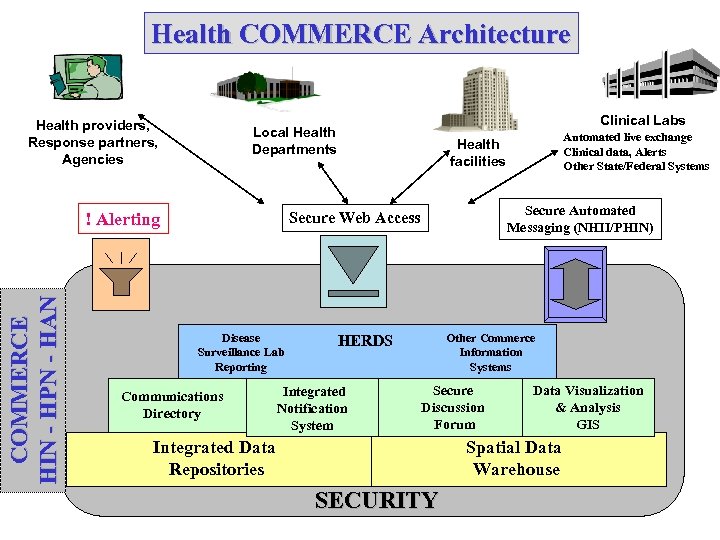 Health COMMERCE Architecture Health providers, Response partners, Agencies Disease Surveillance Lab Reporting Communications Directory Automated live exchange Clinical data, Alerts Other State/Federal Systems Health facilities Secure Automated Messaging (NHII/PHIN) Secure Web Access ! Alerting COMMERCE HIN - HPN - HAN Clinical Labs Local Health Departments Other Commerce Information Systems HERDS Integrated Notification System Secure Discussion Forum Integrated Data Repositories Data Visualization & Analysis GIS Spatial Data Warehouse SECURITY
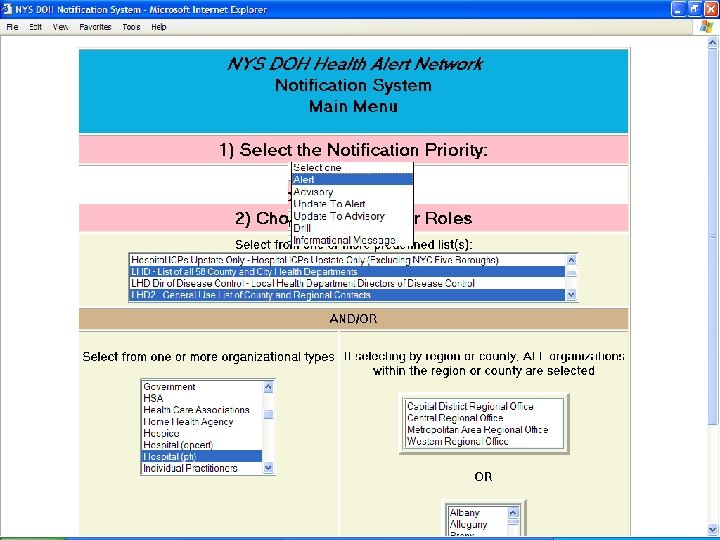
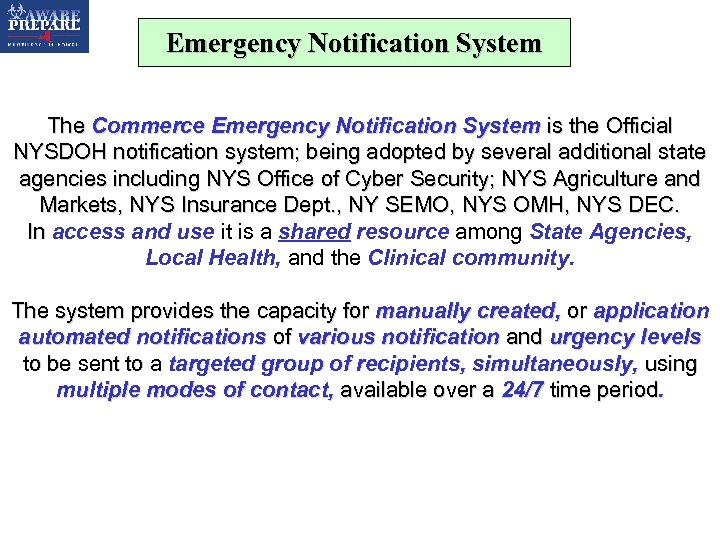 Emergency Notification System The Commerce Emergency Notification System is the Official NYSDOH notification system; being adopted by several additional state agencies including NYS Office of Cyber Security; NYS Agriculture and Markets, NYS Insurance Dept. , NY SEMO, NYS OMH, NYS DEC. In access and use it is a shared resource among State Agencies, Local Health, and the Clinical community. The system provides the capacity for manually created, or application automated notifications of various notification and urgency levels to be sent to a targeted group of recipients, simultaneously, using multiple modes of contact, available over a 24/7 time period.
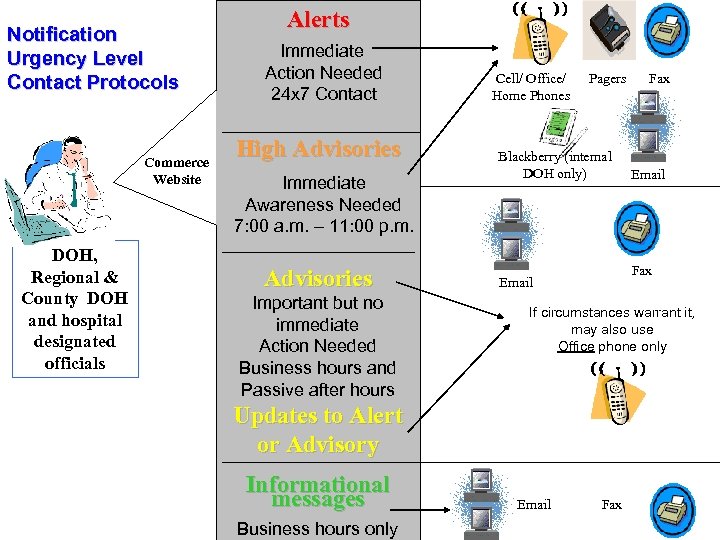 Notification Urgency Level Contact Protocols Commerce Website DOH, Regional & County DOH and hospital designated officials Alerts Immediate Action Needed 24 x 7 Contact High Advisories Immediate Awareness Needed 7: 00 a. m. – 11: 00 p. m. Advisories Important but no immediate Action Needed Business hours and Passive after hours Cell/ Office/ Home Phones Pagers Blackberry (internal DOH only) Business hours only Email Fax Email If circumstances warrant it, may also use Office phone only Updates to Alert or Advisory Informational messages Fax Email Fax
 Emergency Notification System The NYSDOH Commerce Emergency Notification System is an integrated infrastructure; utilizing and interoperating with various technologies and applications supported and residing on the NYSDOH Commerce Network, including: – Integrated Voice Response software and hardware, oracle databases – Multiple fax appliances – Enterprise email servers – Communications directory and notification system interfaces – NYSDOH Commerce accounts system. – Multiple applications/Sybase • Capacity of 48 lines; approximately 2800, 1 - minute calls per hour • Compliant (architecture) and compatible (concepts) with CDC/State Alerts and Communications Workgroup (PHIN) • Cascading PHIN Alerting System Compliant with Common Alerting Protocol (CAP) suggested standards for vocabulary
 Emergency Notification System Cascading Notification Flow Federal Alerts Hospitals and other regulated entities, e. g. , long term care. All other hospitals and other entities within their jurisdiction, i. e. , LHD, long term care. NYSDOH Central and regional offices Other state level agencies, e. g. SEMO, CSCIC, AG & Markets, Operations, EMS. LHD; NYCDOHMH Additional appropriate local LHD personnel as well as all other LHDs. Local jurisdiction emergency response partners For local event, local jurisdiction hospitals and other entities, e. g. , nursing homes.
 Emergency Notification System Contact information: Contacts based on accurate information of communications directory. Phone Notification messages: created either as pre-recorded voice messages or as “Text to Speech” conversion of typed text to voice. Who can send emergency notifications/ access control: use of notification tool is based on Communications Directory role (e. g. , all LHD Commissioners, Public Health Directors), or may be assigned to designated individuals. Scope of Recipient Audience is restricted by jurisdiction of individual sending the notification. Currently notifications sent via web-based tool. Soon to deploy phone creation/activation of an emergency notification via IVR. Automated Application based alerts: utilize XML schema to communicate appropriate parameters and values to notification system (HERDS, ECLRS)
 Vertical hierarchy across geographic jurisdiction Jurisdictional, role and Organizational type Contact Protocols for Notifications & bulk messaging Horizontal hierarchy across like-type organization entities Emergency notifications and bulk messaging across all organization types. Across all jurisdictions State DOH staff Across all county jurisdictions in their region State Regional Office Staff Across only their county Local Health Depts. Emergency notifications and bulk messaging to all other regional offices; to all other type organizations within their region. Emergency notifications and bulk messaging to all other local health depts; to all other type organizations within their county
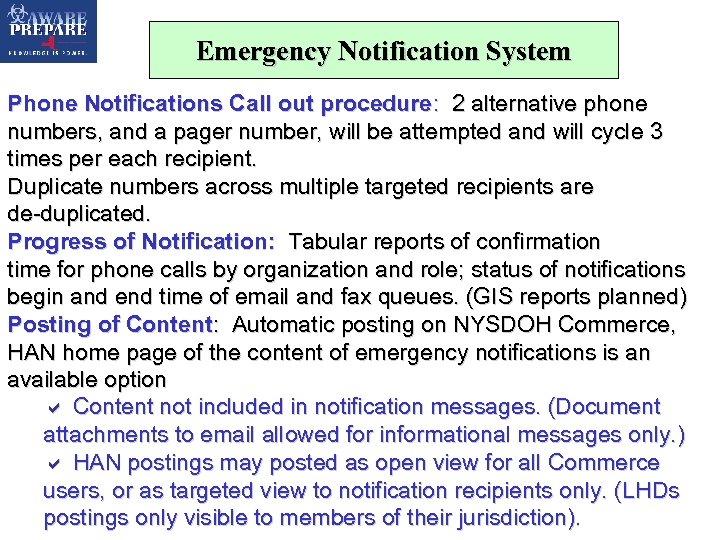 Emergency Notification System Phone Notifications Call out procedure: 2 alternative phone numbers, and a pager number, will be attempted and will cycle 3 times per each recipient. Duplicate numbers across multiple targeted recipients are de-duplicated. Progress of Notification: Tabular reports of confirmation time for phone calls by organization and role; status of notifications begin and end time of email and fax queues. (GIS reports planned) Posting of Content: Automatic posting on NYSDOH Commerce, HAN home page of the content of emergency notifications is an available option Content not included in notification messages. (Document attachments to email allowed for informational messages only. ) HAN postings may posted as open view for all Commerce users, or as targeted view to notification recipients only. (LHDs postings only visible to members of their jurisdiction).
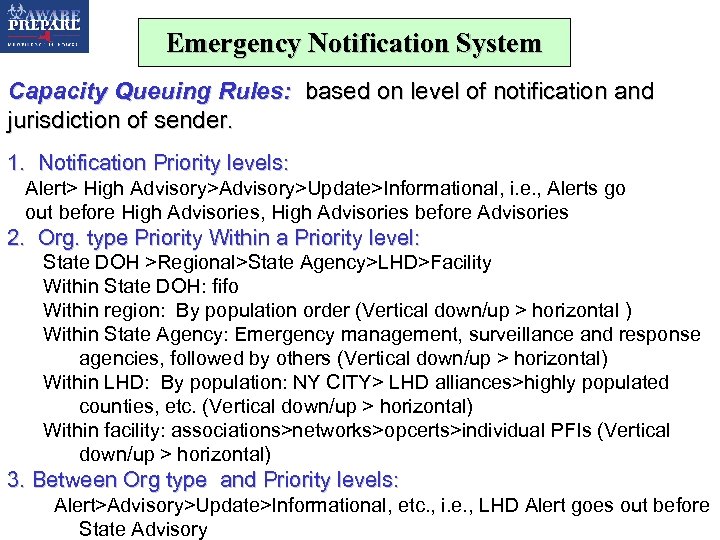 Emergency Notification System Capacity Queuing Rules: based on level of notification and jurisdiction of sender. 1. Notification Priority levels: Alert> High Advisory>Update>Informational, i. e. , Alerts go out before High Advisories, High Advisories before Advisories 2. Org. type Priority Within a Priority level: State DOH >Regional>State Agency>LHD>Facility Within State DOH: fifo Within region: By population order (Vertical down/up > horizontal ) Within State Agency: Emergency management, surveillance and response agencies, followed by others (Vertical down/up > horizontal) Within LHD: By population: NY CITY> LHD alliances>highly populated counties, etc. (Vertical down/up > horizontal) Within facility: associations>networks>opcerts>individual PFIs (Vertical down/up > horizontal) 3. Between Org type and Priority levels: Alert>Advisory>Update>Informational, etc. , i. e. , LHD Alert goes out before State Advisory
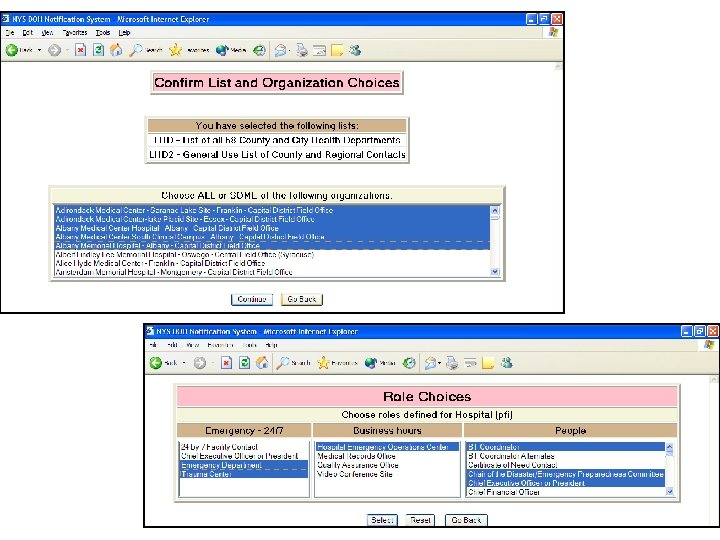
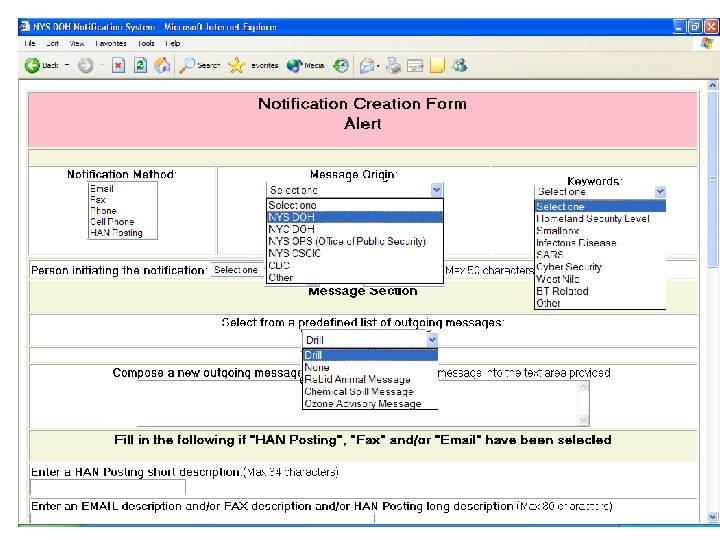
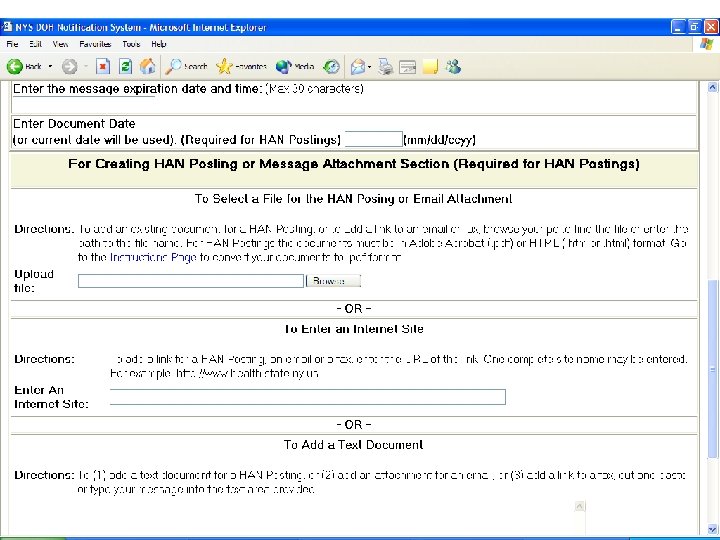
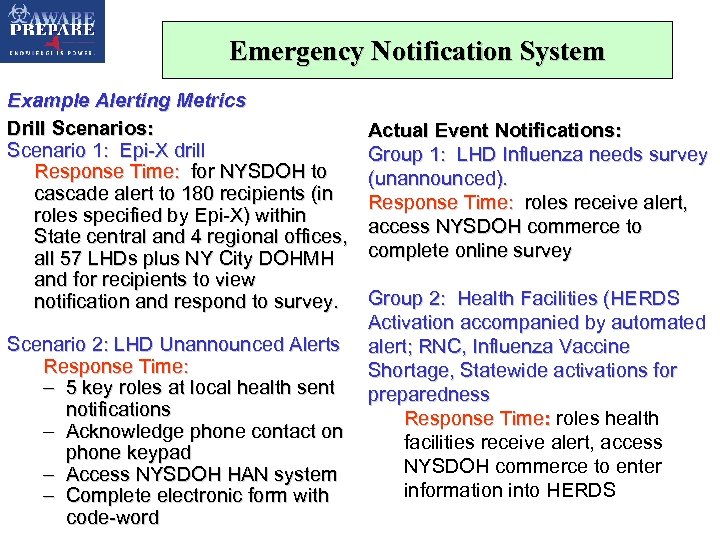 Emergency Notification System Example Alerting Metrics Drill Scenarios: Scenario 1: Epi-X drill Response Time: for NYSDOH to cascade alert to 180 recipients (in roles specified by Epi-X) within State central and 4 regional offices, all 57 LHDs plus NY City DOHMH and for recipients to view notification and respond to survey. Scenario 2: LHD Unannounced Alerts Response Time: – 5 key roles at local health sent notifications – Acknowledge phone contact on phone keypad – Access NYSDOH HAN system – Complete electronic form with code-word Actual Event Notifications: Group 1: LHD Influenza needs survey (unannounced). Response Time: roles receive alert, access NYSDOH commerce to complete online survey Group 2: Health Facilities (HERDS Activation accompanied by automated alert; RNC, Influenza Vaccine Shortage, Statewide activations for preparedness Response Time: roles health facilities receive alert, access NYSDOH commerce to enter information into HERDS
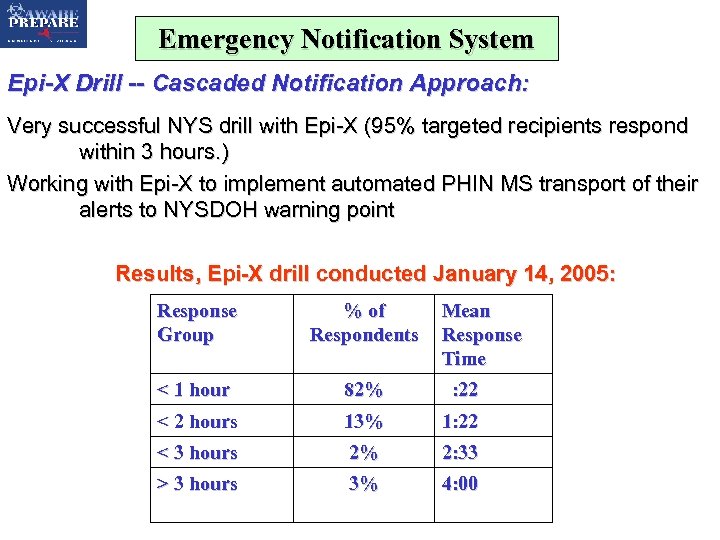 Emergency Notification System Epi-X Drill -- Cascaded Notification Approach: Very successful NYS drill with Epi-X (95% targeted recipients respond within 3 hours. ) Working with Epi-X to implement automated PHIN MS transport of their alerts to NYSDOH warning point Results, Epi-X drill conducted January 14, 2005: Response Group % of Respondents Mean Response Time < 1 hour 82% : 22 < 2 hours 13% 1: 22 < 3 hours 2% 2: 33 > 3 hours 3% 4: 00
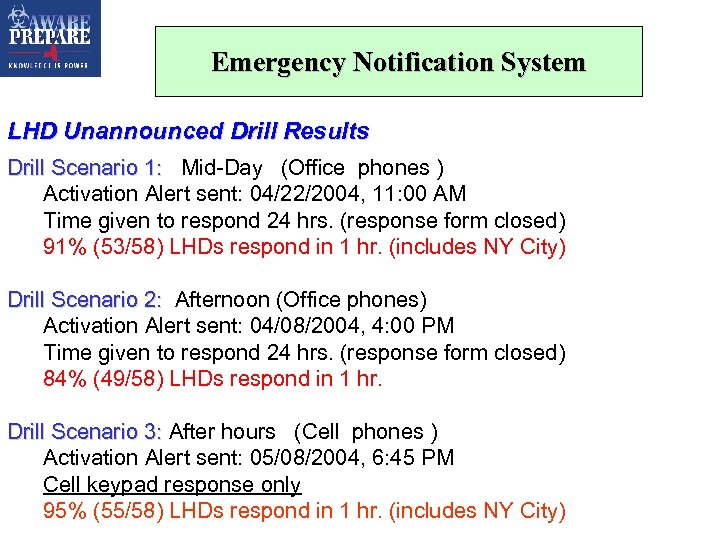 Emergency Notification System LHD Unannounced Drill Results Drill Scenario 1: Mid-Day (Office phones ) Activation Alert sent: 04/22/2004, 11: 00 AM Time given to respond 24 hrs. (response form closed) 91% (53/58) LHDs respond in 1 hr. (includes NY City) Drill Scenario 2: Afternoon (Office phones) Activation Alert sent: 04/08/2004, 4: 00 PM Time given to respond 24 hrs. (response form closed) 84% (49/58) LHDs respond in 1 hr. Drill Scenario 3: After hours (Cell phones ) Activation Alert sent: 05/08/2004, 6: 45 PM Cell keypad response only 95% (55/58) LHDs respond in 1 hr. (includes NY City)
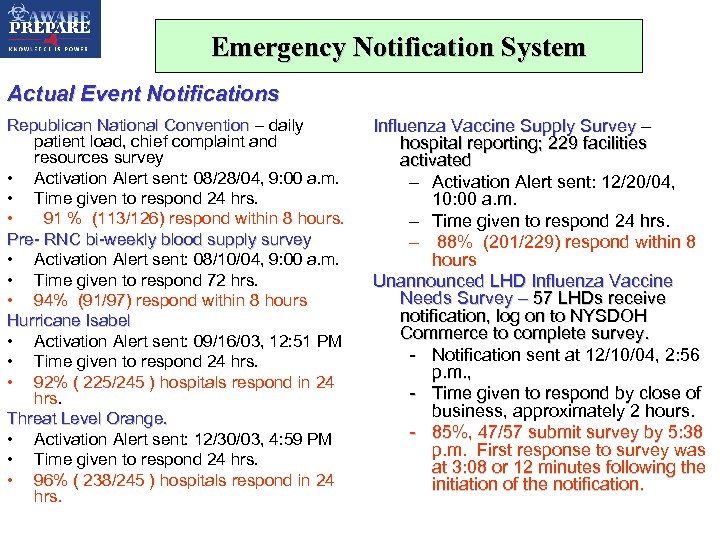 Emergency Notification System Actual Event Notifications Republican National Convention – daily patient load, chief complaint and resources survey • Activation Alert sent: 08/28/04, 9: 00 a. m. • Time given to respond 24 hrs. • 91 % (113/126) respond within 8 hours. Pre- RNC bi-weekly blood supply survey • Activation Alert sent: 08/10/04, 9: 00 a. m. • Time given to respond 72 hrs. • 94% (91/97) respond within 8 hours Hurricane Isabel • Activation Alert sent: 09/16/03, 12: 51 PM • Time given to respond 24 hrs. • 92% ( 225/245 ) hospitals respond in 24 hrs. Threat Level Orange. • Activation Alert sent: 12/30/03, 4: 59 PM • Time given to respond 24 hrs. • 96% ( 238/245 ) hospitals respond in 24 hrs. Influenza Vaccine Supply Survey – hospital reporting; 229 facilities activated – Activation Alert sent: 12/20/04, 10: 00 a. m. – Time given to respond 24 hrs. – 88% (201/229) respond within 8 hours Unannounced LHD Influenza Vaccine Needs Survey – 57 LHDs receive notification, log on to NYSDOH Commerce to complete survey. - Notification sent at 12/10/04, 2: 56 p. m. , - Time given to respond by close of business, approximately 2 hours. - 85%, 47/57 submit survey by 5: 38 p. m. First response to survey was at 3: 08 or 12 minutes following the initiation of the notification.
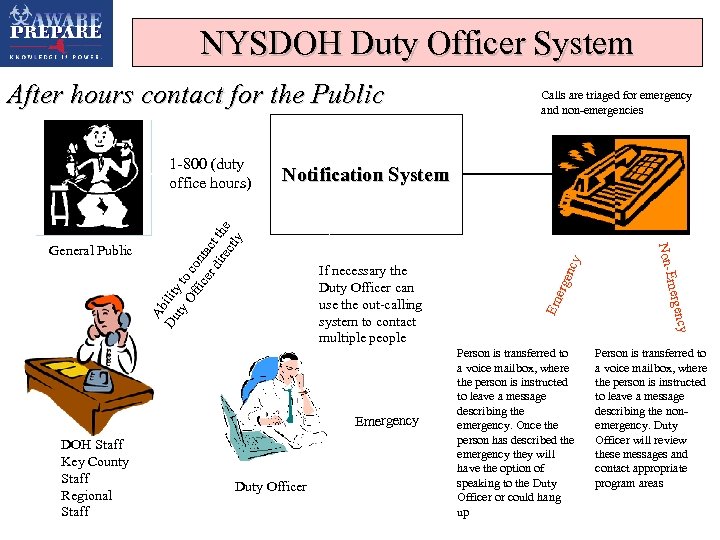 NYSDOH Duty Officer System After hours contact for the Public DOH Staff Key County Staff Regional Staff Duty Officer y erg enc Em ncy Emergency Person is transferred to a voice mailbox, where the person is instructed to leave a message describing the emergency. Once the person has described the emergency they will have the option of speaking to the Duty Officer or could hang up merge If necessary the Duty Officer can use the out-calling system to contact multiple people Non-E General Public Notification System Ab Du ility ty Of to co fic nt er ac dir t th ec e tly 1 -800 (duty office hours) Calls are triaged for emergency and non-emergencies Person is transferred to a voice mailbox, where the person is instructed to leave a message describing the nonemergency. Duty Officer will review these messages and contact appropriate program areas
 NYSDOH Duty Officer System Advantages for Duty Officer System • Ability to triage calls – reduces number of non-emergency calls sent to the duty officer. Pre-recorded message to public assists the caller in understanding which calls are deemed to be an emergency and need to be triaged to the Duty Officer. • Review/management -- of non-emergency calls by Duty Officer in the voice mailbox at his/her convenience • Secure system – Information will be contained and recorded in a secure environment, eliminating the need for the answering service. • Use of Notification System For local health calls to Duty officer -- system will actually triage calls through Duty Officer call down lists, saving time of manual call down by duty officer. (In Progress)