


 Скачать презентацию Special Requirements for CR QC w In film
1c759ecffa3ec1339b12d3e1843e0663.ppt
- Количество слайдов: 30
 Special Requirements for CR QC w In film screen systems the film is changed for every image w With CR the IP is read up to 10, 000 times w Almost all plates suffer from wear artifacts w If you are suspicious about an artifact take an image using the same plate and no patient w Make sure there is a QC program to detect wear before you detect it clinically Hammerstrom et al J Digital Imaging 2006 19: 226
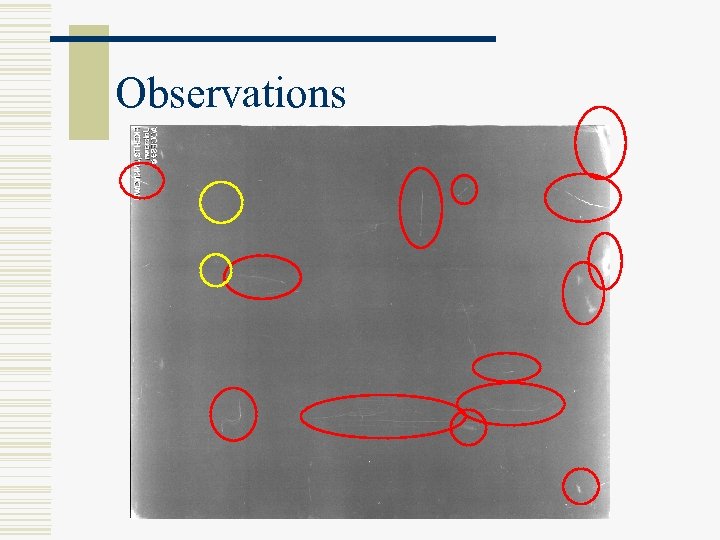 Observations
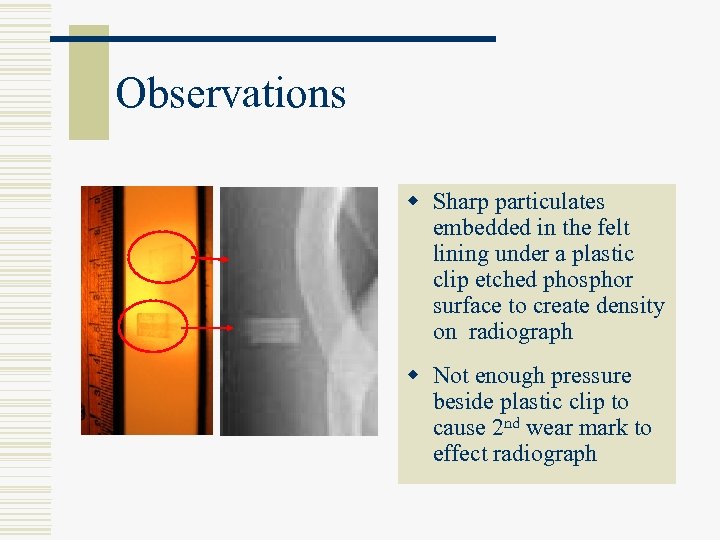 Observations w Sharp particulates embedded in the felt lining under a plastic clip etched phosphor surface to create density on radiograph w Not enough pressure beside plastic clip to cause 2 nd wear mark to effect radiograph
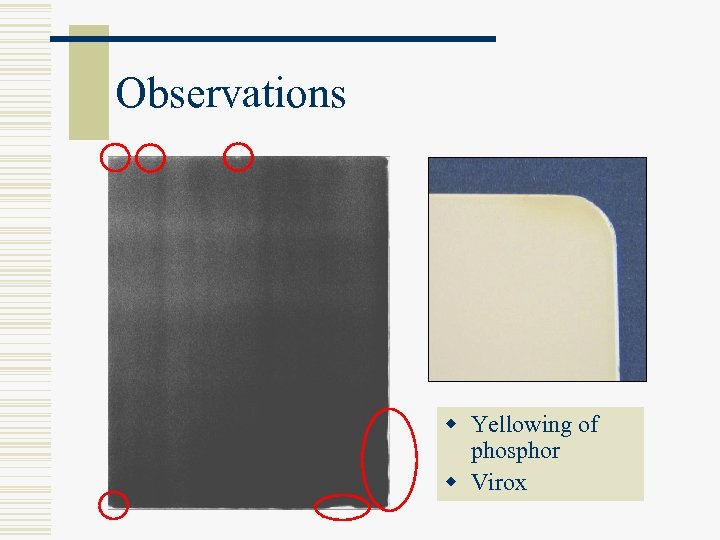 Observations w Yellowing of phosphor w Virox
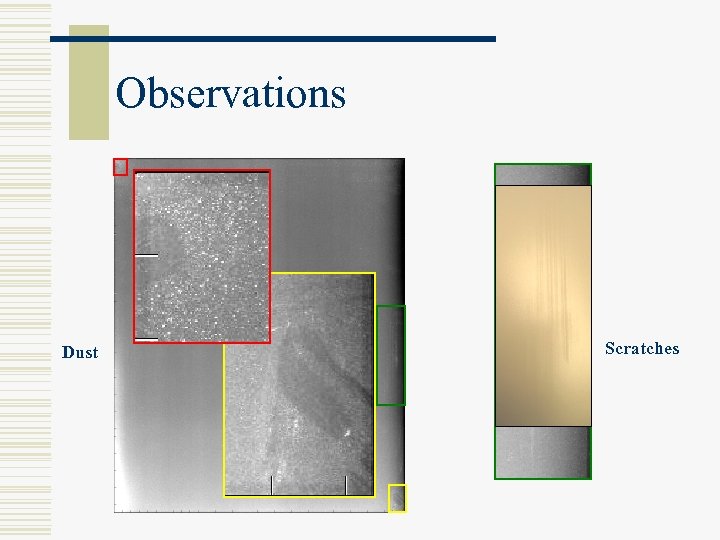 Observations Dust Scratches
 CR QC Recommendations w Quality Control (QC) - perform monthly n Inspection – cassette and IP l l n n n Visual Radiographic CR Cassette cleaning CR IP cleaning Benefits l l l Fewer image artifacts and repeated exposures Increased life cycle of cassettes, IPs, and readers Compliance with vendor warranties
 Retake Analysis w Facilities must maintain records of every retake, including the reason and any corrective actions w An analysis must be done to identify and correct any errors or trends
 Retake Analysis w Optional Retake Analysis software n n Agfa - NX Quality Assurance (2008 vers. ) Fuji - Retake Analysis Kodak - Administrative Analysis and Reporting Software records all exposures and rejected images and produce charts / graphs
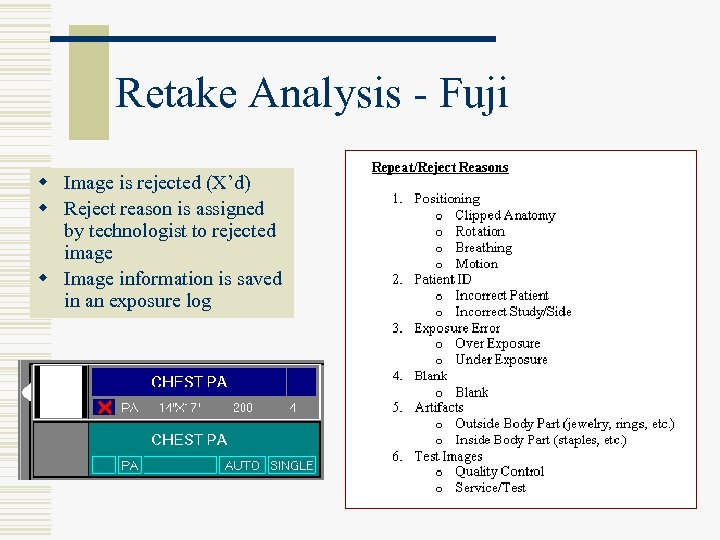 Retake Analysis - Fuji w Image is rejected (X’d) w Reject reason is assigned by technologist to rejected image w Image information is saved in an exposure log
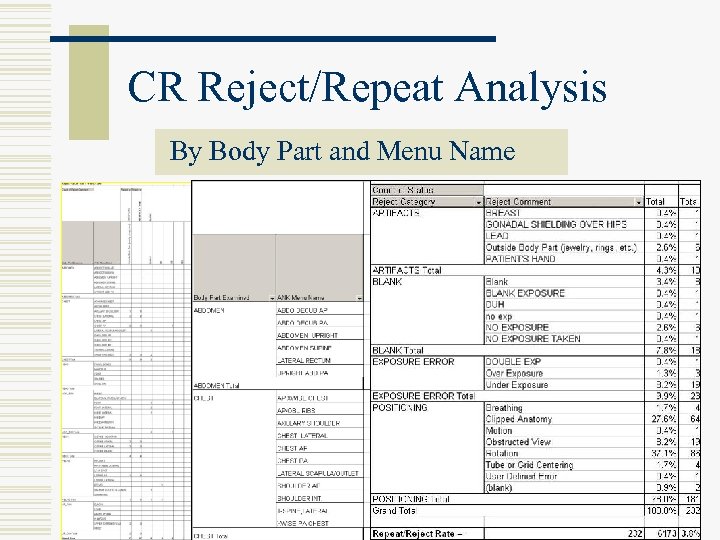 CR Reject/Repeat Analysis By Body Part and Menu Name
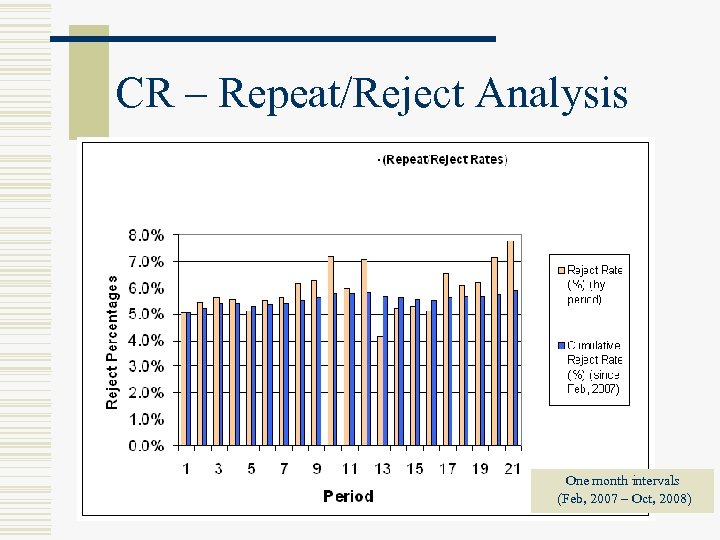 CR – Repeat/Reject Analysis One month intervals (Feb, 2007 – Oct, 2008)
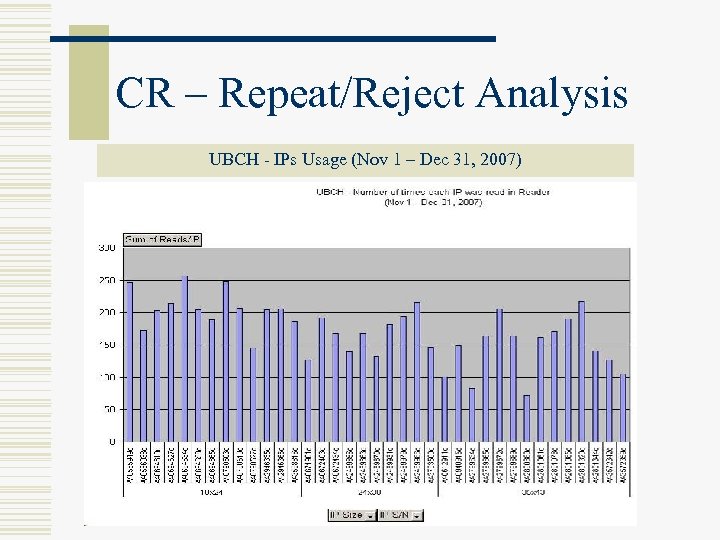 CR – Repeat/Reject Analysis UBCH - IPs Usage (Nov 1 – Dec 31, 2007)
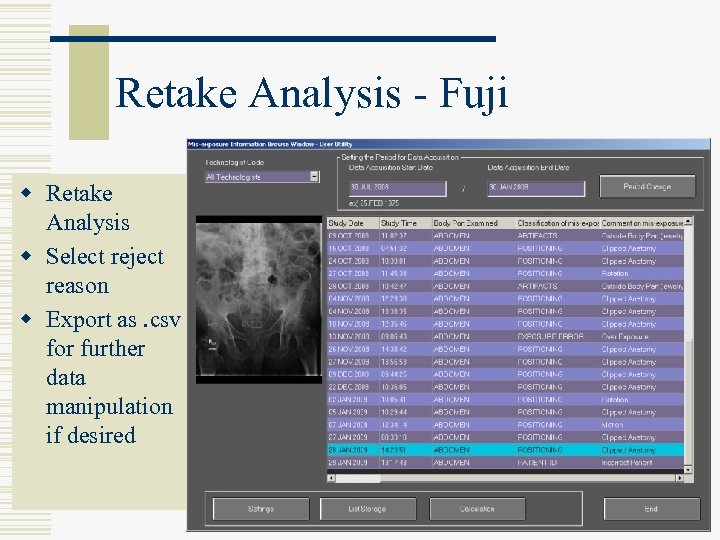 Retake Analysis - Fuji w Retake Analysis w Select reject reason w Export as. csv for further data manipulation if desired
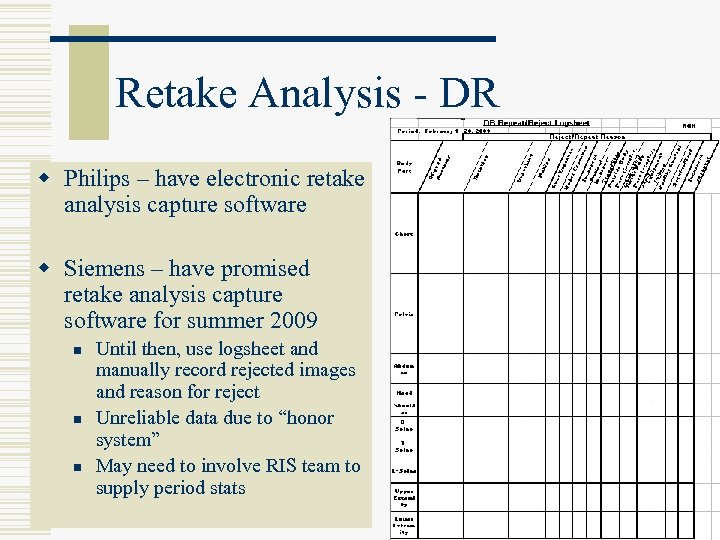 Retake Analysis - DR w Philips – have electronic retake analysis capture software w Siemens – have promised retake analysis capture software for summer 2009 n n n Until then, use logsheet and manually record rejected images and reason for reject Unreliable data due to “honor system” May need to involve RIS team to supply period stats
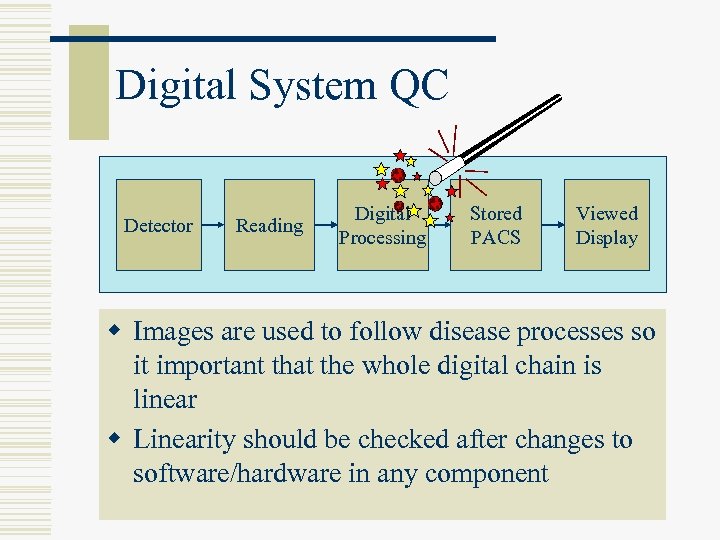 Digital System QC Detector Reading Digital Processing Stored PACS Viewed Display w Images are used to follow disease processes so it important that the whole digital chain is linear w Linearity should be checked after changes to software/hardware in any component
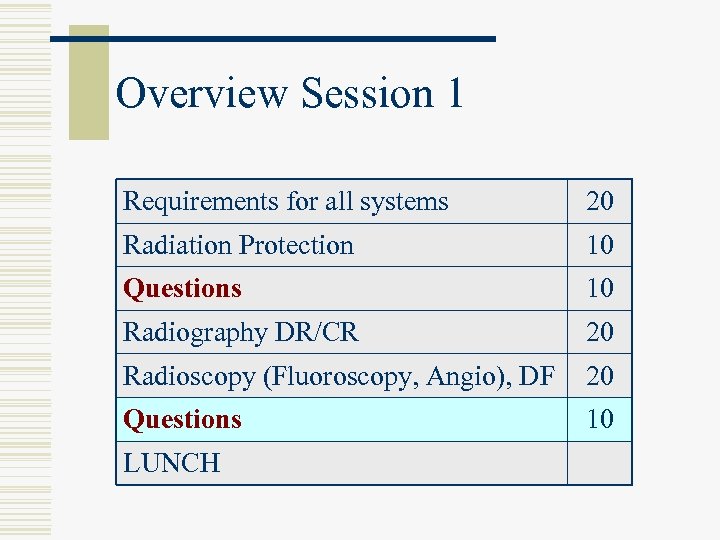
 Overview Session 1 Requirements for all systems 20 Radiation Protection 10 Questions 10 Radiography DR/CR 20 Radioscopy (Fluoroscopy, Angio), DF 20 Questions LUNCH 10
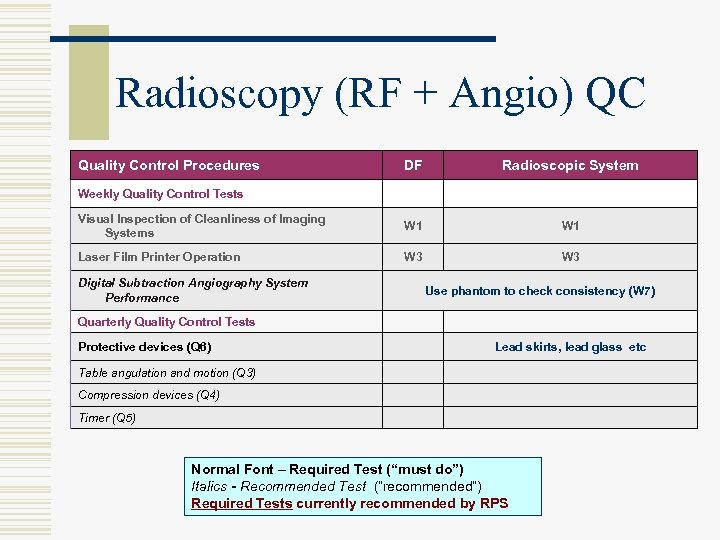 Radioscopy (RF + Angio) QC Quality Control Procedures DF Radioscopic System Visual Inspection of Cleanliness of Imaging Systems W 1 Laser Film Printer Operation W 3 Weekly Quality Control Tests Digital Subtraction Angiography System Performance Use phantom to check consistency (W 7) Quarterly Quality Control Tests Protective devices (Q 6) Lead skirts, lead glass etc Table angulation and motion (Q 3) Compression devices (Q 4) Timer (Q 5) Normal Font – Required Test (“must do”) Italics - Recommended Test (“recommended”) Required Tests currently recommended by RPS
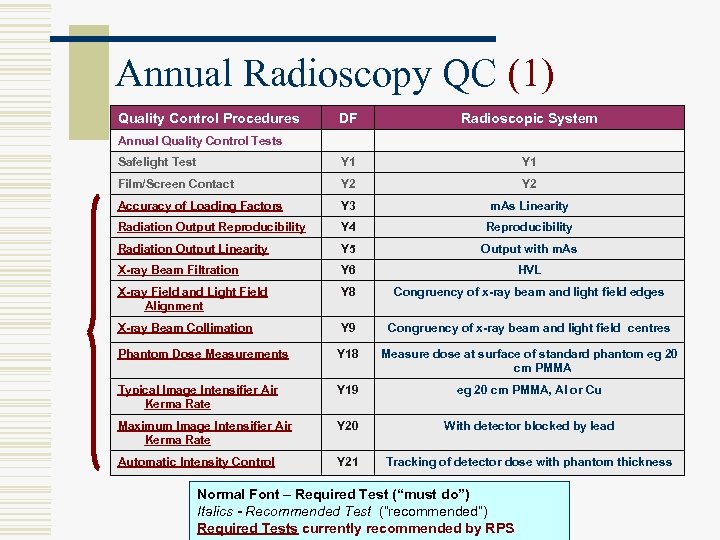 Annual Radioscopy QC (1) Quality Control Procedures DF Radioscopic System Safelight Test Y 1 Film/Screen Contact Y 2 Accuracy of Loading Factors Y 3 m. As Linearity Radiation Output Reproducibility Y 4 Reproducibility Radiation Output Linearity Y 5 Output with m. As X-ray Beam Filtration Y 6 HVL X-ray Field and Light Field Alignment Y 8 Congruency of x-ray beam and light field edges X-ray Beam Collimation Y 9 Congruency of x-ray beam and light field centres Phantom Dose Measurements Y 18 Measure dose at surface of standard phantom eg 20 cm PMMA Typical Image Intensifier Air Kerma Rate Y 19 eg 20 cm PMMA, Al or Cu Maximum Image Intensifier Air Kerma Rate Y 20 With detector blocked by lead Automatic Intensity Control Y 21 Tracking of detector dose with phantom thickness Annual Quality Control Tests Normal Font – Required Test (“must do”) Italics - Recommended Test (“recommended”) Required Tests currently recommended by RPS
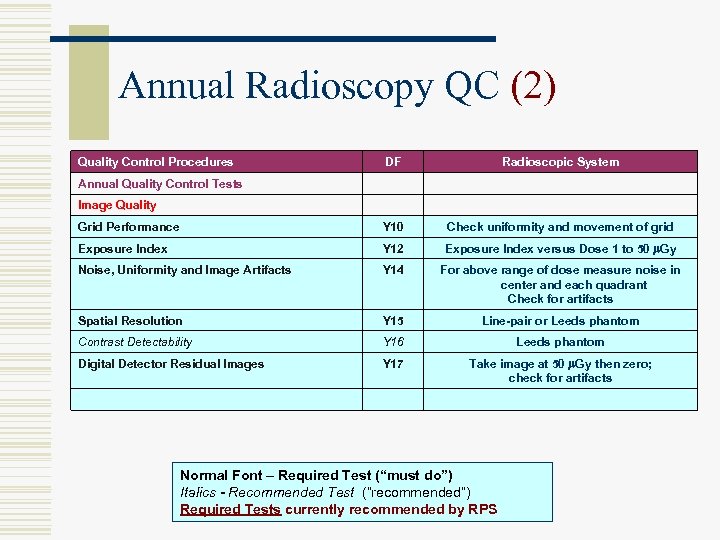 Annual Radioscopy QC (2) Quality Control Procedures DF Radioscopic System Grid Performance Y 10 Check uniformity and movement of grid Exposure Index Y 12 Exposure Index versus Dose 1 to 50 m. Gy Noise, Uniformity and Image Artifacts Y 14 For above range of dose measure noise in center and each quadrant Check for artifacts Spatial Resolution Y 15 Line-pair or Leeds phantom Contrast Detectability Y 16 Leeds phantom Digital Detector Residual Images Y 17 Take image at 50 m. Gy then zero; check for artifacts Annual Quality Control Tests Image Quality Normal Font – Required Test (“must do”) Italics - Recommended Test (“recommended”) Required Tests currently recommended by RPS
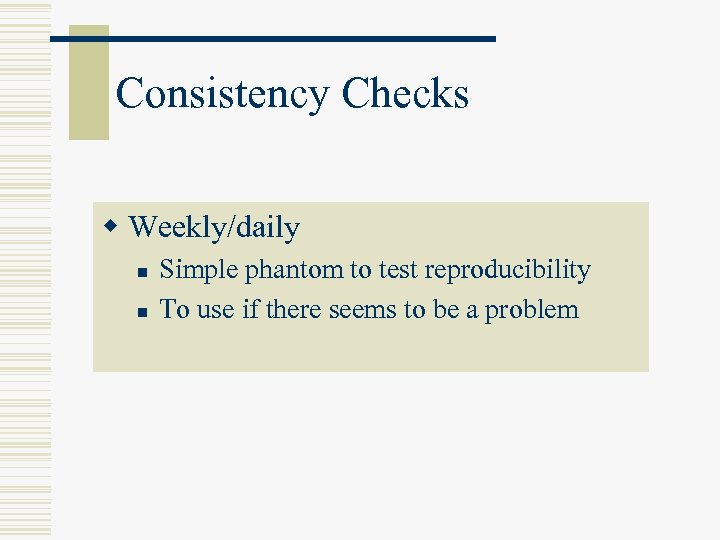 Consistency Checks w Weekly/daily n n Simple phantom to test reproducibility To use if there seems to be a problem
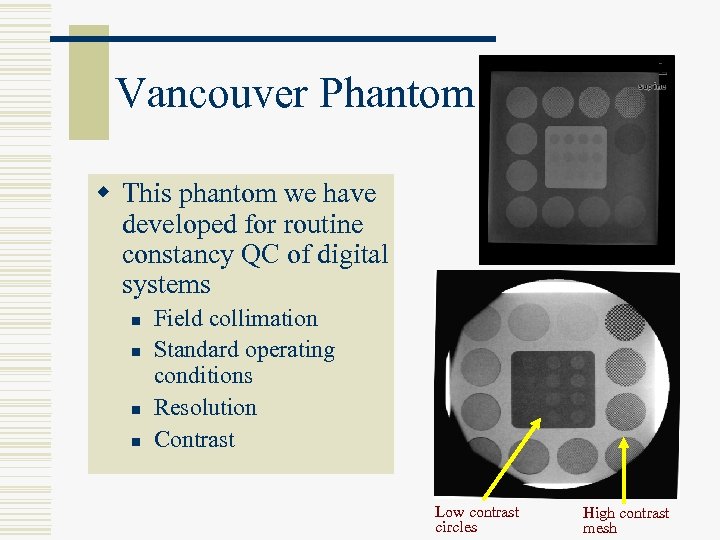 Vancouver Phantom w This phantom we have developed for routine constancy QC of digital systems n n Field collimation Standard operating conditions Resolution Contrast Low contrast circles High contrast mesh
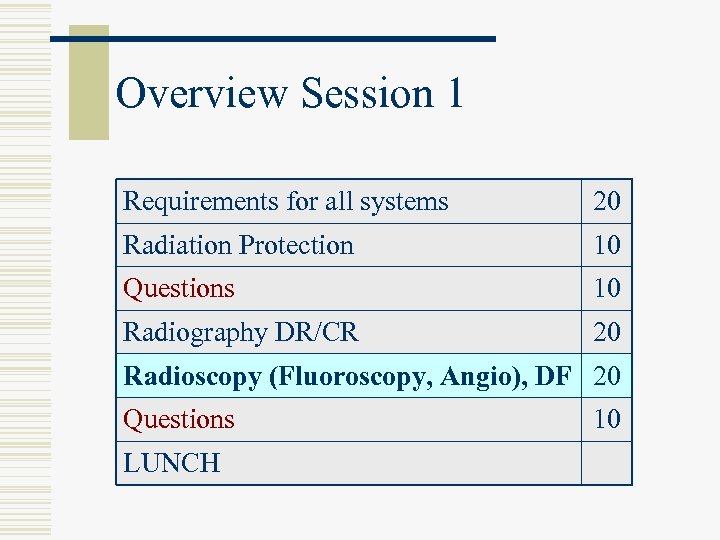
 Overview Session 1 Requirements for all systems 20 Radiation Protection 10 Questions 10 Radiography DR/CR 20 Radioscopy (Fluoroscopy, Angio), DF 20 Questions 10 LUNCH
 Overview Session 2 CT 20 Equipment Purchase/ Acceptance Testing 15 Patient dose 15 Questions 10 Personnel qualifications 20 Education and training 10 Questions 20
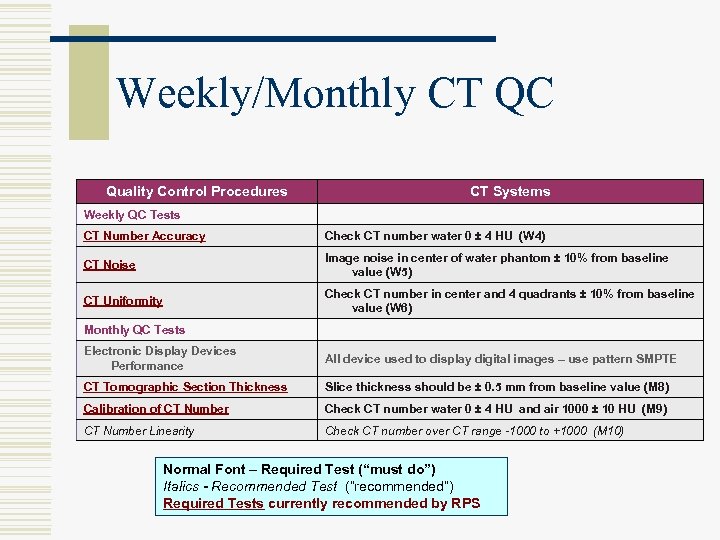 Weekly/Monthly CT QC Quality Control Procedures CT Systems Weekly QC Tests CT Number Accuracy Check CT number water 0 ± 4 HU (W 4) CT Noise Image noise in center of water phantom ± 10% from baseline value (W 5) CT Uniformity Check CT number in center and 4 quadrants ± 10% from baseline value (W 6) Monthly QC Tests Electronic Display Devices Performance All device used to display digital images – use pattern SMPTE CT Tomographic Section Thickness Slice thickness should be ± 0. 5 mm from baseline value (M 8) Calibration of CT Number Check CT number water 0 ± 4 HU and air 1000 ± 10 HU (M 9) CT Number Linearity Check CT number over CT range -1000 to +1000 (M 10) Normal Font – Required Test (“must do”) Italics - Recommended Test (“recommended”) Required Tests currently recommended by RPS
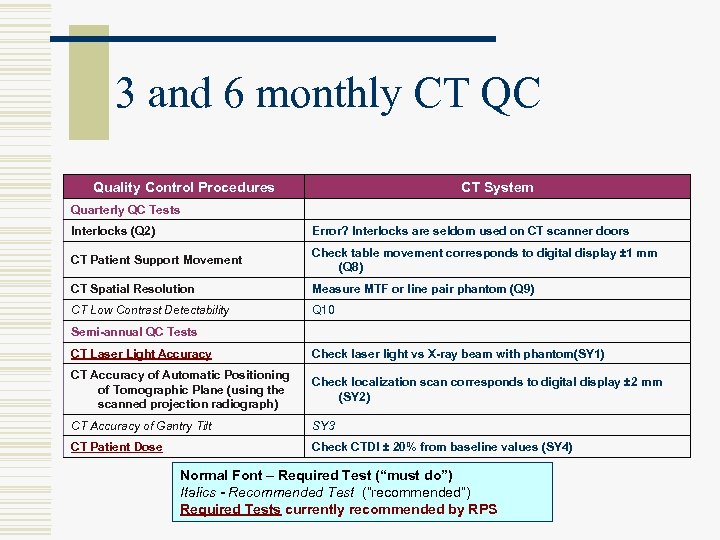 3 and 6 monthly CT QC Quality Control Procedures CT System Quarterly QC Tests Interlocks (Q 2) Error? Interlocks are seldom used on CT scanner doors CT Patient Support Movement Check table movement corresponds to digital display ± 1 mm (Q 8) CT Spatial Resolution Measure MTF or line pair phantom (Q 9) CT Low Contrast Detectability Q 10 Semi-annual QC Tests CT Laser Light Accuracy Check laser light vs X-ray beam with phantom(SY 1) CT Accuracy of Automatic Positioning of Tomographic Plane (using the scanned projection radiograph) Check localization scan corresponds to digital display ± 2 mm (SY 2) CT Accuracy of Gantry Tilt SY 3 CT Patient Dose Check CTDI ± 20% from baseline values (SY 4) Normal Font – Required Test (“must do”) Italics - Recommended Test (“recommended”) Required Tests currently recommended by RPS
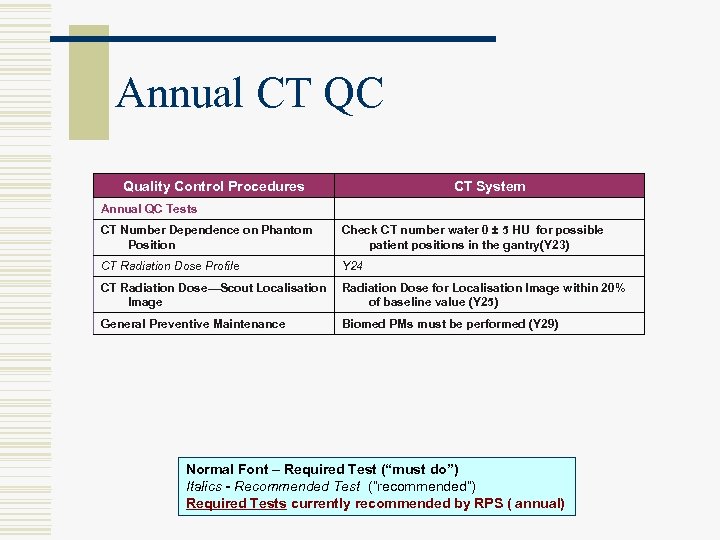 Annual CT QC Quality Control Procedures CT System Annual QC Tests CT Number Dependence on Phantom Position Check CT number water 0 ± 5 HU for possible patient positions in the gantry(Y 23) CT Radiation Dose Profile Y 24 CT Radiation Dose—Scout Localisation Image Radiation Dose for Localisation Image within 20% of baseline value (Y 25) General Preventive Maintenance Biomed PMs must be performed (Y 29) Normal Font – Required Test (“must do”) Italics - Recommended Test (“recommended”) Required Tests currently recommended by RPS ( annual)
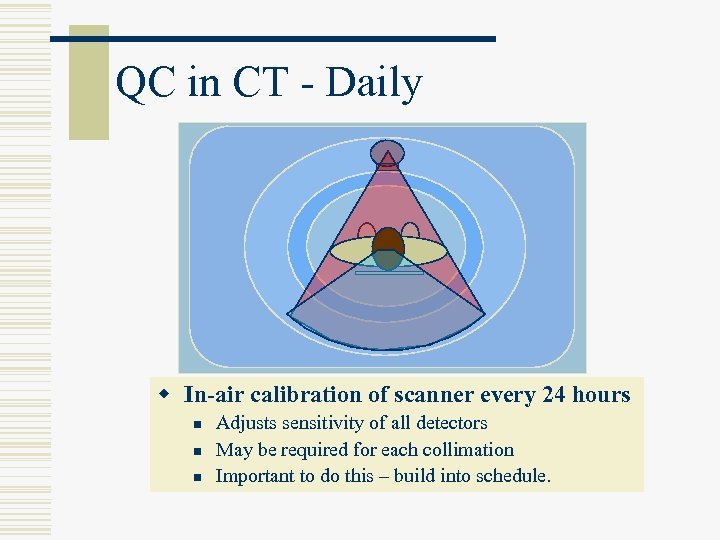 QC in CT - Daily w In-air calibration of scanner every 24 hours n n n Adjusts sensitivity of all detectors May be required for each collimation Important to do this – build into schedule.
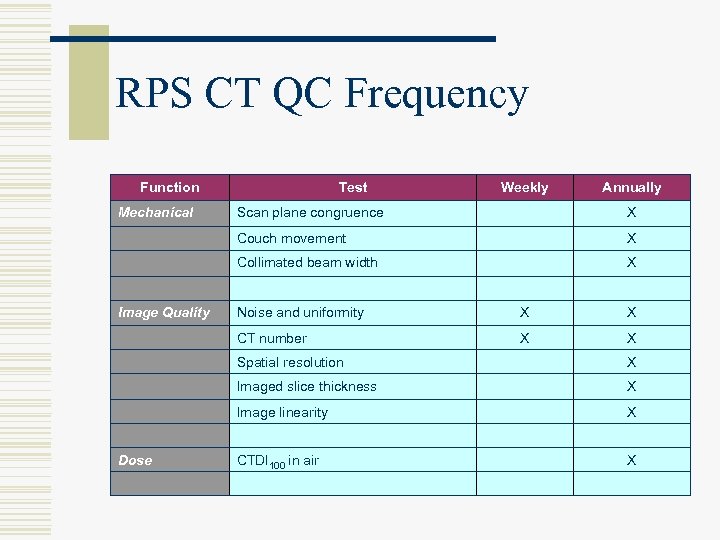 RPS CT QC Frequency Function Mechanical Test Weekly Annually X Couch movement X Collimated beam width Image Quality Scan plane congruence X Noise and uniformity X X CT number X X Spatial resolution Imaged slice thickness X Image linearity Dose X X CTDI 100 in air X
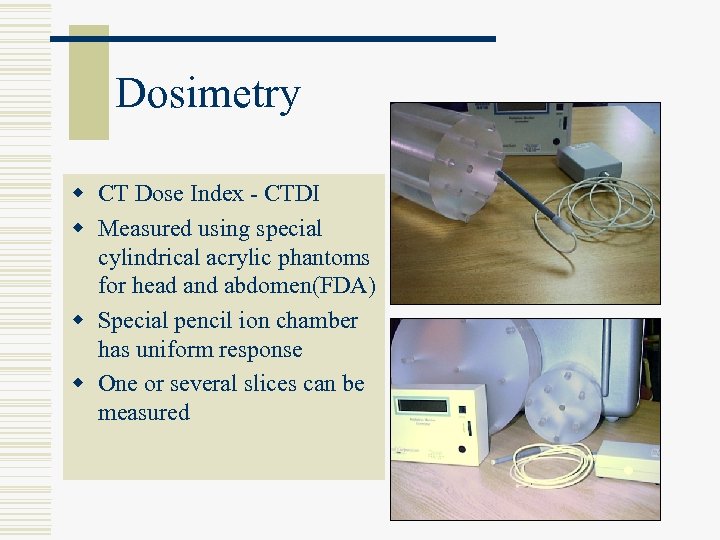 Dosimetry w CT Dose Index - CTDI w Measured using special cylindrical acrylic phantoms for head and abdomen(FDA) w Special pencil ion chamber has uniform response w One or several slices can be measured
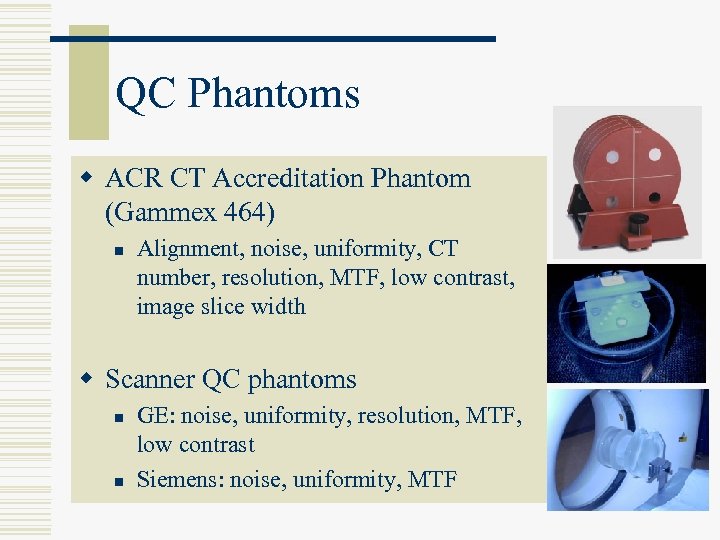 QC Phantoms w ACR CT Accreditation Phantom (Gammex 464) n Alignment, noise, uniformity, CT number, resolution, MTF, low contrast, image slice width w Scanner QC phantoms n n GE: noise, uniformity, resolution, MTF, low contrast Siemens: noise, uniformity, MTF