


 Скачать презентацию Special Electives of Comp Linguistics Processing Anaphoric Expressions
2357c74d433a27e9b4c179f33b0ce5a0.ppt
- Количество слайдов: 15
 Special Electives of Comp. Linguistics: Processing Anaphoric Expressions Eleni Miltsakaki AUTH Fall 2005 -Lecture 2 1
 Main points from Lecture 1 • Anaphoric pronouns – Referring and non-referring pronouns • Referring: ref to a contextually salient individual • Non-referring: treated as bound variables in sentence semantics • Main theoretical approaches – Structural and semantic/pragmatic • Fields of study – Linguistics, computational linguistics, psycholinguistics 2
 Outline of today’s lecture • Linguistic semantics: the difference between pronouns interpreted as bound variables vs referring expressions • Centering theory 3
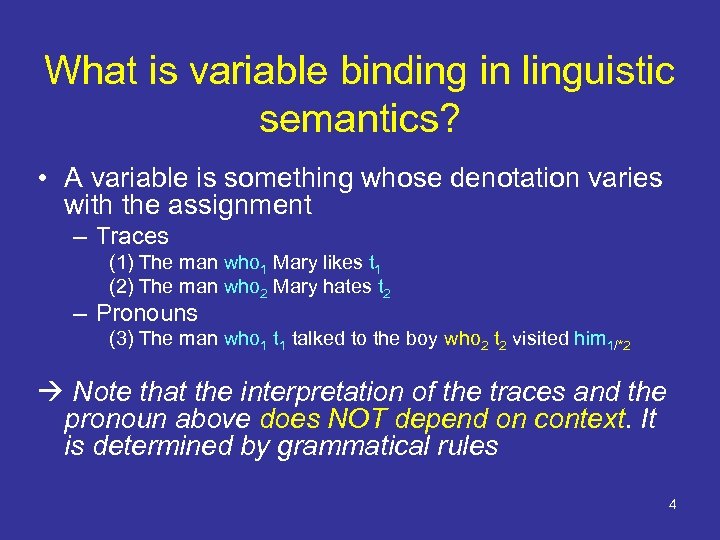 What is variable binding in linguistic semantics? • A variable is something whose denotation varies with the assignment – Traces (1) The man who 1 Mary likes t 1 (2) The man who 2 Mary hates t 2 – Pronouns (3) The man who 1 talked to the boy who 2 t 2 visited him 1/*2 Note that the interpretation of the traces and the pronoun above does NOT depend on context. It is determined by grammatical rules 4
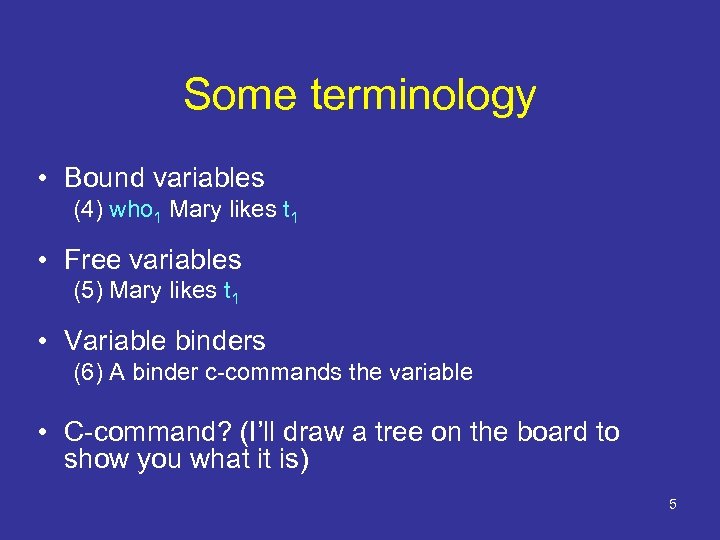 Some terminology • Bound variables (4) who 1 Mary likes t 1 • Free variables (5) Mary likes t 1 • Variable binders (6) A binder c-commands the variable • C-command? (I’ll draw a tree on the board to show you what it is) 5
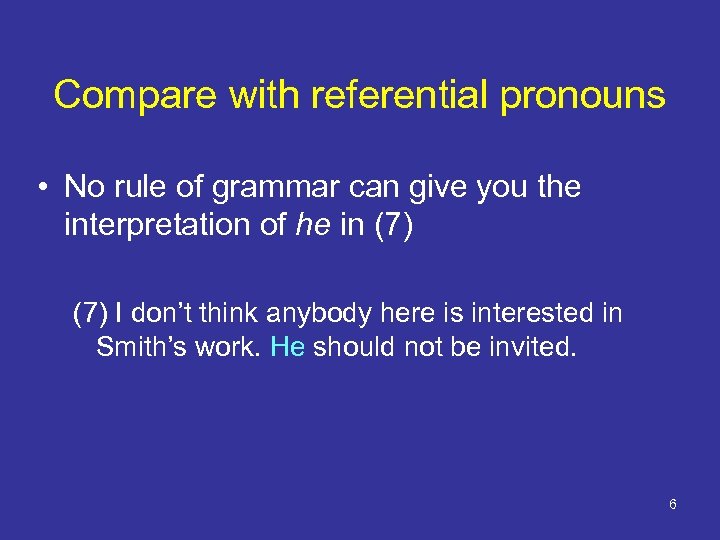 Compare with referential pronouns • No rule of grammar can give you the interpretation of he in (7) I don’t think anybody here is interested in Smith’s work. He should not be invited. 6
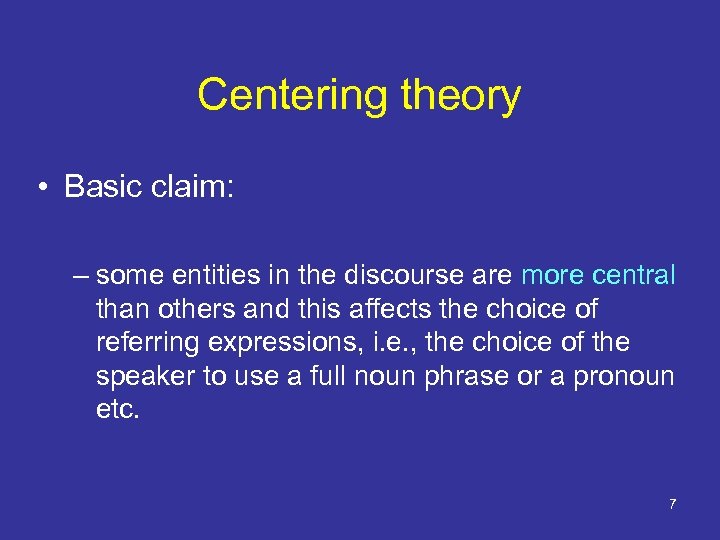 Centering theory • Basic claim: – some entities in the discourse are more central than others and this affects the choice of referring expressions, i. e. , the choice of the speaker to use a full noun phrase or a pronoun etc. 7
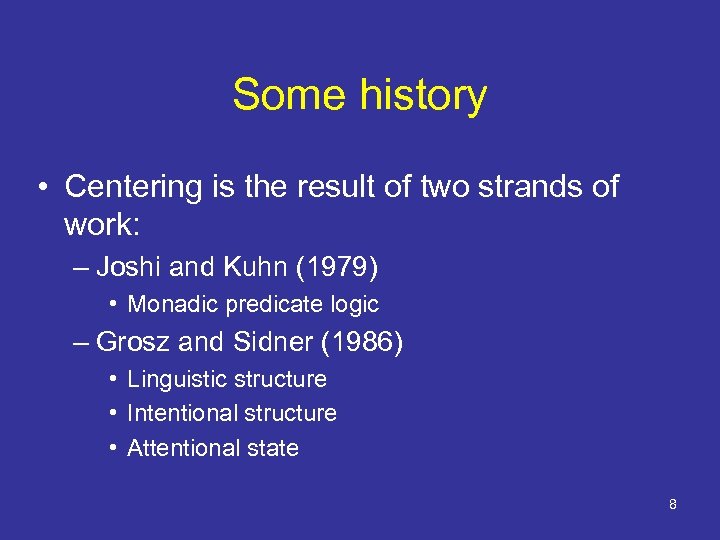 Some history • Centering is the result of two strands of work: – Joshi and Kuhn (1979) • Monadic predicate logic – Grosz and Sidner (1986) • Linguistic structure • Intentional structure • Attentional state 8
 Monadic predicate logic • Makes n-ary predicates look monadic • Singles out an individual (center) among all those which are arguments to the main predicate • It can be proved that inferencing is facilitated in monadic predicate logic Joshi and Kuhn (1979) 9
 Discourse structure • Linguistic structure – Utterances (what is actually said) are the basic elements of linguistic structure • Intentional structure – Intentions (discourse purposes) and some basic relations between them (dominance and satisfaction-precedence) • Attentional state – Contains information about the objects, properties, relations, intentions that are most salient at any given point 10
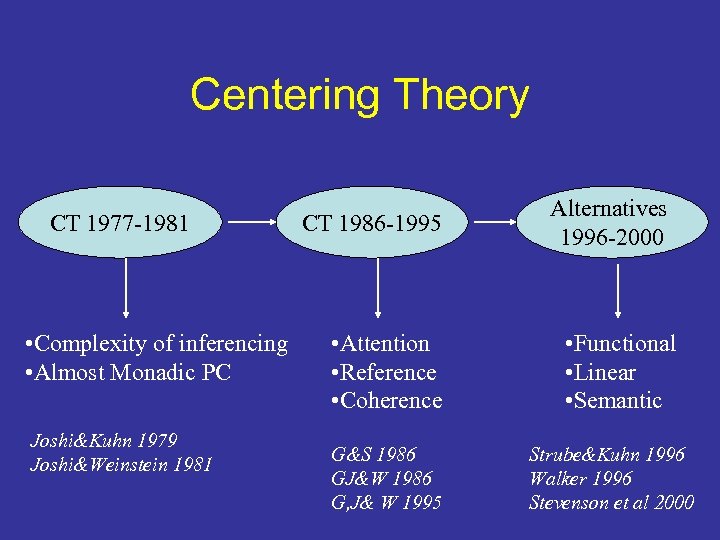 Centering Theory CT 1977 -1981 • Complexity of inferencing • Almost Monadic PC Joshi&Kuhn 1979 Joshi&Weinstein 1981 CT 1986 -1995 • Attention • Reference • Coherence G&S 1986 GJ&W 1986 G, J& W 1995 Alternatives 1996 -2000 • Functional • Linear • Semantic Strube&Kuhn 1996 Walker 1996 Stevenson et al 2000
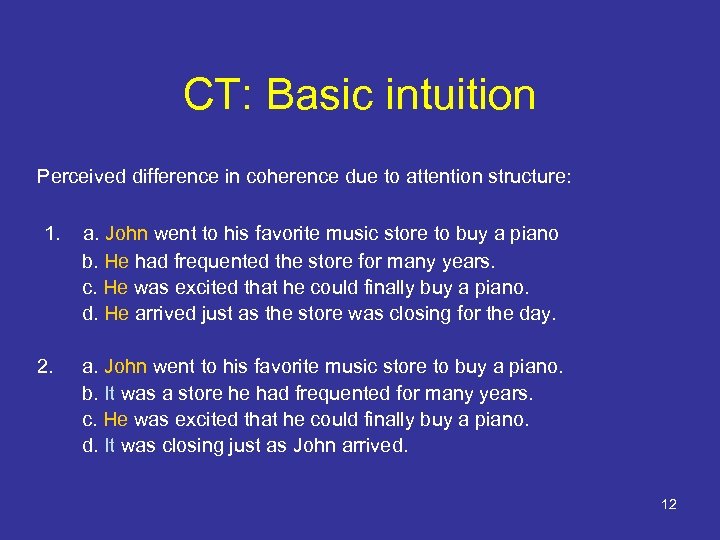 CT: Basic intuition Perceived difference in coherence due to attention structure: 1. 2. a. John went to his favorite music store to buy a piano b. He had frequented the store for many years. c. He was excited that he could finally buy a piano. d. He arrived just as the store was closing for the day. a. John went to his favorite music store to buy a piano. b. It was a store he had frequented for many years. c. He was excited that he could finally buy a piano. d. It was closing just as John arrived. 12
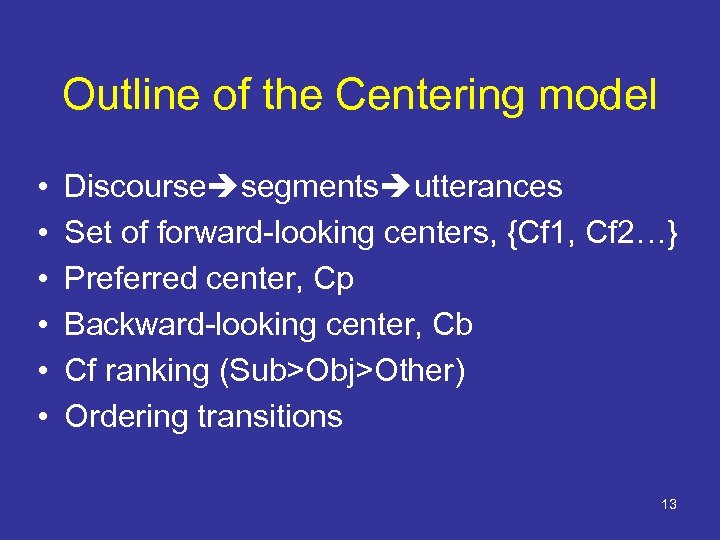 Outline of the Centering model • • • Discourse segments utterances Set of forward-looking centers, {Cf 1, Cf 2…} Preferred center, Cp Backward-looking center, Cb Cf ranking (Sub>Obj>Other) Ordering transitions 13
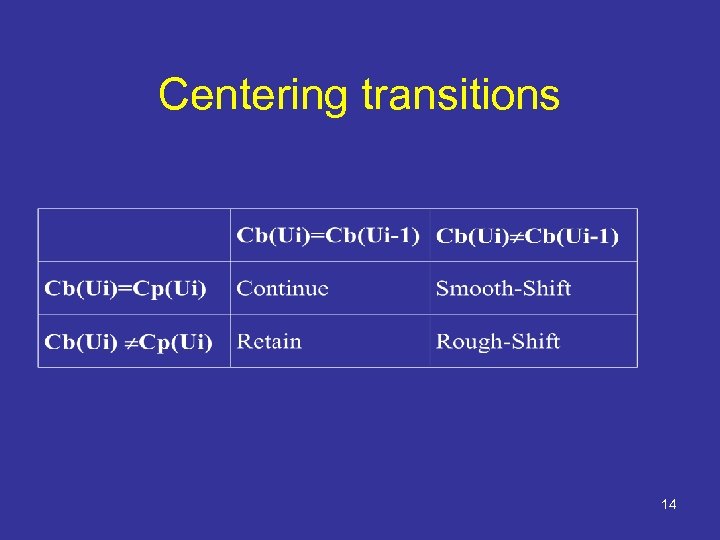 Centering transitions 14
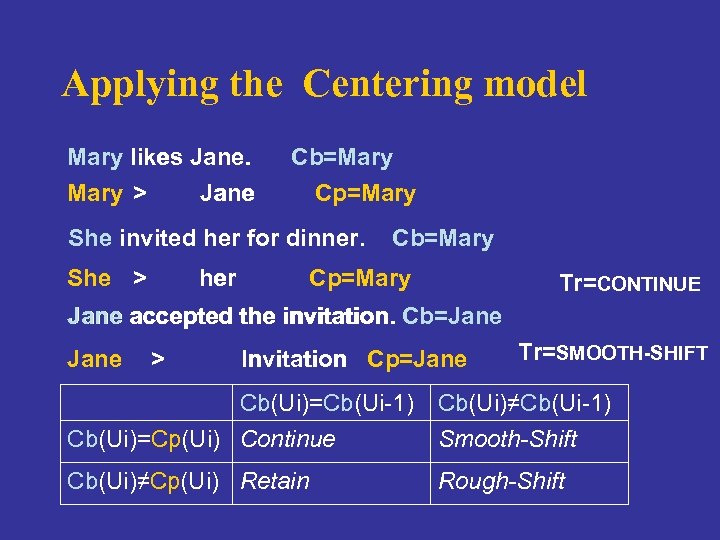 Applying the Centering model Mary likes Jane. Mary > Jane Cb=Mary Cp=Mary She invited her for dinner. She > her Cb=Mary Cp=Mary Tr=CONTINUE Jane accepted the invitation. Cb=Jane > Invitation Cp=Jane invitation Tr=SMOOTH-SHIFT Cb(Ui)=Cb(Ui-1) Cb(Ui)=Cp(Ui) Continue Cb(Ui)≠Cb(Ui-1) Smooth-Shift Cb(Ui)≠Cp(Ui) Retain Rough-Shift