 Скачать презентацию Special Education Leadership Network September 13 2007 Copyright
7ad0218ff0583d5029877193aa20061c.ppt
- Количество слайдов: 52



Special Education Leadership Network September 13, 2007 Copyright© 2007 Education Service Center Region XIII 1
SELN Agenda • Welcome and Celebrations • OSEP Letter RE: LD and Role of School Psychologist • Where Are We on The SPP • Special Education Certification Training • PBM • 2006 -2007 SDAA II Grade Level Comparison Charts • Overview of Facilitated IEP Project • IEPs and Essence Statements • To Do List/Announcements Copyright© 2007 Education Service Center Region XIII 2
OSEP Letter RE: LD and Role of School Psychologist Jim Walsh Copyright© 2007 Education Service Center Region XIII 3
OSEP, School Psychologists and LD Jim Walsh, Anderson, Brown, Schulze & Aldridge, P. C.
What Caused the Concern Comments to federal regulations included the observation that the costs of gathering data on student achievement “are likely to be offset by REDUCED NEED FOR PSYCHOLOGISTS TO ADMINISTER INTELLECTUAL ASSESSMENTS. ”
But There is More Comments also said: “There is no current evidence that [assessments of psychological or cognitive processing] are necessary or sufficient for identifying SLD. Further, in many cases these assessments have not been used to make appropriate intervention decisions…. In many cases…assessments of cognitive processes simply add to the testing burden…. ” 71 Fed. Register 46651.
So…. n The executive director of NASP asked OSEP just what they meant….
And OSEP Said “The regulatory changes in procedures for evaluating children suspected of having learning disabilities are quite significant, and, in our view, provide ENHANCED OPPORTUNITIES for school psychologists to participate in the process….
And… “We do not construe the referenced language as diminishing the vital role that school psychologists can play in the assessment of children suspected of having learning disabilities. ” Letter to Gorin, 48 IDELR 104, (2006).
Proposed New LD Standard: Factor One Child has a disorder in one of the basic psychological processes involved in using or understanding language that results in an imperfect ability to listen, think, speak, read, write, spell, or to do mathematical calculations. This includes conditions such as perceptual disabilities, brain injury, minimal brain dysfunction, dyslexia, and developmental aphasia. 34 CFR 300. 8(c)(10)(i).
Proposed New LD Standard: Factor Two The child’s learning problems cannot be primarily the result of visual, hearing, or motor disabilities, mental retardation, emotional disturbance, or environmental, cultural or economic disadvantage. 34 CFR 300. 8(c)(10)(ii). n
Proposed New LD Standard: Factor Three n Child does NOT ACHIEVE ADEQUATELY for the child’s AGE or meet state-approved GRADE LEVEL STANDARDS in oral expression, listening comprehension, written expression, basic reading skill, reading fluency skills, reading comprehension, mathematics calculation, or mathematics problem solving WHEN PROVIDED APPROPRIATE INSTRUCTION.
Proposed New LD Standard: Factor Four EITHER: Child does not make sufficient progress when provided a process based on the child’s response to scientific, research-based intervention; OR: Child exhibits a pattern of strengths and weaknesses in performance, achievement, or both, relative to age, grade-level standards, or intellectual ability.
LD Factors: Summary n n A disorder regarding language; Not attributable to any of the “rule out” factors (remember that LEP is a “rule out” factor with regard to ALL disabilities); Underachieving compared to age level standards, after receiving good instruction; EITHER not responding to RTI; OR showing a “pattern of strengths and weaknesses. ”
IQ Testing Under the New Model? n n n IQ is not specifically mentioned in the new model, BUT: Student’s underachievement must not be primarily due to mental retardation, and The “pattern of strengths and weaknesses” may be “relative to intellectual ability. ”
Moreover n n Federal regulations make it clear that RTI is just a part of the FIE process and not intended to comprise the whole enchilada. “An RTI process does not replace the need for comprehensive evaluation, and a child’s eligibility…cannot be changed solely on the basis of data from the RTI process. ” 71 Federal Register 46648
Therefore… n n n IQ testing is certainly not prohibited. Use your judgment as to its usefulness. If you believe that IQ testing will render useful information, then it should be included in the FIE.
Where Are We on The SPP Shirley Sanford Copyright© 2007 Education Service Center Region XIII 18
2007 LEA Profiles of SPP Indicators Received in June 2007 by email from ESC Region XIII Email Shirley Sanford for another copy if needed. Copyright© 2007 Education Service Center Region XIII 19
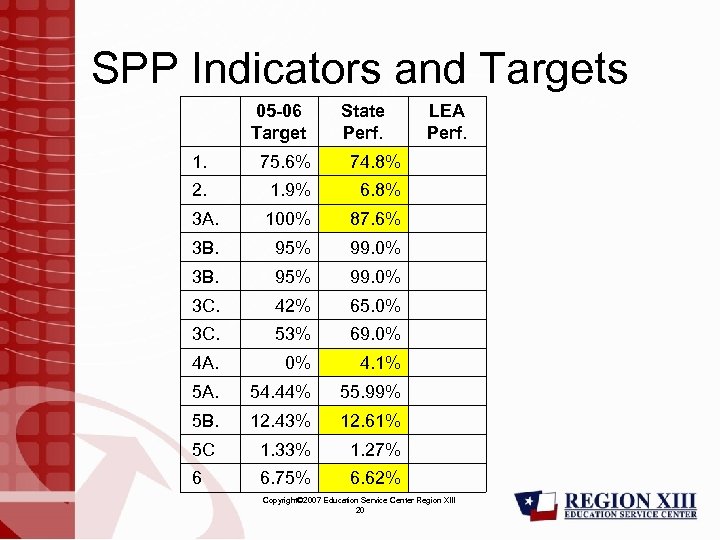
SPP Indicators and Targets 05 -06 Target State Perf. 1. 75. 6% 74. 8% 2. 1. 9% 6. 8% 3 A. 100% 87. 6% 3 B. 95% 99. 0% 3 C. 42% 65. 0% 3 C. 53% 69. 0% 4 A. 0% 4. 1% 5 A. 54. 44% 55. 99% 5 B. 12. 43% 12. 61% 5 C 1. 33% 1. 27% 6 6. 75% LEA Perf. 6. 62% Copyright© 2007 Education Service Center Region XIII 20
SPP Determinations State Determination by OSEP was Needs Assistance Based on 2005 APR sent to OSEP in February 2007. Data in the 2005 APR is the data in the LEA Profiles of SPP Indicators Copyright© 2007 Education Service Center Region XIII 21
LEA Determinations • Every LEA will get a letter within two weeks. • All but 22 LEAs received a Meets the Requirements • 22 LEAs – Will receive a call from TEA – Needs assistance – Uncorrected noncompliance in PBMAS – Should not be a surprise Copyright© 2007 Education Service Center Region XIII 22
What to Expect in 07 -08 • More data in LEA Profile of SPP Indicators • Increase in targets for indicators • More data added to make LEA determinations for 07 -08 – Performance on compliance indicators in SPP – Data is valid, reliable, and timely – Uncorrected non compliance – Audit findings Copyright© 2007 Education Service Center Region XIII 23
2005 -2006 LEA Disproportionate Representation Profile Received in June 2007 by email from ESC Region XIII Email Shirley Sanford for another copy if needed. Copyright© 2007 Education Service Center Region XIII 24
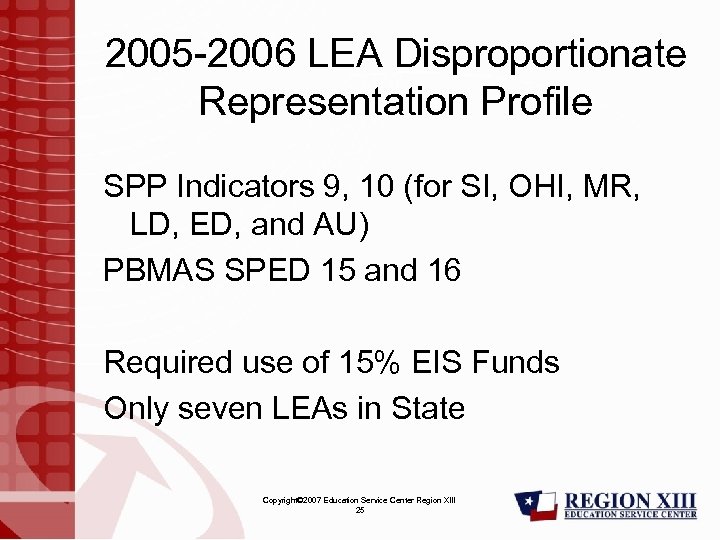
2005 -2006 LEA Disproportionate Representation Profile SPP Indicators 9, 10 (for SI, OHI, MR, LD, ED, and AU) PBMAS SPED 15 and 16 Required use of 15% EIS Funds Only seven LEAs in State Copyright© 2007 Education Service Center Region XIII 25
Special Education Certification Training Martha Blanton Copyright© 2007 Education Service Center Region XIII 26
PBM Update Stephaine Camarilla Copyright© 2007 Education Service Center Region XIII 27
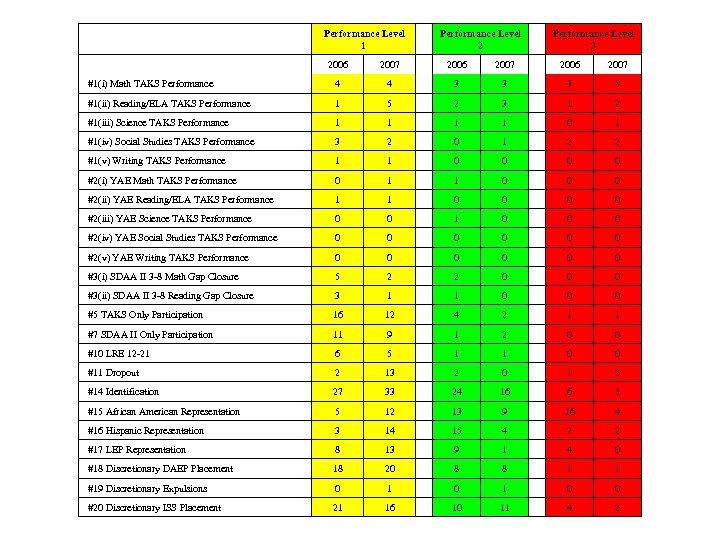
Performance Level 1 Performance Level 2 Performance Level 3 2006 2007 #1(i) Math TAKS Performance 4 4 3 3 3 5 #1(ii) Reading/ELA TAKS Performance 1 5 2 3 1 2 #1(iii) Science TAKS Performance 1 1 0 1 #1(iv) Social Studies TAKS Performance 3 2 0 1 2 2 #1(v) Writing TAKS Performance 1 1 0 0 #2(i) YAE Math TAKS Performance 0 1 1 0 0 0 #2(ii) YAE Reading/ELA TAKS Performance 1 1 0 0 #2(iii) YAE Science TAKS Performance 0 0 1 0 0 0 #2(iv) YAE Social Studies TAKS Performance 0 0 0 #2(v) YAE Writing TAKS Performance 0 0 0 #3(i) SDAA II 3 -8 Math Gap Closure 5 2 2 0 0 0 #3(ii) SDAA II 3 -8 Reading Gap Closure 3 1 1 0 0 0 #5 TAKS Only Participation 16 12 4 2 1 1 #7 SDAA II Only Participation 11 9 1 2 0 0 #10 LRE 12 -21 6 5 1 1 0 0 #11 Dropout 2 13 2 0 1 2 #14 Identification 27 33 24 16 6 5 #15 African American Representation 5 12 13 9 16 4 #16 Hispanic Representation 3 14 15 4 7 2 #17 LEP Representation 8 13 9 1 4 0 #18 Discretionary DAEP Placement 18 20 8 8 1 1 #19 Discretionary Expulsions 0 1 0 0 #20 Discretionary ISS Placement 21 16 10 11 4 2
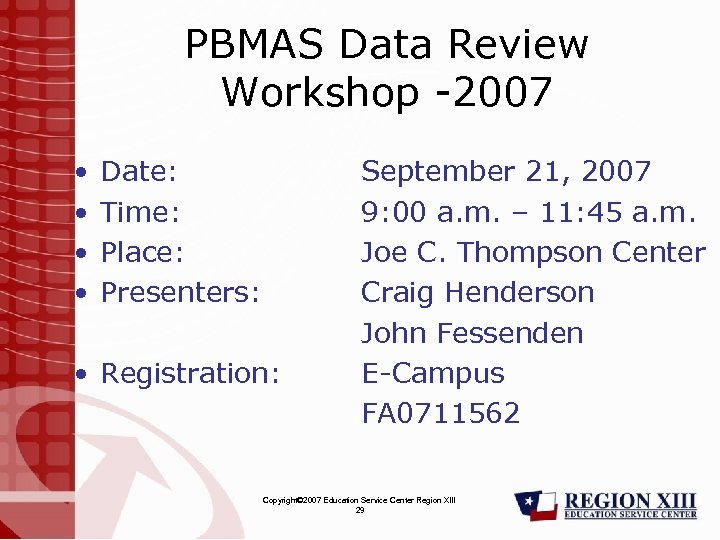
PBMAS Data Review Workshop -2007 • • Date: Time: Place: Presenters: • Registration: September 21, 2007 9: 00 a. m. – 11: 45 a. m. Joe C. Thompson Center Craig Henderson John Fessenden E-Campus FA 0711562 Copyright© 2007 Education Service Center Region XIII 29
2006 -2007 SDAA II Grade Level Comparison Charts Shirley Sanford Copyright© 2007 Education Service Center Region XIII 30
Overview of Facilitated IEP Project Linda Mc. Daniel Copyright© 2007 Education Service Center Region XIII 31
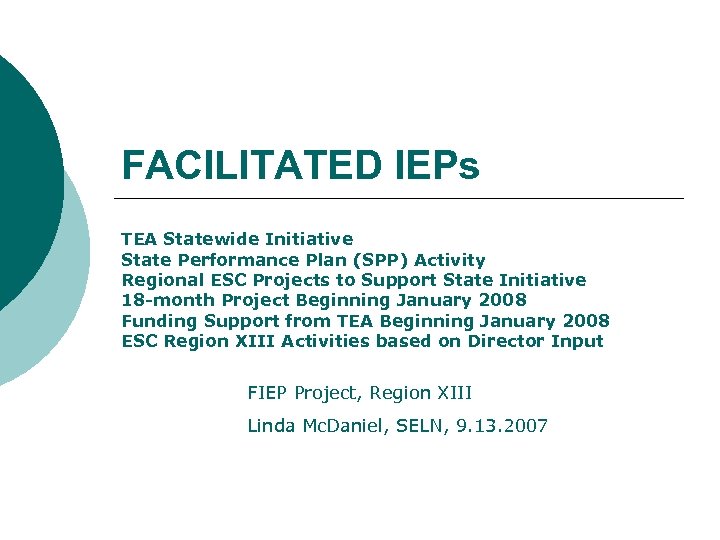
FACILITATED IEPs TEA Statewide Initiative State Performance Plan (SPP) Activity Regional ESC Projects to Support State Initiative 18 -month Project Beginning January 2008 Funding Support from TEA Beginning January 2008 ESC Region XIII Activities based on Director Input FIEP Project, Region XIII Linda Mc. Daniel, SELN, 9. 13. 2007
Presidential Commission View of IEP Facilitation “Early processes such as expert IEP facilitation. . . to increase collaboration and problem solving skills of school staff and parents can help avoid expensive disputes and promote efforts to help students. ” -The President’s Commission on Excellence in Special Education, 2002
IDEA? ¡ ¡ ¡ IDEA 2004 did not include reference to facilitated IEPs Not required by IDEA to have states make facilitated IEPs available to parents & schools Commission recommended IDEA support training for skilled facilitators to run IEP meetings in a way that gets parents and school staffs to win-win solutions for children.
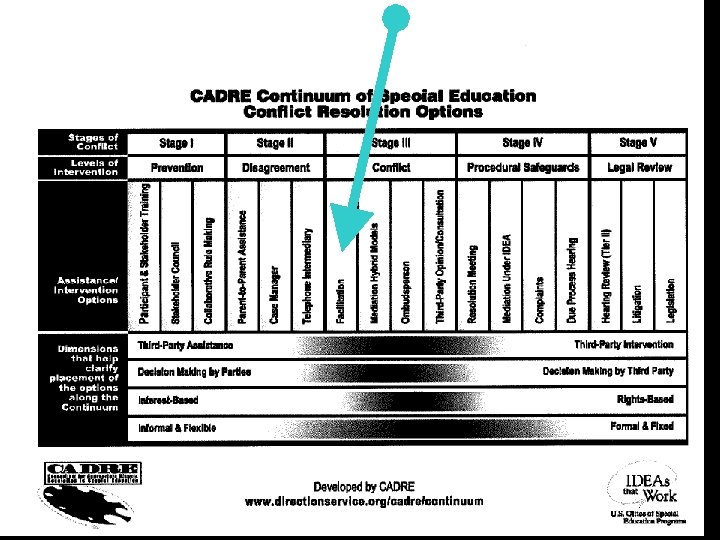
ESC 1 Data
TEA ¡ Vision: A statewide dispute resolution culture based on trust and a shared commitment to appropriate services and improved outcomes for students with disabilities. ¡ Goal: Build bridges between TEA's guidance responsibilities and ESC's technical assistance responsibilities in order to establish a dispute resolution continuum that includes FACILITATION practices.
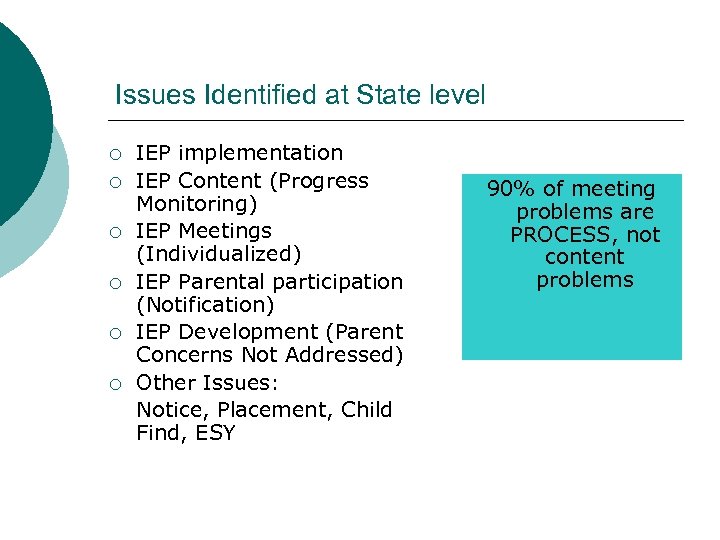
Issues Identified at State level ¡ ¡ ¡ IEP implementation IEP Content (Progress Monitoring) IEP Meetings (Individualized) IEP Parental participation (Notification) IEP Development (Parent Concerns Not Addressed) Other Issues: Notice, Placement, Child Find, ESY 90% of meeting problems are PROCESS, not content problems
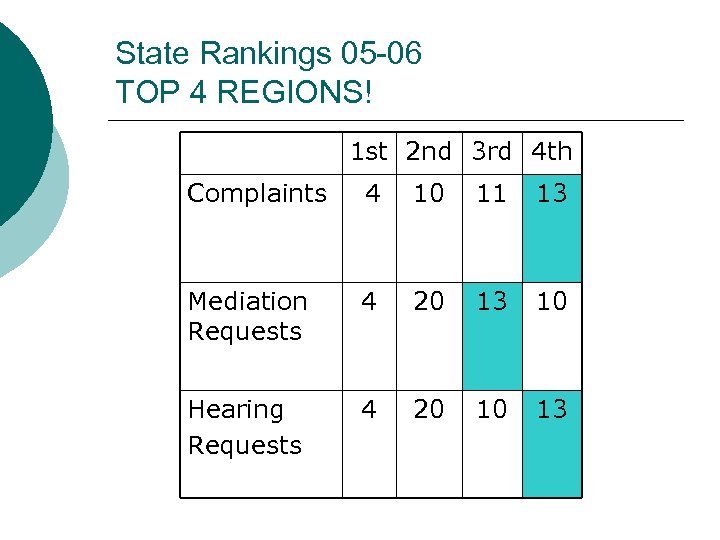
State Rankings 05 -06 TOP 4 REGIONS! 1 st 2 nd 3 rd 4 th Complaints 4 10 11 13 Mediation Requests 4 20 13 10 Hearing Requests 4 20 10 13
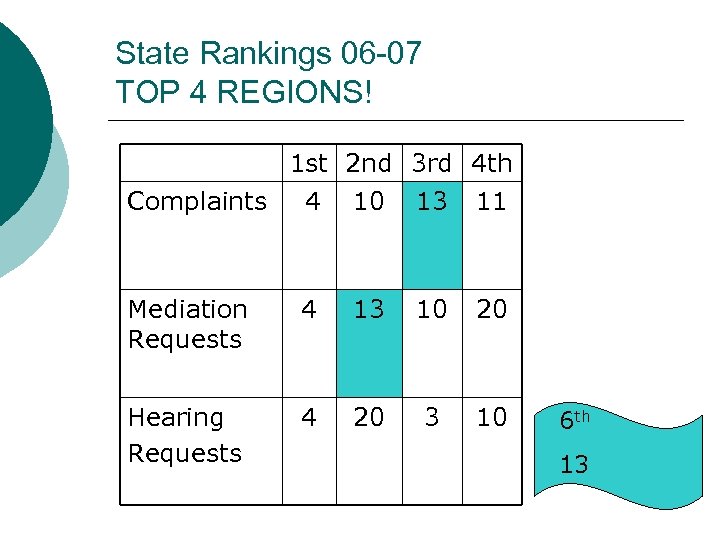
State Rankings 06 -07 TOP 4 REGIONS! 1 st 2 nd 3 rd 4 th Complaints 4 10 13 11 Mediation Requests 4 13 10 20 Hearing Requests 4 20 3 10 6 th 13
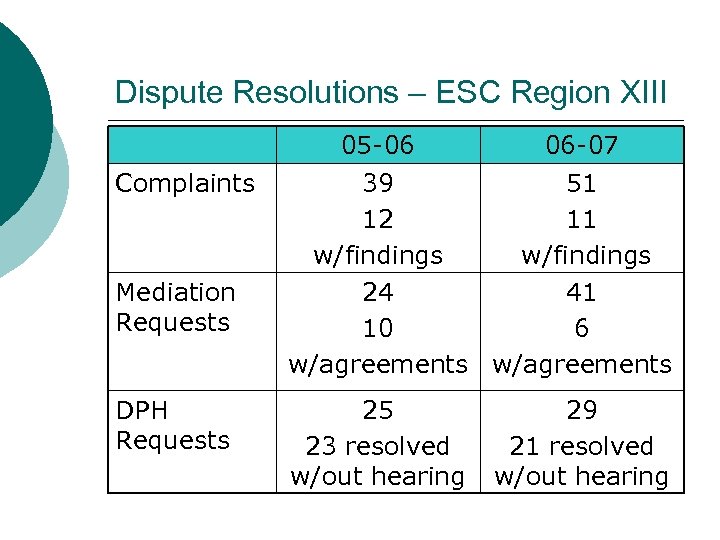
Dispute Resolutions – ESC Region XIII Complaints Mediation Requests DPH Requests 05 -06 06 -07 39 51 12 11 w/findings 24 41 10 6 w/agreements 25 23 resolved w/out hearing 29 21 resolved w/out hearing
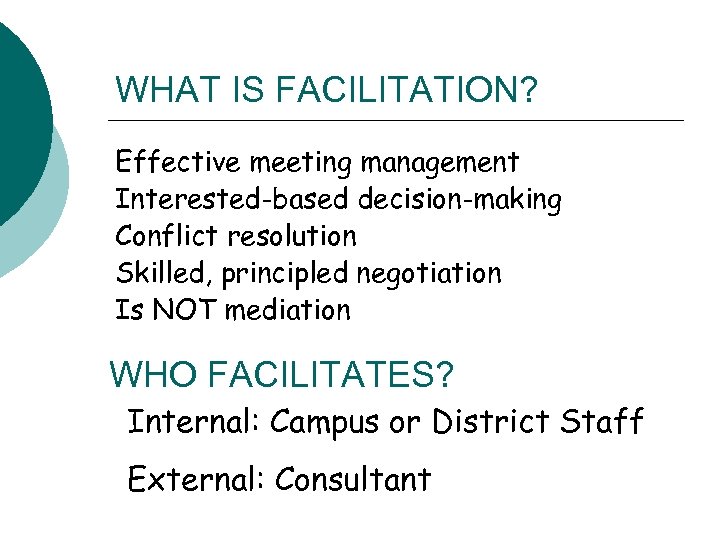
WHAT IS FACILITATION? Effective meeting management Interested-based decision-making Conflict resolution Skilled, principled negotiation Is NOT mediation WHO FACILITATES? Internal: Campus or District Staff External: Consultant
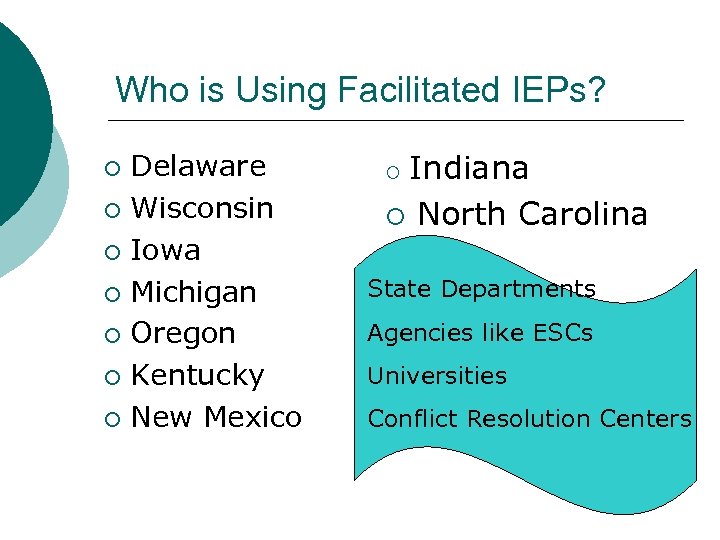
Who is Using Facilitated IEPs? Delaware ¡ Wisconsin ¡ Iowa ¡ Michigan ¡ Oregon ¡ Kentucky ¡ New Mexico ¡ Indiana ¡ North Carolina ¡ State Departments Agencies like ESCs Universities Conflict Resolution Centers
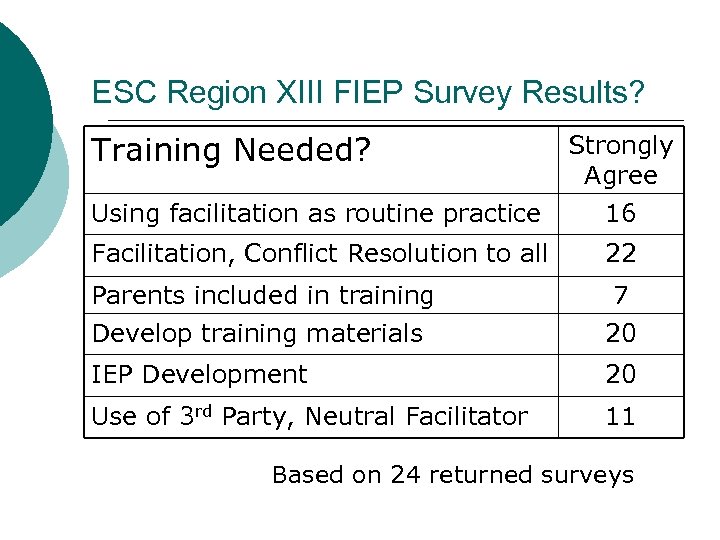
ESC Region XIII FIEP Survey Results? Training Needed? Using facilitation as routine practice Strongly Agree 16 Facilitation, Conflict Resolution to all 22 Parents included in training Develop training materials 7 20 IEP Development 20 Use of 3 rd Party, Neutral Facilitator 11 Based on 24 returned surveys
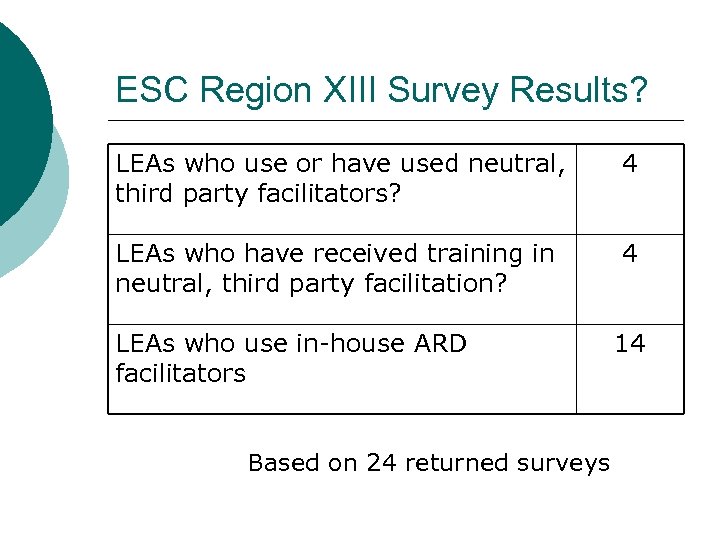
ESC Region XIII Survey Results? LEAs who use or have used neutral, third party facilitators? 4 LEAs who have received training in neutral, third party facilitation? 4 LEAs who use in-house ARD facilitators Based on 24 returned surveys 14
Benefits of IEP Facilitation ¡ ¡ ¡ Builds and improves relationships among the IEP team members and between parents and schools. Provides opportunities for IEP team members to resolve conflicts if they arise. Encourages parents and professionals to identify new options to address unresolved problems.
Benefits of IEP Facilitation Serves as a more cost efficient mechanism for resolving disputes than more formal proceedings such as due process hearings. ¡ Is typically a less stressful mechanism for resolving disputes. ¡ Supports all parties in participating fully ¡
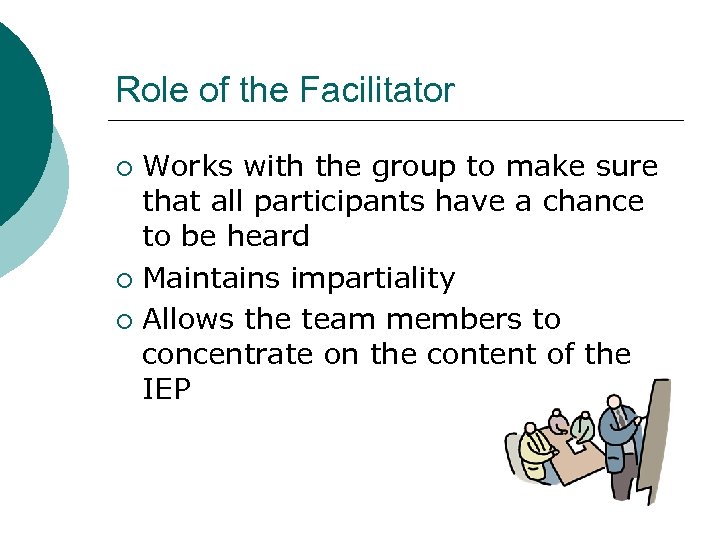
Role of the Facilitator Works with the group to make sure that all participants have a chance to be heard ¡ Maintains impartiality ¡ Allows the team members to concentrate on the content of the IEP ¡
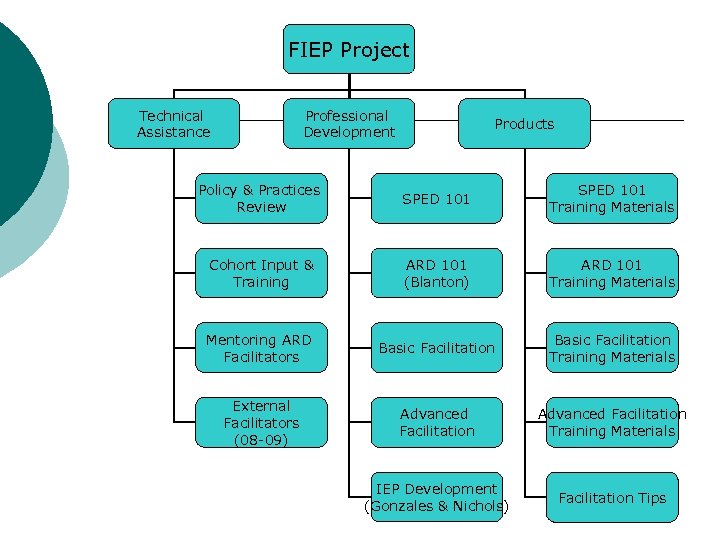
FIEP Project Technical Assistance Professional Development Products Policy & Practices Review SPED 101 Training Materials Cohort Input & Training ARD 101 (Blanton) ARD 101 Training Materials Mentoring ARD Facilitators Basic Facilitation Training Materials External Facilitators (08 -09) Advanced Facilitation Training Materials IEP Development (Gonzales & Nichols) Facilitation Tips
How Can You Participate? 1. Share materials on SPED 101, ARD 101, & Facilitation Skills for product development. 2. Participate as Cohort. 3. Contribute Data. 4. Pilot use of External Facilitators. 5. Encourage workshop attendance.
IEPs and Essence Statements Monte Parker Copyright© 2007 Education Service Center Region XIII 50
To Do List Copyright© 2007 Education Service Center Region XIII 51
After Lunch at 1: 00 • Autism Focus Group from 0607 meeting • New Directors Meeting • SELN Retreat Planning Committee Meeting Copyright© 2007 Education Service Center Region XIII 52
Скачать презентацию Special Education Leadership Network September 13 2007 Copyright
7ad0218ff0583d5029877193aa20061c.ppt