


 Скачать презентацию Speaking Accuracy to Fluency Gerard Mc Loughlin
8ec7c81972bd8e90d2400645dc2e3092.ppt
- Количество слайдов: 26
 Speaking: Accuracy to Fluency Gerard Mc. Loughlin
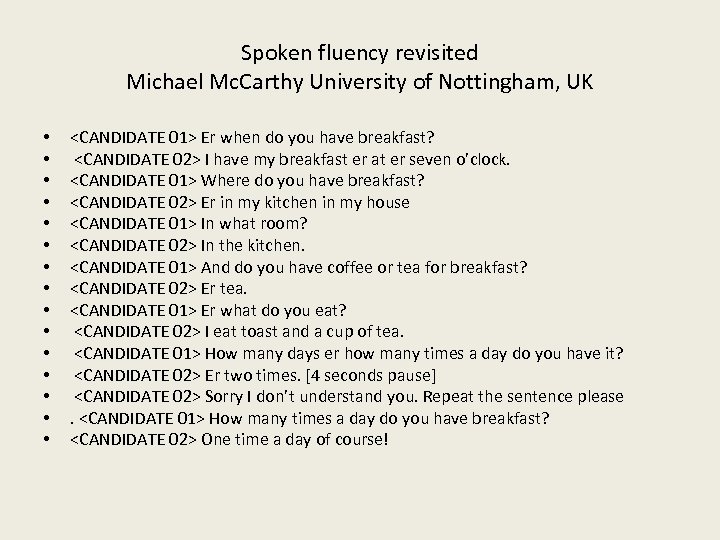 Spoken fluency revisited Michael Mc. Carthy University of Nottingham, UK • • • •
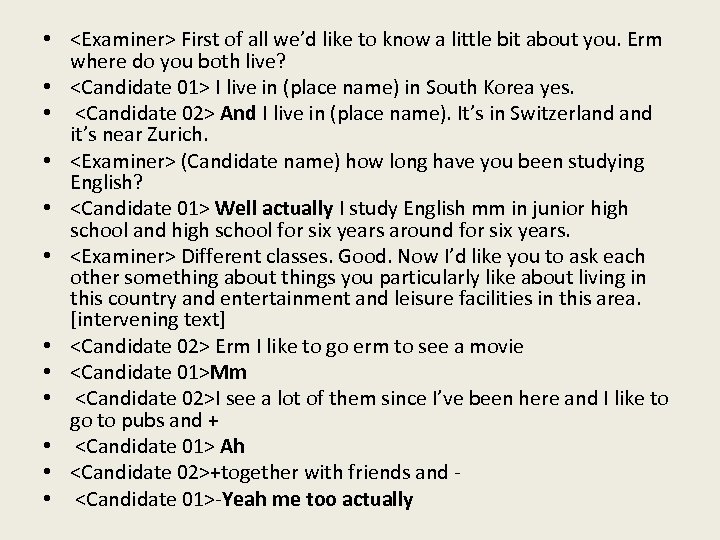 •
•
 Disappearing dialogues A: Did you have a good weekend? B: Yeah, I did, thanks. It was really nice. A: What did you do? B: Well, I went to visit a friend in London. A: Oh yes? Did you have a good time? B: Yes, it was great. We had a really good time. We went dancing on Saturday night. © Framework, Jones & Goldstein, Richmond 2005
 memorise A: Hi, Good Morning. B: Oh, Hello. How are you? What happened to you last Friday? A: Yes, sorry I couldn’t come to class. I was ill. B: That’s OK. Are you feeling better now? A: Yes, much better thanks. Can you give me the papers from last week? B: Yes, of course. Here you are. A: Great. Thanks. I’ll look at them tonight. B: OK. No problem. © Innovations, Dellar & Walkley, Heinle 2005
 Read and Listen D: Oh, and I saw John a couple of days ago. M: Oh yes! How was he? D: Very well. Did you know he’s got a new girlfriend? M: No, I didn’t. But you know your brother, he never tells me anything. Have you met her? D: Yes, she was there when I went to his house. M: and what’s she like? D: She’s really nice. She’s very interesting, she works in an art gallery and she likes painting. © Innovations, Dellar & Walker, Heinle 2005
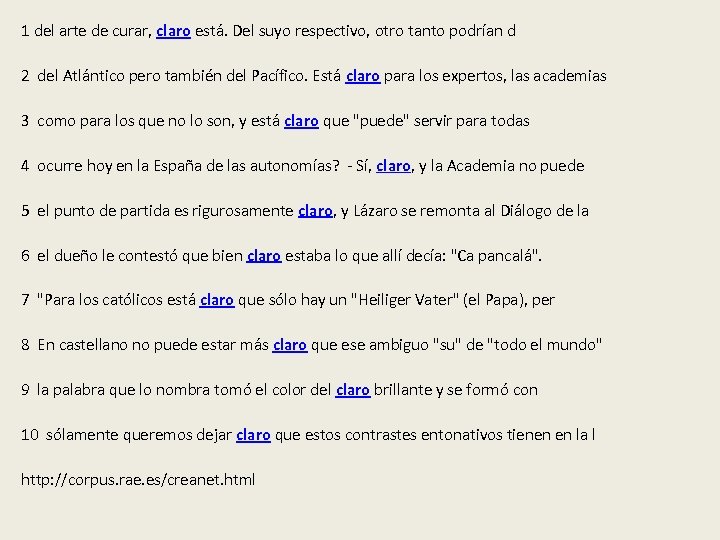 1 del arte de curar, claro está. Del suyo respectivo, otro tanto podrían d 2 del Atlántico pero también del Pacífico. Está claro para los expertos, las academias 3 como para los que no lo son, y está claro que "puede" servir para todas 4 ocurre hoy en la España de las autonomías? - Sí, claro, y la Academia no puede 5 el punto de partida es rigurosamente claro, y Lázaro se remonta al Diálogo de la 6 el dueño le contestó que bien claro estaba lo que allí decía: "Ca pancalá". 7 "Para los católicos está claro que sólo hay un "Heiliger Vater" (el Papa), per 8 En castellano no puede estar más claro que ese ambiguo "su" de "todo el mundo" 9 la palabra que lo nombra tomó el color del claro brillante y se formó con 10 sólamente queremos dejar claro que estos contrastes entonativos tienen en la l http: //corpus. rae. es/creanet. html
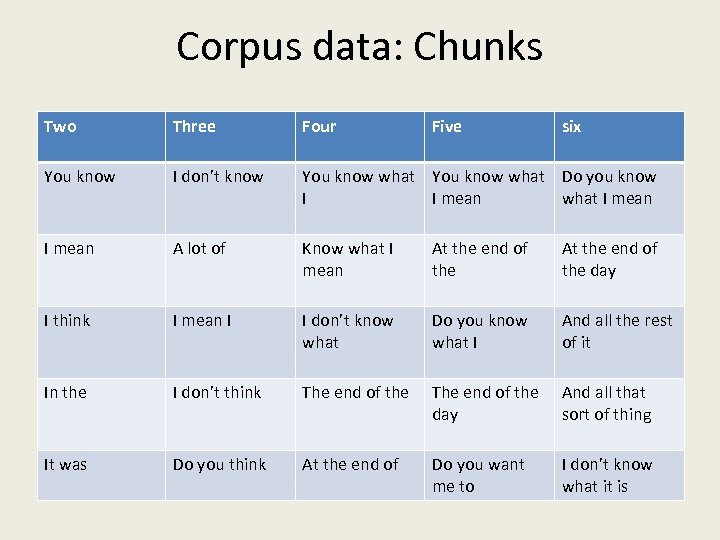 Corpus data: Chunks Two Three Four Five six You know I don’t know You know what Do you know I I mean what I mean A lot of Know what I mean At the end of the day I think I mean I I don’t know what Do you know what I And all the rest of it In the I don’t think The end of the day And all that sort of thing It was Do you think At the end of Do you want me to I don’t know what it is
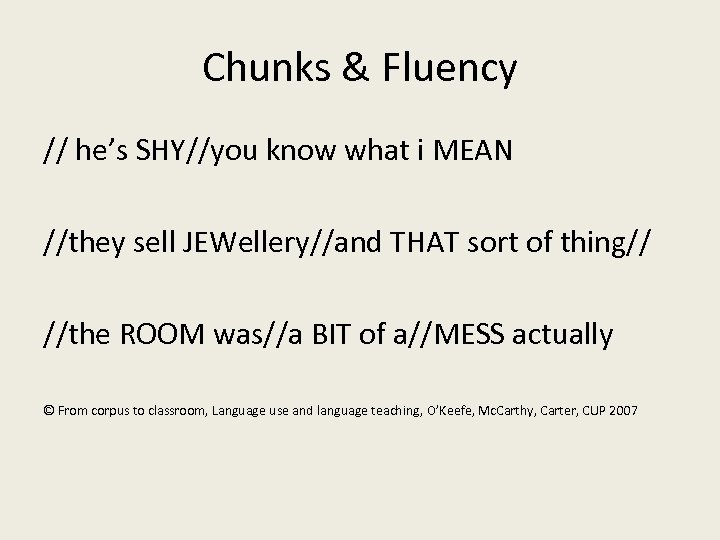 Chunks & Fluency // he’s SHY//you know what i MEAN //they sell JEWellery//and THAT sort of thing// //the ROOM was//a BIT of a//MESS actually © From corpus to classroom, Language use and language teaching, O’Keefe, Mc. Carthy, Carter, CUP 2007
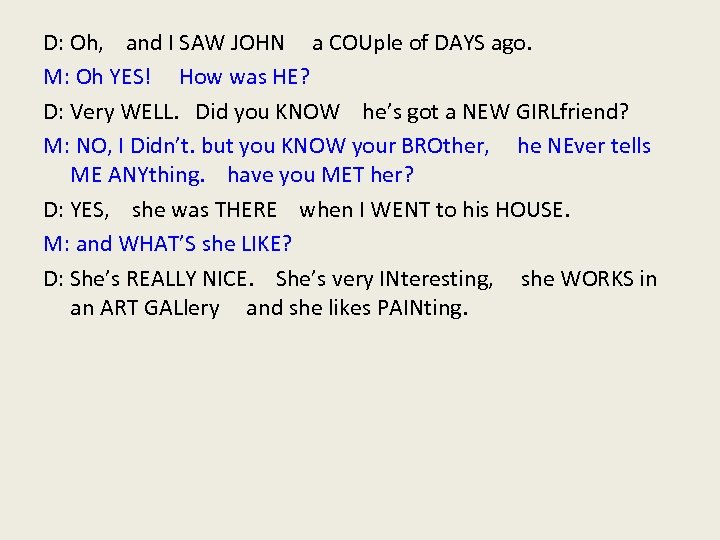 D: Oh, and I SAW JOHN a COUple of DAYS ago. M: Oh YES! How was HE? D: Very WELL. Did you KNOW he’s got a NEW GIRLfriend? M: NO, I Didn’t. but you KNOW your BROther, he NEver tells ME ANYthing. have you MET her? D: YES, she was THERE when I WENT to his HOUSE. M: and WHAT’S she LIKE? D: She’s REALLY NICE. She’s very INteresting, she WORKS in an ART GALlery and she likes PAINting.
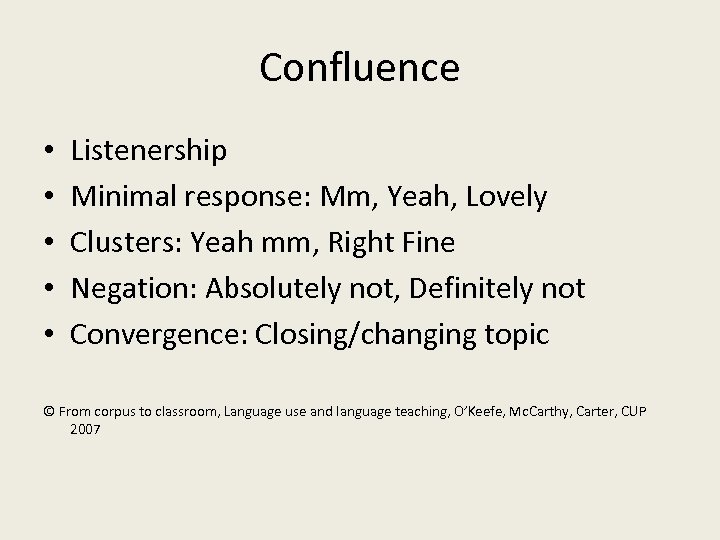 Confluence • • • Listenership Minimal response: Mm, Yeah, Lovely Clusters: Yeah mm, Right Fine Negation: Absolutely not, Definitely not Convergence: Closing/changing topic © From corpus to classroom, Language use and language teaching, O’Keefe, Mc. Carthy, Carter, CUP 2007
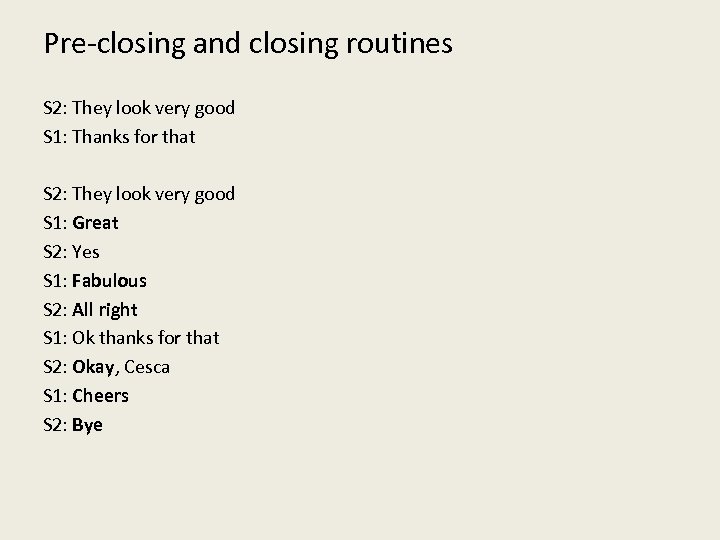 Pre-closing and closing routines S 2: They look very good S 1: Thanks for that S 2: They look very good S 1: Great S 2: Yes S 1: Fabulous S 2: All right S 1: Ok thanks for that S 2: Okay, Cesca S 1: Cheers S 2: Bye
 Opening & Closing Conversation & daily chat In a bar/café At a bus stop In a waiting room
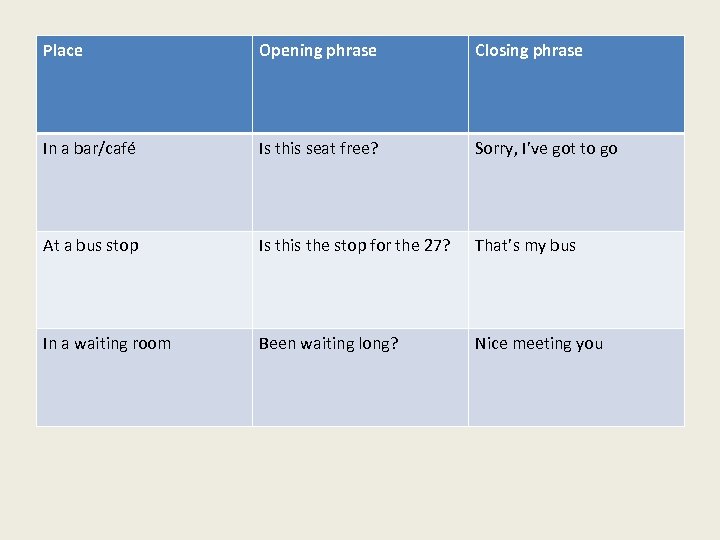 Place Opening phrase Closing phrase In a bar/café Is this seat free? Sorry, I’ve got to go At a bus stop Is this the stop for the 27? That’s my bus In a waiting room Been waiting long? Nice meeting you
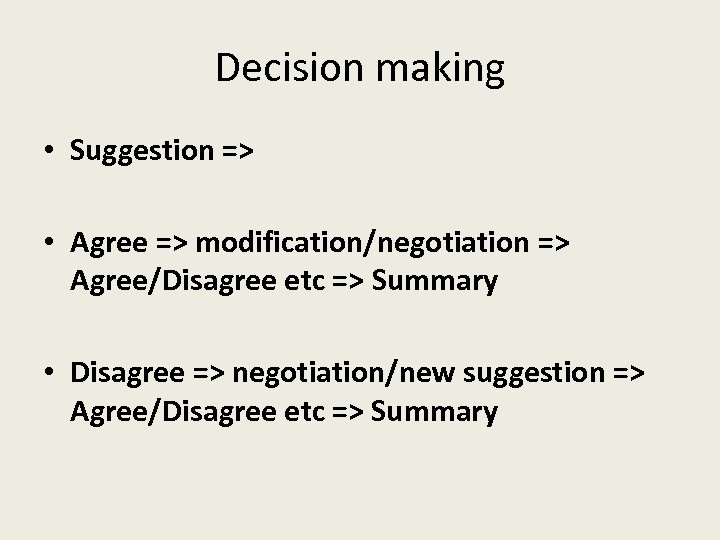 Decision making • Suggestion => • Agree => modification/negotiation => Agree/Disagree etc => Summary • Disagree => negotiation/new suggestion => Agree/Disagree etc => Summary
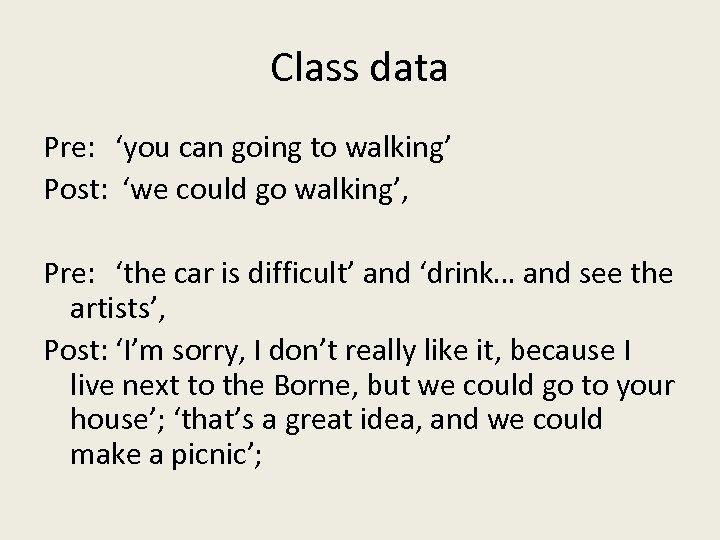 Class data Pre: ‘you can going to walking’ Post: ‘we could go walking’, Pre: ‘the car is difficult’ and ‘drink… and see the artists’, Post: ‘I’m sorry, I don’t really like it, because I live next to the Borne, but we could go to your house’; ‘that’s a great idea, and we could make a picnic’;
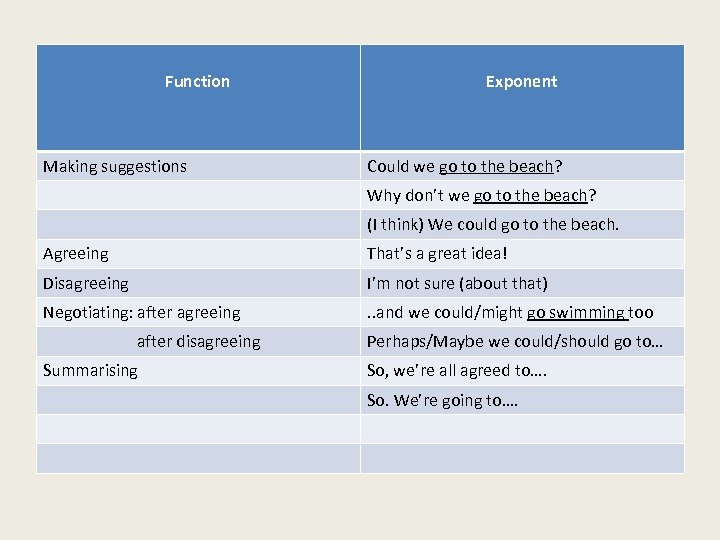 Function Making suggestions Exponent Could we go to the beach? Why don’t we go to the beach? (I think) We could go to the beach. Agreeing That’s a great idea! Disagreeing I’m not sure (about that) Negotiating: after agreeing . . and we could/might go swimming too after disagreeing Perhaps/Maybe we could/should go to… Summarising So, we’re all agreed to…. So. We’re going to….
 Daily chats • • Restaurant Film Football Weekend…. .
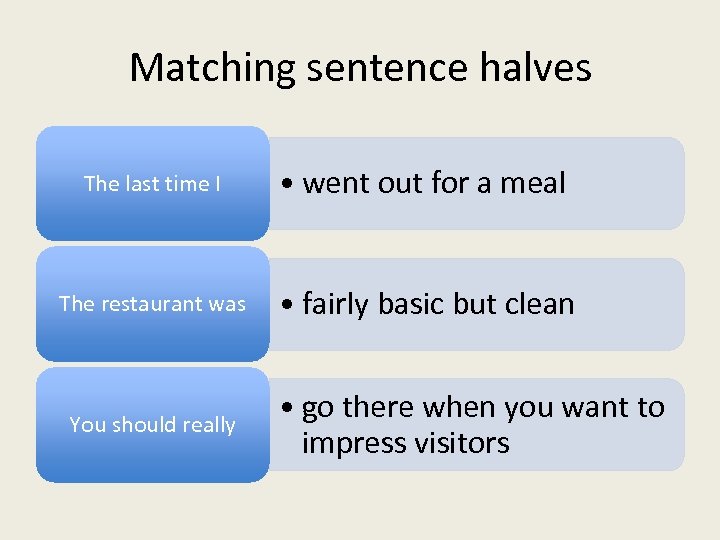 Matching sentence halves The last time I • went out for a meal The restaurant was • fairly basic but clean You should really • go there when you want to impress visitors
 The last time I • ………… The restaurant was • ………… You should really • …………
 How? • Memorisation • Chunking • Noticing
 Bibliography • Framework, Jones & Goldstein, Richmond • Innovations, Dellar & Walkley, Heinle • Spoken fluency revistited, Mc. Carthy, English Profile Journal 2010 • From corpus to classroom Language use and Language teaching, O’Keefe, Mc. Carthy, Carter, CUP • Johnny Depp interview: http: //www. youtube. com/watch? v=CEa. TOSRMif. U • Hofesh Scheckter interview: • http: //www. youtube. com/watch? v=CEa. TOSRMif. U
 THANK YOU!!! Gerard Mc. Loughlin gmcloughlin@bcn. ihes. com