


 Скачать презентацию Spatial response and temporal development 1901 2010
95515ec9c1ffdefbe3558d7cdb92ebb5.ppt
- Количество слайдов: 19
 Spatial response and temporal development (1901 – 2010) of two manual atmospheric circulation classifications in Europe Andreas Hoy, Mait Sepp, Jörg Matschullat andreas. hoy@ioez. tu-freiberg. de TU Bergakademie Freiberg , Brennhausgasse 14, 09596 Freiberg, Germany Phone: 0 37 31/39 -3533, www. tu-freiberg. de
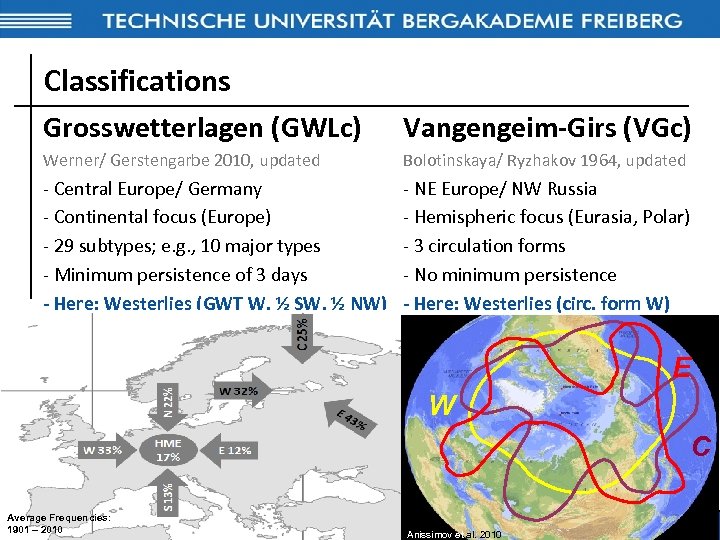 Classifications Grosswetterlagen (GWLc) Vangengeim-Girs (VGc) Werner/ Gerstengarbe 2010, updated Bolotinskaya/ Ryzhakov 1964, updated - Central Europe/ Germany - Continental focus (Europe) - 29 subtypes; e. g. , 10 major types - Minimum persistence of 3 days - Here: Westerlies (GWT W, ½ SW, ½ NW) - NE Europe/ NW Russia - Hemispheric focus (Eurasia, Polar) - 3 circulation forms - No minimum persistence - Here: Westerlies (circ. form W) E W C Average Frequencies: EMS, 1901 – 2010 15. 09. 2011 andreas. hoy@ioez. tu-freiberg. de Anissimov et al. 2010 2
 Spatial Response – Methods • Correlation mapping of montly sea level pressure averages/ circulation type frequency (via SURFER 9. 2. 397) • Goal: visualisation of average distribution of pressure centres (location of cyclones/ anticyclones: negative/ positive correlations) • Global illustrations (80°N to 80°S) for full spatial response • Sea level pressure: gridded set of monthly averages in 5 x 5° worldwide resolution (Allan/ Ansell 2006) • Focus on highly significant correlations with r≥ 0. 3/ r≤‑ 0. 3, α=0. 001 • Linear detrending of time series to reduce „artificial“ correlations (! subperiodical, polynomial, … trends) EMS, 15. 09. 2011 andreas. hoy@ioez. tu-freiberg. de 3
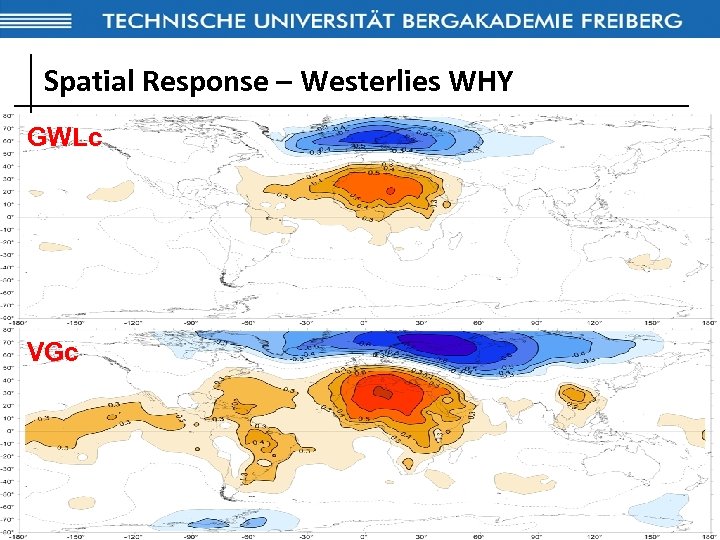 Spatial Response – Westerlies WHY GWLc VGc EMS, 15. 09. 2011 andreas. hoy@ioez. tu-freiberg. de 4
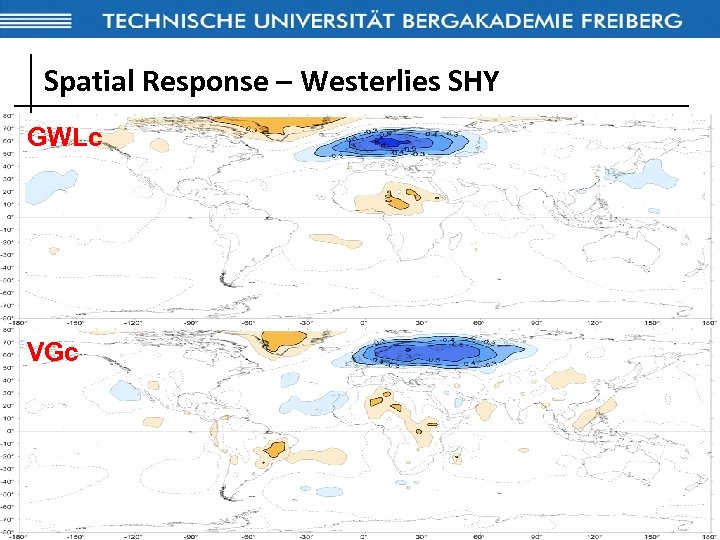 Spatial Response – Westerlies SHY GWLc VGc EMS, 15. 09. 2011 andreas. hoy@ioez. tu-freiberg. de 5
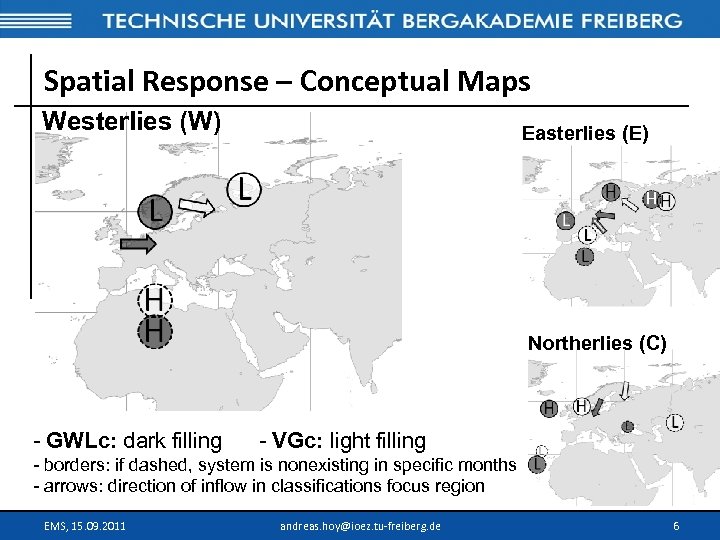 Spatial Response – Conceptual Maps Westerlies (W) Easterlies (E) Northerlies (C) - GWLc: dark filling - VGc: light filling - borders: if dashed, system is nonexisting in specific months - arrows: direction of inflow in classifications focus region EMS, 15. 09. 2011 andreas. hoy@ioez. tu-freiberg. de 6
 Temporal Development - Methods • Relative frequency (%) of circulation types • Time series and linear trends for 1901 – 2010 (yearly, half yearly) • Annual cycle: 31 day smoothing, 1901 – 2010 vs. climate normals 1951 -1980, 1981 -2010 • Goal: evaluation of annual/ inner-annual changes in frequency of atmospheric circulation patterns EMS, 15. 09. 2011 andreas. hoy@ioez. tu-freiberg. de 7
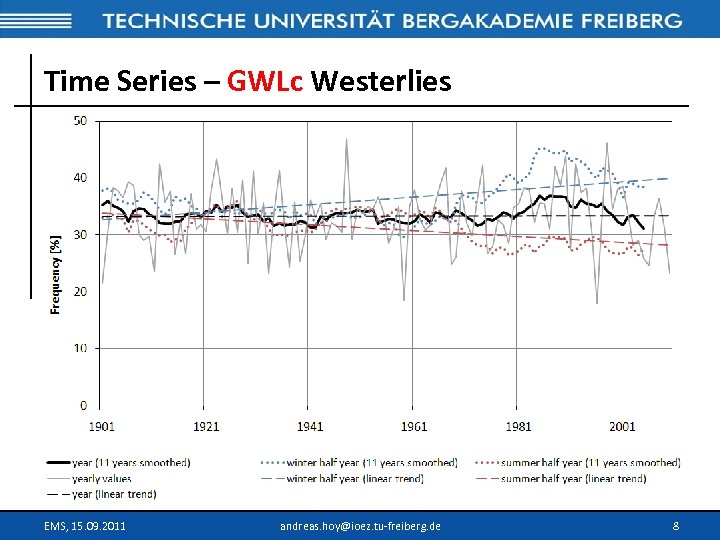 Time Series – GWLc Westerlies EMS, 15. 09. 2011 andreas. hoy@ioez. tu-freiberg. de 8
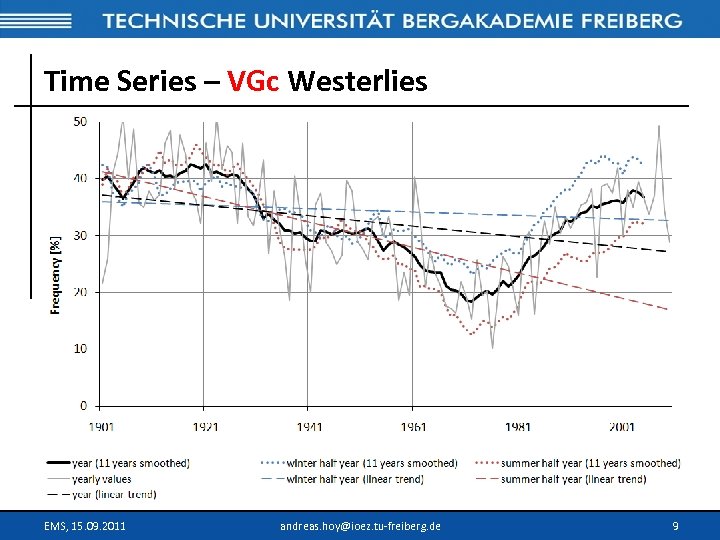 Time Series – VGc Westerlies EMS, 15. 09. 2011 andreas. hoy@ioez. tu-freiberg. de 9
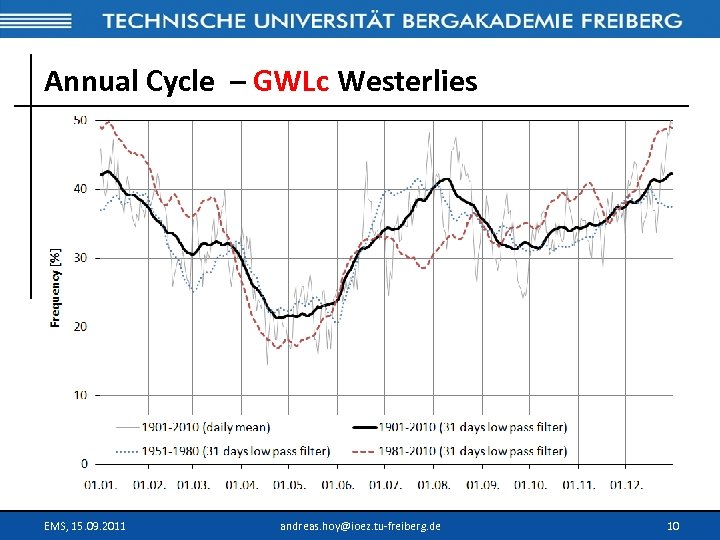 Annual Cycle – GWLc Westerlies EMS, 15. 09. 2011 andreas. hoy@ioez. tu-freiberg. de 10
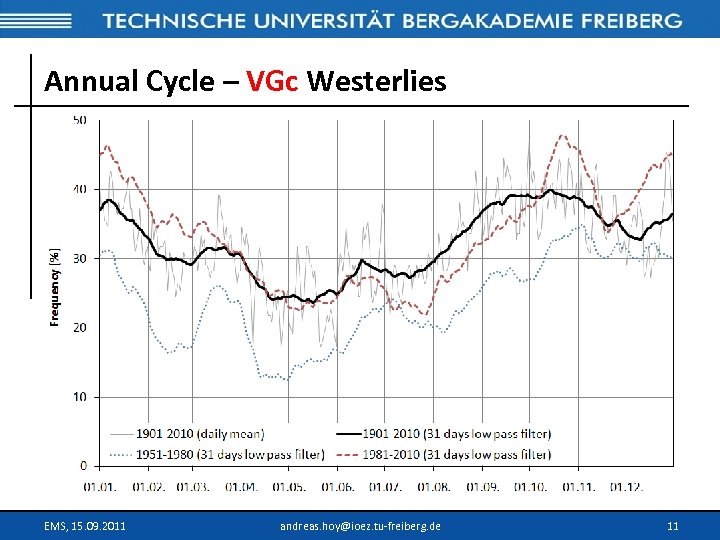 Annual Cycle – VGc Westerlies EMS, 15. 09. 2011 andreas. hoy@ioez. tu-freiberg. de 11
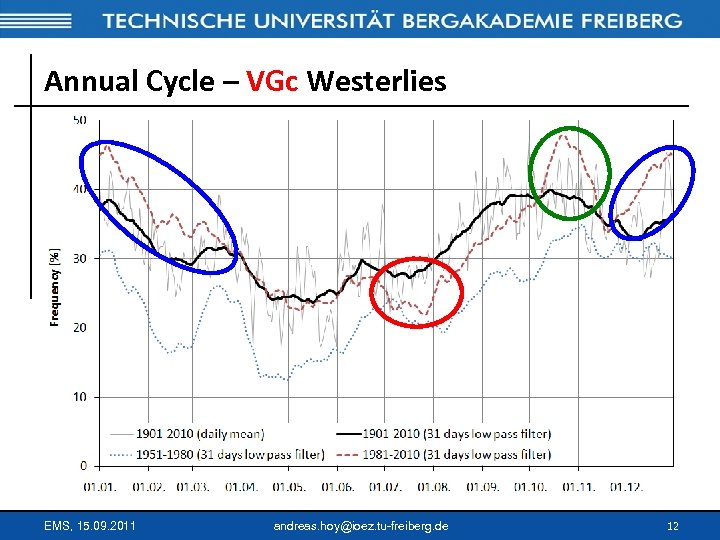 Annual Cycle – VGc Westerlies EMS, 15. 09. 2011 andreas. hoy@ioez. tu-freiberg. de 12
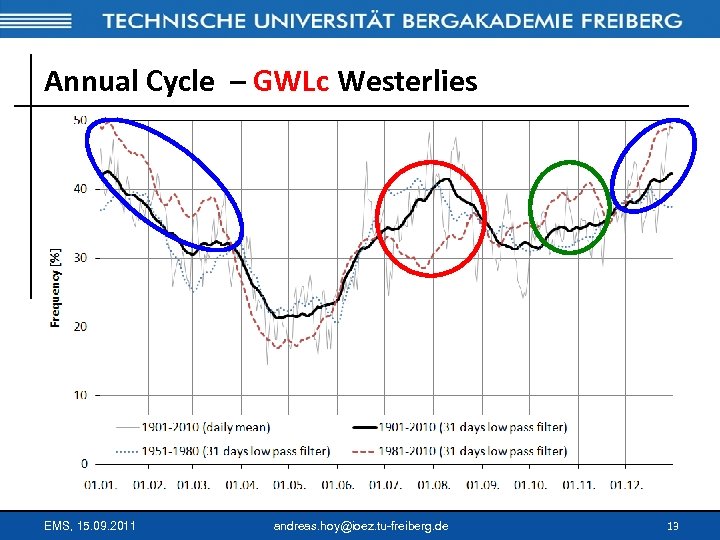 Annual Cycle – GWLc Westerlies EMS, 15. 09. 2011 andreas. hoy@ioez. tu-freiberg. de 13
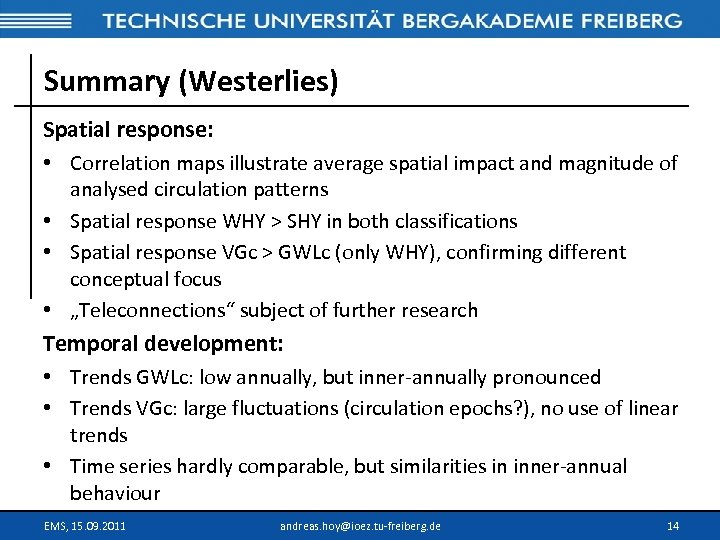 Summary (Westerlies) Spatial response: • Correlation maps illustrate average spatial impact and magnitude of analysed circulation patterns • Spatial response WHY > SHY in both classifications • Spatial response VGc > GWLc (only WHY), confirming different conceptual focus • „Teleconnections“ subject of further research Temporal development: • Trends GWLc: low annually, but inner-annually pronounced • Trends VGc: large fluctuations (circulation epochs? ), no use of linear trends • Time series hardly comparable, but similarities in inner-annual behaviour EMS, 15. 09. 2011 andreas. hoy@ioez. tu-freiberg. de 14
 Spare slides EMS, 15. 09. 2011 andreas. hoy@ioez. tu-freiberg. de 15
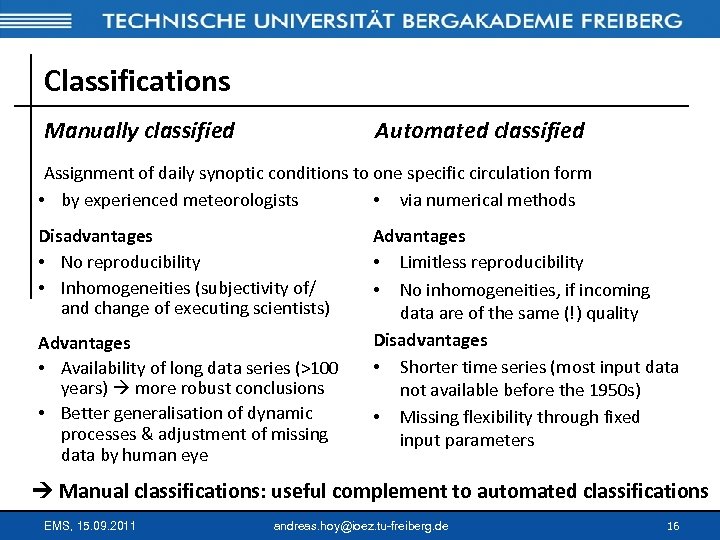 Classifications Manually classified Automated classified Assignment of daily synoptic conditions to one specific circulation form • by experienced meteorologists • via numerical methods Disadvantages • No reproducibility • Inhomogeneities (subjectivity of/ and change of executing scientists) Advantages • Availability of long data series (>100 years) more robust conclusions • Better generalisation of dynamic processes & adjustment of missing data by human eye Advantages • Limitless reproducibility • No inhomogeneities, if incoming data are of the same (!) quality Disadvantages • Shorter time series (most input data not available before the 1950 s) • Missing flexibility through fixed input parameters Manual classifications: useful complement to automated classifications EMS, 15. 09. 2011 andreas. hoy@ioez. tu-freiberg. de 16
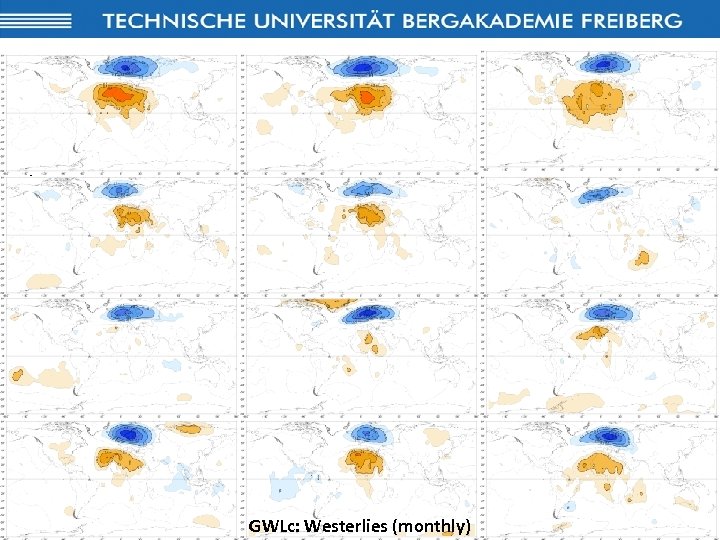 EMS, 15. 09. 2011 andreas. hoy@ioez. tu-freiberg. de GWLc: Westerlies (monthly) 17
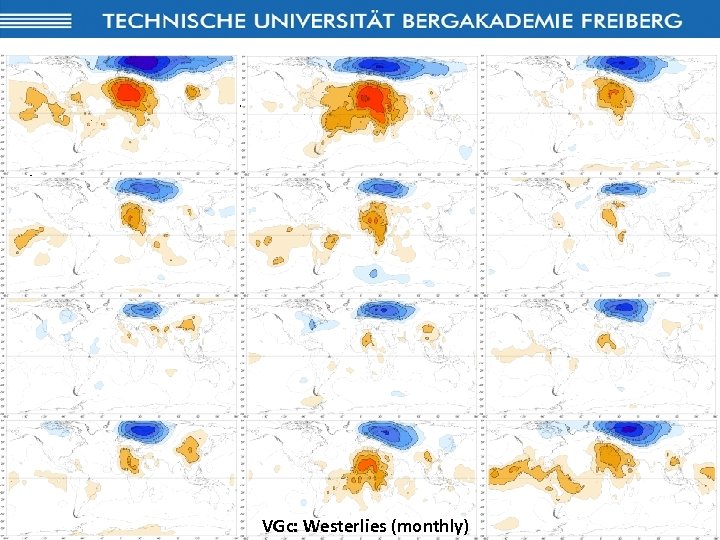 EMS, 15. 09. 2011 andreas. hoy@ioez. tu-freiberg. de VGc: Westerlies (monthly) 18
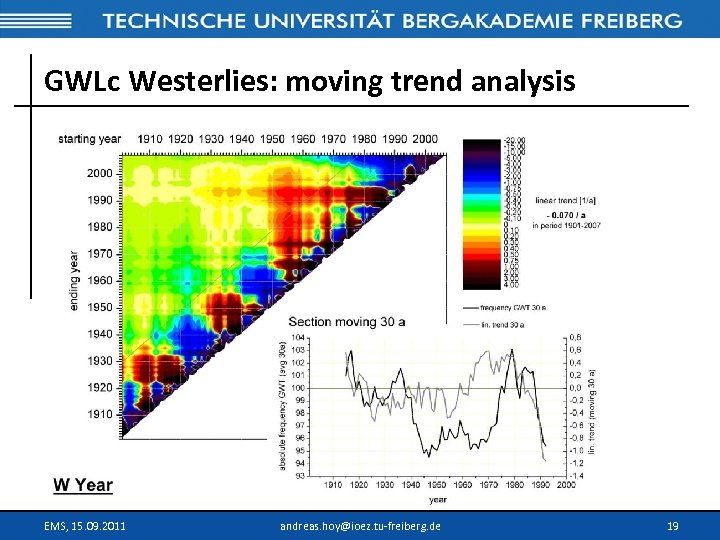 GWLc Westerlies: moving trend analysis EMS, 15. 09. 2011 andreas. hoy@ioez. tu-freiberg. de 19