


 Скачать презентацию Spatial Clustering of Illegal Drug Dealers Swarming for
92b96ee625abf797fb295c7f1078fdc6.ppt
- Количество слайдов: 61
 Spatial Clustering of Illegal Drug Dealers: Swarming for Safety or Agglomeration for Profit Dr. George F. Rengert Department of Criminal Justice Temple University Philadelphia, PA. 19122 grengert@temple. edu Temple University Department of Criminal Justice
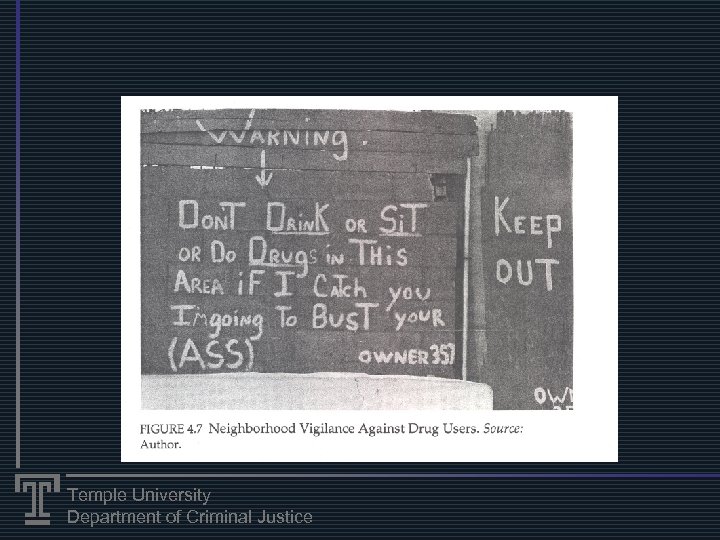
 w Where can illegal drug markets locate? w Folk wisdom: any where they want to. w Scientific knowledge: any where they want to as long as: w w w Safe from neighbors and detection by police. Profits can be made. Safest areas to sell drugs generally thought to be in socially disorganized areas. w If not socially disorganized, may experience resistance from neighbors. w Example from North Philadelphia: Temple University Department of Criminal Justice
 Temple University Department of Criminal Justice
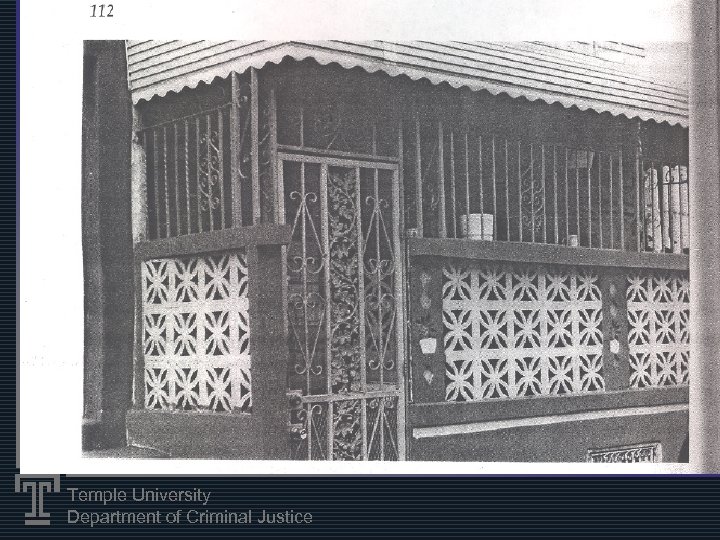
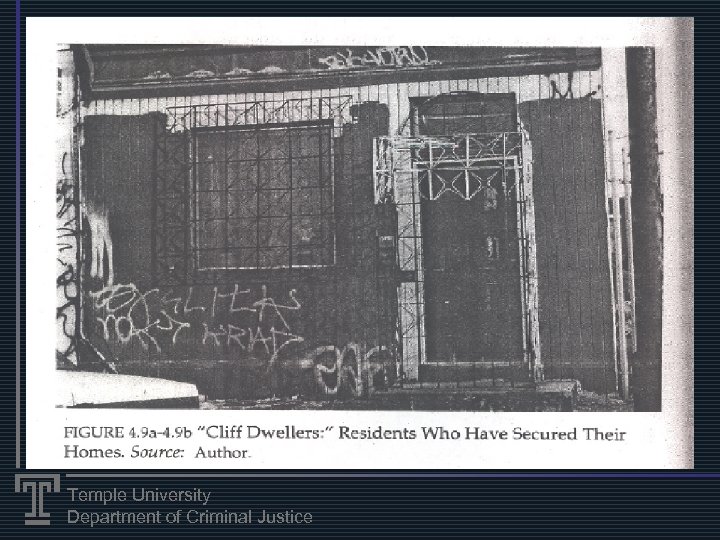
 w But most socially disorganized areas may be least profitable areas. w Lack local demand—abandoned houses. w Drug dealing can lead to abandoned houses as more people sell than buy houses in this community. n Would you buy one of these houses located in a drug sales area of North Philadelphia? Temple University Department of Criminal Justice
 Temple University Department of Criminal Justice
 Temple University Department of Criminal Justice
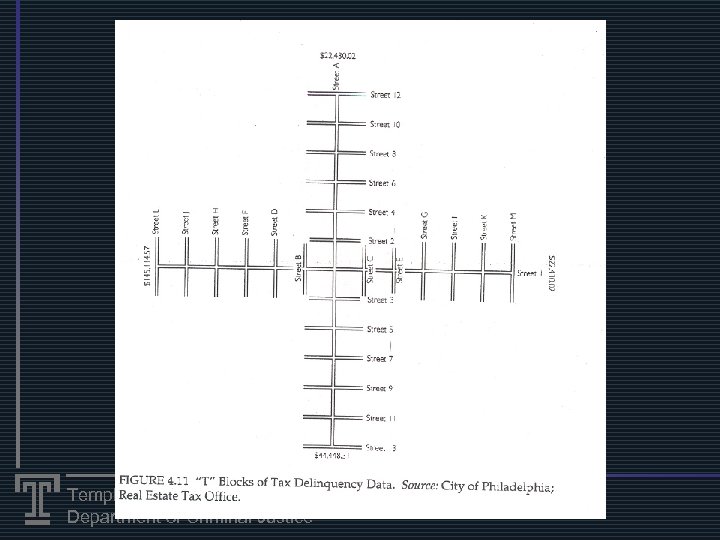
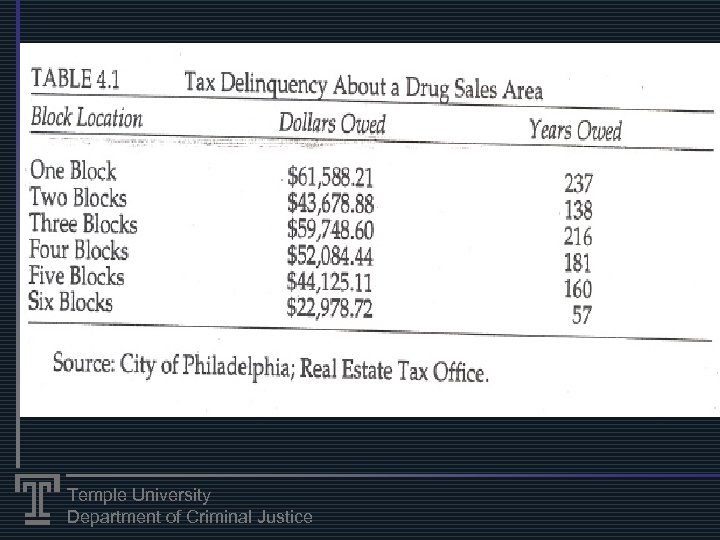
 w The following is an example of housing abandonment measured by tax delinquency around a drug sales area. Temple University Department of Criminal Justice
 Temple University Department of Criminal Justice
 Temple University Department of Criminal Justice
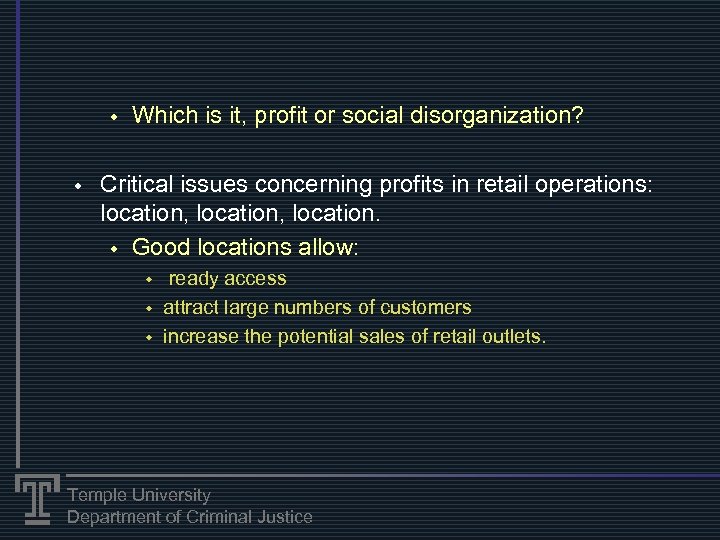 w w Which is it, profit or social disorganization? Critical issues concerning profits in retail operations: location, location. w Good locations allow: w w w ready access attract large numbers of customers increase the potential sales of retail outlets. Temple University Department of Criminal Justice
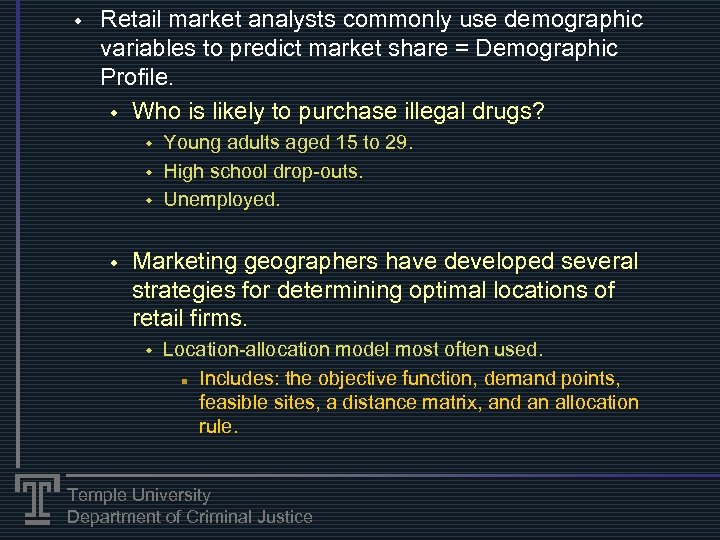 w Retail market analysts commonly use demographic variables to predict market share = Demographic Profile. w Who is likely to purchase illegal drugs? w w Young adults aged 15 to 29. High school drop-outs. Unemployed. Marketing geographers have developed several strategies for determining optimal locations of retail firms. w Location-allocation model most often used. n Includes: the objective function, demand points, feasible sites, a distance matrix, and an allocation rule. Temple University Department of Criminal Justice
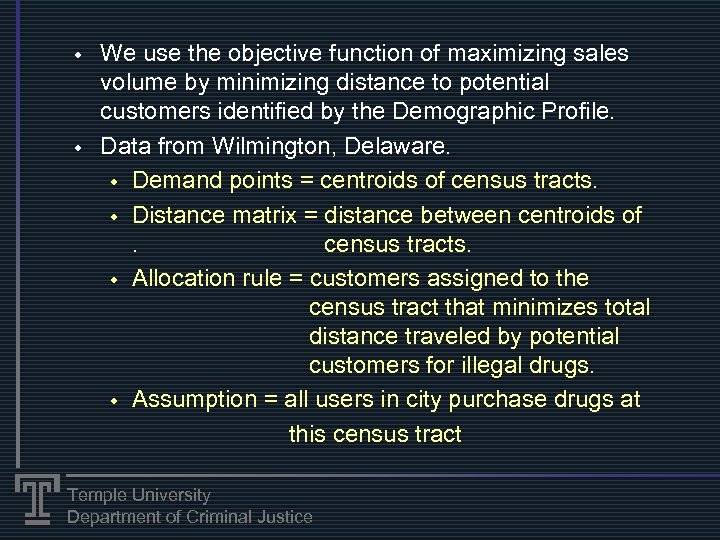 w w We use the objective function of maximizing sales volume by minimizing distance to potential customers identified by the Demographic Profile. Data from Wilmington, Delaware. w Demand points = centroids of census tracts. w Distance matrix = distance between centroids of. census tracts. w Allocation rule = customers assigned to the census tract that minimizes total distance traveled by potential customers for illegal drugs. w Assumption = all users in city purchase drugs at this census tract Temple University Department of Criminal Justice
 w Would have to travel the fewest person-miles if illegal drug market was located in census tract 1600. w w This tract was fourth from the highest in reality. Limitations of the simple form of location-allocation model: w Planar model = any location in city is a potential site. w w Residents of expensive housing areas not likely. n Masked out areas where medium housing values above average. Local addicts will travel any distance for drugs. w Assigned zero to distance if beyond a mile, 1 if less. Temple University Department of Criminal Justice
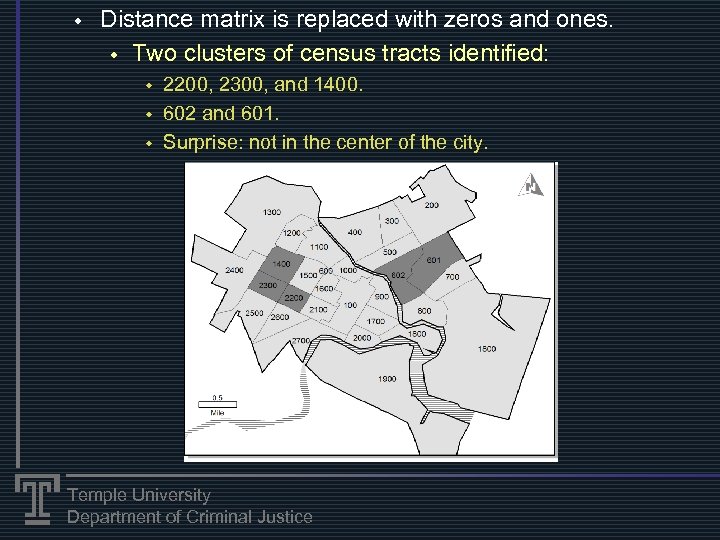 w Distance matrix is replaced with zeros and ones. w Two clusters of census tracts identified: w w w 2200, 2300, and 1400. 602 and 601. Surprise: not in the center of the city. Temple University Department of Criminal Justice
 w w The analysis yielded two clusters of census tracts. w The census tracts that ranked first, second and third formed the first cluster. w The census tracts that ranked fifth and sixth the second. The preceding map portrayed this analysis. w It is not census tract 600 or 1600 that are in the center of the city. w w Rather it is a group of census tracts that are in the center of a population of potential drug users. Rather large areas. w We need specific sites for our drug market. w Requires more refined analysis possible with GIS. Temple University Department of Criminal Justice
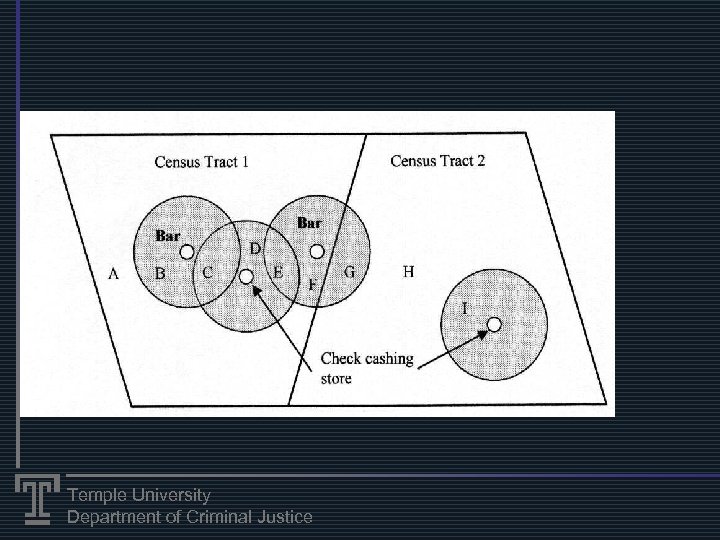
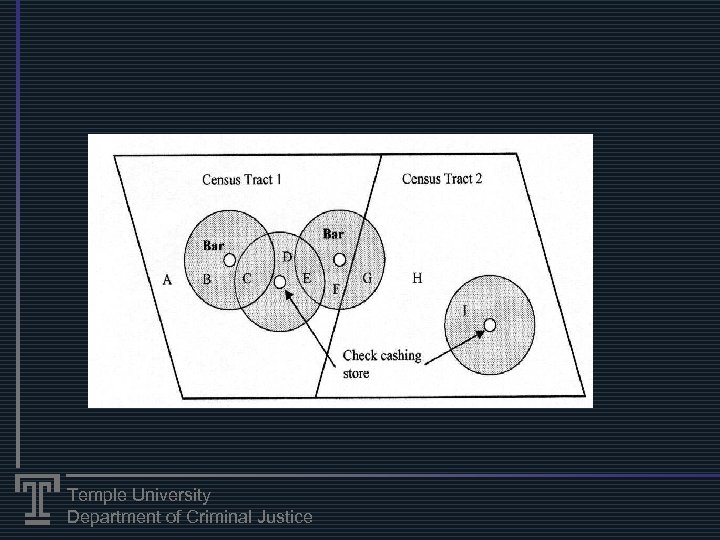
 w What can Geographic Information Systems do for us? w Compare traditional analysis with what possible with GIS: w Traditional analysis assigns features to census space. n Census tracts. n Block groups. n Block faces. Census boundaries are set and determine the spatial nature of the analysis. Temple University Department of Criminal Justice
 Temple University Department of Criminal Justice
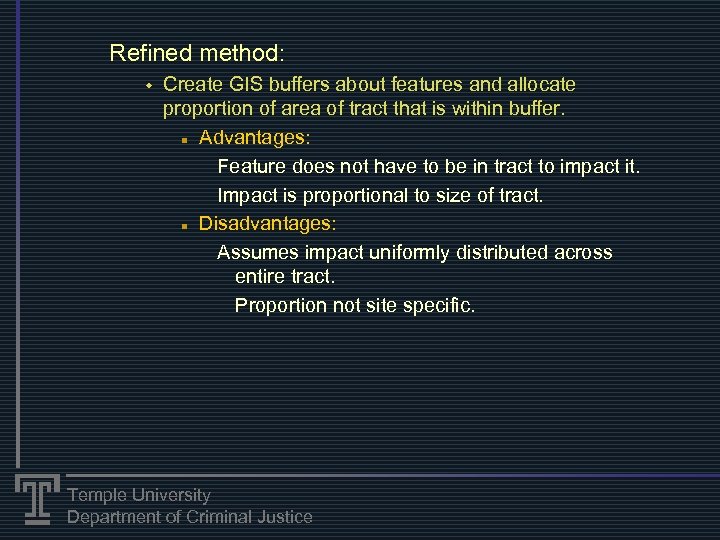 Refined method: w Create GIS buffers about features and allocate proportion of area of tract that is within buffer. n Advantages: Feature does not have to be in tract to impact it. Impact is proportional to size of tract. n Disadvantages: Assumes impact uniformly distributed across entire tract. Proportion not site specific. Temple University Department of Criminal Justice
 Temple University Department of Criminal Justice
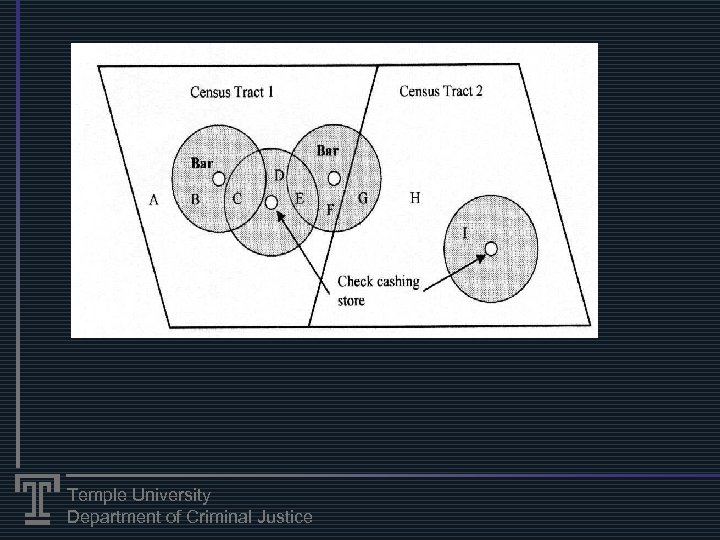
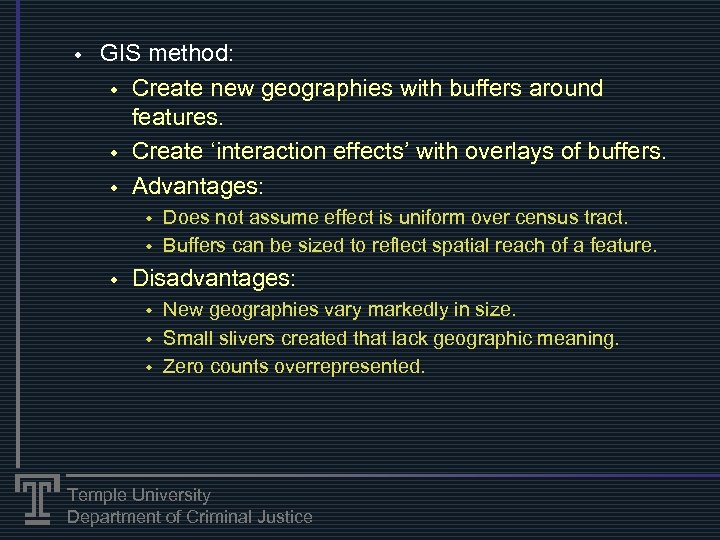 w GIS method: w Create new geographies with buffers around features. w Create ‘interaction effects’ with overlays of buffers. w Advantages: w w w Does not assume effect is uniform over census tract. Buffers can be sized to reflect spatial reach of a feature. Disadvantages: w w w New geographies vary markedly in size. Small slivers created that lack geographic meaning. Zero counts overrepresented. Temple University Department of Criminal Justice
 Temple University Department of Criminal Justice
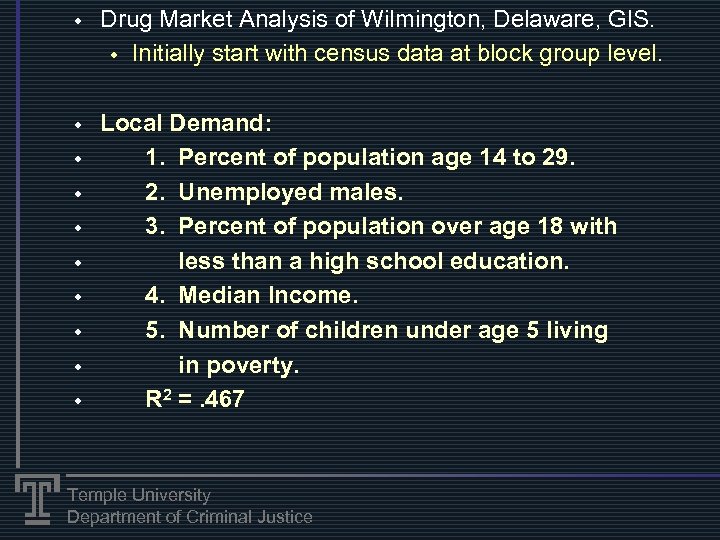 w Drug Market Analysis of Wilmington, Delaware, GIS. w Initially start with census data at block group level. w Local Demand: 1. Percent of population age 14 to 29. 2. Unemployed males. 3. Percent of population over age 18 with less than a high school education. 4. Median Income. 5. Number of children under age 5 living in poverty. R 2 =. 467 w w w w Temple University Department of Criminal Justice
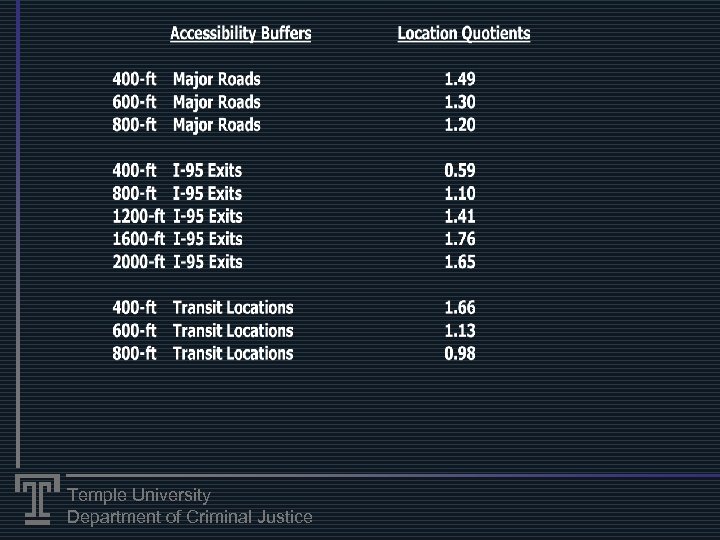
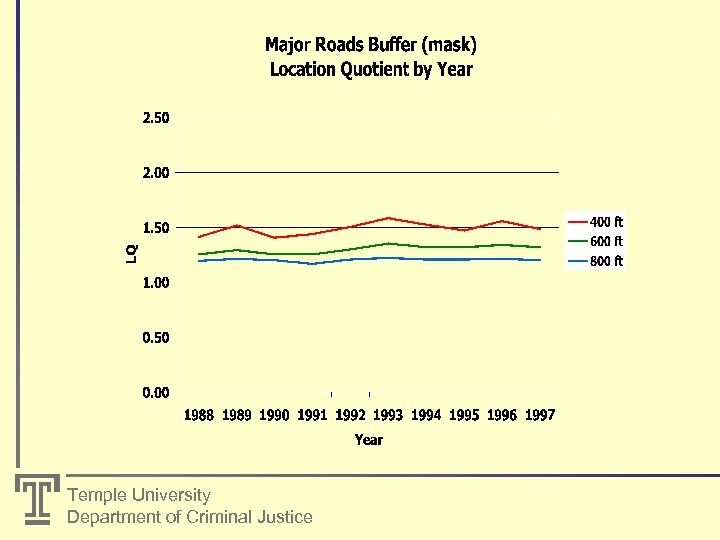
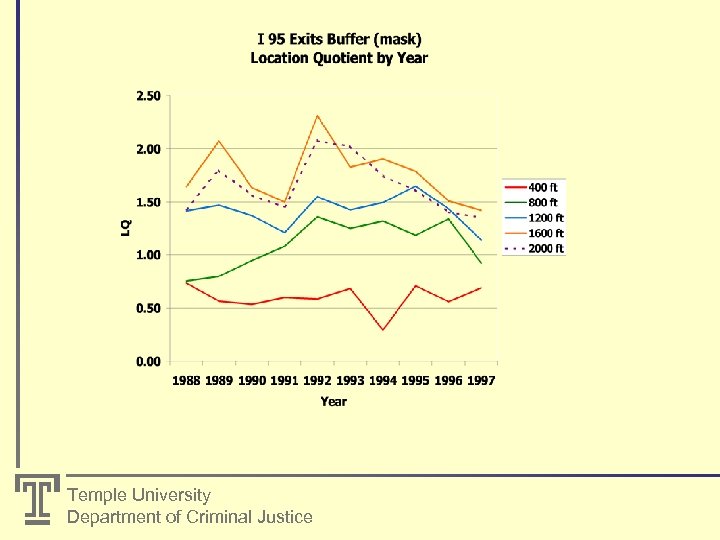
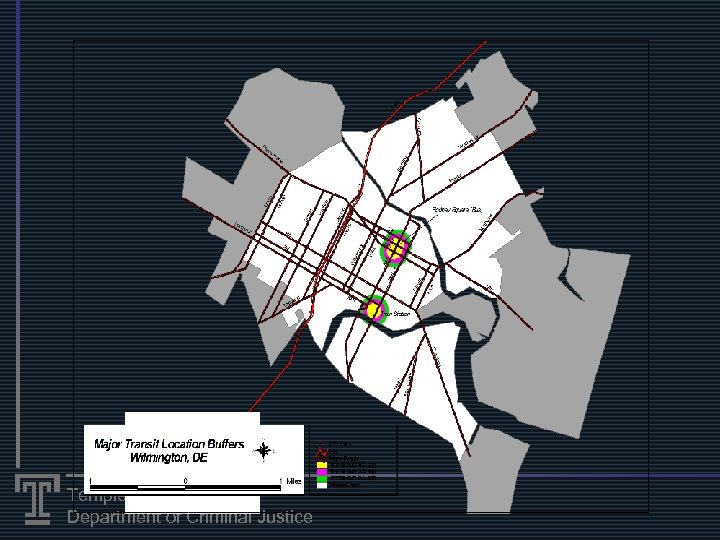
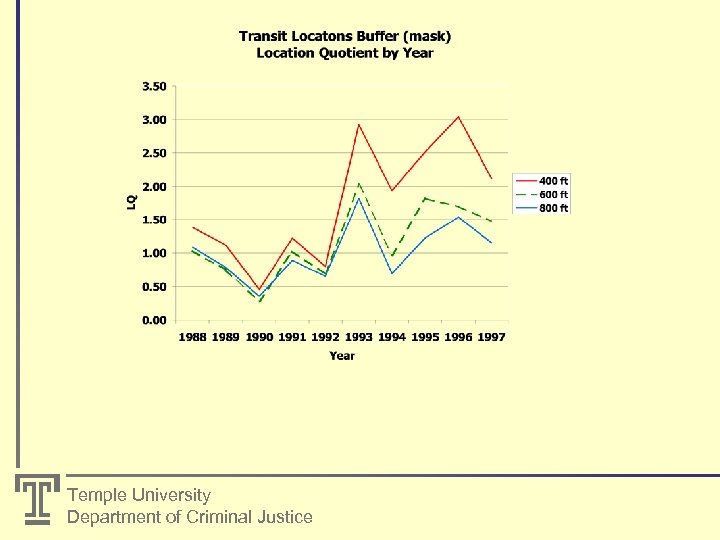
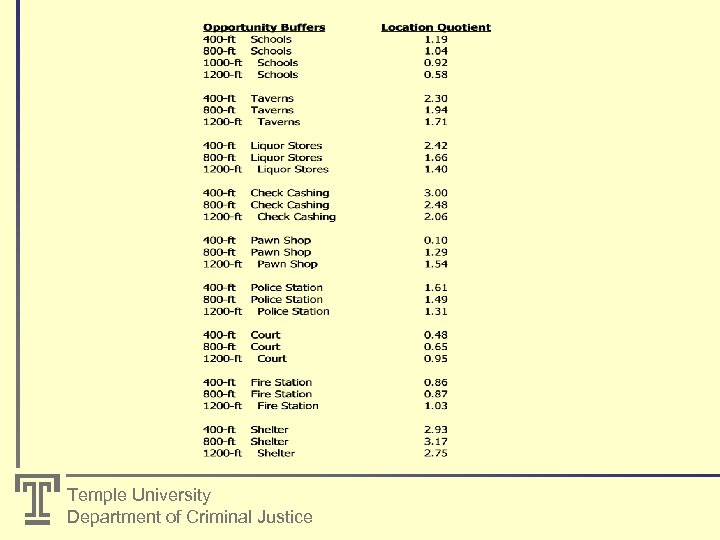
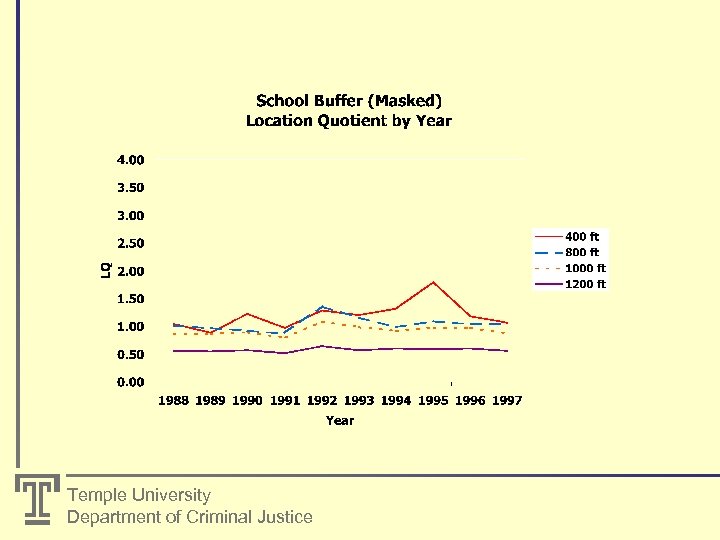
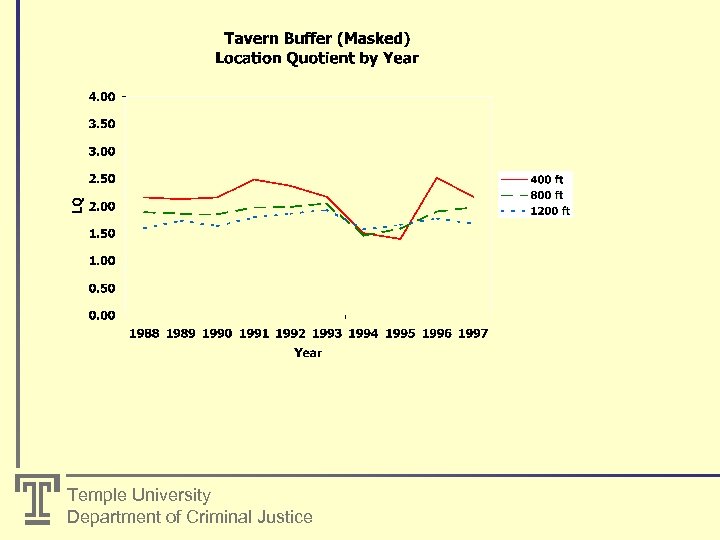
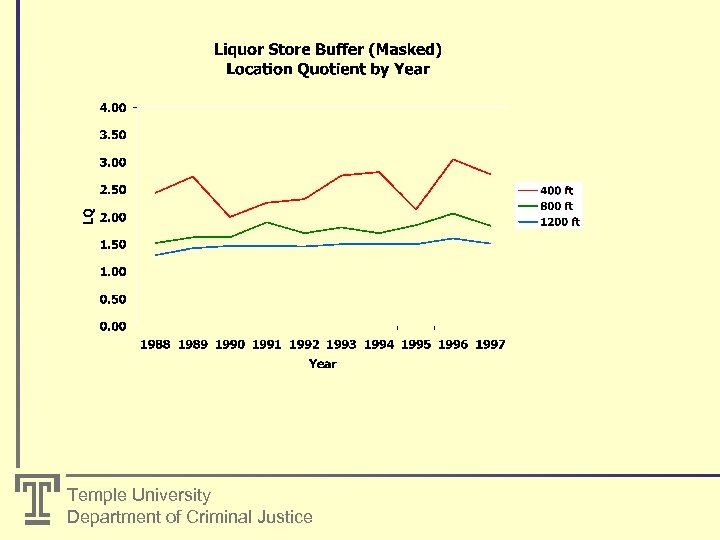
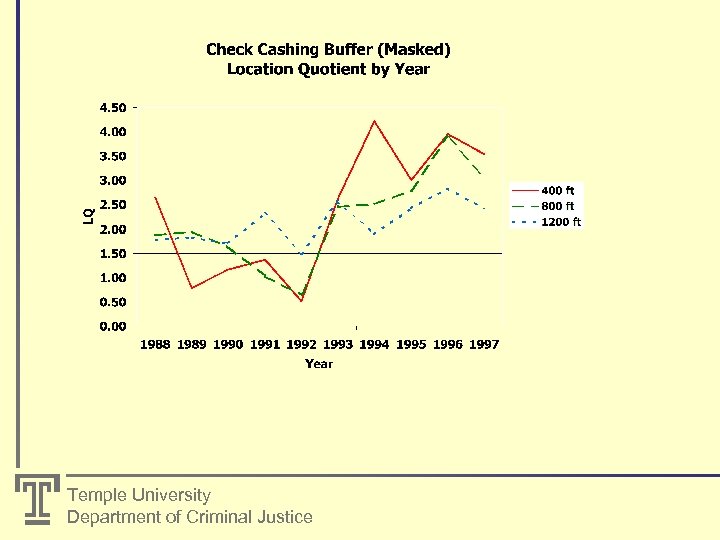
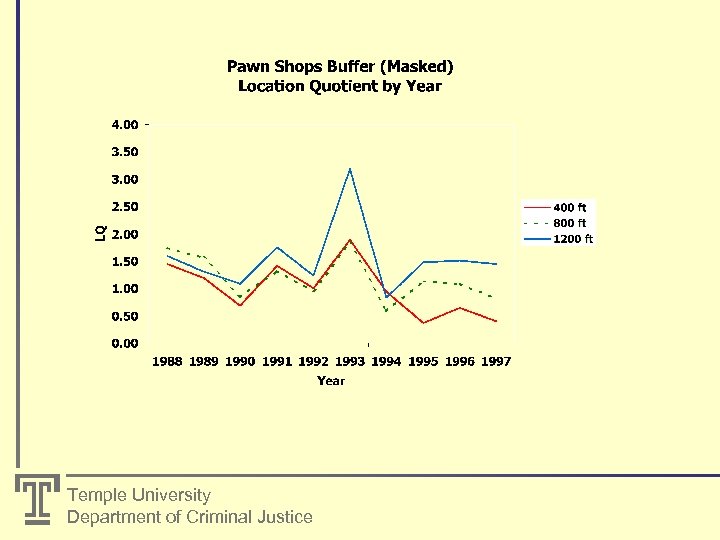
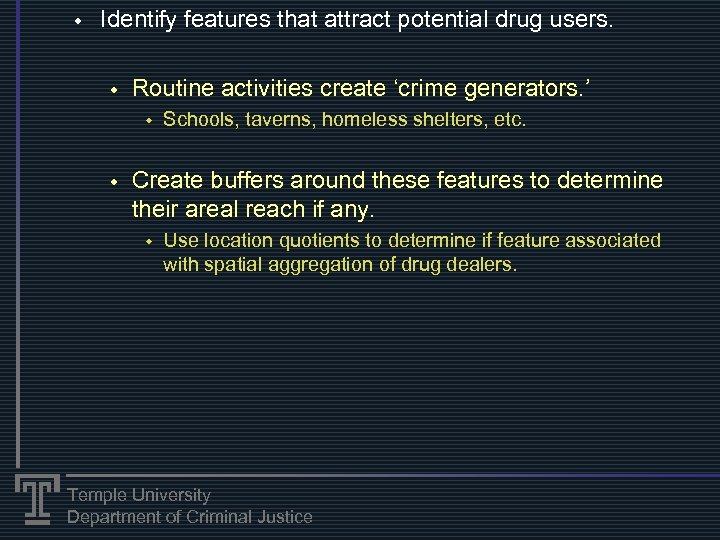 w Identify features that attract potential drug users. w Routine activities create ‘crime generators. ’ w w Schools, taverns, homeless shelters, etc. Create buffers around these features to determine their areal reach if any. w Use location quotients to determine if feature associated with spatial aggregation of drug dealers. Temple University Department of Criminal Justice
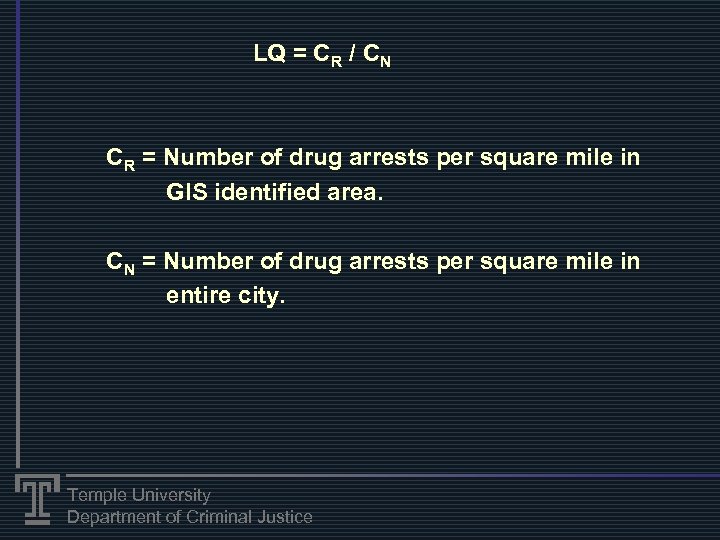 LQ = CR / CN CR = Number of drug arrests per square mile in GIS identified area. CN = Number of drug arrests per square mile in entire city. Temple University Department of Criminal Justice
 Temple University Department of Criminal Justice
 Temple University Department of Criminal Justice
 Temple University Department of Criminal Justice
 Temple University Department of Criminal Justice
 Temple University Department of Criminal Justice
 Temple University Department of Criminal Justice
 Temple University Department of Criminal Justice
 Temple University Department of Criminal Justice
 Local Accessibility w w Routine activity nodes. Anchor points of daily activities. Temple University Department of Criminal Justice
 Temple University Department of Criminal Justice
 Temple University Department of Criminal Justice
 Temple University Department of Criminal Justice
 Temple University Department of Criminal Justice
 Temple University Department of Criminal Justice
 Temple University Department of Criminal Justice
 Temple University Department of Criminal Justice
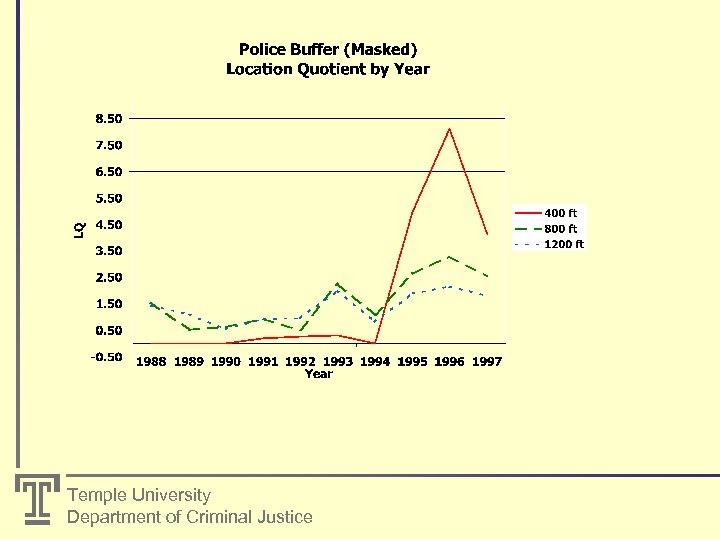 Temple University Department of Criminal Justice
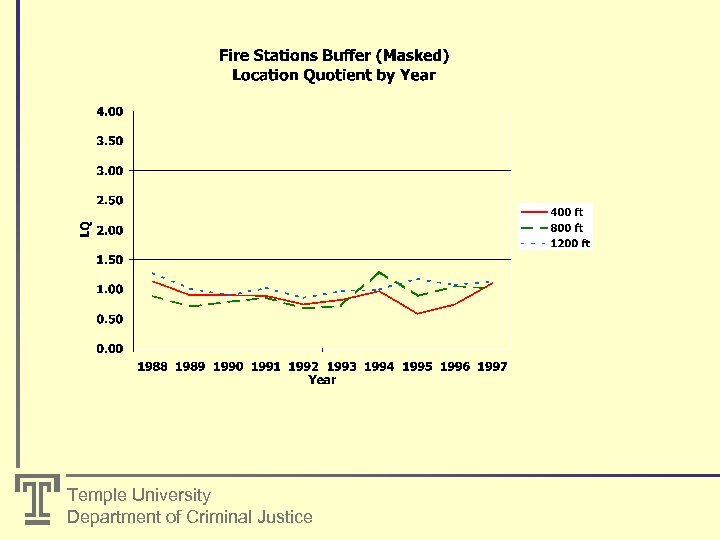 Temple University Department of Criminal Justice
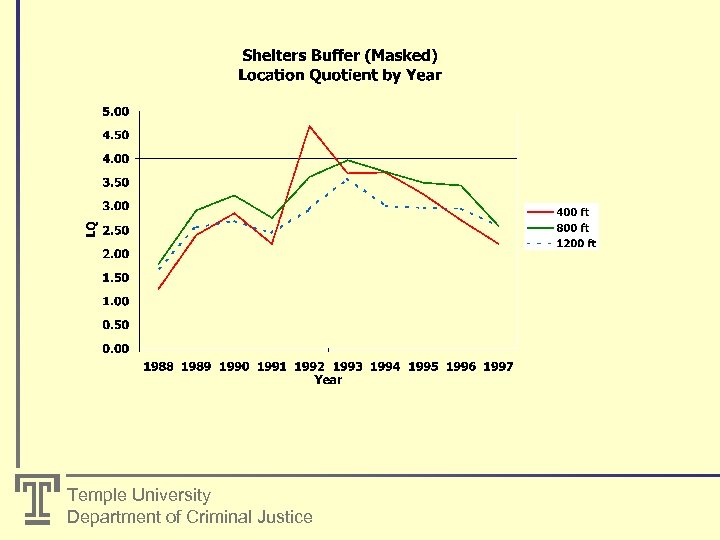 Temple University Department of Criminal Justice
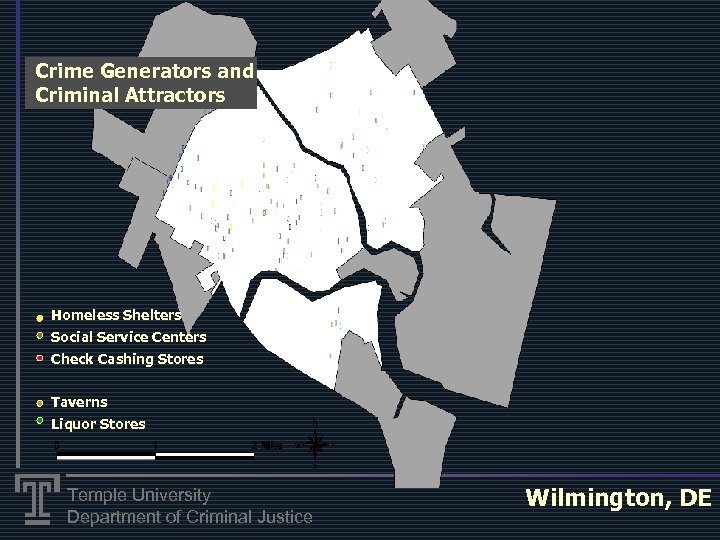 Crime Generators and Criminal Attractors Homeless Shelters Social Service Centers Check Cashing Stores Taverns Liquor Stores Temple University Department of Criminal Justice Wilmington, DE
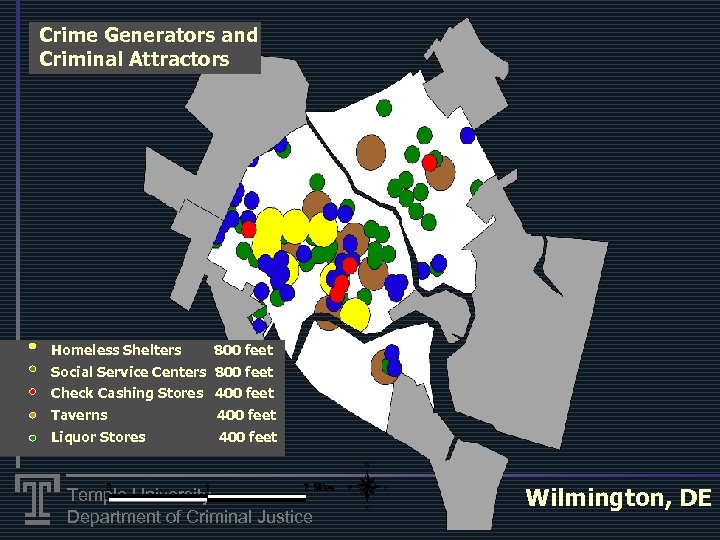 Crime Generators and Criminal Attractors Homeless Shelters 800 feet Social Service Centers 800 feet Check Cashing Stores 400 feet Taverns 400 feet Liquor Stores 400 feet Temple University Department of Criminal Justice Wilmington, DE
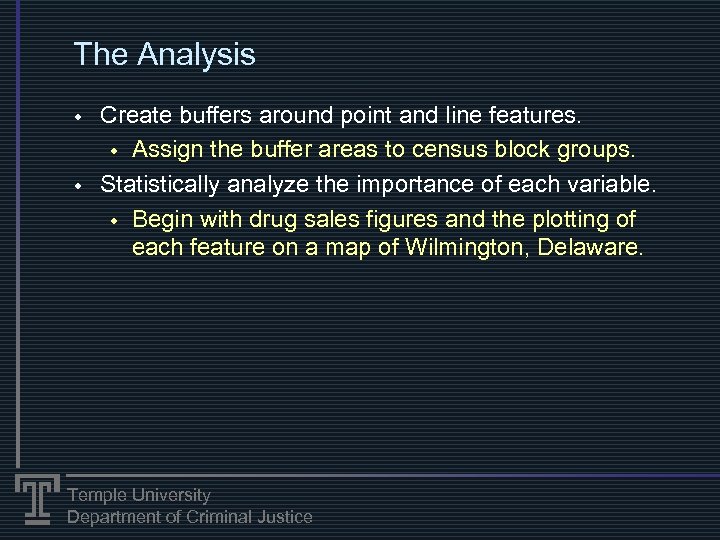 The Analysis w w Create buffers around point and line features. w Assign the buffer areas to census block groups. Statistically analyze the importance of each variable. w Begin with drug sales figures and the plotting of each feature on a map of Wilmington, Delaware. Temple University Department of Criminal Justice
 Temple University Department of Criminal Justice
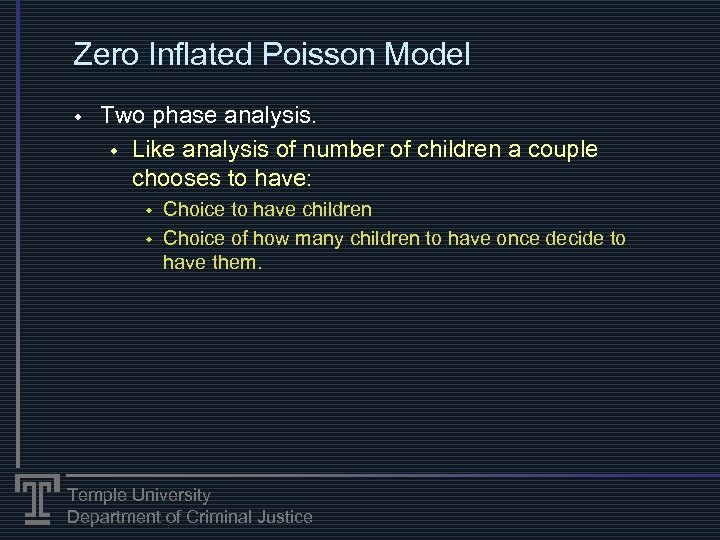 Zero Inflated Poisson Model w Two phase analysis. w Like analysis of number of children a couple chooses to have: w w Choice to have children Choice of how many children to have once decide to have them. Temple University Department of Criminal Justice
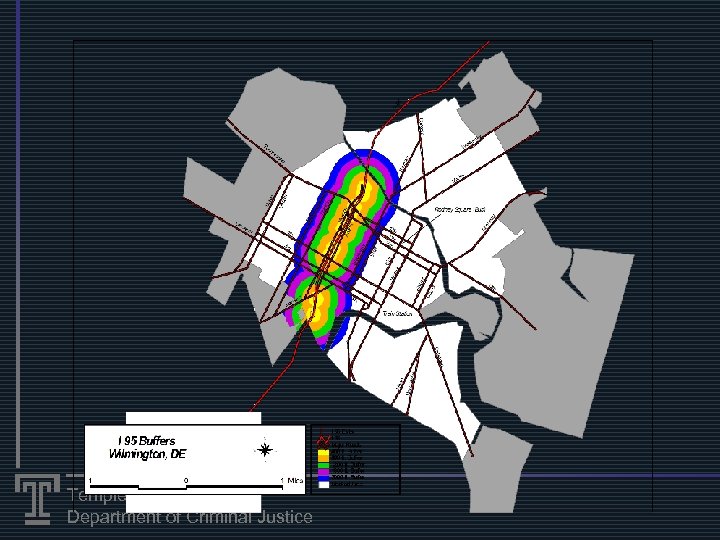
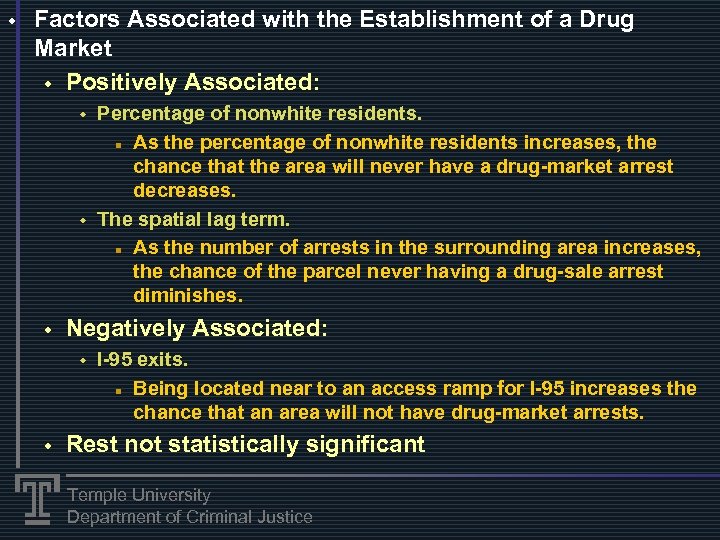 w Factors Associated with the Establishment of a Drug Market w Positively Associated: w w w Negatively Associated: w w Percentage of nonwhite residents. n As the percentage of nonwhite residents increases, the chance that the area will never have a drug-market arrest decreases. The spatial lag term. n As the number of arrests in the surrounding area increases, the chance of the parcel never having a drug-sale arrest diminishes. I-95 exits. n Being located near to an access ramp for I-95 increases the chance that an area will not have drug-market arrests. Rest not statistically significant Temple University Department of Criminal Justice
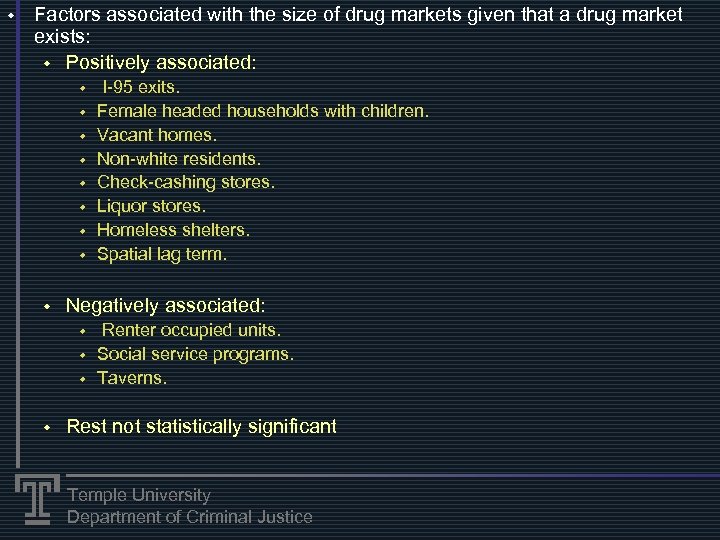 w Factors associated with the size of drug markets given that a drug market exists: w Positively associated: w w w w w Negatively associated: w w I-95 exits. Female headed households with children. Vacant homes. Non-white residents. Check-cashing stores. Liquor stores. Homeless shelters. Spatial lag term. Renter occupied units. Social service programs. Taverns. Rest not statistically significant Temple University Department of Criminal Justice
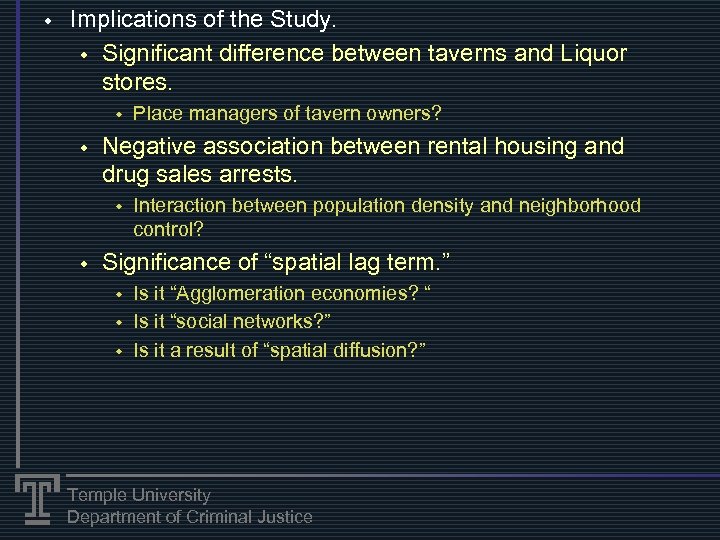 w Implications of the Study. w Significant difference between taverns and Liquor stores. w w Negative association between rental housing and drug sales arrests. w w Place managers of tavern owners? Interaction between population density and neighborhood control? Significance of “spatial lag term. ” w w w Is it “Agglomeration economies? “ Is it “social networks? ” Is it a result of “spatial diffusion? ” Temple University Department of Criminal Justice
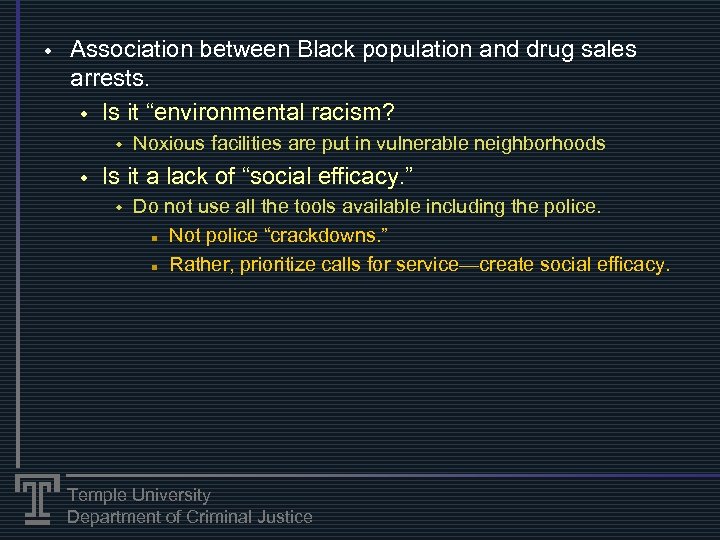 w Association between Black population and drug sales arrests. w Is it “environmental racism? w w Noxious facilities are put in vulnerable neighborhoods Is it a lack of “social efficacy. ” w Do not use all the tools available including the police. n Not police “crackdowns. ” n Rather, prioritize calls for service—create social efficacy. Temple University Department of Criminal Justice
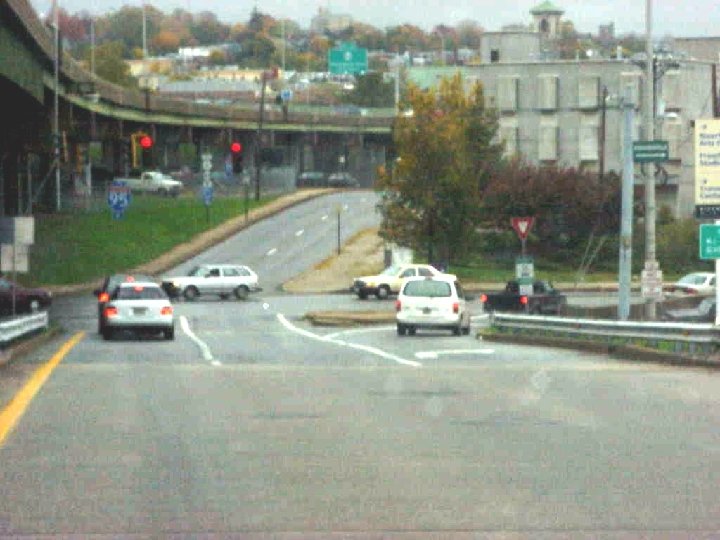
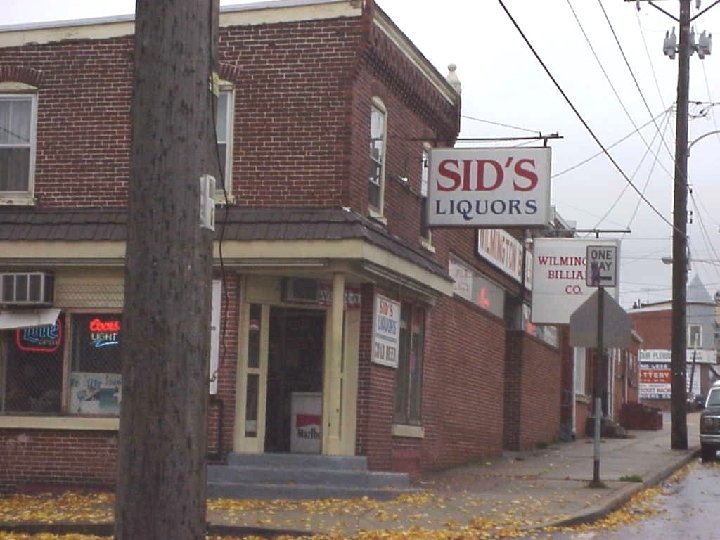
 w Clearly what is needed at this point is contextual analysis to determine interaction effects. w We especially see this in the I-95 access. w w w We also see this in the difference between taverns and liquor stores. w w w Not all are bad. But if is bad, is very bad as size of market illustrates. Notice that the difference between location quotients is not great for taverns. n Indicates they might locate in bad areas rather than attracting drug sales. Liquor stores have greater difference in LQ. In order to obtain contextual variables, can use GIS to visualize: Temple University Department of Criminal Justice
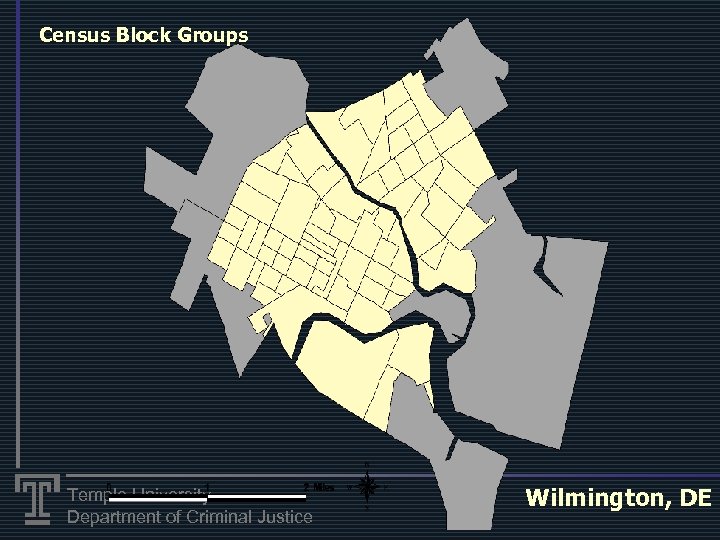 Census Block Groups Temple University Department of Criminal Justice Wilmington, DE
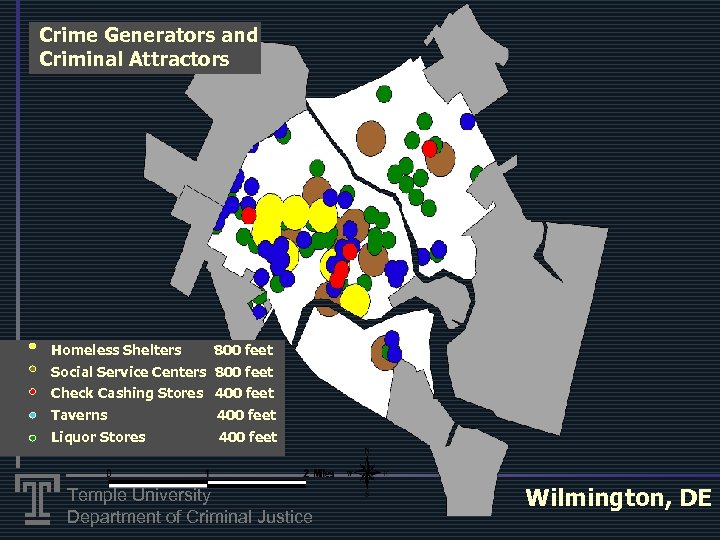 Crime Generators and Criminal Attractors Homeless Shelters 800 feet Social Service Centers 800 feet Check Cashing Stores 400 feet Taverns 400 feet Liquor Stores 400 feet Temple University Department of Criminal Justice Wilmington, DE
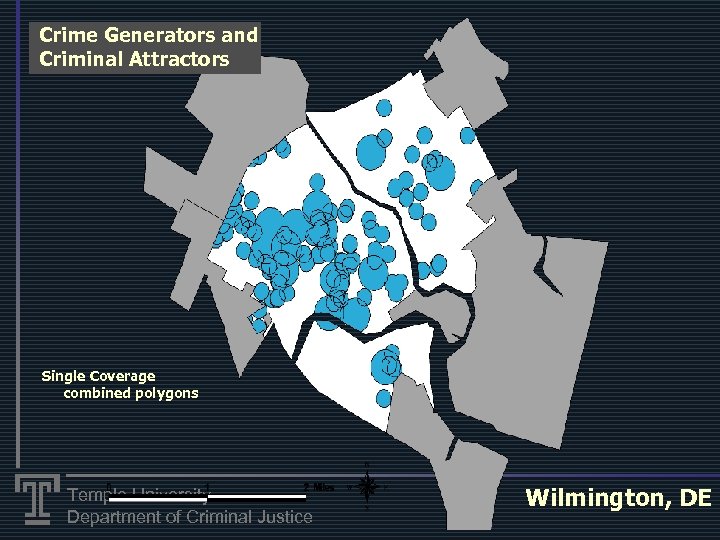 Crime Generators and Criminal Attractors Single Coverage combined polygons Temple University Department of Criminal Justice Wilmington, DE
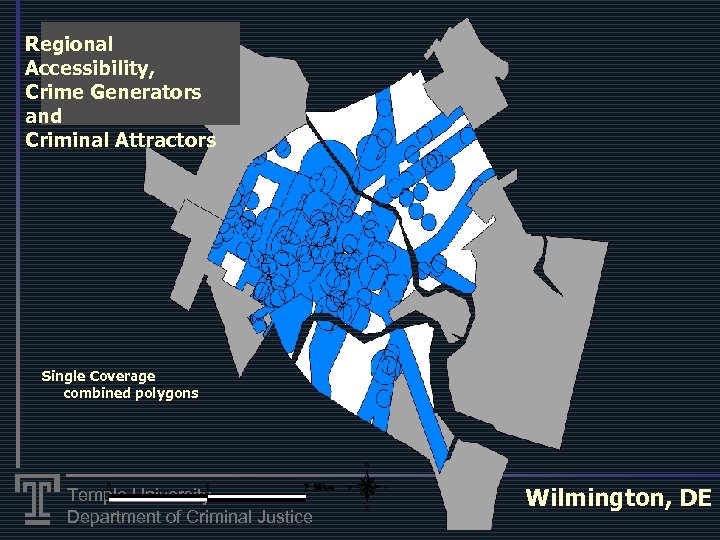 Regional Accessibility, Crime Generators and Criminal Attractors Single Coverage combined polygons Temple University Department of Criminal Justice Wilmington, DE
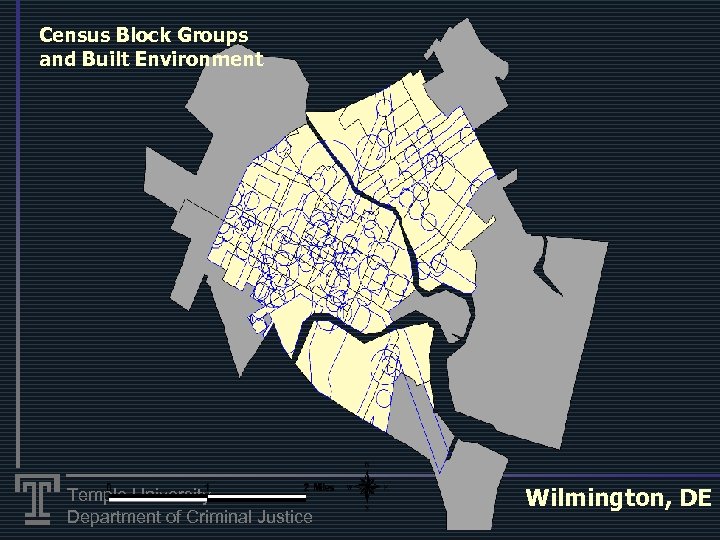 Census Block Groups and Built Environment Temple University Department of Criminal Justice Wilmington, DE
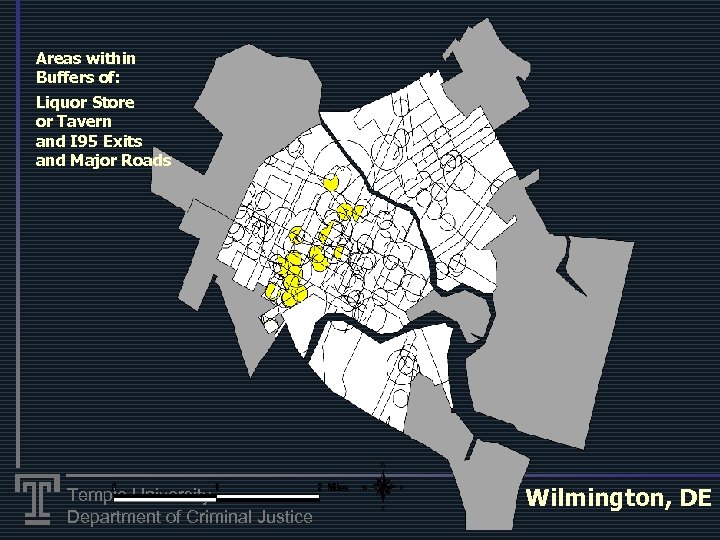 Areas within Buffers of: Liquor Store or Tavern and I 95 Exits and Major Roads Temple University Department of Criminal Justice Wilmington, DE
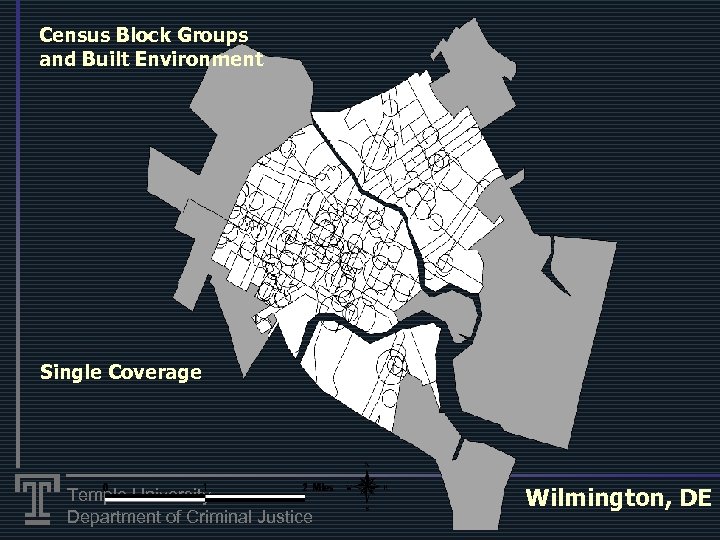 Census Block Groups and Built Environment Single Coverage Temple University Department of Criminal Justice Wilmington, DE
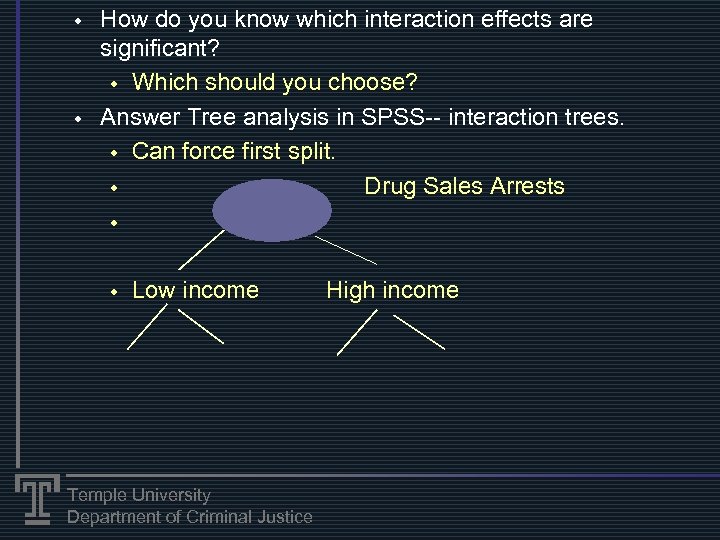 w w How do you know which interaction effects are significant? w Which should you choose? Answer Tree analysis in SPSS-- interaction trees. w Can force first split. w Drug Sales Arrests w w Low income Temple University Department of Criminal Justice High income