


 Скачать презентацию SPARC use-cases and results Requirements and Controller Architecture
568515ba449f5954d149fb8e76c4e176.ppt
- Количество слайдов: 43
 SPARC: use-cases and results Requirements and Controller Architecture Wolfgang John wolfgang. john@ericsson. com November 23 th 2012
 Split Architecture for Carrier-Grade Networks. Ø EU FP 7 Project Ø Start date: July 2010; End date: November 2012 (1 week ago …) Ø 6 Partners: = 23. 11. 2012 ER Kista SPARC @ ACREO ER Budapest
 Split Architecture for Carrier-Grade Networks. Ø Mission: Applying Software Defined Networking (SDN) to operator networks Ø Results Ø 23 publications, presentations and demos (GENI engineering conference, World Telecommunication Congress, Globecom, etc. ) Ø Standardization impact in ONF and IRTF Ø Key Project Deliverables Ø D 2. 2: Use cases, requirements, techno-economic study (CAPEX and OPEX), business environment Ø D 3. 3: Main technical document, study of architecture and required extensions Ø D 4. 2: Documentation of specific Open. Flow extensions Ø D 4. 3: Technical documentation of implementation and prototyping activities Ø D 5. 2: Results of validation and performance evaluation Ø Movie: Summarizing the most important demo’s Ø (Soon) all to find on: http: //www. fp 7 -sparc. eu 23. 11. 2012 SPARC @ ACREO 3
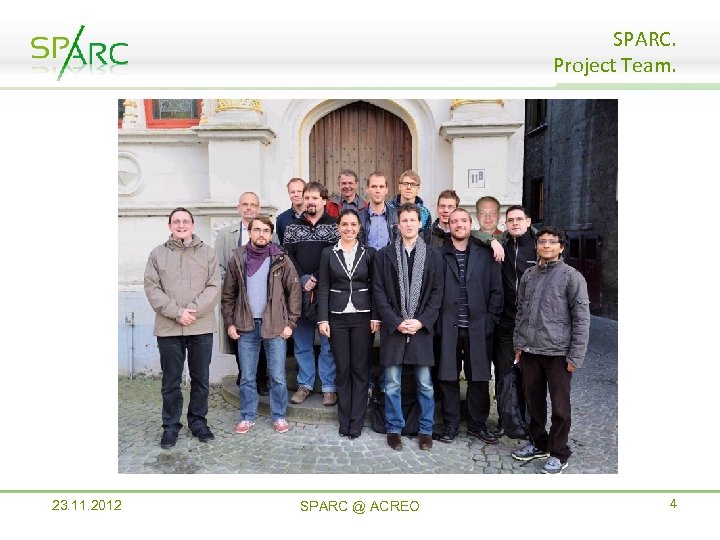 SPARC. Project Team. 23. 11. 2012 SPARC @ ACREO 4
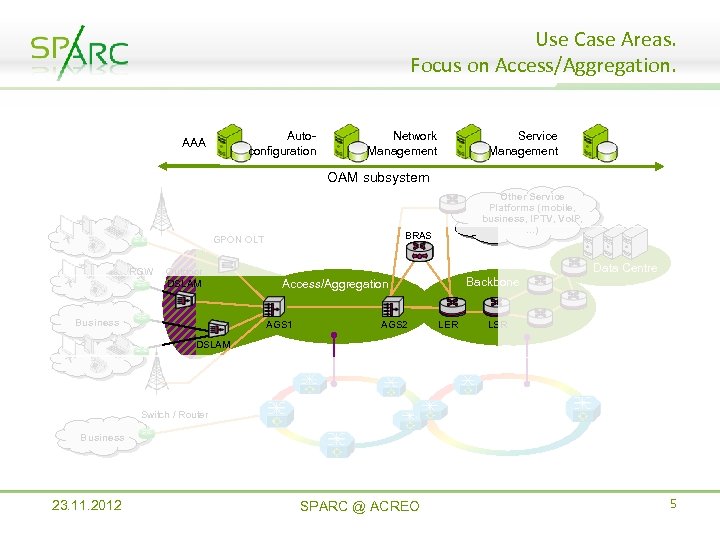 Use Case Areas. Focus on Access/Aggregation. Autoconfiguration AAA Network Management Service Management OAM subsystem BRAS GPON OLT RGW Outdoor DSLAM Business Other Service Platforms (mobile, business, IPTV, Vo. IP, . . . ) Data Centre Backbone Access/Aggregation AGS 1 AGS 2 LER LSR DSLAM Switch / Router Optical transport Business 23. 11. 2012 SPARC @ ACREO 5
 SPARC. Main Objectives. Ø The vision of SPARC is to define, implement & evaluate a scalable carrier class Split Architecture. Ø Seven objectives of SPARC, with the three main objectives highlighted: Ø Definition of typical use cases for Split Architecture (D 2. 2) Ø Analysis and description of business potential (D 2. 2) Ø Definition of Split Architecture blueprint (D 3. 3) Ø Extension of the Open. Flow protocol (D 3. 3 and D 4. 2) Ø Development of SPARC prototype (D 4. 3) Ø Validation of SPARC prototype (D 5. 2) Ø Exploitation of results (papers, demos, presentations, videos) 23. 11. 2012 SPARC @ ACREO 6
 SPARC Objectives. Carrier-grade. Ø What is carrier-grade? Ø Scalability Ø Support large-scale deployments for carrier-grade networks. E. g. a controller shall be able to control forwarding devices that could count in the order of hundreds. Ø Availability and Reliability Ø The availability of networking services shall be equivalent to that of traditional technologies. Ø Network and service management Ø The ability to monitor, diagnose and centrally manage the network Ø Quality of Service Ø Allowing the assurance of SLAs using Qo. S guarantees for service attributes (e. g. rate, loss, delay) and service isolation Ø Support for legacy technology Ø allowing deployment of new services in parallel to existing legacy protocol stacks 23. 11. 2012 SPARC @ ACREO 7
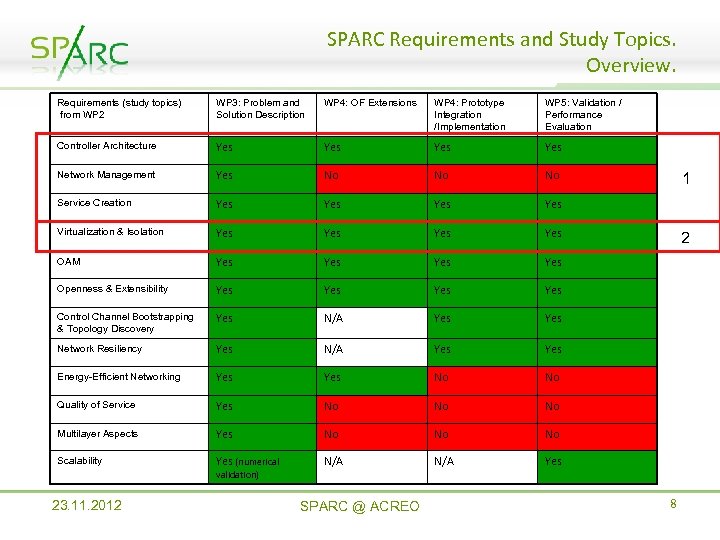 SPARC Requirements and Study Topics. Overview. Requirements (study topics) from WP 2 WP 3: Problem and Solution Description WP 4: OF Extensions WP 4: Prototype Integration /Implementation WP 5: Validation / Performance Evaluation Controller Architecture Yes Yes Network Management Yes No No No Service Creation Yes Yes Virtualization & Isolation Yes Yes OAM Yes Yes Openness & Extensibility Yes Yes Control Channel Bootstrapping & Topology Discovery Yes N/A Yes Network Resiliency Yes N/A Yes Energy-Efficient Networking Yes No No Quality of Service Yes No No No Multilayer Aspects Yes No No No Scalability Yes (numerical N/A Yes validation) 23. 11. 2012 SPARC @ ACREO 1 2 8
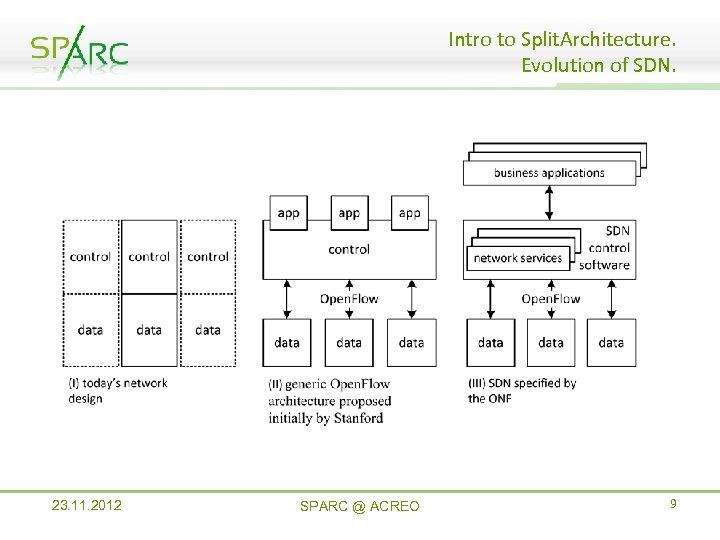 Intro to Split. Architecture. Evolution of SDN. 23. 11. 2012 SPARC @ ACREO 9
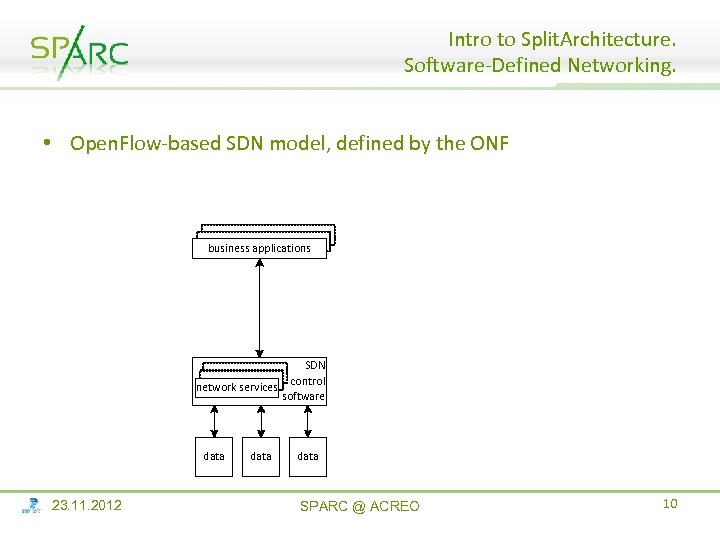 Intro to Split. Architecture. Software-Defined Networking. • Open. Flow-based SDN model, defined by the ONF business applications SDN control network services software data 23. 11. 2012 data SPARC @ ACREO 10
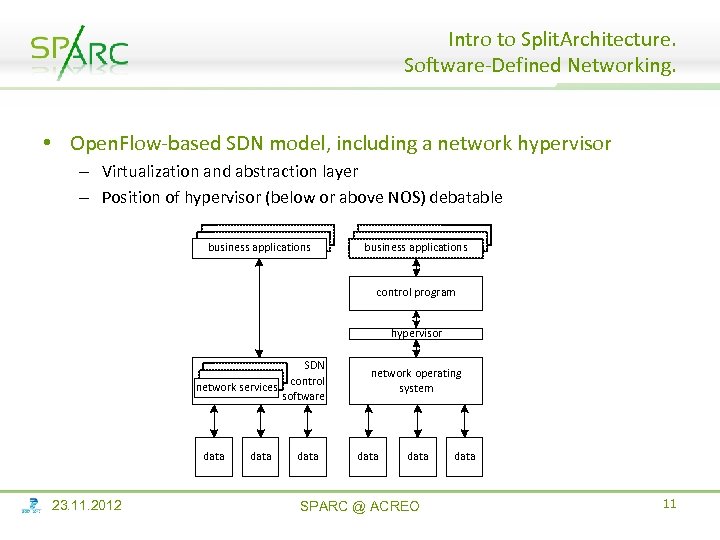 Intro to Split. Architecture. Software-Defined Networking. • Open. Flow-based SDN model, including a network hypervisor – Virtualization and abstraction layer – Position of hypervisor (below or above NOS) debatable business applications control program hypervisor SDN control network services software data 23. 11. 2012 data network operating system data SPARC @ ACREO data 11
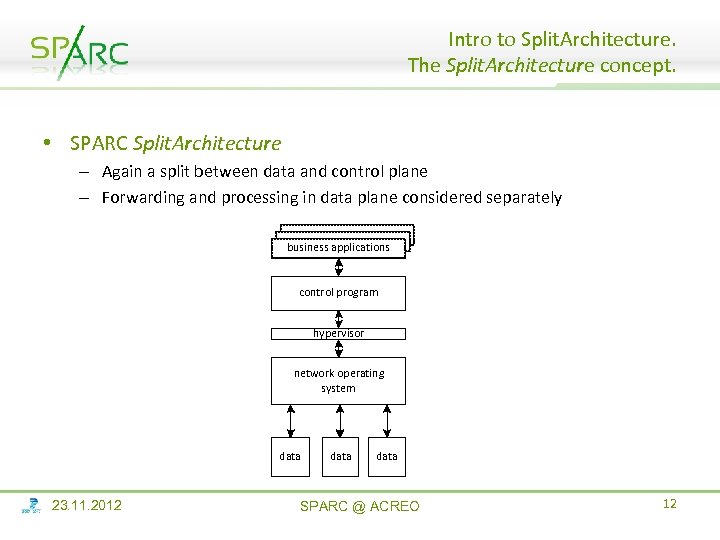 Intro to Split. Architecture. The Split. Architecture concept. • SPARC Split. Architecture – Again a split between data and control plane – Forwarding and processing in data plane considered separately business applications control program hypervisor network operating system data 23. 11. 2012 data SPARC @ ACREO 12
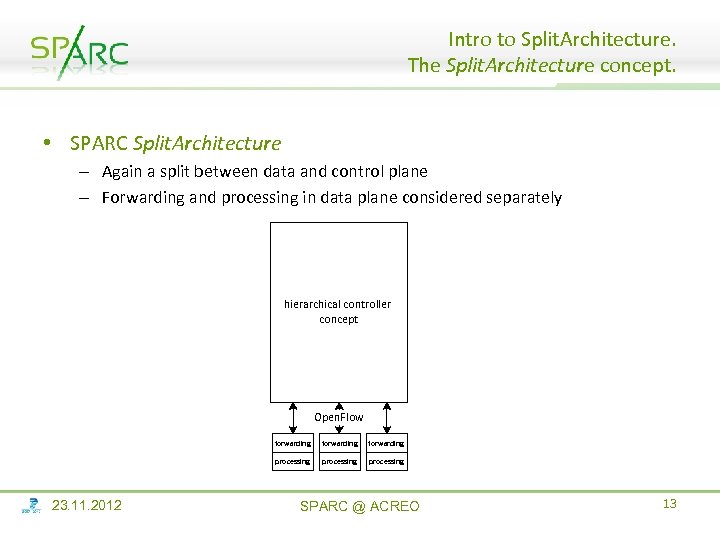 Intro to Split. Architecture. The Split. Architecture concept. • SPARC Split. Architecture – Again a split between data and control plane – Forwarding and processing in data plane considered separately hierarchical controller concept Open. Flow forwarding processing 23. 11. 2012 forwarding processing SPARC @ ACREO 13
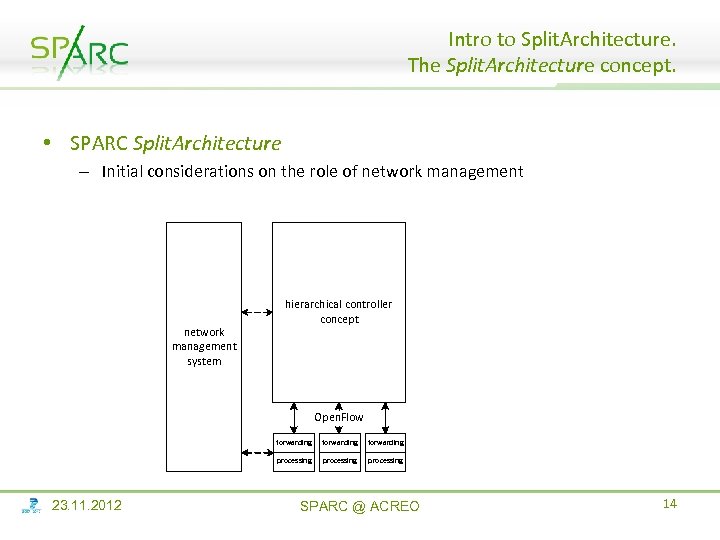 Intro to Split. Architecture. The Split. Architecture concept. • SPARC Split. Architecture – Initial considerations on the role of network management system hierarchical controller concept Open. Flow forwarding processing 23. 11. 2012 forwarding processing SPARC @ ACREO 14
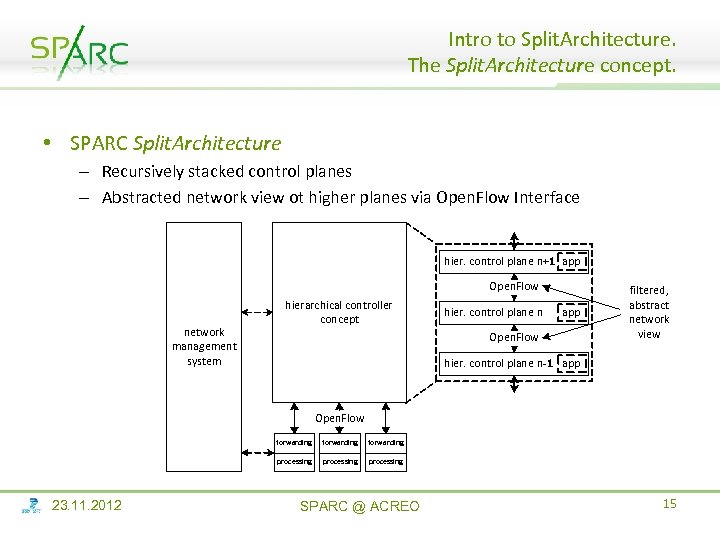 Intro to Split. Architecture. The Split. Architecture concept. • SPARC Split. Architecture – Recursively stacked control planes – Abstracted network view ot higher planes via Open. Flow Interface hier. control plane n+1 app Open. Flow network management system hierarchical controller concept hier. control plane n app Open. Flow filtered, abstract network view hier. control plane n-1 app Open. Flow forwarding processing 23. 11. 2012 forwarding processing SPARC @ ACREO 15
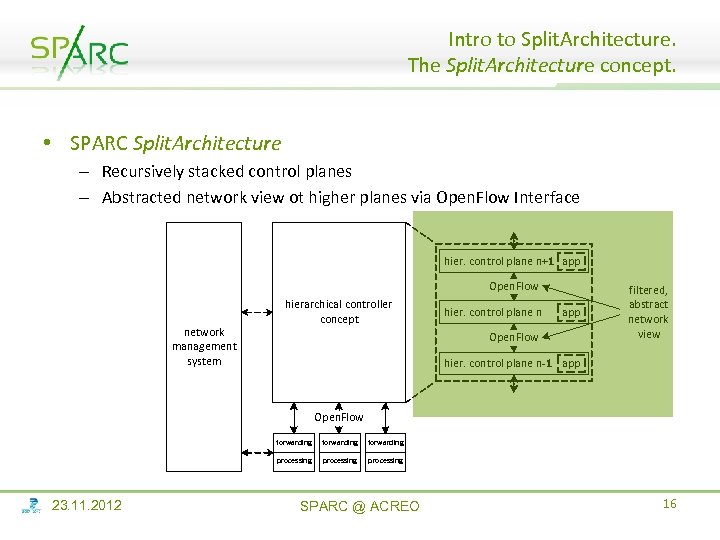 Intro to Split. Architecture. The Split. Architecture concept. • SPARC Split. Architecture – Recursively stacked control planes – Abstracted network view ot higher planes via Open. Flow Interface hier. control plane n+1 app Open. Flow network management system hierarchical controller concept hier. control plane n app Open. Flow filtered, abstract network view hier. control plane n-1 app Open. Flow forwarding processing 23. 11. 2012 forwarding processing SPARC @ ACREO 16
 Hierarchical controller. Design goals. • Goals for a carrier-grade control layer: – Increase flexibility • Adapt control architecture to use-cases and business models • Distribute the control layer to adapt to network capabilities • Allowing both cross-layering and strict layering of control logic – Increase scalability • Operator networks are complex -> divide and conquer the problem space – Allow smooth migration • Supporting control protocol operations with legacy domains 23. 11. 2012 SPARC @ ACREO 17
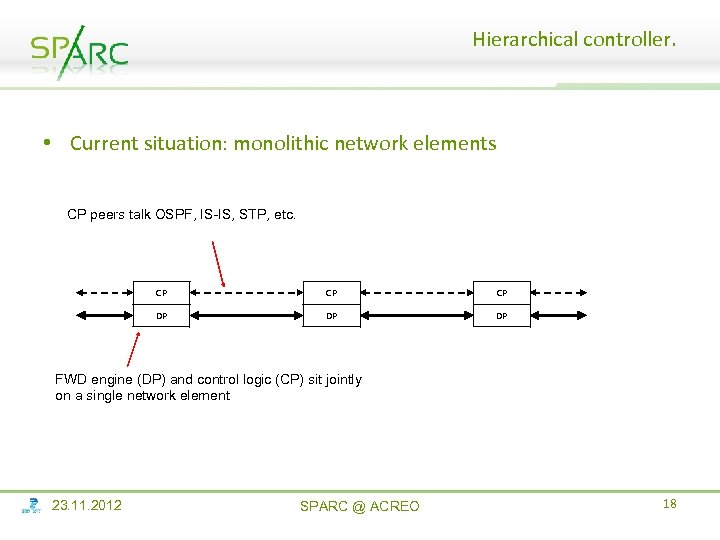 Hierarchical controller. • Current situation: monolithic network elements CP peers talk OSPF, IS-IS, STP, etc. CP CP CP DP DP DP FWD engine (DP) and control logic (CP) sit jointly on a single network element 23. 11. 2012 SPARC @ ACREO 18
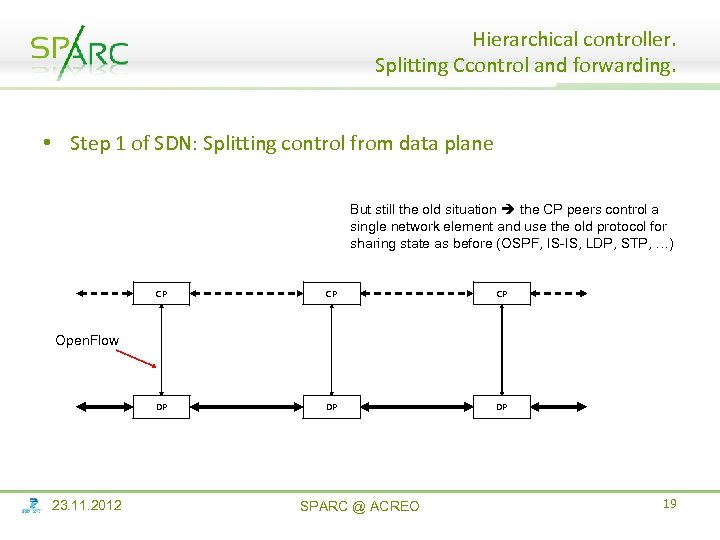 Hierarchical controller. Splitting Ccontrol and forwarding. • Step 1 of SDN: Splitting control from data plane But still the old situation the CP peers control a single network element and use the old protocol for sharing state as before (OSPF, IS-IS, LDP, STP, …) CP CP CP DP DP DP Open. Flow 23. 11. 2012 SPARC @ ACREO 19
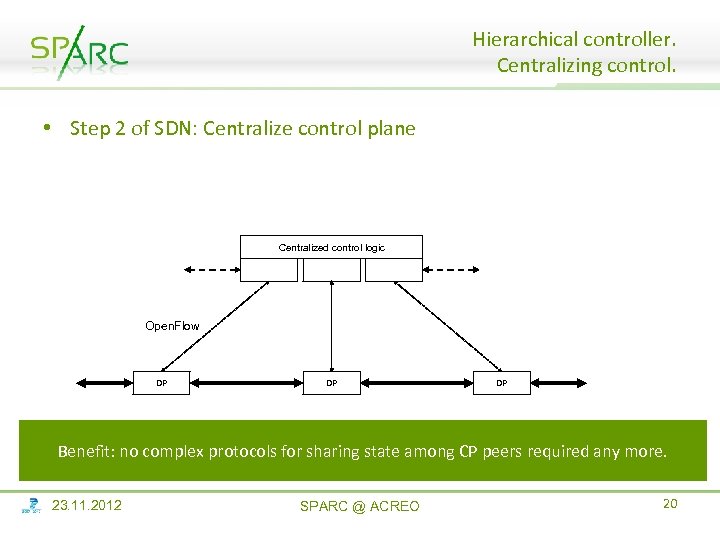 Hierarchical controller. Centralizing control. • Step 2 of SDN: Centralize control plane Centralized control logic Open. Flow DP DP DP Benefit: no complex protocols for sharing state among CP peers required any more. 23. 11. 2012 SPARC @ ACREO 20
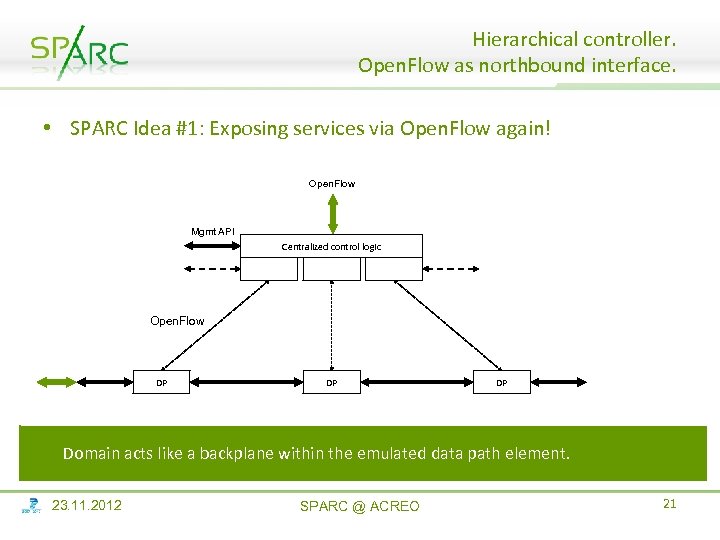 Hierarchical controller. Open. Flow as northbound interface. • SPARC Idea #1: Exposing services via Open. Flow again! Open. Flow Mgmt API Centralized control logic Open. Flow DP DP DP Domain acts like a backplane within the emulated data path element. 23. 11. 2012 SPARC @ ACREO 21
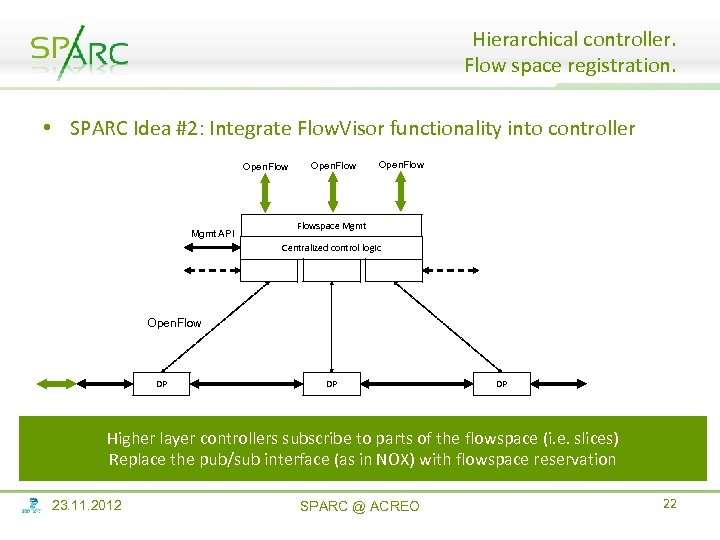 Hierarchical controller. Flow space registration. • SPARC Idea #2: Integrate Flow. Visor functionality into controller Open. Flow Mgmt API Open. Flowspace Mgmt Centralized control logic Open. Flow DP DP DP Higher layer controllers subscribe to parts of the flowspace (i. e. slices) Replace the pub/sub interface (as in NOX) with flowspace reservation 23. 11. 2012 SPARC @ ACREO 22
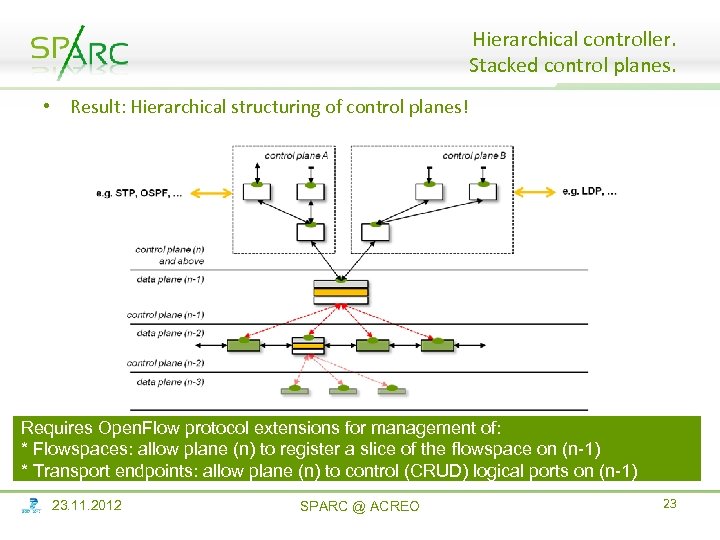 Hierarchical controller. Stacked control planes. • Result: Hierarchical structuring of control planes! Requires Open. Flow protocol extensions for management of: * Flowspaces: allow plane (n) to register a slice of the flowspace on (n-1) * Transport endpoints: allow plane (n) to control (CRUD) logical ports on (n-1) 23. 11. 2012 SPARC @ ACREO 23
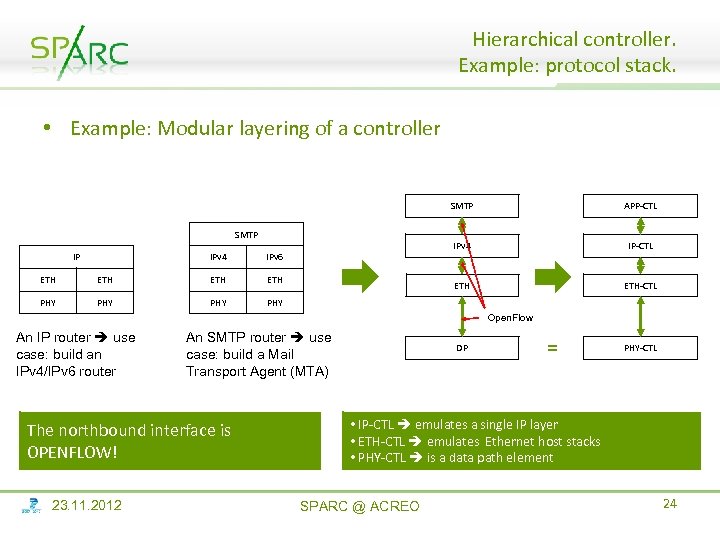 Hierarchical controller. Example: protocol stack. • Example: Modular layering of a controller SMTP IPv 4 IPv 6 ETH ETH PHY PHY IP-CTL ETH SMTP APP-CTL ETH-CTL PHY Open. Flow An IP router use case: build an IPv 4/IPv 6 router An SMTP router use case: build a Mail Transport Agent (MTA) The northbound interface is OPENFLOW! 3/19/2018 23. 11. 2012 DP = PHY-CTL • IP-CTL emulates a single IP layer • ETH-CTL emulates Ethernet host stacks • PHY-CTL is a data path element SPARC @ ACREO 24
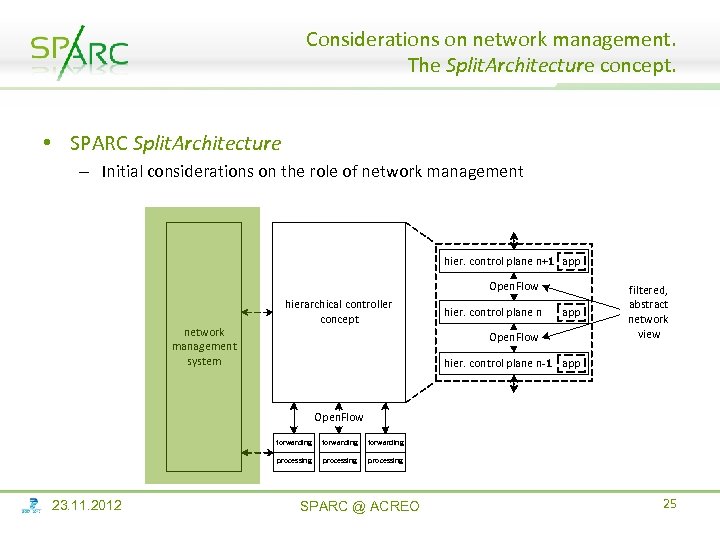 Considerations on network management. The Split. Architecture concept. • SPARC Split. Architecture – Initial considerations on the role of network management hier. control plane n+1 app Open. Flow network management system hierarchical controller concept hier. control plane n app Open. Flow filtered, abstract network view hier. control plane n-1 app Open. Flow forwarding processing 23. 11. 2012 forwarding processing SPARC @ ACREO 25
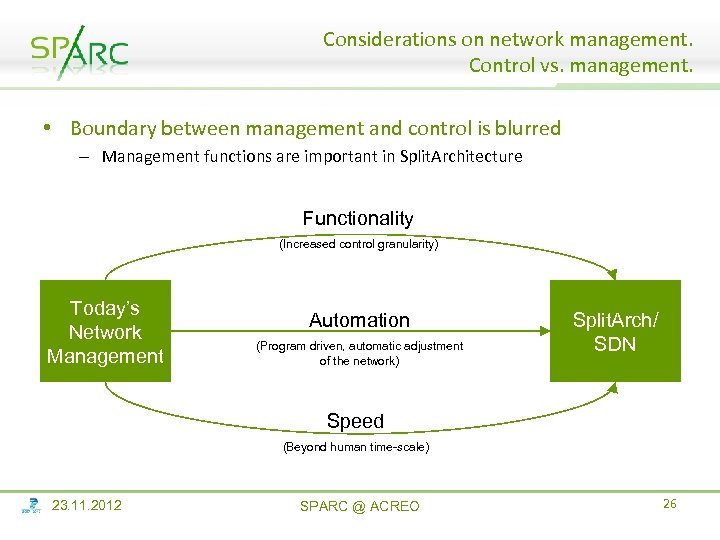 Considerations on network management. Control vs. management. • Boundary between management and control is blurred – Management functions are important in Split. Architecture Functionality (Increased control granularity) Today’s Network Management Automation (Program driven, automatic adjustment of the network) Split. Arch/ SDN Speed (Beyond human time-scale) 23. 11. 2012 SPARC @ ACREO 26
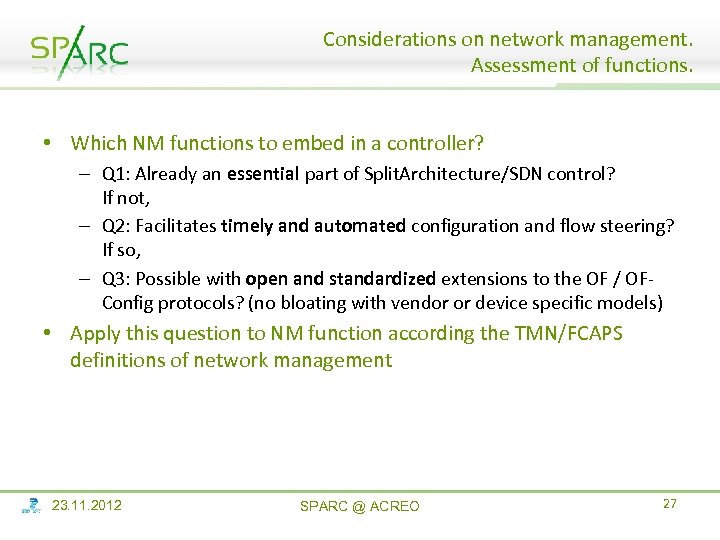 Considerations on network management. Assessment of functions. • Which NM functions to embed in a controller? – Q 1: Already an essential part of Split. Architecture/SDN control? If not, – Q 2: Facilitates timely and automated configuration and flow steering? If so, – Q 3: Possible with open and standardized extensions to the OF / OFConfig protocols? (no bloating with vendor or device specific models) • Apply this question to NM function according the TMN/FCAPS definitions of network management 23. 11. 2012 SPARC @ ACREO 27
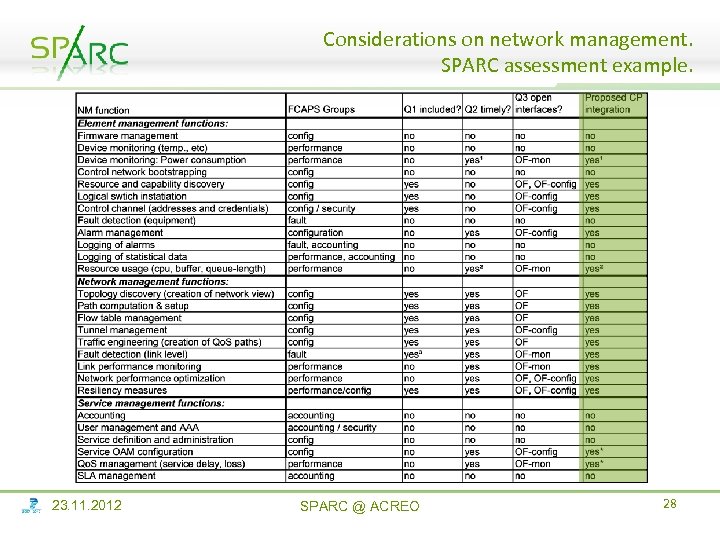 Considerations on network management. SPARC assessment example. 23. 11. 2012 SPARC @ ACREO 28
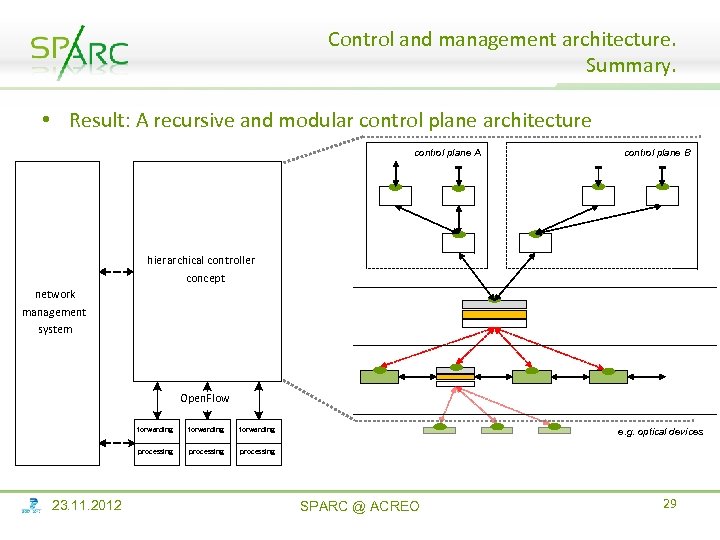 Control and management architecture. Summary. • Result: A recursive and modular control plane architecture control plane A control plane B hierarchical controller concept network management system Open. Flow forwarding processing 23. 11. 2012 forwarding processing e. g. optical devices SPARC @ ACREO 29
 SPARC: use-cases and results SPARC prototype implementations Wolfgang John wolfgang. john@ericsson. com November 23 th 2012
 Seamless MPLS aka carrier grade packet transport • Seamless MPLS “…architecture which can be used to extend MPLS networks to integrate access and aggregation networks into a single MPLS domain…” draft-leymann-mpls-seamless-mpls-03 Forklifting access/aggregation to MPLS may be too expensive apply SDN principles for Seamless MPLS 23. 11. 2012 SPARC @ ACREO 31
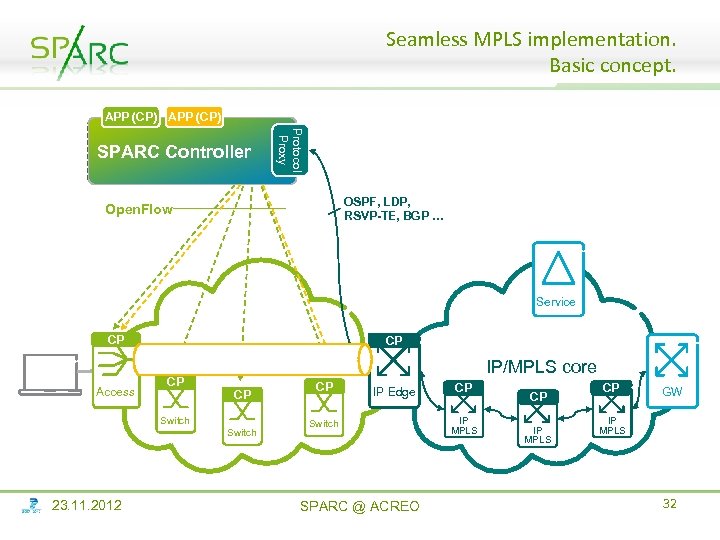 Seamless MPLS implementation. Basic concept. APP (CP) Protocol Proxy Central element SPARC Controller OSPF, LDP, RSVP-TE, BGP … Open. Flow Service CP Access CP CP Aggregation CP Switch 23. 11. 2012 IP/MPLS core CP IP Edge Switch SPARC @ ACREO CP IP MPLS CP GW IP MPLS 32
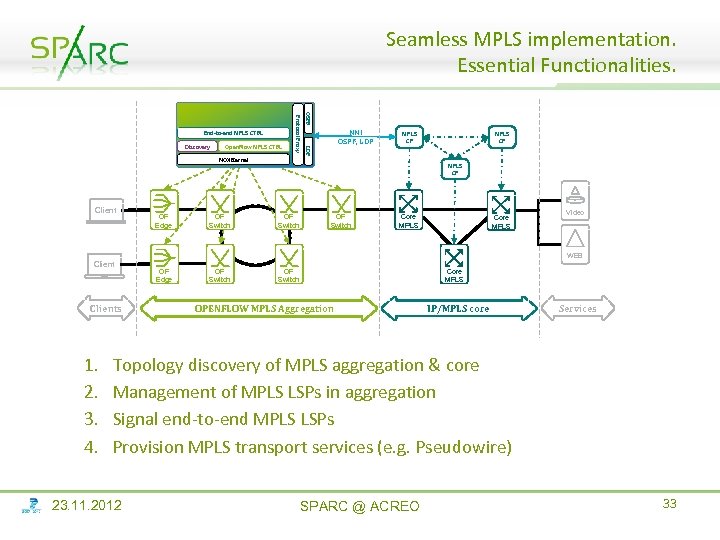 Seamless MPLS implementation. Essential Functionalities. NOX Kernel Client OF Edge OF Switch NNI OSPF, LDP Open. Flow MPLS CTRL Protocol Proxy Discovery OSPF End-to-end SPARC Controller MPLS CTRL MPLS CP OF Switch Core MPLS Video WEB Clients 1. 2. 3. 4. OF Edge OF Switch Core MPLS OPENFLOW MPLS Aggregation IP/MPLS core Services Topology discovery of MPLS aggregation & core Management of MPLS LSPs in aggregation Signal end-to-end MPLS LSPs Provision MPLS transport services (e. g. Pseudowire) 23. 11. 2012 SPARC @ ACREO 33
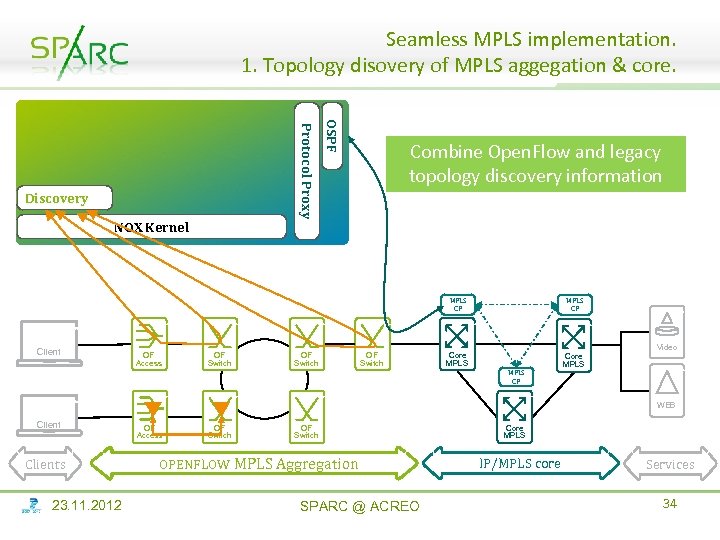 Seamless MPLS implementation. 1. Topology disovery of MPLS aggegation & core. NOX Kernel OSPF Protocol Proxy Discovery Combine Open. Flow and legacy topology discovery information MPLS CP Client OF Access OF Switch MPLS CP Core MPLS Video MPLS CP WEB Clients 23. 11. 2012 OF Access OF Switch OPENFLOW MPLS Aggregation SPARC @ ACREO Core MPLS IP/MPLS core Services 34
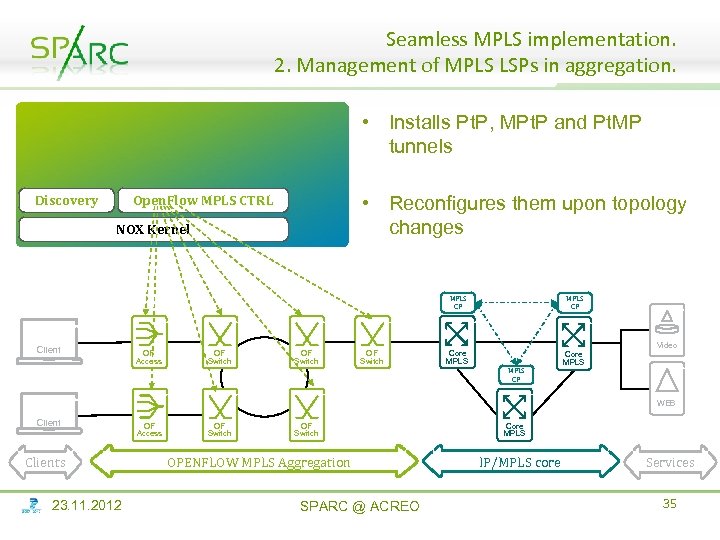 Seamless MPLS implementation. 2. Management of MPLS LSPs in aggregation. • Installs Pt. P, MPt. P and Pt. MP tunnels SPARC Controller • Reconfigures them upon topology changes Open. Flow MPLS CTRL Discovery NOX Kernel MPLS CP Client OF Access OF Switch MPLS CP Core MPLS Video MPLS CP WEB Clients 23. 11. 2012 OF Access OF Switch OPENFLOW MPLS Aggregation SPARC @ ACREO Core MPLS IP/MPLS core Services 35
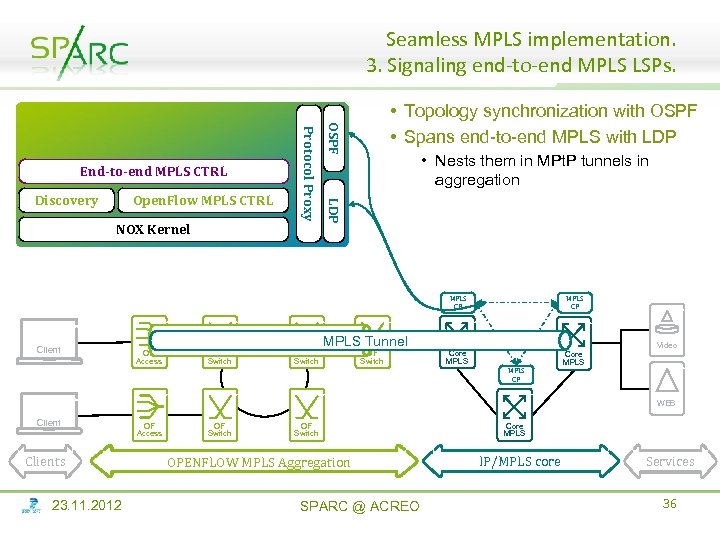 Seamless MPLS implementation. 3. Signaling end-to-end MPLS LSPs. • Nests them in MPt. P tunnels in aggregation LDP NOX Kernel OSPF Open. Flow MPLS CTRL Discovery Protocol Proxy End-to-end MPLS SPARC Controller CTRL • Topology synchronization with OSPF • Spans end-to-end MPLS with LDP MPLS CP Client MPLS Tunnel OF Access OF Switch MPLS CP Core MPLS Tunnel OF Switch Video MPLS CP WEB Clients 23. 11. 2012 OF Access OF Switch OPENFLOW MPLS Aggregation SPARC @ ACREO Core MPLS IP/MPLS core Services 36
 Split-BRAS • Split-BRAS is complex and expensive integrated node since it must handle all subscriber traffic, hence it must cope with continuously increasing capacity need, this means increasing cost Traditional way of deploying BRAS will not scale apply SDN principles to distribute BRAS functionality 23. 11. 2012 SPARC @ ACREO 37
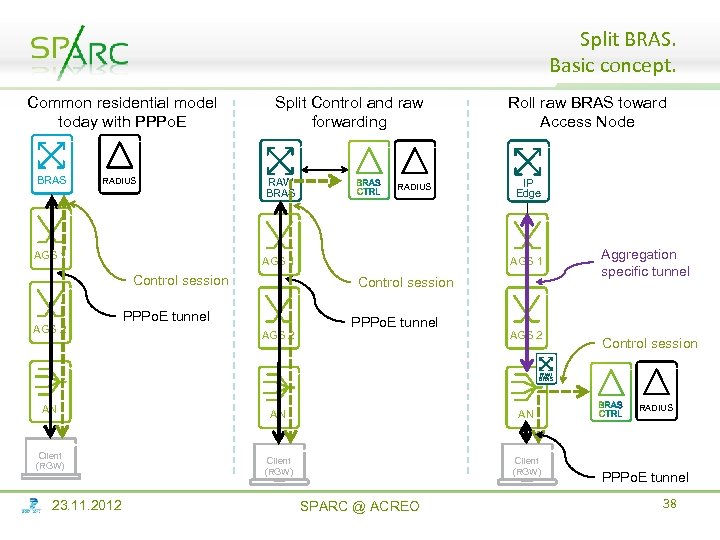 Split BRAS. Basic concept. Common residential model today with PPPo. E BRAS RADIUS AGS 1 Split Control and raw forwarding RAW BRAS AGS 1 Control session AGS 2 RADIUS Roll raw BRAS toward Access Node IP Edge AGS 1 Control session PPPo. E tunnel AGS 2 Aggregation specific tunnel Control session RAW BRAS AN Client (RGW) 23. 11. 2012 AN AN Client (RGW) SPARC @ ACREO RADIUS PPPo. E tunnel 38
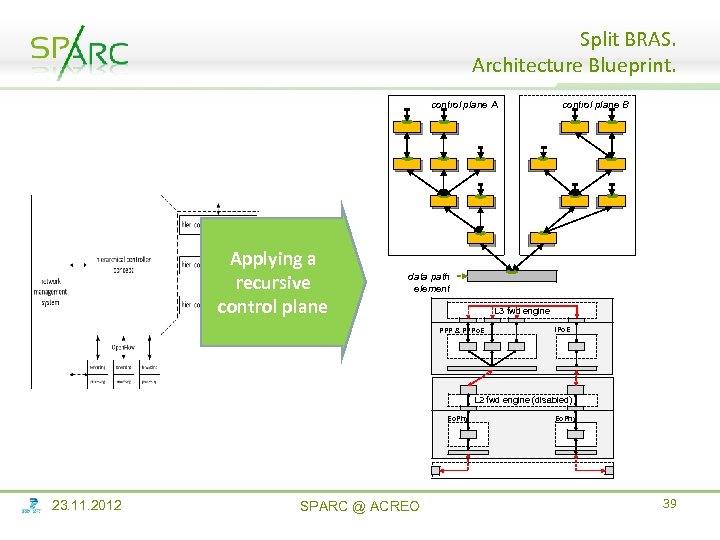 Split BRAS. Architecture Blueprint. control plane A Applying a recursive control plane B data path element L 3 fwd engine PPP & PPPo. E IPo. E L 2 fwd engine (disabled) Eo. Phy 23. 11. 2012 SPARC @ ACREO Eo. Phy 39
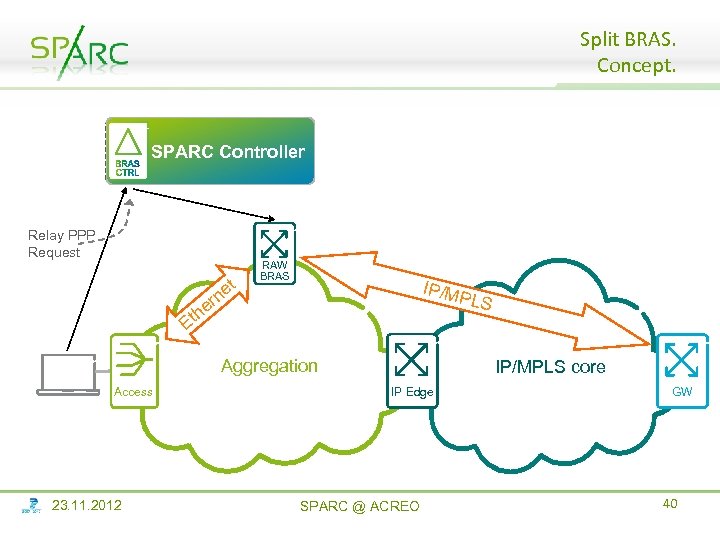 Split BRAS. Concept. Central element SPARC Controller Relay PPP Request t Et e rn he RAW BRAS IP/M PLS Aggregation Access 23. 11. 2012 IP/MPLS core IP Edge SPARC @ ACREO GW 40
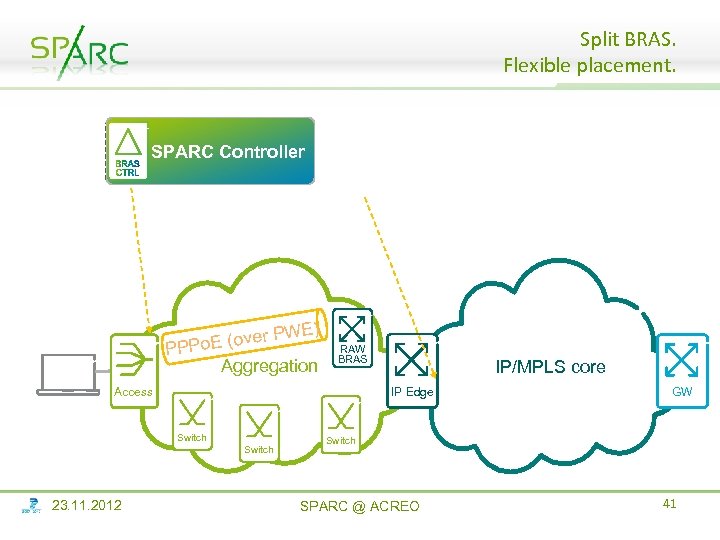 Split BRAS. Flexible placement. Central element SPARC Controller E) (over PW PPPo. E Aggregation RAW BRAS IP Edge Access Switch 23. 11. 2012 IP/MPLS core GW Switch SPARC @ ACREO 41
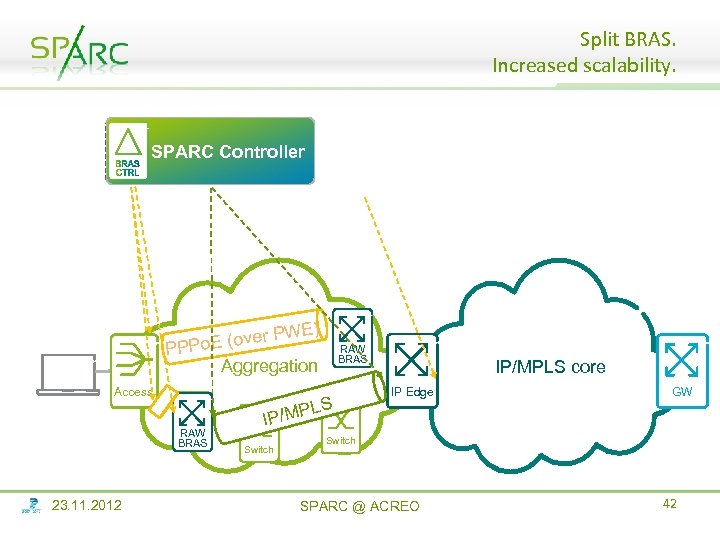 Split BRAS. Increased scalability. Central element SPARC Controller E) (over PW PPPo. E Aggregation Access RAW Switch BRAS 23. 11. 2012 RAW BRAS S /MPL IP Switch IP/MPLS core IP Edge GW Switch SPARC @ ACREO 42
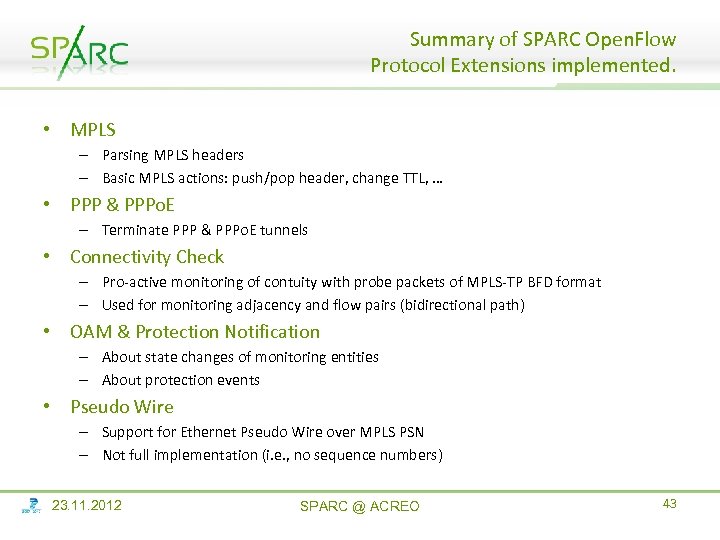 Summary of SPARC Open. Flow Protocol Extensions implemented. • MPLS – Parsing MPLS headers – Basic MPLS actions: push/pop header, change TTL, … • PPP & PPPo. E – Terminate PPP & PPPo. E tunnels • Connectivity Check – Pro-active monitoring of contuity with probe packets of MPLS-TP BFD format – Used for monitoring adjacency and flow pairs (bidirectional path) • OAM & Protection Notification – About state changes of monitoring entities – About protection events • Pseudo Wire – Support for Ethernet Pseudo Wire over MPLS PSN – Not full implementation (i. e. , no sequence numbers) 23. 11. 2012 SPARC @ ACREO 43