


 Скачать презентацию SPACESUIT KNOWLEDGE CAPTURE SESSIONS Development of the Spacesuit
70f002d99fe776ed1d1f52e4ed1f4ddb.ppt
- Количество слайдов: 50
 SPACESUIT KNOWLEDGE CAPTURE SESSIONS Development of the Spacesuit for the Skylab SL-2 through SL-4 Missions and Suited Missions Experience James W Mc. Barron II Retired NASA JSC March 25, 2015 1
 SPACESUIT KNOWLEDGE CAPTURE SESSIONS Today - “Development of the Spacesuit for the Skylab SL-2 through SL-4 Missions and Suited Missions Experience. ” Completed - “Apollo A-7 LB Spacesuit Development for Apollo 15 -17 Missions, ” February 2015. - “Apollo A-7 L Spacesuit Development for Apollo 7 -14 Missions, ” January 2015. - “Apollo Block I Spacesuit Development and Apollo Block II Spacesuit Competition, ” January 2013. - “Spacesuit Development and Qualification for Project Gemini, ” December 2012. - “Spacesuit Development and Qualification for Project Mercury, ” November 2012. jmcbarron 2
 TODAY’S AGENDA • Background - Skylab Program Baseline • Requirements - Spacesuit Interface Definition Study • Apollo A-7 LB Extravehicular (EV) Spacesuit Modifications - Design Configuration - Verification Testing • Skylab 1 through 4 Missions - Skylab Emergency - Suited Experience • Lessons Learned • References jmcbarron 3
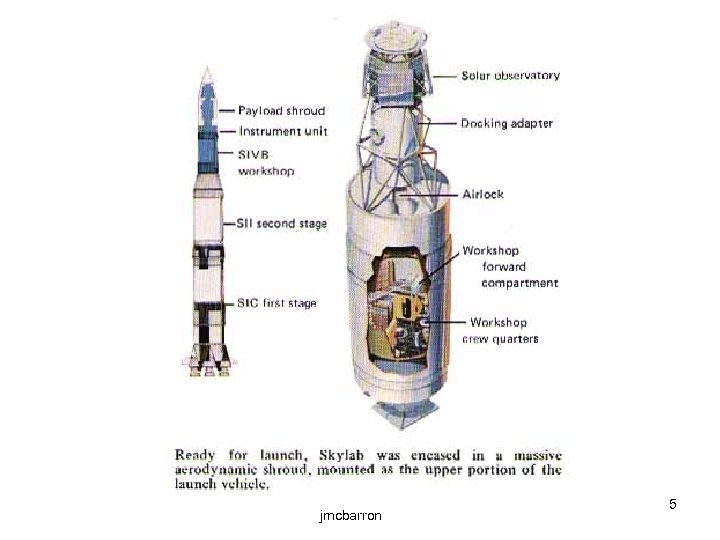
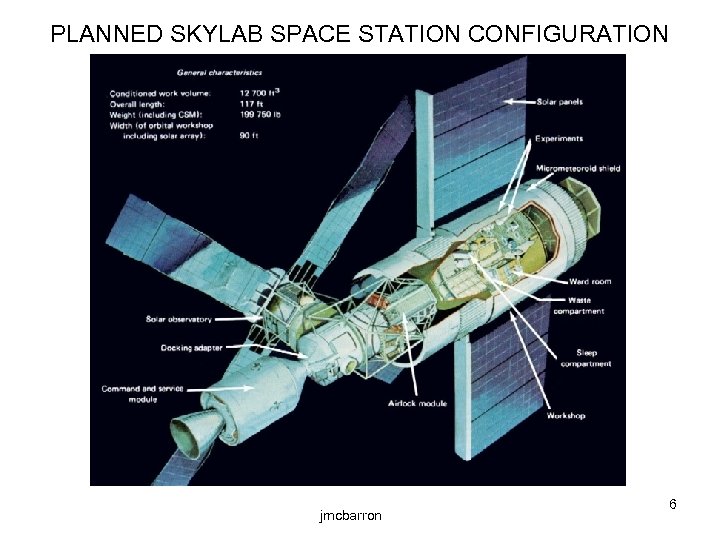
 SKYLAB PROGRAM BASELINE • Program provided one unmanned (SL-1) and three manned (SL-2 through SL-4) launches. • SL-1 Unmanned Launch Configuration - Skylab cluster encased in an aerodynamic shroud launched on a two-stage Saturn V launch vehicle. • SL-1 Earth Orbit Operations - Solar observatory rotated to face the Sun. - Orbital workshop solar array extended after shroud jettisoned. - Micrometeoroid shield fitted snugly around the orbital workshop is extended outward. - Shield to provide workshop protection from micrometeoroids and the sun to keep inside temperatures to a habitable level. jmcbarron 4
 jmcbarron 5
 PLANNED SKYLAB SPACE STATION CONFIGURATION jmcbarron 6
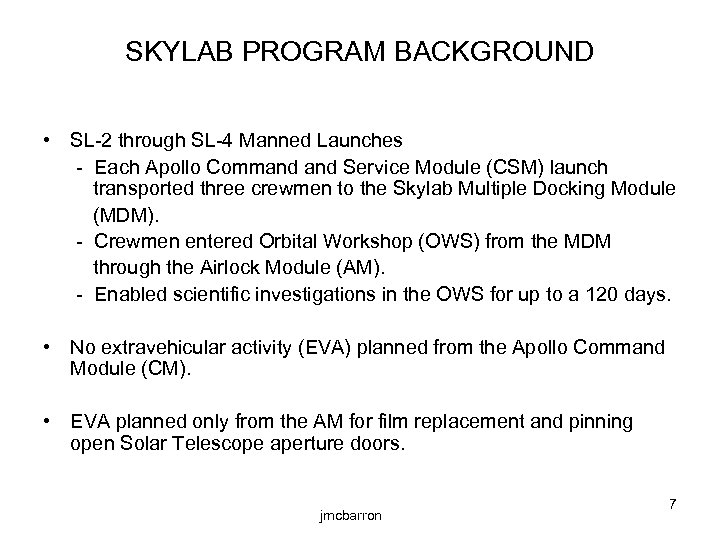 SKYLAB PROGRAM BACKGROUND • SL-2 through SL-4 Manned Launches - Each Apollo Command Service Module (CSM) launch transported three crewmen to the Skylab Multiple Docking Module (MDM). - Crewmen entered Orbital Workshop (OWS) from the MDM through the Airlock Module (AM). - Enabled scientific investigations in the OWS for up to a 120 days. • No extravehicular activity (EVA) planned from the Apollo Command Module (CM). • EVA planned only from the AM for film replacement and pinning open Solar Telescope aperture doors. jmcbarron 7
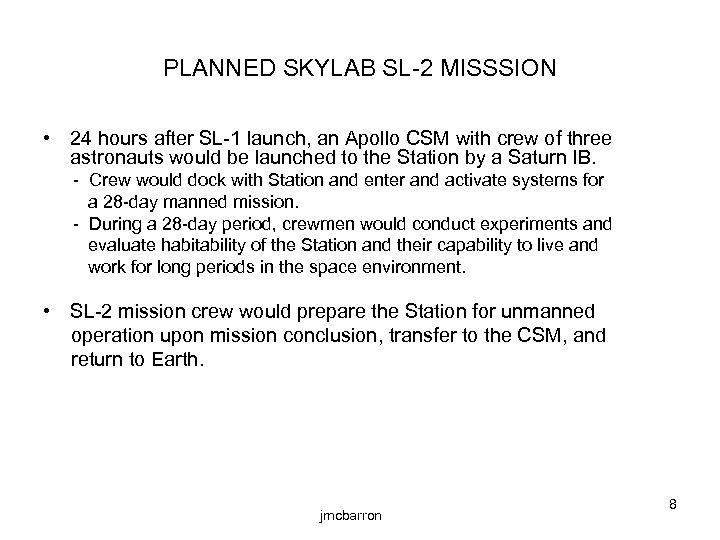 PLANNED SKYLAB SL-2 MISSSION • 24 hours after SL-1 launch, an Apollo CSM with crew of three astronauts would be launched to the Station by a Saturn IB. - Crew would dock with Station and enter and activate systems for a 28 -day manned mission. - During a 28 -day period, crewmen would conduct experiments and evaluate habitability of the Station and their capability to live and work for long periods in the space environment. • SL-2 mission crew would prepare the Station for unmanned operation upon mission conclusion, transfer to the CSM, and return to Earth. jmcbarron 8
 PLANNED SKYLAB SL-3 MISSION • 60 days following return of the SL-2 crew, a second crew of three astronauts would launch to, rendezvous, and dock with the orbiting Station. • Crew would perform extensive work in solar astronomy and Earth resources observations during a 56 -day mission. • Upon mission conclusion, the crew would prepare the station for unmanned operation, transfer to the CSM, and return to Earth. jmcbarron 9
 PLANNED SKYLAB SL-4 MISSION • 30 days following the return of the SL-3 crew, the third manned mission would be launched to the Station. • Additional scientific experiments were to be performed, and additional data would be obtained on the crew's adaptability and performance in the orbital environment. • Upon conclusion of the Sl-4 mission, the crew would prepare the Station for unmanned operation, transfer to the CSM, and return to Earth. jmcbarron 10
 SPACESUIT INTERFACE DEFINITION STUDY • NASA JSC Crew Systems Division initiated study to identify Skylab system to spacesuit interface requirements in 1969. • Study was conducted by ILC Industries under NASA JSC Contract NAS 9 -6100. • System interfaces included in study: - Skylab Station developed under NASA Marshall Space Flight Center (MSFC) contract with Mc. Donnell Aircraft Corporation. - Government Furnished Equipment (GFE) Astronaut Life Support Assembly (ALSA) developed under NASA JSC contract with Air Research Corporation. jmcbarron 11
 IDENTIFIED INTERFACE REQUIREMENTS • Apollo CM – Interfaces same as for Apollo 7 through 17 missions. • Orbital Space Station and Workshop - Provide crewmen intravehicular transfer into/from the combination Station Multiple Docking Module (MDM) and AM, and the Apollo CM. - Provide crewmen EVA from the AM. - Provide OWS spacesuit equipment post use drying and stowage. - Provide ground communication and instrumentation with CM, OWS, and ALSA. - Provide crewmen vacuum transfer between the AM and ALSA without loss of suit pressure. - Provide crewman restraint in OWS and AM EVA foot restraints. jmcbarron 12
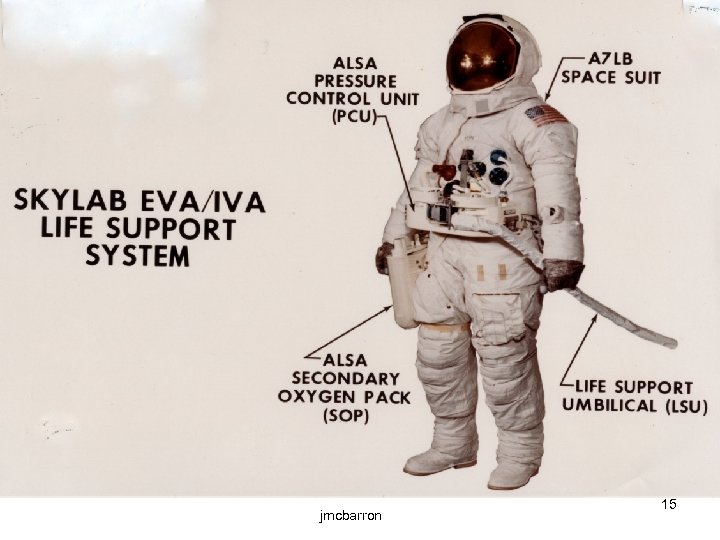
 IDENTIFIED INTERFACE REQUIREMENTS • ALSA - Self donning and doffing with attachment provision for the chestmounted Pressure Control Unit (PCU). - Attachment of PCU ventilation inlet and outlet oxygen, Liquid Cooling Garment (LCG) water, and electrical communication and biomedical instrumentation connectors. - Self donning and doffing and attachment of a leg-mounted Secondary Oxygen Pack (SOP). - Self donning and doffing, and self connect-disconnect-reconnect for all spacesuit connectors (gas, water, urine, and electrical) and an oxygen purge valve. jmcbarron 13
 IDENTIFIED INTERFACE REQUIREMENTS • Spacesuit - Latest in-production and flight certified configuration A-7 LB EV Pressure Garment Assembly (PGA) and components recommended as baseline spacesuit configuration. - Provide adequate crewman mobility and visibility for selfoperation of necessary CM, AM, and ALSA controls. - Provide vacuum transfer capability between the spacesuit and CM Environmental Control System (ECS). - In-suit urine transfer to OWS waste storage. - Spacesuit drying and stowage in the OWS. jmcbarron 14
 jmcbarron 15
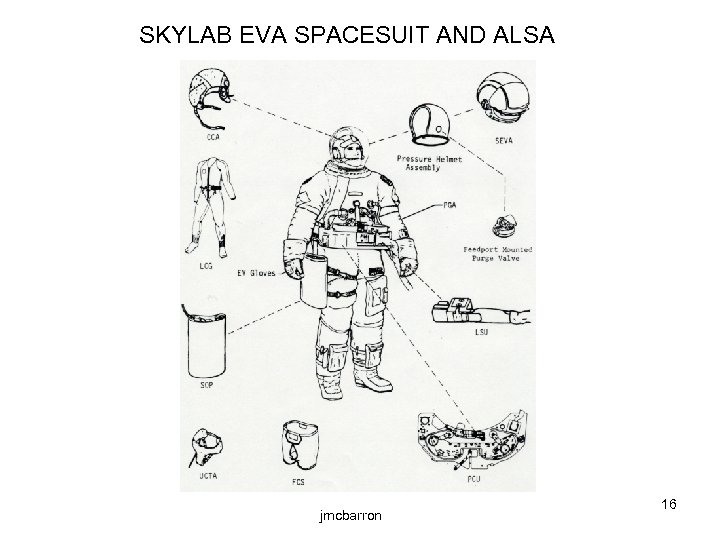 SKYLAB EVA SPACESUIT AND ALSA jmcbarron 16
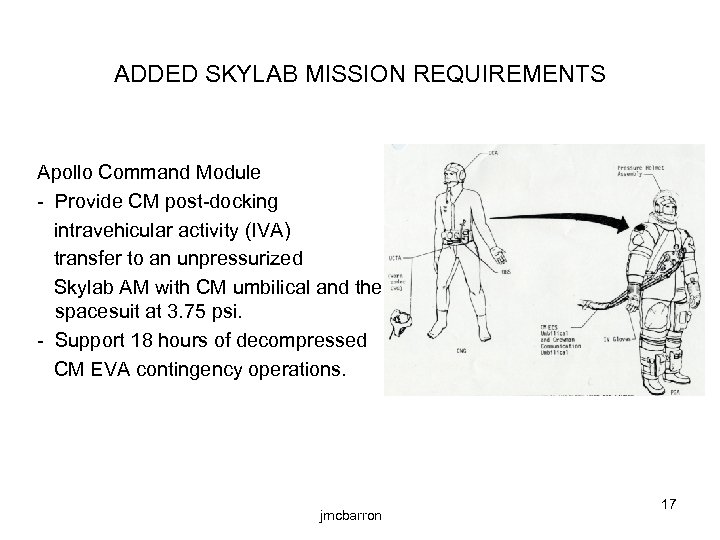 ADDED SKYLAB MISSION REQUIREMENTS Apollo Command Module - Provide CM post-docking intravehicular activity (IVA) transfer to an unpressurized Skylab AM with CM umbilical and the spacesuit at 3. 75 psi. - Support 18 hours of decompressed CM EVA contingency operations. jmcbarron 17
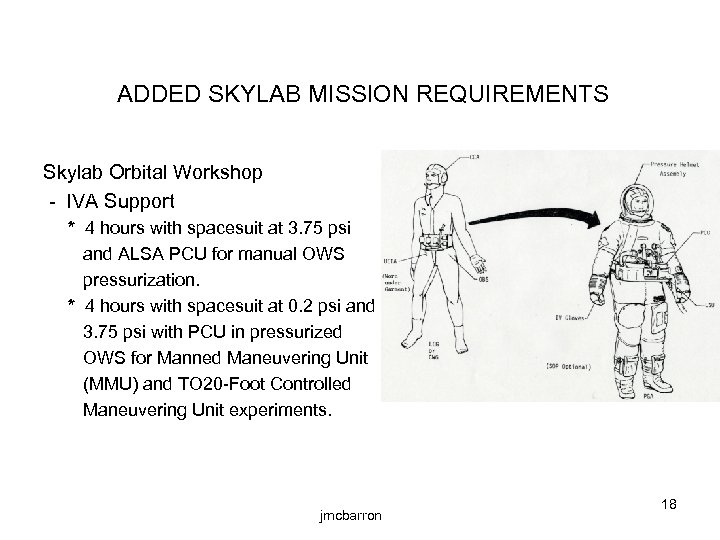 ADDED SKYLAB MISSION REQUIREMENTS Skylab Orbital Workshop - IVA Support * 4 hours with spacesuit at 3. 75 psi and ALSA PCU for manual OWS pressurization. * 4 hours with spacesuit at 0. 2 psi and 3. 75 psi with PCU in pressurized OWS for Manned Maneuvering Unit (MMU) and TO 20 -Foot Controlled Maneuvering Unit experiments. jmcbarron 18
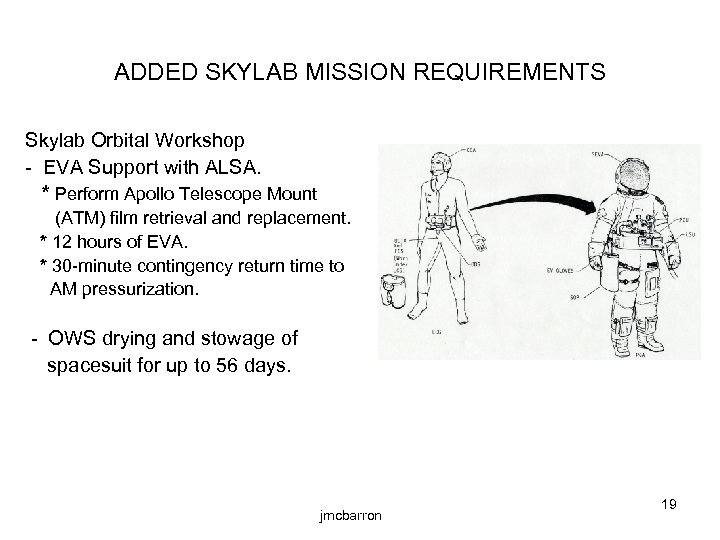 ADDED SKYLAB MISSION REQUIREMENTS Skylab Orbital Workshop - EVA Support with ALSA. * Perform Apollo Telescope Mount (ATM) film retrieval and replacement. * 12 hours of EVA. * 30 -minute contingency return time to AM pressurization. - OWS drying and stowage of spacesuit for up to 56 days. jmcbarron 19
 CHANGED ILC CONTRACT DELIVERY REQUIREMENTS • • Conduct manned design verification test (DVT) and Life Cycle Certification testing of A-7 LB EV spacesuit configuration changes. Support manned ALSA interface and certification testing, and crewman training at vacuum and thermal/vacuum at NASA MSC. Support manned CM vacuum and OWS interface tests at NASA Kennedy Space Center (KSC). Support launch at NASA KSC and NASA MSC in-flight mission analysis. jmcbarron 20
 CHANGED APOLLO ENVIRONMENTAL REQUIREMENTS • Lunar Surface Environment - Requirements deleted • Earth Orbital Environment - Thermal vacuum and micrometeorite exposure - Solar light and space darkness visibility jmcbarron 21
 ADDED OR CHANGED APOLLO DESIGN REQUIREMENTS • PGA - Helmet-mounted integral oxygen purge valve and feed port for emergency CO 2 control and in-suit nourishment. - Integrated covering over torso limb suit assembly (TLSA) to provide flammability and Earth orbital thermal/micrometeoroid protection. - Interface provision for boots attachment to OWS foot restraints. - Lanyard added to pressure sealing closure to aid self donning. - ALSA PCU attachment bracket replaced upper Apollo Portable Life Support System (PLSS) bracket. - Lower Apollo PLSS attachment bracket deleted. - Arm wrist tether attachment added. jmcbarron 22
 ADDED OR CHANGED APOLLO DESIGN REQUIREMENTS • LCG - Provide water cooling during suited OWS IVA/EVA from ALSA PCU and OWS umbilical. - Tubing compatibility for OWS water recharge. - OWS drying and 56 days stowage. • Extravehicular Visor Assembly - Less severe Earth orbital thermal environment requirement allowing redesign to reduce cost by elimination of thermal collar and replacement of the Polysonfone sun visor material with Polycarbonate. - Capability to replace visors in-flight. - Apollo 11 -17 Lunar Extravehicular Visor Assembly (LEVA) redesign name change to Skylab Extravehicular Visor Assembly (SEVA). jmcbarron 23
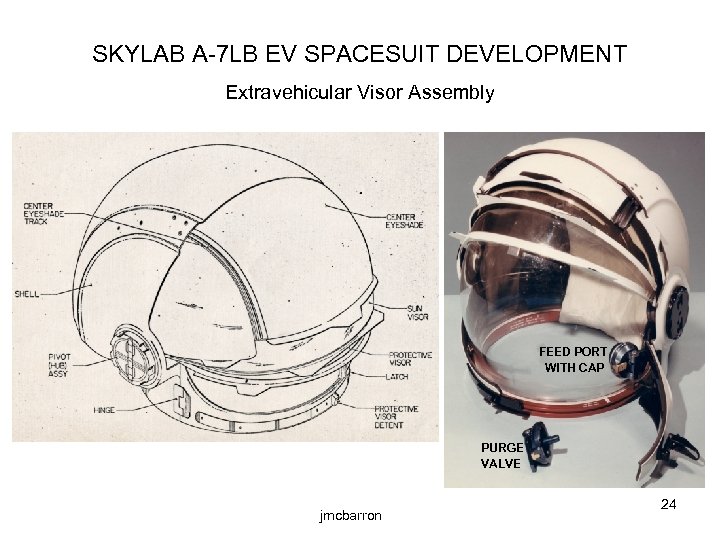 SKYLAB A-7 LB EV SPACESUIT DEVELOPMENT Extravehicular Visor Assembly FEED PORT WITH CAP PURGE VALVE jmcbarron 24
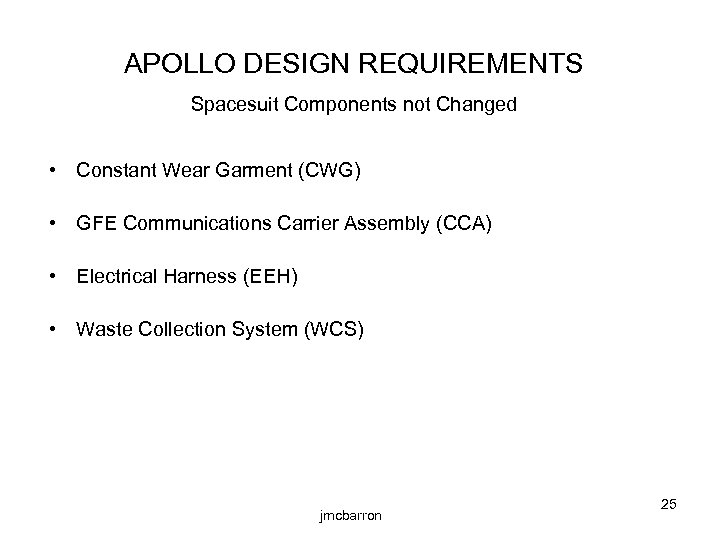 APOLLO DESIGN REQUIREMENTS Spacesuit Components not Changed • Constant Wear Garment (CWG) • GFE Communications Carrier Assembly (CCA) • Electrical Harness (EEH) • Waste Collection System (WCS) jmcbarron 25
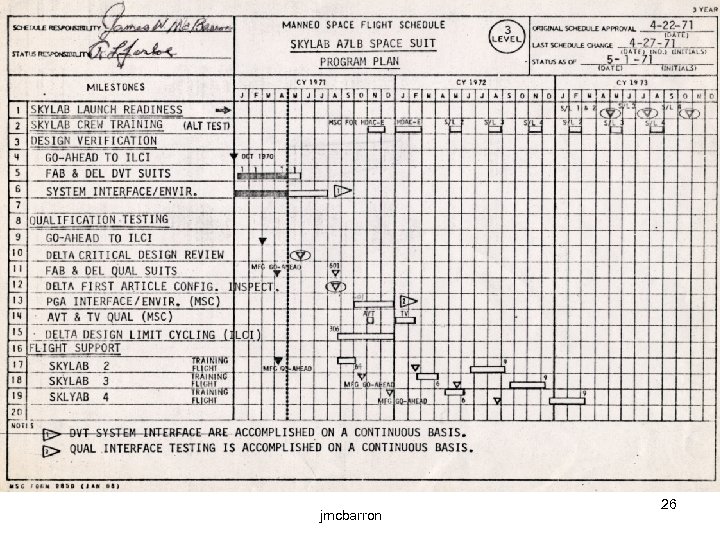 jmcbarron 26
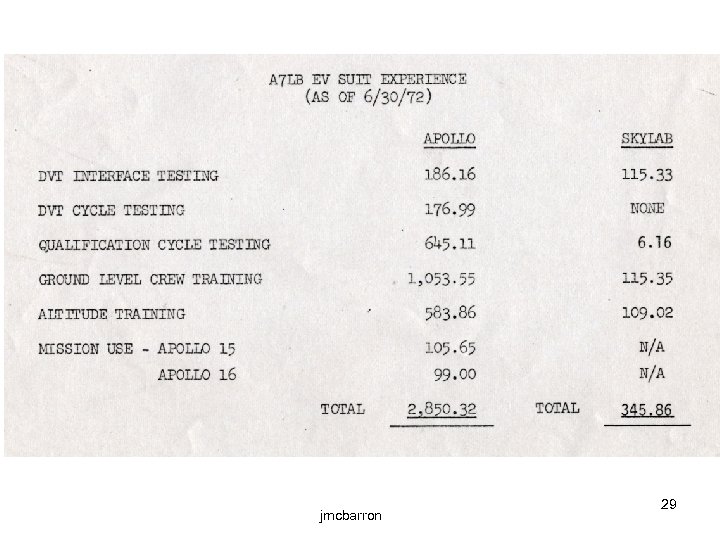
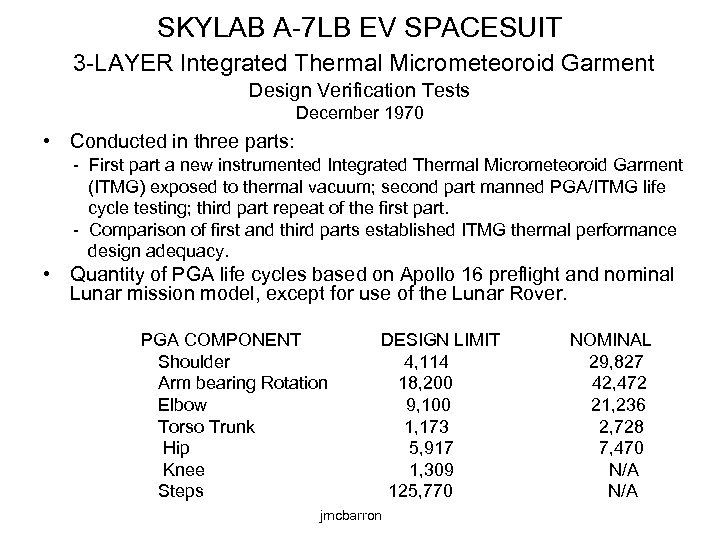 SKYLAB A-7 LB EV SPACESUIT 3 -LAYER Integrated Thermal Micrometeoroid Garment Design Verification Tests December 1970 • Conducted in three parts: - First part a new instrumented Integrated Thermal Micrometeoroid Garment (ITMG) exposed to thermal vacuum; second part manned PGA/ITMG life cycle testing; third part repeat of the first part. - Comparison of first and third parts established ITMG thermal performance design adequacy. • Quantity of PGA life cycles based on Apollo 16 preflight and nominal Lunar mission model, except for use of the Lunar Rover. PGA COMPONENT Shoulder Arm bearing Rotation Elbow Torso Trunk Hip Knee Steps DESIGN LIMIT 4, 114 18, 200 9, 100 1, 173 5, 917 1, 309 125, 770 jmcbarron NOMINAL 29, 827 42, 472 21, 236 2, 728 7, 470 N/A
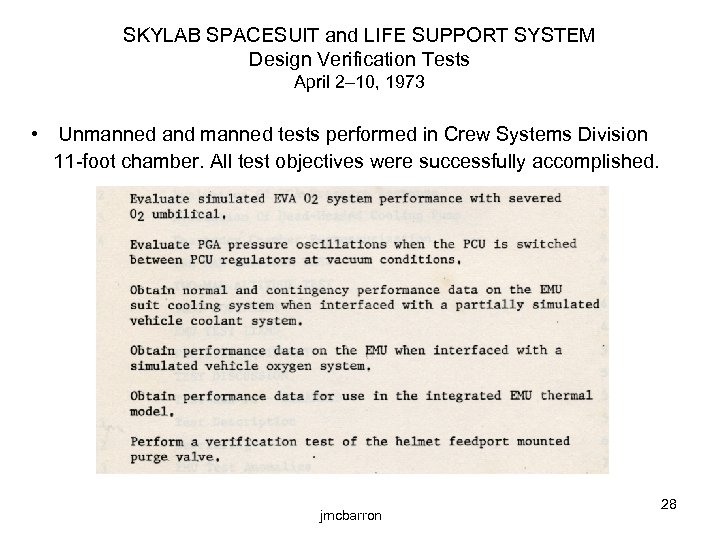 SKYLAB SPACESUIT and LIFE SUPPORT SYSTEM Design Verification Tests April 2– 10, 1973 • Unmanned and manned tests performed in Crew Systems Division 11 -foot chamber. All test objectives were successfully accomplished. jmcbarron 28
 jmcbarron 29
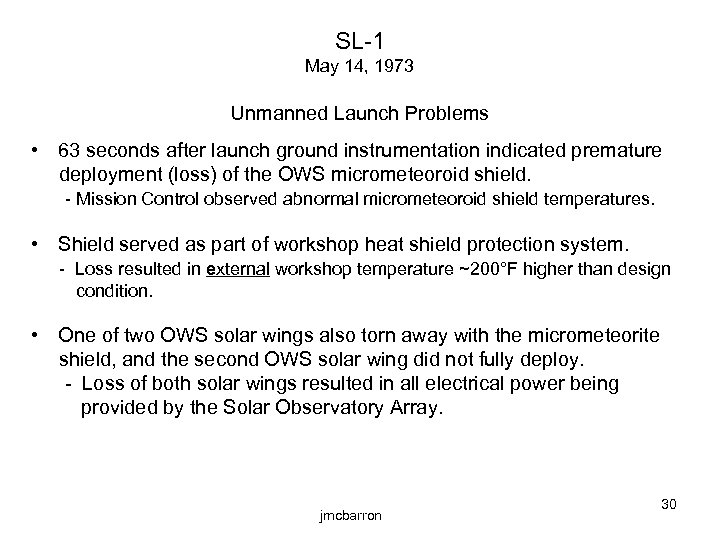 SL-1 May 14, 1973 Unmanned Launch Problems • 63 seconds after launch ground instrumentation indicated premature deployment (loss) of the OWS micrometeoroid shield. - Mission Control observed abnormal micrometeoroid shield temperatures. • Shield served as part of workshop heat shield protection system. - Loss resulted in external workshop temperature ~200°F higher than design condition. • One of two OWS solar wings also torn away with the micrometeorite shield, and the second OWS solar wing did not fully deploy. - Loss of both solar wings resulted in all electrical power being provided by the Solar Observatory Array. jmcbarron 30
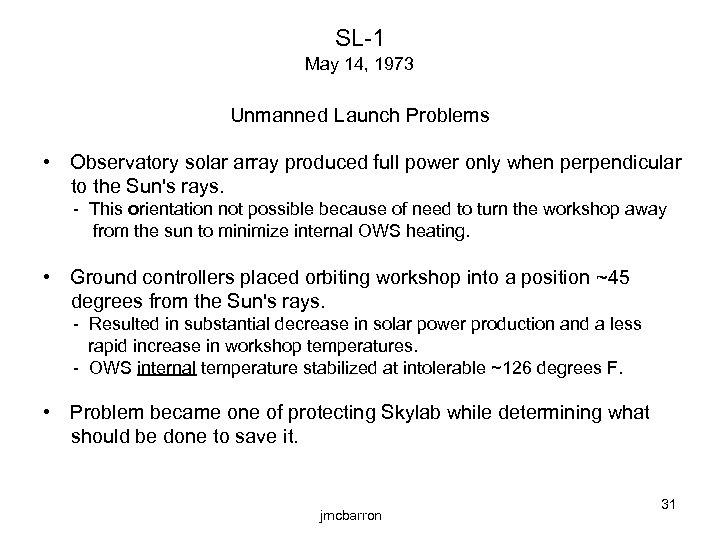 SL-1 May 14, 1973 Unmanned Launch Problems • Observatory solar array produced full power only when perpendicular to the Sun's rays. - This orientation not possible because of need to turn the workshop away from the sun to minimize internal OWS heating. • Ground controllers placed orbiting workshop into a position ~45 degrees from the Sun's rays. - Resulted in substantial decrease in solar power production and a less rapid increase in workshop temperatures. - OWS internal temperature stabilized at intolerable ~126 degrees F. • Problem became one of protecting Skylab while determining what should be done to save it. jmcbarron 31
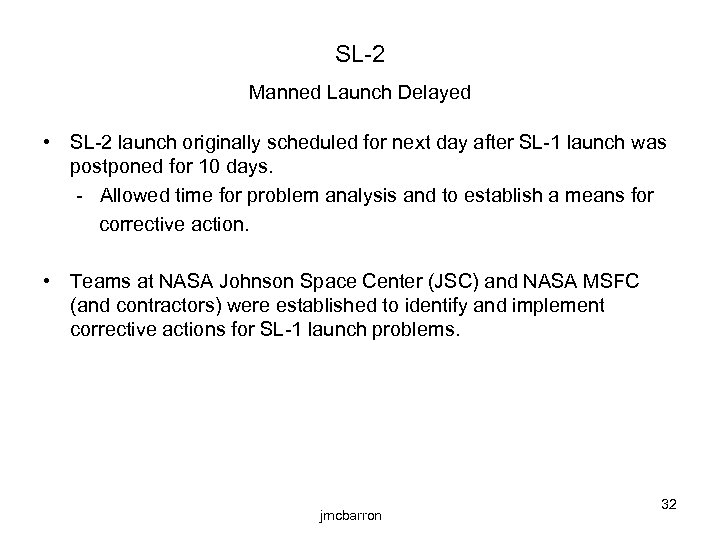 SL-2 Manned Launch Delayed • SL-2 launch originally scheduled for next day after SL-1 launch was postponed for 10 days. - Allowed time for problem analysis and to establish a means for corrective action. • Teams at NASA Johnson Space Center (JSC) and NASA MSFC (and contractors) were established to identify and implement corrective actions for SL-1 launch problems. jmcbarron 32
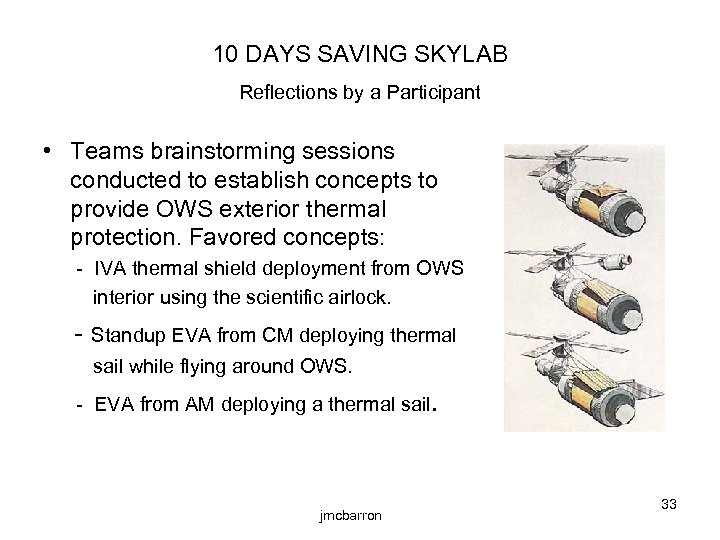 10 DAYS SAVING SKYLAB Reflections by a Participant • Teams brainstorming sessions conducted to establish concepts to provide OWS exterior thermal protection. Favored concepts: - IVA thermal shield deployment from OWS interior using the scientific airlock. - Standup EVA from CM deploying thermal sail while flying around OWS. - EVA from AM deploying a thermal sail. jmcbarron 33
 SAVING SKYLAB Reflections by a Participant • Candidate thermal shield material identified by materials personnel. - Made a late evening telephone call to the manufacturer of Nylon coated Aluminized Mylar material. - Resulted in supplier opening plant and overnight production of required material ready for delivery the next morning. • Skilled sewers and sewing machines needed by NASA MSFC for thermal shield fabrication. - Made late evening telephone call to ILC Spacesuit Program manager resulting in availability and readiness of sewers and machines to travel the next morning. jmcbarron 34
 SAVING SKYLAB Reflections by a Participant • NASA Gulfstream Aircraft made stops the next morning at the fabric manufacturer in Minnesota, to pick up fabric, and then at Dover Air Force Base, Delaware to pick up ILC sewers and sewing machines. - Thermal material and ILC personnel and machines were delivered to NASA MSFC and a sewing shop capability was established to manufacture MSFC thermal sails. • That afternoon the Gulfstream delivered thermal material to Ellington Air Force Base where it was picked up and delivered to MSC to support Parasol Thermal Canopy Manufacture. jmcbarron 35
 SAVING SKYLAB Reflections by a Participant • Parasol Canopy Fabrication area set up in Bldg. 29 Rotunda. - Tables were moved from Bldg. 7 offices to Bldg. 29 to provide large workspace. - Suit engineer led canopy fabrication on top of tables workspace. - He provided directions to sewing technicians and assembly personnel located around tables periphery while at the time standing on the tables. - He expedited assembly of large surface canopies in support of JSC Technical Services Bldg. 10 parasol deployment tests, and later for flight. jmcbarron 36
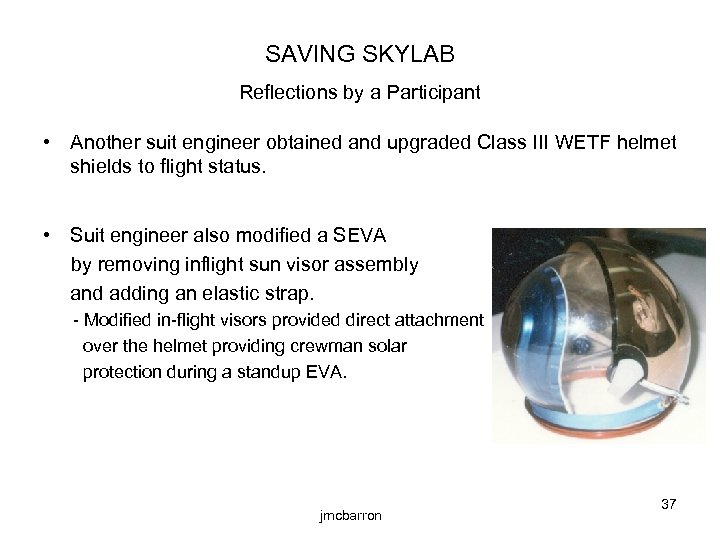 SAVING SKYLAB Reflections by a Participant • Another suit engineer obtained and upgraded Class III WETF helmet shields to flight status. • Suit engineer also modified a SEVA by removing inflight sun visor assembly and adding an elastic strap. - Modified in-flight visors provided direct attachment over the helmet providing crewman solar protection during a standup EVA. jmcbarron 37
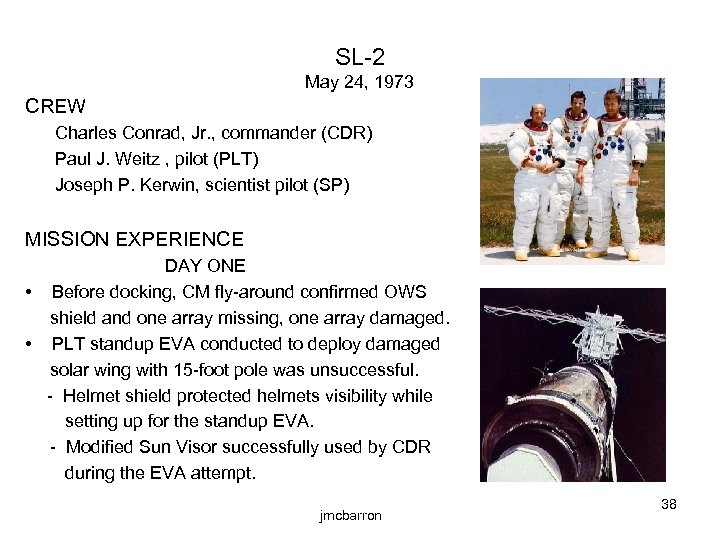 SL-2 May 24, 1973 CREW Charles Conrad, Jr. , commander (CDR) Paul J. Weitz , pilot (PLT) Joseph P. Kerwin, scientist pilot (SP) MISSION EXPERIENCE DAY ONE • Before docking, CM fly-around confirmed OWS shield and one array missing, one array damaged. • PLT standup EVA conducted to deploy damaged solar wing with 15 -foot pole was unsuccessful. - Helmet shield protected helmets visibility while setting up for the standup EVA. - Modified Sun Visor successfully used by CDR during the EVA attempt. jmcbarron 38
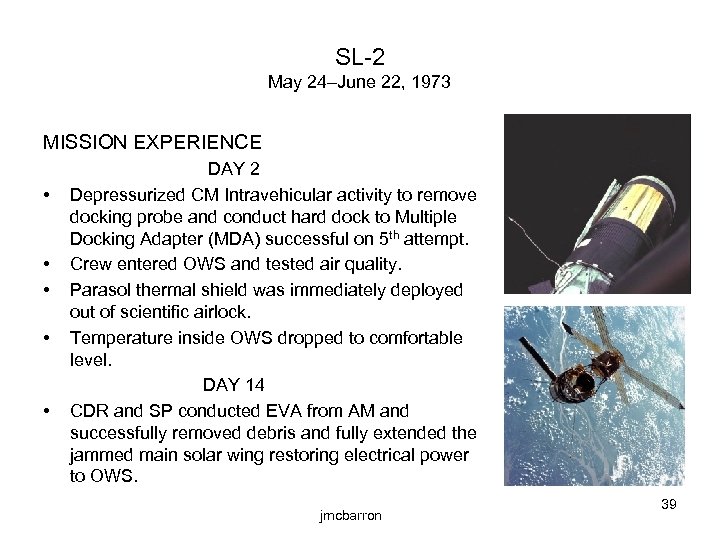 SL-2 May 24–June 22, 1973 MISSION EXPERIENCE • • • DAY 2 Depressurized CM Intravehicular activity to remove docking probe and conduct hard dock to Multiple Docking Adapter (MDA) successful on 5 th attempt. Crew entered OWS and tested air quality. Parasol thermal shield was immediately deployed out of scientific airlock. Temperature inside OWS dropped to comfortable level. DAY 14 CDR and SP conducted EVA from AM and successfully removed debris and fully extended the jammed main solar wing restoring electrical power to OWS. jmcbarron 39
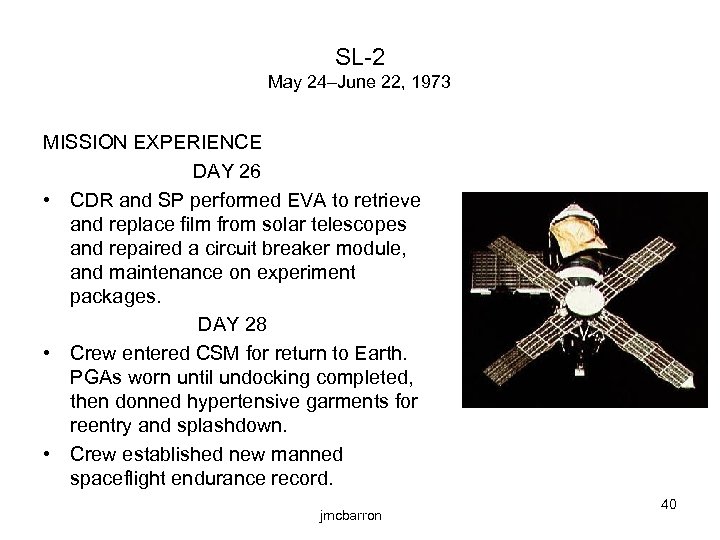 SL-2 May 24–June 22, 1973 MISSION EXPERIENCE DAY 26 • CDR and SP performed EVA to retrieve and replace film from solar telescopes and repaired a circuit breaker module, and maintenance on experiment packages. DAY 28 • Crew entered CSM for return to Earth. PGAs worn until undocking completed, then donned hypertensive garments for reentry and splashdown. • Crew established new manned spaceflight endurance record. jmcbarron 40
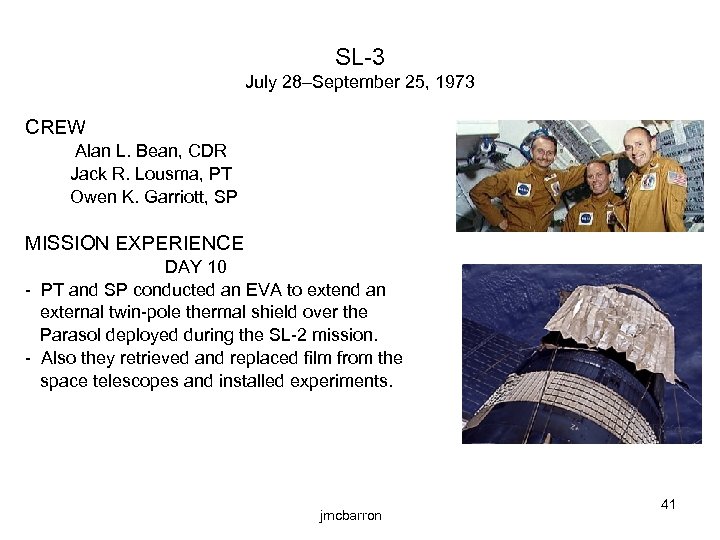 SL-3 July 28–September 25, 1973 CREW Alan L. Bean, CDR Jack R. Lousma, PT Owen K. Garriott, SP MISSION EXPERIENCE DAY 10 - PT and SP conducted an EVA to extend an external twin-pole thermal shield over the Parasol deployed during the SL-2 mission. - Also they retrieved and replaced film from the space telescopes and installed experiments. jmcbarron 41
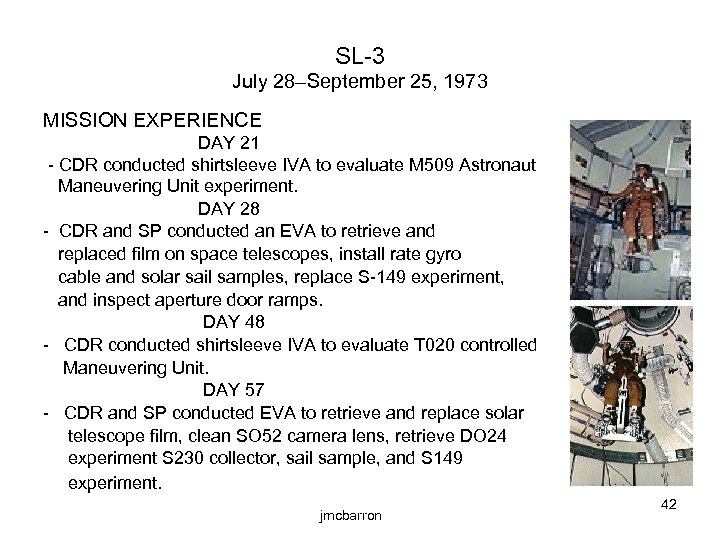 SL-3 July 28–September 25, 1973 MISSION EXPERIENCE DAY 21 - CDR conducted shirtsleeve IVA to evaluate M 509 Astronaut Maneuvering Unit experiment. DAY 28 - CDR and SP conducted an EVA to retrieve and replaced film on space telescopes, install rate gyro cable and solar sail samples, replace S-149 experiment, and inspect aperture door ramps. DAY 48 - CDR conducted shirtsleeve IVA to evaluate T 020 controlled Maneuvering Unit. DAY 57 - CDR and SP conducted EVA to retrieve and replace solar telescope film, clean SO 52 camera lens, retrieve DO 24 experiment S 230 collector, sail sample, and S 149 experiment. jmcbarron 42
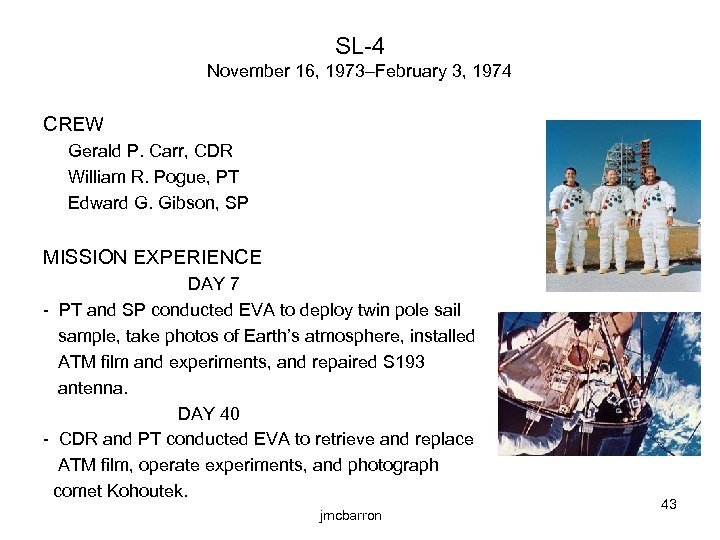 SL-4 November 16, 1973–February 3, 1974 CREW Gerald P. Carr, CDR William R. Pogue, PT Edward G. Gibson, SP MISSION EXPERIENCE DAY 7 - PT and SP conducted EVA to deploy twin pole sail sample, take photos of Earth’s atmosphere, installed ATM film and experiments, and repaired S 193 antenna. DAY 40 - CDR and PT conducted EVA to retrieve and replace ATM film, operate experiments, and photograph comet Kohoutek. jmcbarron 43
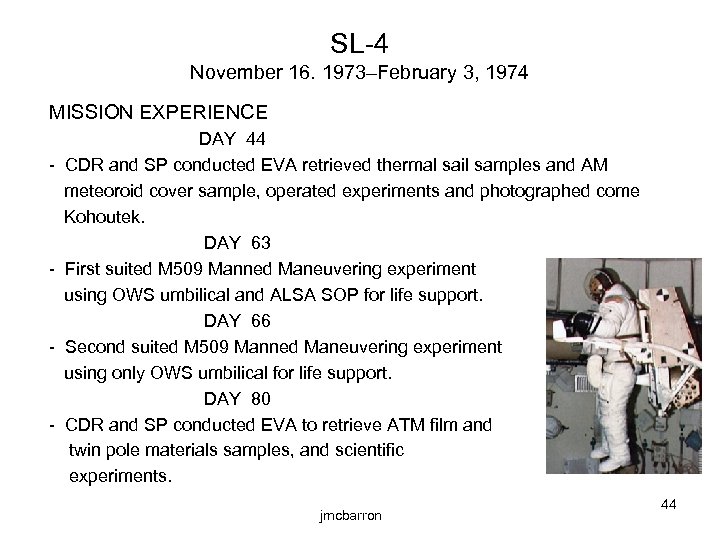 SL-4 November 16. 1973–February 3, 1974 MISSION EXPERIENCE - - DAY 44 CDR and SP conducted EVA retrieved thermal sail samples and AM meteoroid cover sample, operated experiments and photographed come Kohoutek. DAY 63 First suited M 509 Manned Maneuvering experiment using OWS umbilical and ALSA SOP for life support. DAY 66 Second suited M 509 Manned Maneuvering experiment using only OWS umbilical for life support. DAY 80 CDR and SP conducted EVA to retrieve ATM film and twin pole materials samples, and scientific experiments. jmcbarron 44
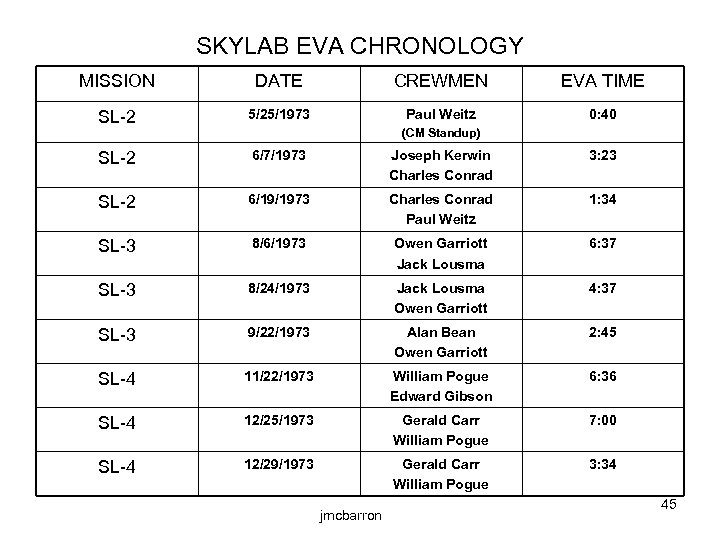 SKYLAB EVA CHRONOLOGY MISSION DATE CREWMEN EVA TIME SL-2 5/25/1973 Paul Weitz 0: 40 SL-2 6/7/1973 Joseph Kerwin Charles Conrad 3: 23 SL-2 6/19/1973 Charles Conrad Paul Weitz 1: 34 SL-3 8/6/1973 Owen Garriott Jack Lousma 6: 37 SL-3 8/24/1973 Jack Lousma Owen Garriott 4: 37 SL-3 9/22/1973 Alan Bean Owen Garriott 2: 45 SL-4 11/22/1973 William Pogue Edward Gibson 6: 36 SL-4 12/25/1973 Gerald Carr William Pogue 7: 00 SL-4 12/29/1973 Gerald Carr William Pogue 3: 34 (CM Standup) jmcbarron 45
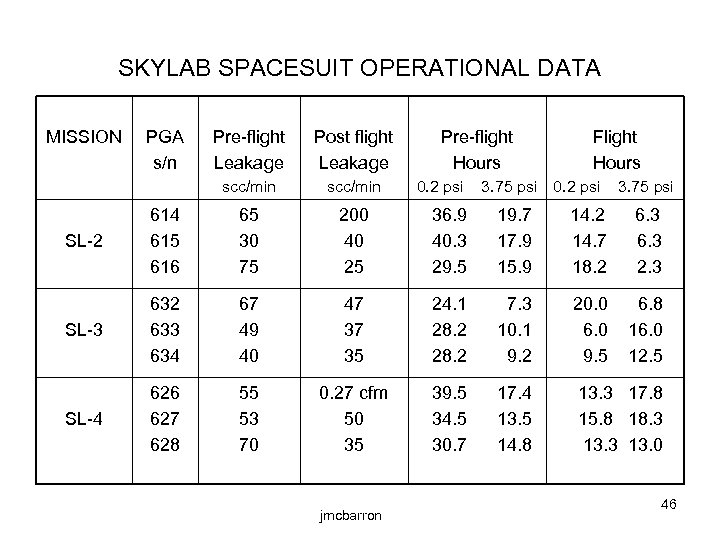 SKYLAB SPACESUIT OPERATIONAL DATA MISSION PGA s/n Pre-flight Leakage Post flight Leakage scc/min SL-2 614 615 616 65 30 75 200 40 25 36. 9 40. 3 29. 5 19. 7 17. 9 15. 9 14. 2 14. 7 18. 2 6. 3 2. 3 SL-3 632 633 634 67 49 40 47 37 35 24. 1 28. 2 7. 3 10. 1 9. 2 20. 0 6. 0 9. 5 6. 8 16. 0 12. 5 SL-4 626 627 628 55 53 70 0. 27 cfm 50 35 39. 5 34. 5 30. 7 17. 4 13. 5 14. 8 13. 3 17. 8 15. 8 18. 3 13. 0 jmcbarron Pre-flight Hours 0. 2 psi Flight Hours 3. 75 psi 0. 2 psi 3. 75 psi 46
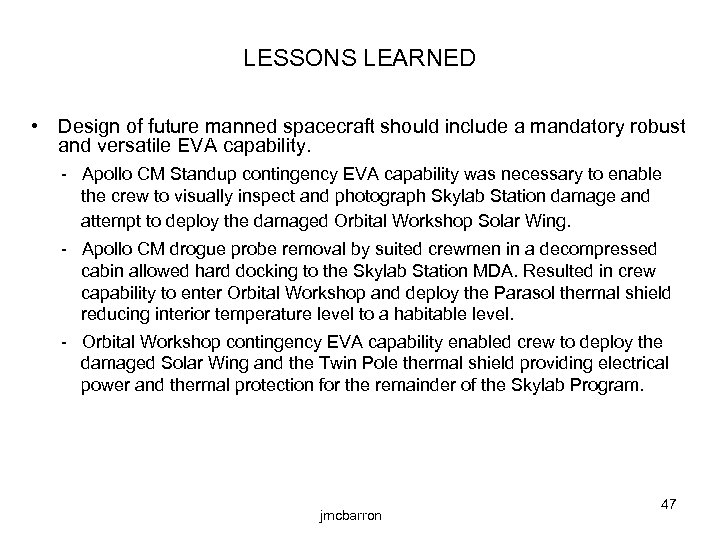 LESSONS LEARNED • Design of future manned spacecraft should include a mandatory robust and versatile EVA capability. - Apollo CM Standup contingency EVA capability was necessary to enable the crew to visually inspect and photograph Skylab Station damage and attempt to deploy the damaged Orbital Workshop Solar Wing. - Apollo CM drogue probe removal by suited crewmen in a decompressed cabin allowed hard docking to the Skylab Station MDA. Resulted in crew capability to enter Orbital Workshop and deploy the Parasol thermal shield reducing interior temperature level to a habitable level. - Orbital Workshop contingency EVA capability enabled crew to deploy the damaged Solar Wing and the Twin Pole thermal shield providing electrical power and thermal protection for the remainder of the Skylab Program. jmcbarron 47
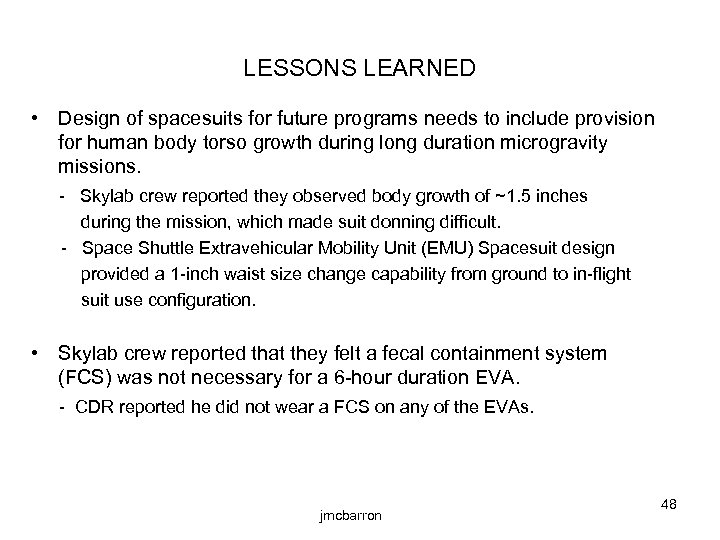 LESSONS LEARNED • Design of spacesuits for future programs needs to include provision for human body torso growth during long duration microgravity missions. - Skylab crew reported they observed body growth of ~1. 5 inches during the mission, which made suit donning difficult. - Space Shuttle Extravehicular Mobility Unit (EMU) Spacesuit design provided a 1 -inch waist size change capability from ground to in-flight suit use configuration. • Skylab crew reported that they felt a fecal containment system (FCS) was not necessary for a 6 -hour duration EVA. - CDR reported he did not wear a FCS on any of the EVAs. jmcbarron 48
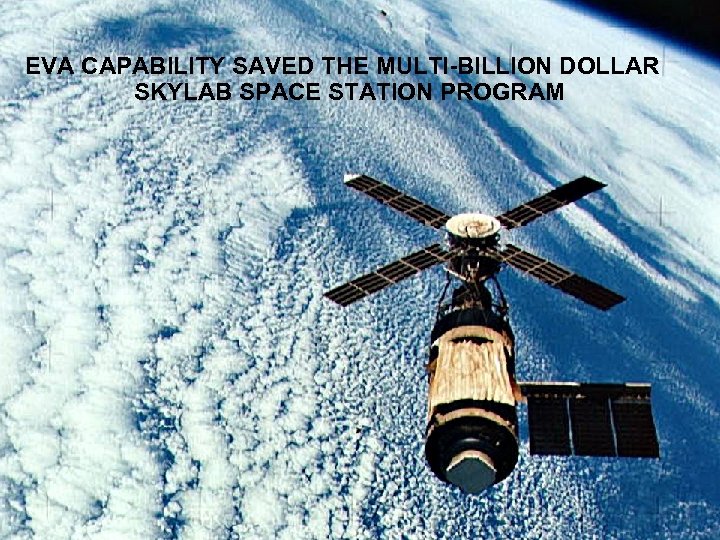 EVA CAPABILITY SAVED THE MULTI-BILLION DOLLAR SKYLAB SPACE STATION PROGRAM jmcbarron 49
 SPACESUIT KNOWLEDGE CAPTURE SESSIONS Session Briefings In-work - “Spacesuit Development for the Apollo Soyuz Test Project” - “Space Shuttle EMU Spacesuit Development for Initial Space Shuttle Program Flights” - “Space Shuttle EMU Spacesuit Development for the International Space Station Program” jmcbarron 50