


 Скачать презентацию Space weather in the solar system Andrew Coates
f9e682e8c2f751b58521ec0e9b200cf5.ppt
- Количество слайдов: 36
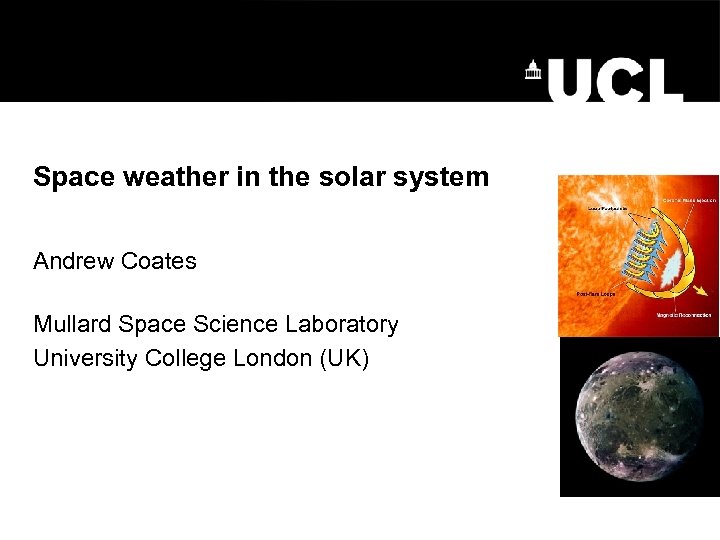 Space weather in the solar system Andrew Coates Mullard Space Science Laboratory University College London (UK)
 Outline • Space weather and solar wind • Interaction with magnetic fields – Earth – Mercury – Giant planets • Interaction with other objects – Venus (unmagnetized) – Mars, moon (crustal fields) – Moons in planetary magnetospheres: Titan, Enceladus, Io, Europa, Callisto • Magnetosphere within magnetosphere: Ganymede • Conclusions and future missions
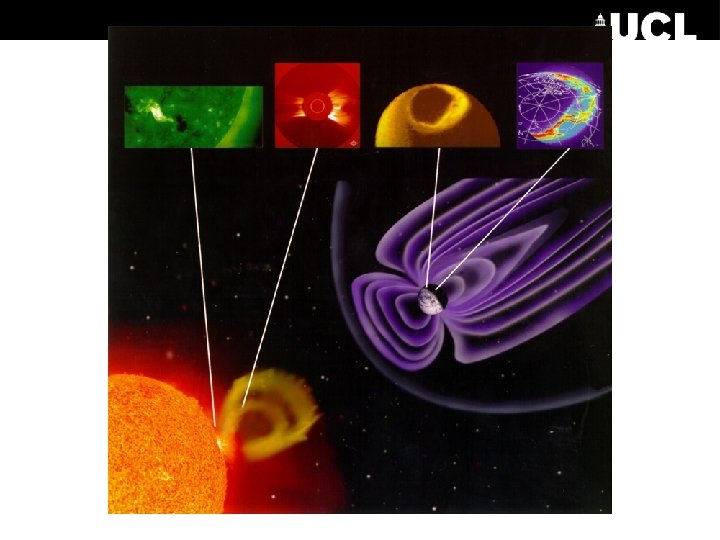
 Space weather - timescales Earth’s magnetic field shields us from solar, galactic particles – but some penetrate; radiation belts always present Event from Sun reaches Earth (or planet at R AU) on 3 timescales: 1. 8 (x. R) minutes: high energy X- or - rays, radio noise 2. Minutes - hours (x. R), high energy charged particles 3. 2 -3 days (x. R), solar wind disturbances Effects on spacecraft of 1 and 2 are computer upsets; 3 can distort and energise magnetic environments
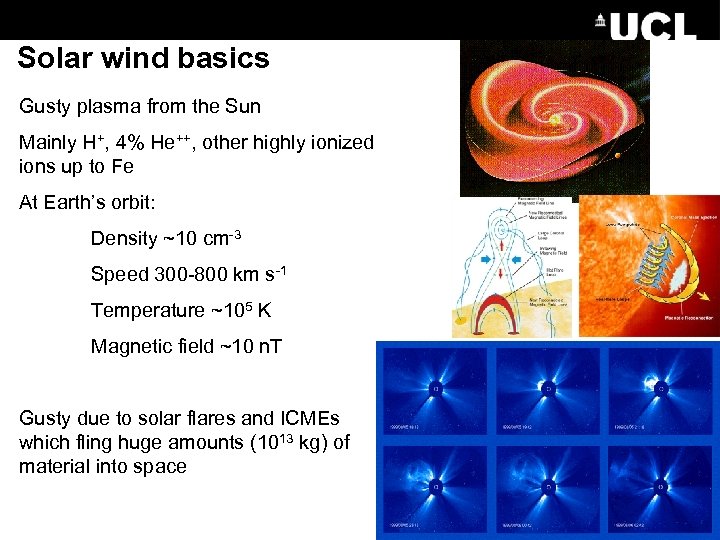 Solar wind basics Gusty plasma from the Sun Mainly H+, 4% He++, other highly ionized ions up to Fe At Earth’s orbit: Density ~10 cm-3 Speed 300 -800 km s-1 Temperature ~105 K Magnetic field ~10 n. T Gusty due to solar flares and ICMEs which fling huge amounts (1013 kg) of material into space http: //science. nasa. gov/medialibrary/2009 /08/31/ 31 aug_mms_resources/14_flare_model_med. gif http: //berkeley. edu/news/media/ releases/ 2003/07/images/flare. jpg
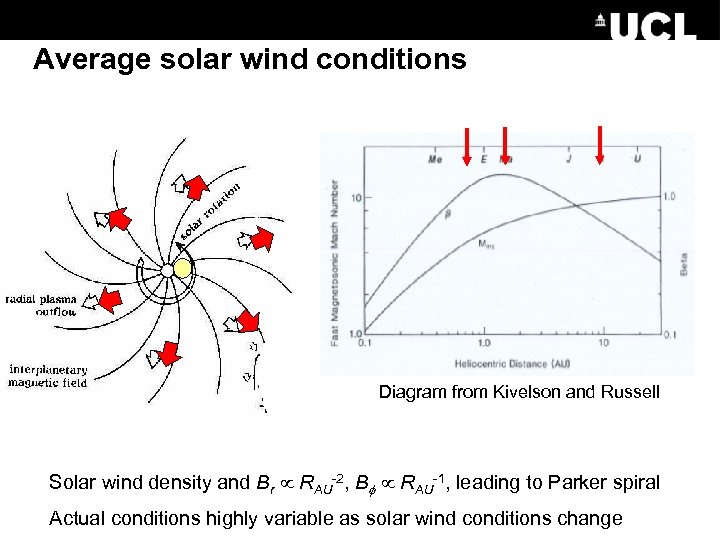 Average solar wind conditions Diagram from Kivelson and Russell Solar wind density and Br RAU-2, B RAU-1, leading to Parker spiral Actual conditions highly variable as solar wind conditions change
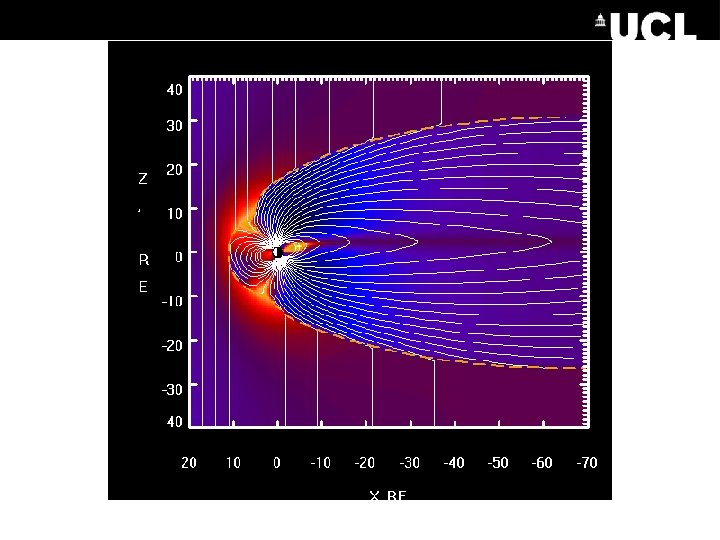
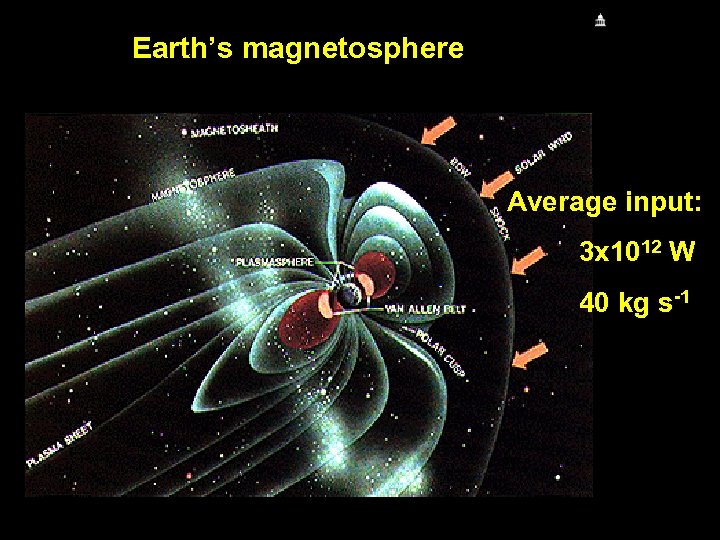 Earth’s magnetosphere Average input: 3 x 10¹² W 40 kg s-1
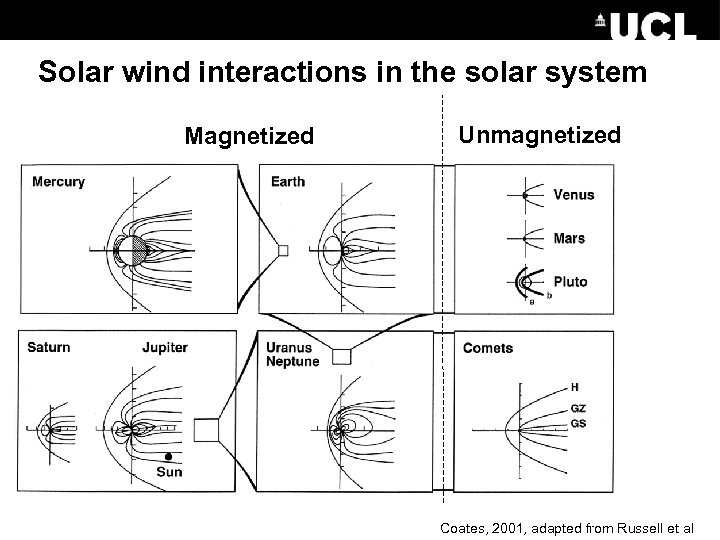 Solar wind interactions in the solar system Magnetized Unmagnetized Coates, 2001, adapted from Russell et al
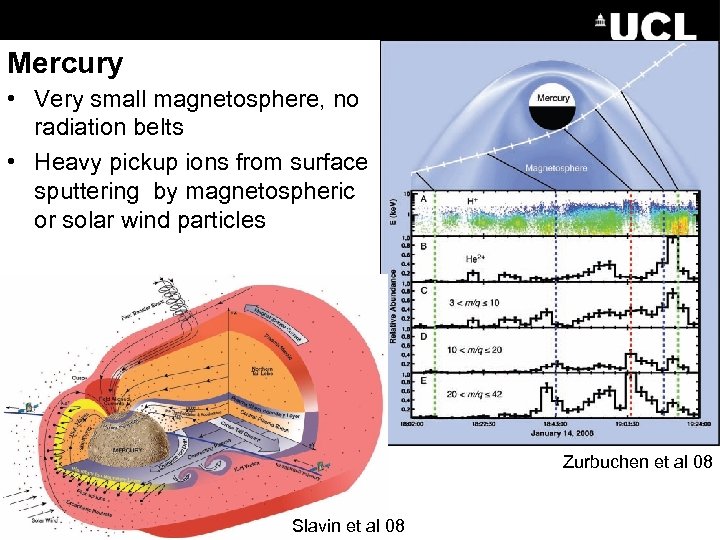 Mercury • Very small magnetosphere, no radiation belts • Heavy pickup ions from surface sputtering by magnetospheric or solar wind particles Zurbuchen et al 08 Slavin et al 08
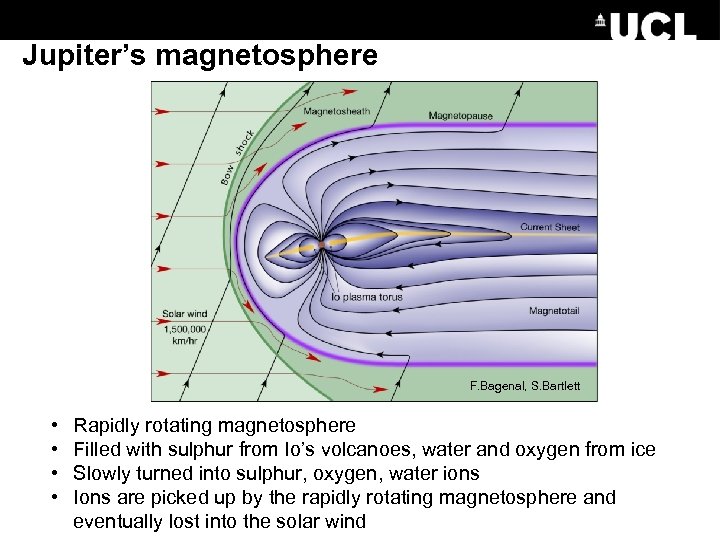 Jupiter’s magnetosphere F. Bagenal, S. Bartlett • • Rapidly rotating magnetosphere Filled with sulphur from Io’s volcanoes, water and oxygen from ice Slowly turned into sulphur, oxygen, water ions Ions are picked up by the rapidly rotating magnetosphere and eventually lost into the solar wind
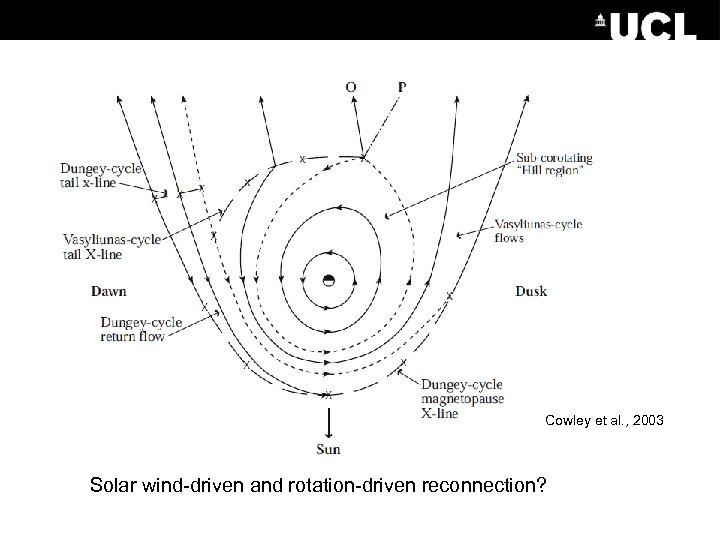 Cowley et al. , 2003 Solar wind-driven and rotation-driven reconnection?
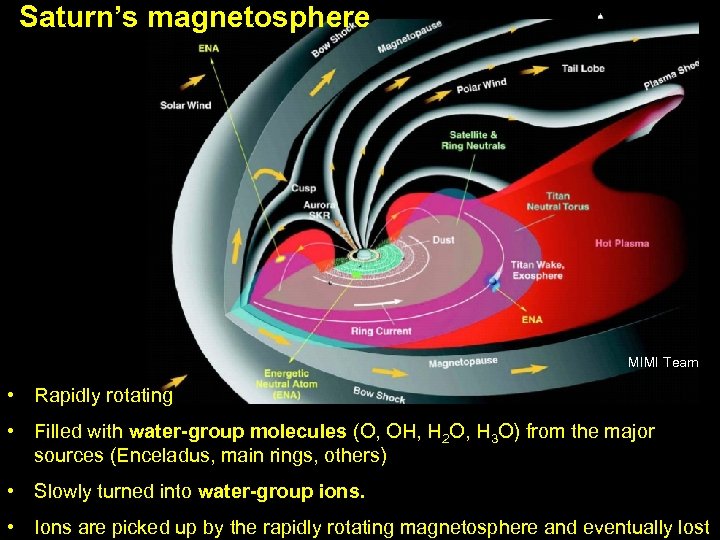 Saturn’s magnetosphere MIMI Team • Rapidly rotating • Filled with water-group molecules (O, OH, H 2 O, H 3 O) from the major sources (Enceladus, main rings, others) • Slowly turned into water-group ions. • Ions are picked up by the rapidly rotating magnetosphere and eventually lost
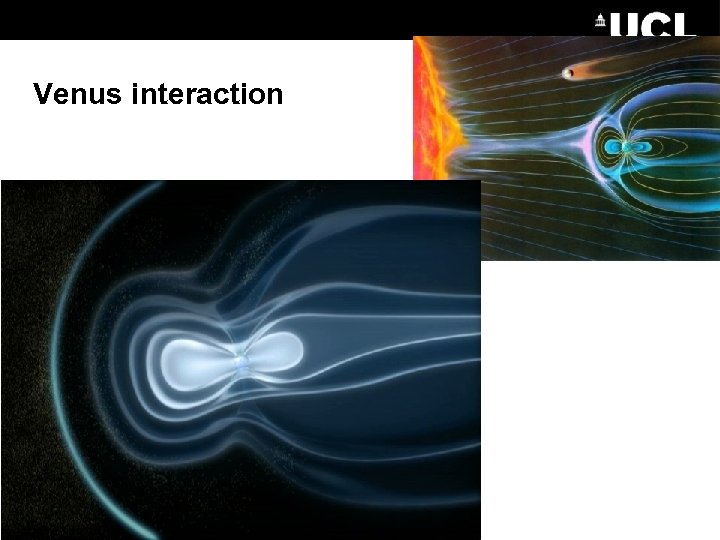 Venus interaction
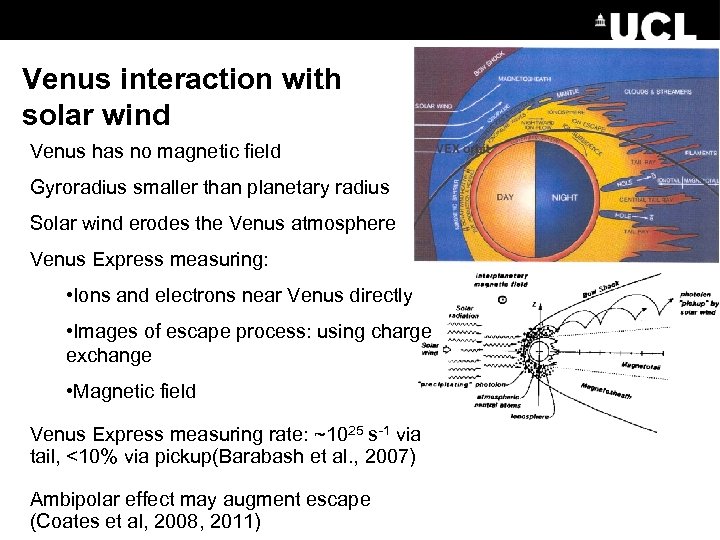 Venus interaction with solar wind Venus has no magnetic field Gyroradius smaller than planetary radius Solar wind erodes the Venus atmosphere Venus Express measuring: • Ions and electrons near Venus directly • Images of escape process: using charge exchange • Magnetic field Venus Express measuring rate: ~1025 s-1 via tail, <10% via pickup(Barabash et al. , 2007) Ambipolar effect may augment escape (Coates et al, 2008, 2011)
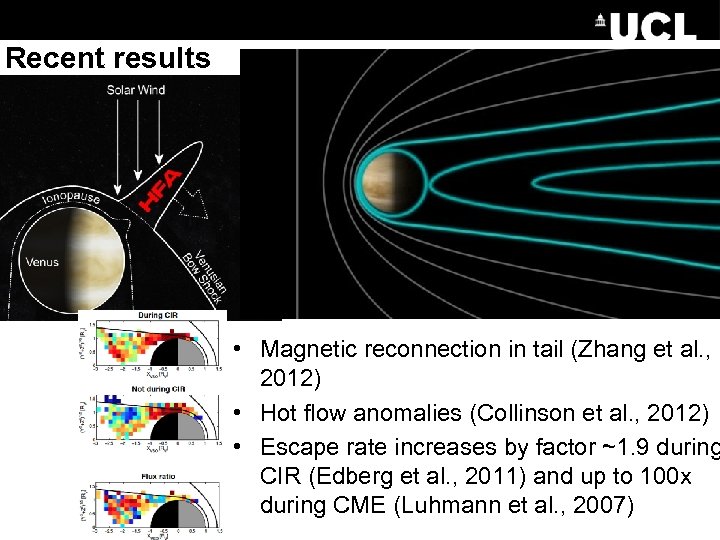 Recent results • Magnetic reconnection in tail (Zhang et al. , 2012) • Hot flow anomalies (Collinson et al. , 2012) • Escape rate increases by factor ~1. 9 during CIR (Edberg et al. , 2011) and up to 100 x during CME (Luhmann et al. , 2007)
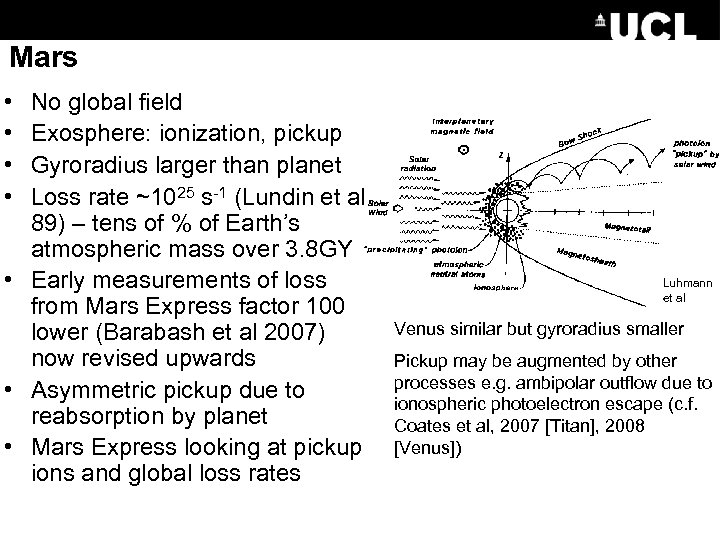 Mars • • No global field Exosphere: ionization, pickup Gyroradius larger than planet Loss rate ~1025 s-1 (Lundin et al 89) – tens of % of Earth’s atmospheric mass over 3. 8 GY • Early measurements of loss from Mars Express factor 100 lower (Barabash et al 2007) now revised upwards • Asymmetric pickup due to reabsorption by planet • Mars Express looking at pickup ions and global loss rates Luhmann et al Venus similar but gyroradius smaller Pickup may be augmented by other processes e. g. ambipolar outflow due to ionospheric photoelectron escape (c. f. Coates et al, 2007 [Titan], 2008 [Venus])
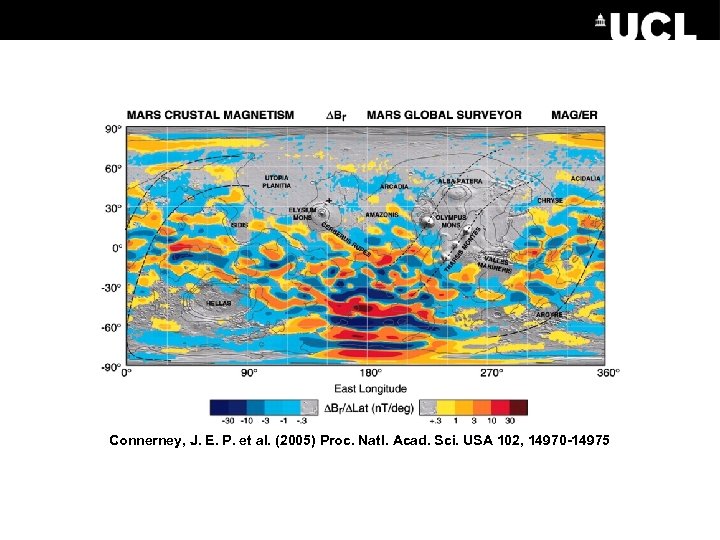 Connerney, J. E. P. et al. (2005) Proc. Natl. Acad. Sci. USA 102, 14970 -14975
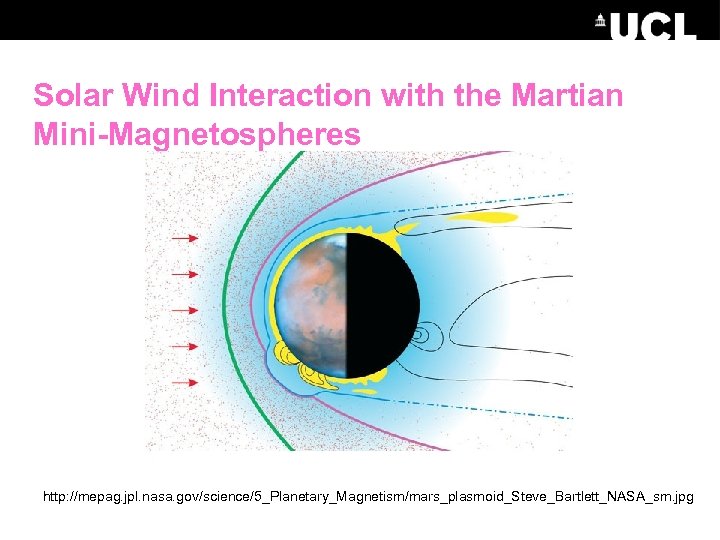 Solar Wind Interaction with the Martian Mini-Magnetospheres http: //mepag. jpl. nasa. gov/science/5_Planetary_Magnetism/mars_plasmoid_Steve_Bartlett_NASA_sm. jpg
 Mars space weather effects • Upstream plasma supersonic, Super. Alfvenic so bow shock (Phobos, MGS, MEX) • Scale of interaction not as sensitive as Venus to solar wind conditions • Induced magnetosphere: field draping (Phobos, MGS) • Photoelectron production • Auroral emissions, accelerated electrons on night side (Bertaux et al, Lundin et al) – associated with acceleration over crustal fields • Plasma escape – Preliminary measurements (Barabash et al, Science, 2007) show lower escape flux than expected – implications for where early Mars water went – Measurement did not include lowest energy ions – Escape rate sensitive to solar wind conditions – 3 xescape rate during CIR (Edberg et al. , 2010) • Crustal fields may affect low energy plasma escape • Radiation environment important for life
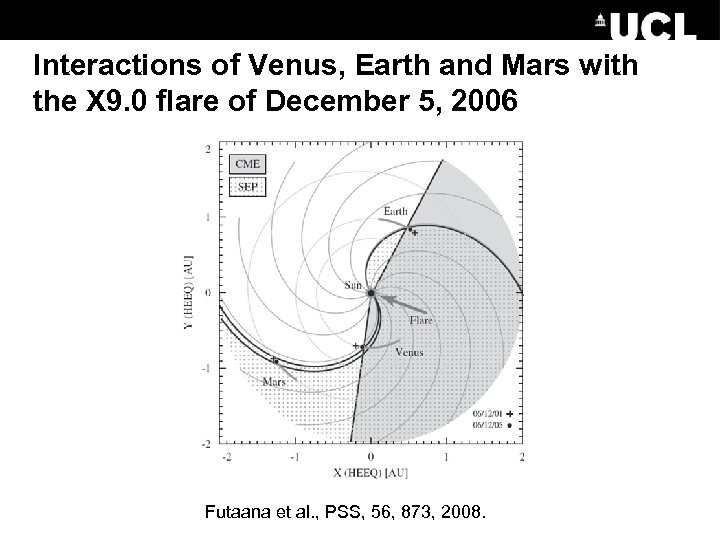 Interactions of Venus, Earth and Mars with the X 9. 0 flare of December 5, 2006 Futaana et al. , PSS, 56, 873, 2008.
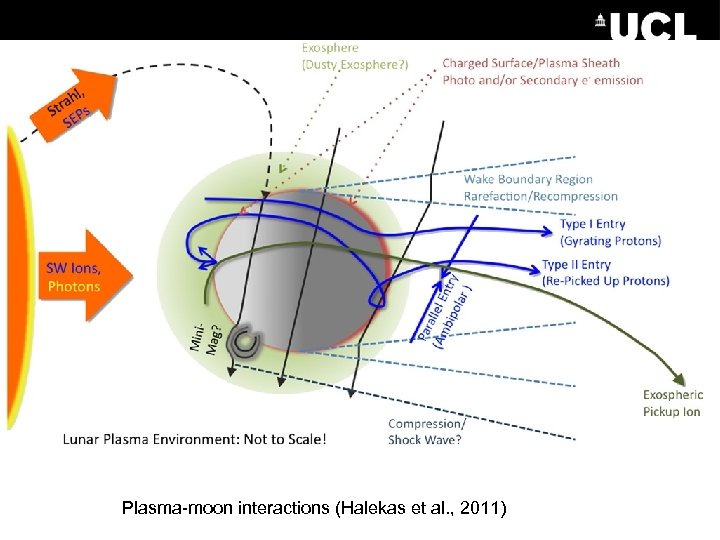 Plasma-moon interactions (Halekas et al. , 2011)
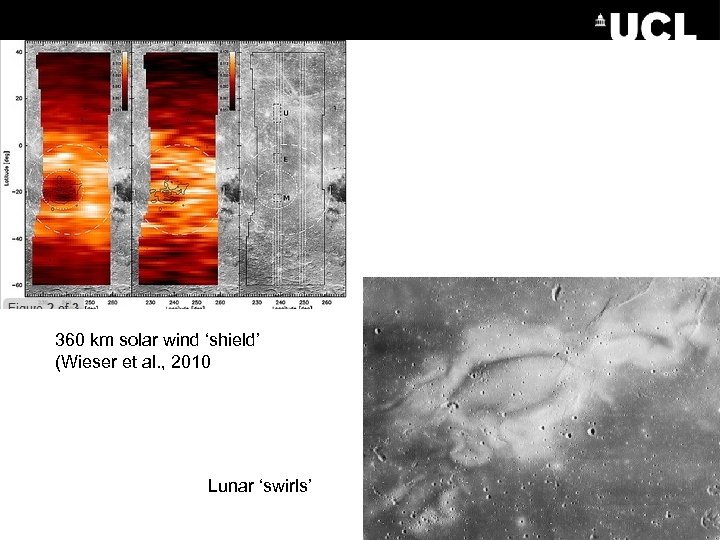 360 km solar wind ‘shield’ (Wieser et al. , 2010 Lunar ‘swirls’
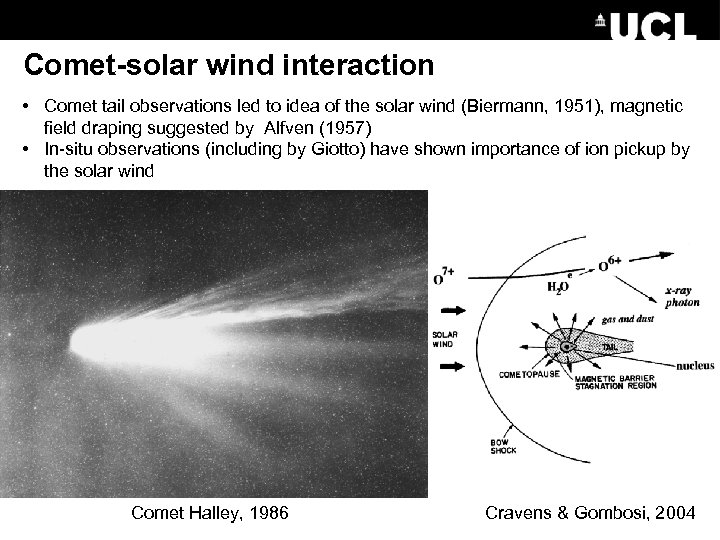 Comet-solar wind interaction • Comet tail observations led to idea of the solar wind (Biermann, 1951), magnetic field draping suggested by Alfven (1957) • In-situ observations (including by Giotto) have shown importance of ion pickup by the solar wind Comet Halley, 1986 Cravens & Gombosi, 2004
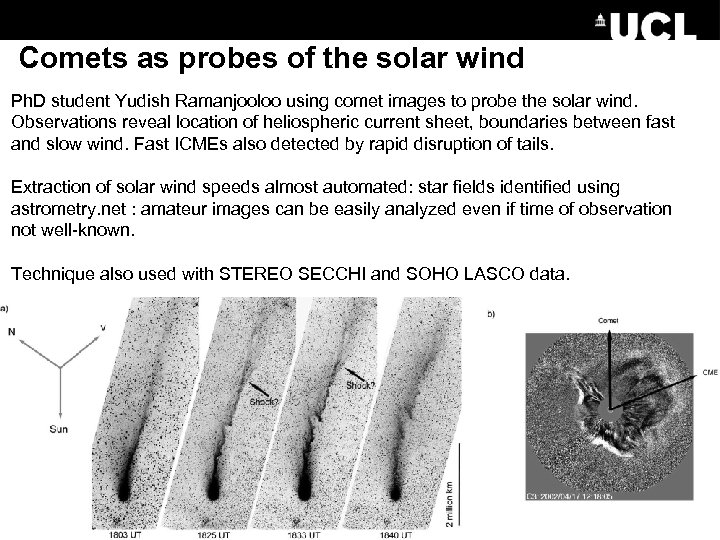 Comets as probes of the solar wind Ph. D student Yudish Ramanjooloo using comet images to probe the solar wind. Observations reveal location of heliospheric current sheet, boundaries between fast and slow wind. Fast ICMEs also detected by rapid disruption of tails. Extraction of solar wind speeds almost automated: star fields identified using astrometry. net : amateur images can be easily analyzed even if time of observation not well-known. Technique also used with STEREO SECCHI and SOHO LASCO data.
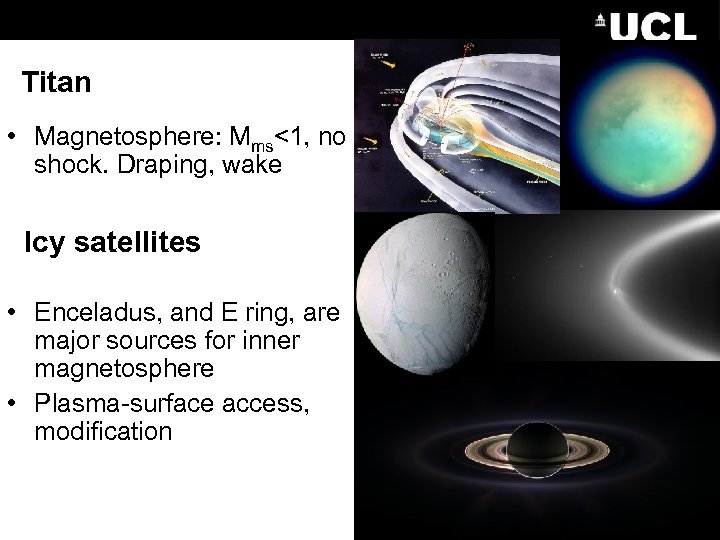 Titan • Magnetosphere: Mms<1, no shock. Draping, wake Icy satellites • Enceladus, and E ring, are major sources for inner magnetosphere • Plasma-surface access, modification
 Titan space weather effects • Mostly inside Saturn’s magnetosphare • Dependent on upstream conditions • Encounters at different local times and positions within magnetosphere – building up picture of hoe interaction varies with conditions • Heating of upper atmosphere • Photoelectron production • Production of heavy hydrocarbons, positive and negative ions – seed particles for aerosols, tholins • Escape of Titan atmosphere • Nitrogen isotope ratio (INMS – Waite et al. ) indicates loss over time • Observations in tail (Coates et al. , 2012) indicate significant loss of Titan atmosphere (7 tonnes/day average)
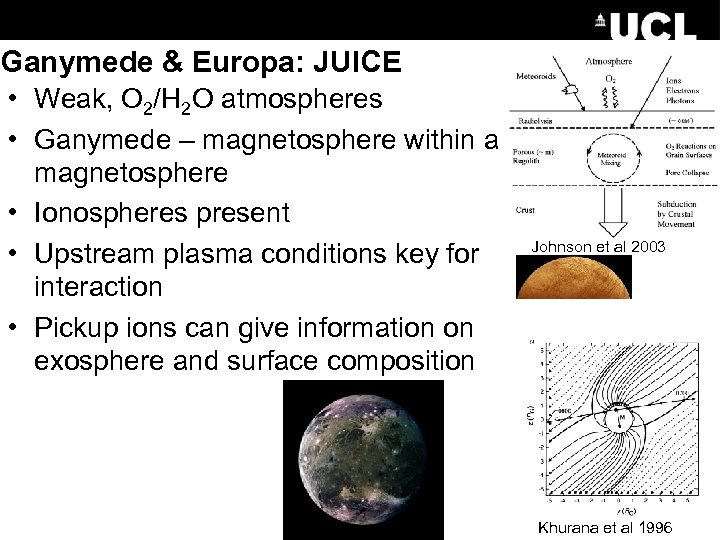 Ganymede & Europa: JUICE • Weak, O 2/H 2 O atmospheres • Ganymede – magnetosphere within a magnetosphere • Ionospheres present • Upstream plasma conditions key for interaction • Pickup ions can give information on exosphere and surface composition Johnson et al 2003 28 Khurana et al 1996
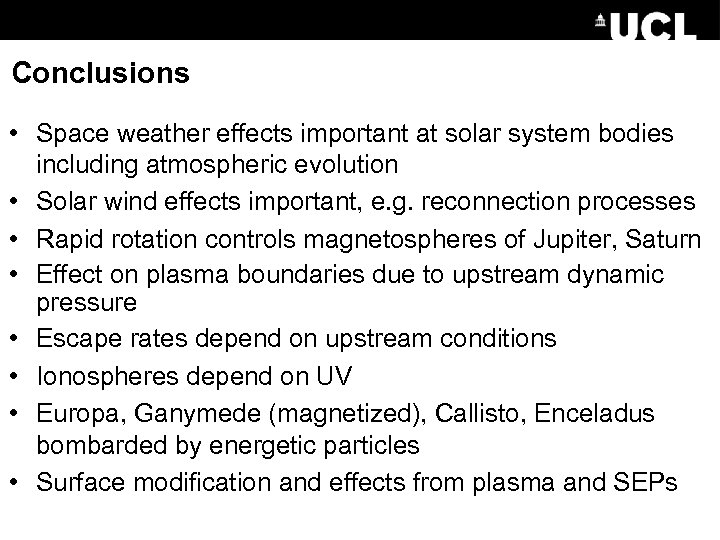 Conclusions • Space weather effects important at solar system bodies including atmospheric evolution • Solar wind effects important, e. g. reconnection processes • Rapid rotation controls magnetospheres of Jupiter, Saturn • Effect on plasma boundaries due to upstream dynamic pressure • Escape rates depend on upstream conditions • Ionospheres depend on UV • Europa, Ganymede (magnetized), Callisto, Enceladus bombarded by energetic particles • Surface modification and effects from plasma and SEPs
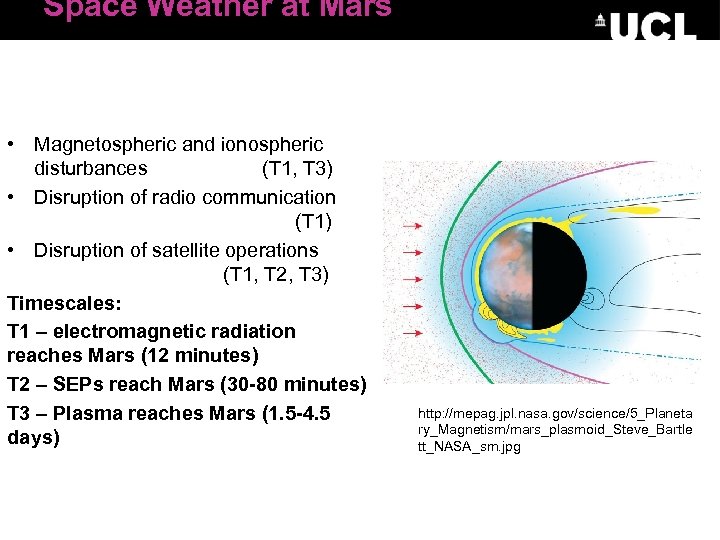 Space Weather at Mars • Magnetospheric and ionospheric disturbances (T 1, T 3) • Disruption of radio communication (T 1) • Disruption of satellite operations (T 1, T 2, T 3) Timescales: T 1 – electromagnetic radiation reaches Mars (12 minutes) T 2 – SEPs reach Mars (30 -80 minutes) T 3 – Plasma reaches Mars (1. 5 -4. 5 days) http: //mepag. jpl. nasa. gov/science/5_Planeta ry_Magnetism/mars_plasmoid_Steve_Bartle tt_NASA_sm. jpg
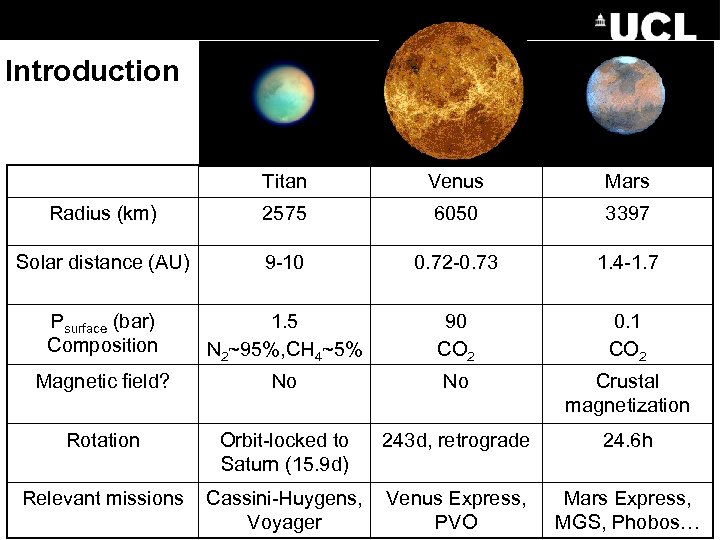 Introduction Titan Venus Mars Radius (km) 2575 6050 3397 Solar distance (AU) 9 -10 0. 72 -0. 73 1. 4 -1. 7 Psurface (bar) Composition 1. 5 N 2~95%, CH 4~5% 90 CO 2 0. 1 CO 2 Magnetic field? No No Crustal magnetization Rotation Orbit-locked to Saturn (15. 9 d) 243 d, retrograde 24. 6 h Relevant missions Cassini-Huygens, Voyager Venus Express, PVO Mars Express, MGS, Phobos…
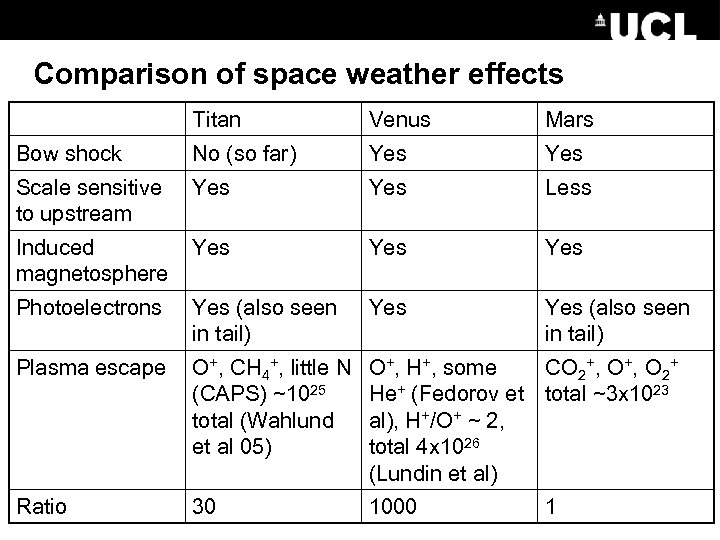 Comparison of space weather effects Titan Venus Mars Bow shock No (so far) Yes Scale sensitive to upstream Yes Less Induced magnetosphere Yes Yes Photoelectrons Yes (also seen in tail) Plasma escape O+, CH 4+, little N (CAPS) ~1025 total (Wahlund et al 05) O+, H+, some CO 2+, O 2+ He+ (Fedorov et total ~3 x 10²³ al), H+/O+ ~ 2, total 4 x 1026 (Lundin et al) Ratio 30 1000 1
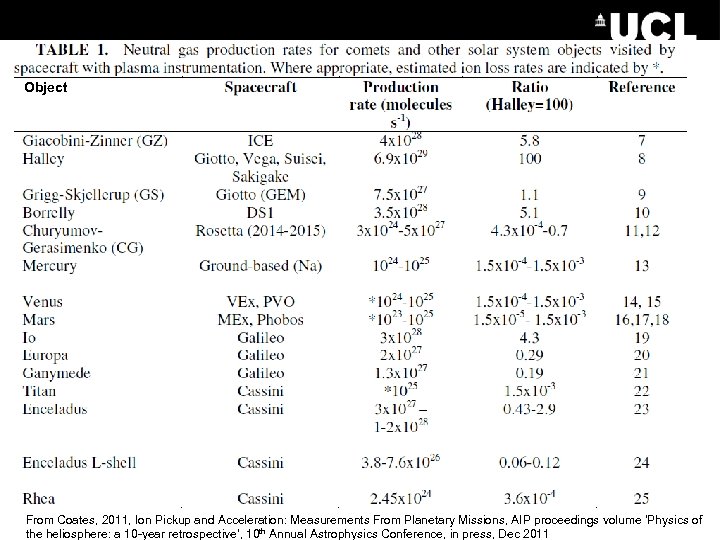 Object From Coates, 2011, Ion Pickup and Acceleration: Measurements From Planetary Missions, AIP proceedings volume ‘Physics of the heliosphere: a 10 -year retrospective’, 10 th Annual Astrophysics Conference, in press, Dec 2011
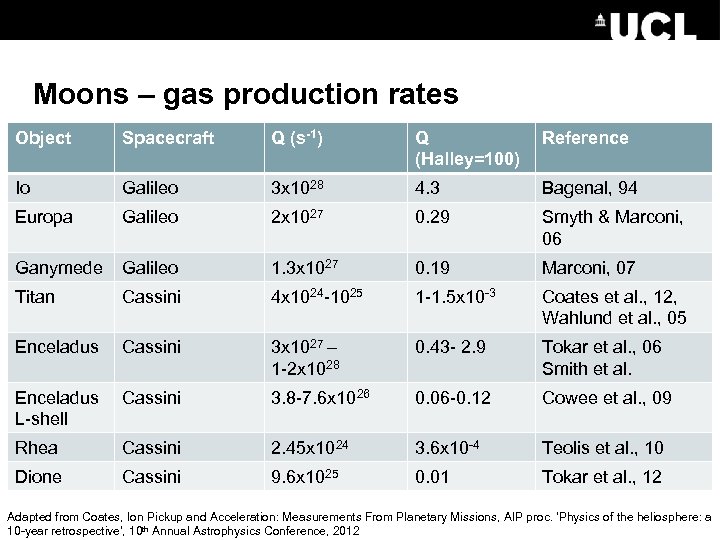 Moons – gas production rates Object Spacecraft Q (s-1) Q (Halley=100) Reference Io Galileo 3 x 1028 4. 3 Bagenal, 94 Europa Galileo 2 x 1027 0. 29 Smyth & Marconi, 06 Ganymede Galileo 1. 3 x 1027 0. 19 Marconi, 07 Titan Cassini 4 x 1024 -1025 1 -1. 5 x 10 -3 Coates et al. , 12, Wahlund et al. , 05 Enceladus Cassini 3 x 1027 – 1 -2 x 1028 0. 43 - 2. 9 Tokar et al. , 06 Smith et al. Enceladus L-shell Cassini 3. 8 -7. 6 x 1026 0. 06 -0. 12 Cowee et al. , 09 Rhea Cassini 2. 45 x 1024 3. 6 x 10 -4 Teolis et al. , 10 Dione Cassini 9. 6 x 1025 0. 01 Tokar et al. , 12 Adapted from Coates, Ion Pickup and Acceleration: Measurements From Planetary Missions, AIP proc. ‘Physics of the heliosphere: a 10 -year retrospective’, 10 th Annual Astrophysics Conference, 2012
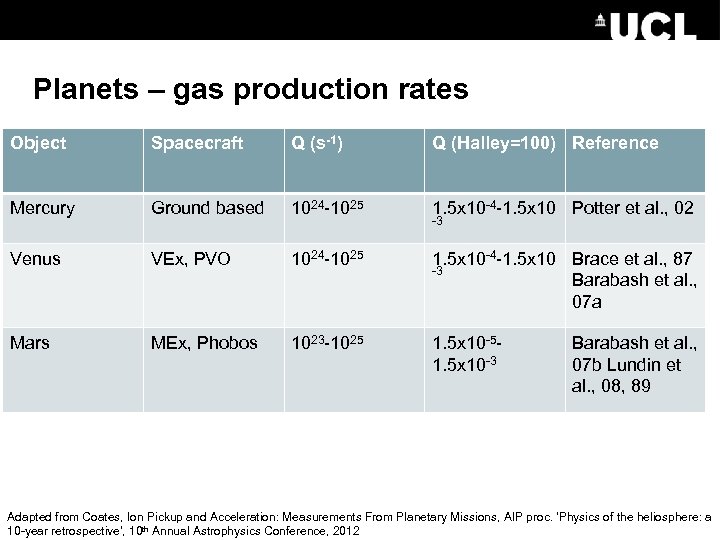 Planets – gas production rates Object Spacecraft Q (s-1) Q (Halley=100) Reference Mercury Ground based 1024 -1025 1. 5 x 10 -4 -1. 5 x 10 Potter et al. , 02 Venus VEx, PVO 1024 -1025 1. 5 x 10 -4 -1. 5 x 10 Brace et al. , 87 -3 Barabash et al. , 07 a Mars MEx, Phobos 1023 -1025 1. 5 x 10 -51. 5 x 10 -3 -3 Barabash et al. , 07 b Lundin et al. , 08, 89 Adapted from Coates, Ion Pickup and Acceleration: Measurements From Planetary Missions, AIP proc. ‘Physics of the heliosphere: a 10 -year retrospective’, 10 th Annual Astrophysics Conference, 2012
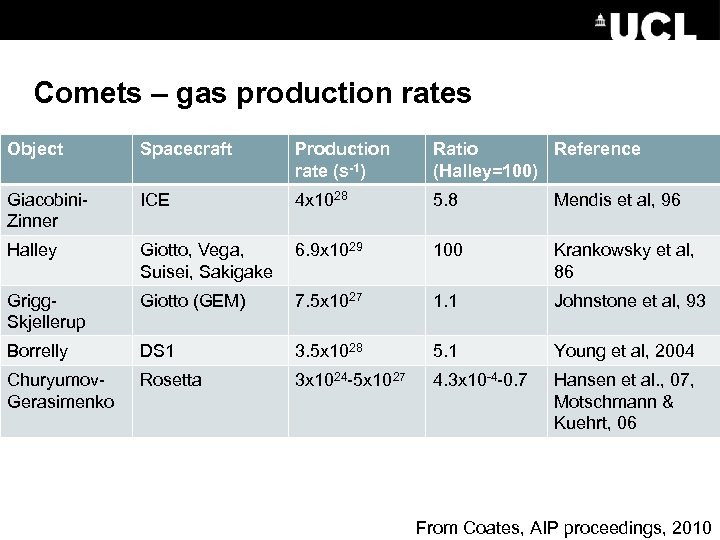 Comets – gas production rates Object Spacecraft Production rate (s-1) Ratio Reference (Halley=100) Giacobini. Zinner ICE 4 x 1028 5. 8 Mendis et al, 96 Halley Giotto, Vega, Suisei, Sakigake 6. 9 x 1029 100 Krankowsky et al, 86 Grigg. Skjellerup Giotto (GEM) 7. 5 x 1027 1. 1 Johnstone et al, 93 Borrelly DS 1 3. 5 x 1028 5. 1 Young et al, 2004 Churyumov. Gerasimenko Rosetta 3 x 1024 -5 x 1027 4. 3 x 10 -4 -0. 7 Hansen et al. , 07, Motschmann & Kuehrt, 06 From Coates, AIP proceedings, 2010