


 Скачать презентацию Space Technology GSFC 5 Tomorrow s Technology Today Section
008b6fc40b089aae097edc7393103f69.ppt
- Количество слайдов: 28
 Space Technology GSFC 5 “Tomorrow’s Technology Today” Section 12. 0 Guidance, Navigation & Control Samuel J. Placanica GN&C Lead Engineer ST 5 PDR June 19 -20, 2001
 GSFC Agenda • Requirements • Documentation • Components • Operational Modes • Mission Planning • Attitude Determination • Dynamic Simulator • Risk Mitigation ST 5 PDR June 19 -20, 2001 12 - 2
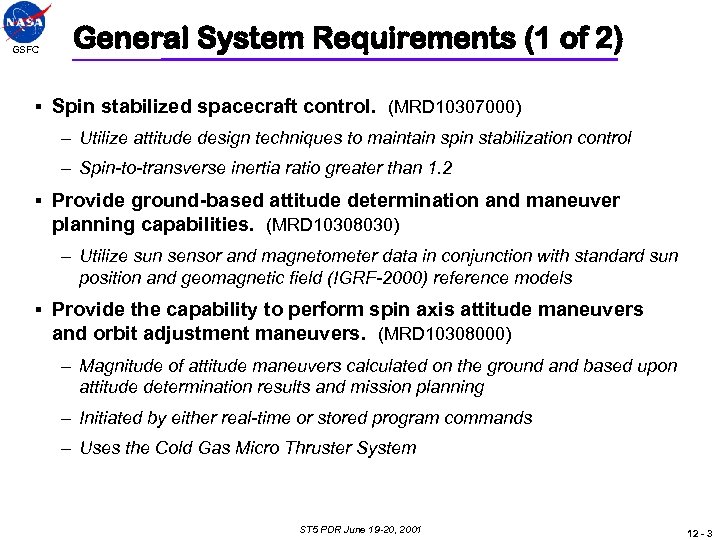 GSFC General System Requirements (1 of 2) § Spin stabilized spacecraft control. (MRD 10307000) – Utilize attitude design techniques to maintain spin stabilization control – Spin-to-transverse inertia ratio greater than 1. 2 § Provide ground-based attitude determination and maneuver planning capabilities. (MRD 10308030) – Utilize sun sensor and magnetometer data in conjunction with standard sun position and geomagnetic field (IGRF-2000) reference models § Provide the capability to perform spin axis attitude maneuvers and orbit adjustment maneuvers. (MRD 10308000) – Magnitude of attitude maneuvers calculated on the ground and based upon attitude determination results and mission planning – Initiated by either real-time or stored program commands – Uses the Cold Gas Micro Thruster System ST 5 PDR June 19 -20, 2001 12 - 3
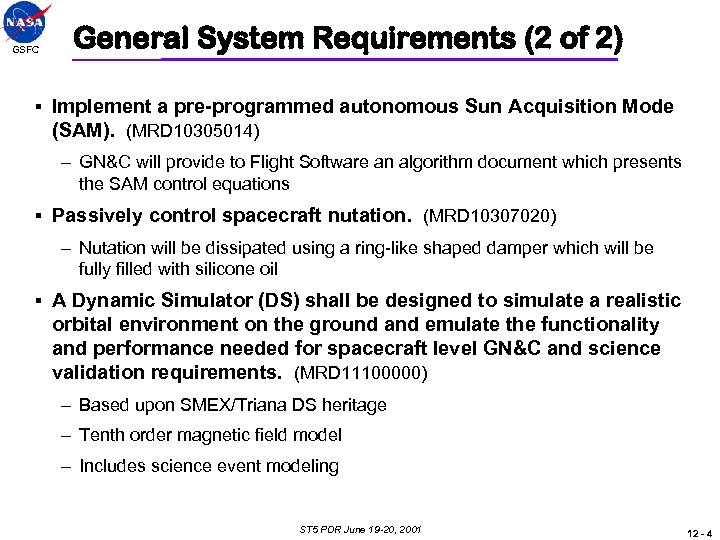 GSFC General System Requirements (2 of 2) § Implement a pre-programmed autonomous Sun Acquisition Mode (SAM). (MRD 10305014) – GN&C will provide to Flight Software an algorithm document which presents the SAM control equations § Passively control spacecraft nutation. (MRD 10307020) – Nutation will be dissipated using a ring-like shaped damper which will be fully filled with silicone oil § A Dynamic Simulator (DS) shall be designed to simulate a realistic orbital environment on the ground and emulate the functionality and performance needed for spacecraft level GN&C and science validation requirements. (MRD 11100000) – Based upon SMEX/Triana DS heritage – Tenth order magnetic field model – Includes science event modeling ST 5 PDR June 19 -20, 2001 12 - 4
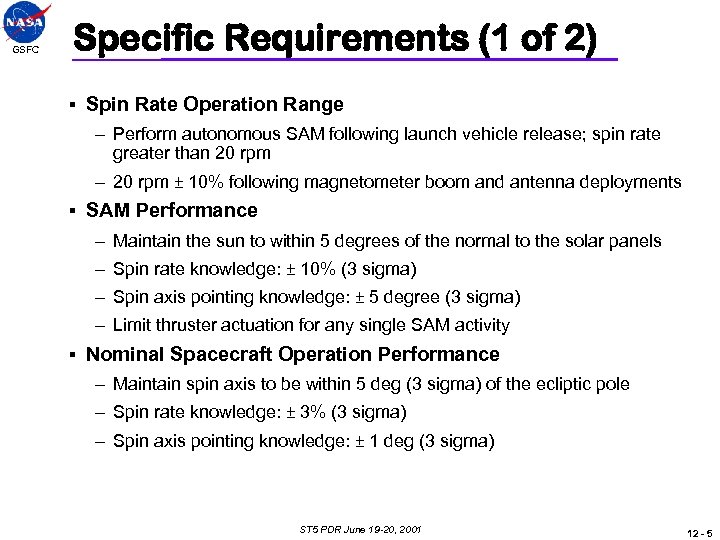 GSFC Specific Requirements (1 of 2) § Spin Rate Operation Range – Perform autonomous SAM following launch vehicle release; spin rate greater than 20 rpm – 20 rpm ± 10% following magnetometer boom and antenna deployments § SAM Performance – Maintain the sun to within 5 degrees of the normal to the solar panels – Spin rate knowledge: ± 10% (3 sigma) – Spin axis pointing knowledge: ± 5 degree (3 sigma) – Limit thruster actuation for any single SAM activity § Nominal Spacecraft Operation Performance – Maintain spin axis to be within 5 deg (3 sigma) of the ecliptic pole – Spin rate knowledge: ± 3% (3 sigma) – Spin axis pointing knowledge: ± 1 deg (3 sigma) ST 5 PDR June 19 -20, 2001 12 - 5
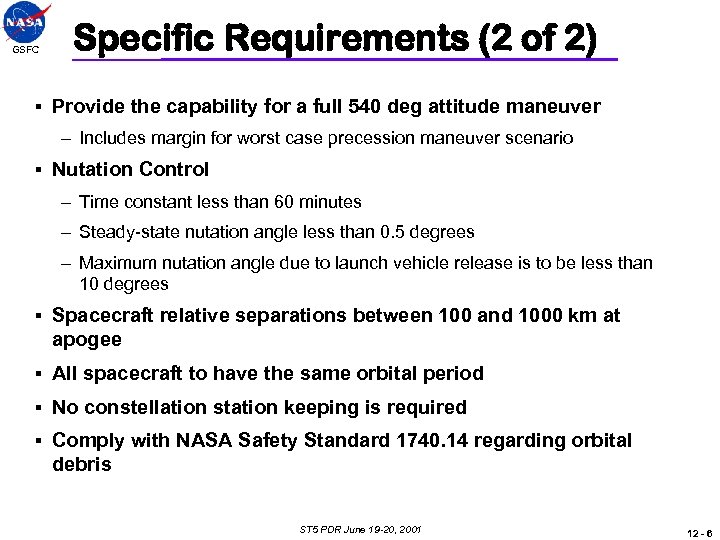 GSFC Specific Requirements (2 of 2) § Provide the capability for a full 540 deg attitude maneuver – Includes margin for worst case precession maneuver scenario § Nutation Control – Time constant less than 60 minutes – Steady-state nutation angle less than 0. 5 degrees – Maximum nutation angle due to launch vehicle release is to be less than 10 degrees § Spacecraft relative separations between 100 and 1000 km at apogee § All spacecraft to have the same orbital period § No constellation station keeping is required § Comply with NASA Safety Standard 1740. 14 regarding orbital debris ST 5 PDR June 19 -20, 2001 12 - 6
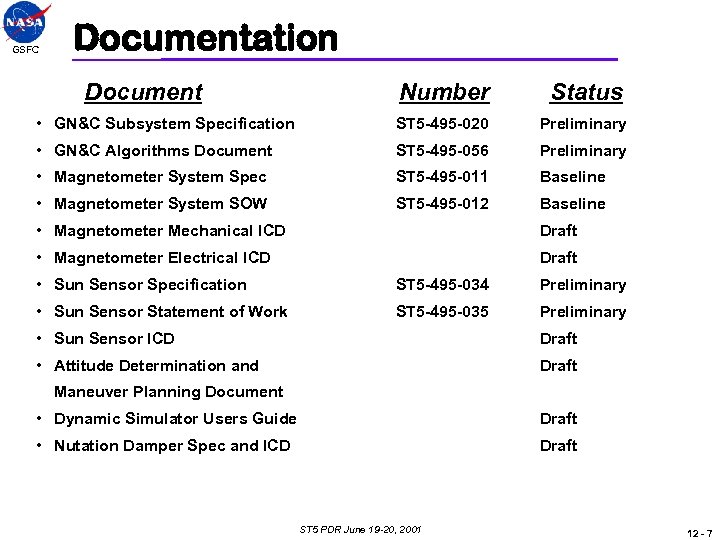 GSFC Documentation Document Number Status • GN&C Subsystem Specification ST 5 -495 -020 Preliminary • GN&C Algorithms Document ST 5 -495 -056 Preliminary • Magnetometer System Spec ST 5 -495 -011 Baseline • Magnetometer System SOW ST 5 -495 -012 Baseline • Magnetometer Mechanical ICD Draft • Magnetometer Electrical ICD Draft • Sun Sensor Specification ST 5 -495 -034 Preliminary • Sun Sensor Statement of Work ST 5 -495 -035 Preliminary • Sun Sensor ICD Draft • Attitude Determination and Draft Maneuver Planning Document • Dynamic Simulator Users Guide Draft • Nutation Damper Spec and ICD Draft ST 5 PDR June 19 -20, 2001 12 - 7
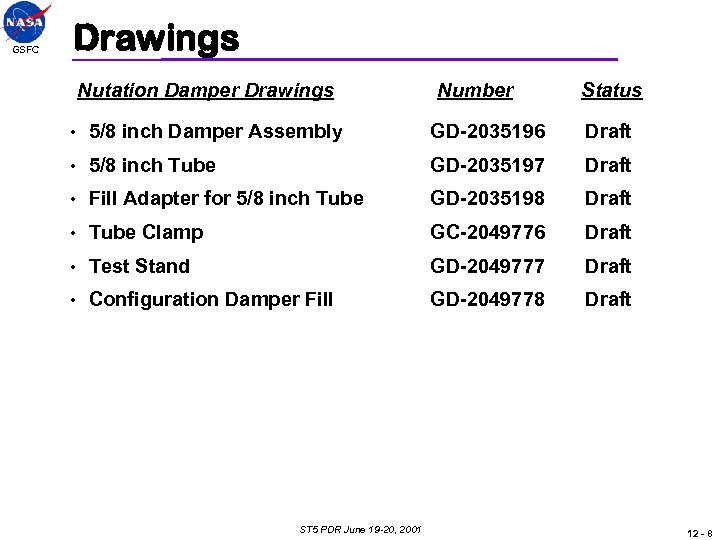 GSFC Drawings Nutation Damper Drawings Number Status • 5/8 inch Damper Assembly GD-2035196 Draft • 5/8 inch Tube GD-2035197 Draft • Fill Adapter for 5/8 inch Tube GD-2035198 Draft • Tube Clamp GC-2049776 Draft • Test Stand GD-2049777 Draft • Configuration Damper Fill GD-2049778 Draft ST 5 PDR June 19 -20, 2001 12 - 8
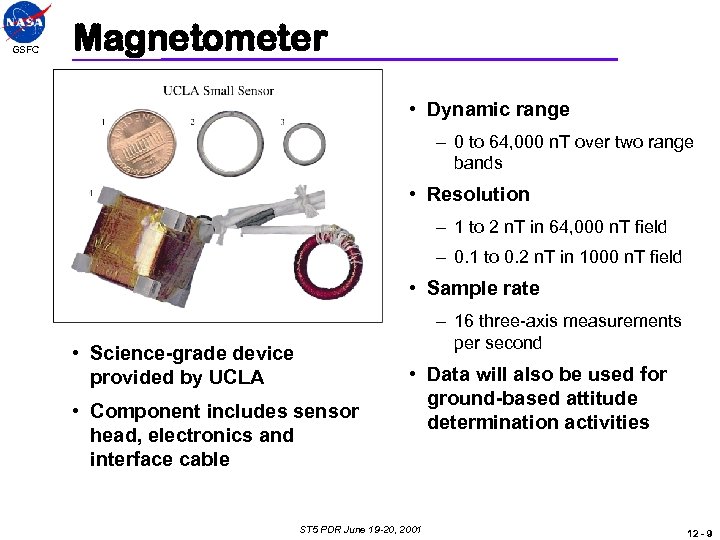 GSFC Magnetometer • Dynamic range – 0 to 64, 000 n. T over two range bands • Resolution – 1 to 2 n. T in 64, 000 n. T field – 0. 1 to 0. 2 n. T in 1000 n. T field • Sample rate – 16 three-axis measurements per second • Science-grade device provided by UCLA • Component includes sensor head, electronics and interface cable • Data will also be used for ground-based attitude determination activities ST 5 PDR June 19 -20, 2001 12 - 9
 GSFC Magnetometer • Total mass: ~ 0. 611 kg • Thermal operating environment – Electronics unit: ~ 0. 220 kg – Electronics unit: -20 to +40 deg C – Electronics chassis: ~ 0. 250 kg – Sensor head: -20 to +40 deg C – Sensor head: ~ 0. 075 kg – Interface cable: -100 to +40 deg C – Interface cable: ~ 0. 066 kg • Total power: 0. 550 W • Thermal survival environment – Electronics unit: -40 to +50 deg C – Electronics unit: 0. 500 W – Sensor head: -40 to +50 deg C – Sensor head: 0. 050 W – Interface cable: -130 to +80 deg C • Volume/Length (cm) – Electronics chassis : 10 x 12 – Sensor head: 4 x 6 – Interface cable: 100 max ST 5 PDR June 19 -20, 2001 12 - 10
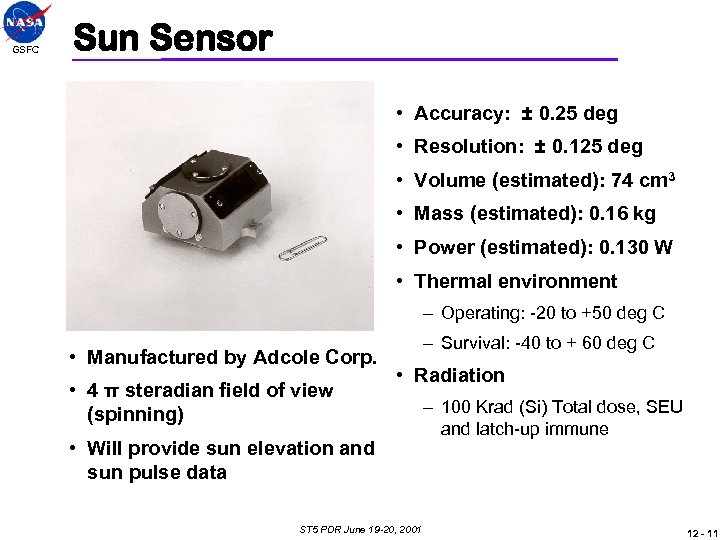 GSFC Sun Sensor • Accuracy: ± 0. 25 deg • Resolution: ± 0. 125 deg • Volume (estimated): 74 cm 3 • Mass (estimated): 0. 16 kg • Power (estimated): 0. 130 W • Thermal environment – Operating: -20 to +50 deg C • Manufactured by Adcole Corp. • 4 π steradian field of view (spinning) – Survival: -40 to + 60 deg C • Radiation • Will provide sun elevation and sun pulse data ST 5 PDR June 19 -20, 2001 – 100 Krad (Si) Total dose, SEU and latch-up immune 12 - 11
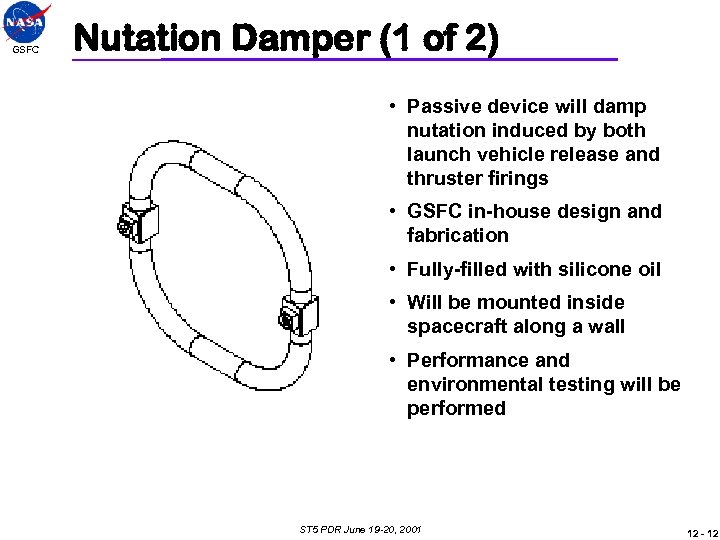 GSFC Nutation Damper (1 of 2) • Passive device will damp nutation induced by both launch vehicle release and thruster firings • GSFC in-house design and fabrication • Fully-filled with silicone oil • Will be mounted inside spacecraft along a wall • Performance and environmental testing will be performed ST 5 PDR June 19 -20, 2001 12 - 12
 GSFC Nutation Damper (2 of 2) 1. Size: 18 cm x 18 cm 2. Tubing material: Aluminum Alloy 6061 -T 6 – 0. 625 inch outer diameter – 0. 035 inch wall thickness 3. Fill adapter material: Aluminum Alloy 6061 -T 6 4. Fluid: Fully filled with Dow Corning 200 Silicone – 5 centistoke viscosity at 25 deg C 5. Mass (best current estimate): 0. 2533 kg 6. Power: None 7. Thermal – Operating: -20 to +50 deg C – Survival: -40 to +60 deg C ST 5 PDR June 19 -20, 2001 12 - 13
 GSFC Operational Modes (1 of 2) • Standby Mode – Used during nominal spacecraft operations – No thruster activity • Sun Acquisition Mode (SAM) – Can remain in mode for indefinite amount of time – Uses on-board flight software to process sun sensor data – SAM control logic will issue the appropriate commands to the cold gas thruster to orient spacecraft into a power positive attitude – Activation methods: • Autonomously entered following launch vehicle release • On cold CPU reset, initialization will boot spacecraft CPU into SAM • Ground command ST 5 PDR June 19 -20, 2001 12 - 14
 GSFC Operational Modes (2 of 2) • Maneuver Mode – Spacecraft spin axis is processed to a pre-determined orientation – Required prior to a delta V in order to orient the spacecraft spin axis along the velocity vector – Ground-based processing of sun sensor and magnetometer data results in thruster fire commands which are uploaded to the spacecraft and executed in open-loop fashion • Delta V Mode – Required to maneuver the three spacecraft into a mission orbit constellation in order to demonstrate inter-spacecraft communications/crosslink capabilities – Ground command ST 5 PDR June 19 -20, 2001 12 - 15
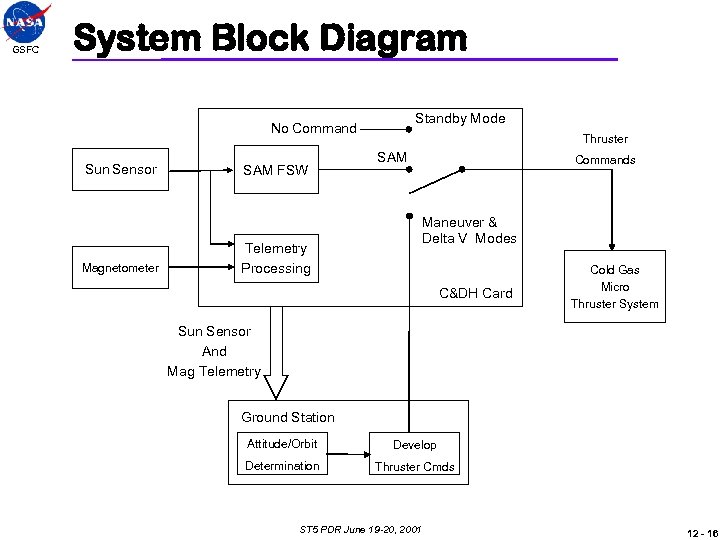 GSFC System Block Diagram Standby Mode No Command Sun Sensor Magnetometer SAM FSW Thruster SAM Commands Maneuver & Delta V Modes Telemetry Processing C&DH Card Cold Gas Micro Thruster System Sun Sensor And Mag Telemetry Ground Station Attitude/Orbit Develop Determination Thruster Cmds ST 5 PDR June 19 -20, 2001 12 - 16
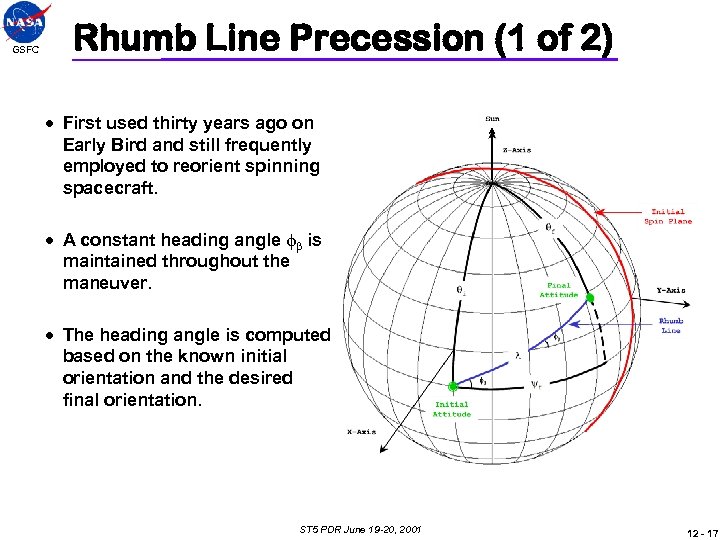 GSFC Rhumb Line Precession (1 of 2) · First used thirty years ago on Early Bird and still frequently employed to reorient spinning spacecraft. · A constant heading angle fb is maintained throughout the maneuver. · The heading angle is computed based on the known initial orientation and the desired final orientation. ST 5 PDR June 19 -20, 2001 12 - 17
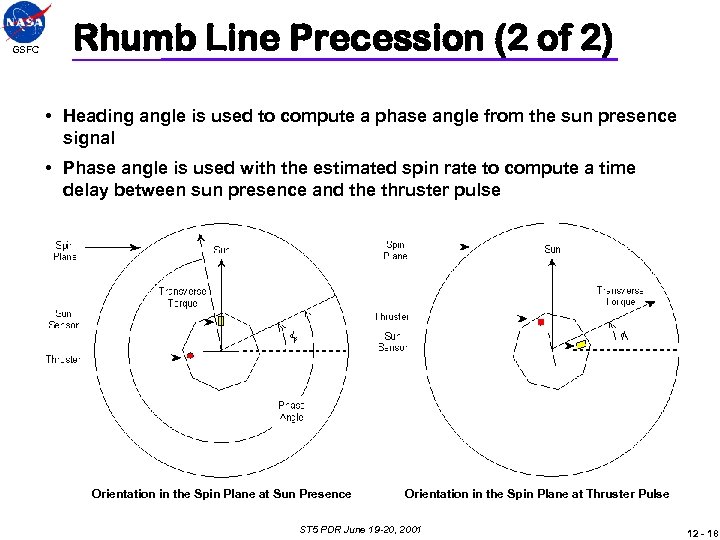 GSFC Rhumb Line Precession (2 of 2) • Heading angle is used to compute a phase angle from the sun presence signal • Phase angle is used with the estimated spin rate to compute a time delay between sun presence and the thruster pulse Orientation in the Spin Plane at Sun Presence Orientation in the Spin Plane at Thruster Pulse ST 5 PDR June 19 -20, 2001 12 - 18
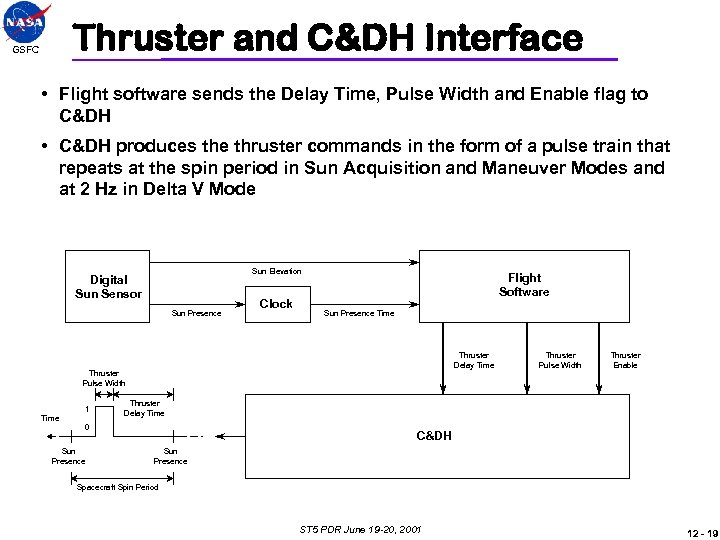 Thruster and C&DH Interface GSFC • Flight software sends the Delay Time, Pulse Width and Enable flag to C&DH • C&DH produces the thruster commands in the form of a pulse train that repeats at the spin period in Sun Acquisition and Maneuver Modes and at 2 Hz in Delta V Mode Sun Elevation Digital Sun Sensor Sun Presence Clock Flight Software Sun Presence Time Thruster Delay Time Thruster Pulse Width 1 Time Thruster Enable Thruster Delay Time 0 Sun Presence Thruster Pulse Width C&DH Sun Presence Spacecraft Spin Period ST 5 PDR June 19 -20, 2001 12 - 19
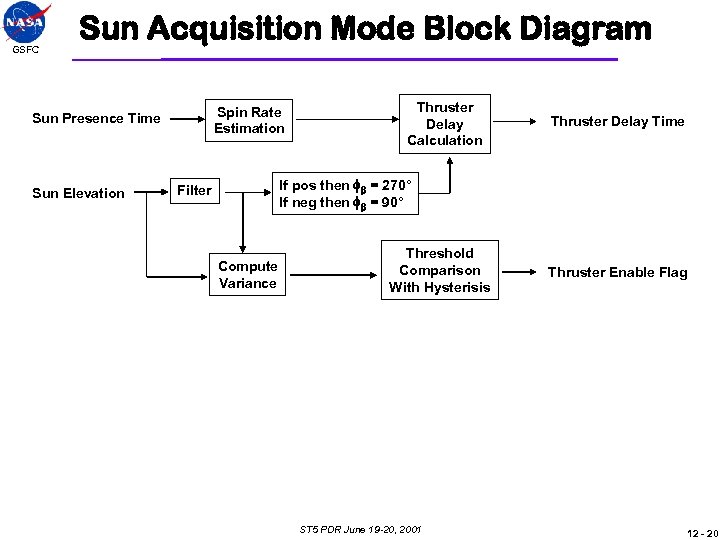 GSFC Sun Acquisition Mode Block Diagram Spin Rate Estimation Sun Presence Time Sun Elevation Thruster Delay Calculation Thruster Delay Time If pos then fb = 270° If neg then fb = 90° Filter Compute Variance Threshold Comparison With Hysterisis ST 5 PDR June 19 -20, 2001 Thruster Enable Flag 12 - 20
 GSFC Mission Planning • Constellation - Formation defined as inter-spacecraft distances greater than 100 km and less than 1000 km at apogee • Lifetime - 3 months, 6 month goal • On-board maneuvers to final configuration • Orbit Debris mitigation - NASA NSS-1740. 14 • Orbit Determination - 10 km knowledge • All spacecraft in same orbit plane, identical periods • Delta V required to deploy from geosynchronous transfer orbit no greater than 1. 6 m/s • No provision for orbit maintenance ST 5 PDR June 19 -20, 2001 12 - 21
 GSFC Orbit Characteristics • Assumptions – Launch November 2003 – Nominal Orbit: from empirical survey of launch vehicle histories • 200 x 38, 000 km altitude (Period: 10. 5 hours) • 28 deg inclination • perigee at descending node (typical LV injection for GTO) • apogee sun side (noon) • Eclipse History – 30 minutes max eclipse, 143 days from launch • Lifetime - nominal scenario – +2 sigma solar flux = 1. 1 years, meets 6 month goal ST 5 PDR June 19 -20, 2001 12 - 22
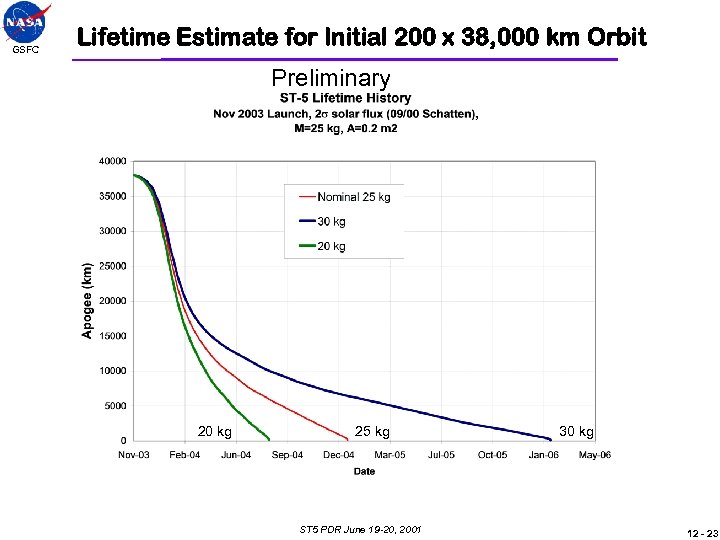 GSFC Lifetime Estimate for Initial 200 x 38, 000 km Orbit Preliminary 20 kg 25 kg ST 5 PDR June 19 -20, 2001 30 kg 12 - 23
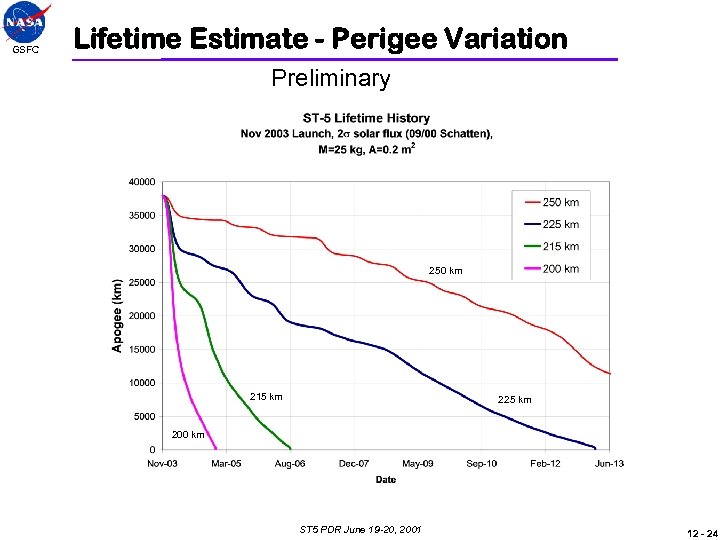 GSFC Lifetime Estimate - Perigee Variation Preliminary 250 km 215 km 225 km 200 km ST 5 PDR June 19 -20, 2001 12 - 24
 GSFC Attitude Determination • Shall accurately determine rate and attitude of the spacecraft for both the normal on-orbit mode and the orbit and attitude adjustment modes • The ground-based Attitude Determination System (ADS) will reuse components from the Multi. Mission Spin-Axis Support System (MSASS) • MSASS is a Matlab-based attitude determination system which has been used to support several GSFC missions, including FAST, Wind, and Polar • ADS will utilize magnetometer and sun sensor telemetry data • GN&C will provide hardware and analysis tools to support two redundant strings in the mission operation control center ST 5 PDR June 19 -20, 2001 12 - 25
 GSFC Dynamic Simulator (1 of 2) • Simulator core simulates single spacecraft • Simulator core code is hosted in a single PC-compatible • Simulator core code is a ‘C’ program running under Linux • Interface is through commercial PCI plug-in cards (via custom hardware as needed) • ASCII text configuration files are used extensively to allow rapid reconfiguration as needed • Internal data is stored in a mnemonic-driven database • Simulator core is derived from SMEX/Triana heritage code (especially Triana and FAST) • One copy of simulator to be built for each of three test environments (Flight S/W, C&DH S/W, and Flat. Sat – no testing at spacecraft level intended) ST 5 PDR June 19 -20, 2001 12 - 26
 GSFC Dynamic Simulator (2 of 2) • Simulator can be configured for “open loop” operation (i. e. , sensor data is static regardless of actuators and dynamics, and interfaces can be tested in this fashion) • Simulator can be configured for “mixed loop” operation (i. e. , sensor data reflects the response of the dynamics to constant actuation regardless of actual commands, and interfaces can be tested in this fashion) • Simulator can be configured for “closed loop” operation (i. e. , sensor data reflects the response of the dynamics to the actuator commands received) • Regardless of loop configuration, individual sensors and actuators can be disconnected from the simulator and actual hardware substituted (it will not then be “in the loop”) • No simulation of GPS or inter-spacecraft signals intended ST 5 PDR June 19 -20, 2001 12 - 27
 GSFC Risk Mitigation • Risk: Magnetometer electronics parts availability - Mitigation: GSFC will assist UCLA in parts procurement • Risk: Sun sensor shock environment - Mitigation: Adcole will perform analysis and redesign to strengthen the sun sensor in the areas of recticle hold-down and recticle/solar cell separation • Risk: Rapidly decaying orbit - Mitigation: • Provide larger delta V capacity • Acquire higher perigee altitude due to launch vehicle insertion • Accommodate through system-level design ST 5 PDR June 19 -20, 2001 12 - 28