


 Скачать презентацию Space Network Overview Part 1 of 5 1
7d91a24fed67458f44e7f9a9247f1065.ppt
- Количество слайдов: 74
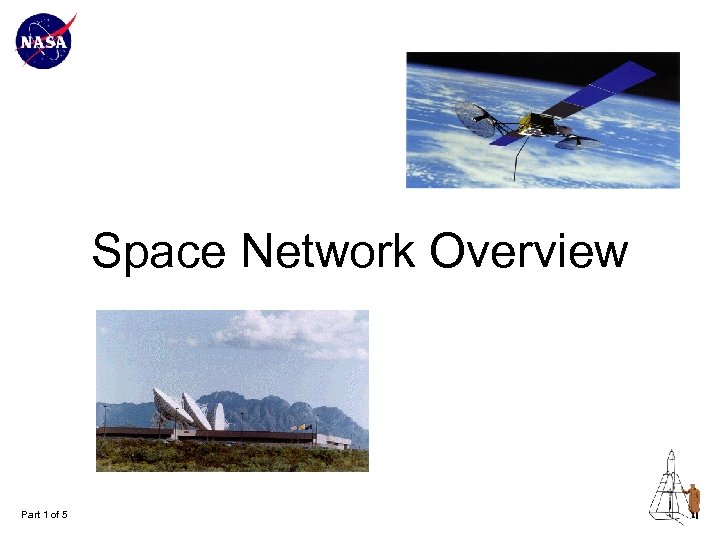 Space Network Overview Part 1 of 5 1
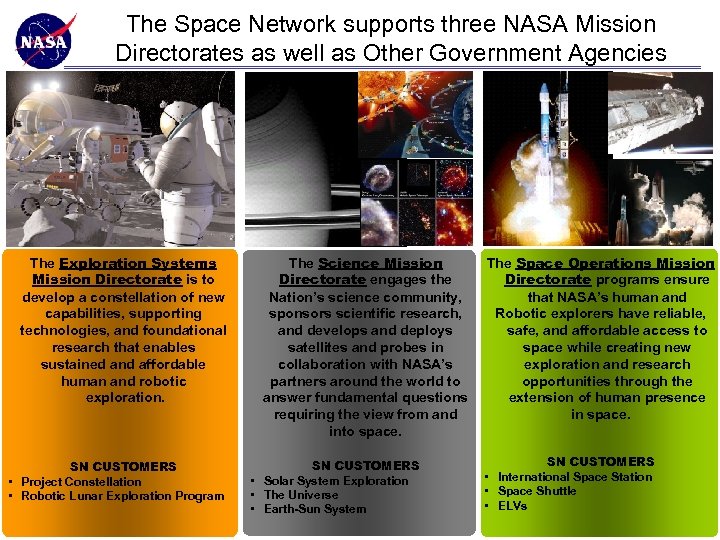 The Space Network supports three NASA Mission Directorates as well as Other Government Agencies The Exploration Systems Mission Directorate is to develop a constellation of new capabilities, supporting technologies, and foundational research that enables sustained and affordable human and robotic exploration. SN CUSTOMERS • Project Constellation • Robotic Lunar Exploration Program The Science Mission Directorate engages the Nation’s science community, sponsors scientific research, and develops and deploys satellites and probes in collaboration with NASA’s partners around the world to answer fundamental questions requiring the view from and into space. SN CUSTOMERS • Solar System Exploration • The Universe • Earth-Sun System The Space Operations Mission Directorate programs ensure that NASA’s human and Robotic explorers have reliable, safe, and affordable access to space while creating new exploration and research opportunities through the extension of human presence in space. SN CUSTOMERS • International Space Station • Space Shuttle • ELVs 2
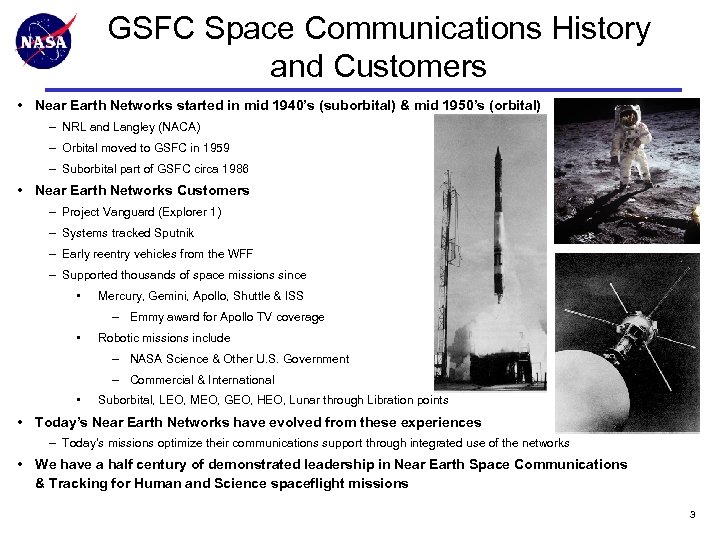 GSFC Space Communications History and Customers • Near Earth Networks started in mid 1940’s (suborbital) & mid 1950’s (orbital) – NRL and Langley (NACA) – Orbital moved to GSFC in 1959 – Suborbital part of GSFC circa 1986 • Near Earth Networks Customers – Project Vanguard (Explorer 1) – Systems tracked Sputnik – Early reentry vehicles from the WFF – Supported thousands of space missions since • Mercury, Gemini, Apollo, Shuttle & ISS – Emmy award for Apollo TV coverage • Robotic missions include – NASA Science & Other U. S. Government – Commercial & International • Suborbital, LEO, MEO, GEO, HEO, Lunar through Libration points • Today’s Near Earth Networks have evolved from these experiences – Today’s missions optimize their communications support through integrated use of the networks • We have a half century of demonstrated leadership in Near Earth Space Communications & Tracking for Human and Science spaceflight missions 3
 Concept of Operations • The Space Network is designed as a highly automated user driven/controlled system for supporting Spacecraft Tracking and Data Acquisition • The SN is a highly reliable, highly available system • Space Network operations utilizes three major segments: – Space Segment (Tracking and Data Relay Satellite Constellation) – Ground Segment (White Sands Complex/Guam Remote Ground Terminal) – Monitor and Control Segment (Data Services Management Center) 4
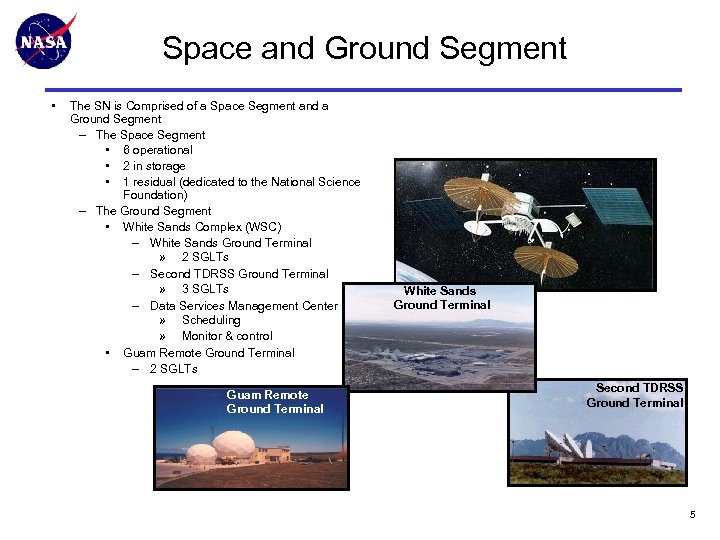 Space and Ground Segment • The SN is Comprised of a Space Segment and a Ground Segment – The Space Segment • 6 operational • 2 in storage • 1 residual (dedicated to the National Science Foundation) – The Ground Segment • White Sands Complex (WSC) – White Sands Ground Terminal » 2 SGLTs – Second TDRSS Ground Terminal » 3 SGLTs – Data Services Management Center » Scheduling » Monitor & control • Guam Remote Ground Terminal – 2 SGLTs Guam Remote Ground Terminal White Sands Ground Terminal Second TDRSS Ground Terminal 5
 Space Segment • The Space Segment consists of the Tracking and Data Relay Satellites positioned in geosynchronous orbit. • Each TDRS can provide up to: • • • Two S-Band Single Access (SSA) Forward (SSAF) and Return (SSAR) services Two Ku-Band Single Access (KSA) Forward (KSAF) and Return (KSAR) services, with TDRS-8, 9, 10 providing Ka-Band services as well One Multiple Access (MA) Forward (MAF) service MA Return (MAR) services One-way Doppler and two-way Doppler & range – All components are redundant with the exception of the TDRS antenna systems – One SA antenna can support one K-Band one S-Band service – Each SA points to a maximum North-South ± 28º, and an ± East. West 22º – TDRS spacecraft are not North-South station kept and can be inclined in orbit 6
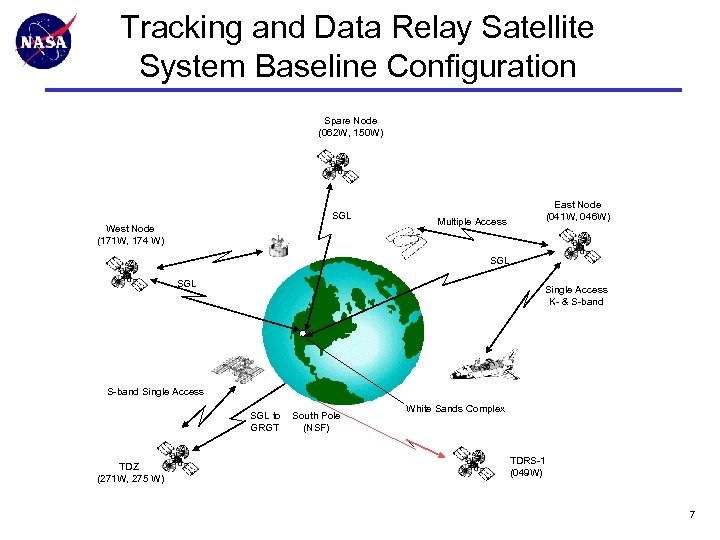 Tracking and Data Relay Satellite System Baseline Configuration Spare Node (062 W, 150 W) SGL West Node (171 W, 174 W) Multiple Access East Node (041 W, 046 W) SGL Single Access K- & S-band Single Access SGL to South Pole GRGT (NSF) TDZ (271 W, 275 W) White Sands Complex TDRS-1 (049 W) 7
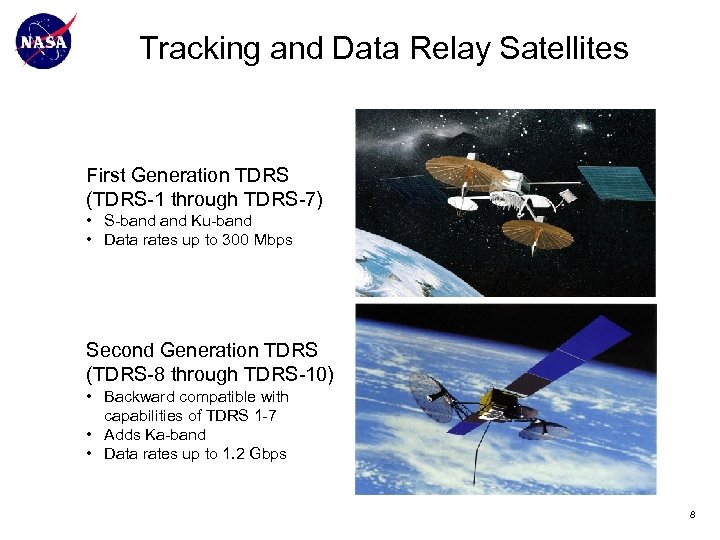 Tracking and Data Relay Satellites First Generation TDRS (TDRS-1 through TDRS-7) • S-band Ku-band • Data rates up to 300 Mbps Second Generation TDRS (TDRS-8 through TDRS-10) • Backward compatible with capabilities of TDRS 1 -7 • Adds Ka-band • Data rates up to 1. 2 Gbps 8
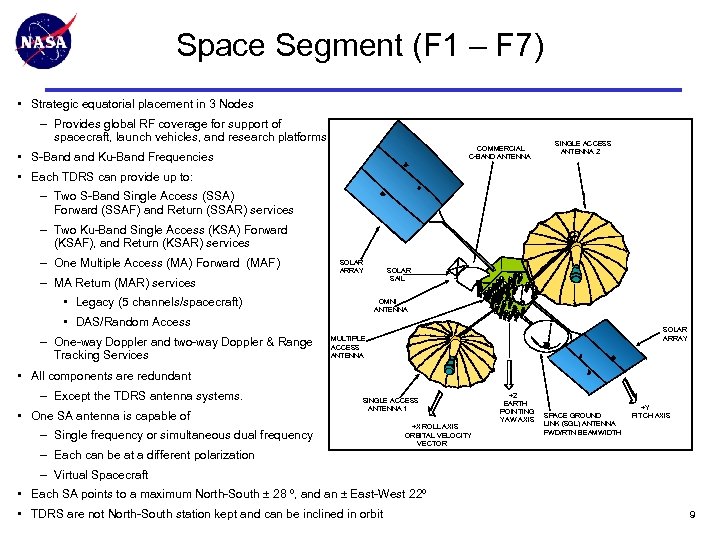 Space Segment (F 1 – F 7) • Strategic equatorial placement in 3 Nodes – Provides global RF coverage for support of spacecraft, launch vehicles, and research platforms COMMERCIAL C-BAND ANTENNA • S-Band Ku-Band Frequencies SINGLE ACCESS ANTENNA 2 • Each TDRS can provide up to: – Two S-Band Single Access (SSA) Forward (SSAF) and Return (SSAR) services – Two Ku-Band Single Access (KSA) Forward (KSAF), and Return (KSAR) services – One Multiple Access (MA) Forward (MAF) SOLAR ARRAY SOLAR SAIL – MA Return (MAR) services • Legacy (5 channels/spacecraft) OMNI ANTENNA • DAS/Random Access – One-way Doppler and two-way Doppler & Range Tracking Services SOLAR ARRAY MULTIPLE ACCESS ANTENNA • All components are redundant – Except the TDRS antenna systems. • One SA antenna is capable of SINGLE ACCESS ANTENNA 1 – Single frequency or simultaneous dual frequency +X ROLL AXIS ORBITAL VELOCITY VECTOR +Z EARTH POINTING YAW AXIS SPACE GROUND LINK (SGL) ANTENNA FWD/RTN BEAMWIDTH +Y PITCH AXIS – Each can be at a different polarization – Virtual Spacecraft • Each SA points to a maximum North-South ± 28 º, and an ± East-West 22º • TDRS are not North-South station kept and can be inclined in orbit 9
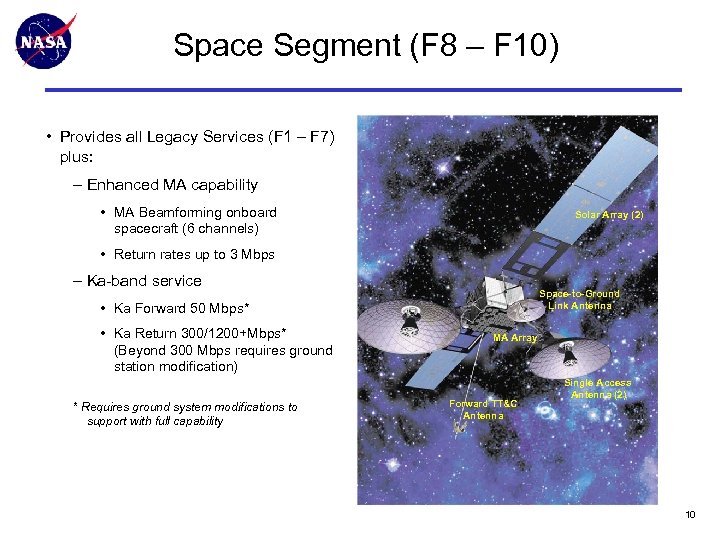 Space Segment (F 8 – F 10) • Provides all Legacy Services (F 1 – F 7) plus: – Enhanced MA capability • MA Beamforming onboard spacecraft (6 channels) Solar Array (2) • Return rates up to 3 Mbps – Ka-band service Space-to-Ground Link Antenna • Ka Forward 50 Mbps* • Ka Return 300/1200+Mbps* (Beyond 300 Mbps requires ground station modification) * Requires ground system modifications to support with full capability MA Array Forward TT&C Antenna Single Access Antenna (2) 10
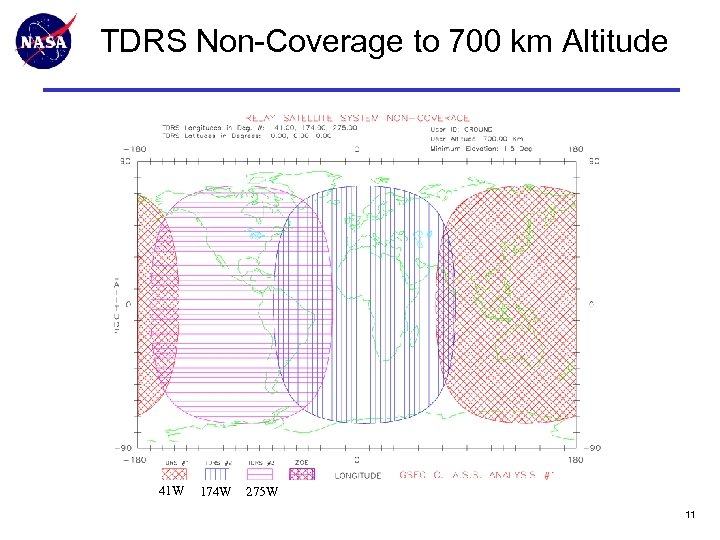 TDRS Non-Coverage to 700 km Altitude 41 W 174 W 275 W 11
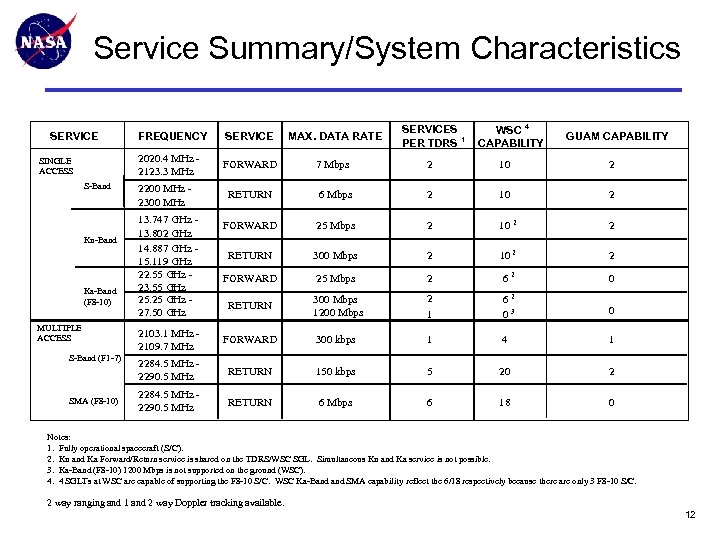 Service Summary/System Characteristics WSC 4 CAPABILITY SINGLE ACCESS S-Band Ku-Band Ka-Band (F 8 -10) MULTIPLE ACCESS S-Band (F 1 -7) SMA (F 8 -10) FREQUENCY SERVICE MAX. DATA RATE SERVICES PER TDRS 2020. 4 MHz 2123. 3 MHz SERVICE FORWARD 7 Mbps 2 10 2 2200 MHz 2300 MHz 1 GUAM CAPABILITY RETURN 6 Mbps 2 10 2 FORWARD 25 Mbps 2 10 2 2 RETURN 300 Mbps 2 10 2 2 FORWARD 25 Mbps 2 62 0 RETURN 300 Mbps 1200 Mbps 2 1 62 03 0 2103. 1 MHz 2109. 7 MHz FORWARD 300 kbps 1 4 1 2284. 5 MHz 2290. 5 MHz RETURN 150 kbps 5 20 2 2284. 5 MHz 2290. 5 MHz RETURN 6 Mbps 6 18 0 13. 747 GHz 13. 802 GHz 14. 887 GHz 15. 119 GHz 22. 55 GHz 23. 55 GHz 25. 25 GHz 27. 50 GHz Notes: 1. Fully operational spacecraft (S/C). 2. Ku and Ka Forward/Return service is shared on the TDRS/WSC SGL. Simultaneous Ku and Ka service is not possible. 3. Ka-Band (F 8 -10) 1200 Mbps is not supported on the ground (WSC). 4. 4 SGLTs at WSC are capable of supporting the F 8 -10 S/C. WSC Ka-Band SMA capability reflect the 6/18 respectively because there are only 3 F 8 -10 S/C. 2 way ranging and 1 and 2 way Doppler tracking available. 12
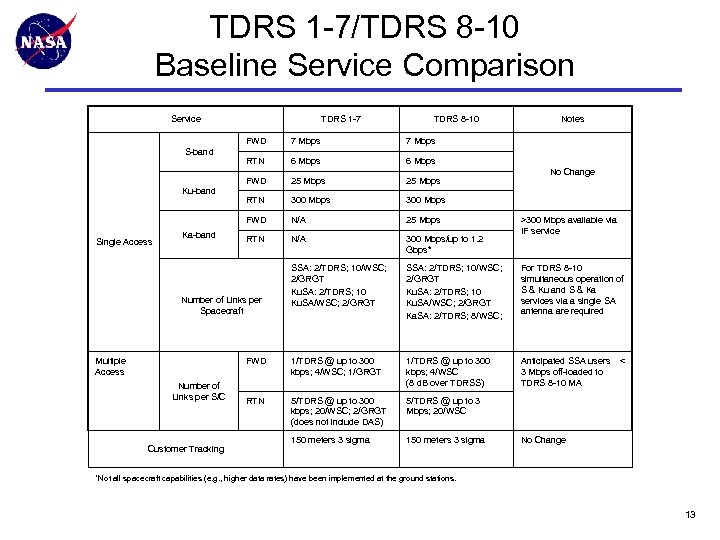 TDRS 1 -7/TDRS 8 -10 Baseline Service Comparison Service TDRS 1 -7 TDRS 8 -10 Notes FWD Ka-band RTN 6 Mbps 25 Mbps RTN 300 Mbps N/A 25 Mbps RTN N/A 300 Mbps/up to 1. 2 Gbps* SSA: 2/TDRS; 10/WSC; 2/GRGT Ku. SA: 2/TDRS; 10 Ku. SA/WSC; 2/GRGT Ka. SA: 2/TDRS; 8/WSC; For TDRS 8 -10 simultaneous operation of S & Ku and S & Ka services via a single SA antenna are required FWD Single Access 7 Mbps FWD Ku-band 7 Mbps FWD S-band 1/TDRS @ up to 300 kbps; 4/WSC; 1/GRGT 1/TDRS @ up to 300 kbps; 4/WSC (8 d. B over TDRSS) Anticipated SSA users < 3 Mbps off-loaded to TDRS 8 -10 MA RTN 5/TDRS @ up to 300 kbps; 20/WSC; 2/GRGT (does not include DAS) 5/TDRS @ up to 3 Mbps; 20/WSC 150 meters 3 sigma Number of Links per Spacecraft Multiple Access Number of Links per S/C Customer Tracking No Change >300 Mbps available via IF service No Change *Not all spacecraft capabilities (e. g. , higher data rates) have been implemented at the ground stations. 13
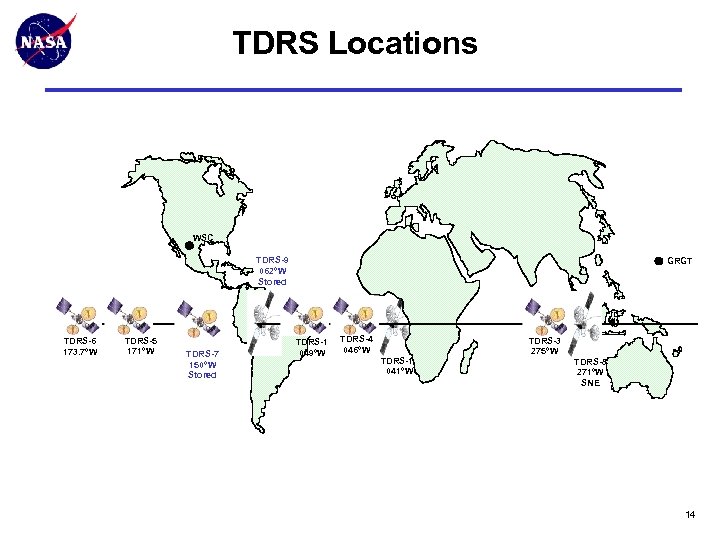 TDRS Locations WSC TDRS-9 062°W Stored TDRS-6 173. 7°W TDRS-5 171°W TDRS-7 150°W Stored GRGT TDRS-1 049°W TDRS-4 046°W TDRS-10 041°W TDRS-3 275°W TDRS-8 271°W SNE 14
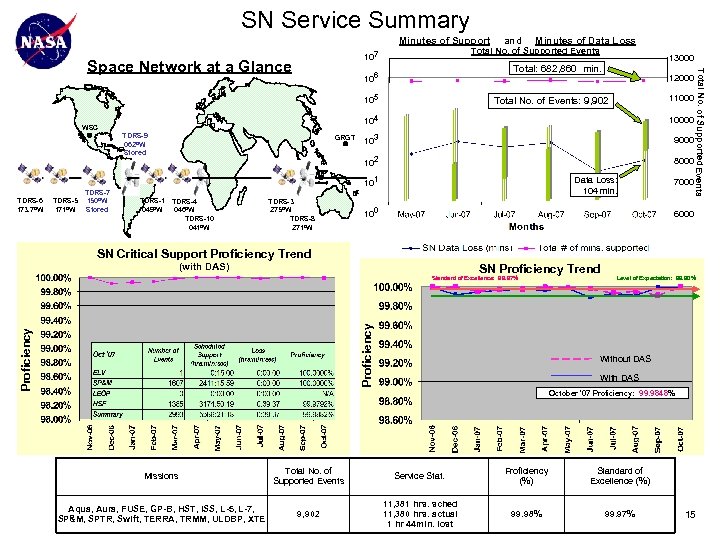 SN Service Summary Minutes of Support 107 106 TDRS-6 173. 7°W 12000 11000 Total No. of Events: 9, 902 104 GRGT 103 9000 102 TDRS-9 062°W Stored 10000 8000 Data Loss: 104 min. 101 TDRS-7 TDRS-5 150°W 171°W Stored 13000 Total: 682, 860 min. 105 WSC Minutes of Data Loss TDRS-1 TDRS-4 049°W 046°W TDRS-10 041°W TDRS-3 275°W TDRS-8 271°W 100 7000 Total No. of Supported Events Space Network at a Glance and Total No. of Supported Events 6000 SN Critical Support Proficiency Trend (with DAS) SN Proficiency Trend Proficiency Standard of Excellence: 99. 97% Level of Expectation: 99. 90% Without DAS With DAS October ‘ 07 Proficiency: 99. 9848% Missions Total No. of Supported Events Service Stat. Proficiency (%) Standard of Excellence (%) Aqua, Aura, FUSE, GP-B, HST, ISS, L-5, L-7, SP&M, SPTR, Swift, TERRA, TRMM, ULDBP, XTE 9, 902 11, 381 hrs. sched 11, 380 hrs. actual 1 hr 44 min. lost 99. 98% 99. 97% 15
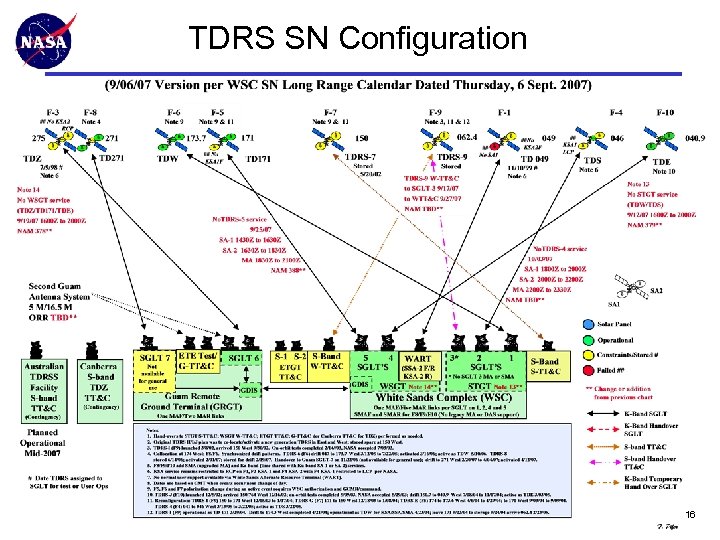 TDRS SN Configuration 16
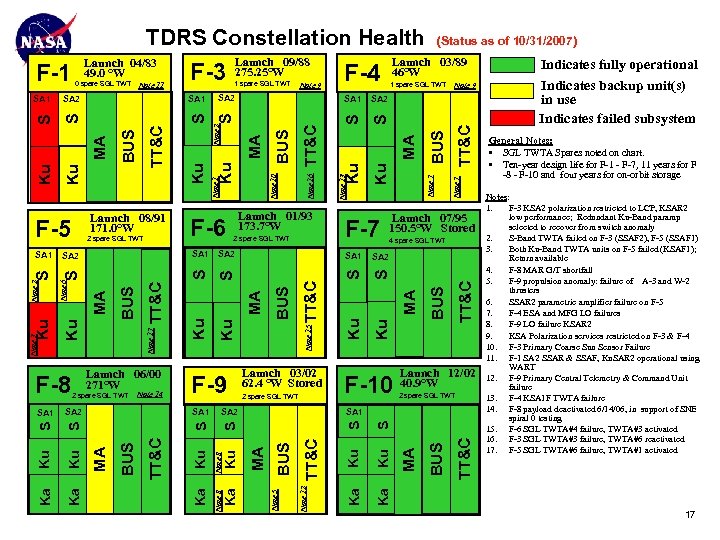 TDRS Constellation Health 1 spare SGL TWT Note 9 F-7 TT&C Note 7 BUS Launch 07/95 150. 5°W Stored 4 spare SGL TWT F-10 TT&C BUS S Ku MA S SA 2 Ku TT&C Note 15 BUS Note 7 Ku MA S S Ku Note 13 TT&C Note 16 Note 10 BUS MA Ku 2 spare SGL TWT Launch 12/02 40. 9°W 2 spare SGL TWT TT&C BUS S Ku Indicates fully operational Indicates backup unit(s) in use Indicates failed subsystem General Notes: • SGL TWTA Spares noted on chart. • Ten-year design life for F-1 - F-7, 11 years for F -8 - F-10 and four years for on-orbit storage Notes: 1. F-3 KSA 2 polarization restricted to LCP, KSAR 2 low performance; Redundant Ku-Band paramp selected to recover from switch anomaly 2. S-Band TWTA failed on F-3 (SSAF 2), F-5 (SSAF 1) 3. Both Ku-Band TWTA units on F-5 failed (KSAF 1); Return available 4. F-8 MAR G/T shortfall 5. F-9 propulsion anomaly: failure of A-3 and W-2 thrusters 6. SSAR 2 parametric amplifier failure on F-5 7. F-4 ESA and MFG LO failures 8. F-9 LO failure KSAR 2 9. KSA Polarization services restricted on F-3 & F-4 10. F-3 Primary Coarse Sun Sensor Failure 11. F-1 SA 2 SSAR & SSAF, Ku. SAR 2 operational using WART 12. F-9 Primary Central Telemetry & Command Unit failure 13. F-4 KSA 1 F TWTA failure 14. F-8 payload deactivated 6/14/06, in support of SNE spiral 0 testing 15. F-6 SGL TWTA#4 failure, TWTA#3 activated 16. F-3 SGL TWTA#3 failure, TWTA#6 reactivated 17. F-5 SGL TWTA#6 failure, TWTA#1 activated Ka MA S Ku TT&C Note 12 BUS Note 5 MA Ka SA 1 S Note 8 S Launch 03/02 62. 4 °W Stored SA 2 Ku TT&C BUS MA S Ku Ka Note 4 S S SA 1 SA 2 Ku F-9 Ku Note 14 Ka 2 spare SGL TWT F-4 SA 1 MA S Launch 06/00 271°W Ka 2 spare SGL TWT Ku Note 17 TT&C MA BUS S Note 6 Ku S Note 2 Ku Note 3 SA 1 Launch 01/93 173. 7°W SA 1 SA 2 F-8 F-6 Launch 03/89 46°W SA 1 SA 2 S S 2 spare SGL TWT Ka F-5 Ku BUS TT&C Ku Ku Launch 08/91 171. 0°W Note 9 SA 2 Note 2 S SA 1 1 spare SGL TWT Ku SA 2 MA SA 1 Note 11 F-3 Launch 09/88 275. 25°W Note 1 0 spare SGL TWT S F-1 Launch 04/83 49. 0 °W (Status as of 10/31/2007) 17
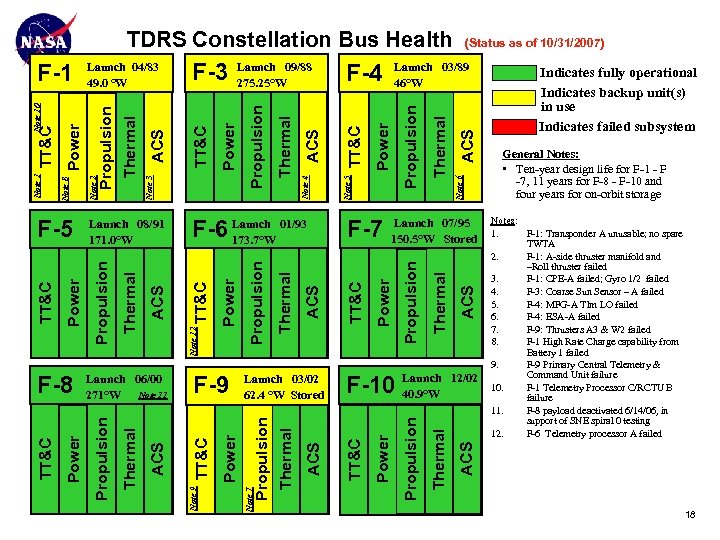 TDRS Constellation Bus Health ACS Indicates fully operational Indicates backup unit(s) in use Indicates failed subsystem General Notes: • Ten-year design life for F-1 - F -7, 11 years for F-8 - F-10 and four years for on-orbit storage Note 6 Thermal Launch 07/95 150. 5°W Stored Notes: 1. ACS 2. Thermal Propulsion F-7 Propulsion Power Note 5 TT&C Launch 03/89 46°W Power ACS F-4 TT&C ACS Note 4 Thermal Propulsion Power TT&C F-6 Launch 01/93 173. 7°W Note 12 ACS Propulsion Launch 09/88 275. 25°W Power TT&C ACS F-3 Note 3 Thermal Propulsion Note 2 Launch 08/91 171. 0°W Thermal Power TT&C F-5 Launch 04/83 49. 0 °W Propulsion Power Note 8 Note 1 TT&C Note 10 F-1 (Status as of 10/31/2007) 3. 4. 5. 6. 7. 8. 9. F-8 Launch 06/00 271°W Note 11 F-9 Launch 03/02 62. 4 °W Stored F-10 Launch 12/02 40. 9°W 10. 12. ACS Thermal Propulsion Power TT&C ACS Thermal Propulsion Note 7 Power TT&C Note 9 ACS Thermal Propulsion Power TT&C 11. F-1: Transponder A unusable; no spare TWTA F-1: A-side thruster manifold and –Roll thruster failed F-1: CPE-A failed; Gyro 1/2 failed F-3: Coarse Sun Sensor – A failed F-4: MFG-A Tlm LO failed F-4: ESA-A failed F-9: Thrusters A 3 & W 2 failed F-1 High Rate Charge capability from Battery 1 failed F-9 Primary Central Telemetry & Command Unit failure F-1 Telemetry Processor C/RCTU B failure F-8 payload deactivated 6/14/06, in support of SNE spiral 0 testing F-6 Telemetry processor A failed 18
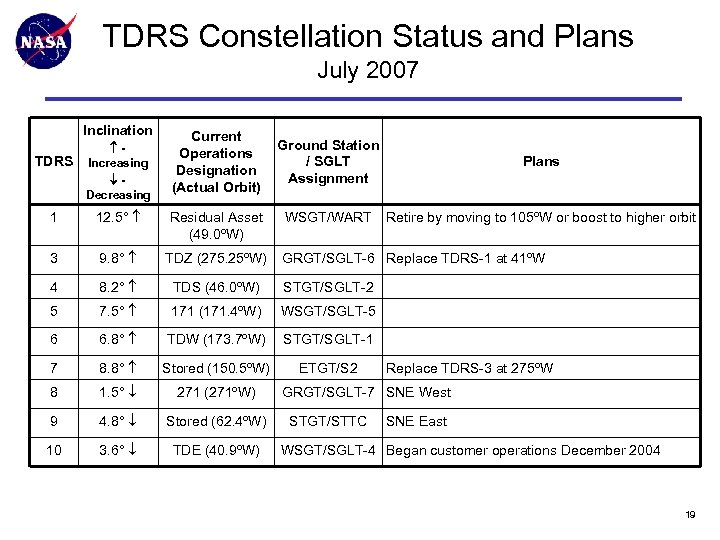 TDRS Constellation Status and Plans July 2007 Inclination TDRS Increasing Decreasing Current Operations Designation (Actual Orbit) Ground Station / SGLT Assignment Plans Retire by moving to 105ºW or boost to higher orbit 1 12. 5° Residual Asset (49. 0ºW) WSGT/WART 3 9. 8° TDZ (275. 25ºW) GRGT/SGLT-6 Replace TDRS-1 at 41ºW 4 8. 2° TDS (46. 0ºW) STGT/SGLT-2 5 7. 5° 171 (171. 4ºW) WSGT/SGLT-5 6 6. 8° TDW (173. 7ºW) STGT/SGLT-1 7 8. 8° Stored (150. 5ºW) ETGT/S 2 8 1. 5° 271 (271ºW) 9 4. 8° Stored (62. 4ºW) 10 3. 6° TDE (40. 9ºW) Replace TDRS-3 at 275ºW GRGT/SGLT-7 SNE West STGT/STTC SNE East WSGT/SGLT-4 Began customer operations December 2004 19
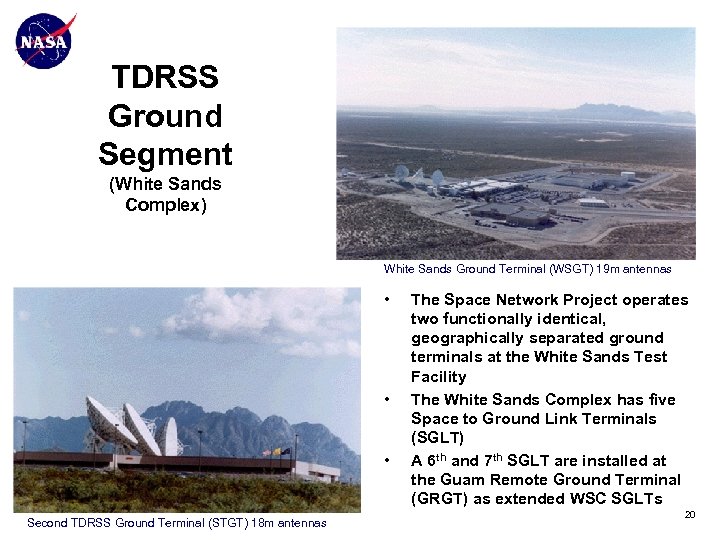 TDRSS Ground Segment (White Sands Complex) White Sands Ground Terminal (WSGT) 19 m antennas • • • Second TDRSS Ground Terminal (STGT) 18 m antennas The Space Network Project operates two functionally identical, geographically separated ground terminals at the White Sands Test Facility The White Sands Complex has five Space to Ground Link Terminals (SGLT) A 6 th and 7 th SGLT are installed at the Guam Remote Ground Terminal (GRGT) as extended WSC SGLTs 20
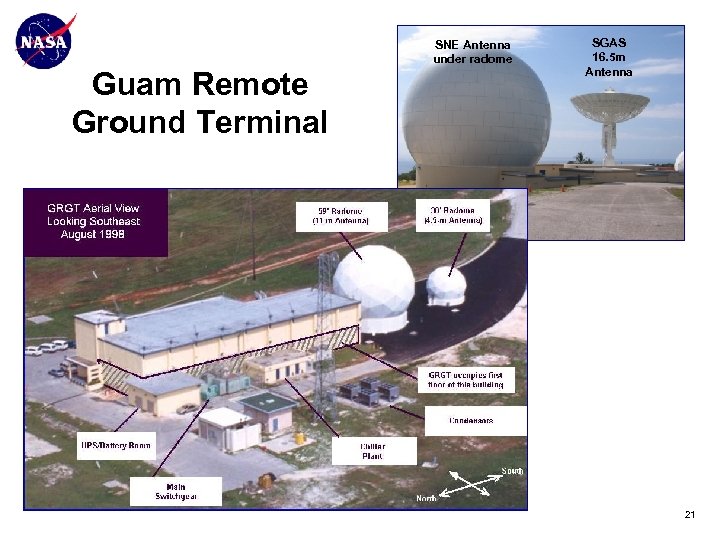 Guam Remote Ground Terminal SNE Antenna under radome SGAS 16. 5 m Antenna 21
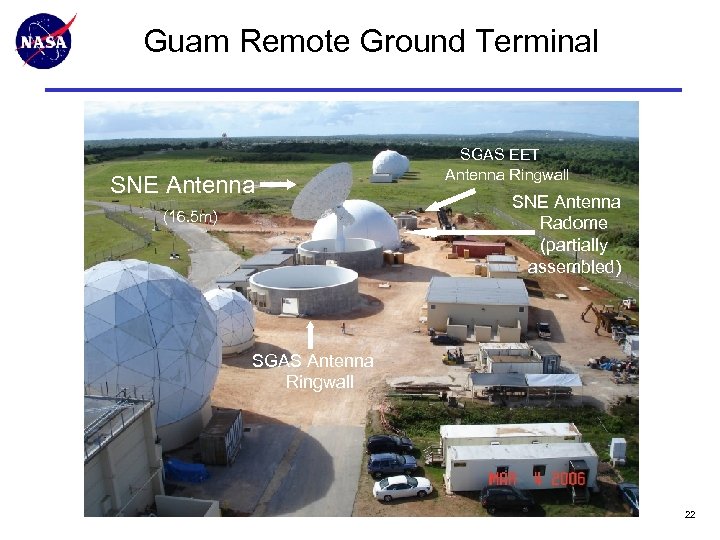 Guam Remote Ground Terminal SNE Antenna (16. 5 m) SGAS EET Antenna Ringwall SNE Antenna Radome (partially assembled) SGAS Antenna Ringwall 22
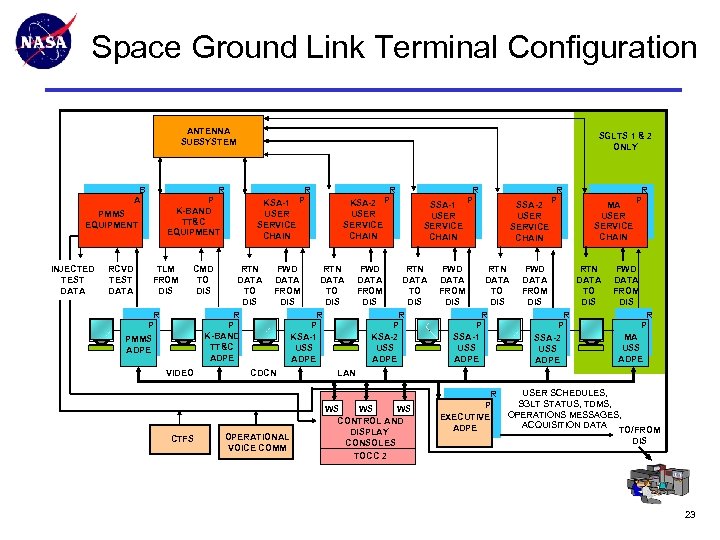 Space Ground Link Terminal Configuration ANTENNA SUBSYSTEM R P K-BAND TT&C EQUIPMENT B A PMMS EQUIPMENT INJECTED TEST DATA RCVD TEST DATA TLM FROM DIS CMD TO DIS R P PMMS ADPE VIDEO CTFS SGLTS 1 & 2 ONLY R KSA-1 P USER SERVICE CHAIN RTN DATA TO DIS R P K-BAND TT&C ADPE R KSA-2 P USER SERVICE CHAIN FWD DATA FROM DIS CDCN OPERATIONAL VOICE COMM RTN DATA TO DIS R P KSA-1 USS ADPE FWD DATA FROM DIS R SSA-1 P USER SERVICE CHAIN RTN DATA TO DIS R P KSA-2 USS ADPE FWD DATA FROM DIS SSA-2 USER SERVICE CHAIN RTN DATA TO DIS R P SSA-1 USS ADPE R P FWD DATA FROM DIS R P SSA-2 USS ADPE R P MA USER SERVICE CHAIN RTN DATA TO DIS FWD DATA FROM DIS R P MA USS ADPE LAN WS WS WS CONTROL AND DISPLAY CONSOLES TOCC 2 R P EXECUTIVE ADPE USER SCHEDULES, SGLT STATUS, TDMS, OPERATIONS MESSAGES, ACQUISITION DATA TO/FROM DIS 23
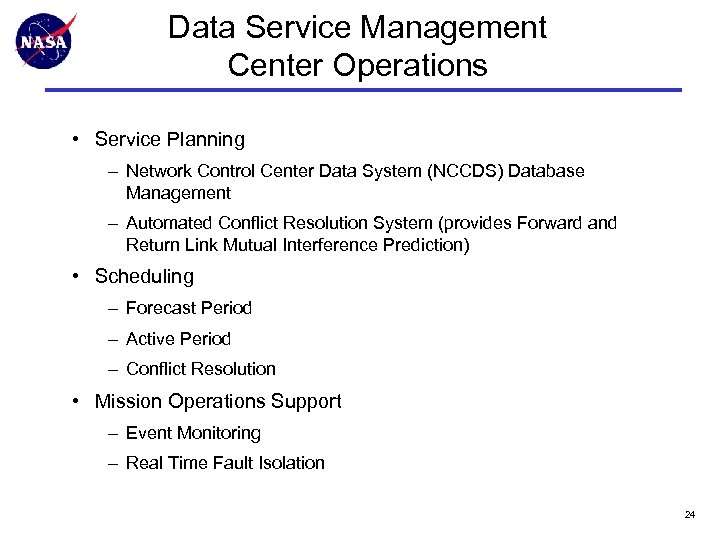 Data Service Management Center Operations • Service Planning – Network Control Center Data System (NCCDS) Database Management – Automated Conflict Resolution System (provides Forward and Return Link Mutual Interference Prediction) • Scheduling – Forecast Period – Active Period – Conflict Resolution • Mission Operations Support – Event Monitoring – Real Time Fault Isolation 24
 Schedule Driven Operations • TDRSS designed as a schedule driven network – The SN Priority List provides strict guidelines for mission support in the event of service request conflicts during the forecast period and is used to resolve conflicts. – Each scheduled event is completely described by a Scheduling Order (SHO). – The SHO is the tool used by the NCCDS for specifying customer requirements to TDRSS. • Constrained Scheduling – User specifies exact time and spacecraft to use to support the event • Flexible Scheduling – User requests a specified number of minutes of contact from any TDRS in a specified cluster within a specified window of opportunity. 25
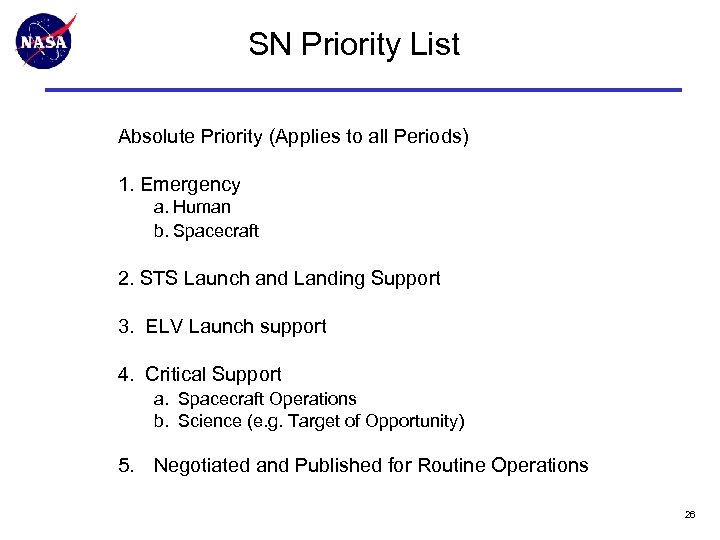 SN Priority List Absolute Priority (Applies to all Periods) 1. Emergency a. Human b. Spacecraft 2. STS Launch and Landing Support 3. ELV Launch support 4. Critical Support a. Spacecraft Operations b. Science (e. g. Target of Opportunity) 5. Negotiated and Published for Routine Operations 26
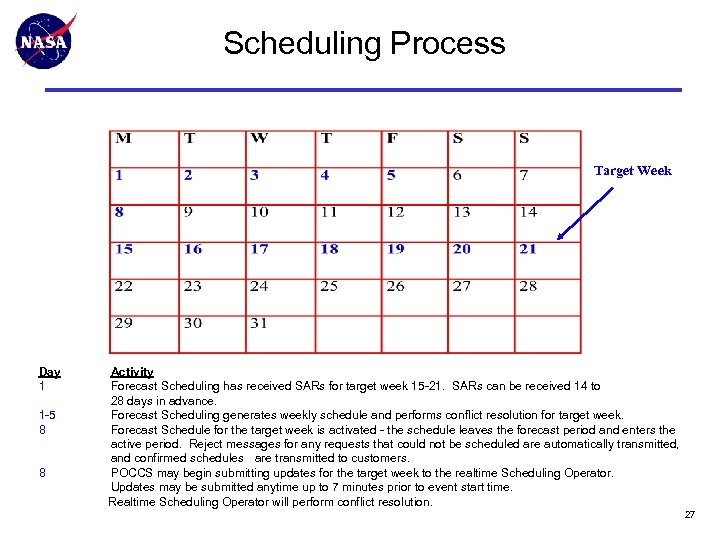 Scheduling Process Target Week Day 1 Activity Forecast Scheduling has received SARs for target week 15 -21. SARs can be received 14 to 28 days in advance. 1 -5 Forecast Scheduling generates weekly schedule and performs conflict resolution for target week. 8 Forecast Schedule for the target week is activated - the schedule leaves the forecast period and enters the active period. Reject messages for any requests that could not be scheduled are automatically transmitted, and confirmed schedules are transmitted to customers. 8 POCCS may begin submitting updates for the target week to the realtime Scheduling Operator. Updates may be submitted anytime up to 7 minutes prior to event start time. Realtime Scheduling Operator will perform conflict resolution. 27
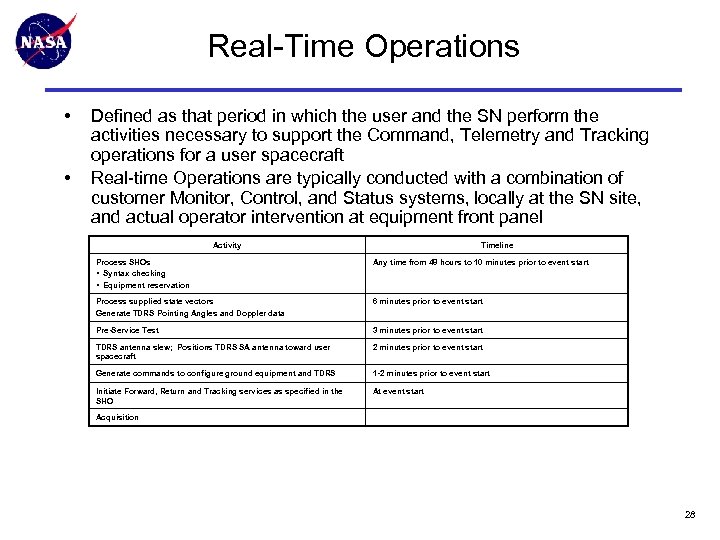 Real-Time Operations • • Defined as that period in which the user and the SN perform the activities necessary to support the Command, Telemetry and Tracking operations for a user spacecraft Real-time Operations are typically conducted with a combination of customer Monitor, Control, and Status systems, locally at the SN site, and actual operator intervention at equipment front panel Activity Timeline Process SHOs • Syntax checking • Equipment reservation Any time from 48 hours to 10 minutes prior to event start Process supplied state vectors Generate TDRS Pointing Angles and Doppler data 6 minutes prior to event start Pre-Service Test 3 minutes prior to event start TDRS antenna slew; Positions TDRS SA antenna toward user spacecraft 2 minutes prior to event start Generate commands to configure ground equipment and TDRS 1 -2 minutes prior to event start Initiate Forward, Return and Tracking services as specified in the SHO At event start Acquisition 28
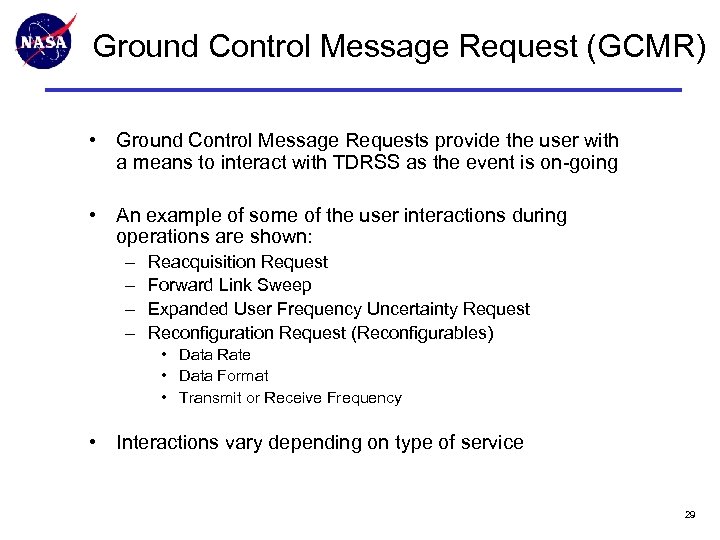 Ground Control Message Request (GCMR) • Ground Control Message Requests provide the user with a means to interact with TDRSS as the event is on-going • An example of some of the user interactions during operations are shown: – – Reacquisition Request Forward Link Sweep Expanded User Frequency Uncertainty Request Reconfiguration Request (Reconfigurables) • Data Rate • Data Format • Transmit or Receive Frequency • Interactions vary depending on type of service 29
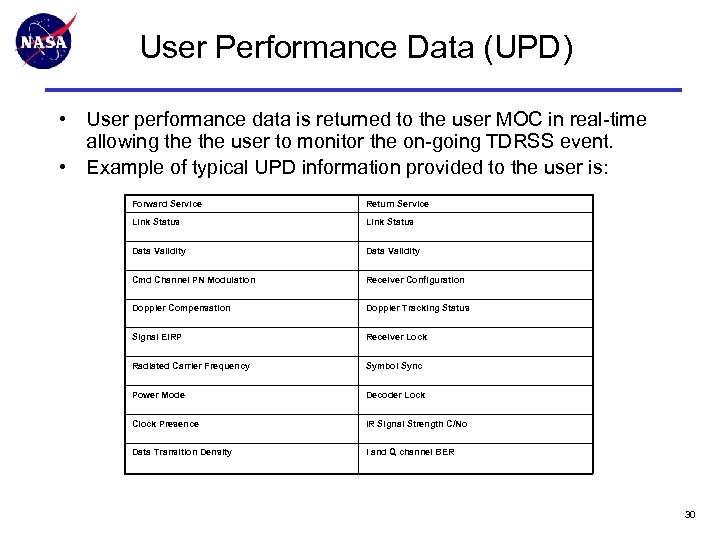 User Performance Data (UPD) • User performance data is returned to the user MOC in real-time allowing the user to monitor the on-going TDRSS event. • Example of typical UPD information provided to the user is: Forward Service Return Service Link Status Data Validity Cmd Channel PN Modulation Receiver Configuration Doppler Compensation Doppler Tracking Status Signal EIRP Receiver Lock Radiated Carrier Frequency Symbol Sync Power Mode Decoder Lock Clock Presence IR Signal Strength C/No Data Transition Density I and Q channel BER 30
 Service Assurance • Monitor performance data from WSC • Receive and process status reports from supporting elements • Coordinate fault isolation 31
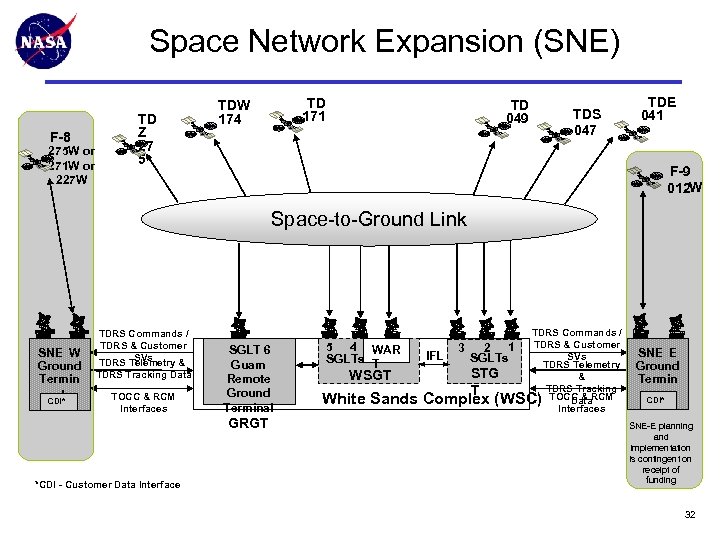 Space Network Expansion (SNE) F-8 275 W or 271 W or 227 W TD Z 27 5 TD 171 TDW 174 TD 049 TDS 047 TDE 041 F-9 012 W Space-to-Ground Link SNE W Ground Termin al CDI* TDRS Commands / TDRS & Customer SVs TDRS Telemetry & TDRS Tracking Data TOCC & RCM Interfaces SGLT 6 Guam Remote Ground Terminal GRGT *CDI - Customer Data Interface 5 4 WAR SGLTs T WSGT IFL 3 2 1 SGLTs STG T TDRS Commands / TDRS & Customer SVs TDRS Telemetry & TDRS Tracking TOCC & RCM Data Interfaces White Sands Complex (WSC) SNE E Ground Termin al CDI* SNE-E planning and implementation is contingent on receipt of funding 32
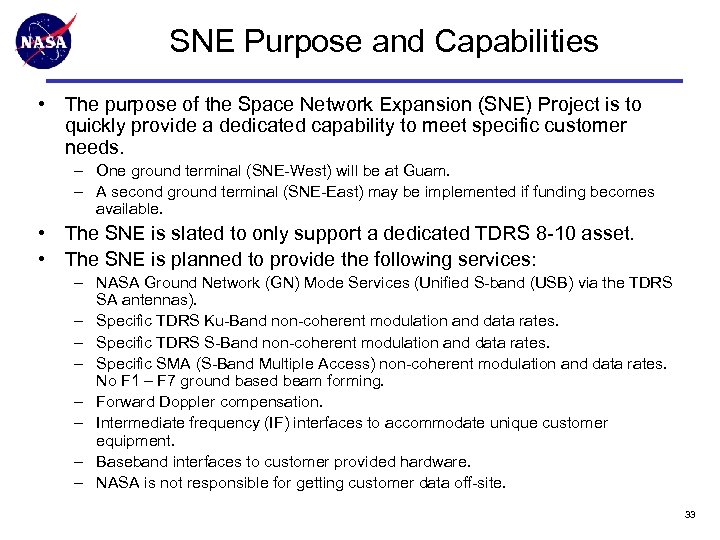 SNE Purpose and Capabilities • The purpose of the Space Network Expansion (SNE) Project is to quickly provide a dedicated capability to meet specific customer needs. – One ground terminal (SNE-West) will be at Guam. – A second ground terminal (SNE-East) may be implemented if funding becomes available. • The SNE is slated to only support a dedicated TDRS 8 -10 asset. • The SNE is planned to provide the following services: – NASA Ground Network (GN) Mode Services (Unified S-band (USB) via the TDRS SA antennas). – Specific TDRS Ku-Band non-coherent modulation and data rates. – Specific TDRS S-Band non-coherent modulation and data rates. – Specific SMA (S-Band Multiple Access) non-coherent modulation and data rates. No F 1 – F 7 ground based beam forming. – Forward Doppler compensation. – Intermediate frequency (IF) interfaces to accommodate unique customer equipment. – Baseband interfaces to customer provided hardware. – NASA is not responsible for getting customer data off-site. 33
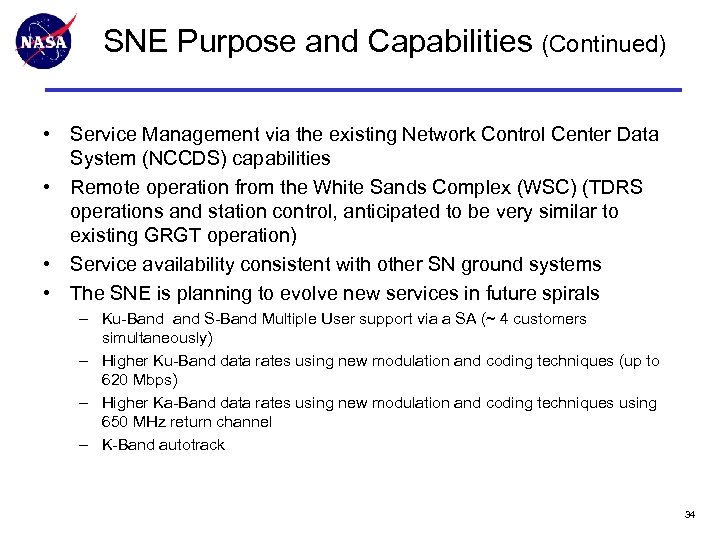 SNE Purpose and Capabilities (Continued) • Service Management via the existing Network Control Center Data System (NCCDS) capabilities • Remote operation from the White Sands Complex (WSC) (TDRS operations and station control, anticipated to be very similar to existing GRGT operation) • Service availability consistent with other SN ground systems • The SNE is planning to evolve new services in future spirals – Ku-Band S-Band Multiple User support via a SA (~ 4 customers simultaneously) – Higher Ku-Band data rates using new modulation and coding techniques (up to 620 Mbps) – Higher Ka-Band data rates using new modulation and coding techniques using 650 MHz return channel – K-Band autotrack 34
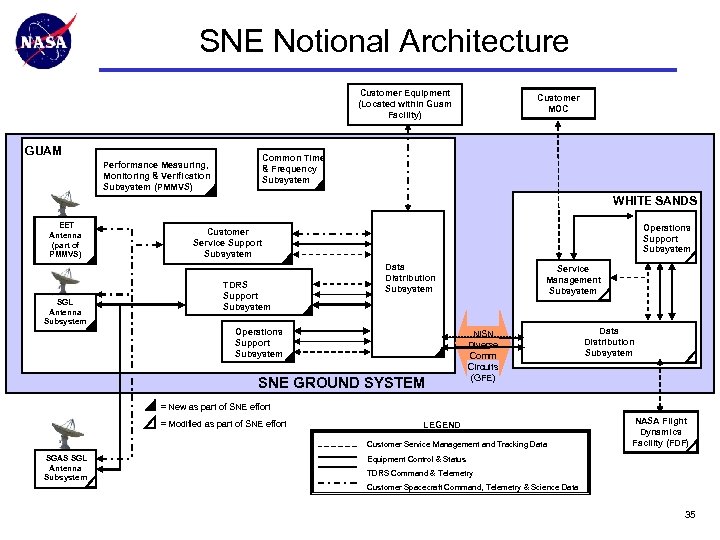 SNE Notional Architecture Customer Equipment (Located within Guam Facility) GUAM Customer MOC Common Time & Frequency Subsystem Performance Measuring, Monitoring & Verification Subsystem (PMMVS) WHITE SANDS EET Antenna (part of PMMVS) SGL Antenna Subsystem Operations Support Subsystem Customer Service Support Subsystem TDRS Support Subsystem Data Distribution Subsystem Operations Support Subsystem SNE GROUND SYSTEM Service Management Subsystem NISN Diverse Comm Circuits (GFE) Data Distribution Subsystem = New as part of SNE effort = Modified as part of SNE effort LEGEND Customer Service Management and Tracking Data SGAS SGL Antenna Subsystem NASA Flight Dynamics Facility (FDF) Equipment Control & Status TDRS Command & Telemetry Customer Spacecraft Command, Telemetry & Science Data 35
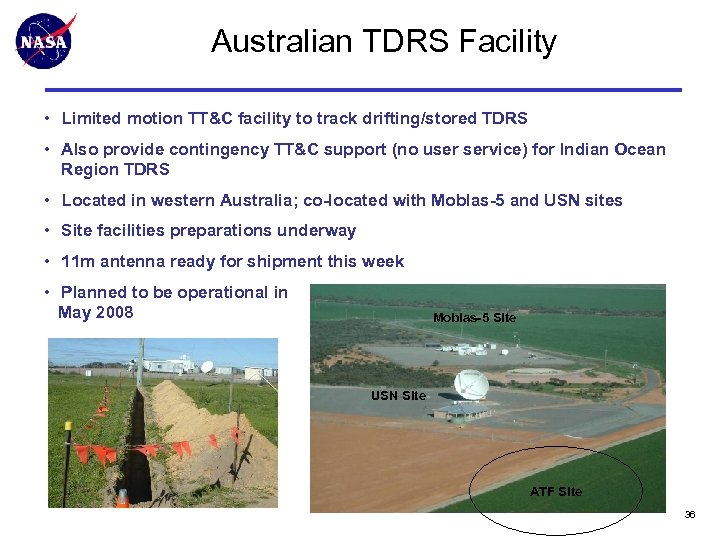 Australian TDRS Facility • Limited motion TT&C facility to track drifting/stored TDRS • Also provide contingency TT&C support (no user service) for Indian Ocean Region TDRS • Located in western Australia; co-located with Moblas-5 and USN sites • Site facilities preparations underway • 11 m antenna ready for shipment this week • Planned to be operational in May 2008 Moblas-5 Site USN Site ATF Site 36
 Space Network Users and Loading 37
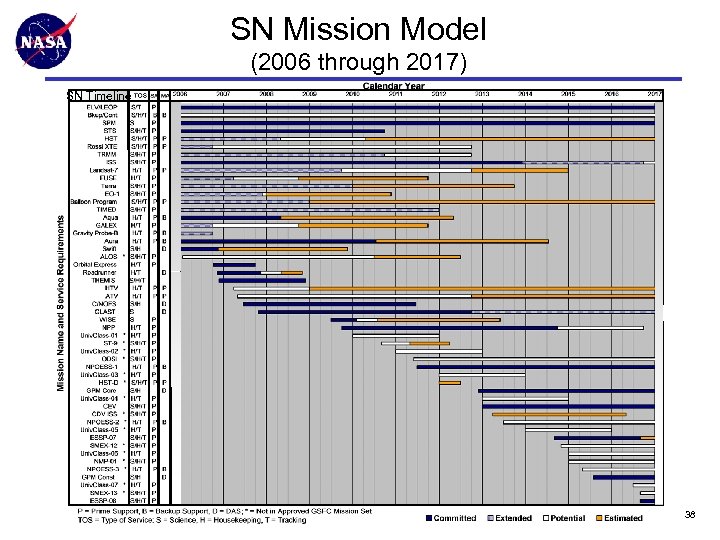 SN Mission Model (2006 through 2017) SN Timeline 38
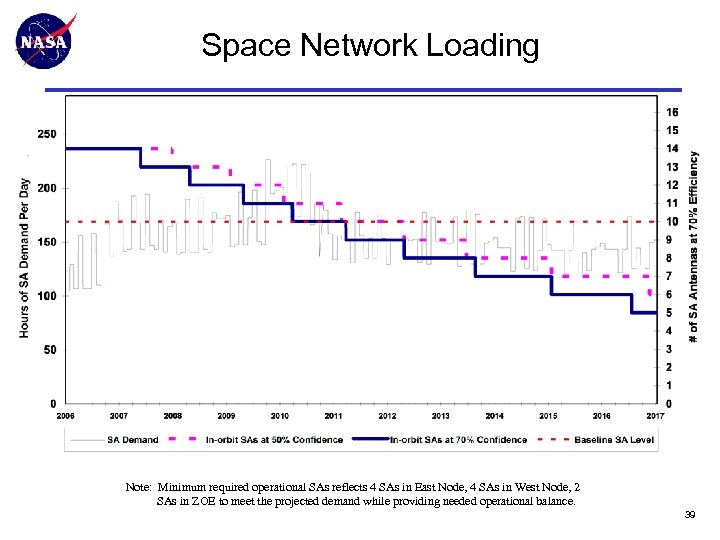 Space Network Loading Note: Minimum required operational SAs reflects 4 SAs in East Node, 4 SAs in West Node, 2 SAs in ZOE to meet the projected demand while providing needed operational balance. 39
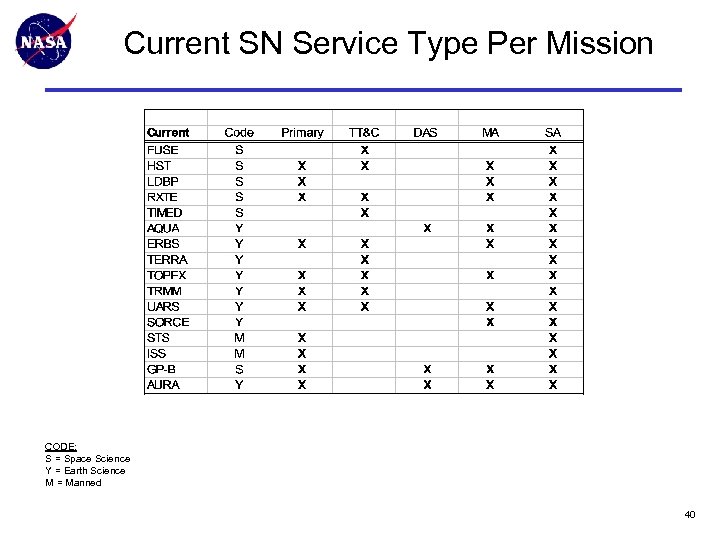 Current SN Service Type Per Mission CODE: S = Space Science Y = Earth Science M = Manned 40
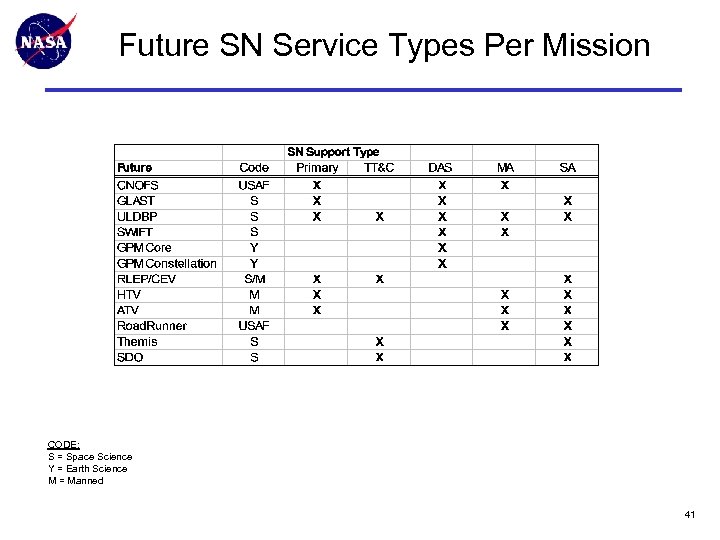 Future SN Service Types Per Mission CODE: S = Space Science Y = Earth Science M = Manned 41
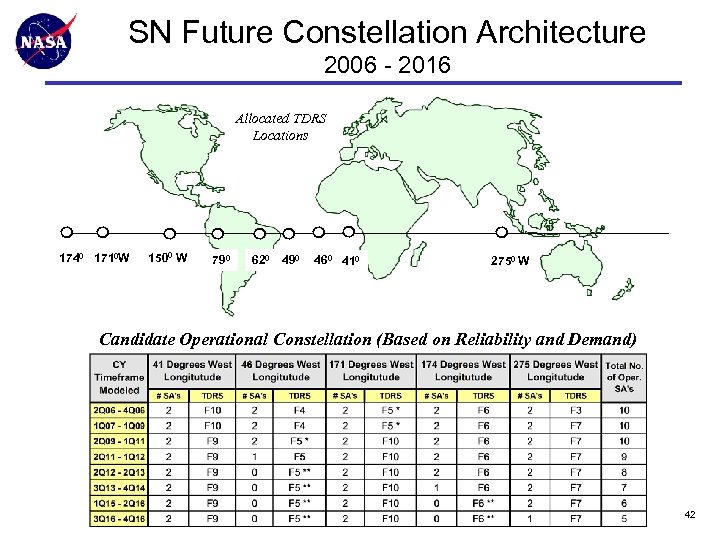 SN Future Constellation Architecture 2006 - 2016 Allocated TDRS Locations 1740 1710 W 1500 W 790 620 490 460 410 2750 W Candidate Operational Constellation (Based on Reliability and Demand) 42
 Additional Features 43
 ELV Support Overview • Operational support to a growing community: – Titan/Centaur support started in May, 1994 – Atlas/Centaur support started in January, 1996 – Realtime relays of Navy P-3 support in August, 1997 – Sea. Launch support started in March, 1999 – Atlas 3 support started in May, 2000 – Titan IUS, Delta 4 (compatible), Atlas V, and H-IIA (in work) • Current ELV telemetry return data rates range from 16 -512 kbps • The Space Network has provided successful, complete, and reliable communication for these launches. – A large number of missions have been supported • Customer response to TDRSS support has been enthusiastic • Customers are focusing on TDRS support for future missions 44
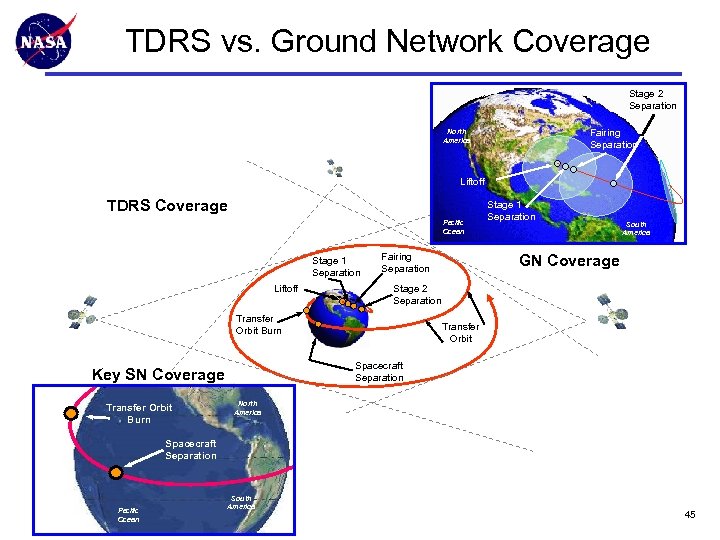 TDRS vs. Ground Network Coverage Stage 2 Separation Fairing Separation North America Liftoff TDRS Coverage Pacific Ocean Stage 1 Separation Liftoff Fairing Separation South America GN Coverage Stage 2 Separation Transfer Orbit Burn Transfer Orbit Spacecraft Separation Key SN Coverage Transfer Orbit Burn Stage 1 Separation North America Spacecraft Separation Pacific Ocean South America 45
 SN SSA Support of GN Operations • Commands can be modulated directly onto the carrier or a subcarrier through SSAF service – Direct data modulation RF characteristics: • Data rate: 125 bps to 1 Mbps • Modulation index: 0. 2 to 1. 5 radians, or 90 degrees – Subcarrier (BPSK) modulation RF characteristics: • Data rate: 125 bps to 8 kbps • Subcarrier (square wave or sine wave) frequency: 2, 4, 8, or 16 k. Hz • Modulation index: 0. 2 to 1. 8 radians • GN telemetry supports are configured as DG 2 through the SSA return service – The TDRSS Integrated Receivers (IRs) are suppressed carrier receivers that can recover modulation directly from the carrier – Direct Carrier Modulation: • BPSK/QPSK demodulation are a normal IR support mode. • PCM/PM demodulation – direct carrier modulation requires extensive customer testing because of the dependency on EIRP, data rate, PCM data format (NRZ or biphase), modulation index, and data transition density – The higher the modulation index and data density the better chance of data recovery. The SN has supported biphase modulation as low as 0. 8 radians. – Subcarrier Modulation: • The TDRSS IR can be detuned to recover PSK data modulated on a subcarrier • A loss of 3 d. B can be expected since the IR only recovers the upper or lower subcarrier/sideband (not combined) 46
 Bilateration Ranging and Tracking System (BRTS) Replacement • BRTS provides tracking data/information on the TDRS constellation: – The tracking units are located in Australia, American Samoa, Ascension Island, and White Sands • The current system is the original system specified in 1980 and deployed prior to the launch of TDRS-1 in April 1983 • This effort is a replacement - we intend to keep the remaining units of the current system operating as long as practical • The new system will be “functionally identical” to the current BRTSA transponder subsystem, with some options for enhancement, such as the use of GPS receiver • NENS task order began April 1, Preliminary Design Review scheduled for late September • All 9 units have been delivered and tested • Units have been deployed and are operational at Ascension and White Sands – Installation in Australia is to begin this month (December 2007) 47
 Space-Based Range Safety Overview • Range Safety service can be defined as those communication services provided at the launch range to maintain the integrity of the launch system and avoid threat to Human Life • The current system is effective, but could benefit from New Technology – Reduce Cost – Improve Flexibility – Increase Coverage – Maintain Reliability – Maintain Safety 48
 Space-Based Range Safety Operations Scenario • On the launch pad, the Launch-Head is prime communications interface • After launch and clear of initial interference (such as the Launch Tower), the vehicle acquires TDRS • Launch-Head and TDRS simultaneously radiate S-Band PN-Spread forward signal (commands), same frequency • Launch-Head loses link Over-the-Horizon, TDRS is prime communications interface • Flight Vehicle could carry two multi-channel transceivers capable of tracking three TDRS Mode PN Spread Signals and up to eight GPS signals • Telemetry will be relayed to the ground both directly to the Launch. Head (when available) from the vehicle and via the TDRSS – Including position data from GPS and onboard IMU 49
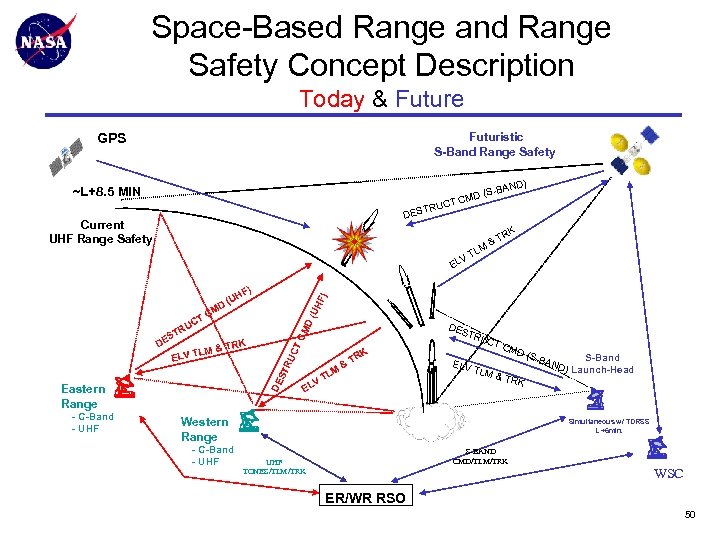 Space-Based Range and Range Safety Concept Description Today & Future GPS Futuristic S-Band Range Safety D) -BAN ~L+8. 5 MIN D (S T CM RUC T DES Current UHF Range Safety TR & LM T K V EL F) Eastern Range DES TRU UC T DE S TR RK M&T L ELV T - C-Band - UHF CM D( C CT U TR S DE UH F) MD H (U M L VT & RK T EL CT CM D (S S-Band -BA ELV ND) TLM Launch-Head & T RK Western Range - C-Band - UHF Simultaneous w/ TDRSS L +6 min. S-BAND CMD/TLM/TRK UHF TONES/TLM/TRK WSC ER/WR RSO 50
 Space Network Access System (SNAS) • • The Space Network Access System (SNAS) will consolidate the functionalities of the UPS and SWSI into a single system, and will replace the UPS and SWSI as the primary scheduling interface between the SN customer and the SN. SNAS Capabilities: – Provides a network-based (server-client relationship) customer interface for performing SN scheduling and real-time control and monitoring – Supports customers who currently schedule SN services through both the Network Control Center Data System (NCCDS) and the Demand Access System (DAS) – Accessible from the Internet and the NISN Open and Closed IONet – Provides for easy system setup and workstation independence for the SN customer (the SNAS client software is envisioned to run on any type of personal computer or workstation) • Held a Delta Systems Requirements Review on April 28, 2005 – Responded to 28 RFAs • • Continue to interface with current and new missions (~45) on new capabilities Test Readiness Review scheduled for October 2007 51
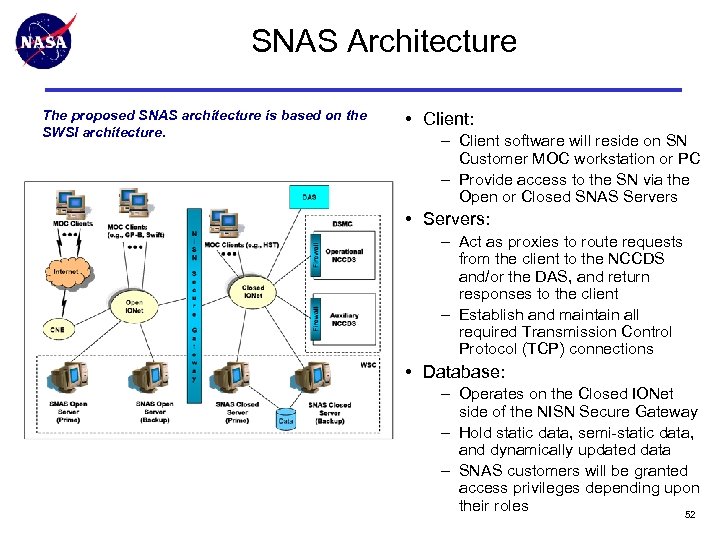 SNAS Architecture The proposed SNAS architecture is based on the SWSI architecture. • Client: – Client software will reside on SN Customer MOC workstation or PC – Provide access to the SN via the Open or Closed SNAS Servers • Servers: – Act as proxies to route requests from the client to the NCCDS and/or the DAS, and return responses to the client – Establish and maintain all required Transmission Control Protocol (TCP) connections • Database: – Operates on the Closed IONet side of the NISN Secure Gateway – Hold static data, semi-static data, and dynamically updated data – SNAS customers will be granted access privileges depending upon their roles 52
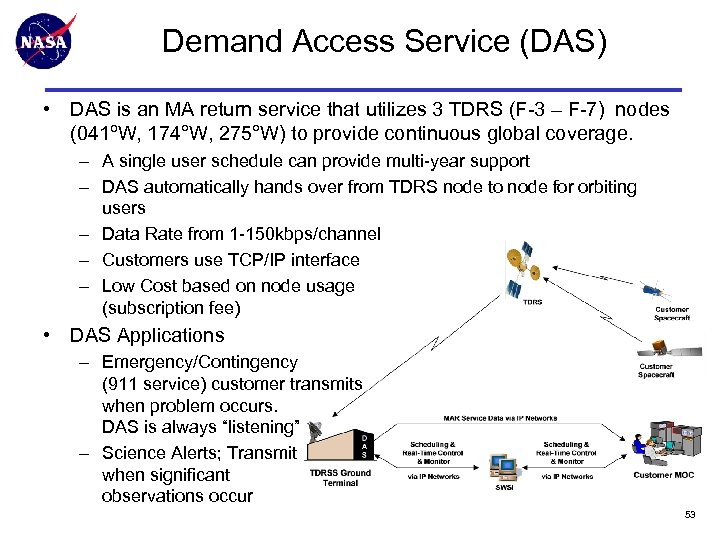 Demand Access Service (DAS) • DAS is an MA return service that utilizes 3 TDRS (F-3 – F-7) nodes (041ºW, 174°W, 275°W) to provide continuous global coverage. – A single user schedule can provide multi-year support – DAS automatically hands over from TDRS node to node for orbiting users – Data Rate from 1 -150 kbps/channel – Customers use TCP/IP interface – Low Cost based on node usage (subscription fee) • DAS Applications – Emergency/Contingency (911 service) customer transmits when problem occurs. DAS is always “listening” – Science Alerts; Transmit when significant observations occur 53
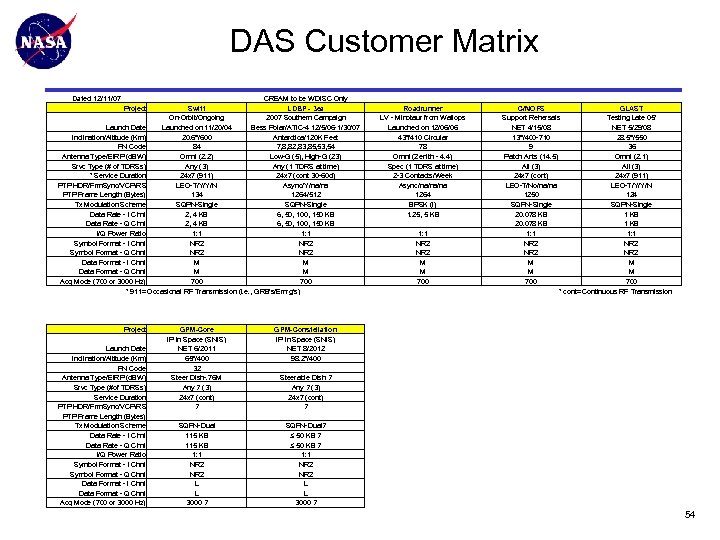 DAS Customer Matrix Dated 12/11/07 CREAM to be WDISC Only Swift LDBP - 3 ea On-Orbit/Ongoing 2007 Southern Campaign Launch Date Launched on 11/20/04 Bess Polar/ATIC-4 12/5/06 -1/30/07 Inclination/Altitude (Km) 20. 6°/600 Antarctica/120 K Feet PN Code 84 7, 8, 82, 83, 85, 53, 54 Antenna Type/EIRP (d. BW) Omni (2. 2) Low-G (5), High-G (23) Srvc Type (# of TDRSs) Any (3) Any (1 TDRS at time) * Service Duration 24 x 7 (911) 24 x 7 (cont 30 -60 d) PTP HDR/Frm. Sync/VCP/RS LEO-T/Y/Y/N Async/Y/na/na PTP Frame Length (Bytes) 134 1264/512 Tx Modulation Scheme SQPN-Single Data Rate - I Chnl 2, 4 KB 6, 50, 100, 150 KB Data Rate - Q Chnl 2, 4 KB 6, 50, 100, 150 KB I/Q Power Ratio 1: 1 Symbol Format - I Chnl NRZ Symbol Format - Q Chnl NRZ Data Format - I Chnl M M Data Format - Q Chnl M M Acq Mode (700 or 3000 Hz) 700 * 911= Occasional RF Transmission (i. e. , GRB's/Emrg's) Project Launch Date Inclination/Altitude (Km) PN Code Antenna Type/EIRP (d. BW) Srvc Type (#of TDRSs) Service Duration PTP HDR/Frm. Sync/VCP/RS PTP Frame Length (Bytes) Tx Modulation Scheme Data Rate - I Chnl Data Rate - Q Chnl I/Q Power Ratio Symbol Format - I Chnl Symbol Format - Q Chnl Data Format - I Chnl Data Format - Q Chnl Acq Mode (700 or 3000 Hz) GPM-Core IP in Space (SNIS) NET 6/2011 65°/400 32 Steer Dish-. 76 M Any ? (3) 24 x 7 (cont) ? SQPN-Dual 115 KB 1: 1 NRZ L L 3000 ? Roadrunner LV - Minotaur from Wallops Launched on 12/06/06 43°/410 Circular 78 Omni (Zenith - 4. 4) Spec (1 TDRS at time) 2 -3 Contacts/Week Async/na/na/na 1264 BPSK (I) 1. 25, 5 KB 1: 1 NRZ M M 700 C/NOFS GLAST Support Rehersals Testing Late 05' NET 4/15/08 NET 5/29/08 13°/400 -710 28. 5°/550 9 36 Patch Ants (14. 5) Omni (2. 1) All (3) 24 x 7 (cont) 24 x 7 (911) LEO-T/No/na/na LEO-T/Y/Y/N 1250 124 SQPN-Single 20. 078 KB 1: 1 NRZ NRZ M M 700 * cont= Continuous RF Transmission GPM-Constellation IP in Space (SNIS) NET 8/2012 98. 2°/400 Steerable Dish ? Any ? (3) 24 x 7 (cont) ? SQPN-Dual? ≤ 50 KB ? 1: 1 NRZ L L 3000 ? 54
 TDRS 8 -10/DAS • F 8 -F 10 have on-board MA beamformers (vs. F 1 -F 7 which use ground beamformers) • Study on-going through FY 05 to see if it is possible to utilize F 8 -F 10 to perform DAS • Concept under study uses 18 of the 32 receive elements • Elements grouped in triads, 3 elements per each of 6 receive beams • Downlinked to WSC and processed in specialized ground beamformers • This would allow continuance of DAS capability after F 1 -F 7 retired and as a bridge to next generation TDRS 55
 Ku/Ka-Band Technology Development • Currently, NASA has limited capabilities in the ground systems to support Ka-band customers: – SN 225 MHz customer services are available today using the modulation schemes in the SNUG (i. e. , 300 Mbps max using QPSK) – SN 650 MHz customer services are available today using the 1200 MHz IF service, where customers need to provide compatible receivers at WSC • NASA is currently reassessing future initiatives and has suspended activities for a full SN 650 MHz receive capability. • NASA is beginning formulating projects to consider: – Bandwidth efficient modulation and coding schemes for use with the Ku/Ka-band SN 225 MHz services • Currently, max data rate planned is 548 Mbps (8 PSK) – Flight system development compatible with bandwidth efficient modulation and coding schemes proposed 56
 TDRSS K-Band Upgrade Project (TKUP) • Replace and enhance the TDRSS Ku-Band return data services, and optionally increase the Ka-Band return data services to 1. 5 Gbps via the 650 MHz channel. - System Requirements Review – April 27, 2005 - Request For Information (RFI) – January 2006 - Demonstration Requirements Review – August 2006 - Demonstration RFP – October 2006 - Demonstration contract award – May 2007 - Tech. Interchange meetings and prelim. Demos – through November 2007 - Final Demonstration and report – January 2008 and February 2008 • Cx participation via the JPL Ka-Band Rate ½ LDPC CODEC. • Provided the GSFC Rate ½ LDPC CODEC core to both contractors. • Plan activities beyond the demonstration phase, recognizing that there are several major parallel Ground Segment efforts taking place. • Obtain funding to carry out the next steps. 57
 TDRSS Augmentation Service for Satellites (TASS) Introduction • Global, real-time monitoring network of GPS satellites provides basis for determining high-accuracy differential corrections • 24 x 7 global broadcast of differential correction data would enable LEO spacecraft to enhance their GPS-based navigation solution to 10 cm accuracy • Proposed NASA approach is to enable 24 x 7 global broadcast via TDRSS S-band Multiple Access (MA) • Use of TDRS-1 during current demonstration period 58
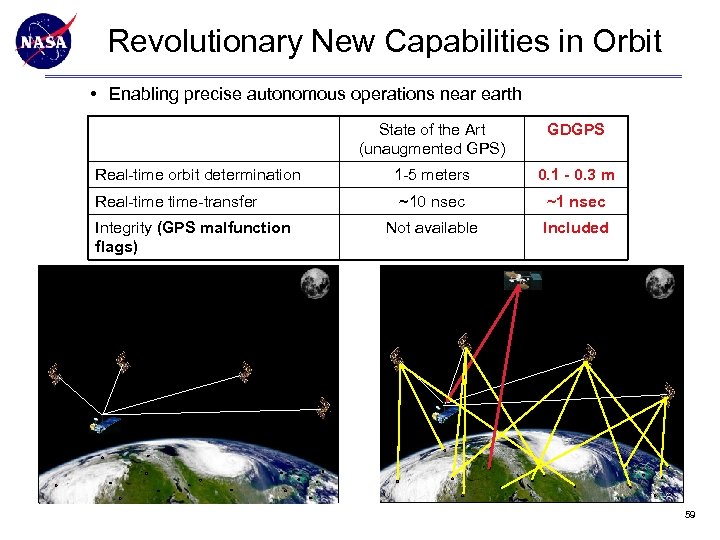 Revolutionary New Capabilities in Orbit • Enabling precise autonomous operations near earth State of the Art (unaugmented GPS) Real-time orbit determination Real-time-transfer Integrity (GPS malfunction flags) GDGPS 1 -5 meters 0. 1 - 0. 3 m ~10 nsec ~1 nsec Not available Included 59
 Space Network IP Services (SNIS) • SNIS is an SN Product that will accomplish the following: – Makes spacecraft systems look and operate just like any other nodes on the IONET – Provide operational IP services that were previously supported in test and demonstration modes – Enables end-to-end, standard IP communication between all mission resources (e. g. spacecraft, control center, Principal Investigators (PIs)) • SN has been supporting a daily IP connection to the South Pole since 1997 (South Pole TDRSS relay (SPTR)) • Multiple ground demonstrations and activities have been done since (TILT, eclipses, OMNI, demonstrations) • The LPT CANDOS experiment onboard STS-107 demonstrated SN/GN IP support to an orbiting user • Held a System Requirements Review on March 30, 2005 60
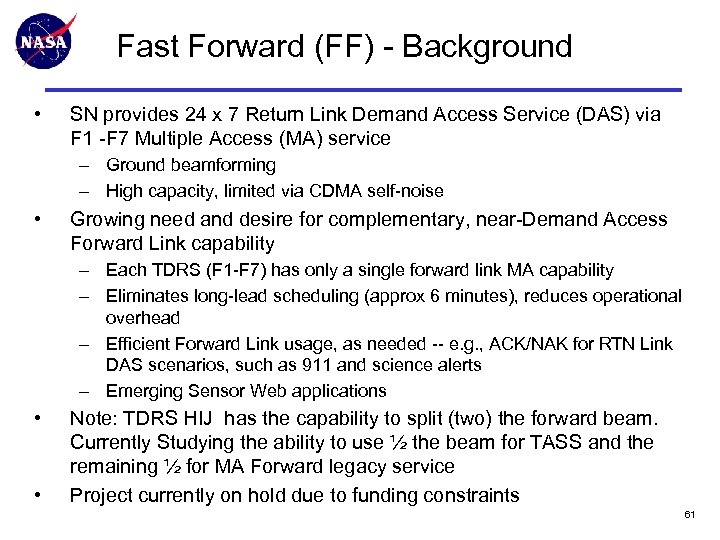 Fast Forward (FF) - Background • SN provides 24 x 7 Return Link Demand Access Service (DAS) via F 1 -F 7 Multiple Access (MA) service – Ground beamforming – High capacity, limited via CDMA self-noise • Growing need and desire for complementary, near-Demand Access Forward Link capability – Each TDRS (F 1 -F 7) has only a single forward link MA capability – Eliminates long-lead scheduling (approx 6 minutes), reduces operational overhead – Efficient Forward Link usage, as needed -- e. g. , ACK/NAK for RTN Link DAS scenarios, such as 911 and science alerts – Emerging Sensor Web applications • • Note: TDRS HIJ has the capability to split (two) the forward beam. Currently Studying the ability to use ½ the beam for TASS and the remaining ½ for MA Forward legacy service Project currently on hold due to funding constraints 61
 Reference Web Sites • • DAS: http: //stelwscpo. gsfc. nasa. gov/das/ Fast Forward: http: //fastforward. gsfc. nasa. gov/ Ka. TP: http: //classwww. gsfc. nasa. gov/kaband-updates/ SN: http: //scp. gsfc. nasa. gov/sn/ SNAS: http: //snas. gsfc. nasa. gov/ SNIS: http: //scp. gsfc. nasa. gov/snis/ SNUG: http: //scp. gsfc. nasa. gov/tdrss/ – Click on Space Network Users Guide • SN Online Information Center: http: //scp. gsfc. nasa. gov/tdrss/ • SWSI: http: //swsi. gsfc. nasa. gov/ • TDRS Project: http: //scp. gsfc. nasa. gov/tdrs/ 62
 Backup 63
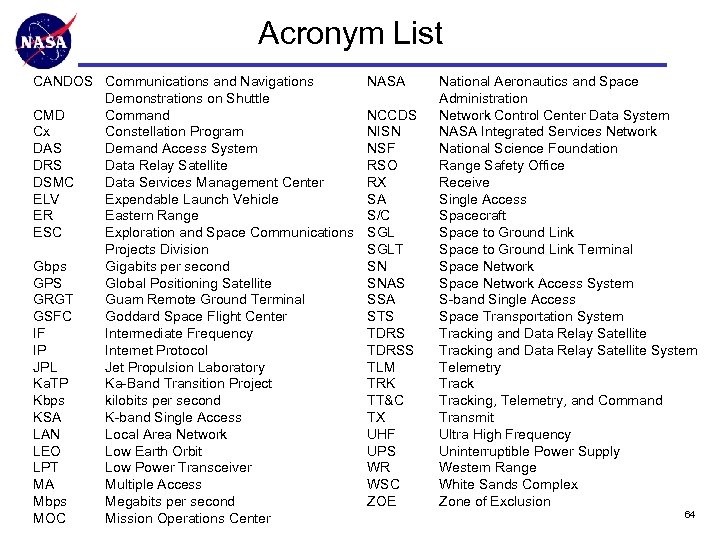 Acronym List CANDOS Communications and Navigations Demonstrations on Shuttle CMD Command Cx Constellation Program DAS Demand Access System DRS Data Relay Satellite DSMC Data Services Management Center ELV Expendable Launch Vehicle ER Eastern Range ESC Exploration and Space Communications Projects Division Gbps Gigabits per second GPS Global Positioning Satellite GRGT Guam Remote Ground Terminal GSFC Goddard Space Flight Center IF Intermediate Frequency IP Internet Protocol JPL Jet Propulsion Laboratory Ka. TP Ka-Band Transition Project Kbps kilobits per second KSA K-band Single Access LAN Local Area Network LEO Low Earth Orbit LPT Low Power Transceiver MA Multiple Access Mbps Megabits per second MOC Mission Operations Center NASA NCCDS NISN NSF RSO RX SA S/C SGLT SN SNAS SSA STS TDRSS TLM TRK TT&C TX UHF UPS WR WSC ZOE National Aeronautics and Space Administration Network Control Center Data System NASA Integrated Services Network National Science Foundation Range Safety Office Receive Single Access Spacecraft Space to Ground Link Terminal Space Network Access System S-band Single Access Space Transportation System Tracking and Data Relay Satellite System Telemetry Tracking, Telemetry, and Command Transmit Ultra High Frequency Uninterruptible Power Supply Western Range White Sands Complex Zone of Exclusion 64
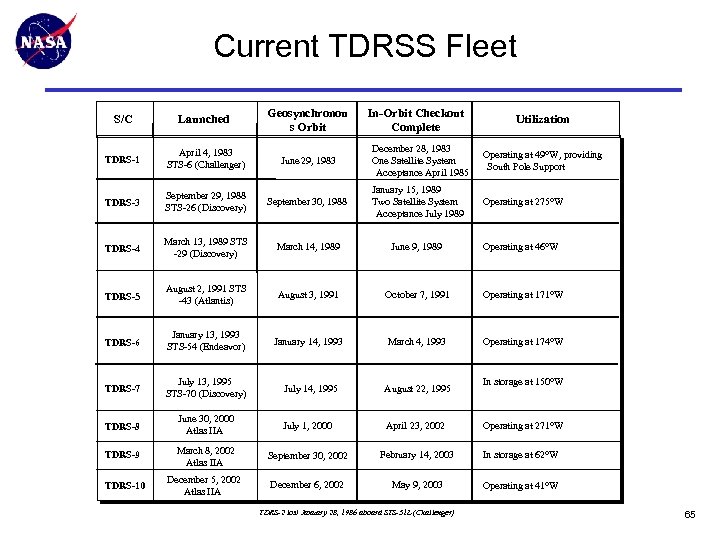 Current TDRSS Fleet S/C Launched Geosynchronou s Orbit TDRS-1 April 4, 1983 STS-6 (Challenger) June 29, 1983 December 28, 1983 One Satellite System Acceptance April 1985 Operating at 49°W, providing South Pole Support TDRS-3 September 29, 1988 STS-26 (Discovery) September 30, 1988 January 15, 1989 Two Satellite System Acceptance July 1989 Operating at 275°W TDRS-4 March 13, 1989 STS -29 (Discovery) March 14, 1989 June 9, 1989 Operating at 46°W TDRS-5 August 2, 1991 STS -43 (Atlantis) August 3, 1991 October 7, 1991 Operating at 171°W TDRS-6 January 13, 1993 STS-54 (Endeavor) January 14, 1993 March 4, 1993 Operating at 174°W TDRS-7 July 13, 1995 STS-70 (Discovery) July 14, 1995 August 22, 1995 TDRS-8 June 30, 2000 Atlas IIA July 1, 2000 April 23, 2002 Operating at 271°W TDRS-9 March 8, 2002 Atlas IIA September 30, 2002 February 14, 2003 In storage at 62°W TDRS-10 December 5, 2002 Atlas IIA December 6, 2002 May 9, 2003 Operating at 41°W In-Orbit Checkout Complete TDRS-2 lost January 28, 1986 aboard STS-51 L (Challenger) Utilization In storage at 150°W 65
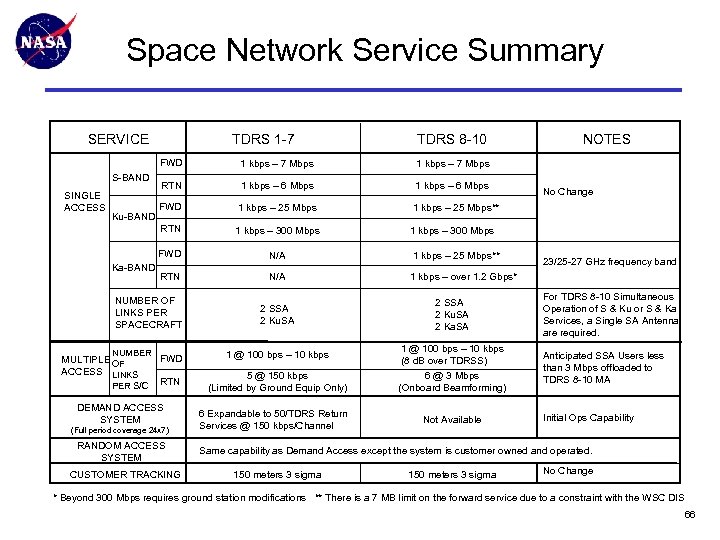 Space Network Service Summary SERVICE TDRS 1 -7 TDRS 8 -10 FWD Ku-BAND Ka-BAND RTN 1 kbps – 6 Mbps FWD 1 kbps – 25 Mbps** 1 kbps – 300 Mbps FWD SINGLE ACCESS 1 kbps – 7 Mbps RTN S-BAND 1 kbps – 7 Mbps N/A 1 kbps – 25 Mbps** RTN N/A 1 kbps – over 1. 2 Gbps* NUMBER OF LINKS PER SPACECRAFT NUMBER MULTIPLE OF ACCESS LINKS PER S/C NOTES 2 SSA 2 Ku. SA FWD 1 @ 100 bps – 10 kbps RTN 5 @ 150 kbps (Limited by Ground Equip Only) DEMAND ACCESS SYSTEM (Full period coverage 24 x 7) RANDOM ACCESS SYSTEM CUSTOMER TRACKING 6 Expandable to 50/TDRS Return Services @ 150 kbps/Channel 2 SSA 2 Ku. SA 2 Ka. SA 1 @ 100 bps – 10 kbps (8 d. B over TDRSS) 6 @ 3 Mbps (Onboard Beamforming) Not Available No Change 23/25 -27 GHz frequency band For TDRS 8 -10 Simultaneous Operation of S & Ku or S & Ka Services, a Single SA Antenna are required. Anticipated SSA Users less than 3 Mbps offloaded to TDRS 8 -10 MA Initial Ops Capability Same capability as Demand Access except the system is customer owned and operated. 150 meters 3 sigma No Change * Beyond 300 Mbps requires ground station modifications ** There is a 7 MB limit on the forward service due to a constraint with the WSC DIS 66
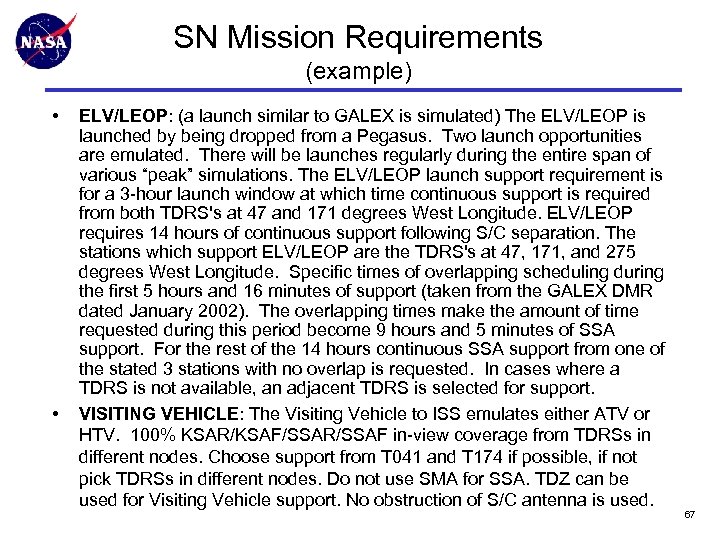 SN Mission Requirements (example) • • ELV/LEOP: (a launch similar to GALEX is simulated) The ELV/LEOP is launched by being dropped from a Pegasus. Two launch opportunities are emulated. There will be launches regularly during the entire span of various “peak” simulations. The ELV/LEOP launch support requirement is for a 3 -hour launch window at which time continuous support is required from both TDRS's at 47 and 171 degrees West Longitude. ELV/LEOP requires 14 hours of continuous support following S/C separation. The stations which support ELV/LEOP are the TDRS's at 47, 171, and 275 degrees West Longitude. Specific times of overlapping scheduling during the first 5 hours and 16 minutes of support (taken from the GALEX DMR dated January 2002). The overlapping times make the amount of time requested during this period become 9 hours and 5 minutes of SSA support. For the rest of the 14 hours continuous SSA support from one of the stated 3 stations with no overlap is requested. In cases where a TDRS is not available, an adjacent TDRS is selected for support. VISITING VEHICLE: The Visiting Vehicle to ISS emulates either ATV or HTV. 100% KSAR/KSAF/SSAR/SSAF in-view coverage from TDRSs in different nodes. Choose support from T 041 and T 174 if possible, if not pick TDRSs in different nodes. Do not use SMA for SSA. TDZ can be used for Visiting Vehicle support. No obstruction of S/C antenna is used. 67
 Scheduling Backup Material 68
 Network Control Center Data System (NCCDS) Database • • Contains the user specified mission Service Specification Codes that describe the T&DA services to be provided. The Service Specification Codes are utilized in the development of the SHO Service Specification Codes – Describes an established set of Respecifiable and Reconfigurable parameters for a single TDRSS service – Respecifiable Parameters • Those whose initial value can be changed PRIOR to the scheduling of an event – Reconfigurable Parameters • Those whose initial values can be changed while the service is in progress for example data rate, transmit and receive frequency • Service Specification Codes also contains information relative to the SN element support requirements for each service, such as MOC interface channels • Prototype Events – A single Prototype Event consists of multiple Service Specification Codes – Designed for use with routine user spacecraft contacts 69
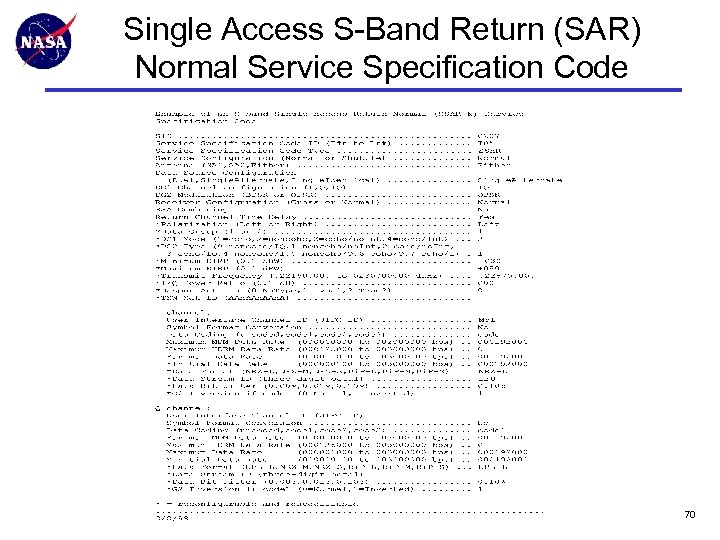 Single Access S-Band Return (SAR) Normal Service Specification Code 70
 Schedule Driven Operations • Scheduling Order (SHO) – A SHO is made up of a header, followed by a data set consisting of selected fixed and reconfigurable parameters that completely specify the service type, subtype, start/stop times and parametric values to be employed by the TDRSS in establishing the support services 71
 Definitions • Forecast Period – Schedule Add Requests (SARs) received electronically, 14 to 28 days prior to beginning of schedule week – Scheduling priorities utilized – Resource availability confirmed – Scheduling conflicts analyzed – Possible resolutions provided to customers – Activates a confirmed schedule for TDRSS customers – Forecast Analyst (FA) point of contact 72
 Definitions • Active and Realtime Periods – Schedule requests can be received at WSC up to 7 minutes in advance of event start – Scheduling priorities not utilized – Coordinates support based on customer requests and resource availability – Scheduling conflicts analyzed and realtime conflict resolution performed – Transmits current TDRSS schedules daily – Scheduling Operator (SO) point of contact – 24 hour support provided 73
 SN Priority List • Forecast Scheduling – The SN Priority List is created for the use of operations personnel at the Network Control Center (NCC) and White Sands Complex (WSC). The list provides strict guidelines for mission support in the event of service request conflicts during the forecast period and the list is utilized to resolve conflicts. • Active and Realtime Scheduling – After the confirmed schedule is transmitted, the Priority List does not apply; priority is given to the confirmed scheduled request, except for the absolute priorities. Final authority is reserved for the Technical Manager or Mission Managers on duty, who may refer to the priority list for guidance. 74