


 Скачать презентацию Space Launch Initiative 2 nd Generation RLV Program
567d6226831cec1acaa5033e45cb6ad2.ppt
- Количество слайдов: 33
 Space Launch Initiative 2 nd Generation RLV Program Alternate Access to Station May 2002 Update 5936 -
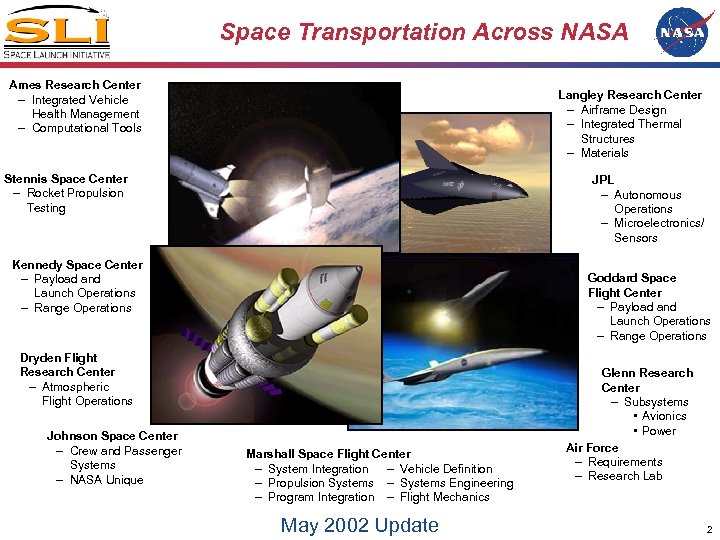 Space Transportation Across NASA Ames Research Center – Integrated Vehicle Health Management – Computational Tools Langley Research Center – Airframe Design – Integrated Thermal Structures – Materials Stennis Space Center – Rocket Propulsion Testing JPL – Autonomous Operations – Microelectronics/ Sensors Kennedy Space Center – Payload and Launch Operations – Range Operations Goddard Space Flight Center – Payload and Launch Operations – Range Operations Dryden Flight Research Center – Atmospheric Flight Operations Johnson Space Center – Crew and Passenger Systems – NASA Unique Marshall Space Flight Center – Vehicle Definition – System Integration – Propulsion Systems – Systems Engineering – Program Integration – Flight Mechanics May 2002 Update Glenn Research Center – Subsystems • Avionics • Power Air Force – Requirements – Research Lab 2
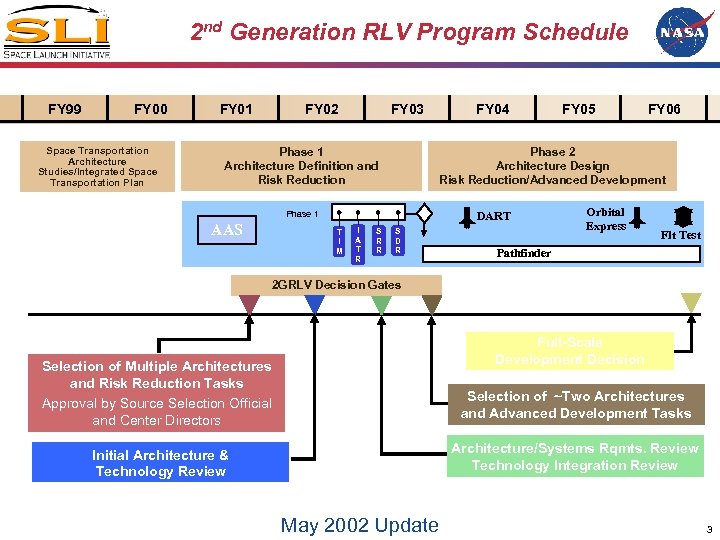 2 nd Generation RLV Program Schedule FY 99 FY 00 Space Transportation Architecture Studies/Integrated Space Transportation Plan FY 01 FY 02 FY 03 Phase 1 Architecture Definition and Risk Reduction DART T I M I A T R S R R FY 05 FY 06 Phase 2 Architecture Design Risk Reduction/Advanced Development Phase 1 AAS FY 04 S D R Orbital Express Flt Test Pathfinder 2 GRLV Decision Gates Full-Scale Development Decision Selection of Multiple Architectures and Risk Reduction Tasks Approval by Source Selection Official and Center Directors Selection of ~Two Architectures and Advanced Development Tasks Initial Architecture & Technology Review Architecture/Systems Rqmts. Review Technology Integration Review May 2002 Update 3
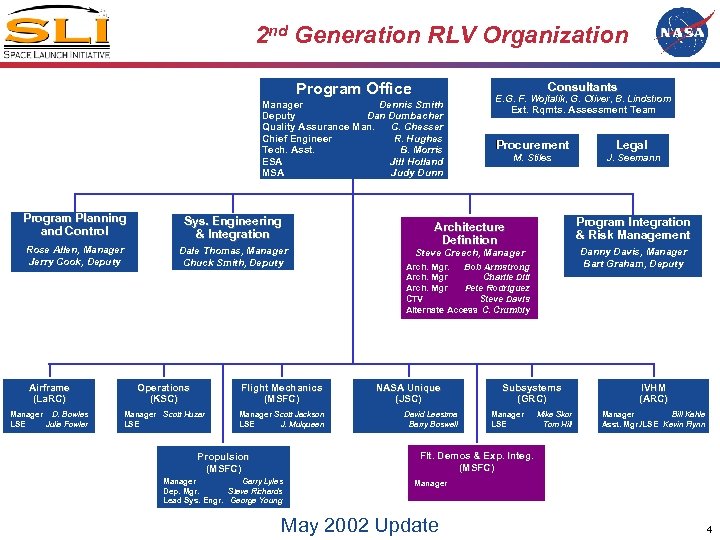 2 nd Generation RLV Organization Program Office Consultants Manager Dennis Smith Deputy Dan Dumbacher Quality Assurance Man. C. Chesser Chief Engineer R. Hughes Tech. Asst. B. Morris ESA Jill Holland MSA Judy Dunn Program Planning and Control Sys. Engineering & Integration Rose Allen, Manager Jerry Cook, Deputy Dale Thomas, Manager Chuck Smith, Deputy Airframe (La. RC) Operations (KSC) Flight Mechanics (MSFC) Manager D. Bowles LSE Julie Fowler Manager Scott Huzar LSE Manager Scott Jackson LSE J. Mulqueen E. G. F. Wojtalik, G. Oliver, B. Lindstrom Ext. Rqmts. Assessment Team Procurement Legal M. Stiles J. Seemann Program Integration & Risk Management Architecture Definition Danny Davis, Manager Bart Graham, Deputy Steve Creech, Manager Arch. Mgr. Bob Armstrong Arch. Mgr Charlie Dill Arch. Mgr Pete Rodriguez CTV Steve Davis Alternate Access C. Crumbly NASA Unique (JSC) David Leestma Barry Boswell Subsystems (GRC) Manager LSE Mike Skor Tom Hill IVHM (ARC) Manager Bill Kahle Asst. Mgr. /LSE Kevin Flynn Flt. Demos & Exp. Integ. (MSFC) Propulsion (MSFC) Manager Garry Lyles Dep. Mgr. Steve Richards Lead Sys. Engr. George Young Manager May 2002 Update 4
 Alternate Access to Station Project Description 5936 -
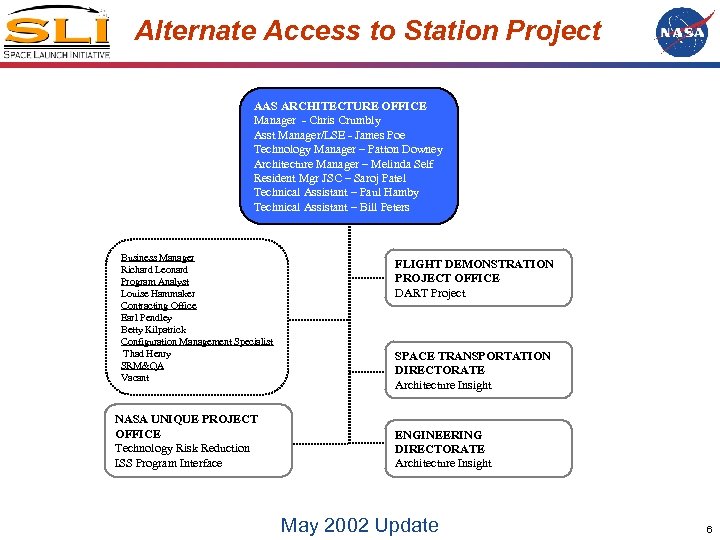 Alternate Access to Station Project AAS ARCHITECTURE OFFICE Manager - Chris Crumbly Asst Manager/LSE - James Poe Technology Manager – Patton Downey Architecture Manager – Melinda Self Resident Mgr JSC – Saroj Patel Technical Assistant – Paul Hamby Technical Assistant – Bill Peters Business Manager Richard Leonard Program Analyst Louise Hammaker Contracting Office Earl Pendley Betty Kilpatrick Configuration Management Specialist Thad Henry SRM&QA Vacant NASA UNIQUE PROJECT OFFICE Technology Risk Reduction ISS Program Interface FLIGHT DEMONSTRATION PROJECT OFFICE DART Project SPACE TRANSPORTATION DIRECTORATE Architecture Insight ENGINEERING DIRECTORATE Architecture Insight May 2002 Update 6
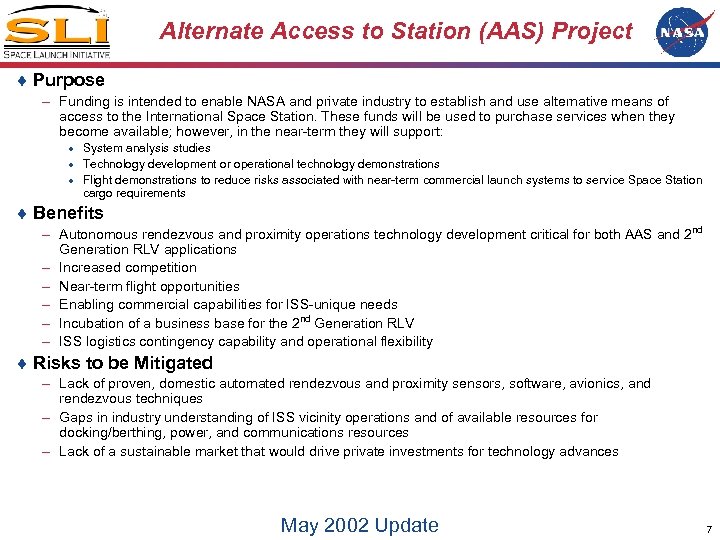 Alternate Access to Station (AAS) Project ¨ Purpose – Funding is intended to enable NASA and private industry to establish and use alternative means of access to the International Space Station. These funds will be used to purchase services when they become available; however, in the near-term they will support: · System analysis studies · Technology development or operational technology demonstrations · Flight demonstrations to reduce risks associated with near-term commercial launch systems to service Space Station cargo requirements ¨ Benefits – Autonomous rendezvous and proximity operations technology development critical for both AAS and 2 nd Generation RLV applications – Increased competition – Near-term flight opportunities – Enabling commercial capabilities for ISS-unique needs – Incubation of a business base for the 2 nd Generation RLV – ISS logistics contingency capability and operational flexibility ¨ Risks to be Mitigated – Lack of proven, domestic automated rendezvous and proximity sensors, software, avionics, and rendezvous techniques – Gaps in industry understanding of ISS vicinity operations and of available resources for docking/berthing, power, and communications resources – Lack of a sustainable market that would drive private investments for technology advances May 2002 Update 7
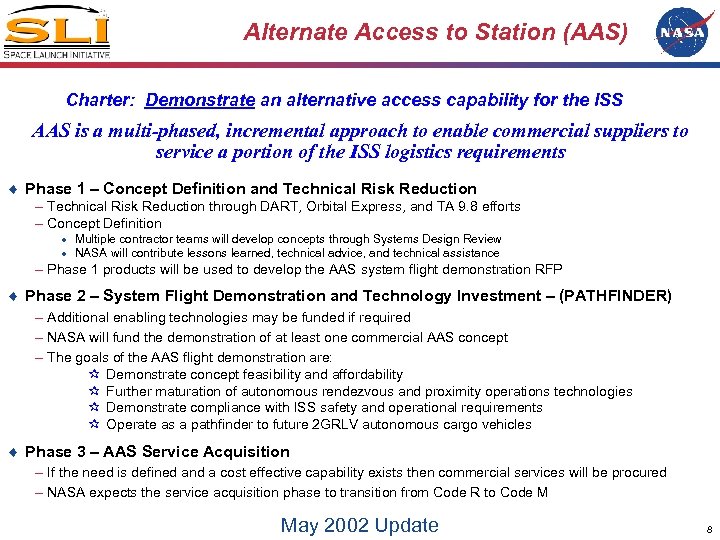 Alternate Access to Station (AAS) Charter: Demonstrate an alternative access capability for the ISS AAS is a multi-phased, incremental approach to enable commercial suppliers to service a portion of the ISS logistics requirements ¨ Phase 1 – Concept Definition and Technical Risk Reduction – Technical Risk Reduction through DART, Orbital Express, and TA 9. 8 efforts – Concept Definition · Multiple contractor teams will develop concepts through Systems Design Review · NASA will contribute lessons learned, technical advice, and technical assistance – Phase 1 products will be used to develop the AAS system flight demonstration RFP ¨ Phase 2 – System Flight Demonstration and Technology Investment – (PATHFINDER) – Additional enabling technologies may be funded if required – NASA will fund the demonstration of at least one commercial AAS concept – The goals of the AAS flight demonstration are: ¶ Demonstrate concept feasibility and affordability ¶ Further maturation of autonomous rendezvous and proximity operations technologies ¶ Demonstrate compliance with ISS safety and operational requirements ¶ Operate as a pathfinder to future 2 GRLV autonomous cargo vehicles ¨ Phase 3 – AAS Service Acquisition – If the need is defined and a cost effective capability exists then commercial services will be procured – NASA expects the service acquisition phase to transition from Code R to Code M May 2002 Update 8
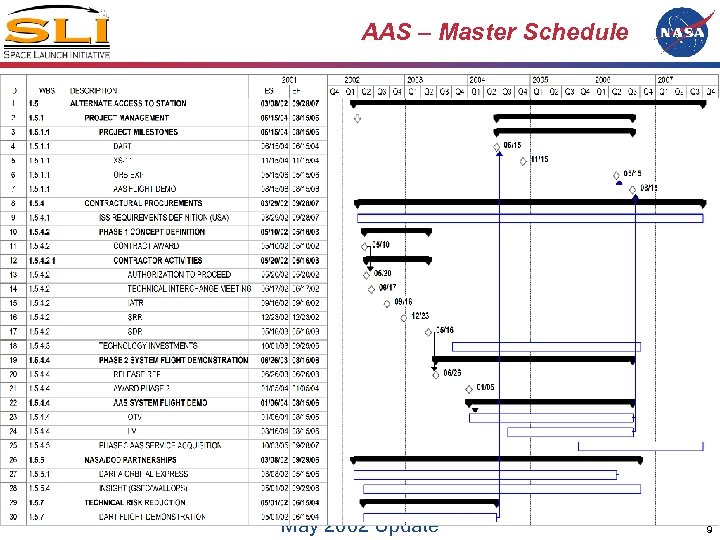 AAS – Master Schedule May 2002 Update 9
 Alternate Access to Station History 5936 -
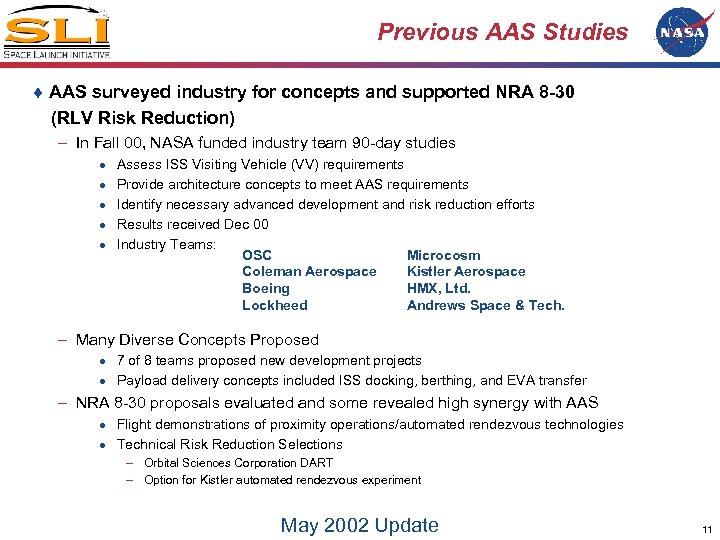 Previous AAS Studies ¨ AAS surveyed industry for concepts and supported NRA 8 -30 (RLV Risk Reduction) – In Fall 00, NASA funded industry team 90 -day studies · · · Assess ISS Visiting Vehicle (VV) requirements Provide architecture concepts to meet AAS requirements Identify necessary advanced development and risk reduction efforts Results received Dec 00 Industry Teams: OSC Microcosm Coleman Aerospace Kistler Aerospace Boeing HMX, Ltd. Lockheed Andrews Space & Tech. – Many Diverse Concepts Proposed · 7 of 8 teams proposed new development projects · Payload delivery concepts included ISS docking, berthing, and EVA transfer – NRA 8 -30 proposals evaluated and some revealed high synergy with AAS · Flight demonstrations of proximity operations/automated rendezvous technologies · Technical Risk Reduction Selections - Orbital Sciences Corporation DART - Option for Kistler automated rendezvous experiment May 2002 Update 11
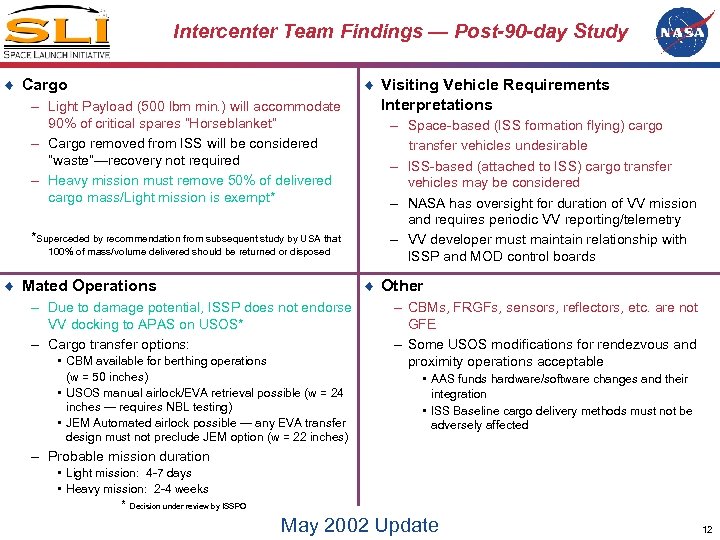 Intercenter Team Findings — Post-90 -day Study ¨ Cargo – Light Payload (500 lbm min. ) will accommodate 90% of critical spares “Horseblanket” – Cargo removed from ISS will be considered “waste”—recovery not required – Heavy mission must remove 50% of delivered cargo mass/Light mission is exempt* *Superceded by recommendation from subsequent study by USA that 100% of mass/volume delivered should be returned or disposed ¨ Mated Operations ¨ Visiting Vehicle Requirements Interpretations – Space-based (ISS formation flying) cargo transfer vehicles undesirable – ISS-based (attached to ISS) cargo transfer vehicles may be considered – NASA has oversight for duration of VV mission and requires periodic VV reporting/telemetry – VV developer must maintain relationship with ISSP and MOD control boards ¨ Other – Due to damage potential, ISSP does not endorse VV docking to APAS on USOS* – Cargo transfer options: • CBM available for berthing operations (w = 50 inches) • USOS manual airlock/EVA retrieval possible (w = 24 inches — requires NBL testing) • JEM Automated airlock possible — any EVA transfer design must not preclude JEM option (w = 22 inches) – CBMs, FRGFs, sensors, reflectors, etc. are not GFE – Some USOS modifications for rendezvous and proximity operations acceptable • AAS funds hardware/software changes and their integration • ISS Baseline cargo delivery methods must not be adversely affected – Probable mission duration • Light mission: 4 -7 days • Heavy mission: 2 -4 weeks * Decision under review by ISSPO May 2002 Update 12
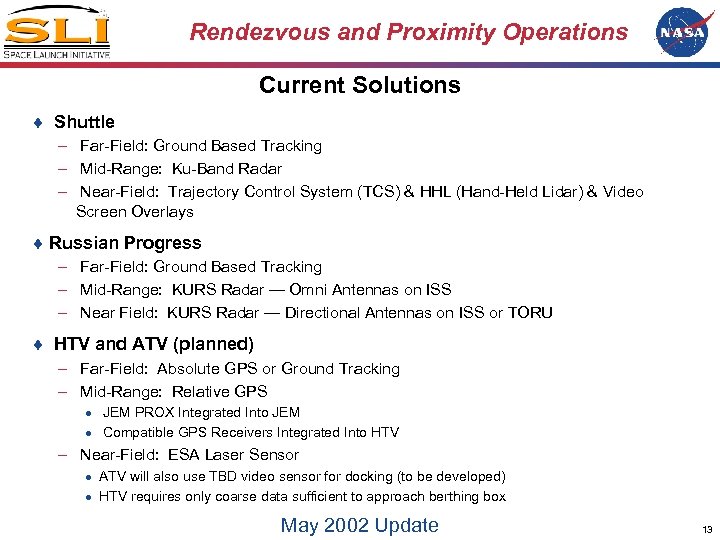 Rendezvous and Proximity Operations Current Solutions ¨ Shuttle – Far-Field: Ground Based Tracking – Mid-Range: Ku-Band Radar – Near-Field: Trajectory Control System (TCS) & HHL (Hand-Held Lidar) & Video Screen Overlays ¨ Russian Progress – Far-Field: Ground Based Tracking – Mid-Range: KURS Radar — Omni Antennas on ISS – Near Field: KURS Radar — Directional Antennas on ISS or TORU ¨ HTV and ATV (planned) – Far-Field: Absolute GPS or Ground Tracking – Mid-Range: Relative GPS · JEM PROX Integrated Into JEM · Compatible GPS Receivers Integrated Into HTV – Near-Field: ESA Laser Sensor · ATV will also use TBD video sensor for docking (to be developed) · HTV requires only coarse data sufficient to approach berthing box May 2002 Update 13
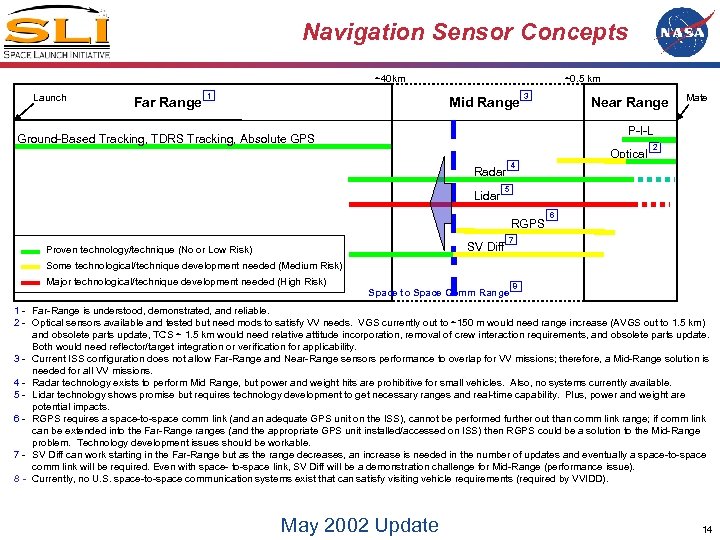 Navigation Sensor Concepts ~40 km Launch Far Range 1 ~0. 5 km Mid Range 3 Near Range Mate P-I-L Ground-Based Tracking, TDRS Tracking, Absolute GPS Optical 4 Radar Lidar 5 RGPS SV Diff Proven technology/technique (No or Low Risk) 2 6 7 Some technological/technique development needed (Medium Risk) Major technological/technique development needed (High Risk) Space to Space Comm Range 8 1 - Far-Range is understood, demonstrated, and reliable. 2 - Optical sensors available and tested but need mods to satisfy VV needs. VGS currently out to ~150 m would need range increase (AVGS out to 1. 5 km) and obsolete parts update, TCS ~ 1. 5 km would need relative attitude incorporation, removal of crew interaction requirements, and obsolete parts update. Both would need reflector/target integration or verification for applicability. 3 - Current ISS configuration does not allow Far-Range and Near-Range sensors performance to overlap for VV missions; therefore, a Mid-Range solution is needed for all VV missions. 4 - Radar technology exists to perform Mid Range, but power and weight hits are prohibitive for small vehicles. Also, no systems currently available. 5 - Lidar technology shows promise but requires technology development to get necessary ranges and real-time capability. Plus, power and weight are potential impacts. 6 - RGPS requires a space-to-space comm link (and an adequate GPS unit on the ISS), cannot be performed further out than comm link range; if comm link can be extended into the Far-Range ranges (and the appropriate GPS unit installed/accessed on ISS) then RGPS could be a solution to the Mid-Range problem. Technology development issues should be workable. 7 - SV Diff can work starting in the Far-Range but as the range decreases, an increase is needed in the number of updates and eventually a space-to-space comm link will be required. Even with space- to-space link, SV Diff will be a demonstration challenge for Mid-Range (performance issue). 8 - Currently, no U. S. space-to-space communication systems exist that can satisfy visiting vehicle requirements (required by VVIDD). May 2002 Update 14
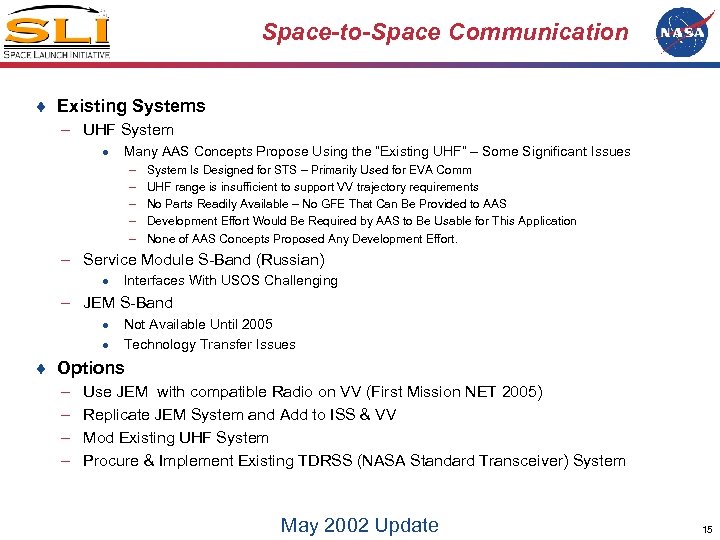 Space-to-Space Communication ¨ Existing Systems – UHF System · Many AAS Concepts Propose Using the “Existing UHF” – Some Significant Issues - System Is Designed for STS – Primarily Used for EVA Comm UHF range is insufficient to support VV trajectory requirements No Parts Readily Available – No GFE That Can Be Provided to AAS Development Effort Would Be Required by AAS to Be Usable for This Application None of AAS Concepts Proposed Any Development Effort. – Service Module S-Band (Russian) · Interfaces With USOS Challenging – JEM S-Band · · Not Available Until 2005 Technology Transfer Issues ¨ Options – – Use JEM with compatible Radio on VV (First Mission NET 2005) Replicate JEM System and Add to ISS & VV Mod Existing UHF System Procure & Implement Existing TDRSS (NASA Standard Transceiver) System May 2002 Update 15
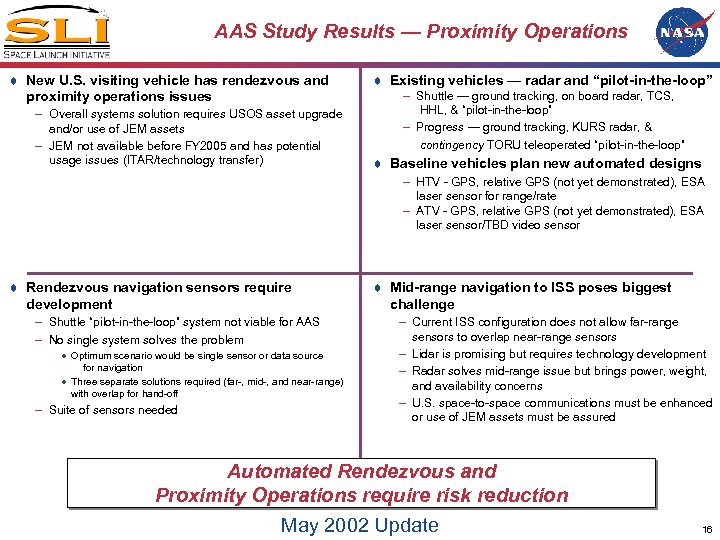 AAS Study Results — Proximity Operations ¨ New U. S. visiting vehicle has rendezvous and proximity operations issues - Overall systems solution requires USOS asset upgrade and/or use of JEM assets - JEM not available before FY 2005 and has potential usage issues (ITAR/technology transfer) ¨ Existing vehicles — radar and “pilot-in-the-loop” - Shuttle — ground tracking, on board radar, TCS, HHL, & “pilot-in-the-loop” - Progress — ground tracking, KURS radar, & contingency TORU teleoperated “pilot-in-the-loop” ¨ Baseline vehicles plan new automated designs - HTV - GPS, relative GPS (not yet demonstrated), ESA laser sensor for range/rate - ATV - GPS, relative GPS (not yet demonstrated), ESA laser sensor/TBD video sensor ¨ Rendezvous navigation sensors require development – Shuttle “pilot-in-the-loop” system not viable for AAS – No single system solves the problem · Optimum scenario would be single sensor or data source for navigation · Three separate solutions required (far-, mid-, and near-range) with overlap for hand-off – Suite of sensors needed ¨ Mid-range navigation to ISS poses biggest challenge - Current ISS configuration does not allow far-range sensors to overlap near-range sensors - Lidar is promising but requires technology development - Radar solves mid-range issue but brings power, weight, and availability concerns - U. S. space-to-space communications must be enhanced or use of JEM assets must be assured Automated Rendezvous and Proximity Operations require risk reduction May 2002 Update 16
 AAS Study Results — Vehicle Development ¨ Launch Vehicle/Cargo Vehicle proposals all require significant development – IOC of FY 03 service is not realistic with present state of the industry – Significant technology development required = high risk – Technologies to be advanced or deployed include: space-to-space communication system, mid-range relative navigation sensors, near-field navigation sensors, cargo integration and delivery systems, GN&C, docking hardware ¨ ISS Visiting Vehicle requirements are challenging ¨ New ISS rendezvous/proximity operations assets probable and must be funded by AAS – Space to Space Com – Reflectors ¨ Cargo integration and delivery system concepts need to converge – On-demand payload integration and delivery technology requires deployment to industry – Ground-based logistics methodology requires some additional attention Alternate Access to Station service acquisition is premature May 2002 Update 17
 AAS Study Conclusions ¨ Industry has not proven that service acquisition is available without significant risks – Technical Risk (technology is not proven) – Business Risk (high non-recurring costs) ¨ New ideas can enter the industry if we implement new business approaches – NASA commercial contracting policies present a perceived barrier – Disruptive innovations can be a catalyst for change in the industry ¨ Automated Rendezvous and Proximity Operations require technical risk reduction – Demonstration missions – Advanced sensor development – Space-to-space communications enhancement ¨ The ability to autonomously dock and deliver payload to the ISS is a critical requirement for the 2 nd Generation RLV and key to the SLI program: – Technology is essential – Significant effort is required to mature this technology ¨ As a part of the 2 nd Generation RLV program, AAS can be utilized to meet significant NASA needs using innovative methods May 2002 Update 18
 Alternate Access to Station Forward Plan 5936 -
 Trade Study for AAS Implementation ¨ Several strategies were studied by NASA for AAS implementation: 1. Development of rendezvous sensor suite and avionics (i. e. , a “smart” front end) 2. Development of a NASA orbital transfer vehicle 3. Conversion to a technology development and demonstration project 4. Incremental approach of technology development, demonstration, and service acquisition Option 4 Chosen ¨ It quickly became apparent that Option 4 was the best strategy – Several implementation approaches were considered: A. Small business set-aside for emerging aerospace providers B. Addition of AAS requirements to NRA 8 -30 (2 GRLV) Cycle 2 solicitation leading to traditional contract C. Commercial contract for full AAS systems D. Cooperative agreements with milestone payments beginning with concept development leading to flight demonstration E. Traditional concept design (study only) contract followed by innovative flight demonstration procurement Option E Chosen May 2002 Update 20
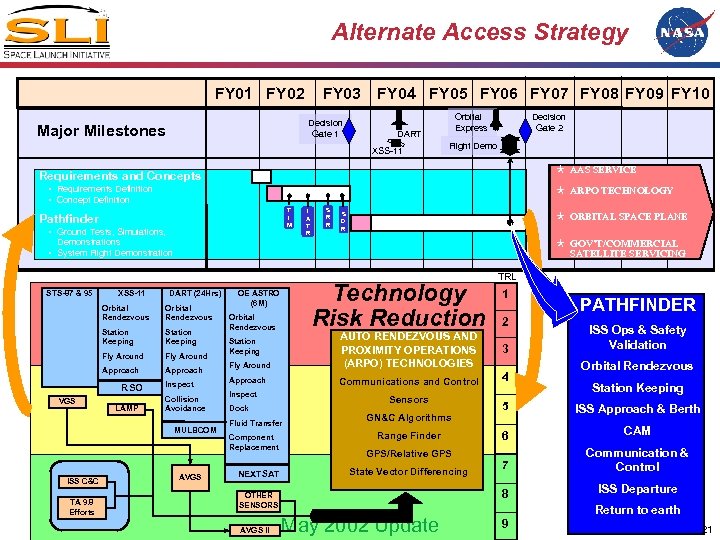 Alternate Access Strategy FY 03 FY 04 FY 05 FY 06 FY 07 FY 08 FY 09 FY 10 FY 01 FY 02 Decision Gate 1 Major Milestones DART XSS-11 Decision Gate 2 Orbital Express Flight Demo × AAS SERVICE Requirements and Concepts • Requirements Definition • Concept Definition × ARPO TECHNOLOGY T I M Pathfinder • Ground Tests, Simulations, I A T R S R R S D R × ORBITAL SPACE PLANE Demonstrations × GOV’T/COMMERCIAL SATELLITE SERVICING • System Flight Demonstration STS-87 & 95 XSS-11 DART (24 Hrs) Orbital Rendezvous Station Keeping Fly Around Approach RSO VGS LAMP Inspect Collision Avoidance MULBCOM ISS C&C TA 9. 8 Efforts AVGS Technology Risk Reduction OE ASTRO (6 M) Orbital Rendezvous Fly Around AUTO RENDEZVOUS AND PROXIMITY OPERATIONS (ARPO) TECHNOLOGIES Approach Communications and Control Station Keeping Inspect Sensors Fluid Transfer NEXTSAT GN&C Algorithms Range Finder GPS/Relative GPS State Vector Differencing OTHER SENSORS AVGS II 1 2 3 4 PATHFINDER ISS Ops & Safety Validation Orbital Rendezvous Station Keeping May 2002 Update 5 ISS Approach & Berth 6 CAM 7 Communication & Control 8 Dock Component Replacement TRL ISS Departure Return to earth 9 21
 AAS Strategy The AAS strategy is a phased and systematic approach to ensure that SLI technology requirements will be met while offering the opportunity for innovative companies to participate and begin commercial AAS services or at least make progress towards that goal. – Phase 1 (Underway) · Reduce the risks associated with Automated Rendezvous/Proximity Operations (ARPO) through technology development and demonstration — initial contracts secured - Orbital’s Demonstration of Autonomous Rendezvous Technologies (DART) - Partnership with the Defense Advanced Research Project Agency (DARPA) on Orbital Express · Pursue definition of requirements with our ISS customer — ongoing · Fund more detailed definition of industry concepts — selection expected early summer 2002 · Evaluate need for and potentially procure target satellite for rendezvous flight demonstrations – Phase 2 (Projected mid-FY 03 start) · Perform the efforts necessary to enable the purchase of AAS mission services - Invest in additional technology development identified in Phase 1 - Demonstrate viable AAS systems on-orbit · Investigating innovative procurement approaches for this phase – Phase 3 (Projected FY 06 start) · AAS service acquisition commences · Acquisition of services is dependent on the maturity of flight demonstrations, technology development; ISS needs; cost justification May 2002 Update 22
 Phase I AAS Logistics Resupply Requirements and Concept Definition 5936 -
 AAS Logistics Resupply Requirements ¨ A 3 -month study was conducted by USA to define AAS Logistics Re. Supply for the ISS. ¨ Scope of study included determination of mission needs, cargo launch requirements/constraints, ISS/crew requirements for orbital transfer, and de-orbit needs. ¨ Design Reference Missions for several payload cases were defined. ¨ USA under contract to support continued ISS OPS education for contractors. May 2002 Update 24
 AAS Logistics Resupply Requirements ¨ A cargo matrix was derived from the ISS Logistics Data Base and U. S. ISS experiment users. – Cargo may include ORU’s, Mid-deck Locker Equivalent (MLE) packages of crew support items including dry and wet consumables, and science experiment support items and return samples. – Cargo assessments will be provided for: · Pre-launch environmental controls and processing requirements · Launch environmental controls requirements · Launch restraint and packaging · Orbital transfer requirements · Cargo Hazard levels May 2002 Update 25
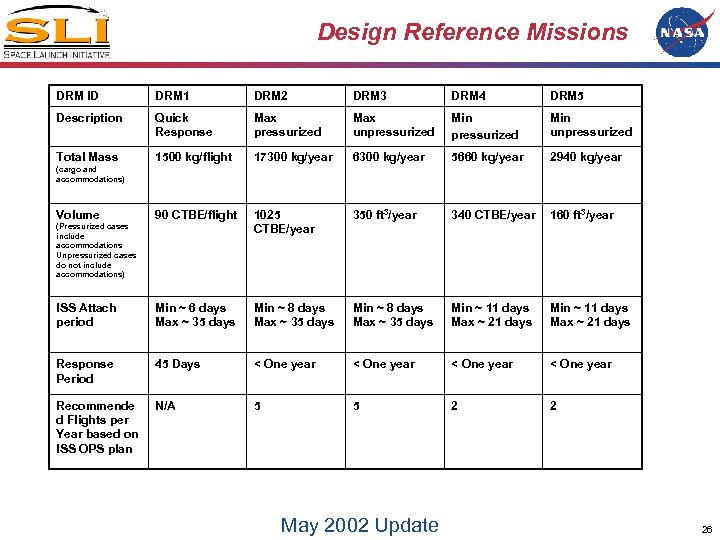 Design Reference Missions DRM ID DRM 1 DRM 2 DRM 3 DRM 4 DRM 5 Description Quick Response Max pressurized Max unpressurized Min unpressurized Total Mass 1500 kg/flight 17300 kg/year 6300 kg/year 5660 kg/year 2940 kg/year 90 CTBE/flight 1025 CTBE/year 350 ft 3/year 340 CTBE/year 160 ft 3/year ISS Attach period Min ~ 6 days Max ~ 35 days Min ~ 8 days Max ~ 35 days Min ~ 11 days Max ~ 21 days Response Period 45 Days < One year Recommende d Flights per Year based on ISS OPS plan N/A 5 5 2 2 (cargo and accommodations) Volume (Pressurized cases include accommodations Unpressurized cases do not include accommodations) May 2002 Update 26
 AAS Logistics Resupply Service Concept Definition ¨ Multiple contracts of 12 months duration are planned for AAS Logistics Resupply Service Concept Definition. – Initial requirements will be based on ISS requirements for visiting vehicles (SSP 50235 IDD) and the USA study results. – Requirements from USA study are bounds for the effort, but are not constraints for a point design. ¨ Scope of the service concept includes all requirements for processing and transporting cargo from the Earth to the ISS. – It is highly desirable, but not mandatory, that the service include a cargo return capability. – ISS vicinity operations, ISS docking/berthing, ISS resources (i. e. , power, communications) are critical to development of a feasible service. – Payload transfer operations should include an assessment of ISS human factors and crew time. May 2002 Update 27
 AAS Logistics Resupply Service Concept Definition ¨ Contractor proposed service concept definition will include: ¨ Systems requirements, ¨ Operations concept, ¨ Systems design definition, ¨ Identification of enabling technologies, ¨ Service plan* * Service plan should include a cost estimate for service implementation. ¨ The systems requirements, design, and operations concept will address the launch facility, ground processing, launch vehicle, carrier/upper stage, ISS rendezvous/proximity operations, berthing/docking with ISS, payload transfer, and payload return capability. – Launch facility considerations include availability, attainable orbits, range safety, vehicle restrictions, hazard requirements, and usage costs. – Launch vehicle considerations include (make or buy decision) performance capability, availability, unique ground processing, reliability, expendable versus reusable, and cost. – Carrier/Upper Stage system design should address performance capability, payload capacity/packaging, reusability, and compatibility with SSP-50235. May 2002 Update 28
 AAS Logistics Resupply Service ¨ Acknowledged Technology gaps exist in the Orbital Transfer Vehicle element, that includes autonomous rendezvous and proximity sensors, software, avionics, and rendezvous techniques. ¨ Identification of key enabling technologies will be requested for potential future efforts. ¨ NASA is looking for innovative and cost-effective approaches to meet the requirements of AAS Logistics Resupply Service. May 2002 Update 29
 AAS Procurement Approach One aspect of AAS is the push for innovative procurement practices. ¨ Phase 1 utilizing traditional procurement methods – Products from Phase 1 activities (requirements definition, concept definition, technical risk reduction) can be procured efficiently through existing procurement processes – Through NRA 8 -30, Kistler Aerospace, United Space Lines, and others proved that emerging aerospace providers can compete and win major NASA contracts within the current structure ¨ Phase 2 procurement methods are TBD – Technology investments for Phase 2 will likely be procured through existing means – NASA intends to study innovative practices for procurement of Phase 2 flight demonstrations – Some procurement options we are studying include: · Commercial Contracts · Cooperative Agreements · Prizes ¨ Phase 3 procurement methods are TBD – AAS intends to capitalize on current efforts within NASA for procurement innovation and reform – Phase 2 procurement options may be adopted for Phase 3 service acquisition – The very nature of service acquisition, rather than hardware acquisition, will drive innovation in Phase 3 procurement processes May 2002 Update 30
 Management Philosophy ¨ AAS could serve as a change agent for the government-industry relationship ¨ NASA seeks to purchase services rather than vehicles ¨ We are committed to pursuing technology advances in support of 2 nd Gen. RLV ¨ However, we are equally committed to providing an alternate means of delivering domestic cargo to the ISS by any means permissible by law and by policy. May 2002 Update 31
 AAS Summary ¨ NASA has selected a strategy to implement Alternate Access in a way that meets the original charter. ¨ AAS will pursue an incremental strategy for enabling commercial AAS services utilizing a multi-phase approach of technology risk reduction, NASA-funded concept definition, demonstration of flight systems capable of meeting AAS mission needs, and initial AAS service acquisition. ¨ Alternate Access will be managed within the 2 nd Generation RLV Program as part of the Office of Aerospace Technology-led Space Launch Initiative. ¨ Alternate Access is responsible for developing key technology for the 2 nd Generation RLV Program and for enabling commercial firms to meet potential ISS needs. ¨ When services become available, the Office of Space Flight will procure such services as the need is justified. May 2002 Update 32
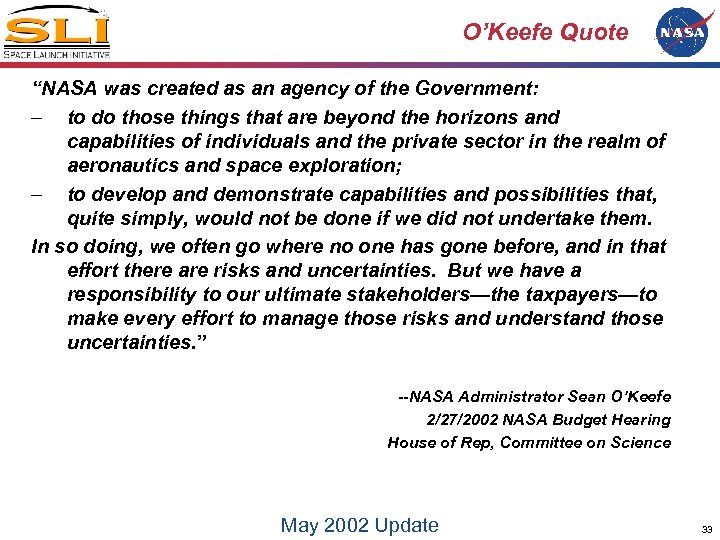 O’Keefe Quote “NASA was created as an agency of the Government: – to do those things that are beyond the horizons and capabilities of individuals and the private sector in the realm of aeronautics and space exploration; – to develop and demonstrate capabilities and possibilities that, quite simply, would not be done if we did not undertake them. In so doing, we often go where no one has gone before, and in that effort there are risks and uncertainties. But we have a responsibility to our ultimate stakeholders—the taxpayers—to make every effort to manage those risks and understand those uncertainties. ” --NASA Administrator Sean O’Keefe 2/27/2002 NASA Budget Hearing House of Rep, Committee on Science May 2002 Update 33