 Скачать презентацию Space development market satellite and applications 1 Telecommunication Sat
c6bc139bcf6634cc541beabe25611d7e.ppt
- Количество слайдов: 10



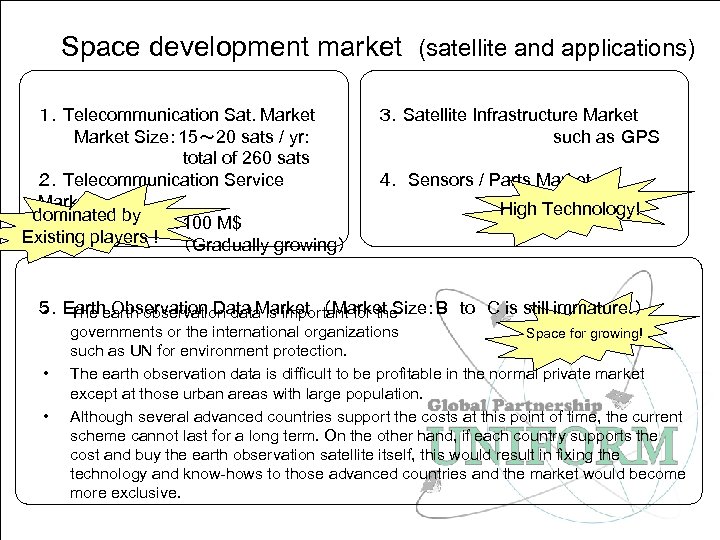
Space development market (satellite and applications) 1.Telecommunication Sat. Market Market Size: 15~ 20 sats / yr: total of 260 sats 2.Telecommunication Service Market dominated by Market Size : 100 M$ Existing players ! (Gradually growing) 3.Satellite Infrastructure Market such as GPS 4. Sensors / Parts Market High Technology! 5.Earthearth observation data is important for the • The Observation Data Market (Market Size:B to C is still immature. ) • • governments or the international organizations Space for growing! such as UN for environment protection. The earth observation data is difficult to be profitable in the normal private market except at those urban areas with large population. Although several advanced countries support the costs at this point of time, the current scheme cannot last for a long term. On the other hand, if each country supports the cost and buy the earth observation satellite itself, this would result in fixing the technology and know-hows to those advanced countries and the market would become more exclusive.
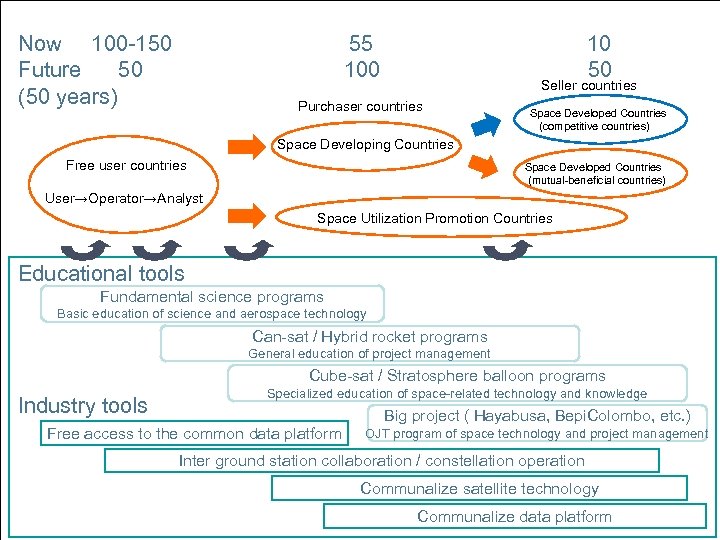
Now 100 -150 Future 50 (50 years) 55 100 10 50 Seller countries Purchaser countries Space Developed Countries (competitive countries) Space Developing Countries Free user countries Space Developed Countries (mutual-beneficial countries) User→Operator→Analyst Space Utilization Promotion Countries Educational tools Fundamental science programs Basic education of science and aerospace technology Can-sat / Hybrid rocket programs General education of project management Cube-sat / Stratosphere balloon programs Industry tools Specialized education of space-related technology and knowledge Free access to the common data platform Big project ( Hayabusa, Bepi. Colombo, etc. ) OJT program of space technology and project management Inter ground station collaboration / constellation operation Communalize satellite technology Communalize data platform
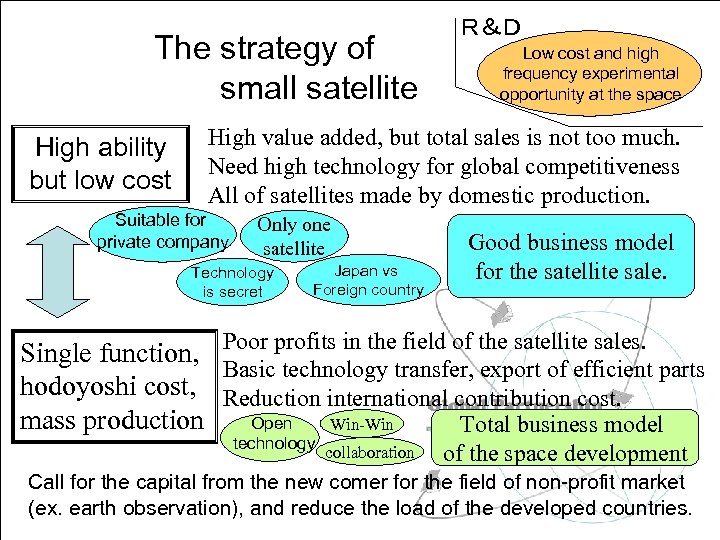
The strategy of small satellite High ability but low cost R&D Low cost and high frequency experimental opportunity at the space High value added, but total sales is not too much. Need high technology for global competitiveness All of satellites made by domestic production. Suitable for private company Only one satellite Technology is secret Japan vs Foreign country Good business model for the satellite sale. Single function, Poor profits in the field of the satellite sales. Basic technology transfer, export of efficient parts hodoyoshi cost, Reduction international contribution cost. Open mass production Win-Win Total business model technology collaboration of the space development Call for the capital from the new comer for the field of non-profit market (ex. earth observation), and reduce the load of the developed countries.
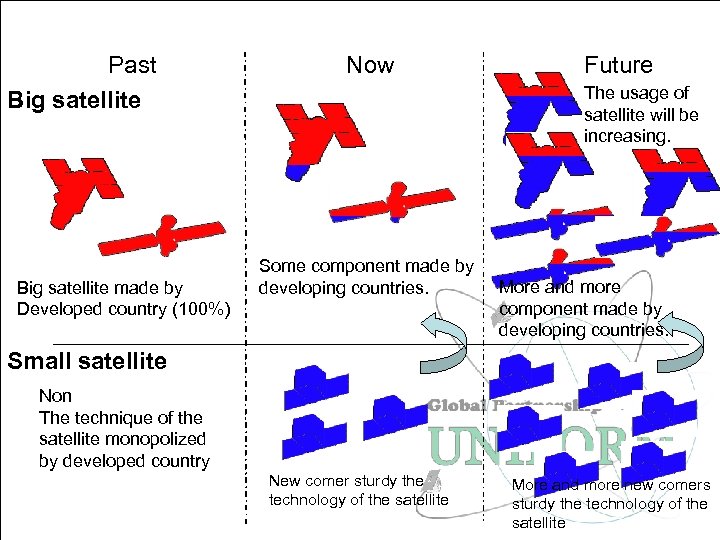
Past Big satellite made by Developed country (100%) Now Future The usage of satellite will be increasing. Some component made by developing countries. More and more component made by developing countries. Small satellite Non The technique of the satellite monopolized by developed country New comer sturdy the technology of the satellite More and more new comers sturdy the technology of the satellite
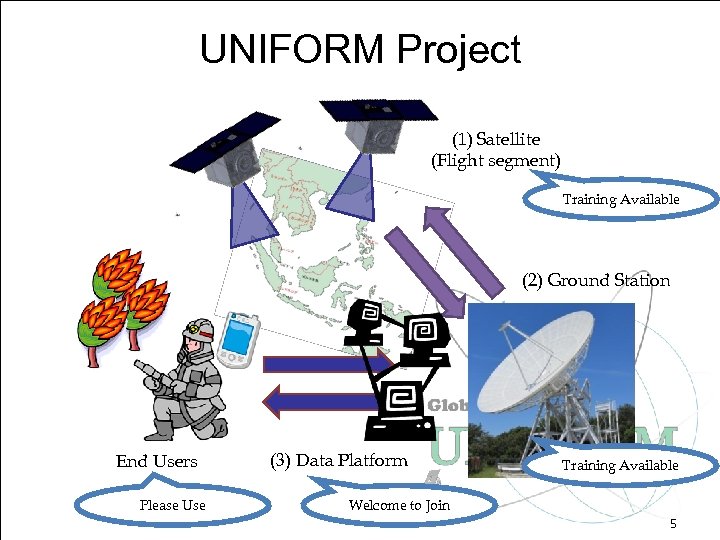
UNIFORM Project (1) Satellite (Flight segment) Training Available (2) Ground Station End Users Please Use (3) Data Platform Training Available Welcome to Join 5
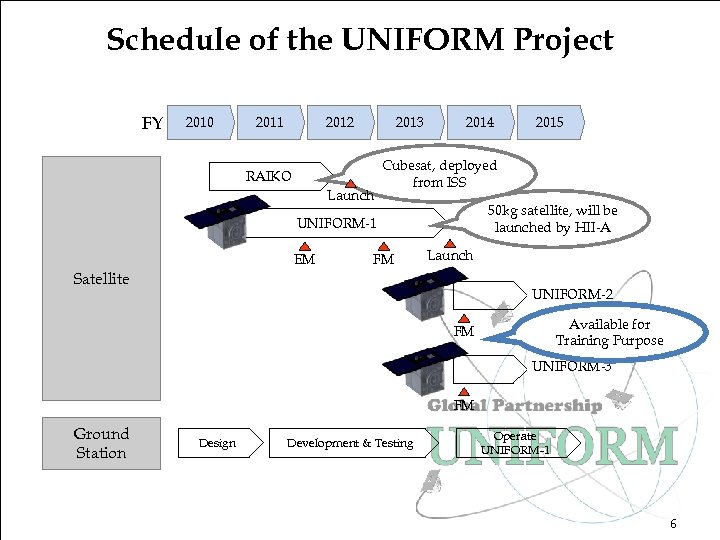
Schedule of the UNIFORM Project FY 2010 2011 2012 2013 RAIKO Launch 2014 Cubesat, deployed from ISS 50 kg satellite, will be launched by HII-A UNIFORM-1 EM 2015 FM Launch Satellite UNIFORM-2 Available for Training Purpose FM UNIFORM-3 FM Ground Station Design Development & Testing Operate UNIFORM-1 6
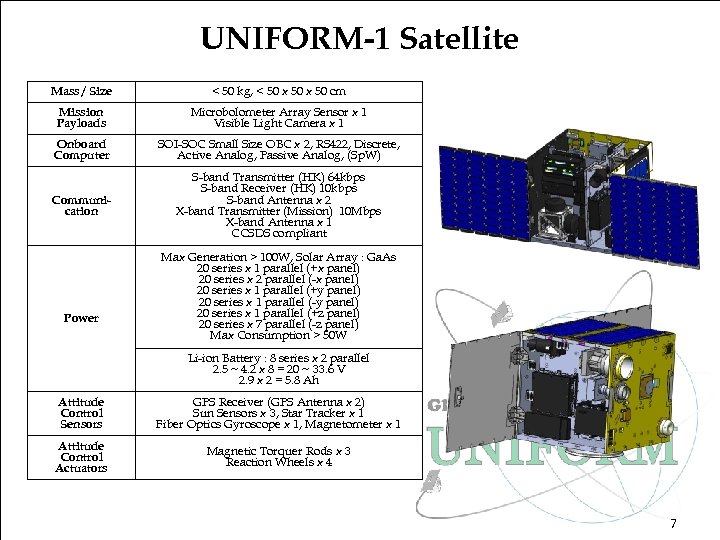
UNIFORM-1 Satellite Mass / Size < 50 kg, < 50 x 50 cm Mission Payloads Microbolometer Array Sensor x 1 Visible Light Camera x 1 Onboard Computer SOI-SOC Small Size OBC x 2, RS 422, Discrete, Active Analog, Passive Analog, (Sp. W) Communication S-band Transmitter (HK) 64 kbps S-band Receiver (HK) 10 kbps S-band Antenna x 2 X-band Transmitter (Mission) 10 Mbps X-band Antenna x 1 CCSDS compliant Power Max Generation > 100 W, Solar Array : Ga. As 20 series x 1 parallel (+x panel) 20 series x 2 parallel (-x panel) 20 series x 1 parallel (+y panel) 20 series x 1 parallel (-y panel) 20 series x 1 parallel (+z panel) 20 series x 7 parallel (-z panel) Max Consumption > 50 W Li-ion Battery : 8 series x 2 parallel 2. 5 ~ 4. 2 x 8 = 20 ~ 33. 6 V 2. 9 x 2 = 5. 8 Ah Attitude Control Sensors GPS Receiver (GPS Antenna x 2) Sun Sensors x 3, Star Tracker x 1 Fiber Optics Gyroscope x 1, Magnetometer x 1 Attitude Control Actuators Magnetic Torquer Rods x 3 Reaction Wheels x 4 7
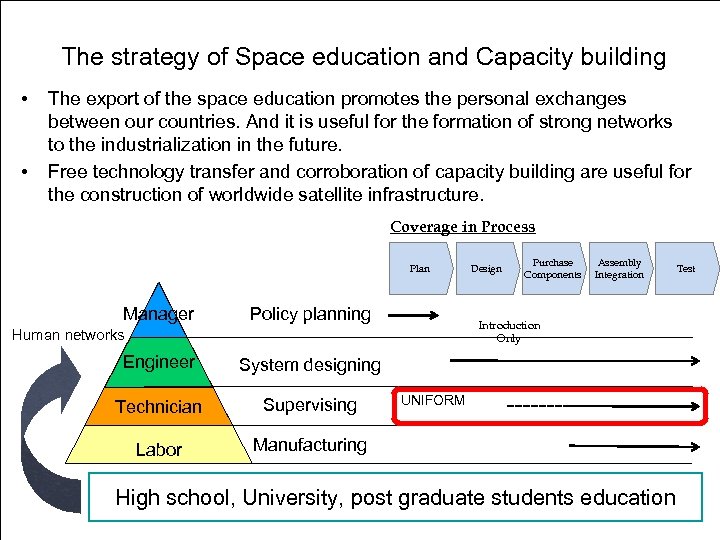
The strategy of Space education and Capacity building • • The export of the space education promotes the personal exchanges between our countries. And it is useful for the formation of strong networks to the industrialization in the future. Free technology transfer and corroboration of capacity building are useful for the construction of worldwide satellite infrastructure. Coverage in Process Plan Manager Policy planning Supervising Labor Assembly Integration System designing Technician Purchase Components Introduction Only Human networks Engineer Design Manufacturing UNIFORM High school, University, post graduate students education Test
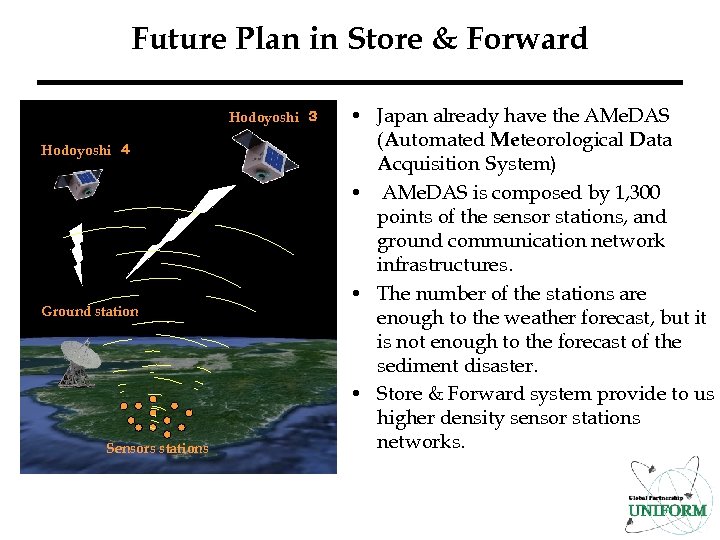
Future Plan in Store & Forward Hodoyoshi 3 Hodoyoshi 4 Ground station Sensors stations • Japan already have the AMe. DAS (Automated Meteorological Data Acquisition System) • AMe. DAS is composed by 1, 300 points of the sensor stations, and ground communication network infrastructures. • The number of the stations are enough to the weather forecast, but it is not enough to the forecast of the sediment disaster. • Store & Forward system provide to us higher density sensor stations networks.
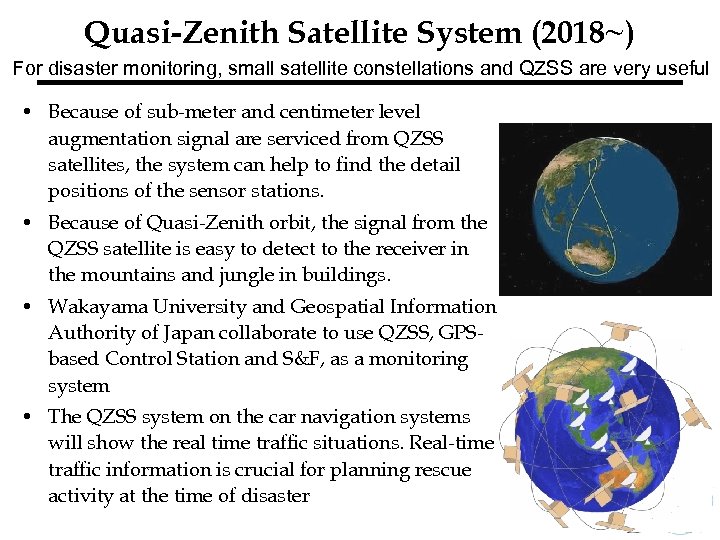
Quasi-Zenith Satellite System (2018~) For disaster monitoring, small satellite constellations and QZSS are very useful • Because of sub-meter and centimeter level augmentation signal are serviced from QZSS satellites, the system can help to find the detail positions of the sensor stations. • Because of Quasi-Zenith orbit, the signal from the QZSS satellite is easy to detect to the receiver in the mountains and jungle in buildings. • Wakayama University and Geospatial Information Authority of Japan collaborate to use QZSS, GPSbased Control Station and S&F, as a monitoring system • The QZSS system on the car navigation systems will show the real time traffic situations. Real-time traffic information is crucial for planning rescue activity at the time of disaster
Скачать презентацию Space development market satellite and applications 1 Telecommunication Sat
c6bc139bcf6634cc541beabe25611d7e.ppt