 Скачать презентацию Sovereign Investment Partnerships Executive Forum on Central Bank
5b358c2d7d4856a08021ce487db01600.ppt
- Количество слайдов: 13



Sovereign Investment Partnerships Executive Forum on Central Bank Reserves and Official Sector Asset Management Governance issues in the central bank investment function: the case of Banca d’Italia Franco Passacantando, Managing Director Central Banking, Markets and Payment System Area Washington, April 27 -29, 2009
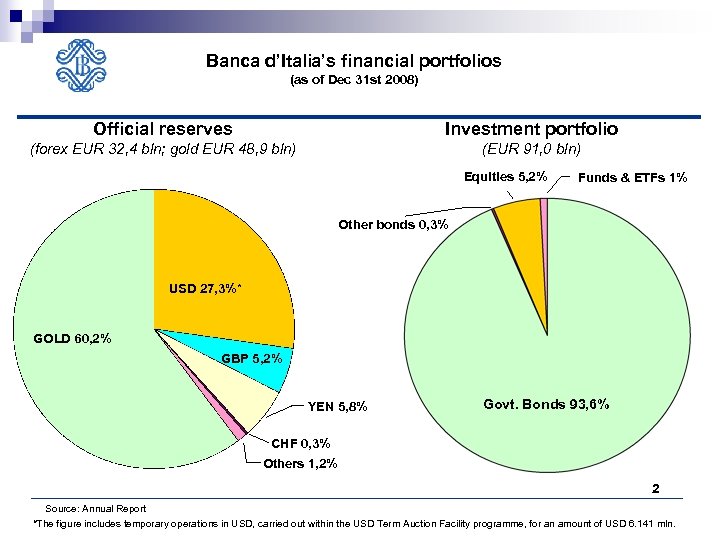
Banca d’Italia’s financial portfolios (as of Dec 31 st 2008) Official reserves Investment portfolio (forex EUR 32, 4 bln; gold EUR 48, 9 bln) (EUR 91, 0 bln) Equities 5, 2% Funds & ETFs 1% Other bonds 0, 3% USD 27, 3%* GOLD 60, 2% GBP 5, 2% YEN 5, 8% Govt. Bonds 93, 6% CHF 0, 3% Others 1, 2% 2 Source: Annual Report *The figure includes temporary operations in USD, carried out within the USD Term Auction Facility programme, for an amount of USD 6. 141 mln.
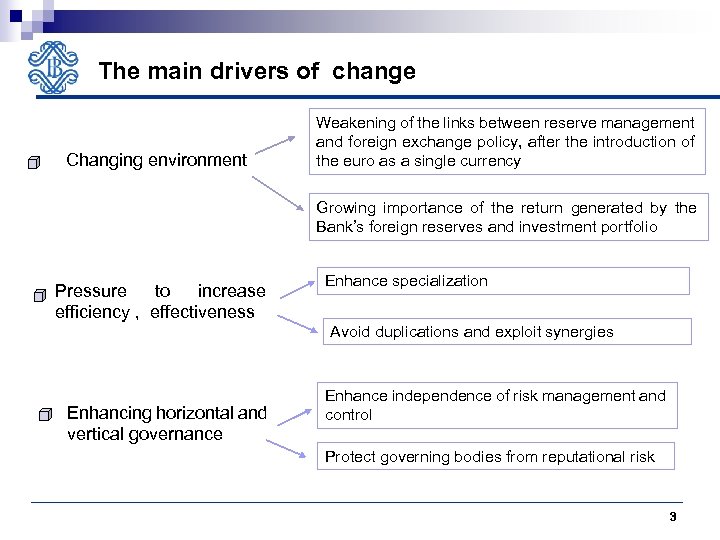
The main drivers of change Changing environment Weakening of the links between reserve management and foreign exchange policy, after the introduction of the euro as a single currency Growing importance of the return generated by the Bank’s foreign reserves and investment portfolio Pressure to increase efficiency , effectiveness Enhance specialization Avoid duplications and exploit synergies Enhancing horizontal and vertical governance Enhance independence of risk management and control Protect governing bodies from reputational risk 3
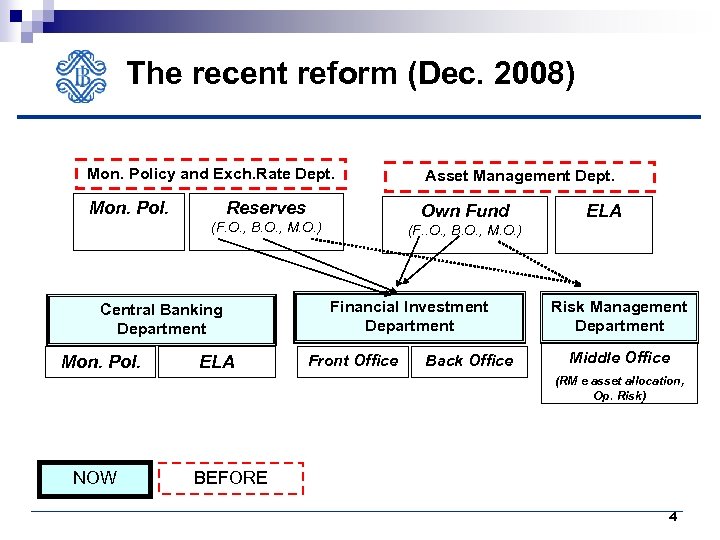
The recent reform (Dec. 2008) Mon. Policy and Exch. Rate Dept. Asset Management Dept. Mon. Pol. Own Fund Reserves (F. O. , B. O. , M. O. ) Central Banking Department Mon. Pol. ELA (F. . O. , B. O. , M. O. ) Financial Investment Department Front Office Back Office Risk Management Department Middle Office (RM e asset allocation, Op. Risk) NOW BEFORE 4
Departments involved and respective functions Central Banking Department: monetary policy operations, foreign exchange interventions, financial stability-related functions (ELA). Financial Investment Department: investment of the Bank's own funds, foreign currencies, gold reserves and reserves held on behalf of the ECB. Risk Management Department: assessment and control of financial and operational risk on all assets of the Bank; proposals for strategic and tactical asset allocation. 5
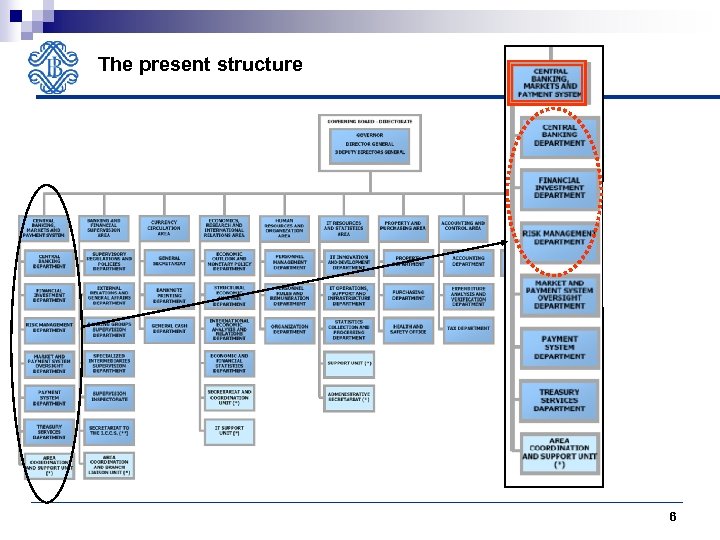
The present structure 6
1. The merger between reserve management and own funds management activities Why? Integrated approach towards asset management Increasing similarities between fx reserve portfolio and investment portfolio Moving towards an integrated risk management approach at enterprise-wide level Efficiency reasons Exploit the synergies arising from the concentration of investment activities within a single team Avoid duplications and costs related to the ‘twin’ dealing rooms (we merged 3 dealing rooms into a single one!) 7
The merger between reserve management and own funds management activities (ctd. ) Issues The institutional reasons why a central bank holds foreign reserves and own funds are different. However, risks of using ‘inside information’ can be mitigated. Foreign reserves must be characterised by a particularly low risk return profile and high liquidity. The merger between operational and decision making structures does not prevent the definition of different profiles for different components of the portfolio. 8
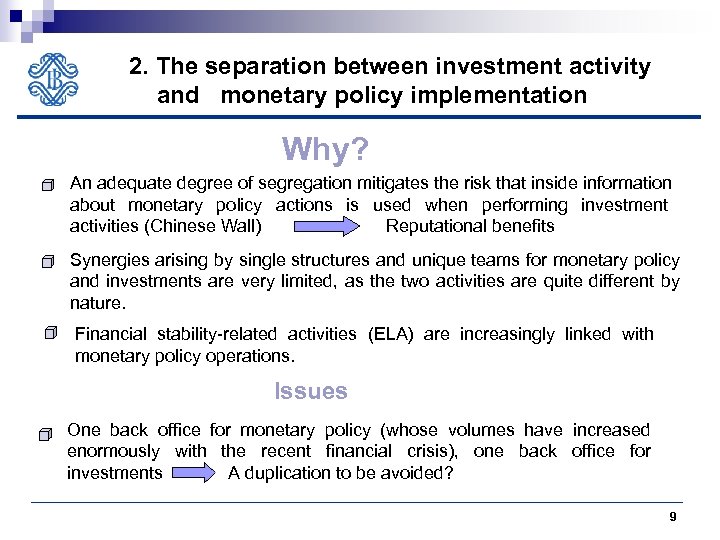
2. The separation between investment activity and monetary policy implementation Why? An adequate degree of segregation mitigates the risk that inside information about monetary policy actions is used when performing investment activities (Chinese Wall) Reputational benefits Synergies arising by single structures and unique teams for monetary policy and investments are very limited, as the two activities are quite different by nature. Financial stability-related activities (ELA) are increasingly linked with monetary policy operations. Issues One back office for monetary policy (whose volumes have increased enormously with the recent financial crisis), one back office for investments A duplication to be avoided? 9
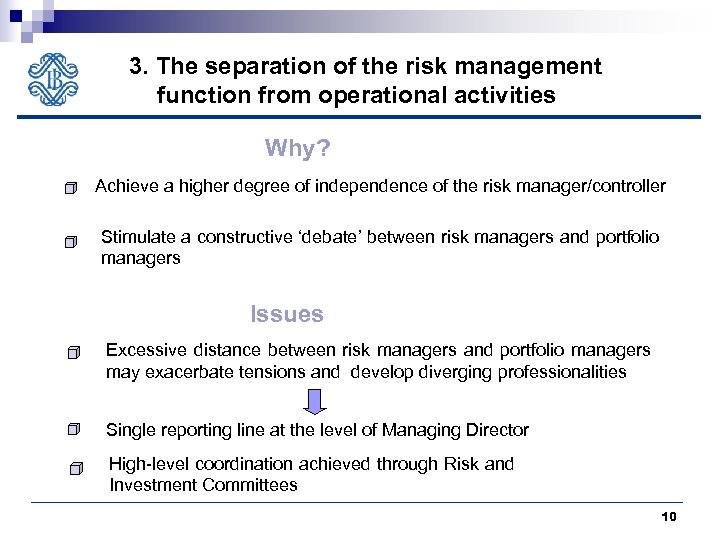
3. The separation of the risk management function from operational activities Why? Achieve a higher degree of independence of the risk manager/controller Stimulate a constructive ‘debate’ between risk managers and portfolio managers Issues Excessive distance between risk managers and portfolio managers may exacerbate tensions and develop diverging professionalities Single reporting line at the level of Managing Director High-level coordination achieved through Risk and Investment Committees 10
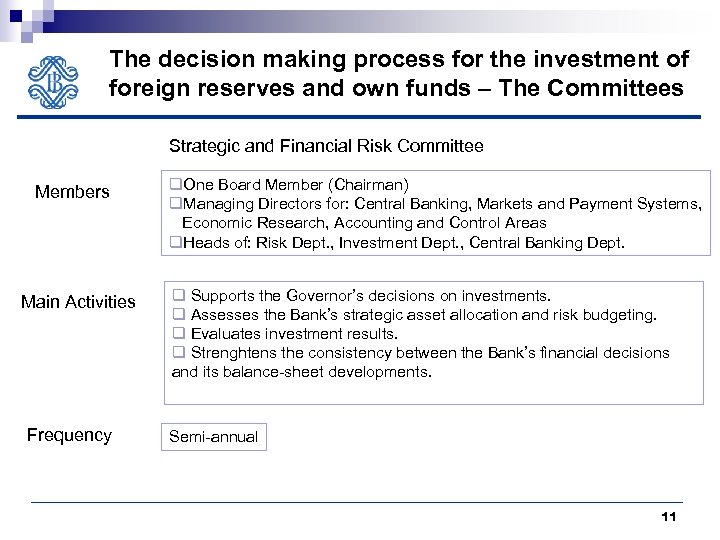
The decision making process for the investment of foreign reserves and own funds – The Committees Strategic and Financial Risk Committee Members Main Activities Frequency q. One Board Member (Chairman) q. Managing Directors for: Central Banking, Markets and Payment Systems, Economic Research, Accounting and Control Areas q. Heads of: Risk Dept. , Investment Dept. , Central Banking Dept. q Supports the Governor’s decisions on investments. q Assesses the Bank’s strategic asset allocation and risk budgeting. q Evaluates investment results. q Strenghtens the consistency between the Bank’s financial decisions and its balance-sheet developments. Semi-annual 11
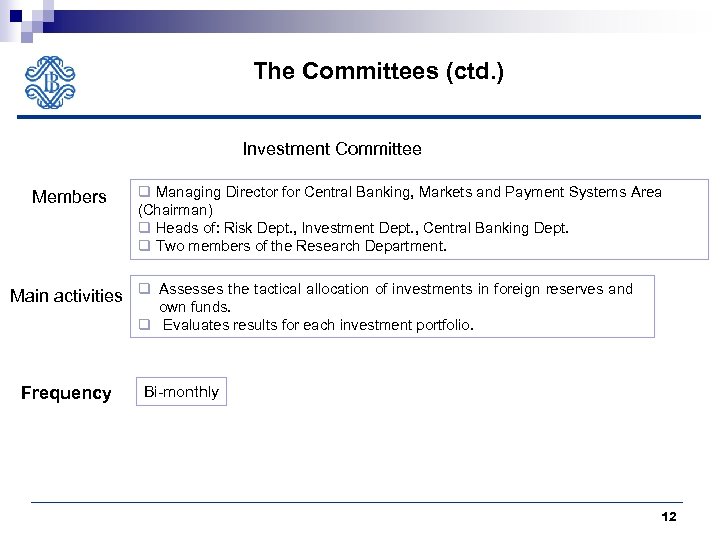
The Committees (ctd. ) Investment Committee Members q Managing Director for Central Banking, Markets and Payment Systems Area (Chairman) q Heads of: Risk Dept. , Investment Dept. , Central Banking Dept. q Two members of the Research Department. Main activities q Assesses the tactical allocation of investments in foreign reserves and own funds. q Evaluates results for each investment portfolio. Frequency Bi-monthly 12
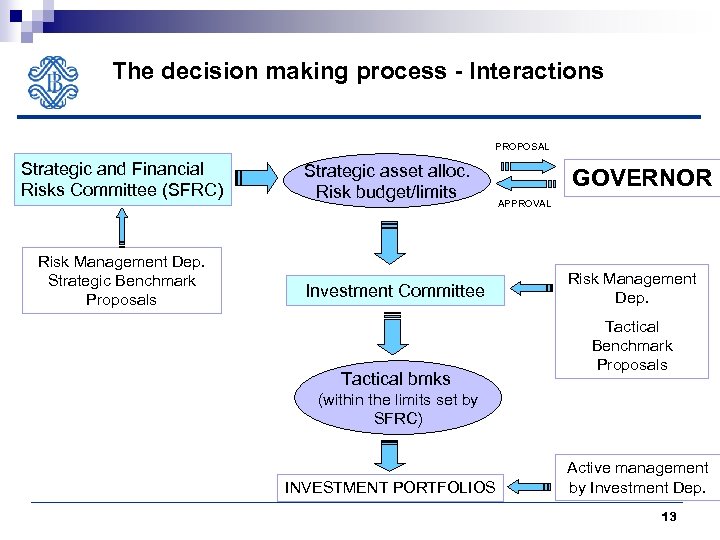
The decision making process - Interactions PROPOSAL Strategic and Financial Risks Committee (SFRC) Risk Management Dep. Strategic Benchmark Proposals Strategic asset alloc. Risk budget/limits Investment Committee Tactical bmks GOVERNOR APPROVAL Risk Management Dep. Tactical Benchmark Proposals (within the limits set by SFRC) INVESTMENT PORTFOLIOS Active management by Investment Dep. 13
Скачать презентацию Sovereign Investment Partnerships Executive Forum on Central Bank
5b358c2d7d4856a08021ce487db01600.ppt