


 Скачать презентацию Southern Nevada Regional Professional Development Program RPDP
bad3a44cdc84e6ef335719303af65c7e.ppt
- Количество слайдов: 70
 Southern Nevada Regional Professional Development Program RPDP. net RPDP Secondary Literacy
 Reading Strategies for Nonfiction Author’s Purpose, Viewpoint, and Intended Audience Created & Developed by Jill M. Leone Reading Specialist RPDP Secondary Literacy Copyright © 2006
 We will discuss how to • identify the writer’s purpose • recognize the writer’s - viewpoint - tone - intended audience RPDP Secondary Literacy
 Everything that is written has a purpose. r RPDP Secondary Literacy tte Le • a letter to a friend • an excuse for an absence • an essay for a class • a book report • a news article • a diary or a journal • a book or movie review
 Books, stories, essays, poems, articles, and all other pieces of writing are written for a variety of reasons. RPDP Secondary Literacy
 The author’s purpose for most of what we read usually falls into these next categories: RPDP Secondary Literacy
 • • Newspaper and magazine articles Book or movie reviews Sports columns Medical reports and research Time tables and schedules Classroom lectures Announcements RPDP Secondary Literacy
 The writer tells a story or gives details and events in chronological order the way they happened in time. RPDP Secondary Literacy
 • A set of instructions • An idea • A step-by-step process • An event • A relationship RPDP Secondary Literacy
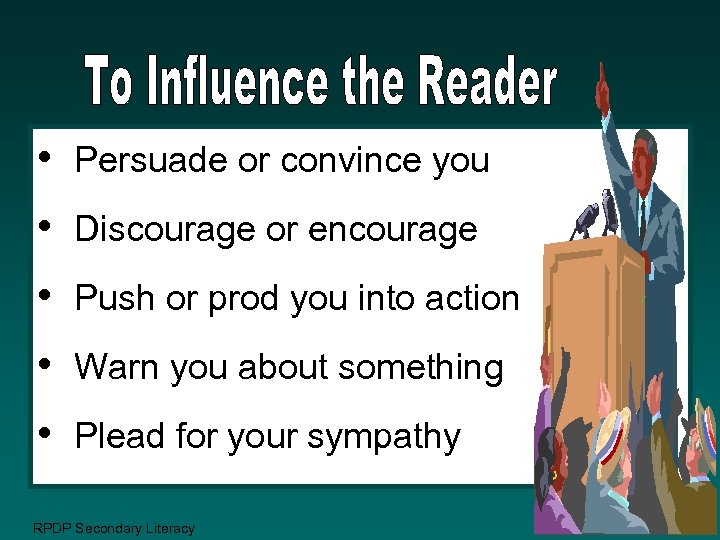 • Persuade or convince you • Discourage or encourage • Push or prod you into action • Warn you about something • Plead for your sympathy RPDP Secondary Literacy
 • Show support • Present a personal view • Express feelings • To motivate • To create suspense • To cause doubt RPDP Secondary Literacy
 Dear Editor: If schools in Clark County begin double sessions, students will have less time in the classroom and less opportunity to learn new things. There will be no time for social interaction among students. I urge you, as parents, to write to your school board representatives RPDP Secondarythem know how you feel about rushing and let Literacy
 The writer’s purpose for this letter is – A. to inform the reader. B. to share a personal experience. C. to explain or instruct. D. to influence the reader. RPDP Secondary Literacy
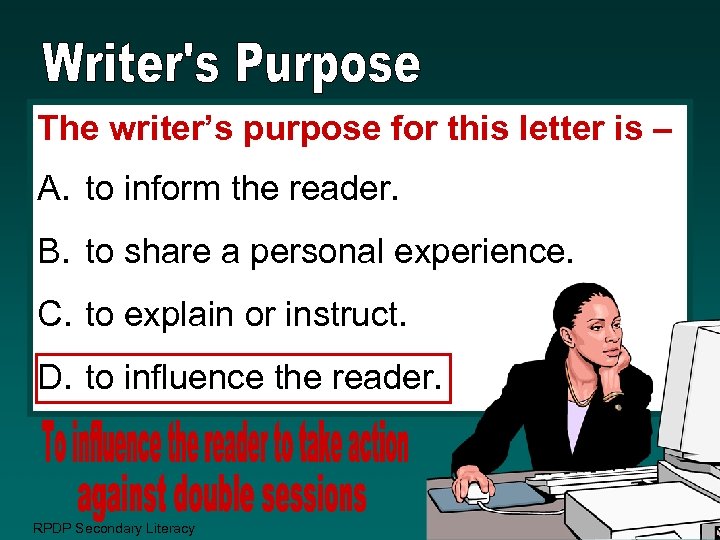 The writer’s purpose for this letter is – A. to inform the reader. B. to share a personal experience. C. to explain or instruct. D. to influence the reader. RPDP Secondary Literacy
 • • Novels Essays Short Stories Poems Songs Newspaper Columns Magazine Articles RPDP Secondary Literacy
 • Textbooks • Encyclopedias • Literature • Classroom Lectures • Internet Websites • Series of Books or Articles RPDP Secondary Literacy
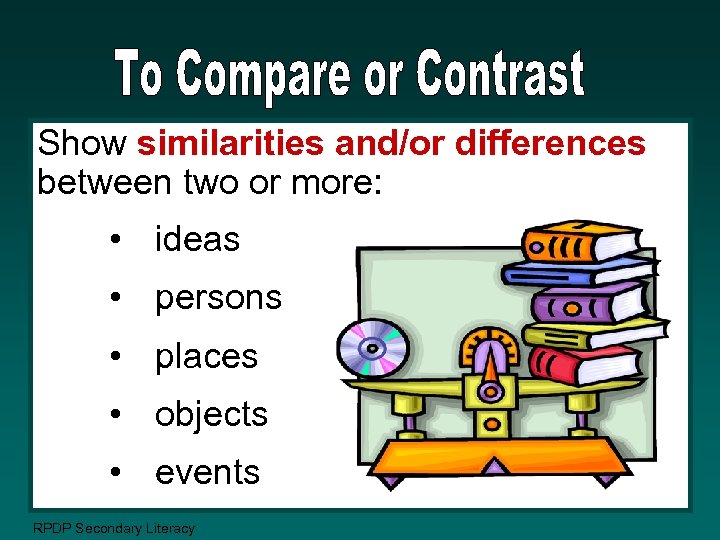 Show similarities and/or differences between two or more: • ideas • persons • places • objects • events RPDP Secondary Literacy
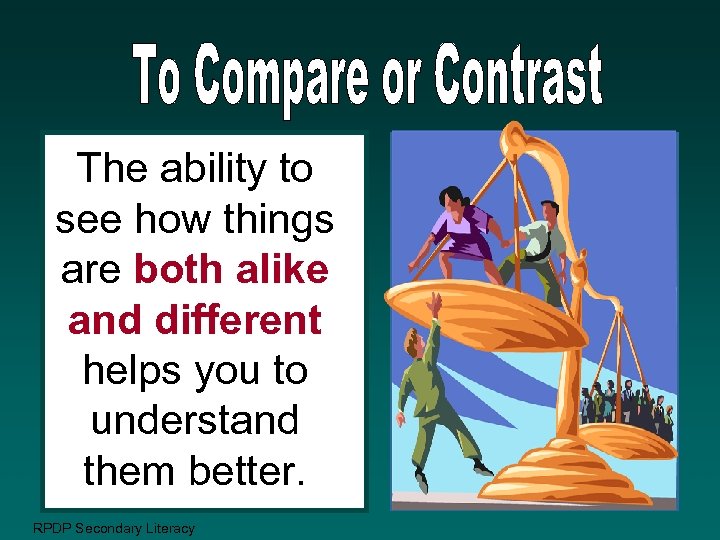 The ability to see how things are both alike and different helps you to understand them better. RPDP Secondary Literacy
 • You compare the music you like with the music that your friends like. • Doing this helps you learn more about yourself and your friends. RPDP Secondary Literacy
 Comparisons can be found in • Essays • Editorial and opinion articles • Information articles in magazines and newspapers • Internet websites • Both fiction and nonfiction writing RPDP Secondary Literacy
 A toy should be fun to use. It should be attractive, and it should be easy to use at first. However, as the player develops more skill, the toy should prove more challenging. These rules are just as true for children’s toys as for adult toys. But there are some special rules for a child’s toy. It should not have any sharp edges, which could cut little fingers. RPDP Secondary Literacy
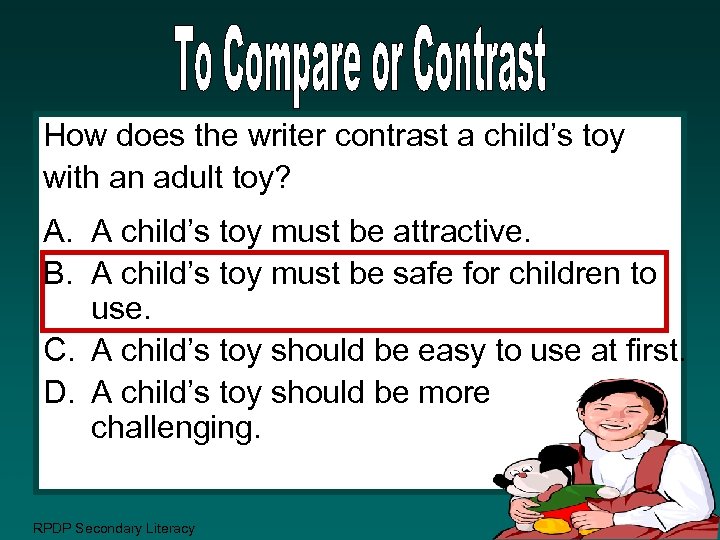 How does the writer contrast a child’s toy with an adult toy? A. A child’s toy must be attractive. B. A child’s toy must be safe for children to use. C. A child’s toy should be easy to use at first. D. A child’s toy should be more challenging. RPDP Secondary Literacy
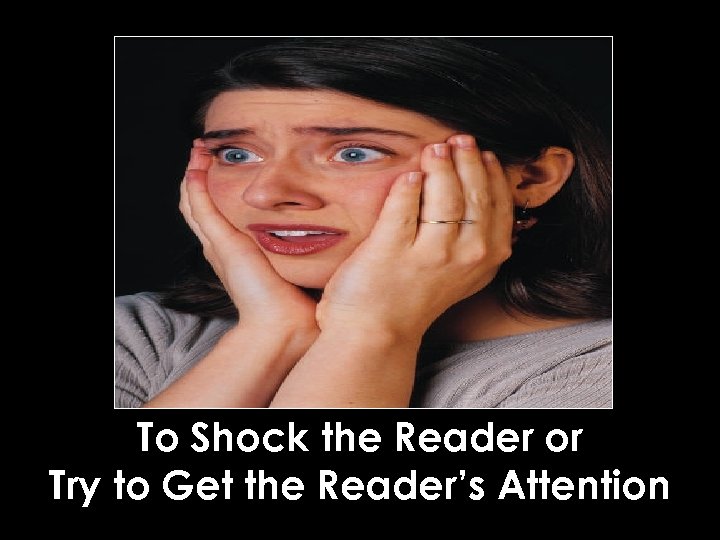 To Shock the Reader or Try to Get the Reader’s Attention RPDP Secondary Literacy
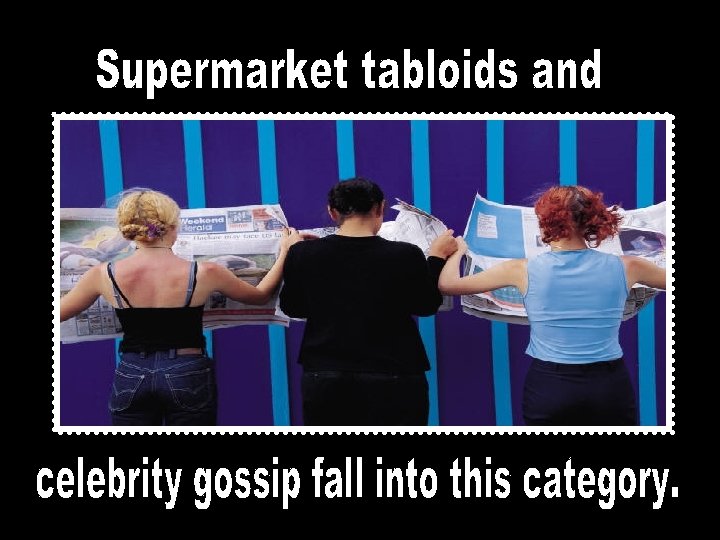 RPDP Secondary Literacy
 To Sell a Product to Readers RPDP Secondary Literacy
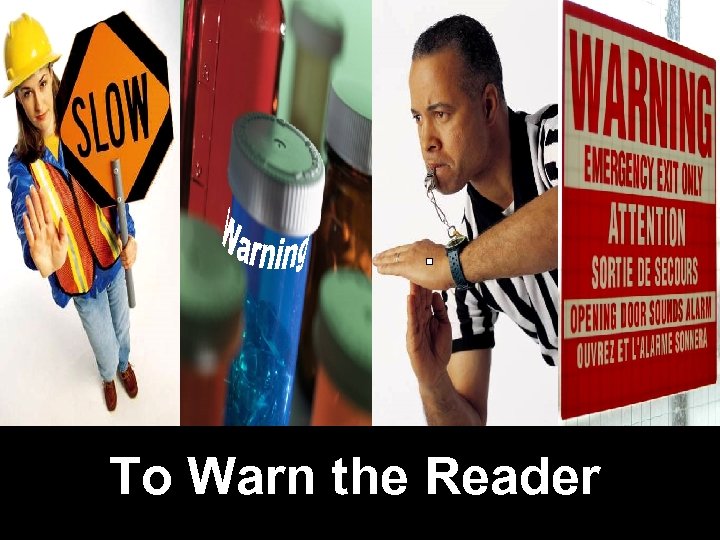 To Warn the Reader RPDP Secondary Literacy
 • Business Letters • Emails • Faxes • Classified Ads • Solicitations for Donations RPDP Secondary Literacy
 Many times a writer has more than one purpose for writing. However Most reading tests will ask you to choose the writer’s primary purpose, so it’s important to always read and think. RPDP Secondary Literacy
 The writer’s purpose is closely related to the main idea. Once you understand the writer’s purpose, it’s not hard to figure out the main idea. And vice versa. RPDP Secondary Literacy
 It may also help to know who the writer is. For example: A humorous or funny writer probably wants to amuse or entertain you. RPDP Secondary Literacy
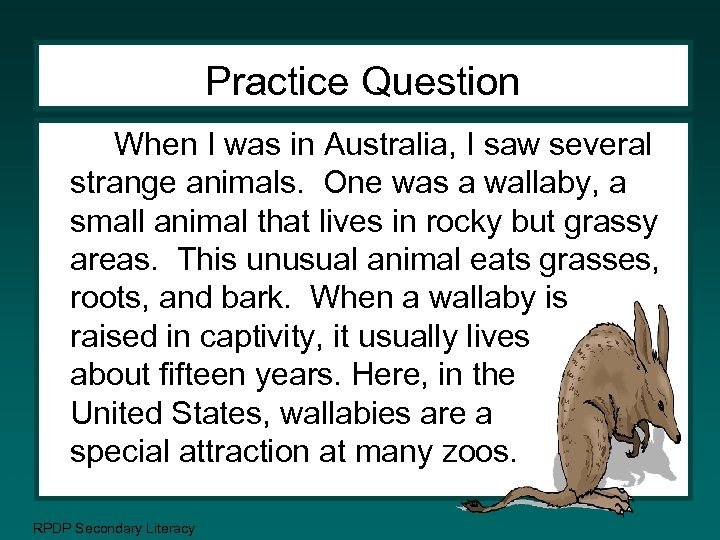 Practice Question When I was in Australia, I saw several strange animals. One was a wallaby, a small animal that lives in rocky but grassy areas. This unusual animal eats grasses, roots, and bark. When a wallaby is raised in captivity, it usually lives about fifteen years. Here, in the United States, wallabies are a special attraction at many zoos. RPDP Secondary Literacy
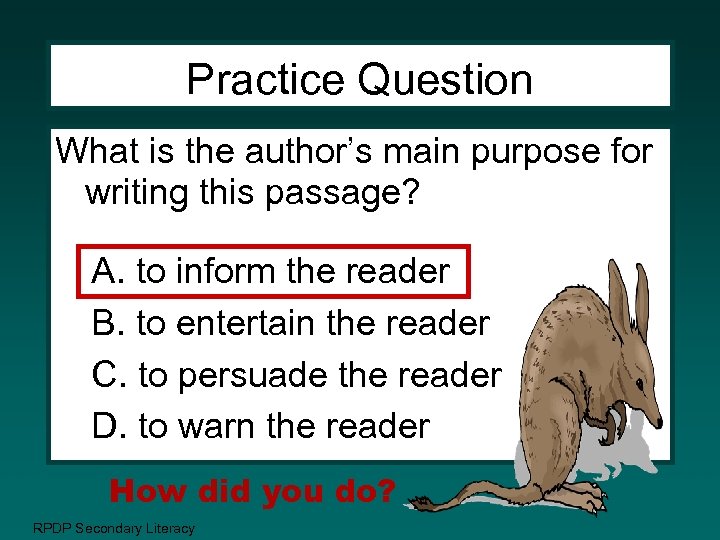 Practice Question What is the author’s main purpose for writing this passage? A. to inform the reader B. to entertain the reader C. to persuade the reader D. to warn the reader How did you do? RPDP Secondary Literacy
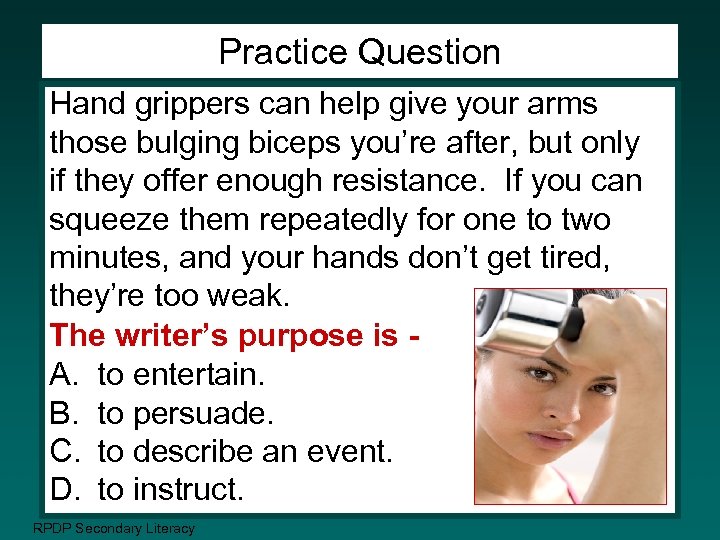 Practice Question Hand grippers can help give your arms those bulging biceps you’re after, but only if they offer enough resistance. If you can squeeze them repeatedly for one to two minutes, and your hands don’t get tired, they’re too weak. The writer’s purpose is A. to entertain. B. to persuade. C. to describe an event. D. to instruct. RPDP Secondary Literacy
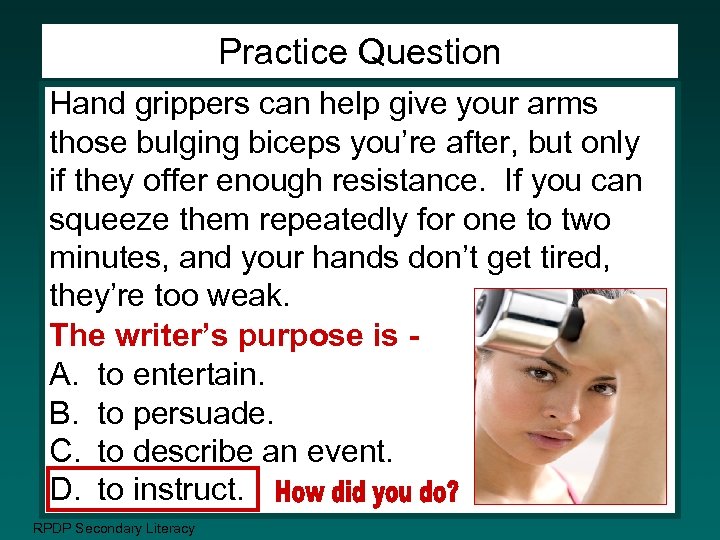 Practice Question Hand grippers can help give your arms those bulging biceps you’re after, but only if they offer enough resistance. If you can squeeze them repeatedly for one to two minutes, and your hands don’t get tired, they’re too weak. The writer’s purpose is A. to entertain. B. to persuade. C. to describe an event. D. to instruct. RPDP Secondary Literacy
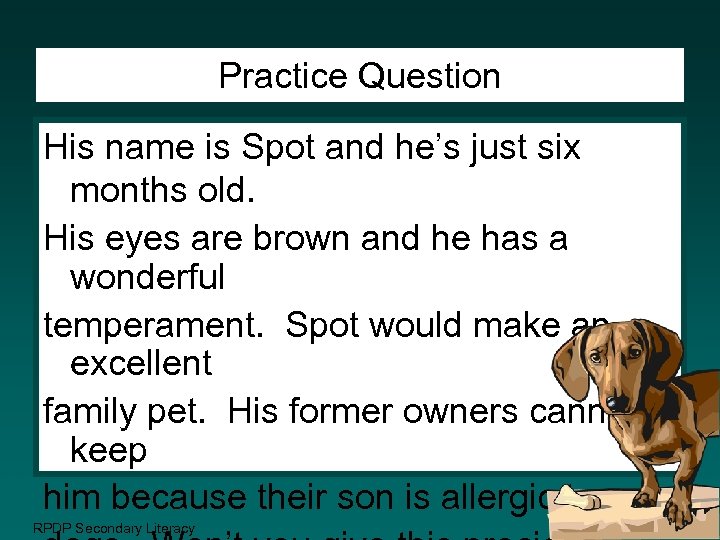 Practice Question His name is Spot and he’s just six months old. His eyes are brown and he has a wonderful temperament. Spot would make an excellent family pet. His former owners cannot keep him because their son is allergic to RPDP Secondary Literacy
 Practice Question This selection was written to – A. make you laugh. B. make you angry. C. make you dislike animals. D. make you sympathetic. RPDP Secondary Literacy
 Practice Question This selection was written to – A. make you laugh. B. make you angry. C. make you dislike animals. D. make you sympathetic. RPDP Secondary Literacy
 STOP! It’s also important for you to understand the author’s viewpoint. The author’s viewpoint is related to both the purpose and the main idea. RPDP Secondary Literacy
 The way a writer feels about someone or something “colors” everything he or she writes. Train yourself to be aware of the writer’s viewpoint. Notice how the writer communicates his own RPDP Secondary Literacy viewpoint.
 Over the summer months, graffiti in this city increases by almost 100%. Homeowners and other decent people are forced to reach into their pockets and spend their hard-earned dollars on chemicals to clean this disgusting mess off the block walls of their homes left by the talented artists who vandalize our neighborhoods as we sleep. RPDP Secondary Literacy
 Over the summer months, graffiti in this city increases by almost 100%. Homeowners and other decent people are forced to reach into their pockets and spend their hardearned dollars on chemicals to clean this disgusting mess off the block walls of their homes left by the talented artists who vandalize our neighborhoods as we sleep. RPDP Secondary Literacy
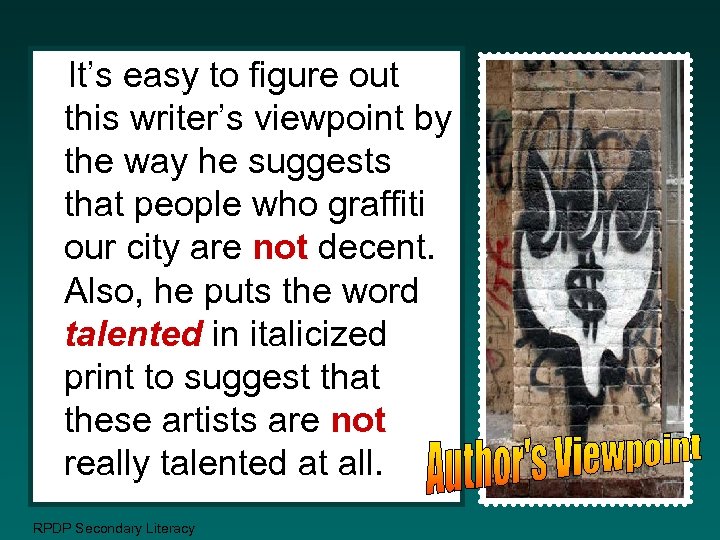 It’s easy to figure out this writer’s viewpoint by the way he suggests that people who graffiti our city are not decent. Also, he puts the word talented in italicized print to suggest that these artists are not really talented at all. RPDP Secondary Literacy
 He also portrays the homeowners as: People who must work hard for their money. People who are victimized while they sleep. RPDP Secondary Literacy
 Look for positive or negative words. When you have no word clues, form your own reaction or impression. Ask yourself if you feel shocked, or surprised, or impressed. RPDP Secondary Literacy
 Practice Question The leader of the gang of smugglers tried everything possible to get Mike to help him. He told him that he’d be rich if he cooperated and given a new car and a well-paying job. Mike was not tempted. He did not give in even when he was threatened with death. Nothing that the gang leader said could change his mind. The author describes Mike as – A. dishonest and cowardly. B. intelligent and well-spoken. C. old and kind. D. honest and courageous. RPDP Secondary Literacy
 Practice Question The leader of the gang of smugglers tried everything possible to get Mike to help him. He told him that he’d be rich if he cooperated and given a new car and a well-paying job. Mike was not tempted. He did not give in even when he was threatened with death. Nothing that the gang leader said could change his mind. The author describes Mike as – A. dishonest and cowardly. B. intelligent and well-spoken. C. old and kind. D. honest and courageous. RPDP Secondary Literacy
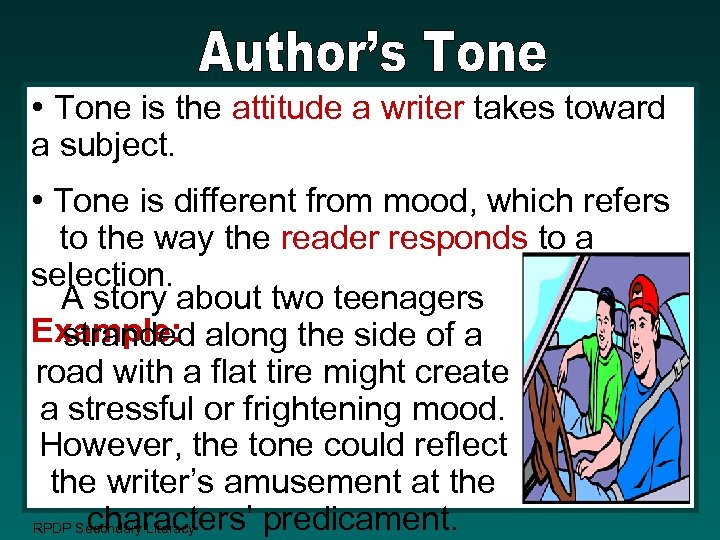 • Tone is the attitude a writer takes toward a subject. • Tone is different from mood, which refers to the way the reader responds to a selection. A story about two teenagers Example: along the side of a stranded road with a flat tire might create a stressful or frightening mood. However, the tone could reflect the writer’s amusement at the characters’ predicament. RPDP Secondary Literacy
 Read for ideas, not just words. Pay careful attention to text features: • Bold print • Italicized words • Underlined words • Capitalized words • Bulleted words RPDP Secondary Literacy
 Ask you to identify the writer's attitude or perspective • Check the adjectives he chooses. • Are the writer's feelings toward the subject positive, negative, or neutral? • Does the writer give his own opinion, or does he objectively present the opinions of others? RPDP Secondary Literacy
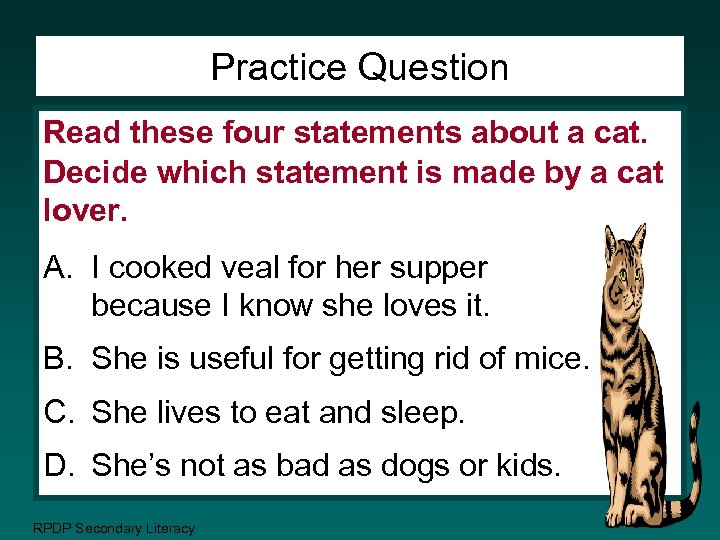 Practice Question Read these four statements about a cat. Decide which statement is made by a cat lover. A. I cooked veal for her supper because I know she loves it. B. She is useful for getting rid of mice. C. She lives to eat and sleep. D. She’s not as bad as dogs or kids. RPDP Secondary Literacy
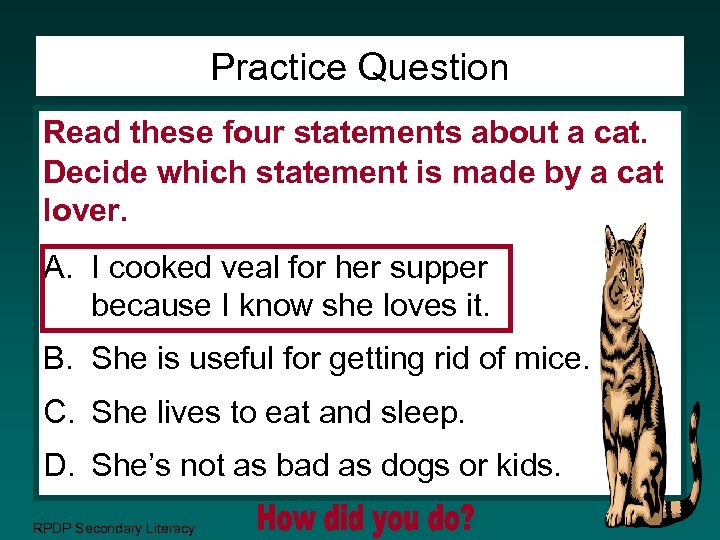 Practice Question Read these four statements about a cat. Decide which statement is made by a cat lover. A. I cooked veal for her supper because I know she loves it. B. She is useful for getting rid of mice. C. She lives to eat and sleep. D. She’s not as bad as dogs or kids. RPDP Secondary Literacy
 Practice Question Although baseball is an interesting and extremely popular sport, it provides much less effective exercise than other sports. In contrast to baseball, soccer is a sport which exercises the entire body. Although running is important in both of these sports, the athlete playing soccer is able to Literacy RPDP Secondary
 Practice Question The author feels that baseball --A. is boring but good exercise. B. is boring and does not provide effective exercise. C. is interesting and provides effective exercise. D. is interesting but does not provide effective exercise. RPDP Secondary Literacy
 Practice Question The author feels that baseball --A. is boring but good exercise. B. is boring and does not provide effective exercise. C. is interesting and provides effective exercise. D. is interesting but does not provide effective exercise. RPDP Secondary Literacy How did you do?
 Practice Question Even though the United Supermarket employs 200 people, there’s no reason that it should remain open. Some people argue that it offers a wide selection of food at low prices, but United sells old or expired food that makes people ill. Health inspectors have issued complaints about it, and more than a dozen patients have been hospitalized after eating food purchased there. This supermarket must be closed! Until then, no one should buy anything at United. RPDP Secondary Literacy
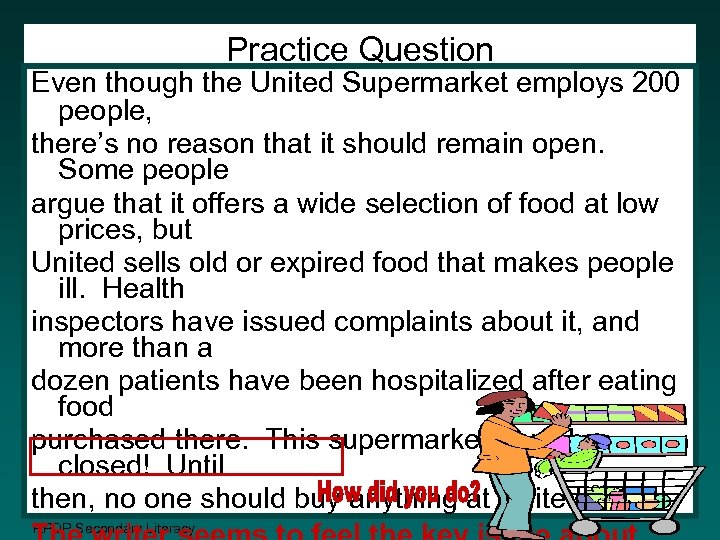 Practice Question Even though the United Supermarket employs 200 people, there’s no reason that it should remain open. Some people argue that it offers a wide selection of food at low prices, but United sells old or expired food that makes people ill. Health inspectors have issued complaints about it, and more than a dozen patients have been hospitalized after eating food purchased there. This supermarket must be closed! Until then, no one should buy anything at United. RPDP Secondary Literacy
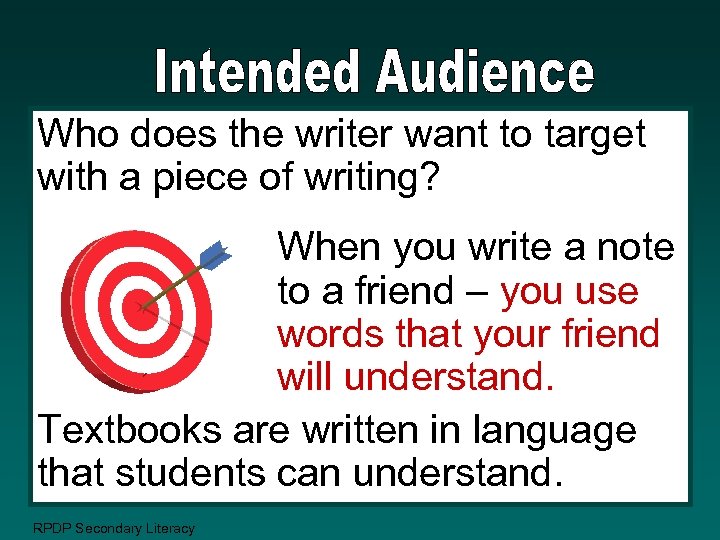 Who does the writer want to target with a piece of writing? When you write a note to a friend – you use words that your friend will understand. Textbooks are written in language that students can understand. RPDP Secondary Literacy
 Imagine trying to read a textbook with words so big and technical that you have no idea what you’re reading! RPDP Secondary Literacy
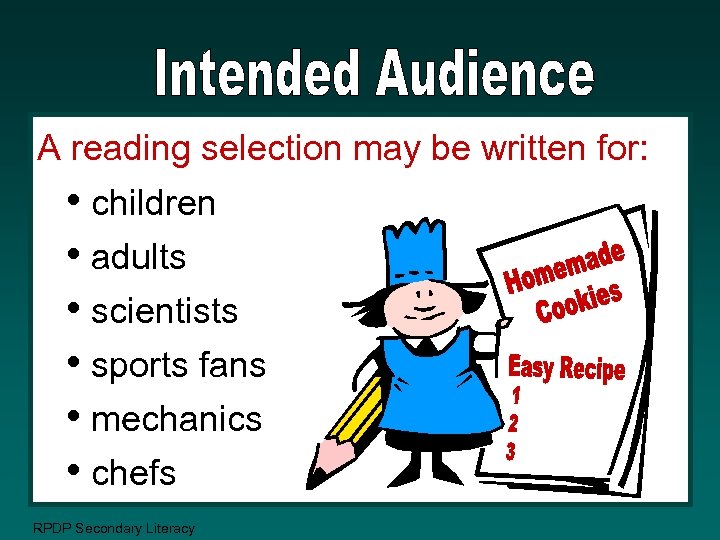 A reading selection may be written for: • children • adults • scientists • sports fans • mechanics • chefs RPDP Secondary Literacy
 You can tell for whom something is written by: • The language used • The way the topics are discussed • What the audience is assumed to know RPDP Secondary Literacy
 Practice Question Click the HELP button in the lower righthand corner of the software screen. This is written for: a. computer programmers b. young children c. people who are learning computers d. computer salespersons RPDP Secondary Literacy
 Practice Question Click the HELP button in the lower righthand corner of the software screen. This is written for: a. computer programmers b. young children c. people who are learning computers d. computer salespersons RPDP Secondary Literacy How did you do?
 How do we know the answer is people who are learning computers? • Computer programmers would already know what to do. • Salespersons would have knowledge of the merchandise they’re selling. • And little children probably wouldn’t understand. RPDP Secondary Literacy
 Practice Question Starting on a hill is tricky. Press the gas pedal gently. You should feel the car ready to move before you let out the brake. If you’ve done it just right, the car will begin to climb the hill in a slow, steady way. This is written for – A. auto mechanics. B. auto sales people. C. people learning to drive. D. fourth grade teachers. RPDP Secondary Literacy
 Practice Question Starting on a hill is tricky. Press the gas pedal gently. You should feel the car ready to move before you let out the brake. If you’ve done it just right, the car will begin to climb the hill in a slow, steady way. This is written for – A. auto mechanics. B. auto sales people. C. people learning to drive. D. fourth grade teachers. RPDP Secondary Literacy
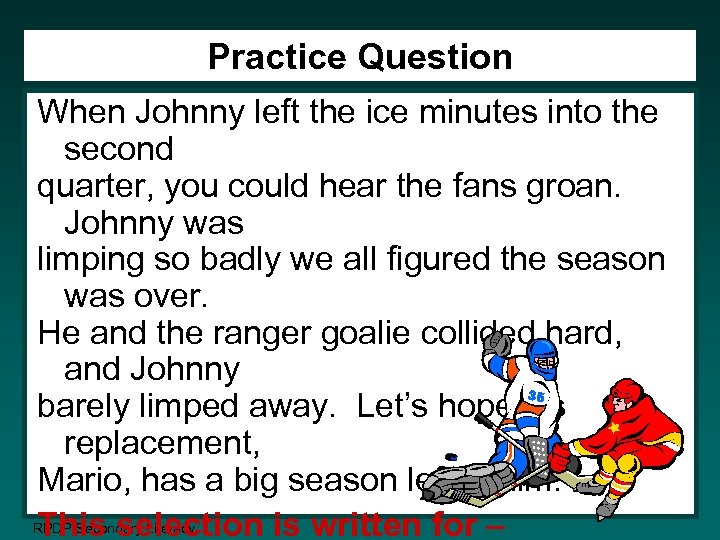 Practice Question When Johnny left the ice minutes into the second quarter, you could hear the fans groan. Johnny was limping so badly we all figured the season was over. He and the ranger goalie collided hard, and Johnny barely limped away. Let’s hope his replacement, Mario, has a big season left in him. RPDP Secondary Literacy This selection is written for –
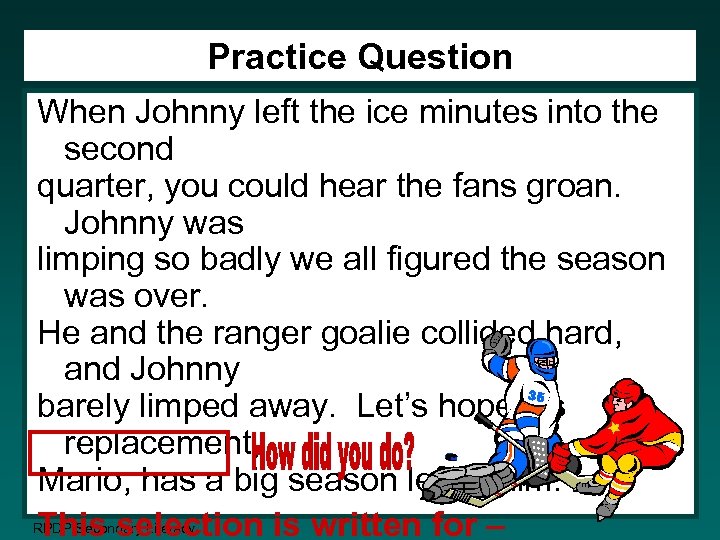 Practice Question When Johnny left the ice minutes into the second quarter, you could hear the fans groan. Johnny was limping so badly we all figured the season was over. He and the ranger goalie collided hard, and Johnny barely limped away. Let’s hope his replacement, Mario, has a big season left in him. RPDP Secondary Literacy This selection is written for –
 It is also helpful to – • Read the first and last sentences carefully. • Think about words and ideas the writer stressed. • Think about what the writer did not tell you and why he may have omitted certain details. • Evaluate whether the writer has RPDP Secondary Literacy
 Today we discussed – • Author’s Purpose • Author’s Viewpoint • Author’s Tone • Intended Audience RPDP Secondary Literacy
 Copyright Notice Permission is granted to copy (unmodified) all or part of this Power. Point for educational, personal, non-commercial use off-line as long as the copyright message (Copyright © 2006 by Jill Leone) is maintained on the title page. This material may not be sold, duplicated on other websites, incorporated in commercial documents or products, or used for promotional purposes. Copyright © 2006 by Jill M. Leone RPDP Secondary Literacy