


 Скачать презентацию South Kazakhstan State Pharmaceutical Academy The Department of
Claudius Galen.pptx
- Количество слайдов: 16
 South Kazakhstan State Pharmaceutical Academy The Department of foreign languages PRESENTATION Subject: Claudius Galen Served: Konratbaeva A Group: 109 “А” HP
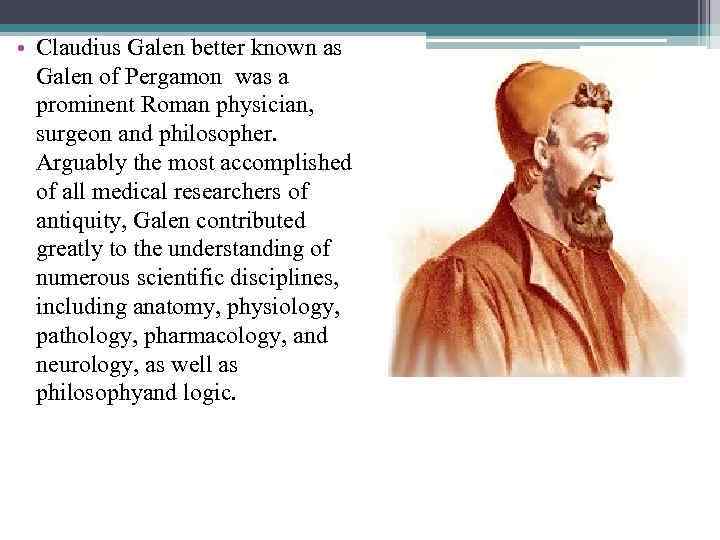 • Claudius Galen better known as Galen of Pergamon was a prominent Roman physician, surgeon and philosopher. Arguably the most accomplished of all medical researchers of antiquity, Galen contributed greatly to the understanding of numerous scientific disciplines, including anatomy, physiology, pathology, pharmacology, and neurology, as well as philosophyand logic.
 • The son of Aelius Nicon, a wealthy architect with scholarly interests, Galen received a comprehensive education that prepared him for a successful career as a physician and philosopher. He traveled extensively, exposing himself to a wide variety of medical theories and discoveries before settling in Rome, where he served prominent members of Roman society and eventually was given the position of personal physician to several emperors.
 • Galen's understanding of anatomy and medicine was principally influenced by then-current theory of humorism, as advanced by many ancient Greek physicians such as Hippocrates. His theories dominated and influenced Western medical science for more than 1, 300 years. His anatomical reports, based mainly on dissection of monkeys, especially the Barbary Macaque, and pigs, remained uncontested until 1543, when printed descriptions and illustrations of human dissections were published in the seminal work De humani corporis fabrica by Andreas Vesalius where Galen's physiological theory was accommodated to these new observations.
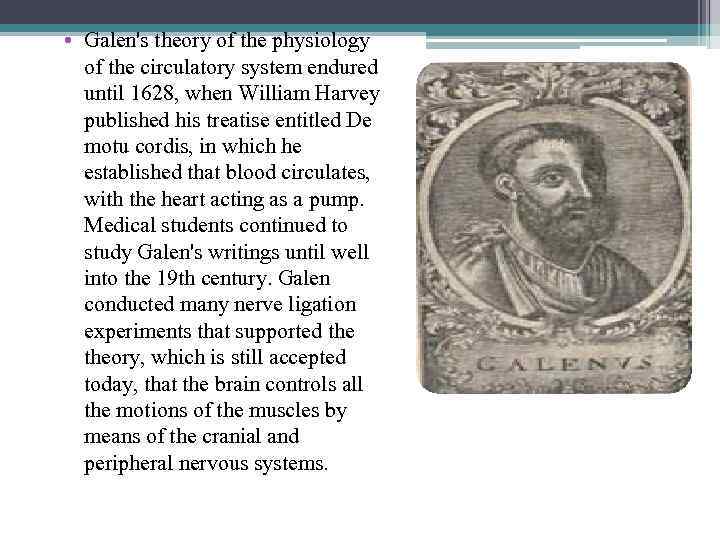 • Galen's theory of the physiology of the circulatory system endured until 1628, when William Harvey published his treatise entitled De motu cordis, in which he established that blood circulates, with the heart acting as a pump. Medical students continued to study Galen's writings until well into the 19 th century. Galen conducted many nerve ligation experiments that supported theory, which is still accepted today, that the brain controls all the motions of the muscles by means of the cranial and peripheral nervous systems.
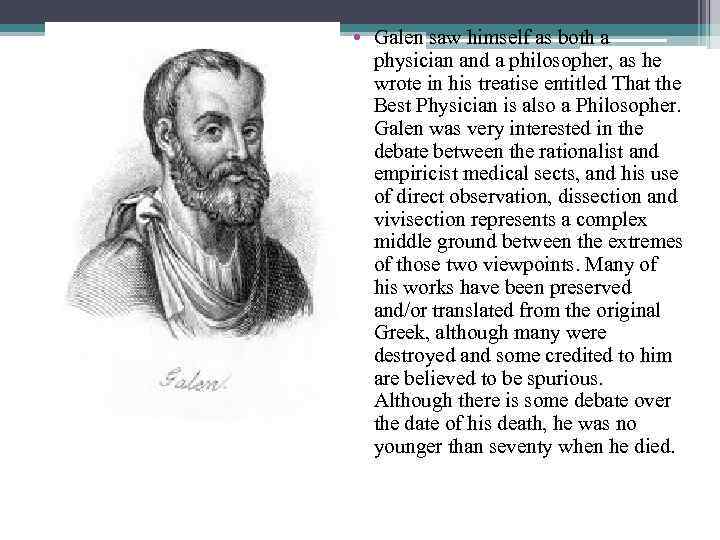 • Galen saw himself as both a physician and a philosopher, as he wrote in his treatise entitled That the Best Physician is also a Philosopher. Galen was very interested in the debate between the rationalist and empiricist medical sects, and his use of direct observation, dissection and vivisection represents a complex middle ground between the extremes of those two viewpoints. Many of his works have been preserved and/or translated from the original Greek, although many were destroyed and some credited to him are believed to be spurious. Although there is some debate over the date of his death, he was no younger than seventy when he died.
 THEORIES • Galen put forward theory that illness was caused by an imbalance of the four humours: blood, phlegm, black bile and yellow bile. He recommended specific diets to help in the "cleansing of the putrefied juices" and often purging and bloodletting would be used. This theory was accepted until challenged by Paracelsus who believed that illness was the result of the body being attacked by outside agents. • With the use of experiment Galen showed that the arteries carried blood and not air as was commonly believed. He also understood the value of the pulse in diagnosis. • However Galen also believed (incorrectly) that blood was continuously being made and used up. • As well as running a busy medical practice he ran his own pharmacy, stocked with his own medicines made from animal and vegetables extracts, many of the plants being grown in his own garden. Galen catalogued in great detail various remedies including how each was made and the correct doses to be given.
 • Early life: AD 129– 161 Galen's name Greek: Γαληνός, Galēnos comes from the adjective "γαληνός", "calm" • Galen describes his early life in On the affections of the mind. He was born in September 129 AD; his father, Aelius Nicon, was a wealthy patrician, an architect and builder, with eclectic interests including philosophy, mathematics, logic, astronomy, agriculture and literature. Galen describes his father as a "highly amiable, just, good and benevolent man". At that time Pergamonwas a major cultural and intellectual centre, noted for its library (Eumenes II), second only to that in Alexandria, and attracted both Stoic and Platonic philosophers, to whom Galen was exposed at age 14. His studies also took in each of the principal philosophical systems of the time, including Aristotelian and Epicurean.
 • His father had planned a traditional career for Galen in philosophy or politics and took care to expose him to literary and philosophical influences. However, Galen states that in around 145 AD his father had a dream in which the god Asclepius(Aesculapius) appeared and commanded Nicon to send his son to study medicine. Again, no expense was spared, and following his earlier liberal education, at 16 he began studies at the prestigious local sanctuary or Asclepieum dedicated to Asclepius, god of medicine, as a θεραπευτής (therapeutes, or attendant) for four years. There he came under the influence of men like. Aeschrion of Pergamon, Stratonicus and Satyrus. Asclepiea functioned as spas or sanitoria to which the sick would come to seek the ministrations of the priesthood. The temple at Pergamon was eagerly sought by Romans in search of a cure. It was also the haunt of notable people such as Claudius Charax the historian, Aelius Aristides the orator, Polemo the sophist, and Cuspius Rufinus the Consul.
 • In 148, when he was 19, his father died, leaving him independently wealthy. He then followed the advice he found in Hippocrates' teaching and travelled and studied widely including such destinations as Smyrna (now Izmir), Corinth, Crete, Cilicia (now Çukuro va), Cyprus, and finally the great medical school of Alexandria, exposing himself to the various schools of thought in medicine. In 157, aged 28, he returned to Pergamon as physician to the gladiators of the High Priest of Asia, one of the most influential and wealthiest men in Asia. Galen claims that the High Priest chose him over other physicians after he eviscerated an ape and challenged other physicians to repair the damage.
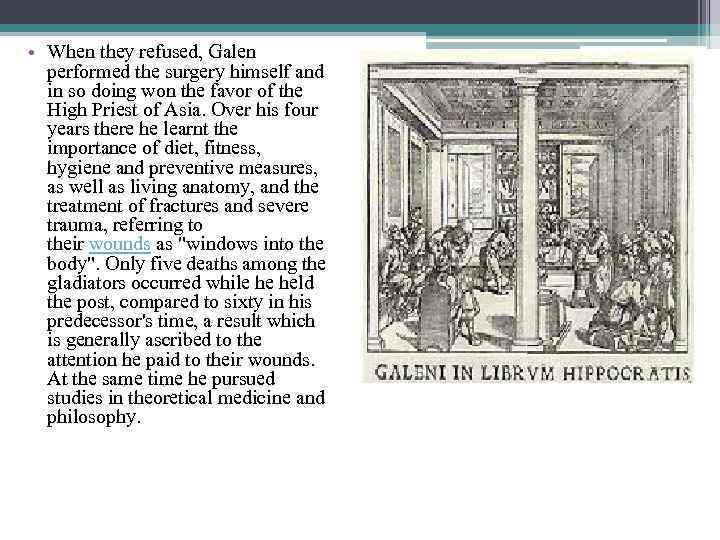 • When they refused, Galen performed the surgery himself and in so doing won the favor of the High Priest of Asia. Over his four years there he learnt the importance of diet, fitness, hygiene and preventive measures, as well as living anatomy, and the treatment of fractures and severe trauma, referring to their wounds as "windows into the body". Only five deaths among the gladiators occurred while he held the post, compared to sixty in his predecessor's time, a result which is generally ascribed to the attention he paid to their wounds. At the same time he pursued studies in theoretical medicine and philosophy.
 Contributions to medicine • Galen contributed a substantial amount to the Hippocratic understanding of pathology. Under Hippocrates’ bodily humors theory, differences in human moods come as a consequence of imbalances in one of the four bodily fluids: blood, yellow bile, black bile, and phlegm. Galen promoted this theory and the typology of human temperaments. An imbalance of each humor corresponded with a particular human temperament (blood—sanguine, black bile —melancholic, yellow bile—choleric, and phlegm—phlegmatic). Individuals with sanguine temperaments are extroverted and social. Choleric people have energy, passion and charisma. Melancholics are creative, kind and considerate. Phlegmatic temperaments are characterized by dependability, kindness, and affection.
 • Galen’s principal interest was in human anatomy, but Roman law had prohibited the dissection of human cadavers since about 150 BC. Because of this restriction, Galen performed anatomical dissections on living (vivisection) and dead animals, mostly focusing on pigs and primates. This work turned out to be particularly useful because in most cases, the anatomical structures of these animals closely mirror those of humans. Galen clarified the anatomy of the trachea and was the first to demonstrate that the larynx generates the voice. Galen may have understood the importance of artificial ventilation, because in one of his experiments he used bellows to inflate the lungs of a dead animal.
 • Among Galen’s major contributions to medicine was his work on the circulatory system. He was the first to recognize that there were distinct differences between venous (dark) and arterial (bright) blood. Although his many anatomical experiments on animal models led him to a more complete understanding of the circulatory system, nervous system, respiratory system and other structures, his work was not without scientific inaccuracies. Galen believed that the circulatory system consisted of two separate one-way systems of distribution, rather than a single unified system of circulation. His understanding was that venous blood was generated in the liver, from where it was distributed and consumed by all organs of the body. He posited that arterial blood originated in the heart, from where it was distributed and consumed by all organs of the body. The blood was then regenerated in either the liver or the heart, completing the cycle. Galen also believed in the existence of a group of blood vessels he called the rete mirabile, in the carotid sinus. Both of these theories of the circulation of blood were later shown to be incorrect.
 • In his work De motu musculorum, Galen explained the difference between motor and sensory nerves, discussed the concept of muscle tone and explained the difference between agonists andantagonists. • Galen was also a highly skilled surgeon, and he performed surgical operations on human patients. Many of the procedures and techniques that he utilized would not be used again for centuries. Of particular note are procedures that Galen performed on patients’ brains and eyes. In order to correct cataracts in patients, Galen performed an operation that was similar to what is performed by contemporary ophthalmologists. Using a needle-shaped instrument, Galen attempted to remove the cataract from behind the lens of the eye. His surgical experiments included using ligatures on the arteries of living animals. • At first reluctantly, but then with increasing vigour, Galen promoted Hippocratic teaching, including venesection and bloodletting, then unknown in Rome. This was sharply criticised by the. Erasistrateans, who predicted dire outcomes, believing that it was not blood but pneuma that flowed in the veins. Galen, however, staunchly defended venesection in his three books on the subject, and in his demonstrations and public disputations.
 References • ^ Page 21 Inside the human body: using scientific and exponential notation. Author: Greg Roza. Edition: Illustrated. Publisher: The Rosen Publishing Group, 2007. ISBN 1 -4042 -3362 -8, ISBN 978 -14042 -3362 -1. Length: 32 pages • ^ Cell Movements and the Shaping of the Vertebrate Body in Chapter 21 of Molecular Biology of the Cell fourth edition, edited by Bruce Alberts (2002) published by Garland Science. • The Alberts text discusses how the "cellular building blocks" move to shape developing embryos. It is also common to describe small molecules such as amino acids as "molecular building blocks“.