 Скачать презентацию South-East Europe Regional Consultation Meeting Bucharest Romania 6
6a472512d7e8ef729caa797ab2b90f9d.ppt
- Количество слайдов: 6



South-East Europe Regional Consultation Meeting Bucharest, Romania 6 – 7 October 2016 Session II: Opportunities and Challenges in RE Deployment in the Region Romania’s intervention (5 min)
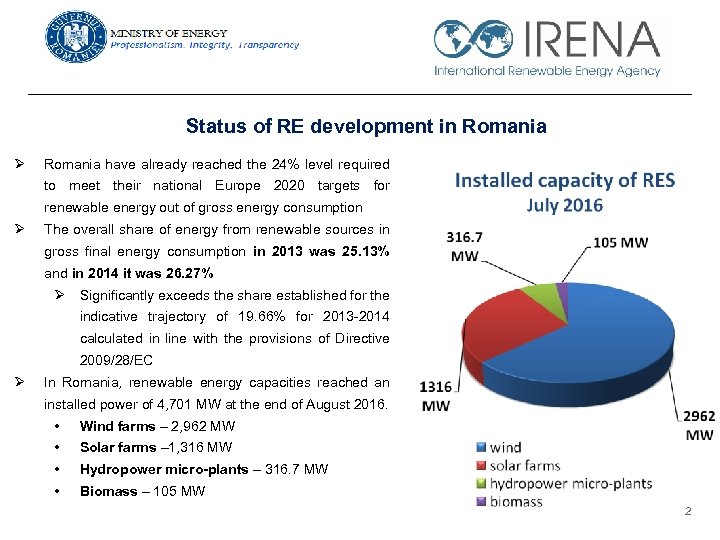
Status of RE development in Romania Ø Romania have already reached the 24% level required to meet their national Europe 2020 targets for renewable energy out of gross energy consumption Ø The overall share of energy from renewable sources in gross final energy consumption in 2013 was 25. 13% and in 2014 it was 26. 27% Ø Significantly exceeds the share established for the indicative trajectory of 19. 66% for 2013 -2014 calculated in line with the provisions of Directive 2009/28/EC Ø In Romania, renewable energy capacities reached an installed power of 4, 701 MW at the end of August 2016. • Wind farms – 2, 962 MW • Solar farms – 1, 316 MW • Hydropower micro-plants – 316. 7 MW • Biomass – 105 MW 2
Support scheme for renewables ØThe Romanian support system for renewable energy is based on green certificates and quota to renewable electricity producers and an obligation imposed on electricity suppliers to acquire a certain amount of green certificates Ø The Romanian Green Certificate Scheme has been operating since November 2011 Ø It awards green certificates (GC) to accredited plants using renewable energy sources (RES) for each MW of generation from RES for a period of up to 15 years from first generation under the scheme ØThe duration of the scheme remains unchanged – the scheme will expire on 31 December 2016 ØNREAP status (National Romanian Renewable Energy Action Plan ) was elaborated in 2010 New Energy Strategy for 2030, with an outlook to 2050 ØSince 2007, Romania has an official Energy Strategy with an outlook to 2020 ØIn 2014, the Department of Energy (now the Ministry of Energy) decided to update and revise the Energy Strategy in light of the changed dynamics of the global, EU and regional energy markets ØIn November 2015, the new Government resumed the revision process started in 2014 and, building on that work, the Ministry of Energy has set the objective of elaborating a new strategic document until the end of this year: the Romanian Energy Strategy – 2016 -2030, with an outlook to 2050 3
Proposed Actions ØFinalize the intensive debate with all the actors involved on the RES market – to identify better solutions for the producers and also for the consumers ØStudy of impact under finalization ØElaborate a new project regarding the completion and amendments to the RES Law ØSustaining the promotion of the biomass, taking into consideration that this one represents 50% of whole renewable sources potential in Romania ØSustaining geothermal resources, taking into account that these kind of resources are less utilized in the present 4
Identified opportunities from the uptake of renewables ØContribution to international commitments on reduction of CO 2 ØBetter and more local control of generation capacity, with potential to control direct flow of electricity to consumers, reducing system inefficiencies associated with large power generation capacity ØCreation of new jobs ØCreation of direct engineering capability, and indirectly growing local manufacturing and technical service economies ØContribution to more energy efficiency ØEnhancing energy security together with traditional resources like coal, gas, which may be imported from areas of high risk ØImproving state budget deficit, by decreasing imports of traditional energy resources and taxes paid by the investors 5
Ruxandra Raluca Florescu Counsellor, Ministry of Energy Contact: E-mail: raluca. florescu@energie. gov. ro Tel: +4021 4079947 Address: Splaiul Independentei, 202 E, Bucharest, Romania www. energie. gov. ro 6
Скачать презентацию South-East Europe Regional Consultation Meeting Bucharest Romania 6
6a472512d7e8ef729caa797ab2b90f9d.ppt