 Скачать презентацию South African Republic Prepared by Tamabaeva Zh Checked
SAR.ppt.pptx
- Количество слайдов: 11



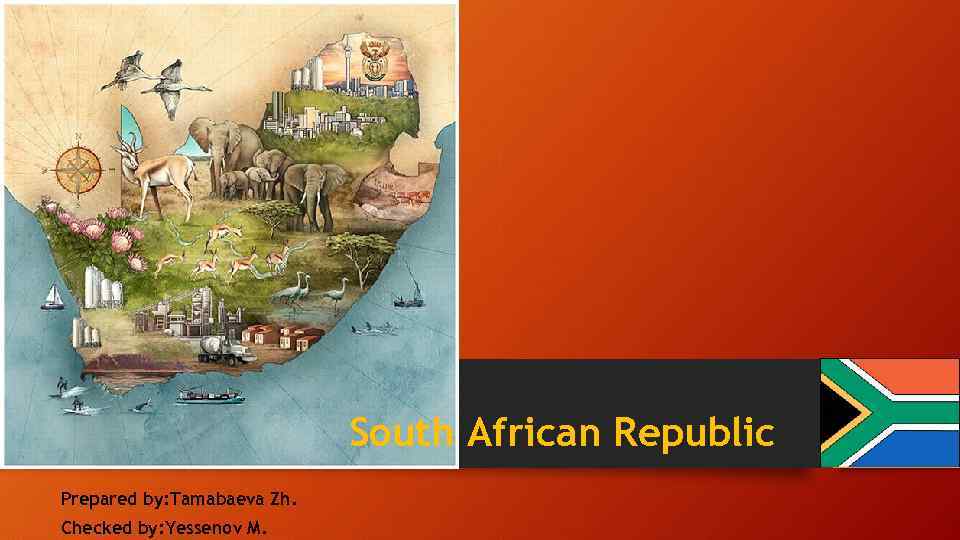
South African Republic Prepared by: Tamabaeva Zh. Checked by: Yessenov M.
FAST FACTS • OFFICIAL NAME: Republic of South Africa FORM OF GOVERNMENT: Republic CAPITALS: Pretoria (administrative), Cape Town (legislative), Bloemfontein (judicial) POPULATION: 55 milllion OFFICIAL LANGUAGES: Afrikans, English, Isi. Ndebele, Isi. Xhosa, Isi. Zulu, Northern Sotho, Sesotho, Setswana, Si. Swati, Tshivenda, Xitsonga MONEY: Rand AREA: 470, 693 square miles (1, 219, 089 square kilometers) MAJOR MOUNTAIN RANGES: Drakensberg MAJOR RIVERS: Limpopo, Orange
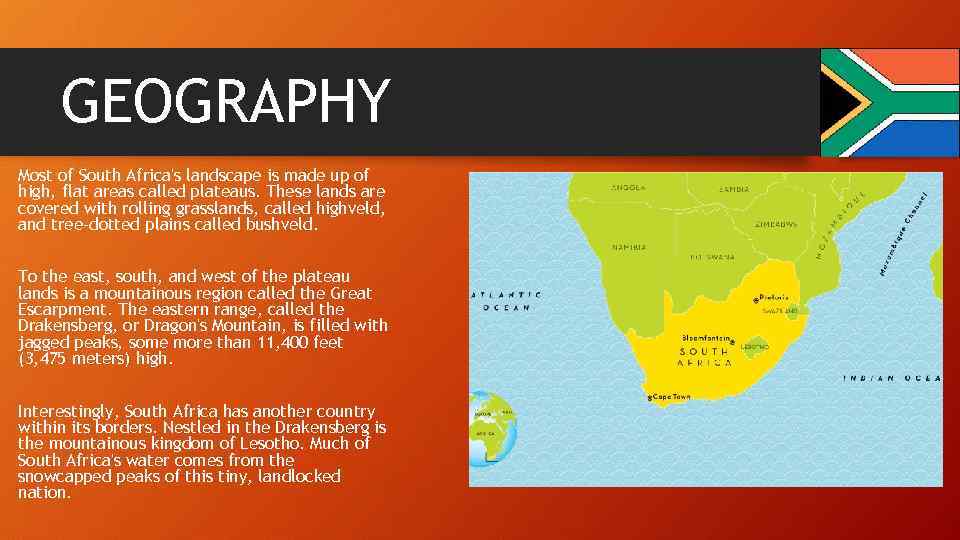
GEOGRAPHY Most of South Africa's landscape is made up of high, flat areas called plateaus. These lands are covered with rolling grasslands, called highveld, and tree-dotted plains called bushveld. To the east, south, and west of the plateau lands is a mountainous region called the Great Escarpment. The eastern range, called the Drakensberg, or Dragon's Mountain, is filled with jagged peaks, some more than 11, 400 feet (3, 475 meters) high. Interestingly, South Africa has another country within its borders. Nestled in the Drakensberg is the mountainous kingdom of Lesotho. Much of South Africa's water comes from the snowcapped peaks of this tiny, landlocked nation.
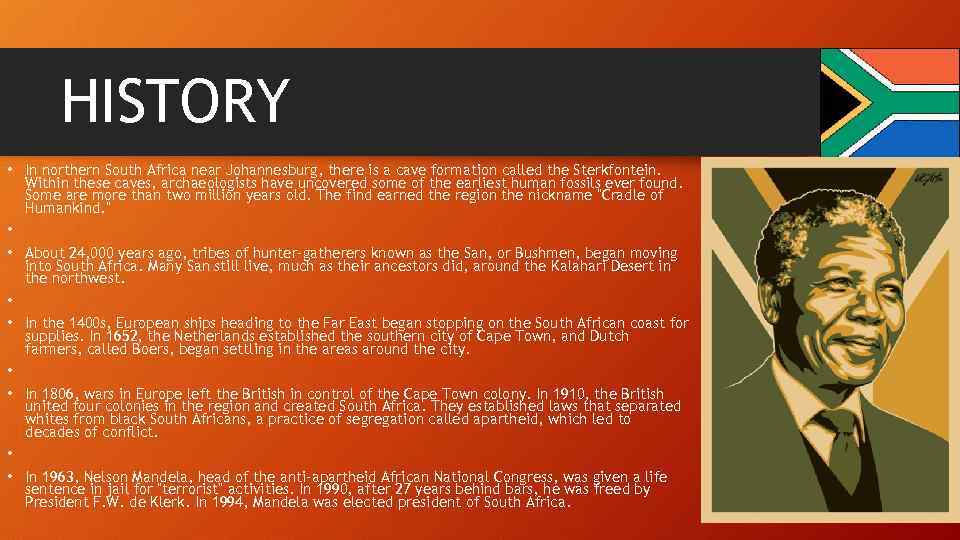
HISTORY • In northern South Africa near Johannesburg, there is a cave formation called the Sterkfontein. Within these caves, archaeologists have uncovered some of the earliest human fossils ever found. Some are more than two million years old. The find earned the region the nickname "Cradle of Humankind. " • • About 24, 000 years ago, tribes of hunter-gatherers known as the San, or Bushmen, began moving into South Africa. Many San still live, much as their ancestors did, around the Kalahari Desert in the northwest. • • In the 1400 s, European ships heading to the Far East began stopping on the South African coast for supplies. In 1652, the Netherlands established the southern city of Cape Town, and Dutch farmers, called Boers, began settling in the areas around the city. • • In 1806, wars in Europe left the British in control of the Cape Town colony. In 1910, the British united four colonies in the region and created South Africa. They established laws that separated whites from black South Africans, a practice of segregation called apartheid, which led to decades of conflict. • • In 1963, Nelson Mandela, head of the anti-apartheid African National Congress, was given a life sentence in jail for "terrorist" activities. In 1990, after 27 years behind bars, he was freed by President F. W. de Klerk. In 1994, Mandela was elected president of South Africa.
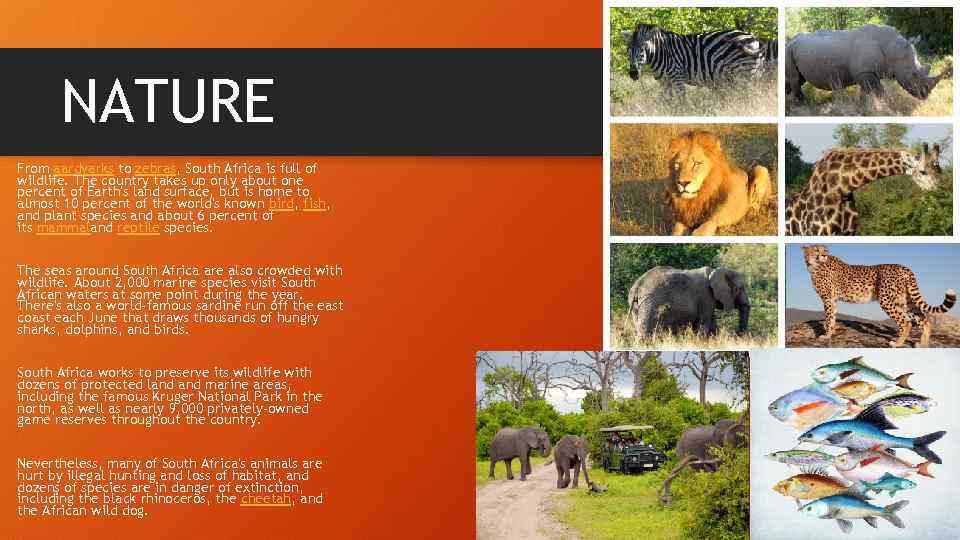
NATURE From aardvarks to zebras, South Africa is full of wildlife. The country takes up only about one percent of Earth's land surface, but is home to almost 10 percent of the world's known bird, fish, and plant species and about 6 percent of its mammaland reptile species. The seas around South Africa are also crowded with wildlife. About 2, 000 marine species visit South African waters at some point during the year. There's also a world-famous sardine run off the east coast each June that draws thousands of hungry sharks, dolphins, and birds. South Africa works to preserve its wildlife with dozens of protected land marine areas, including the famous Kruger National Park in the north, as well as nearly 9, 000 privately-owned game reserves throughout the country. Nevertheless, many of South Africa's animals are hurt by illegal hunting and loss of habitat, and dozens of species are in danger of extinction, including the black rhinoceros, the cheetah, and the African wild dog.
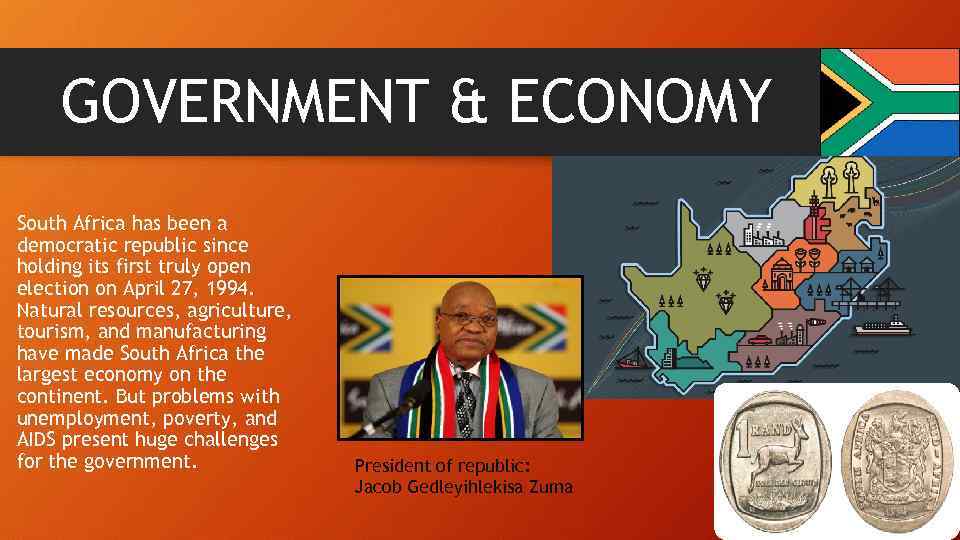
GOVERNMENT & ECONOMY South Africa has been a democratic republic since holding its first truly open election on April 27, 1994. Natural resources, agriculture, tourism, and manufacturing have made South Africa the largest economy on the continent. But problems with unemployment, poverty, and AIDS present huge challenges for the government. President of republic: Jacob Gedleyihlekisa Zuma
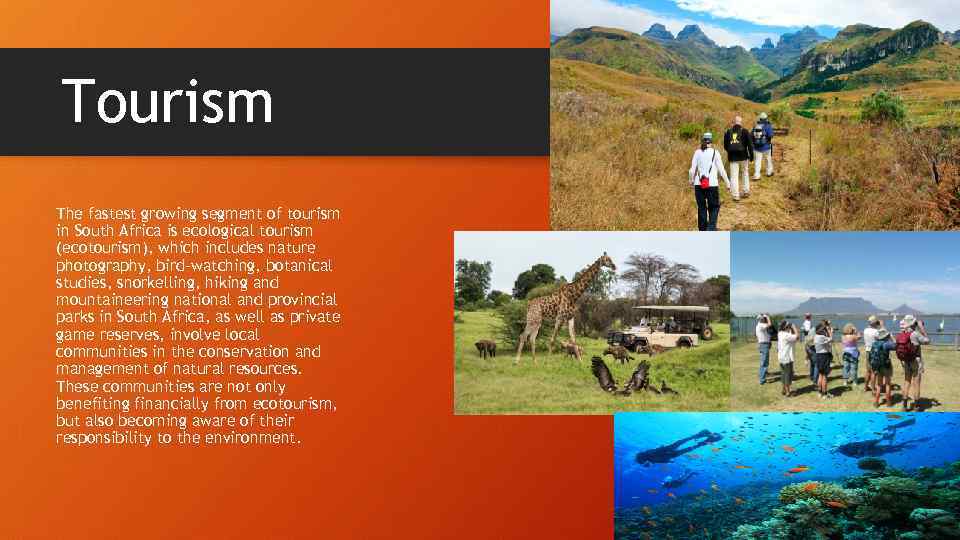
Tourism The fastest growing segment of tourism in South Africa is ecological tourism (ecotourism), which includes nature photography, bird-watching, botanical studies, snorkelling, hiking and mountaineering national and provincial parks in South Africa, as well as private game reserves, involve local communities in the conservation and management of natural resources. These communities are not only benefiting financially from ecotourism, but also becoming aware of their responsibility to the environment.
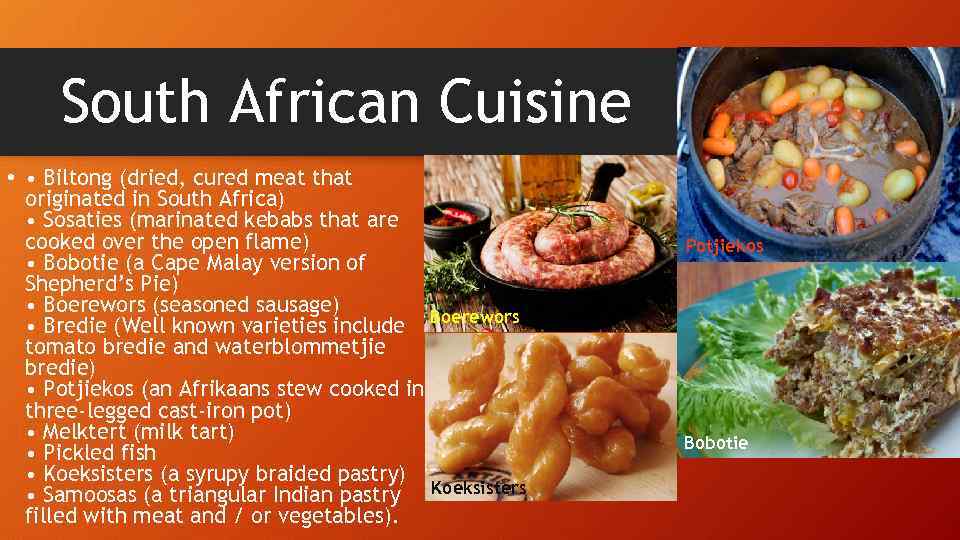
South African Cuisine • • Biltong (dried, cured meat that originated in South Africa) • Sosaties (marinated kebabs that are cooked over the open flame) • Bobotie (a Cape Malay version of Shepherd’s Pie) • Boerewors (seasoned sausage) • Bredie (Well known varieties include Boerewors tomato bredie and waterblommetjie bredie) • Potjiekos (an Afrikaans stew cooked in a three-legged cast-iron pot) • Melktert (milk tart) • Pickled fish • Koeksisters (a syrupy braided pastry) • Samoosas (a triangular Indian pastry Koeksisters filled with meat and / or vegetables). Potjiekos Bobotie
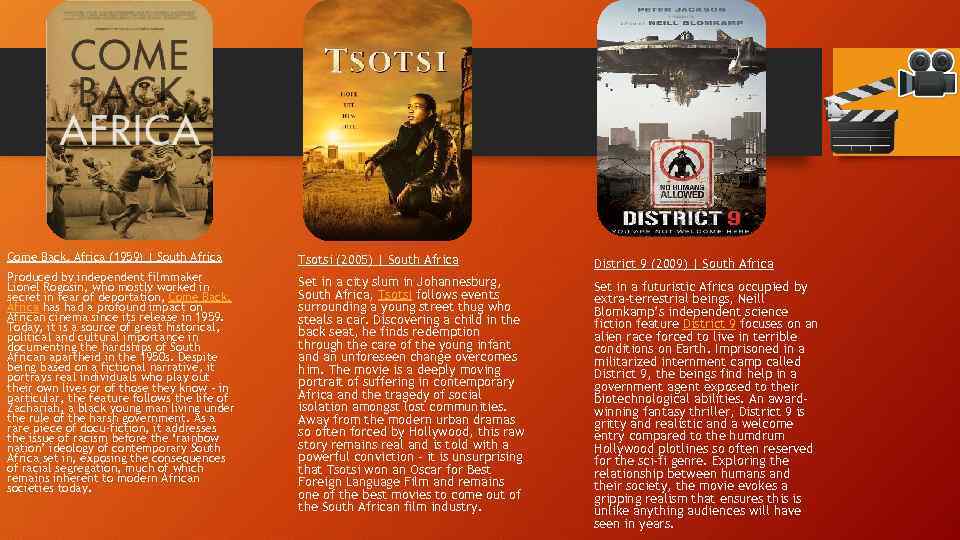
Come Back, Africa (1959) | South Africa Tsotsi (2005) | South Africa Produced by independent filmmaker Lionel Rogosin, who mostly worked in secret in fear of deportation, Come Back, Africa has had a profound impact on African cinema since its release in 1959. Today, it is a source of great historical, political and cultural importance in documenting the hardships of South African apartheid in the 1950 s. Despite being based on a fictional narrative, it portrays real individuals who play out their own lives or of those they know – in particular, the feature follows the life of Zachariah, a black young man living under the rule of the harsh government. As a rare piece of docu-fiction, it addresses the issue of racism before the ‘rainbow nation’ ideology of contemporary South Africa set in, exposing the consequences of racial segregation, much of which remains inherent to modern African societies today. District 9 (2009) | South Africa Set in a city slum in Johannesburg, South Africa, Tsotsi follows events surrounding a young street thug who steals a car. Discovering a child in the back seat, he finds redemption through the care of the young infant and an unforeseen change overcomes him. The movie is a deeply moving portrait of suffering in contemporary Africa and the tragedy of social isolation amongst lost communities. Away from the modern urban dramas so often forced by Hollywood, this raw story remains real and is told with a powerful conviction – it is unsurprising that Tsotsi won an Oscar for Best Foreign Language Film and remains one of the best movies to come out of the South African film industry. Set in a futuristic Africa occupied by extra-terrestrial beings, Neill Blomkamp’s independent science fiction feature District 9 focuses on an alien race forced to live in terrible conditions on Earth. Imprisoned in a militarized internment camp called District 9, the beings find help in a government agent exposed to their biotechnological abilities. An awardwinning fantasy thriller, District 9 is gritty and realistic and a welcome entry compared to the humdrum Hollywood plotlines so often reserved for the sci-fi genre. Exploring the relationship between humans and their society, the movie evokes a gripping realism that ensures this is unlike anything audiences will have seen in years.
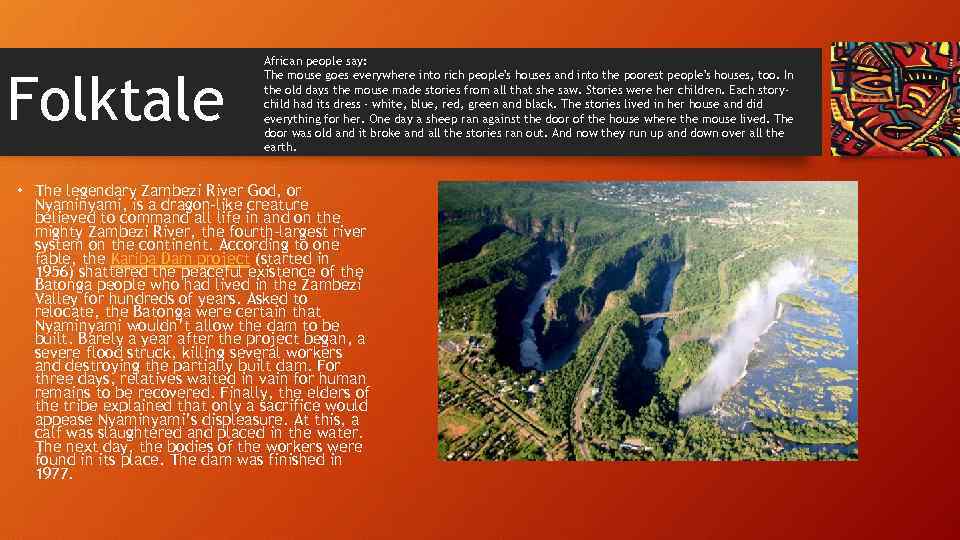
Folktale African people say: The mouse goes everywhere into rich people's houses and into the poorest people's houses, too. In the old days the mouse made stories from all that she saw. Stories were her children. Each storychild had its dress - white, blue, red, green and black. The stories lived in her house and did everything for her. One day a sheep ran against the door of the house where the mouse lived. The door was old and it broke and all the stories ran out. And now they run up and down over all the earth. • The legendary Zambezi River God, or Nyaminyami, is a dragon-like creature believed to command all life in and on the mighty Zambezi River, the fourth-largest river system on the continent. According to one fable, the Kariba Dam project (started in 1956) shattered the peaceful existence of the Batonga people who had lived in the Zambezi Valley for hundreds of years. Asked to relocate, the Batonga were certain that Nyaminyami wouldn’t allow the dam to be built. Barely a year after the project began, a severe flood struck, killing several workers and destroying the partially built dam. For three days, relatives waited in vain for human remains to be recovered. Finally, the elders of the tribe explained that only a sacrifice would appease Nyaminyami’s displeasure. At this, a calf was slaughtered and placed in the water. The next day, the bodies of the workers were found in its place. The dam was finished in 1977.
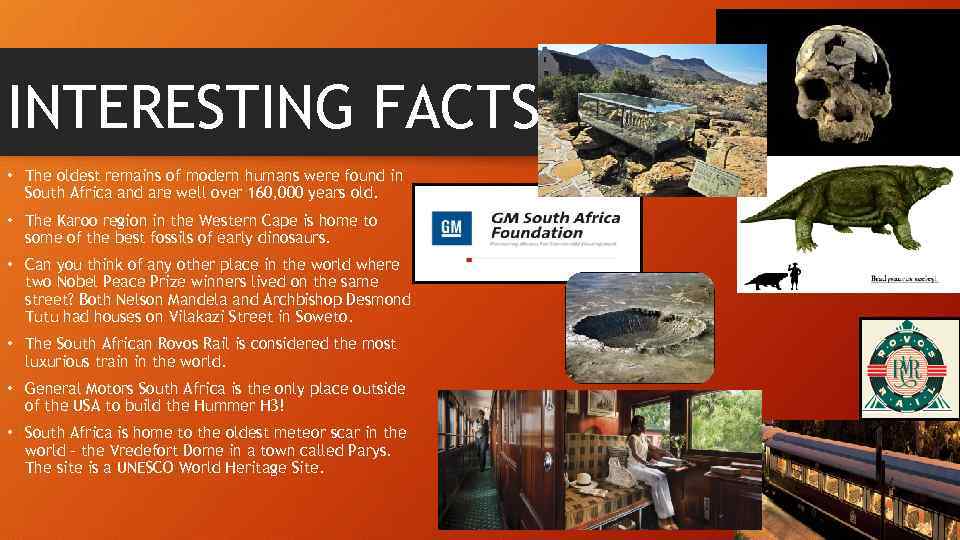
INTERESTING FACTS • The oldest remains of modern humans were found in South Africa and are well over 160, 000 years old. • The Karoo region in the Western Cape is home to some of the best fossils of early dinosaurs. • Can you think of any other place in the world where two Nobel Peace Prize winners lived on the same street? Both Nelson Mandela and Archbishop Desmond Tutu had houses on Vilakazi Street in Soweto. • The South African Rovos Rail is considered the most luxurious train in the world. • General Motors South Africa is the only place outside of the USA to build the Hummer H 3! • South Africa is home to the oldest meteor scar in the world – the Vredefort Dome in a town called Parys. The site is a UNESCO World Heritage Site.
Скачать презентацию South African Republic Prepared by Tamabaeva Zh Checked
SAR.ppt.pptx