Скачать презентацию South Africa s situation relating to climate change and
003260e59ce41ba816d127053b654e6d.ppt
- Количество слайдов: 16
 South Africa’s situation relating to climate change and energy Harald Winkler Presentation to Parliamentary Portfolio Committees Minerals & Energy, Environment & Tourism, Trade & Industry 28 August 2001 Energy & Development Research Centre University of Cape Town
 Overview l What is SA’s situation? - strengths and weaknesses u Sources of emissions u SA’s high emissions intensity compared to other countries l Opportunities and threats from climate change u Opportunities for mitigation and adaptation u How much do these cost? u Impacts on coal exports u How to influence national emissions u Investment opportunities for sustainable energy l Summary: Priorities for SA climate change strategy
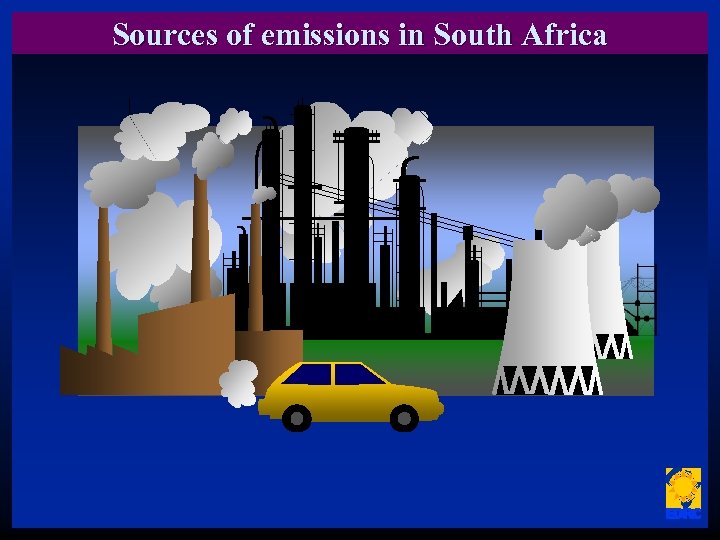 Sources of emissions in South Africa
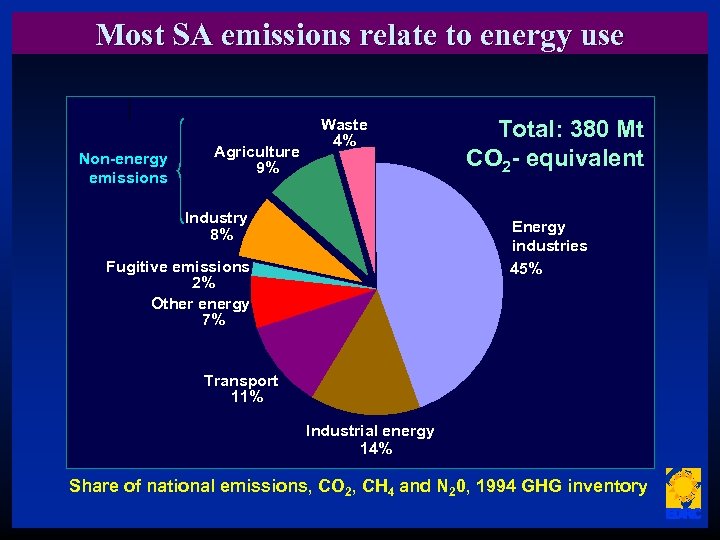 Most SA emissions relate to energy use Non-energy emissions Agriculture 9% Waste 4% Industry 8% Total: 380 Mt CO 2 - equivalent Energy industries 45% Fugitive emissions 2% Other energy 7% Transport 11% Industrial energy 14% Share of national emissions, CO 2, CH 4 and N 20, 1994 GHG inventory
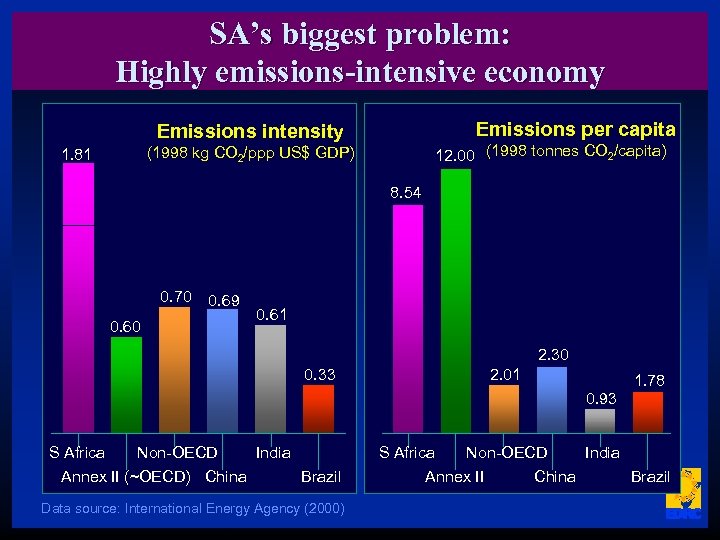 SA’s biggest problem: Highly emissions-intensive economy Emissions per capita Emissions intensity 12. 00 (1998 tonnes CO 2/capita) (1998 kg CO 2/ppp US$ GDP) 1. 81 8. 54 0. 70 0. 69 0. 61 2. 30 0. 33 2. 01 1. 78 0. 93 S Africa Non-OECD India Annex II (~OECD) China Brazil Data source: International Energy Agency (2000) S Africa Non-OECD India Annex II China Brazil
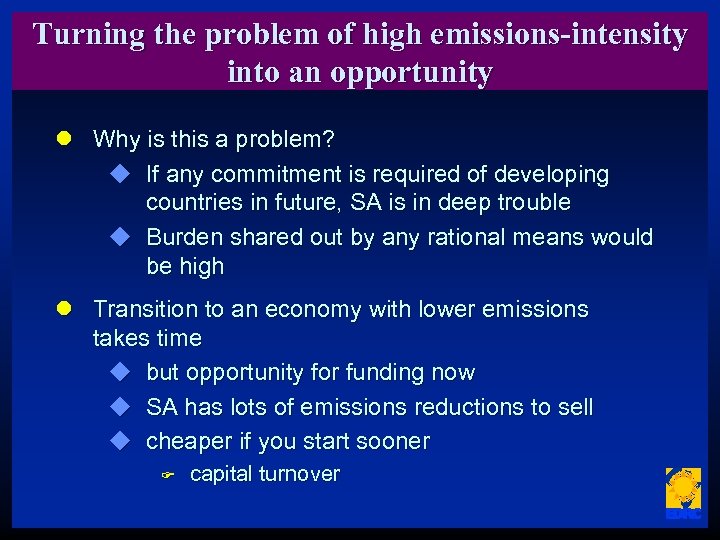 Turning the problem of high emissions-intensity into an opportunity l Why is this a problem? u If any commitment is required of developing countries in future, SA is in deep trouble u Burden shared out by any rational means would be high l Transition to an economy with lower emissions takes time u but opportunity for funding now u SA has lots of emissions reductions to sell u cheaper if you start sooner F capital turnover
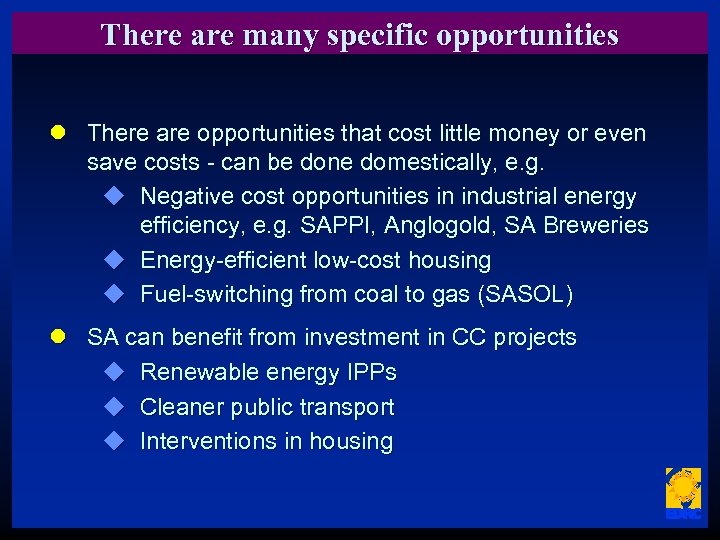 There are many specific opportunities l There are opportunities that cost little money or even save costs - can be done domestically, e. g. u Negative cost opportunities in industrial energy efficiency, e. g. SAPPI, Anglogold, SA Breweries u Energy-efficient low-cost housing u Fuel-switching from coal to gas (SASOL) l SA can benefit from investment in CC projects u Renewable energy IPPs u Cleaner public transport u Interventions in housing
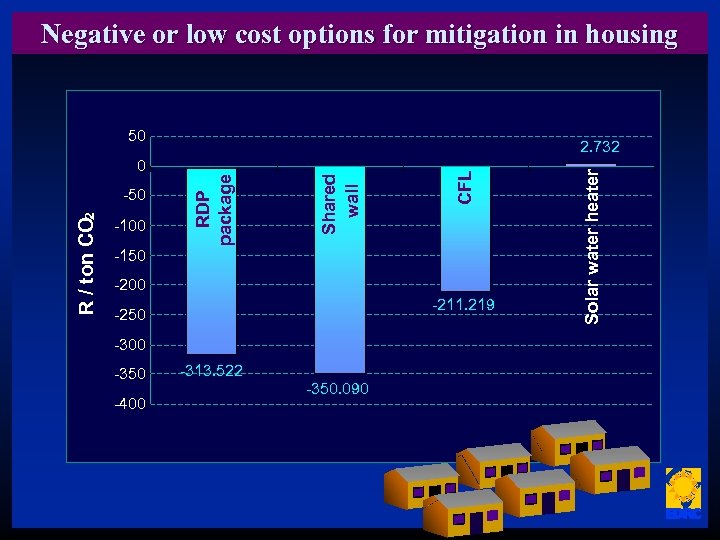 Negative or low cost options for mitigation in housing 50 CFL -150 -200 -211. 219 -250 -300 -350 -400 -313. 522 -350. 090 Solar water heater -100 Shared wall R / ton CO 2 -50 RDP package 0 2. 732
 Threats l SA might face a future commitment to reduce emissions u but acting now will make this easier to achieve in future l If industrialised countries limit their emissions and buy less coal. . . l … SA coal exports might decrease (DME study) l BUT on the other hand, SA may attract more energyintensive industries, as these become less competitive in industrialised countries
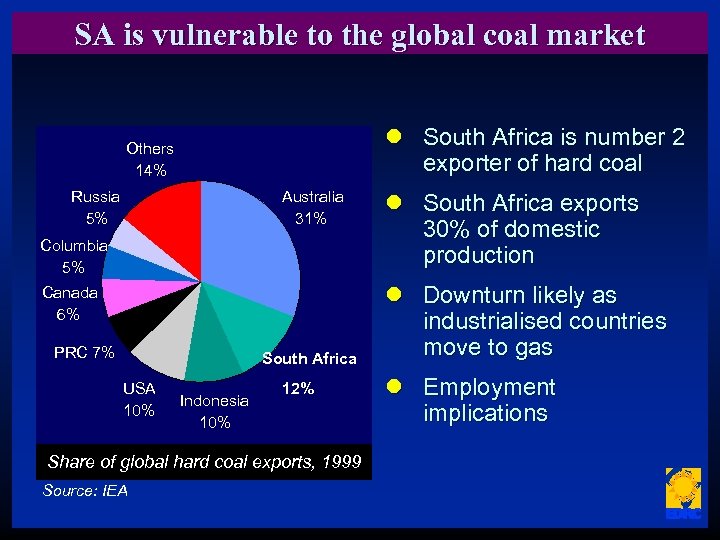 SA is vulnerable to the global coal market l South Africa is number 2 exporter of hard coal Others 14% Russia 5% Australia 31% Columbia 5% Canada 6% PRC 7% South Africa USA 10% Indonesia 10% 12% Share of global hard coal exports, 1999 Source: IEA l South Africa exports 30% of domestic production l Downturn likely as industrialised countries move to gas l Employment implications
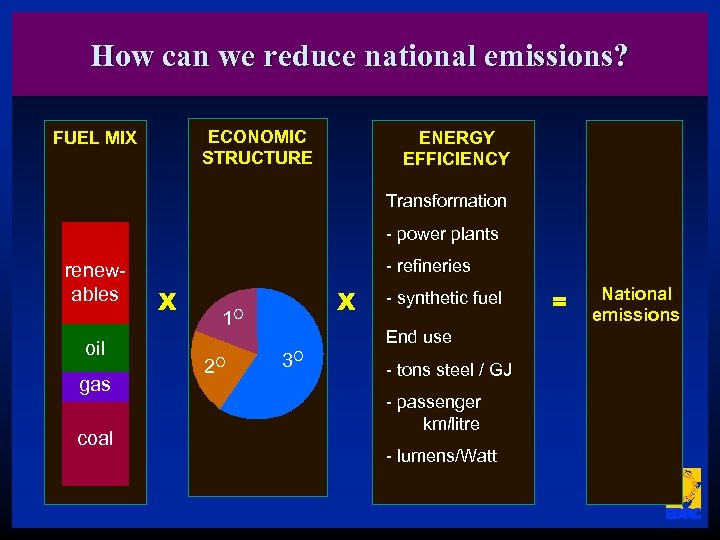 How can we reduce national emissions? ECONOMIC STRUCTURE FUEL MIX ENERGY EFFICIENCY Transformation - power plants renewables oil gas coal - refineries X X 1 O 2 O - synthetic fuel End use 3 O - tons steel / GJ - passenger kmllitre - lumens/Watt = National emissions
 Sustainable development and climate change l Climate change impacts can threaten development u damages such as crop losses, sea-level rise, health costs, floods l Sustainable development path could u promote equity, alleviate poverty u continue to extend access to affordable energy u make country more resilient u reduce emissions l How to make this happen u primarily through national policy u CC funding mechanisms can support implementation of policy
 Climate change funding mechanisms l Global Environmental Facility (GEF) u general environmental funds u specific CC programme l New funds committed in Bonn (ca. $500 million) u for adaptation u and capacity-building l Clean Development Mechanism u allows industrialised countries to invest in developing countries u buy carbon credits u explicit objective: SD in developing countries
 CDM and sustainable development l Sustainable development criteria u choose SD indicators that reflect national policy objectives - to be defined by government l Government needs to create enabling environment u Project pipeline u Project development forum u CDM office l Promote CDM projects that have high SD impact, e. g. u energy-efficiency in low-cost housing u better public transport u typically smaller projects -- need to be bundled
 SA climate change strategy l SA in difficult position, cannot afford to wait until pressured into a commitment u need to be proactive on climate change l SA needs a strategy that u promotes national development priorities u proactively engages the climate debate, beyond ‘no regrets’ u considers long-term implications of immediate choices u protects both South Africa’s interests and the global environment u links sustainable development and climate change issues for SA’s benefit