


 Скачать презентацию South Africa s Intergovernmental Fiscal system 22 June 2007
223b2dba18e99a228e941f45a3a86829.ppt
- Количество слайдов: 37
 South Africa’s Intergovernmental Fiscal system 22 June 2007
 South Africa: Are these really perceptions? ? ? • Federal/Central View: Giving money and power to sub-national governments is like giving whiskey and car keys to teenagers. • Provincial and Local View: We need more grant monies to demonstrate that “money does not buy anything”. • Citizens: The magical art of passing money from one government to another and seeing it vanish in thin air. 2
 The Legal Framework (1) • The Constitution, 1996 – Establishes three spheres • National, 9 provinces and 283 municipalities & assigns functions (Schedules 4 &5) – some functions are concurrent, others are exclusive – Although spheres are distinctive Constitution prescribes • cooperative governance S(40 & 41) • sharing of revenue raised nationally – There is provision for different forms of intervention • Sections (100 for provinces & 139 for Local Gov) 3
 The Legal Framework (2) • Intergovernmental Fiscal relations Act, 1997 – Establishes Budget Council • Comprising Min of Fin and 9 MECs for Finance – Also establishes Budget Forum • Which is the BC extended to include organised LG – The two are used for consultation on • financial & fiscal matters • legislation &/or policy with financial implications • matters pertaining to financial mgt & monitoring 4
 The Legal Framework (3) • The Financial & Fiscal Commission Act, 1997 – sets out functions of the FFC, which include • acting as a consultative body for, and making recommendations and giving advice to, organs of state on financial & fiscal matters • Also assess fiscal impact of changes in powers and functions • The Public Finance Management Act, 1999 – Financial management – Procedures relating to budgeting, budget formats & financial management & reporting • The Municipal Finance Management Act, 2003 – Sets the legal framework for financial management, budgeting, expenditure management, procurement, reporting, roles of administrators led by accounting officer vs roles of political office bearers led by mayor 5
 The Legal Framework (4) • The DOR Act – Required by the Constitution – Divides nationally raised revenues • Municipal Structures Act – Provides for categorisation of municipalities – Broad framework for the assignment of powers and functions • Municipal Systems Act – Framework for core processes of planning …. • Intergovernmental Relations Framework Act – Regulates intergovernmental institutions • Municipal Property Rates Act 6
 Key institutions • Legislatures - national & provincial, Councils • Cabinet & Excos • Ministers’ Committee on the Budget • Budget Council/Budget Forum • Technical Committees – national & provincial – intergovernmental 7
 Financial & fiscal matters • Features of SA system – fiscal imbalance & inequity (historical) • Revenue raising power rest with national gov. • Provinces raise only 4% of total revenue • Local Government about 92% – bulk of public services delivery by provinces • education, health, welfare & housing – but there are moves to expand fiscal capacity of provinces • Provincial Tax Regulations Process Act 8
 Division of nationally raised revenue 9
 The Provincial Equitable Share Formula
 Background • Joint effort between Treasury & FFC • Has explicit components for social services which make the bulk of provincial expenditure • Reviewed annually by Budget Council, and based on FFC’s recommendations • Formula is redistributive 11
 Structure and weights of the provincial formula 12
 Data used in the Formula 13
 Conditional grants 14
 Conditional grants 15
 Provinces and the MTEF • Get baseline allocations – 3 year allocations • equitable share • conditional grants • Revisions to baselines made annually – informed by policy changes • health, education, social development, housing etc – changes in macroeconomic environment – wage agreements/personnel bargaining chamber • Allocation letters – three years – adjustments to budgets during the year 16
 Provinces and the MTEF • Provinces submit their budgets to NT – credibility checks done – try and influence provinces where there are risks • Budgets tabled within 2 weeks after tabling of national budget – legislatures – table strategic plans as well • one year operational plan – hearings which lead to approval of budget • first year voted for 17
 Provinces and the MTEF • Implementation of budget – budget loaded onto system before expenditure commences • Reporting – monitoring during the year • prov. depart. report to provincial treasury monthly • provincial treasuries report to national treasury • State of provincial finances reported on quarterly – financial statements compiled within 2 months after the end of financial year – annual reports within 5 months after the end of financial year 18
 Overview of LG in SA • There are 3 categories of municipalities – Category A - Big cities/metropolitan areas – Category B - Local municipalities – Category C – Combinations of Bs • Powers and functions 19
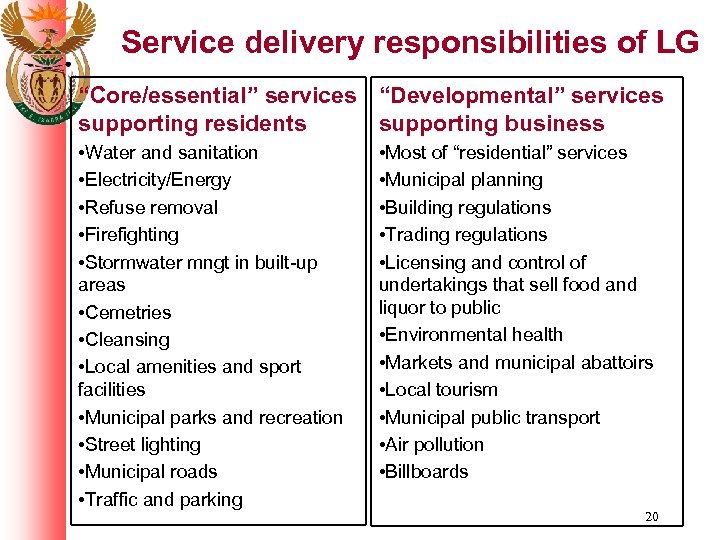 Service delivery responsibilities of LG “Core/essential” services “Developmental” services supporting residents supporting business • Water and sanitation • Electricity/Energy • Refuse removal • Firefighting • Stormwater mngt in built-up areas • Cemetries • Cleansing • Local amenities and sport facilities • Municipal parks and recreation • Street lighting • Municipal roads • Traffic and parking • Most of “residential” services • Municipal planning • Building regulations • Trading regulations • Licensing and control of undertakings that sell food and liquor to public • Environmental health • Markets and municipal abattoirs • Local tourism • Municipal public transport • Air pollution • Billboards 20
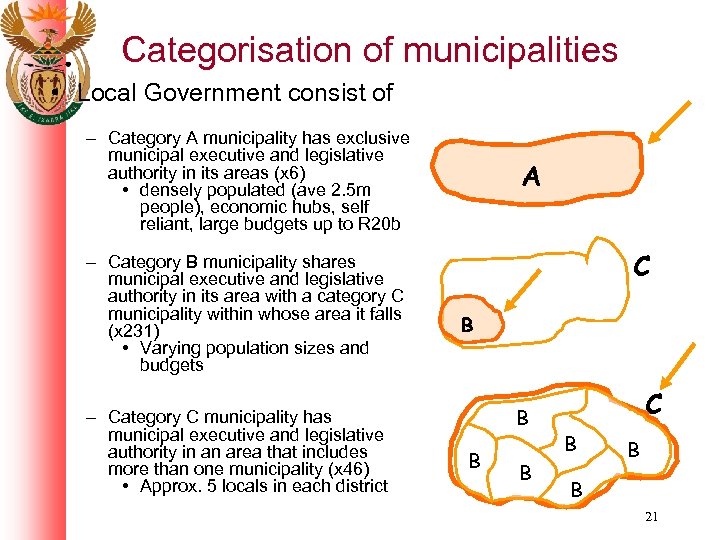 Categorisation of municipalities • Local Government consist of – Category A municipality has exclusive municipal executive and legislative authority in its areas (x 6) • densely populated (ave 2. 5 m people), economic hubs, self reliant, large budgets up to R 20 b – Category B municipality shares municipal executive and legislative authority in its area with a category C municipality within whose area it falls (x 231) • Varying population sizes and budgets – Category C municipality has municipal executive and legislative authority in an area that includes more than one municipality (x 46) • Approx. 5 locals in each district A C B B B 21
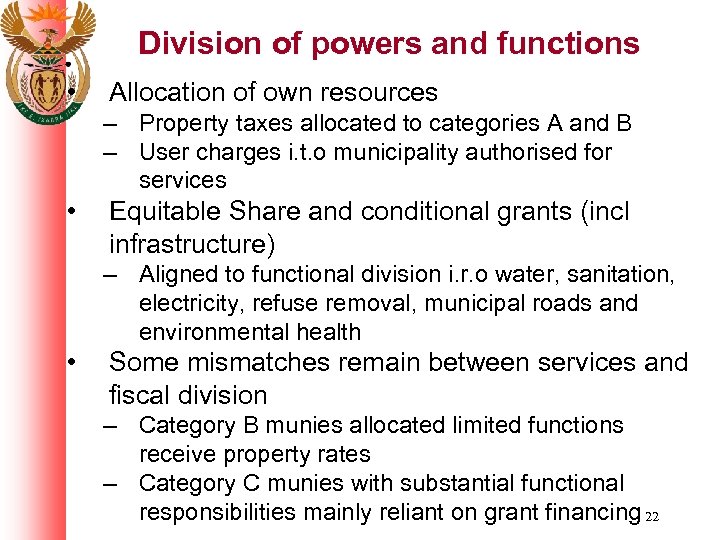 Division of powers and functions • Allocation of own resources – Property taxes allocated to categories A and B – User charges i. t. o municipality authorised for services • Equitable Share and conditional grants (incl infrastructure) – Aligned to functional division i. r. o water, sanitation, electricity, refuse removal, municipal roads and environmental health • Some mismatches remain between services and fiscal division – Category B munies allocated limited functions receive property rates – Category C munies with substantial functional responsibilities mainly reliant on grant financing 22
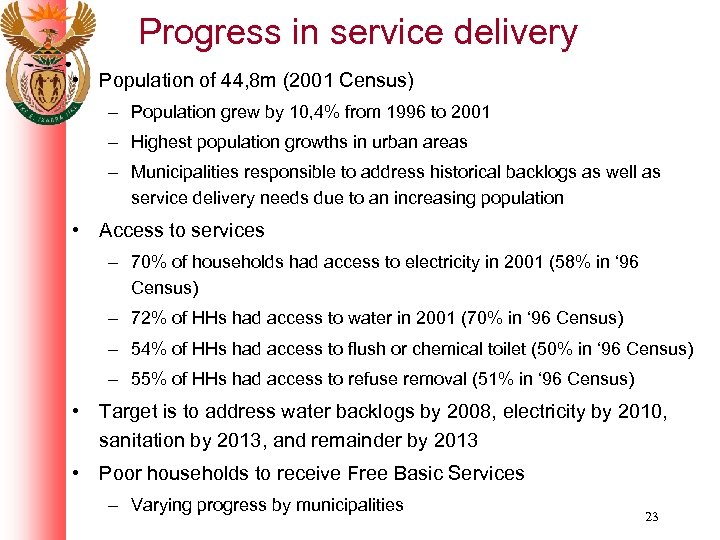 Progress in service delivery • Population of 44, 8 m (2001 Census) – Population grew by 10, 4% from 1996 to 2001 – Highest population growths in urban areas – Municipalities responsible to address historical backlogs as well as service delivery needs due to an increasing population • Access to services – 70% of households had access to electricity in 2001 (58% in ‘ 96 Census) – 72% of HHs had access to water in 2001 (70% in ‘ 96 Census) – 54% of HHs had access to flush or chemical toilet (50% in ‘ 96 Census) – 55% of HHs had access to refuse removal (51% in ‘ 96 Census) • Target is to address water backlogs by 2008, electricity by 2010, sanitation by 2013, and remainder by 2013 • Poor households to receive Free Basic Services – Varying progress by municipalities 23
 Evolvement of LG fiscal system • Various reforms to LG fiscal system – Reforms to both equitable share and infrastructure grants – Substantial increases made to transfers in acknowledgement of local government’s large service delivery responsibilities – Reforms to own resources • The aggregate size of municipal budgets have doubled over the past five years, from R 64 b in 01/02 to R 132 b in 06/07 • Large variances in budgets of the 283 municipalities – Metro • Size of metro budgets range between R 3 b and R 18 b • Average of 2, 4 million people per metro (715 367 HHs) • A third of population resides in metros (which increases to half the population if Top 21 municipalities are included) • Limited reliance on transfers – Local municipalities • Budgets range from very small (below R 10 m) to substantial (R 2 b) • Populations also vary substantially from just below 2 000 households per municipality to 200 000 households per municipality • Reliance on transfers vary – District municipalities • Budgets range between just below R 10 m to approx. R 400 m • Reliance on transfers vary 24
 Trends in transfers to LG 25
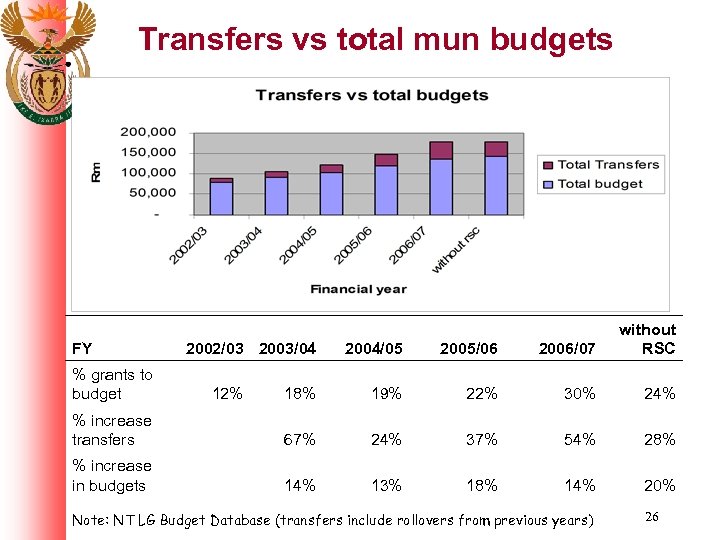 Transfers vs total mun budgets 2004/05 2005/06 2006/07 without RSC 18% 19% 22% 30% 24% % increase transfers 67% 24% 37% 54% 28% % increase in budgets 14% 13% 18% 14% 20% FY % grants to budget 2002/03 2003/04 12% Note: NT LG Budget Database (transfers include rollovers from previous years) 26
 Municipal financial mngt and reforms • Municipal budget reforms introduced under the Municipal Finance Management Act from 1 July 2004, based on following principles – Promoting sound financial governance by clarifying roles and responsibilities of council and officials – Ensuring a strategic approach to budgeting – Modernisation of financial management – Promoting co-operative and consultative governance – Promoting sustainable local government • MFMA’s financial and fiscal reforms include – New budget standards and formats (the objective is to achieve qaulity and credible multi-year budgets) – The establishment of audit committees and internal controls – Improvements to procurement and supply chain management processes – Performance measurement and reporting – Staff competency levels – Mechanisms to resolve financial problems – Procedures to determine and manage misconduct 27
 Future issues / Way forward • LG fiscal framework to be reviewed and updated to account for – Current financial position and service delivery capabilities of various categories and types of municipalities – Alignment between functional and fiscal division of powers and functions between category A and B municipalities – Permanent replacement options for RSC and JSB levies that were abolished 1 July 2006 – Funding of district municipalities – Continued review of the LG equitable share formula – Capital finance and borrowing issues, including role of MIG – Proper alignment between cross-cutting functions required, including priority setting, resource allocation and implementation of services (housing, public transport, health, libraries, etc) – Sector reforms impacting on municipal finances (electricity and water) – When Municipal Fiscal Powers and Functions legislation is enacted • Setting norms and standards i. r. o. municipal surcharges • Evaluate requests for new municipal taxes 28
 Structure of Formula • The LG formula has the following components: – Grant = Basic Services (BS) + + +/- Development (D) Institutional Support (I) Revenue Raising (RRC) Stabilisation Constraint (C) – D will be set at zero for now 29
 Some remaining challenges • IGR system – Coordination in respect of concurrent functions • Tension between cooperative relations vs legislated relations – Division of powers and functions may require minor adjustments – Very wide variations among our municipalities pose challenges for policy development and resource allocation – Implementation of certain programmes is slow, often due to inadequate capacity – Output or performance information is not readily available, thus affecting: • Policy making, planning and resource allocation • Assessment of progress with policy implementation and 30 the impact of policies
 Key priorities under provincial sphere • Reduce poverty and unemployment • Skills development • Better national health • Economic priorities: – Growth – Second economy • Welfare services +EPWP+ housing • GET+FET • Strengthening of health sector • Planning + Public investment + execution – Roads + other projects – EPWP + BBBEE 31
 What issue here? • The debate on coordination/cooperative relations is about: – what the law prescribes and allows • Legal authority to make decisions • Boundaries and limitations – what amount of choices are allowed to provinces – what choices do they make – what effect do provincial choices have on attainment of national objectives/priorities – what tools can national use to influence provincial choices 32
 Types of decisions and degree of provincial choice and discretion • National decides policies and funding mechanism – The nature of decision and funding mechanism determine degree of provincial choice/discretion • Statutory expenditure and CG funding leave little choice/discretion for provinces • ES and non-statutory expenditure leaves lot of room for provincial choices, discretion and risk of deviation from national goals 33
 The nature of the problem • National government makes the ff charges: – Provincial budgets fail to give effect to national priorities that inform the DOR – Consequently: • Insistence on CGs • Calls for broader curtailment of provincial choices and discretion • Assertions that cooperative governance does not work • Etc 34
 Provincial counterarguments • National priorities: – Ignore province-specific circumstances – Do not accommodate non-social services • Policy disagreement – Past funding levels and expenditure trends – Capacity constraints and readiness to spend – Do not provide for full cost of policies • Disagreements on appropriate funding level 35
 Where can things go wrong? • Within the sector – Poor policy processes • Between line departments and treasuries • Within provincial executives • Between national and provinces – Vertical division of revenue • Inadequate resources for non-social service • Insufficient funds for a given priority 36
 Possible solutions • Deepening of policy making process – Including coordination between Cabinet and EXCOs • • • Protocol for communicating national policies with funding implications for provinces Formal discussion of policies at PCC and Makgotla preceded by in-depth discussion in provinces Strengthening of budget processes – Costing of policies must be mandatory – Creation of space for bottom up identification of priorities • Adherence to spirit of cooperative governance • Reviewing the intergovernmental system – Less provinces – Greater implementation role for national government? – Municipalities 37