 Скачать презентацию Sources of Law Katarzyna Gromek Broc York University
e2cca81b94a903e4f93d87bc4726de0e.ppt
- Количество слайдов: 132



Sources of Law Katarzyna Gromek Broc York University York Law School Pag.
Sources of Law Sources: ways by which the law comes into existence English law comes from variety of sources although their importance varies Pag.
Sources - Common Law (case law) - Equity - Custom - Legislation A) primary B) secondary, delegated legislation - Statutory interpretation -International Law (Treaties, EU law) Pag.
Who makes law? Four principal law makers in the UK - the Courts - the Parliament - EU -Council of Europe Pag.
Sources of Law General Overview Case Law: judge-made law lay down rules to be followed in future court decisions: a predominant source of law However Primary Legislation (Act of Parliament, Statutes) prevails over common law Pag.
Sources Overview Primary Legislation(Act of Parliament) interacts and contributes to the development of common law: courts while interpreting the Acts, and such decisions lay down new precedence Pag.
Sources of Law Delegated legislation is made by administration rather than legislation and is concerned with the detailed rules to implement Act of Parliament Note: increasing importance of EU law due to supremacy of EU Law Pag.
Sources of law Common Law Pag.
Common Law Historically primary source of law (unwritten, then recorded) – Common law of the King and the nobility recorded e. g. by Bracton – Developed into the system of precedent Pag.
Common Law Curia Regis (King’s Court) travelling King’s Court, listening to the customs of different lands, resolving disputes, writing down decisions: beginning of Common Law) 1250 Pag.
Common Law - Establishment of the system of collection of the decisions of higher courts; - Publication of reports of cases in the higher courts. Pag.
Defining Common Law “common law was seen to represent a rational ordering of the rules governing human behaviour and it was the claim of a developing class of lawyers to provide a seamless web of regulation. All of these factors contributed to the ability of the common law to withstand the threat of codification and to provide an effective resistance to the incursion of piecemeal legislation” (Goodrich, Reading the Law 1986, 42). Pag.
Common Law When should judges make law? -judges should adapt the law to the changing conditions in society -filling the gap left by statutes -protecting individual rights -giving meaning to parliamentary intention (respecting the parliamentary opinion) Pag.
Advantages of Common Law 1. Certainty: like cases will be treated alike 2. Practical: adapted to the real situations 3. Case law developing in line with the market needs 4. Flexible adapted to changes in society Pag.
Disadvantages of common law 1. Complexity and Volume (long cases, judges discussion not explicit, a crux of the decision buried in irrelevant material) 2. Rigid ( the judges need to follow even bad decisions of higher courts) 3. Depending on chance (precedent created only in response to those who brought the claim) Pag.
Disadvantages of common law 4. Illogical (the fact of the case must be significantly different, unclear, creating the precedence in similar cases); 5. Unsystematic progression (no comprehensive code, ad hoc development depending on cases) 6. Not based on scholarly findings (research) 7. lack of accountability of the judges Pag.
Disadvantages of common law 8. Retrospective effect ( unlike the legislation can apply to the events before the case reached the Court) Pag.
Sources of Law Equity - Equity means fairness - Inspired by ideas of fairness and natural justice - emerged as response to the rigidity of common law (now part of it) Pag.
Equity Common Law only remedy: damages Equity remedies: injunctions, specific performance, rescissions, rectifications: intention of the parties) Petitions to the King (15 th century delegated to Lord High Chancellor) Creation a separate court: court of chancery (now Chancery Division of the High Court) The Judicature Acts 1873 -75: one system Pag.
Equity Although the same courts today, the separate rules remain conflict between equity and common law, equity prevails Pag.
Equity maxims: “Equity is equality” “Equity will not suffer a wrong without remedy” Who comes to equity must come with clean hands” “Who seeks equity must do equity” Pag.
Sources: Legislation ‘Queen in Parliament’ (Dicey) – Legislation superior to common law – Most recent enactment is the law – Statutes superior to secondary legislation Pag.
Legislation Non-intervention of legislation - a law job? – provide the legal framework as a guide for action – recourse to the law –a last resort – law works outside the courts but in the shadow of the courts. Existence of courts (even as a last resort) influences the functioning of the law. – How does the court process fit in with the legal process and the court structure? – Inter-relationship of the court ‘hierarchy’ and our system of judicial law-making Pag.
Legislation who makes it? Queen in the Parliament is the official name for the legislature (or King). The legislature consists of: – the Monarch (King or Queen) – the House of Lords (peers: Lords Spiritual, Lords Temporal) (about 750) – the House of Commons (elected Members of Parliament, MPs) (646) Pag.
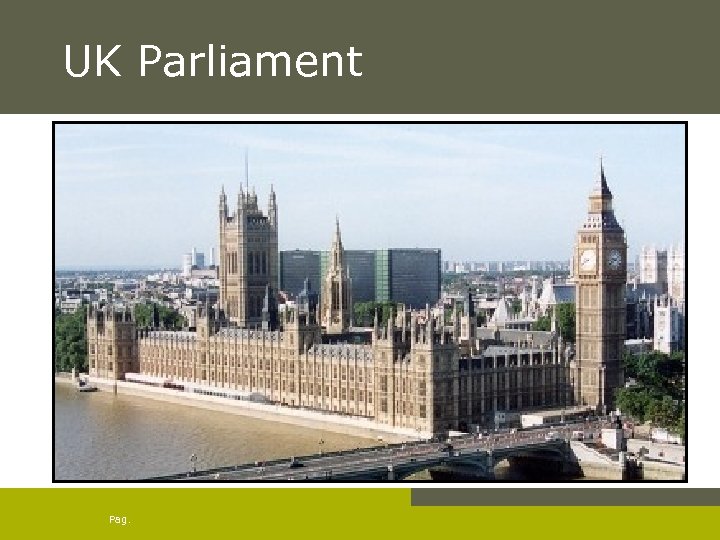
UK Parliament Pag.
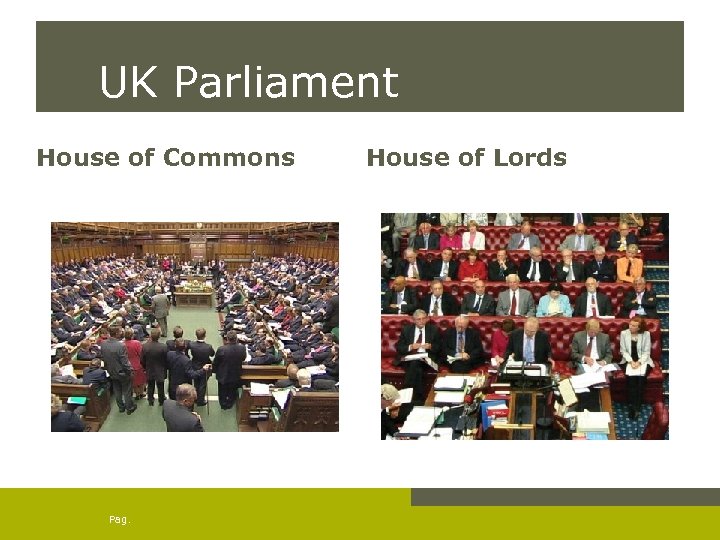
UK Parliament House of Commons Pag. House of Lords
Legislation Primary legislation (Act of Parliament) Secondary legislation (rules made by administration not by legislature on implementation of the Acts) Pag.
Act of Parliament Public (incl. Private Member’s Bills) or Private The Whitehall stage (public bills) – Consultation – Green Paper – White Paper Drafting Pag.
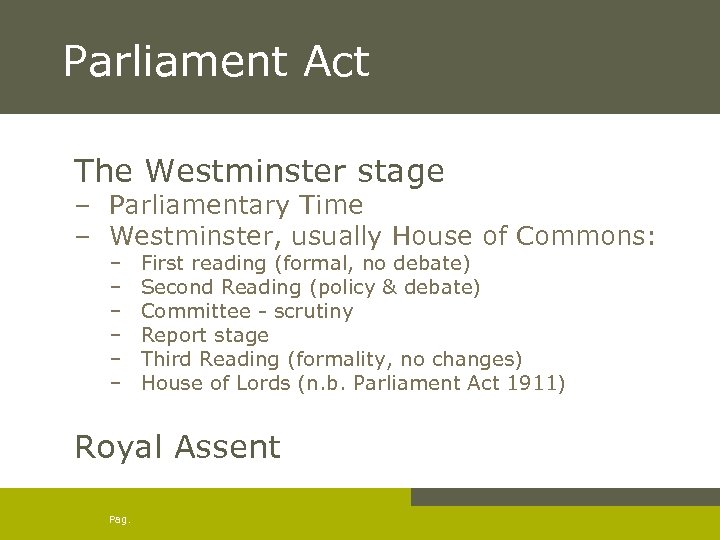
Parliament Act The Westminster stage – Parliamentary Time – Westminster, usually House of Commons: – – – First reading (formal, no debate) Second Reading (policy & debate) Committee - scrutiny Report stage Third Reading (formality, no changes) House of Lords (n. b. Parliament Act 1911) Royal Assent Pag.
Act of Parliament 1. THE WHITEHALL STAGE Once a competent department has decided to ask Parliament to enact a Bill, the department will start a consultation process (Green Paper) with all the concerned parties. To which extent and the time this process will take, differ with the complexity, urgency and importance of the matter. Pag.
Act of Parliament 2. Drafting When the department in question has decided to pass on the process, the provisions are sent to the civil servants called Parliamentary Counsel. These civil servants are lawyers who are specialized in drafting techniques. Once the drafting stage is ended, the bill is ready to be presented to the Parliament (White Paper). Pag.
Act of Parliament 3. The Westminster Stage (HOUSE OF COMMONS) A Bill has to be accepted by the Future Business committee in order to be given time in Parliament. In this cabinet committee the responsible of the cabinet decides which Bill will be presented before the Parliament in the next session. It is important to point out that all the Bills must be passed by both the House of Commons and the House of Lords. Pag.
Act of Parliament 3. Westminster Stage (continues) They are able to start in either of the Houses, but most of the Bills start in the Commons. The process in each of the Houses consists of the following five stages Pag.
Act of Parliament 4. First Reading The first reading is a formal stage, this is when the House orders the Bill to be printed. In this stage, it is likely that there won’t be any debate on the content of the Bill. Pag.
Act of Parliament 5. Second Reading During the second reading, there is a first possibility to hold a debate. Less important Bills and Bills that contain wholly uncontroversial measures can receive their second reading ‘on the nod’, which means devoid of any debate at all. The minister responsible sets out the main policy objectives. The opposing parties then have the chance to set out their reservations. Pag.
Act of Parliament 5. Second reading (continues) And finally the other Members of the Parliament (named the backbenchers) can comment. When the debate ends, there is a summing up by a government minister. Most of the time, it is exceptional that the bill is voted or defeated at this stage. In the case where a vote takes place because of the conflicting opinions, the Bill can go no further if the vote is lost. Pag.
Act of Parliament 6. Committee Stage The detailed analysis of a Bill takes place in a Standing Committee. The Committee has the task to analyze the Bill clause by clause and they can amend it where it seems it could be improved, so that the Bill turns into an acceptable shape. The This Committee is composed of the senior MP’s . Pag.
Act of Parliament An alternative procedure is to inspect the Bill in a Committee of the Whole House (also known as keeping the Bill ‘on the floor’), with all the members of the House that adopt the committee procedure. This procedure is used for example for constitutional measures. A mixture of both procedures is also possible, for example you can consider to bring one part of the Bill before the Committee of the Whole House and to bring the rest to the Standing Committee. Pag.
Act of Parliament 7. Report Stage (CONSIDERATION STAGE) In this stage the Bills which have been changed in the Committee stage, are reported to the main House. The House has the opportunity to, on the one hand, reject the changes made in the Committee or, on the other hand, make new amendments. Pag.
Act of Parliament 7. Report Stage (continues) The advantage of this stage is that all the MP’s can debate on eventual amendments. Often this is the moment at which the government tries to introduce new amendments. This stage is very criticized upon because, when the government uses its right to make significant changes to a Bill, this is done in a late stage in the process of enacting the Bill. Pag.
Act of Parliament 8. Third reading Finally, the third reading is again a more formal stage. In this stage they bring together all the components of the Bill. At that time the bill is ready to be referred to the House of Lords, and when that happens it is no longer possible to change anything to the content of the Bill. Usually a brief discussion takes place, where the MP’s who have been most active during the legislativeprocess, look back on the work which they have contributed in the Committee Stage. Pag.
Act of Parliament 9. The process in the House of Lords The process of law-making of a Bill can start in the House of Lords or can start in the House of Commons to be referred later to the House of Lords. In the House of Lords it goes through the same five stages as in the House of Commons (see the procedure described above) but in the House of Lords the Bill is kept ‘on the floor’ in all but some exceptional cases. In addition, in the House of Lords, changes can be made at the Third reading stage. There is also less government control in the House of Lords in contrast to the House of Commons. Pag.
Act of Parliament 10. The Royal Assent This is the last stage of the whole process a Bill undergoes. The Royal Assent is the stage wherein the Queen signs the Act of Parliament. In other words, this is a formal stage that has to be accomplished. The Royal Assent makes the Bill turn into an Act. There are two ways a Bill can come into force, instantly or at a future stage as stipulated in the Act. In practice it usually contains a ‘commencement clause’, which stipulates the inlet of the Act. Pag.
Sources of Law: Delegated legislation Delegated (secondary legislation) Parliament gives power to local authority or local government to make law. Usually to elaborate a detailed framework to implement an Act of Parliament Pag.
Sources of Law: Delegated Legislation Making delegated legislation - Statutory instruments - Byelaws -Orders of the Council Pag.
Sources: Delegated Legislation Statutory Instruments: Parliament confers the power to make statutory instrument to a governmental department or Minister. They will draft a statutory instrument to implement the requirements to enable Act Pag.
Delegated legislation Byelaws Made by local authority or other public body e. g. British Rail. They regulate a certain behaviour under their control E. g. Regional Council passed a byelaw to fine people who do not clean up after their dogs. Pag.
Delegated Legislation Orders of Council Differently known as Order of the Legislative Committee of the Privy Council: another form of SI but reserved for the most important pieces of secondary legislation Pag.
Delegated legislation: advantages Speed: discharging Parliament, ensure fast and effective implementation More adaptable to local needs: local Council More flexible: easier changeable Parliamentary supervision: affirmative/negative resolution Judicial control: subjected to judicial review (ultra virus, exceeded power, procedural or substantive, then void) Pag.
Sources of Law: Statutory Interpretation Although Acts of Parliament are carefully drafted: Implications of a statute are often unclear Number of factors have been identified that could cause uncertainty 1) some words may be left out: ‘and/or’: should the words be automatically implied? 2) Broad terms are used (ban of vehicles in the park) The court needs to decide of bikes, skateboards are also banned. 3) Ambiguous words used: inadequate wording because of a printing, drafting or other error 4) the events of the case brought before the court where not foreseen when the legislation was drafted Pag.
Sources: Interpretation of the Statute The Court’s role To guess what parliamentary intention was The Interpretation Act 1978: some standard definitions of common provisions Since 1999 all Bills are subject to special explanatory notes’ This background to the legislation available to the public explain the effects of particular provisions are intended to have There are three methods to be used in conjunction with the previously stated assistance Pag.
Sources: Interpretation The literal rule To follow the literal meaning of the words they have used. Under this rule, the literal meaning must be followed even if the result is silly Lord Esher stated in Rv City of London Court Judge[1892] “If the words of an Act are clear you must follow them even though they lead to a manifest absurdity. The Court has nothing to do with the question of whether the legislative has committed an absurdity”. Advantage of literal rule: respect for the doctrine of parliamentary sovereignty, restricted role for the courts, preponderant place for the legislator Pag.
Sources of law: statutory interpretation Disadvantages of the literal rule: If use of the literal rule leads to absurd or unjust conclusion it can hardly be said that this was the intention of Parliament is unlikely to have intended absurdity and injustice Hart (1994): some terms have a core of very clear meaning but it still maybe be unclear how far that word stretches. Zander (The Law-making process) describes the literal approach as’ mechanical, divorced both from the realities of the use of languages and from the expectations and aspirations of the human being concerned. . . In that sense it is irrisponsible’ Pag.
Sources: Statutory Interpretation The Golden Rule: If the literal rule gives an absurd result which Parliament would not have intended, only then the judge can substitute a reasonable meaning in the light of the statute as a whole. Lord Wensleydale said in Grey v Pearson, [1857]: “The grammatical and ordinary sense of the words may be modified so as to avoid that absurdity and inconsistency but not further” Advantage of the Golden Rule: to avoid the absurdity, to endorse the intention of the Parliament Disadvantages: lt interferes within the legislative power. Pag.
Sources: Statutory Interpretation The mischief rule: The rule established in the 16 th century in Heydon’s Case. The judge should consider 3 factors - what the law was before the statute was passed - what problem, or ‘mischief’ the statute was trying to remedy - what remedy Parliament was trying to provide The judge then should consider these three points while providing a solution Smith v Hughes (1960): The Street Offences Act 1959 made it a criminal offence for a prostitute to solicit potential customers in a street or public place: The prostitute was at the window and tapping to attract clients. (The Act should be interpreted to include this activity). Pag.
Sources of Law: Interpretation Advantages of the mischief rule: It helps to avoid absurdity and injustice, it promotes flexibility Disadvantages of the mischief rule: obsolete, does not take into account the predominant role of Parliament today and it relies on judges who in the 16 th century were drafting legislation on behalf of the King. Pag.
Interpretation Other aids: Explanatory notes Presumptions: -statute do not change the common law - the legislature does not remove any matters from the jurisdiction of the Courts - not to interfere with existing rights -law should be interpreted in favour of citizens where there is an ambiguity -legislation does not operate retrospectively Pag.
Interpretation Dworkin (1986) put forward that the job of the judges is to develop a theory about how the particular measure fits with the rest of law as a whole. If there are two possible interpretations of a word or phrase the judge should favour that one that sits more comfortably with the purpose of the rest of the law and with the principles and ideas of law and legality in general. Pag.
Sources: Custom Small role in modern English Law In the past the law was created by the decisions of judges recognising some customs and eliminating others Tanistry case 1608 defined custom as “such usage as has obtained the force of law” Pag.
Custom: To be able to be enforceable the custom must be - In conformity with the statute - Consistent with other customs - Continuity - Locality - Certainty and clarity - Reasonableness: in line with fundamental principles Pag.
Court Structure Separate civil and criminal courts Same facts situation may give rise to both civil and criminal claims e. g. false descriptions of goods, domestic violence Pag.
Magistrates’ Courts Usual criminal, but some civil cases eg – Family Proceedings Court – Licensing Who does the judging: – Three lay magistrates (unpaid, not professional), + Court Clerk or – District Judge Appeals – High Court Pag.
Civil Courts Majority of civil cases – Small Claims Procedure (up to £ 5 k) – Fast-track cases (up to £ 15, 000) Judges – Circuit Judges (senior judges) – District Judges (trained, stipendiary) Pag.
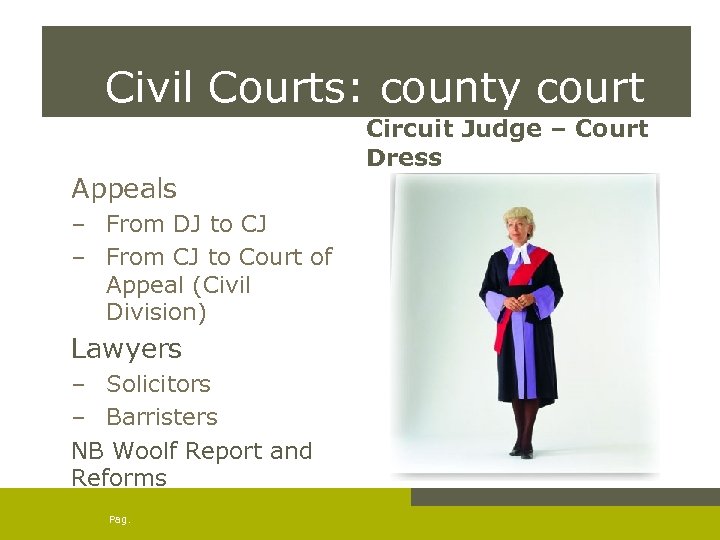
Civil Courts: county court Circuit Judge – Court (2) Dress Appeals – From DJ to CJ – From CJ to Court of Appeal (Civil Division) Lawyers – Solicitors – Barristers NB Woolf Report and Reforms Pag.
High Court of Justice 3 divisions since 1970: – Queen’s Bench (or King’s Bench) – Chancery – Family Hears both cases at first hearing and appeals Decisions are precedents Location: London, Royal Courts in the Strand, also approx 20 provincial cities ‘My Lord’ – Chancery - head is Chancellor – QBD - President is Lord Chief Justice – Family - head is President of the Family Division Pag.
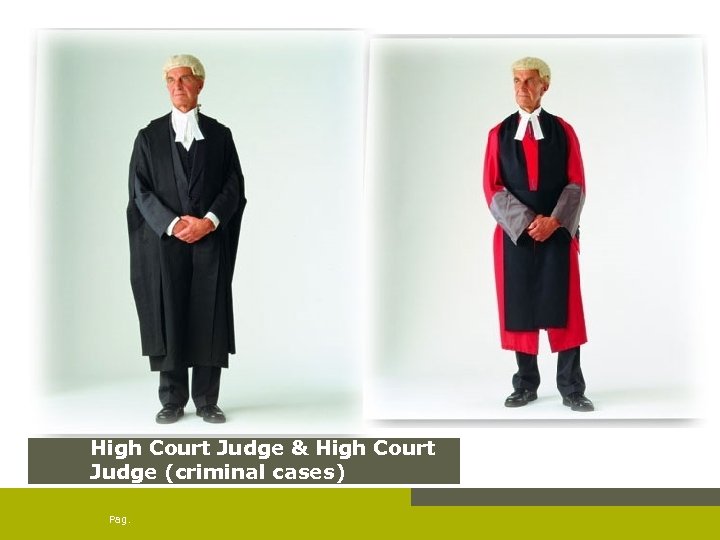
High Court Judge & High Court Judge (criminal cases) Pag.
High Court: Family Division First Instance: Appellate Jurisdiction: Matrimonial and children Appeals from Magistrates matters Courts in Family matters Inherent jurisdiction of the High Court in relation to minors, e. g. commencement of wardship proceedings. Dissolution of civil partnerships Medical treatment declarations Pag.
High Court: Queen’s Bench Division Appellate Jurisdiction - Court of First Instance Divisional Court of the Certain applications for Queen’s Bench Division writs of habeus corpus Mainly criminal appeals from the Magistrates and Judicial review cases Crown Courts heard by the Administrative Court Also Admiralty, Commercial, Technology & Construction courts Pag.
High Court: Chancery Division First Instance Appellate Jurisdiction - Chancery Divisional Trusts, mortgages, Court (limited): company law and partnerships, Appeals in bankruptcy intellectual property cases from county matters, corporate and courts and High Court personal insolvency, registrars trade and industry disputes, contentious probate matters, intellectual property, etc. Pag.
Court of Appeal Civil Division Appeals from all 3 divisions of High Court & county court Quorum of 2, usually 3 judges sit Most senior judge: Master of the Rolls Judges promoted from High Court First woman judge appointed 1988 (Butler-Sloss) Pag.
Judicial Committee of the Privy Council Original function to advise the monarch Senior Judges who are members of the Privy Council Appeals from Commonwealth Countries, also some Admiralty and ecclesiastical matters (Since 1998: appeals from Scotland, Wales and Northern Ireland re devolution appeal now moved to the Supreme Court 2009) Pag.
Privy Council History: Privy Council is descended from the Curia Regis, made up of the king’s tenants in chief, household officials, and other advisers. This group performed all the functions of government in either small groups, which became the king’s council, or large groups, which grew into the great council and Parliament Pag.
Privy Council: History At the beginning, monarchs ruled through the Privy Council without turning to Parliament, and under Edward I it was difficult to identify whether legislative acts emanated from the King-in-Parliament or the King-in-Council Pag.
Privy Council: History The Privy Council has long ceased to be an active body, having lost most of its judicial and political functions since the middle of the 17 th century. The courts took over the business of delivering justice, while Parliament became the supreme legislature of the Kingdom. As the constitution developed into today’s constitutional monarchy, the power moved from the monarch to the prime minister and the cabinet. Pag.
Privy Council: Composition Membership of the Privy Council is today often a titular honour that the members received as reward for public and political service. Members of the Council are called “Privy Counsellors” Individual Privy Counsellors are entitled to the prefix “The Right Honourable”. Pag.
Privy Council Composition The sovereign, when acting on the Council’s advice, is known as the “Queen-in-Council”. Appointments are made by the Sovereign on ministerial advice and generally consist only of senior members of Parliament, the Church and Judiciary. Pag.
Privy Council: Composition The Privy Counsellors are mainly politicians. The prime minister, ministers in the cabinet, and the leader of the Opposition must be sworn to the Privy Council on appointment. Membership ceases upon the dissolution of the Privy Council, which automatically occurs 6 months after the death of a monarch. By convention however, the Sovereign reappoints all members of the Council after its dissolution, so in practice, the Privy Counsellors are members for life, but only Ministers of the democratically elected Government of the day participate in its policy work. The Council now numbers about 550 members Pag.
Privy Council: Meetings The Privy Council meets regularly, once a month. Meetings of the Privy Council are held by the Queen and are attended by Ministers and the Clerk of the Council. The Council may meet wherever the Queen decides, although normally it will meet at Buckingham Palace. At each meeting the Council will seek Her Majesty's formal approval to a number of Orders which have already been discussed and approved by Ministers Pag.
Privy Council: Meetings of the Privy Council are very brief. Only a few privy counsellors attend these regular meetings. The settled practice is that four Privy Counsellors, usually the Ministers responsible for the matters being approved, attend those meetings of the Council. The Orders made at each Council are in the public domain. As Privy Council meetings are usually held at Buckingham Palace Orders generally begin "At the Court at Buckingham Palace", but Orders may also be made in other places. Pag.
Privy Council: Secrecy There is therefore nothing at all "secret" about Privy Council meetings. The myth that the Privy Council is a secretive body springs from the wording of the Privy Council Oath, which, in its current form, dates back to Tudor times. It requires those taking it to "keep secret all matters. . . treated of in Council". The Oath is still administered, and is still binding; but it is only in very special circumstances nowadays that matters will come to a Privy Counsellor on "Privy Council terms". These will mostly concern matters of the national interest. Pag.
Privy Council: Legislation The Order in Council remains a principal method of giving the force of law to acts of the government, especially the more important executive orders. Decisions of the Privy Council are recorded in Orders, which have the force of law. Such Orders come in many forms, but the basic distinction is between Orders in Council and Orders of Council. Pag.
Privy Council: Legislation Orders in Council are Orders that have been approved at a meeting of the Privy Council personally by The Queen. They are drafted by the government rather than by the Sovereign, and are secondary legislation. They fall into two broad categories, Statutory and Prerogative. Statutory Orders are made under any of the numerous powers contained in Acts of Parliament, which give Her Majesty the possibility to make Orders. Prerogative Orders are made under the inherent power of the Crown to act on matters for which Parliament has not legislated. Pag.
Privy Council: Legislation Orders of Council are Orders which do not require personal approval by The Queen, but which can be made by "The Lords of the Privy Council". Acts giving power to the Privy Council to make an Order, will usually specify the quorum of the Privy Council required to exercise it. (required quorum: usually two. ) All Orders of Council are expressed to have been made at "The Council Chamber, Whitehall", though in fact they are all approved in correspondence, and no actual meeting takes place. Pag.
Privy Council: Operation The majority of Privy Council functions are fulfilled by committees. The Privy Council has a great variety of standing committees. There also ad-hoc committees, as for example the committee that considers applications by institutions for Charters and Statutes. The Royal Charters were originally granted to create public or private corporations (including towns and cities), and to define their privileges and purpose. Pag.
Privy Council: Operation The Privy Council also has a role in areas of higher education, having responsibilities both under the royal prerogative and by statute. Older (pre-1992) universities operate under a Royal Charter, which sets out their overall constitution and statutes. The Charter also gives more details as to how the university should operate in practice. The Privy Council is responsible for advising Her Majesty on universities’ proposals to amend their charter. Pag.
Privy Council: Operation The most important committee is the Judicial Committee, established under statute by the Judicial Committee Act 1833. The Judicial Committee of the Privy Council originated as the highest court of civil and criminal appeal for the British Empire. It also acts as the court of final appeal for the UK overseas territories, Sovereign Base Areas, Crown dependencies and for those Commonwealth countries that have retained the appeal to Her Majesty in Council. Over the years, the Judicial Committee has been asked for final rulings and interpretations of many different kinds of law, from Roman Dutch law in appeals from South Africa, to Muslim, Buddhist and Hindu law from India. The Judicial Committee also hears very occasional appeals from a number of ancient and ecclesiastical courts. Pag.
Privy Council: Judicial Committee The Judicial Committee was also the Court of final appeal for determining ‘devolution issues’ Devolution issues are questions of whether acts of the devolved administrations in Scotland, Wales and Northern Ireland are fully in accordance with the legislation which set them up under the United Kingdom devolution statutes of 1998. However, since October 2009, those devolution issues were transferred from the Judicial Committee of the Privy Council to the new “the Supreme Court”. Pag.
Privy Council: Judicial Committee Five judges normally sit to hear Commonwealth appeals and three for other matters. These judges are usually Justices of The Supreme Court. Until October 2009, the Judicial Committee heard appeals in the Council Chamber in Downing Street. Today it shares a building, and many administrative functions, with The Supreme Court. Pag.
Reform: a Supreme Court Constitutional Reform Act 2005 Supreme Court: – – Highest appeal court separate from House of Lords Removal of Lords of Appeal in Ordinary from legislature Enhancement of independence of judiciary Supreme not just for England & Wales: also Scotland & Northern Ireland – No power to overturn legislation New Judicial Appointments Commission http: //www. justice. gov. uk/whatwedo/supremecourt. htm Pag.
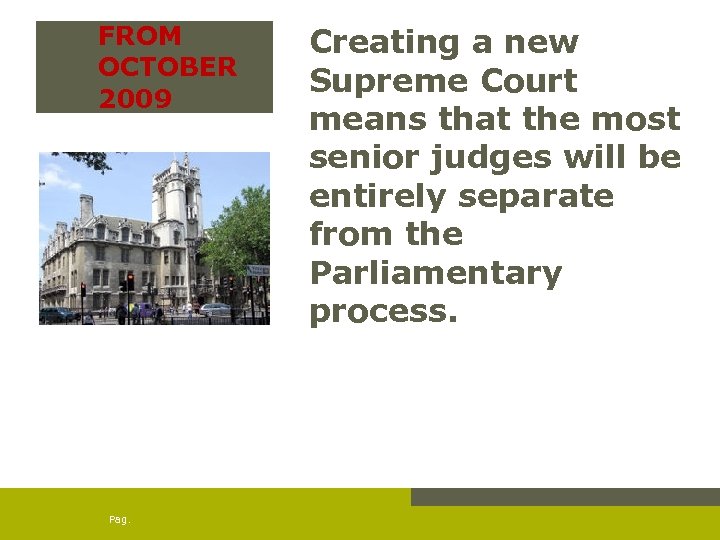
FROM OCTOBER 2009 Pag. Creating a new Supreme Court means that the most senior judges will be entirely separate from the Parliamentary process.
Supreme Court The Supreme Court of the United Kingdom is the new replacement for the judicial function of the House of Lords. The House of Lords, an important part of the British Parliament has been deprived of its judicial function. The creation of the Supreme Court enhanced the doctrine of separation of power. House of Lords is now only a legislative body and lost its judicial function. The judicial independence is now preserved. Pag.
Supreme Court Separation of powers between legislature and the judiciary in the constitutional arrangements is clearer. The office of Lord Chancellor was abolished and the Supreme Court now has its own independent appointments system, staff, budget and building (Middlesex Guildhall on London's Parliament Square, close to the Houses of Parliament and alongside Westminster Abbey and the Treasury) Pag.
Supreme Court: Organisation Part 3 of the Constitutional Reform Act 2005 The Supreme Court in 2009 has assumed the jurisdiction of the House of Lords through the Appellate Jurisdiction Acts 1876 and 1888. To enable the Court’s jurisdiction over the entire United Kingdom, it was necessary to amend the Scotland Act 1998, the Northern Ireland Act 1988 and the Government of Wales Act 2006, in light of the devolution. The jurisdiction was eventually passed along to the Supreme Court through the Judicial Committee of the Privy Council. Supreme Court took the issues on devolution from the Privy Council Pag.
What is the Doctrine of Precedent? Central to case law Traditionally: the law is “a permanent set of unchanging rules which are discovered, declared and applied to new cases” (Goodrich, p 127). Historically, prior decisions not originally binding in themselves, and no coherent system. Authoritative system of law reports dating from 1800 s. 1861 House of Lords first clearly established the doctrine of binding precedent. Pag.
What is the doctrine of precedence Central to case law Traditionally: the law is “a permanent set of unchanging rules which are discovered, declared and applied to new cases” (Goodrich, p 127). Historically, prior decisions not originally binding in themselves, and no coherent system. Authoritative system of law reports dating from 1800 s. 1861 House of Lords first clearly established the doctrine of binding precedent. Pag.
What is the Doctrine of Precedent? Stare Decisis – ratio decidendi/rationes decidendi (binding) – obiter dicta (may be persuasive) Pag.
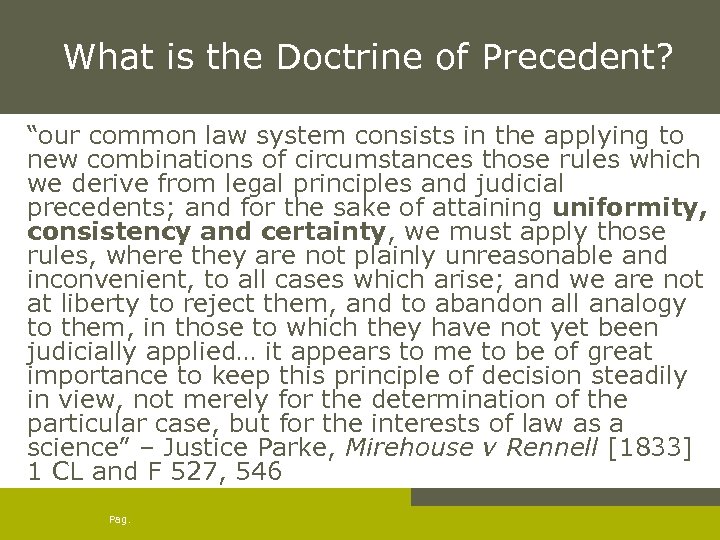
What is the Doctrine of Precedent? “our common law system consists in the applying to new combinations of circumstances those rules which we derive from legal principles and judicial precedents; and for the sake of attaining uniformity, consistency and certainty, we must apply those rules, where they are not plainly unreasonable and inconvenient, to all cases which arise; and we are not at liberty to reject them, and to abandon all analogy to them, in those to which they have not yet been judicially applied… it appears to me to be of great importance to keep this principle of decision steadily in view, not merely for the determination of the particular case, but for the interests of law as a science” – Justice Parke, Mirehouse v Rennell [1833] 1 CL and F 527, 546 Pag.
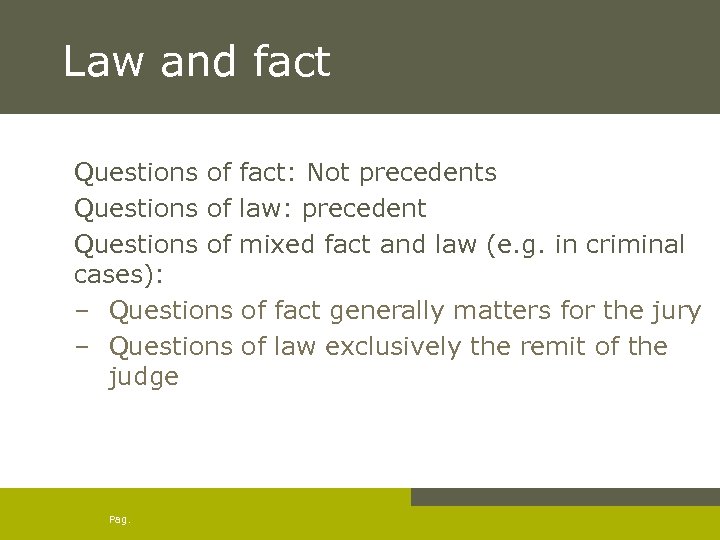
Law and fact Questions of fact: Not precedents Questions of law: precedent Questions of mixed fact and law (e. g. in criminal cases): – Questions of fact generally matters for the jury – Questions of law exclusively the remit of the judge Pag.
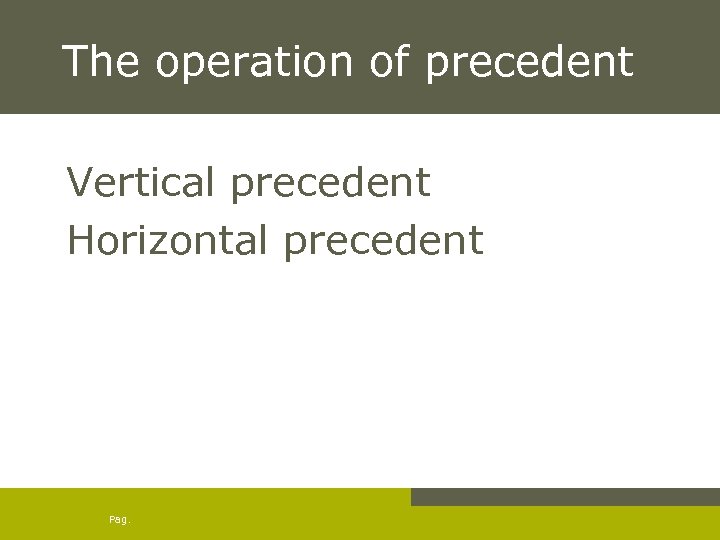
The operation of precedent Vertical precedent Horizontal precedent Pag.
HIERARCHY OF PRECEDENT Pag.
Precedent hierarchy (1) Court of Justice of EU (CJEU) – Binding on all English courts (supremacy of EU Law although not erga omnes) – Not bound by itself (no precedent in CJEU) House of Lords/now Supreme Court – Decisions bind lower courts – Practice Statement [1966] 3 All ER 77 permits departure from own decisions Pag.
Precedent hierarchy (2) Court of Appeal – Bound by House of Lords/ Supreme Court – Bound by own previous decisions UNLESS Young v Bristol Aeroplane Co [1946] AC 163 per Lord Greene MR: – Per incuriam: case didn’t take into account all relevant law AND major defect of material reasoning, or – choice between conflicting decisions, or – earlier decision not expressly overruled by HL but contrary to HL decision. Pag.
Precedent hierarchy (3) Court of Appeal continued – N. B. Davis v Johnson: HL disapproves CA’s disregard for precedent outwith Young v Bristol Aeroplane situations. Divisional Court – Bound by superior courts Pag.
Precedent hierarchy (4) Trial Courts (Magistrates’ Crown Court, County Court, High Court) – Bound by superior courts Privy Council – Not technically binding, but persuasive Pag.
PRECEDENT IN PRACTICE Pag.
![Case Re A (Children) (Conjoined Twins: Surgical Separation) [2001] Fam 147 was an English](https://present5.com/presentation/e2cca81b94a903e4f93d87bc4726de0e/image-106.jpg "Case Re A (Children) (Conjoined Twins: Surgical Separation) [2001] Fam 147 was an English")
Case Re A (Children) (Conjoined Twins: Surgical Separation) [2001] Fam 147 was an English Court of Appeal decision on the separation of conjoined twins. The case raised several legal, ethical and religious dilemmas including whether it would be permissible to kill one of the children to save the other and whether it was permissible to act against the wishes of the twins' parents. Pag.
Case Jodie" and "Mary" (born 8 August 2000) were pseudonyms given to conjoined twins, Rose and Grace Attard, who were joined at the pelvis. The medical evidence indicated that Jodie was the stronger sibling who was sustaining the life of Mary. If surgically separated Jodie could live but Mary would die. However, without separation both twins would die. Pag.
Case: Judgment At first instance, Mr Justice Johnson was left to decide the case without any direct precedents to guide him but reasoned by analogy with Airedale NHS Trust v Bland where it was declared acceptable to remove life support. Johnson ruled that separation would not be murder but a case of "passive euthanasia" in which food and hydration would be withdrawn. Pag.
Judgment The Court of Appeal rejected this analysis but the three judges who presided over the case gave very different legal reasoning. Lord Justice Alan Ward invoked the concept of self-defence suggesting that "If Jodie could speak she would surely protest, `Stop it, Mary, you're killing me. '"Lord Justice Brown relied upon R v Dudley and Stephens and invoked necessity as a defence. Lord Justice Robert Walker focused upon the intention of the surgeons in concluding that surgery could go ahead. Pag.
Case The operation to separate the twins took place on the 7 th November 2000. As expected Jodie survived the operation and Mary died. Pag.
Precedent in practice: dealing with cases What do you do? – Apply, follow (the law is applied in the same way) – Distinguish (facts are different, ) – Reverse (decision of lower court is appealed) – Overrule (by a higher court) ‘To understand case law…is to understand how it is that particular decisions concerning particular parties to particular cases can be used in the construction of general rules applying to the actions & transactions of persons at large’ - Mac. Cormick. Pag.
Dealing with precedents (1) 3 types of cases: – favourable – adverse – neutral Pag.
Dealing with precedents (2) Favourable cases – similarity of facts entails same decision – present facts fall within the scope of the precedent’s facts – principle of law in precedent should be applied in the present case Can be favourable in – result – reasoning – both Pag.
Dealing with precedents (3) Adverse cases Distinguish on facts Distinguish on principle – precedent was wrongly decided – precedent is weak authority – faulty interpretation of prior case – decision given per incuriam – since overruled or doubted – irreconcilable with prior or subsequent decisions Pag.
Dealing with precedents (4) Distinguish on principle – precedent is weak for practical reasons: – court of low authority – scope of decision is unclear – weak reasoning – influenced by special considerations – social conditions have changed – report is unreliable – decision criticised by academics Pag.
Dealing with precedents (5) Additional weight may be attached to a precedent by: – the (good) reputation of the judge – subsequent approval of the case Pag.
Difficulties with the doctrine (1) May be inflexible Repetition of substantively unjust principles May be unpredictable Problems with decisions Pag.
DIFFICULTIES WITH PRECEDENT Pag.
Difficulties with the doctrine (2) Problems with decisions – facts: – Are they ever identical? – Which facts are analagous? – Must similar facts be treated in the same way? Differences can be a) different but not significant; b) different but same principle Rule – What is it? Which part is the ratio decidendi and which the obiter dicta? – Which rule is to be followed given the various opinions or judgments in a case? Pag.
![Precendence Donoghue v Stevenson [1932] A. C. 562 Find out the legal problem that](https://present5.com/presentation/e2cca81b94a903e4f93d87bc4726de0e/image-120.jpg "Precendence Donoghue v Stevenson [1932] A. C. 562 Find out the legal problem that")
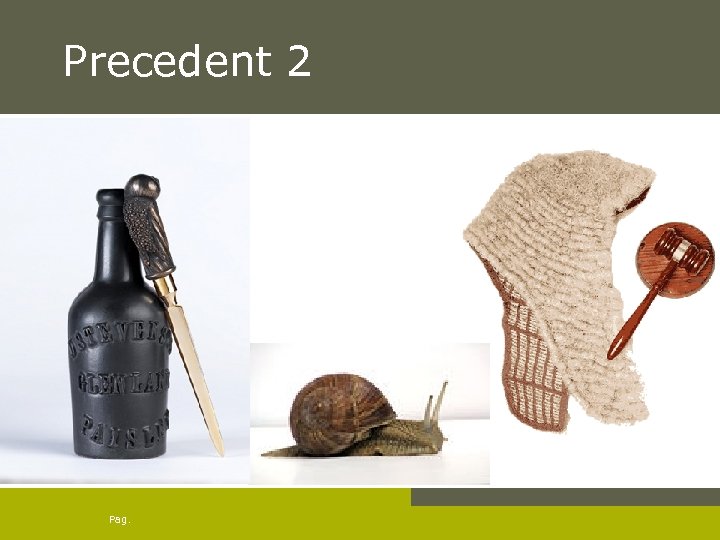
Precendence Donoghue v Stevenson [1932] A. C. 562 Find out the legal problem that you think forms the basis of the ratio decidendi. Pag.
Precedent 2 Pag.
![Donoghue v Stevenson [1932] A. C. 562 Why is this case important? – Foundation](https://present5.com/presentation/e2cca81b94a903e4f93d87bc4726de0e/image-122.jpg "Donoghue v Stevenson [1932] A. C. 562 Why is this case important? – Foundation")
Donoghue v Stevenson [1932] A. C. 562 Why is this case important? – Foundation of the law of negligence – Excellent illustration of judicial manipulation of precedent Pag.
The facts Appellant (Donoghue) Respondent (manufacturer of ginger beer). Donoghue drank some of the contents of a bottle of ginger beer, bought by a friend. Bottle was opaque. After drinking some ginger beer, discovered the decomposing snail. App. suffered shock and gastro-enteritis. Pag.
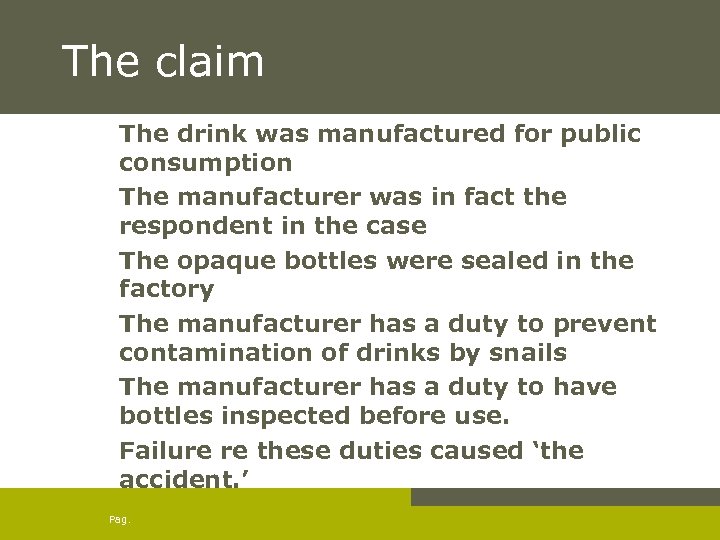
The claim The drink was manufactured for public consumption The manufacturer was in fact the respondent in the case The opaque bottles were sealed in the factory The manufacturer has a duty to prevent contamination of drinks by snails The manufacturer has a duty to have bottles inspected before use. Failure re these duties caused ‘the accident. ’ Pag.
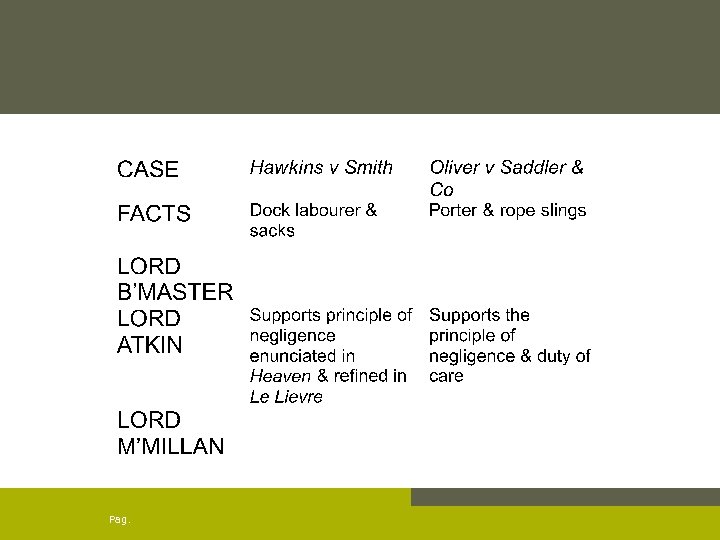
Pag.
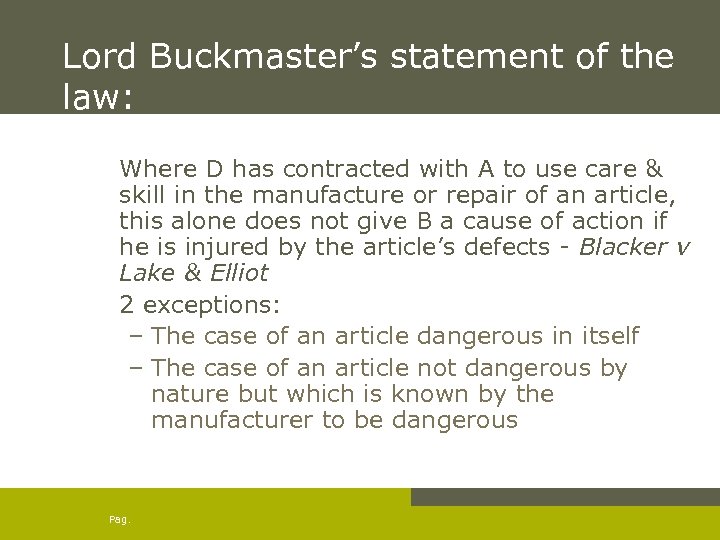
Lord Buckmaster’s statement of the law: Where D has contracted with A to use care & skill in the manufacture or repair of an article, this alone does not give B a cause of action if he is injured by the article’s defects - Blacker v Lake & Elliot 2 exceptions: – The case of an article dangerous in itself – The case of an article not dangerous by nature but which is known by the manufacturer to be dangerous Pag.
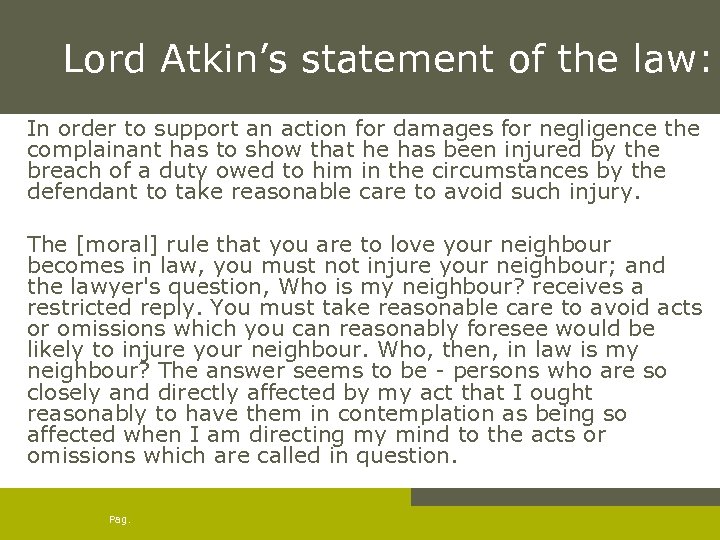
Lord Atkin’s statement of the law: In order to support an action for damages for negligence the complainant has to show that he has been injured by the breach of a duty owed to him in the circumstances by the defendant to take reasonable care to avoid such injury. The [moral] rule that you are to love your neighbour becomes in law, you must not injure your neighbour; and the lawyer's question, Who is my neighbour? receives a restricted reply. You must take reasonable care to avoid acts or omissions which you can reasonably foresee would be likely to injure your neighbour. Who, then, in law is my neighbour? The answer seems to be - persons who are so closely and directly affected by my act that I ought reasonably to have them in contemplation as being so affected when I am directing my mind to the acts or omissions which are called in question. Pag.
Lord Atkin’s statement of the law: I do not think so little of our jurisprudence as to suppose that its principles are so remote from the ordinary needs of civilized society and the ordinary claims it makes upon its members as to deny a legal remedy where there is so obviously a social wrong. Pag.
Lord Buckmaster on Donoghue’s proposition: In Mullen v. Barr & Co. , a case indistinguishable from the present excepting upon the ground that a mouse is not a snail, and necessarily adopted by the Second Division in their judgment, Lord Anderson says this: "In a case like the present, where the goods of the defenders are widely distributed throughout Scotland, it would seem little short of outrageous to make them responsible to members of the public for the condition of the contents of every bottle which issues from their works. It is obvious that, if such responsibility attached to the defenders, they might be called on to meet claims of damages which they could not possibly investigate or answer. " Pag.
The legal problem (1) Does the manufacturer of an article intended for consumption and contained in a receptacle which prevents inspection, owe a duty to the consumer of the article to take care that there is no noxious element in the goods? If he neglects this duty, is he liable for any damage caused by such neglect? Pag.
The legal problem (2) The principle contended for must be this: that the manufacturer, or indeed the repairer, of any article, apart entirely from contract, owes a duty to any person by whom the article is lawfully used to see that it has been carefully constructed. All rights in contract must be excluded from consideration of this principle; such contractual rights as may exist in successive steps from the original manufacturer down to the ultimate purchaser are ex hypothesi immaterial. Nor can the doctrine be confined to cases where inspection is difficult or impossible to introduce. This conception is simply to misapply to tort doctrine applicable to sale and purchase. - Lord Buckmaster Pag.
The legal problem (3) Lord Atkin: Whether the manufacturer of an article of drink sold by him to a distributor, in circumstances which prevent the distributor or the ultimate purchaser or consumer from discovering by inspection any defect, is under any legal duty to the ultimate purchaser or consumer to take reasonable care that the article is free from defect likely to cause injury to health. Pag.
Скачать презентацию Sources of Law Katarzyna Gromek Broc York University
e2cca81b94a903e4f93d87bc4726de0e.ppt