



 Sources of law: common law
 Hello, everyone, you are welcome to hear my presentation and let`s get down to business without a peep. It`s great that so many of you were able to come here to listen to my presentation this morning.
 We decided to tell you about the sources of law, namely the common law sources (also known as case law or precedent).
 A subject I’m sure will be of high priority for the law students as a great lawyer should be familiar with the laws and their origins. It`s only right to say that a lawyer without the knowledge of the law is not a lawyer.
 “I thought why should we learn the laws as they are changing almost every day until I the real court. ”-thoughts of one of the most successful lawyer of our times.
 There are several points I’d like to cover today. First, I will be giving you a little information about what is common law. I’ll then go on to the basic principles of common law. I’ll also introduce you interaction of constitutional, statutory and common law.
 So, to start with, what is common law? Common law is law developed by: judges, courts, and similar tribunals.
 How does it works? First, one must ascertain the facts. Then, one must locate any relevant statutes and cases. Then one must extract the principles, analogies and statements by various courts of what they consider important to determine how the next court is likely to rule on the facts of the present case. Finally, one integrates all the lines drawn and reasons given, and determines "what the law is". Then, one applies that law to the facts.
 What’s about interaction, in common law legal systems the common law is crucial to understanding almost all important areas of law. In almost all areas of the law (even those where there is a statutory framework, such as contracts for the sale of goods, or the criminal law), legislature-enacted statutes generally give only terse statements of general principle, and the fine boundaries and definitions exist only in the interstitial common law.
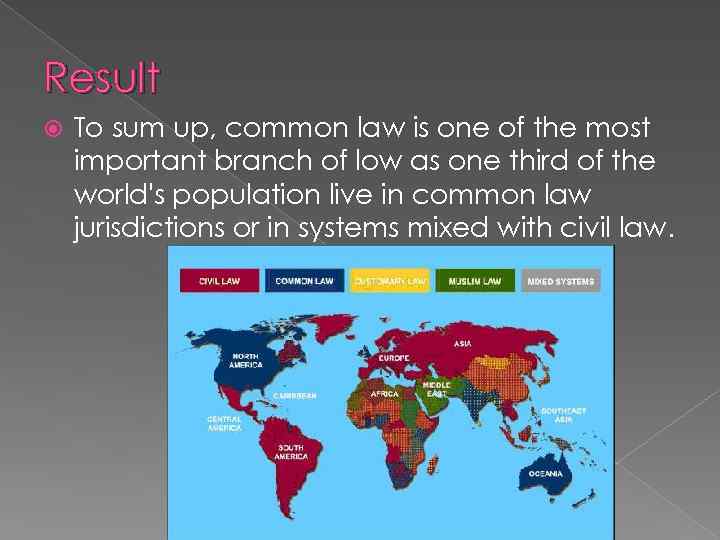 Result To sum up, common law is one of the most important branch of low as one third of the world's population live in common law jurisdictions or in systems mixed with civil law.
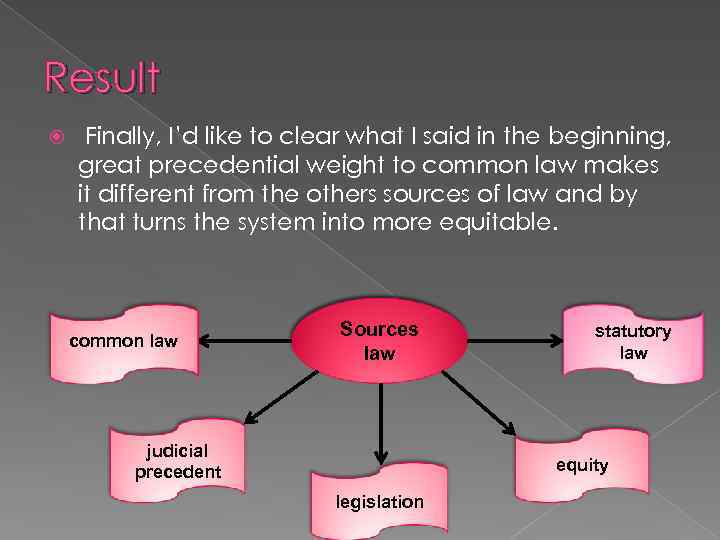 Result Finally, I’d like to clear what I said in the beginning, great precedential weight to common law makes it different from the others sources of law and by that turns the system into more equitable. common law Sources law judicial precedent statutory law equity legislation