


 Скачать презентацию SOUL AND IMMORTALITY Is death the end
SOUL AND IMMORTALITY - Lectire 7.pptx
- Количество слайдов: 46
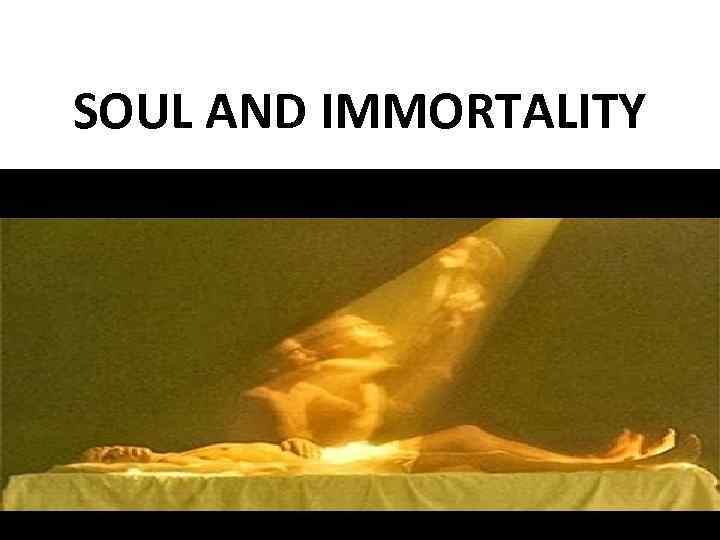 SOUL AND IMMORTALITY
 Is death the end of human existence? Is there any land beyond the grave? Can we find in man a soul that is distinct from his body, which can survive the event of death? What can we believe about hell and heaven?
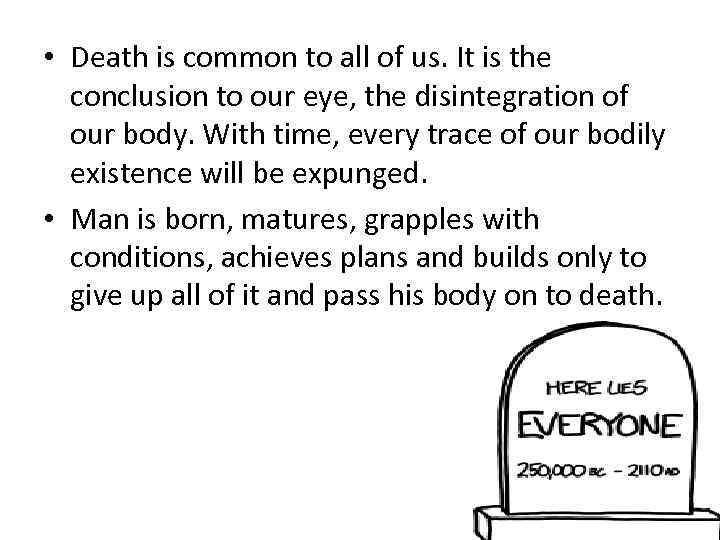 • Death is common to all of us. It is the conclusion to our eye, the disintegration of our body. With time, every trace of our bodily existence will be expunged. • Man is born, matures, grapples with conditions, achieves plans and builds only to give up all of it and pass his body on to death.
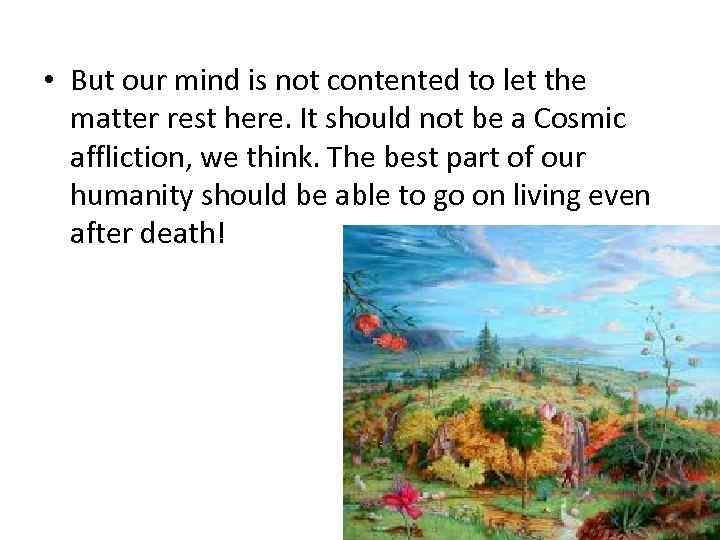 • But our mind is not contented to let the matter rest here. It should not be a Cosmic affliction, we think. The best part of our humanity should be able to go on living even after death!
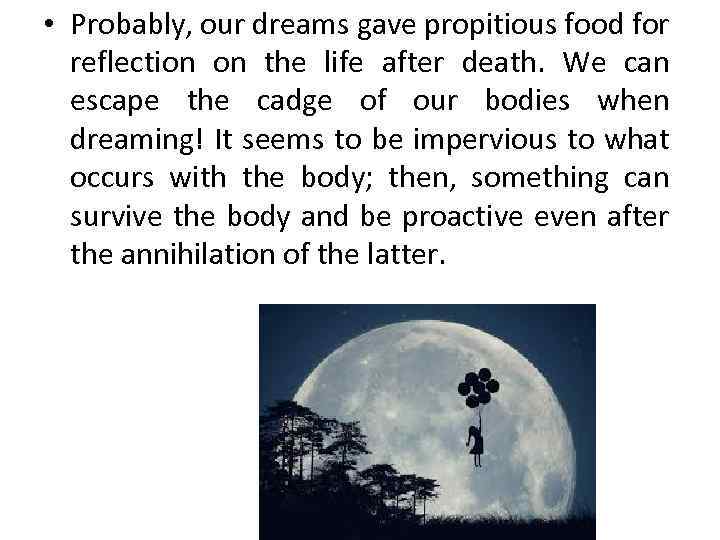 • Probably, our dreams gave propitious food for reflection on the life after death. We can escape the cadge of our bodies when dreaming! It seems to be impervious to what occurs with the body; then, something can survive the body and be proactive even after the annihilation of the latter.
 A place where souls go after death - this conception extends all the way from the old Hebrew idea of Sheol, and the Greek idea of Hades, the land of the shades across the river Styx, to the highly imaginative idea of Heaven held by the Christian tradition. Indeed, almost every religion has held to the belief in a land beyond the grave where good souls go to receive and to enjoy their reward. Many religions have also conceived of another land to which the evil souls go to receive their punishment.
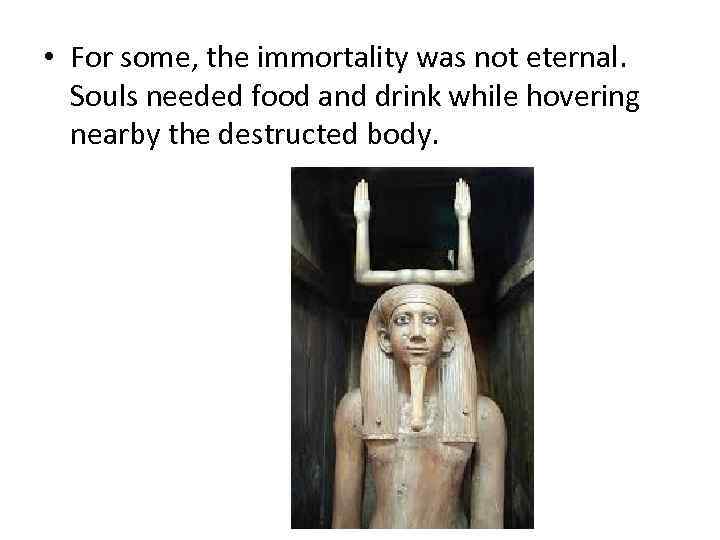 • For some, the immortality was not eternal. Souls needed food and drink while hovering nearby the destructed body.
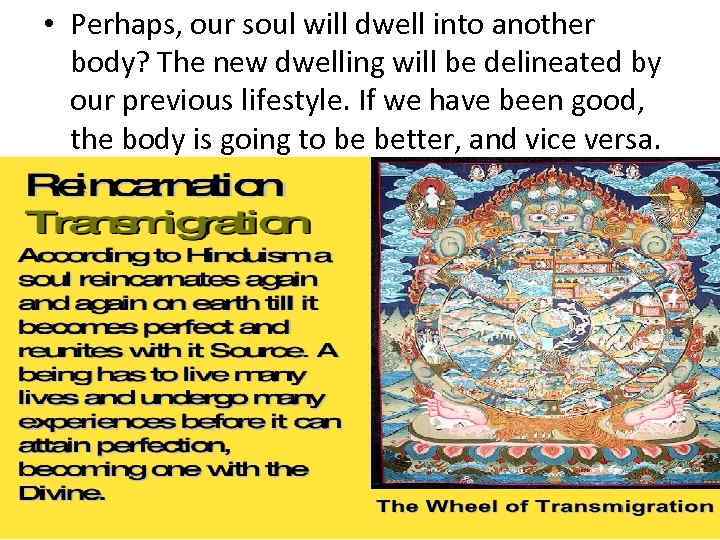 • Perhaps, our soul will dwell into another body? The new dwelling will be delineated by our previous lifestyle. If we have been good, the body is going to be better, and vice versa.
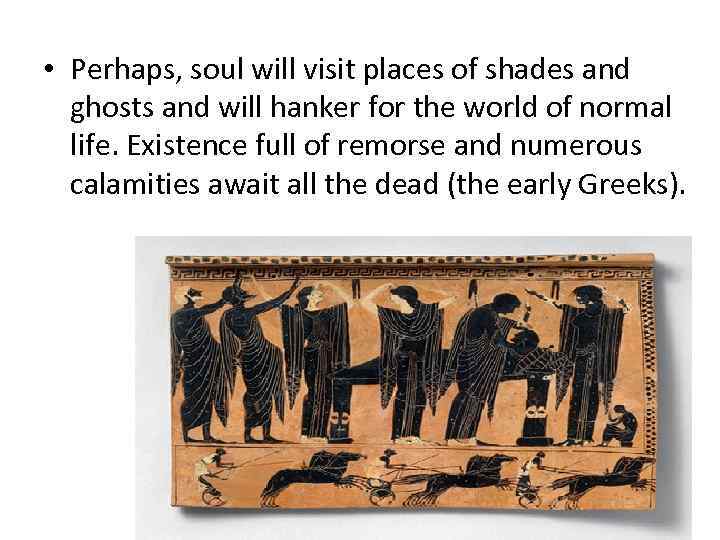 • Perhaps, soul will visit places of shades and ghosts and will hanker for the world of normal life. Existence full of remorse and numerous calamities await all the dead (the early Greeks).
 • Ether was the least material form of the substance out of which everything is made. • Anaximenes – the air is the essence of everything; soul is a rarefied air. It is because of its existence that my body does not fall apart. • Pythagoras – our bodily life pre-determines our next life. The adherence to involved and strict rules was deemed a necessary measure in order to insure that a favorable twist happens in our lives to come.
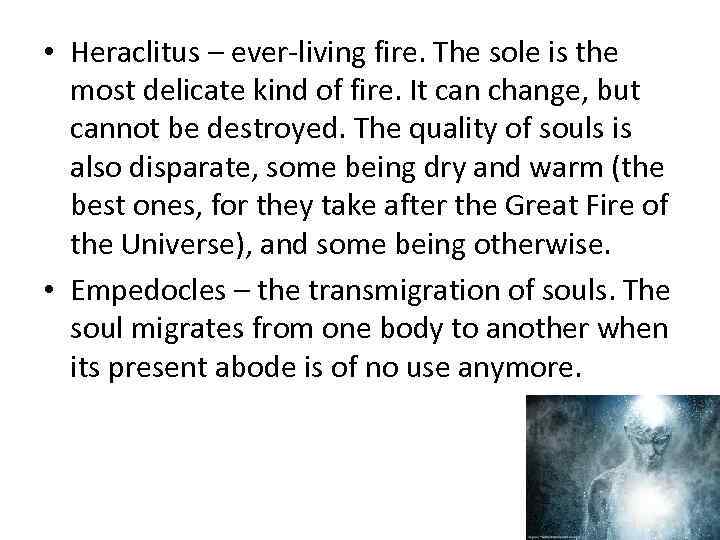 • Heraclitus – ever-living fire. The sole is the most delicate kind of fire. It can change, but cannot be destroyed. The quality of souls is also disparate, some being dry and warm (the best ones, for they take after the Great Fire of the Universe), and some being otherwise. • Empedocles – the transmigration of souls. The soul migrates from one body to another when its present abode is of no use anymore.
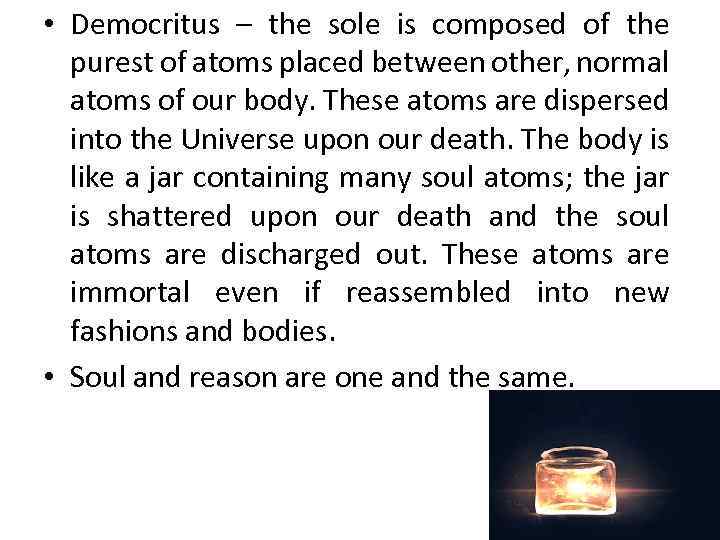 • Democritus – the sole is composed of the purest of atoms placed between other, normal atoms of our body. These atoms are dispersed into the Universe upon our death. The body is like a jar containing many soul atoms; the jar is shattered upon our death and the soul atoms are discharged out. These atoms are immortal even if reassembled into new fashions and bodies. • Soul and reason are one and the same.
 • Plato – Demiurge conferred a soul on this world. It is between the world of ideas and the world of physical reality. It orders the world through certain laws. • All planets and people have souls. We saw all pure ideas in the realm of perfectness. Body is a cloud preventing us understanding the world of ideas. • Knowledge is only a recollection of what has been forgotten due to the bodily experiences. The soul is immortal, for it is too simple; it’s life itself and cannot become not-life.
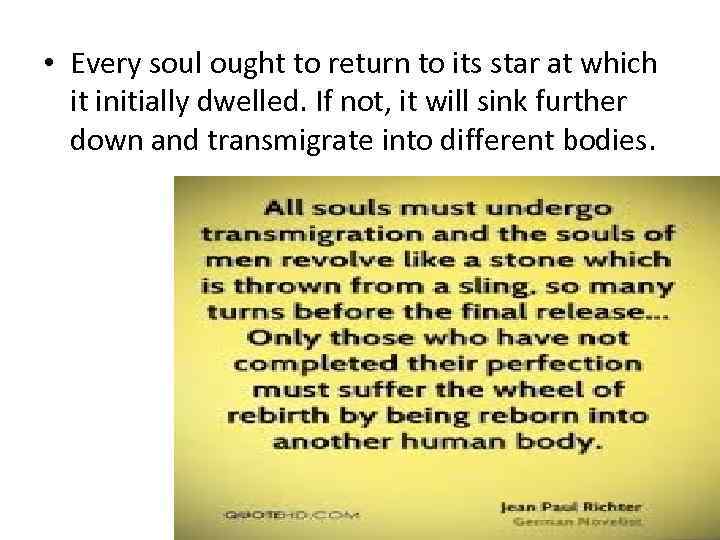 • Every soul ought to return to its star at which it initially dwelled. If not, it will sink further down and transmigrate into different bodies.
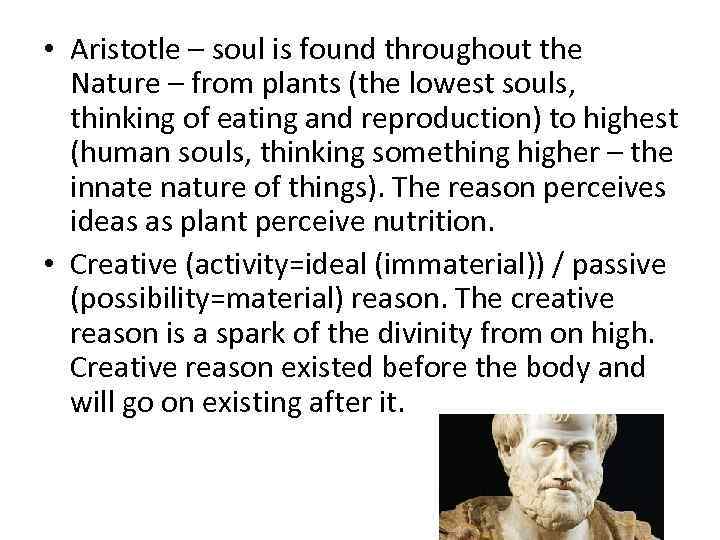 • Aristotle – soul is found throughout the Nature – from plants (the lowest souls, thinking of eating and reproduction) to highest (human souls, thinking something higher – the innate nature of things). The reason perceives ideas as plant perceive nutrition. • Creative (activity=ideal (immaterial)) / passive (possibility=material) reason. The creative reason is a spark of the divinity from on high. Creative reason existed before the body and will go on existing after it.
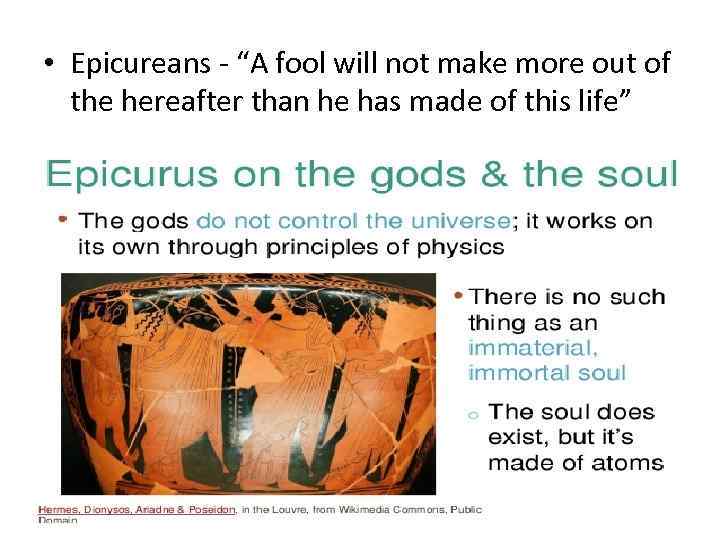 • Epicureans - “A fool will not make more out of the hereafter than he has made of this life”
 • Stoics – man is both soul and body. Soul is a spark from the Devine fire run by a ruling part situated in the heart. It is a blank tablet impressions are written upon. It is like a wax slab! Only good and wise souls went on living after death of the body.
 • Plotinus – we are part of the World Soul. Once we saw it and knew all that is good from it. But we desired to mould matter and turned our back on the Soul. If soul fails to break free from matter, it will enter another body of a man, a plant, or an animal.
 • Apologists – the good part of the Universe is neatly represented through our reasoning capability, which is immortal and have to live in the resurrected body. Death is a refinement of body so that it can become the dwelling place for soul throughout eternity.
 • Augustine – the body is a prison house of the soul, the latter being absolutely disparate from it. The soul is a governing principle of everything in the body. The soul is not there before the existence of the body; it’s individual. During the earthly existence we are to curry favor of God; otherwise, eternal misery is our lot. • Thomas Aquinas – the soul goes on existing after death just as it did while the body was alive. It forms for itself a spiritual body to function through for good (The orthodox position of the Church).
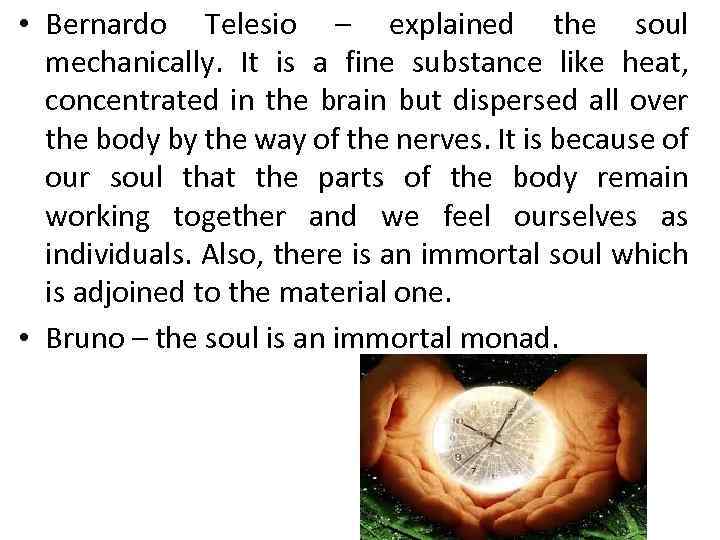 • Bernardo Telesio – explained the soul mechanically. It is a fine substance like heat, concentrated in the brain but dispersed all over the body by the way of the nerves. It is because of our soul that the parts of the body remain working together and we feel ourselves as individuals. Also, there is an immortal soul which is adjoined to the material one. • Bruno – the soul is an immortal monad.
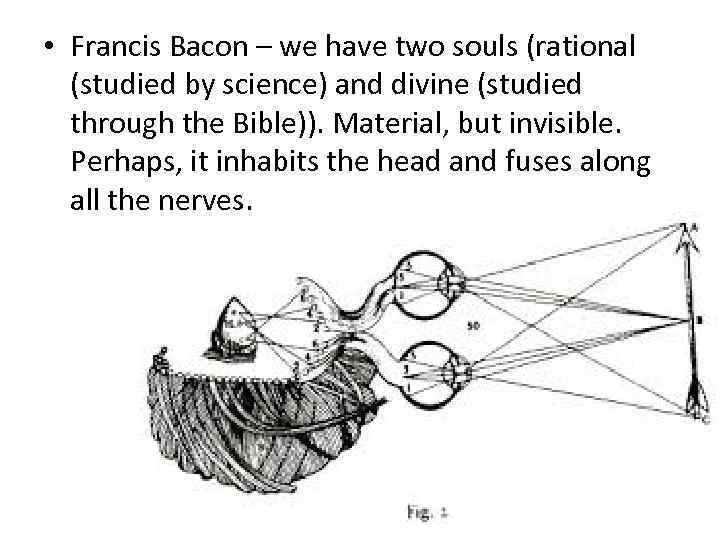 • Francis Bacon – we have two souls (rational (studied by science) and divine (studied through the Bible)). Material, but invisible. Perhaps, it inhabits the head and fuses along all the nerves.
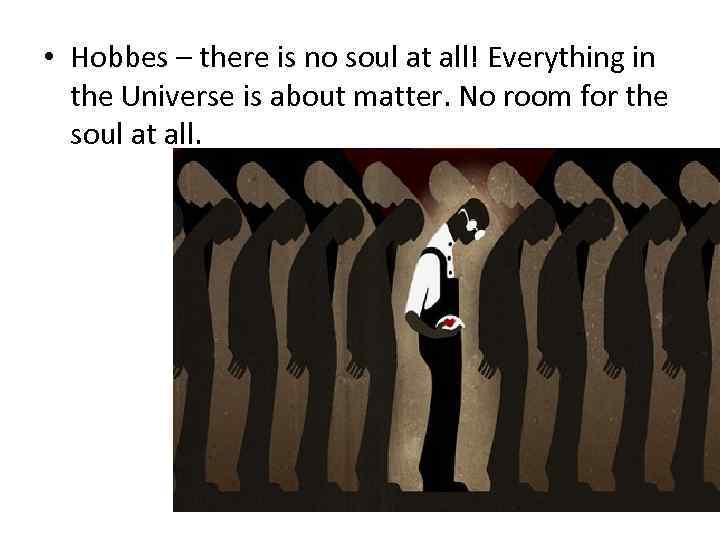 • Hobbes – there is no soul at all! Everything in the Universe is about matter. No room for the soul at all.
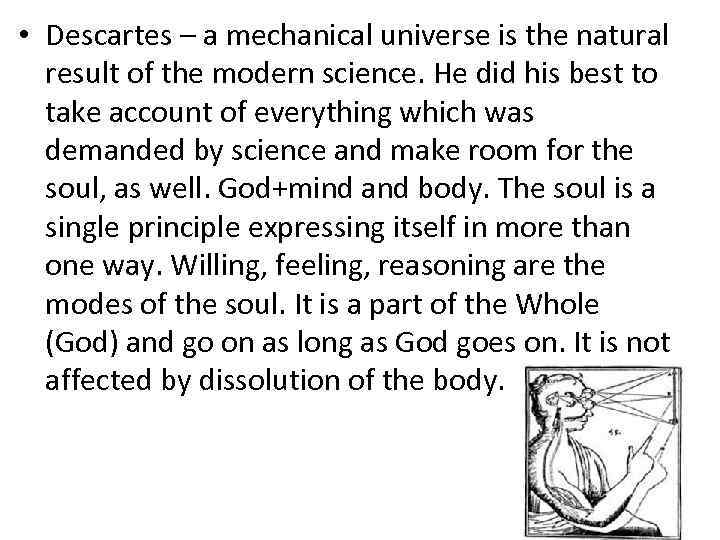 • Descartes – a mechanical universe is the natural result of the modern science. He did his best to take account of everything which was demanded by science and make room for the soul, as well. God+mind and body. The soul is a single principle expressing itself in more than one way. Willing, feeling, reasoning are the modes of the soul. It is a part of the Whole (God) and go on as long as God goes on. It is not affected by dissolution of the body.
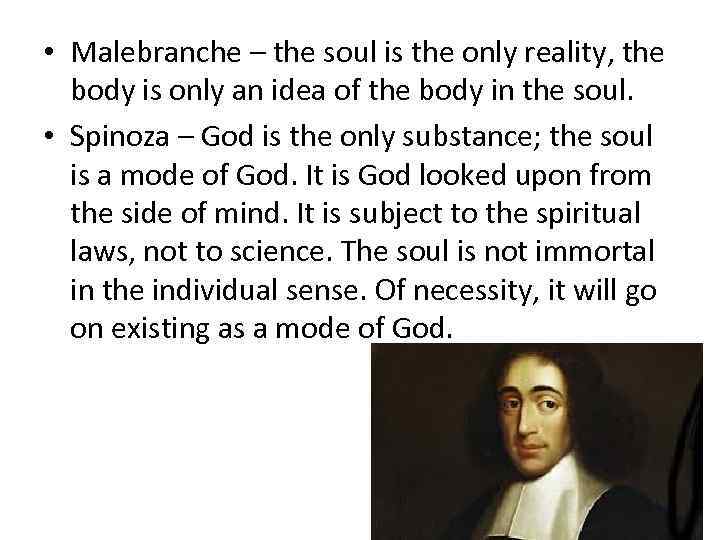 • Malebranche – the soul is the only reality, the body is only an idea of the body in the soul. • Spinoza – God is the only substance; the soul is a mode of God. It is God looked upon from the side of mind. It is subject to the spiritual laws, not to science. The soul is not immortal in the individual sense. Of necessity, it will go on existing as a mode of God.
 • John Lock – the soul is a spiritual substance. Willing, knowing should have some ground to be propped up by. It is influenced (thus ideas are generated) and influences (thus movement is brought about). The afterlife is something taken on faith.
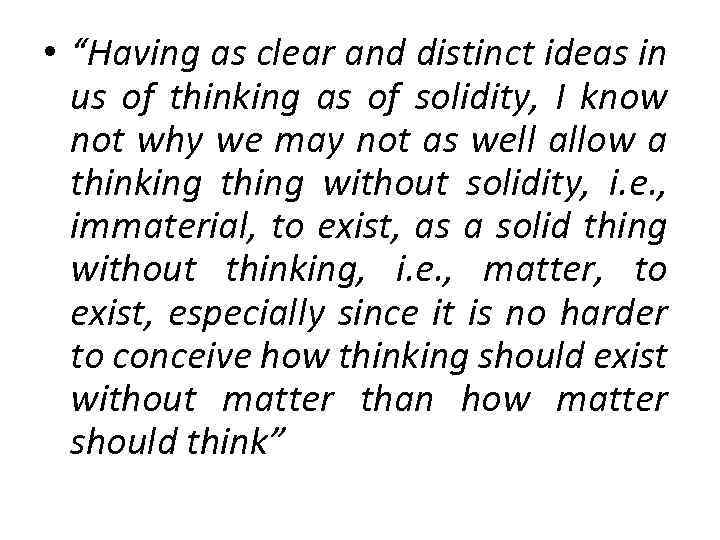 • “Having as clear and distinct ideas in us of thinking as of solidity, I know not why we may not as well allow a thinking thing without solidity, i. e. , immaterial, to exist, as a solid thing without thinking, i. e. , matter, to exist, especially since it is no harder to conceive how thinking should exist without matter than how matter should think”
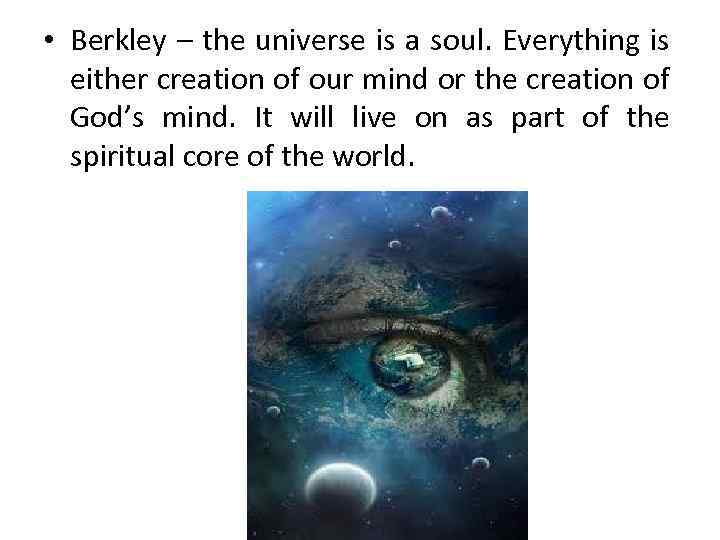 • Berkley – the universe is a soul. Everything is either creation of our mind or the creation of God’s mind. It will live on as part of the spiritual core of the world.
 • Hume – no certitude is there either about the matter or mind! Agnosticism as far as the soul is concerned. Mind is a jumble of perceptions. • “When I enter intimately upon what I call myself, I always stumble on some particular perception or other, of heat or cold light or shade, love or hatred, pain or pleasure. I never catch myself, at any time, without a perception, and never can observe anything but the perception”
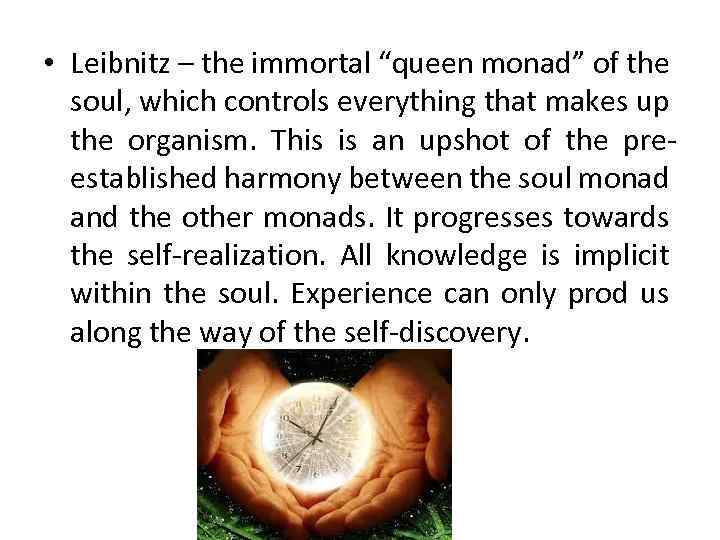 • Leibnitz – the immortal “queen monad” of the soul, which controls everything that makes up the organism. This is an upshot of the preestablished harmony between the soul monad and the other monads. It progresses towards the self-realization. All knowledge is implicit within the soul. Experience can only prod us along the way of the self-discovery.
 • Kant – we can know only that which is experienced. But we can think about the transcendent principles, too! • Soul can be efficaciously thought about as a summation of all mental processes. There is no knowledge without a knower, so let us act as if the soul really existed for the regulative purposes; it can serve as a linchpin for our conscious experiences. It is a basis for the moral law. The good will must be practicable. Immortality is necessary in order for the moral law to be enforced completely.
 • Fichte - “post-Kantian idealism”. The ego is the inventor of the world that we are acquainted with. Man comprehend only that which he has fashioned himself. God’s ego is the foundation for the individual ego, the ego of every person who lives. This ego is shuttered into bits which are the egos of individual persons just as light might be fragmented into bits but is not cut off from the source. The individual ego, because of the moral law which it finds within itself, as Kant had held, must go on struggling and therefore must be immortal.
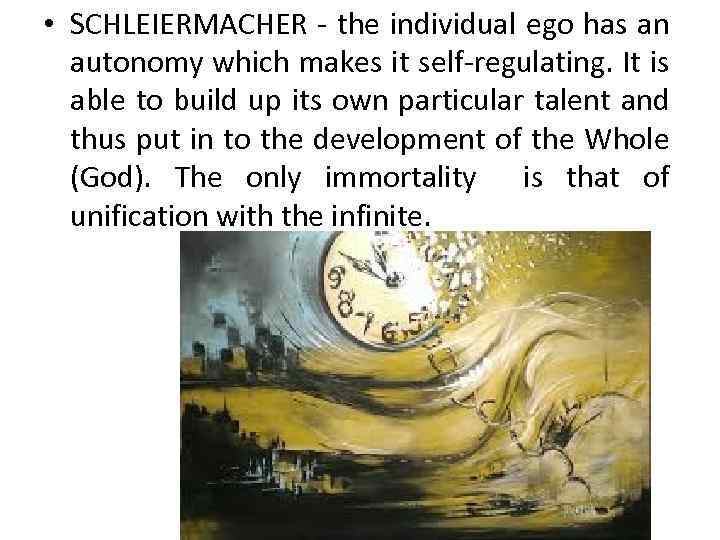 • SCHLEIERMACHER - the individual ego has an autonomy which makes it self-regulating. It is able to build up its own particular talent and thus put in to the development of the Whole (God). The only immortality is that of unification with the infinite.
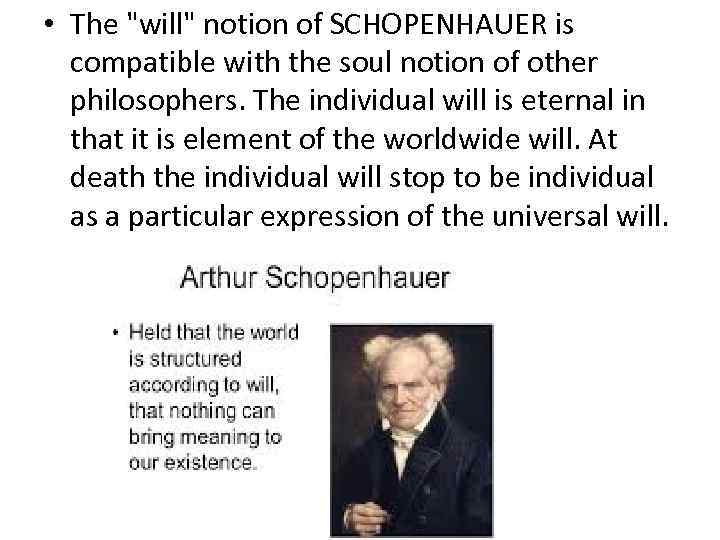 • The "will" notion of SCHOPENHAUER is compatible with the soul notion of other philosophers. The individual will is eternal in that it is element of the worldwide will. At death the individual will stop to be individual as a particular expression of the universal will.
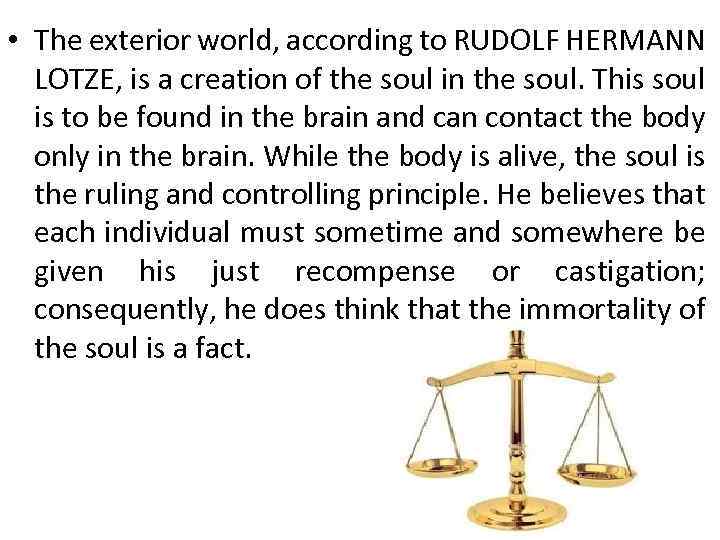 • The exterior world, according to RUDOLF HERMANN LOTZE, is a creation of the soul in the soul. This soul is to be found in the brain and can contact the body only in the brain. While the body is alive, the soul is the ruling and controlling principle. He believes that each individual must sometime and somewhere be given his just recompense or castigation; consequently, he does think that the immortality of the soul is a fact.
 • The position of the majority of the modern philosophers is that the body is capable to act in certain ways which show a high degree of intelligence - "minded action". • Man is a being who, because of his long and highly specialized evolutionary development, is able to do certain things wholly impossible at any other level of the evolutionary process. He is able to reason, think, plan and carry out the results of his planning, is ableto conceive spiritual values and strive for their realization
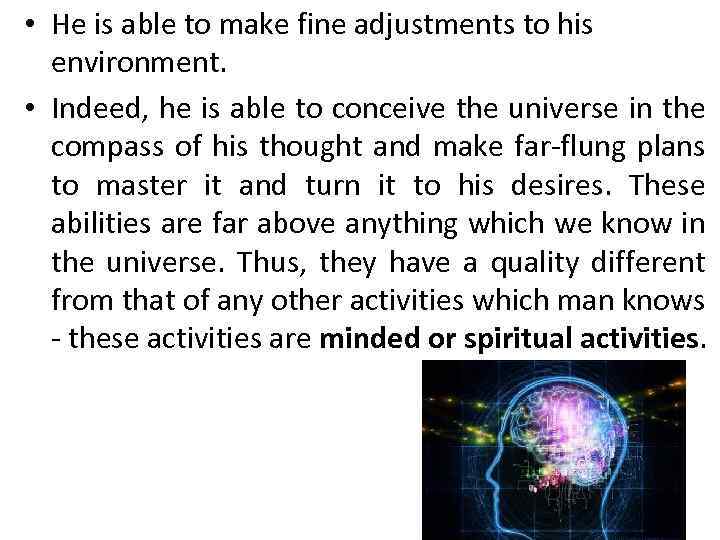 • He is able to make fine adjustments to his environment. • Indeed, he is able to conceive the universe in the compass of his thought and make far-flung plans to master it and turn it to his desires. These abilities are far above anything which we know in the universe. Thus, they have a quality different from that of any other activities which man knows - these activities are minded or spiritual activities.
 • They normally admit that they know nothing of a soul which is distinct from the body • The present-day interest in science & the general conviction that it is dangerous to go beyond what is observable. • Modern thought, therefore, turns to man and to his life between birth and the grave, for a locus of its values.
 • The Behavioristic psychology - behavior as the thing to watch; behavior as seen by an observer is the alpha and omega of a scientific study of man • To account for man's ability to think and to reason on the basis of his possessing of a mind or soul deemed to be a dodging of the issue. • They think that man who thinks does not have a mind distinct from the body with which he thinks.
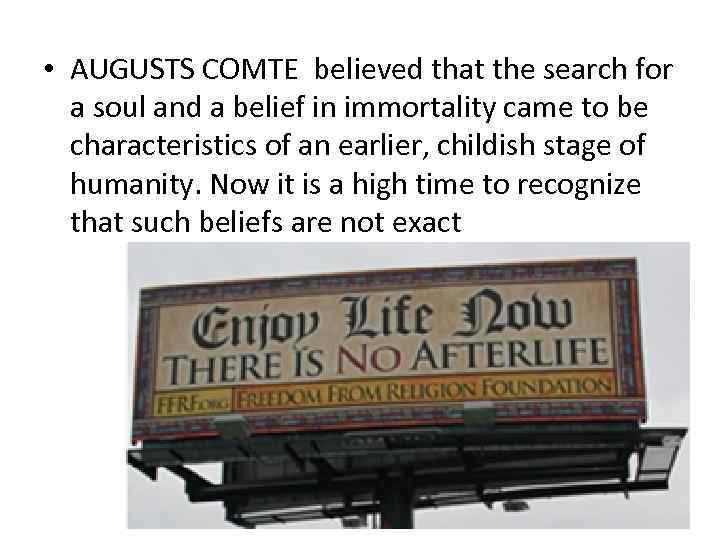 • AUGUSTS COMTE believed that the search for a soul and a belief in immortality came to be characteristics of an earlier, childish stage of humanity. Now it is a high time to recognize that such beliefs are not exact
 • WILLIAM JAMES - belief in the soul has a certain usefulness in man's moral life, but is not a product of a careful thought. JOHN DEWEY - the doctrine of the soul may be definitely harmful since it carries a load of tradition which weights man down or causes him to give up altogether the attempt to understand the workings of the world.
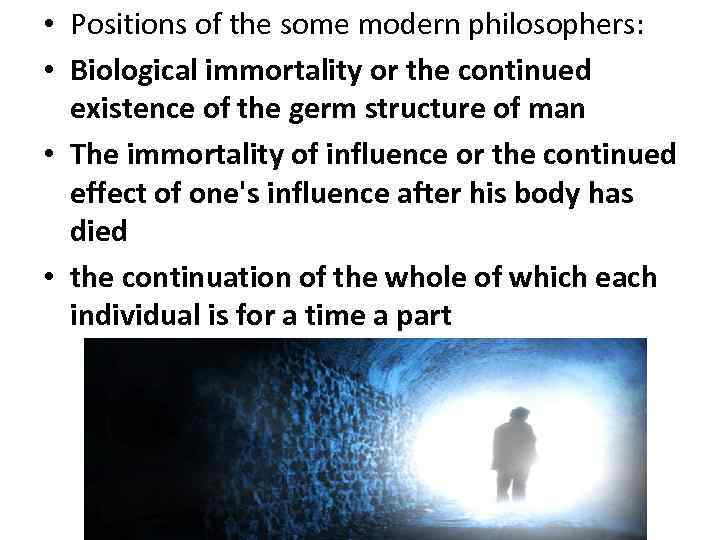 • Positions of the some modern philosophers: • Biological immortality or the continued existence of the germ structure of man • The immortality of influence or the continued effect of one's influence after his body has died • the continuation of the whole of which each individual is for a time a part
 There still remain many philosophers, influenced by the religious tradition, who attempt to interpret the term “soul” and the accompanying term "immortality” in such a way that both can be fitted into the scheme of modem science without too much twisting and turning.
 • “Just as our body, which God creates from elements, needs the spirit to command govern it, the universe (and what it contains) needs God to bring it into existence and to command govern it. • The spirit is not located in any specific place or part of the body. It may even leave the body and, as in the case of dreams, continue its relation with the body by means of a specific cord attached to the body. Likewise, God Almighty is not contained by time or space. He is always present everywhere and nowhere, whereas the spirit is in the body and is contained by time and space.
 • • There is only one sun, and the world is very far from it. However, the sun is present everywhere through its heat and light, and via reflection can even be in every transparent thing. Therefore, we can say that the sun is nearer to things than things are to themselves. The spirit has the same relation with the body, as well as with all of its separate cells. This analogy may help us to understand God's relation with existence. He controls and directs all things at the same time like a single thing, and although we are infinitely distant from Him, He is nearer to us than we are to ourselves.
 • • The spirit is invisible, and its nature is unknown. In the same way, we cannot think of or imagine God as He really is, for His Essence cannot be known. Like the spirit, God Almighty is known via the manifestations of His Names, Attributes, and Essence. • Our spirit has its own cover. When the spirit leaves the body at death, it retains this cover, which is like a body's "negative" It is called by many names: the envelope of light, the person's ethereal figure, energetic form, second body, astral body, double (of that person), and phantom”