 Скачать презентацию Soros Foundations Open Society Fund Bosnia and Herzegovina
9116e6b15e032343a6d212c460dee9bd.ppt
- Количество слайдов: 28



Soros Foundations Open Society Fund Bosnia and Herzegovina MIT Center Sarajevo DEALER Distance Education And Learning Repository The First Draft Idea Zlatan Sabic Sarajevo, July 1998
Basic presumption To support educators by interactive distance learning technologies WE should NOT think of ways how educators SHOULD work, but think instead how educators REALLY work What are their PROBLEMS? How can we help solve them?
Modern Educator’s Problems 4 Need for rapid updates in curricula 4 Curricula more complex 4 Audiences more complex 4 High preparation costs 4 Multiple learning sites (class, home. . ) 4 Technology innovations continuous 4 Teaching cooperation needed to manage complexity
Need for rapid updates in curricula 4 Knowledge and technology continuously changing 4 Innovative education demands continuous change in course curricula 4 Rapid updates critical 4 PROBLEMS – high costs for high quality updates – need high quality content – need rapid and timely access – need ‘digestible’ formats
Curricula more complex 4 Some critical technical content may be needed across several courses 4 PROBLEMS – core content may be difficult to parse across multiple contexts – organization of core content within different contexts
Audiences more complex 4 Even if the content is located only in one course, different audiences require different approaches 4 PROBLEMS – small changes in lessons produce "versions" confusion – lessons need to be well-organized to recognize small differences
High preparation costs 4 "Construction" of new courses based on existing and new material needs to be fast 4 PROBLEMS – too much time ‘removing’ the updatable core lessons from needed context – problems with course scope and sequence can become critical
Multiple learning sites 4 Teachers and students work on computers in classrooms and at home 4 Distance learning creates multiple course sites PROBLEMS – Different learning environments may need different approaches and materials
Technology innovations continuous 4 It is hard to survive as modern and successful educators without continuous adopting of new technologies 4 PROBLEMS – technology dependant teaching materials are too time-expensive (need for structure and technology conversions) – educator has to spend some time to learn the use of technology
Teaching cooperation 4 The most of the topics are too complex for only one educator 4 Cooperation synergy can be very "profitable" 4 PROBLEMS – cooperation coordination – again context dependance of lessons – incompatibility of formats (technology dependance)
What to do? 4 Develop smaller units with more complex organization 4 Downsize lessons – make content loosely coupled with context – make content easy to access and update 4 More complex organization – use multiple criteria to classify modules – faster searches for appropriate lesson – design more rapid ways to update curriculum
Downsizing lessons Small Can Be Beautiful ! A lesson can be constructed using a Learning Module format (comparable to 15 min. - 1 hour of instruction) Each lesson can contain commercial and/or professionally-created materials and/or digitized objects in hardcopy, on the Internet or on CD ROM
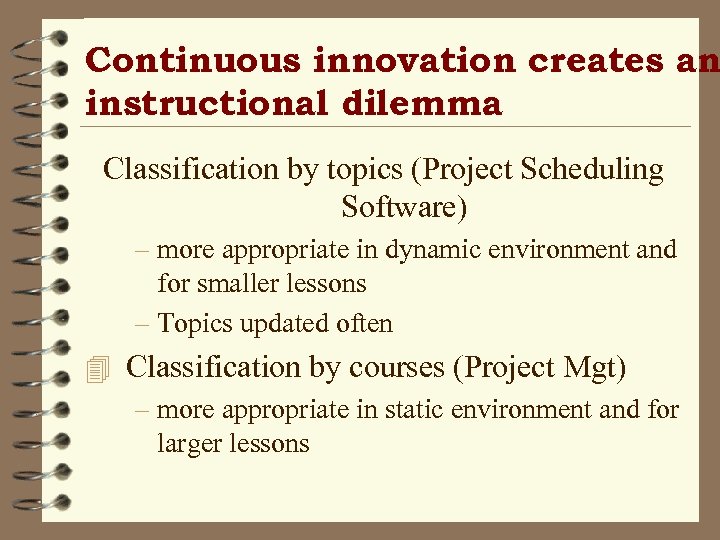
Continuous innovation creates an instructional dilemma Classification by topics (Project Scheduling Software) – more appropriate in dynamic environment and for smaller lessons – Topics updated often 4 Classification by courses (Project Mgt) – more appropriate in static environment and for larger lessons
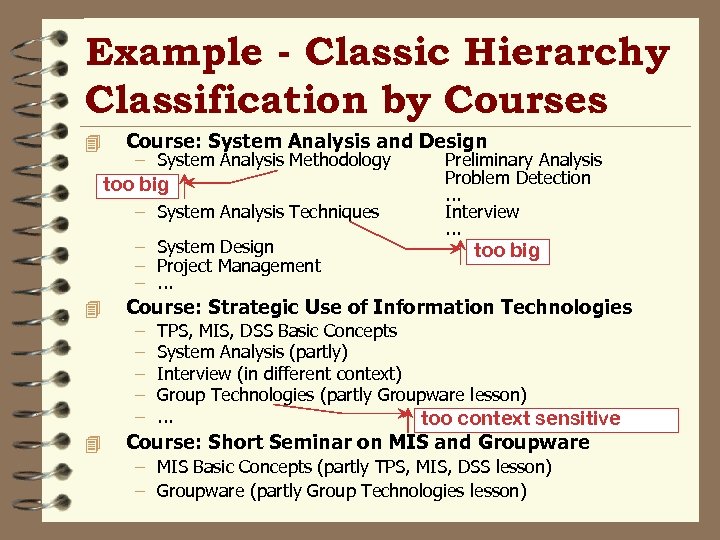
Example - Classic Hierarchy Classification by Courses 4 Course: System Analysis and Design – System Analysis Methodology too big – System Analysis Techniques – System Design – Project Management –. . . 4 4 Preliminary Analysis Problem Detection. . . Interview. . . too big Course: Strategic Use of Information Technologies – – – TPS, MIS, DSS Basic Concepts System Analysis (partly) Interview (in different context) Group Technologies (partly Groupware lesson). . . too context sensitive Course: Short Seminar on MIS and Groupware – MIS Basic Concepts (partly TPS, MIS, DSS lesson) – Groupware (partly Group Technologies lesson)
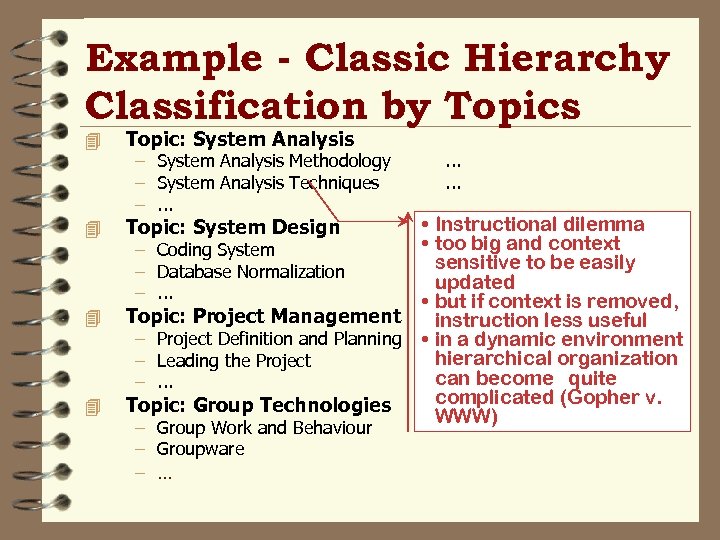
Example - Classic Hierarchy Classification by Topics 4 4 Topic: System Analysis – System Analysis Methodology – System Analysis Techniques –. . • Instructional dilemma • too big and context – Coding System sensitive to be easily – Database Normalization updated –. . . • but if context is removed, Topic: Project Management instruction less useful – Project Definition and Planning • in a dynamic environment hierarchical organization – Leading the Project can become quite –. . . complicated (Gopher v. Topic: Group Technologies WWW) Topic: System Design – Group Work and Behaviour – Groupware –. . .
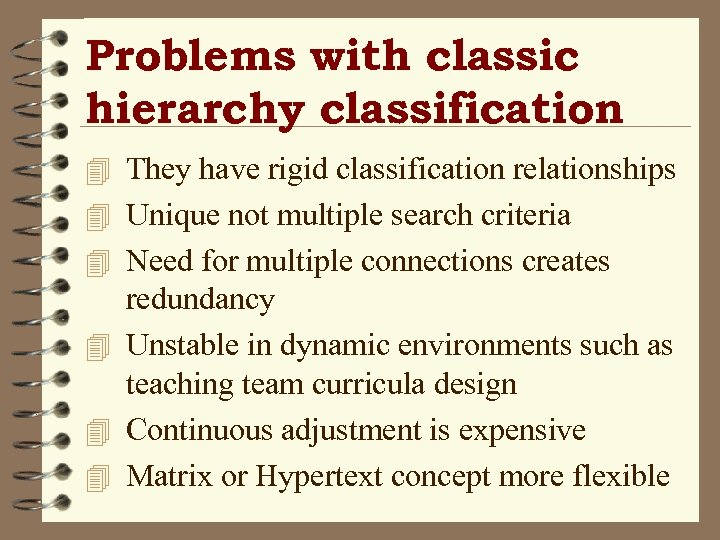
Problems with classic hierarchy classification 4 They have rigid classification relationships 4 Unique not multiple search criteria 4 Need for multiple connections creates redundancy 4 Unstable in dynamic environments such as teaching team curricula design 4 Continuous adjustment is expensive 4 Matrix or Hypertext concept more flexible
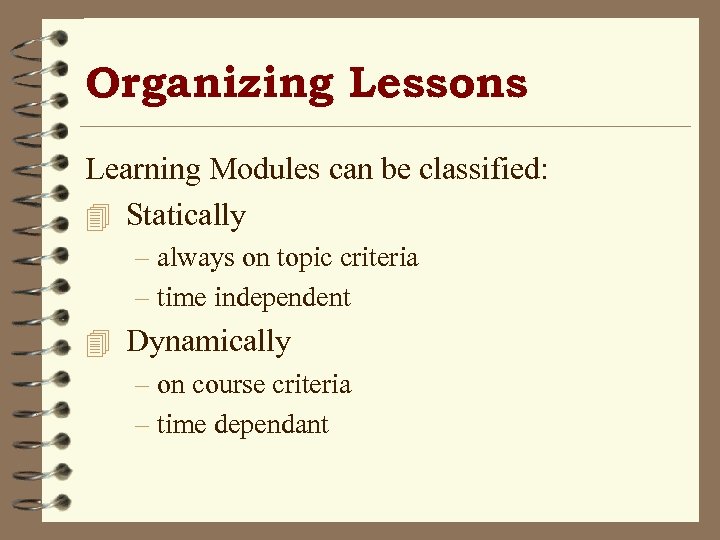
Organizing Lessons Learning Modules can be classified: 4 Statically – always on topic criteria – time independent 4 Dynamically – on course criteria – time dependant
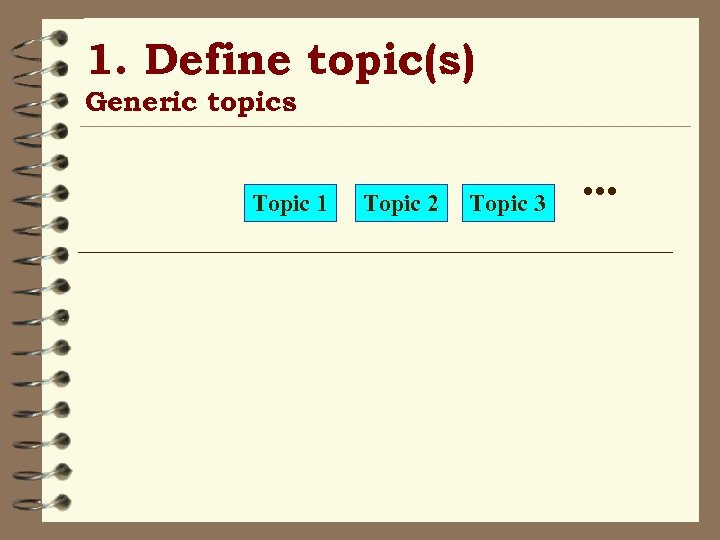
1. Define topic(s) Generic topics Topic 1 Topic 2 Topic 3 . . .
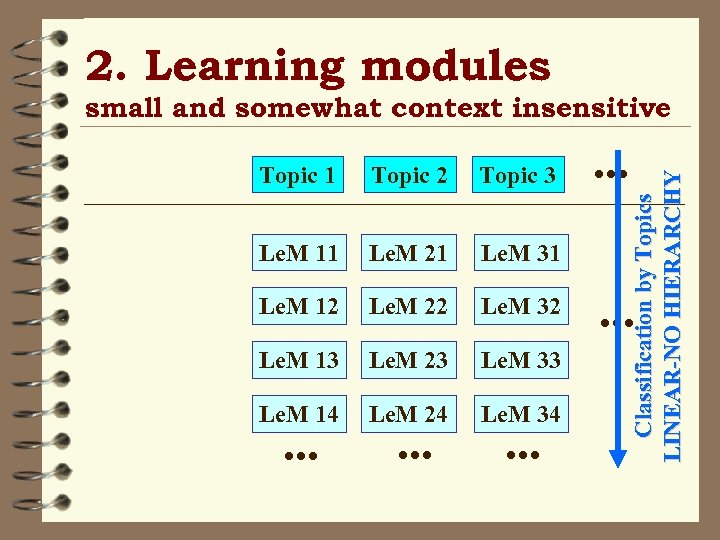
2. Learning modules Topic 1 Topic 2 Topic 3 Le. M 11 Le. M 21 Le. M 31 Le. M 12 Le. M 22 Le. M 32 Le. M 13 Le. M 23 Le. M 33 Le. M 14 Le. M 24 Le. M 34 . . . Classification by Topics LINEAR-NO HIERARCHY small and somewhat context insensitive . . .
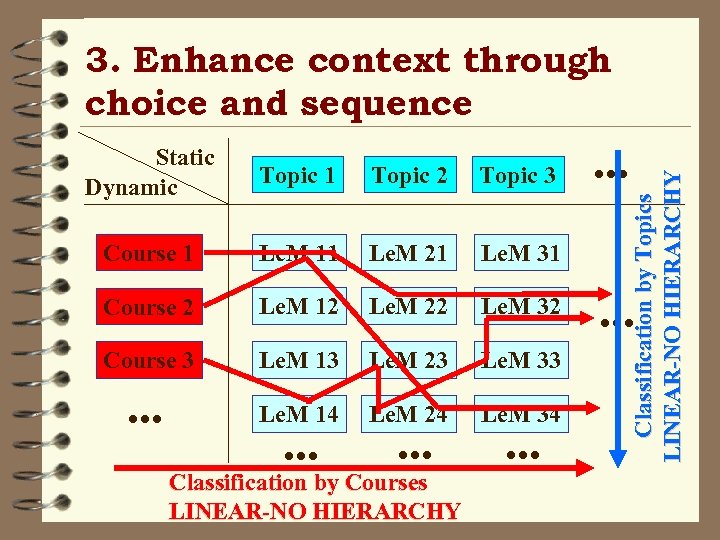
Static Dynamic Topic 1 Topic 2 Topic 3 Course 1 Le. M 11 Le. M 21 Le. M 31 Course 2 Le. M 12 Le. M 22 Le. M 32 Course 3 Le. M 13 Le. M 23 Le. M 33 . . . Le. M 14 Le. M 24 Le. M 34 . . . Classification by Courses LINEAR-NO HIERARCHY . . . Classification by Topics LINEAR-NO HIERARCHY 3. Enhance context through choice and sequence . . .
Small Modules + Matrix Structure 4 Simple 4 Flexible 4 Low maintenance 4 Technology independent 4 Can be created dynamically, step-by-step 4 Can be created and used by more than one educator
Creating Courses 4 Can be designed and updated quickly 4 Complex but not too complicated for users 4 Could be highly automated 4 Easy to test
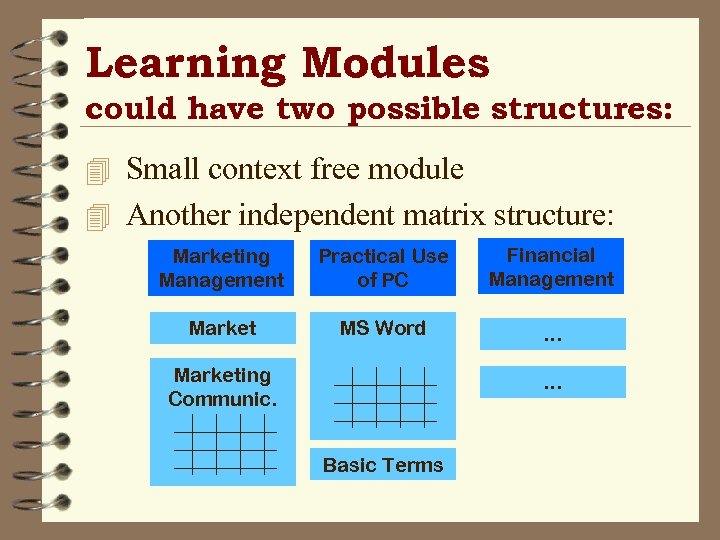
Learning Modules could have two possible structures: 4 Small context free module 4 Another independent matrix structure: Marketing Management Practical Use of PC Financial Management Market MS Word . . . Marketing Communic. . Basic Terms
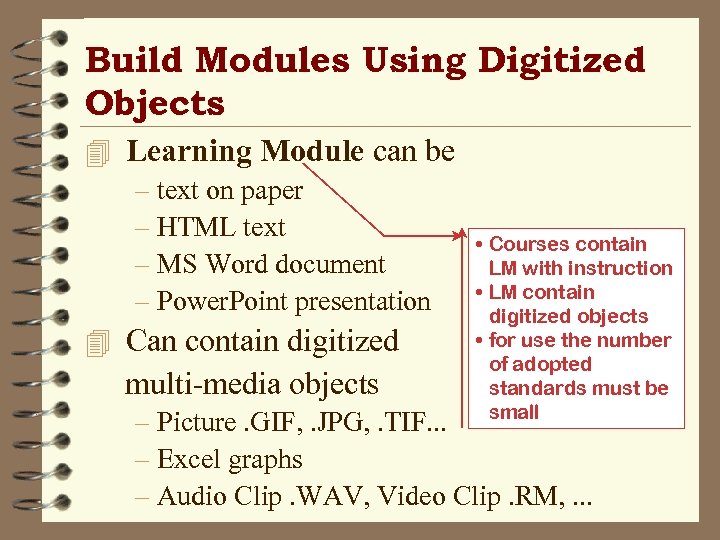
Build Modules Using Digitized Objects 4 Learning Module can be – text on paper – HTML text – MS Word document – Power. Point presentation 4 Can contain digitized multi-media objects • Courses contain LM with instruction • LM contain digitized objects • for use the number of adopted standards must be small – Picture. GIF, . JPG, . TIF. . . – Excel graphs – Audio Clip. WAV, Video Clip. RM, . . .
System management 4 Need to organize teaching groups 4 Small set of materials, use "paper" database – very simple and effective 4 By computer database – simple to construct – large scale of possible technologies (RDBMSs, ODBMSs, HTML+Java+CGI, macro languages, …)
In context of Soros DL Project 4 Tri-level structures create the possibility for 4 4 immediate work on materials restructuring Structures are simple to communicate 1 st level - unique materials and/or digitized objects and limited context 2 nd level- lessons with instruction and some context 3 rd level courses with rich context
Matrix structure for DEALER should be the main principle in every segment of the project: standards development, database development, materials restructuring, communication, cooperation with other institutions (GLEN), . . .
Soros Foundations Open Society Fund Bosnia and Herzegovina MIT Center Sarajevo LEMON Repository Learning Modules Network Repository END Zlatan Sabic Sarajevo, July 1998
Скачать презентацию Soros Foundations Open Society Fund Bosnia and Herzegovina
9116e6b15e032343a6d212c460dee9bd.ppt