


 Скачать презентацию Sophisticated academic writing Kate Howard 2015 Layout
Academic writing.pptx
- Количество слайдов: 17
 Sophisticated academic writing Kate Howard 2015
 Layout of session: - Expectations Critically discussing excerpts from two essays Paragraphs Signposting and useful phrases Editing Quick tips from UCL professors
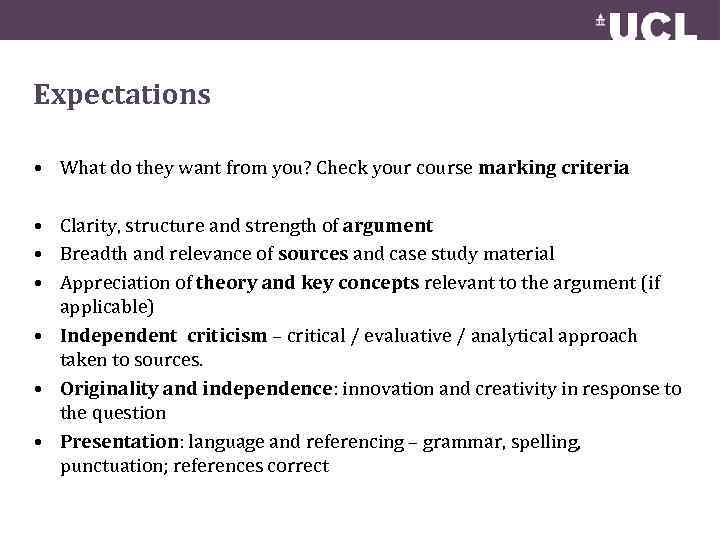 Expectations • What do they want from you? Check your course marking criteria • Clarity, structure and strength of argument • Breadth and relevance of sources and case study material • Appreciation of theory and key concepts relevant to the argument (if applicable) • Independent criticism – critical / evaluative / analytical approach taken to sources. • Originality and independence: innovation and creativity in response to the question • Presentation: language and referencing – grammar, spelling, punctuation; references correct
 In pairs, discuss what is good and bad about these two essay excerpts. Title: “Using examples, critically examine the types of roles civil society organisations (CSOs) play, or might play, in global health governance (GHG). ”
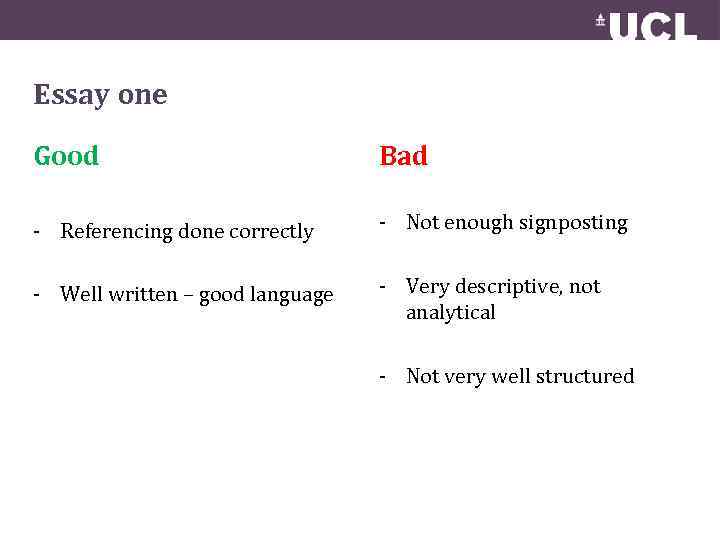 Essay one Good Bad - Referencing done correctly - Not enough signposting - Well written – good language - Very descriptive, not analytical - Not very well structured
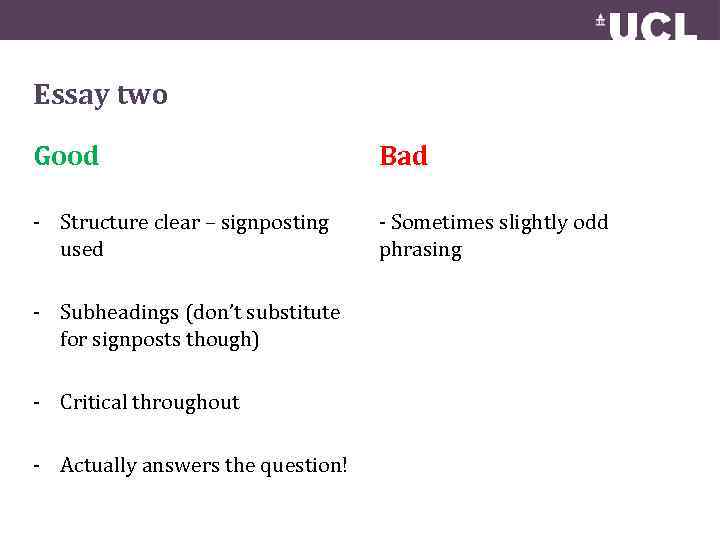 Essay two Good Bad - Structure clear – signposting used - Sometimes slightly odd phrasing - Subheadings (don’t substitute for signposts though) - Critical throughout - Actually answers the question!
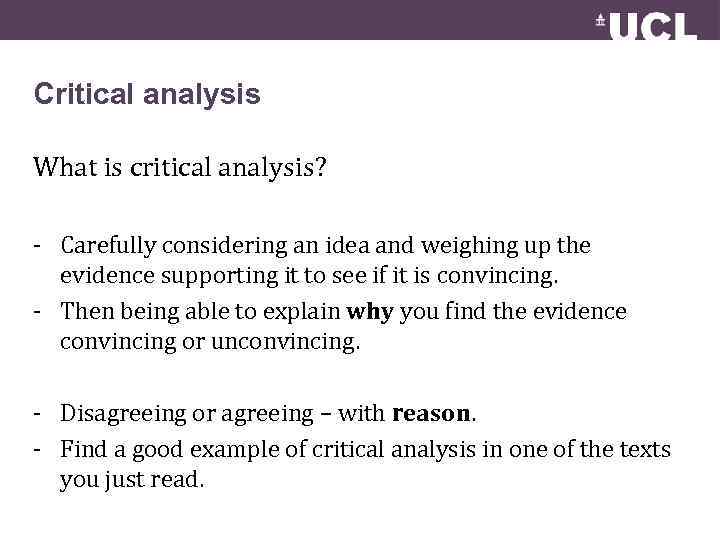 Critical analysis What is critical analysis? - Carefully considering an idea and weighing up the evidence supporting it to see if it is convincing. - Then being able to explain why you find the evidence convincing or unconvincing. - Disagreeing or agreeing – with reason. - Find a good example of critical analysis in one of the texts you just read.
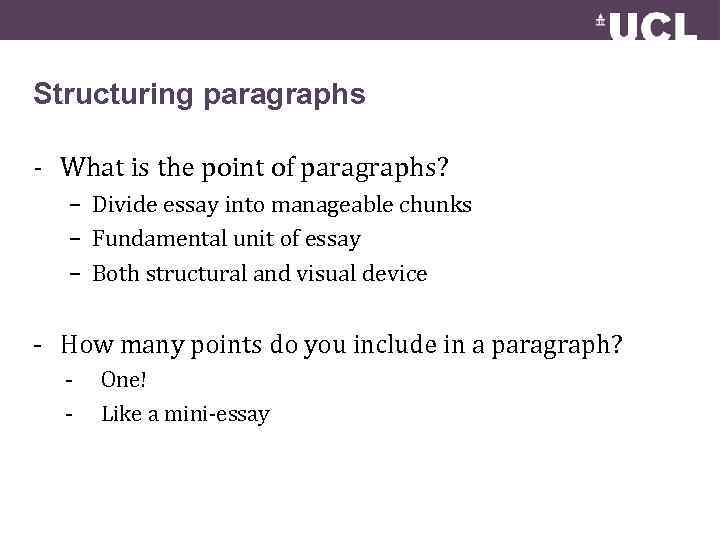 Structuring paragraphs - What is the point of paragraphs? – Divide essay into manageable chunks – Fundamental unit of essay – Both structural and visual device - How many points do you include in a paragraph? - One! Like a mini-essay
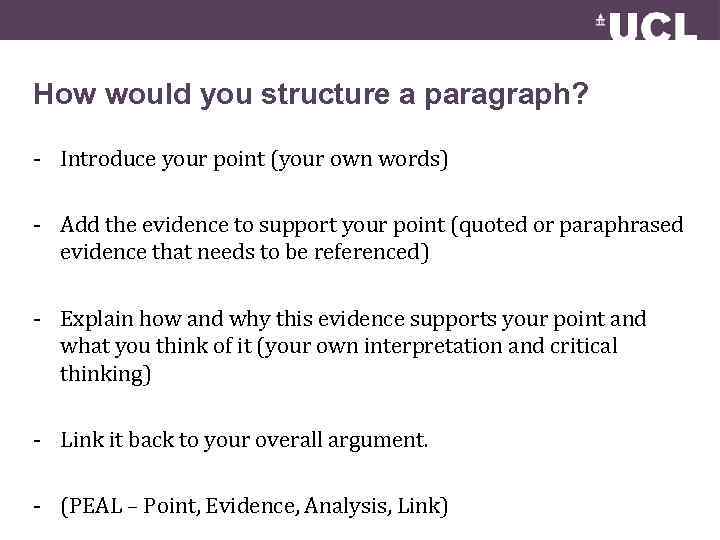 How would you structure a paragraph? - Introduce your point (your own words) - Add the evidence to support your point (quoted or paraphrased evidence that needs to be referenced) - Explain how and why this evidence supports your point and what you think of it (your own interpretation and critical thinking) - Link it back to your overall argument. - (PEAL – Point, Evidence, Analysis, Link)
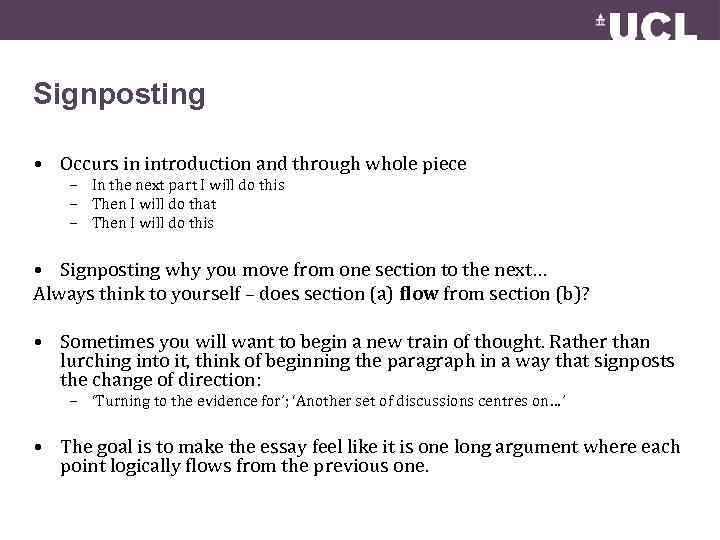 Signposting • Occurs in introduction and through whole piece – In the next part I will do this – Then I will do that – Then I will do this • Signposting why you move from one section to the next… Always think to yourself – does section (a) flow from section (b)? • Sometimes you will want to begin a new train of thought. Rather than lurching into it, think of beginning the paragraph in a way that signposts the change of direction: – ‘Turning to the evidence for’; ‘Another set of discussions centres on…’ • The goal is to make the essay feel like it is one long argument where each point logically flows from the previous one.
 Useful phrases - In groups. Each group will be assigned either: Emphasising a point, Introducing a new idea, Discussion markers or Summing up. - Think about what function your section has. Come up with five phrases that you think will be important to use in your section.
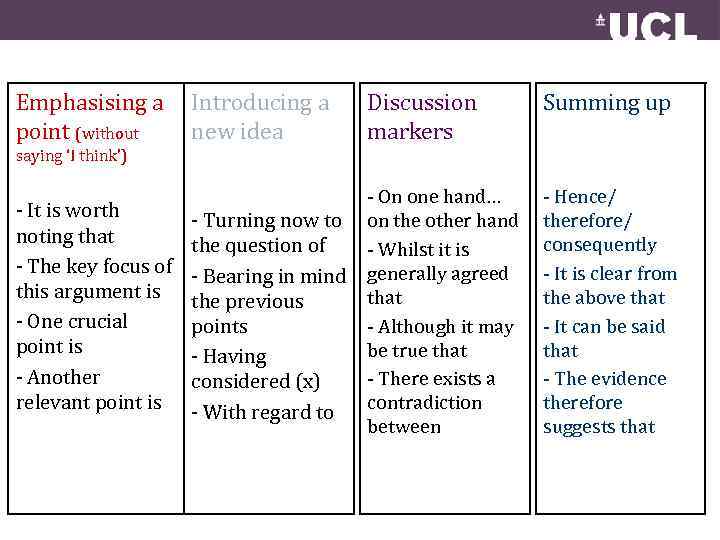 Emphasising a Introducing a point (without new idea Discussion markers Summing up saying ‘I think’) - On one hand… - It is worth - Turning now to on the other hand noting that the question of - Whilst it is - The key focus of - Bearing in mind generally agreed this argument is the previous that - One crucial - Although it may points point is be true that - Having - Another - There exists a considered (x) relevant point is - With regard to contradiction between - Hence/ therefore/ consequently - It is clear from the above that - It can be said that - The evidence therefore suggests that
 Editing ALWAYS check your work thoroughly. Common problem areas to check for: 1) Spelling 2) Conjugations (3 rd person) 3) Consistent use of verb tenses 4) Whether you’ve used the correct form of a word or not (eg verb/noun/adjective) 5) Articles Change words that are cliched/informal Things to cut: - Excessive adjectives - Any sentences that do not directly add to your argument. - Golden rule: If you can take out a word or sentence, and your essay still makes sense, TAKE IT OUT.
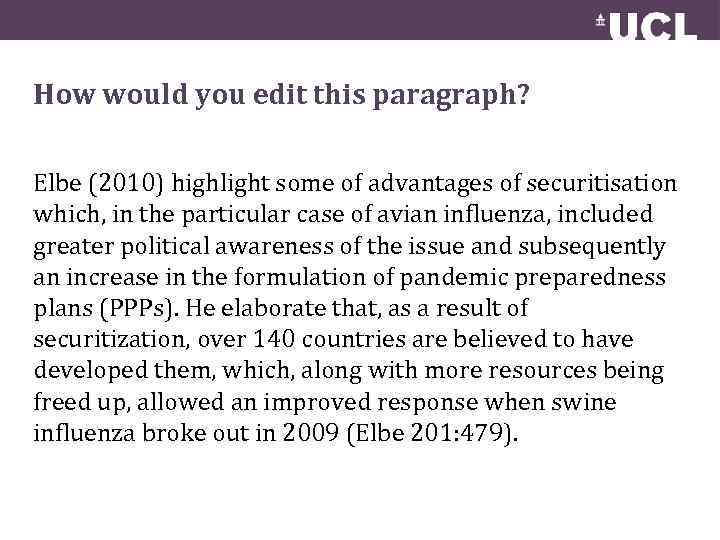 How would you edit this paragraph? Elbe (2010) highlight some of advantages of securitisation which, in the particular case of avian influenza, included greater political awareness of the issue and subsequently an increase in the formulation of pandemic preparedness plans (PPPs). He elaborate that, as a result of securitization, over 140 countries are believed to have developed them, which, along with more resources being freed up, allowed an improved response when swine influenza broke out in 2009 (Elbe 201: 479).
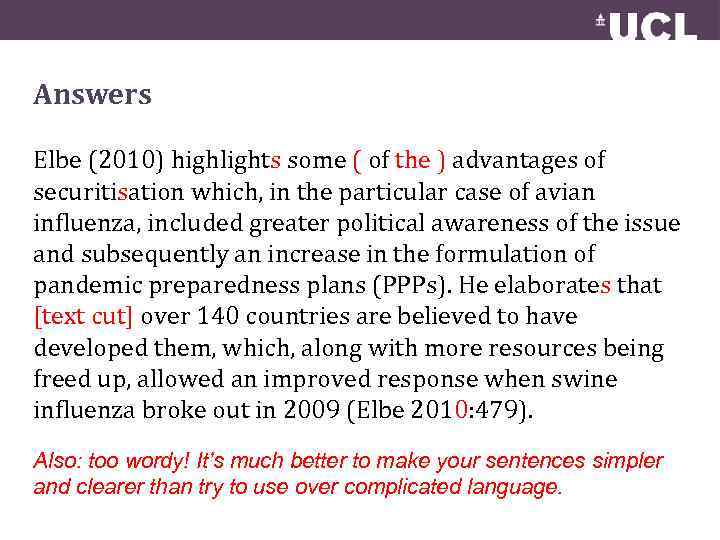 Answers Elbe (2010) highlights some ( of the ) advantages of securitisation which, in the particular case of avian influenza, included greater political awareness of the issue and subsequently an increase in the formulation of pandemic preparedness plans (PPPs). He elaborates that [text cut] over 140 countries are believed to have developed them, which, along with more resources being freed up, allowed an improved response when swine influenza broke out in 2009 (Elbe 2010: 479). Also: too wordy! It’s much better to make your sentences simpler and clearer than try to use over complicated language.
 Extra tips from UCL professors - An argument doesn’t have to ‘come down on one side or the other’. In fact, most often, given the complexity of life, a good argument will offer a nuanced line that rejects any simplicity. - If you have trouble formulating a thought on paper, it may be because you’re trying to express two or three ideas at once. Try breaking it up into several sentences instead. - If you have difficulty working out how to structure an essay try writing some key sentences, showing the development of the argument in its simplest form. These sentences may well form the first sentences of each of your paragraphs. - This ‘key sentence’ approach can also be useful when you’ve written your essay to test whether or not you have a successful structure: try reading only the first sentences of all your paragraphs in sequence. They should all logically build on each other. David Osrin, Adam I. P. Smith
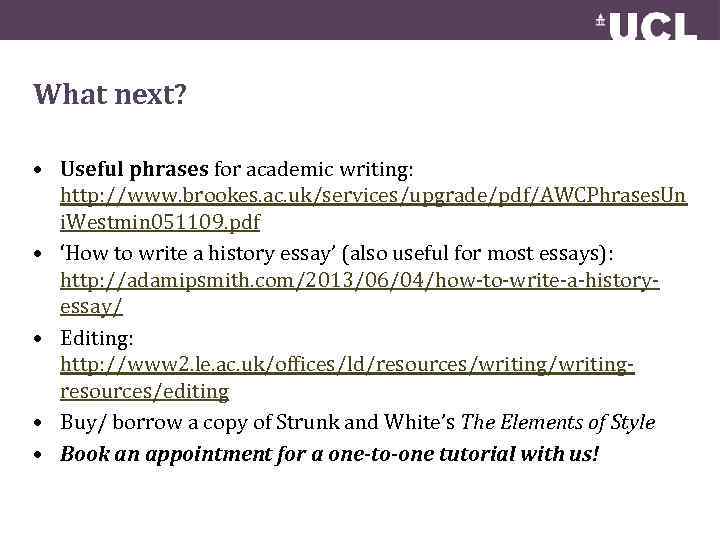 What next? • Useful phrases for academic writing: http: //www. brookes. ac. uk/services/upgrade/pdf/AWCPhrases. Un i. Westmin 051109. pdf • ‘How to write a history essay’ (also useful for most essays): http: //adamipsmith. com/2013/06/04/how-to-write-a-historyessay/ • Editing: http: //www 2. le. ac. uk/offices/ld/resources/writingresources/editing • Buy/ borrow a copy of Strunk and White’s The Elements of Style • Book an appointment for a one-to-one tutorial with us!