


 Скачать презентацию SOONERCARE MANAGED CARE HISTORY AND PERFORMANCE 1115 Waiver
c5f60768e16aa5fc79c5d0190e6e23bb.ppt
- Количество слайдов: 32
 SOONERCARE MANAGED CARE HISTORY AND PERFORMANCE 1115 Waiver Evaluation James Verdier Margaret Colby Mathematica Policy Research, Inc. Presentation to Oklahoma Health Care Authority Board Oklahoma City, Oklahoma January 8, 2009
 Introduction and Overview l Presentation based on comprehensive evaluation of Oklahoma’s Sooner. Care Medicaid managed care 1115 waiver program l Evaluation covers – History of Sooner. Care 1115 waiver from 1992 -2008 – Potential impact of waiver program on health care access, quality, and cost – OHCA’s role and performance – Lessons and implications for other states 1
 MPR’s Approach to the Evaluation l Develop history of Sooner. Care waiver program through site visits, interviews, and document review – Two site visits in May and June 2008 – Nearly 60 interviews with OHCA (Board, leadership, staff and contractors), providers, MCOs, beneficiary advocates, legislators, and other state agencies l Assess program performance based on Oklahoma and national data l Compare Sooner. Care to other state Medicaid programs 2
 Sooner. Care Managed Care History l Origin and early years (1992 -1996) – Goals were to contain growing Medicaid costs and improve access to physicians, especially in rural areas t Unlike other states with new 1115 waivers, OK did not seek to expand coverage at this point – Fully capitated MCOs in three urban areas (Sooner. Care Plus) – Partially capitated primary care case management (PCCM) in rural areas (Sooner. Care Choice) – Goal of expanding fully capitated managed care throughout the state proved not to be feasible 3
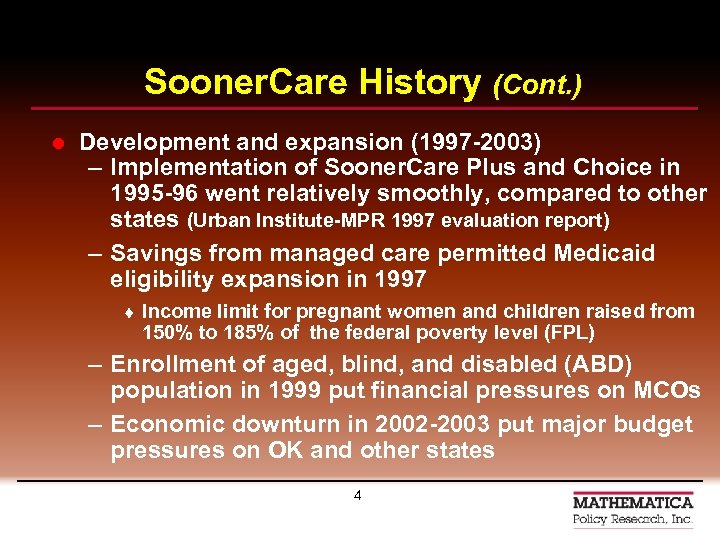 Sooner. Care History (Cont. ) l Development and expansion (1997 -2003) – Implementation of Sooner. Care Plus and Choice in 1995 -96 went relatively smoothly, compared to other states (Urban Institute-MPR 1997 evaluation report) – Savings from managed care permitted Medicaid eligibility expansion in 1997 t Income limit for pregnant women and children raised from 150% to 185% of the federal poverty level (FPL) – Enrollment of aged, blind, and disabled (ABD) population in 1999 put financial pressures on MCOs – Economic downturn in 2002 -2003 put major budget pressures on OK and other states 4
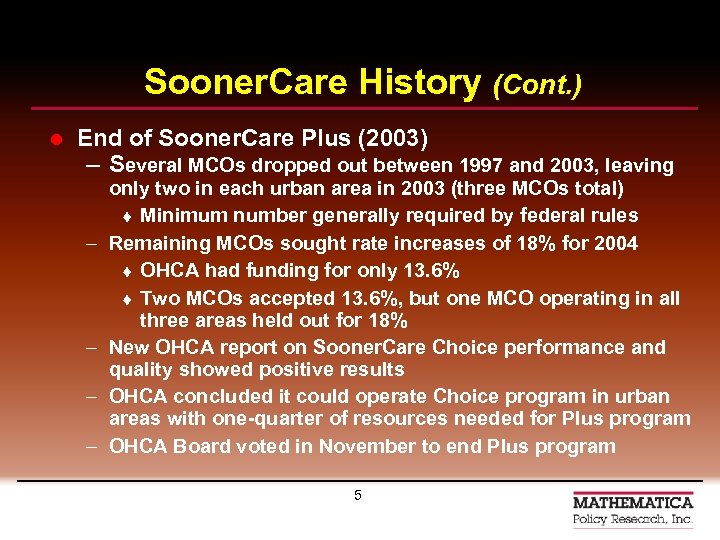 Sooner. Care History (Cont. ) l End of Sooner. Care Plus (2003) – Several MCOs dropped out between 1997 and 2003, leaving – – only two in each urban area in 2003 (three MCOs total) t Minimum number generally required by federal rules Remaining MCOs sought rate increases of 18% for 2004 t OHCA had funding for only 13. 6% t Two MCOs accepted 13. 6%, but one MCO operating in all three areas held out for 18% New OHCA report on Sooner. Care Choice performance and quality showed positive results OHCA concluded it could operate Choice program in urban areas with one-quarter of resources needed for Plus program OHCA Board voted in November to end Plus program 5
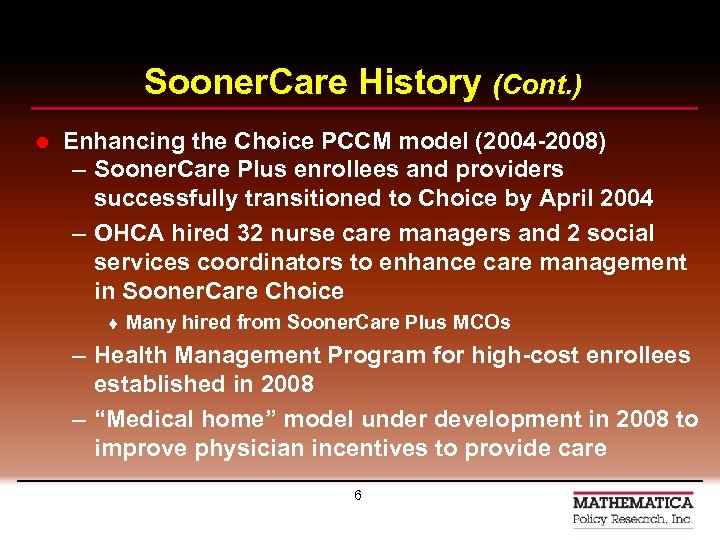 Sooner. Care History (Cont. ) l Enhancing the Choice PCCM model (2004 -2008) – Sooner. Care Plus enrollees and providers successfully transitioned to Choice by April 2004 – OHCA hired 32 nurse care managers and 2 social services coordinators to enhance care management in Sooner. Care Choice t Many hired from Sooner. Care Plus MCOs – Health Management Program for high-cost enrollees established in 2008 – “Medical home” model under development in 2008 to improve physician incentives to provide care 6
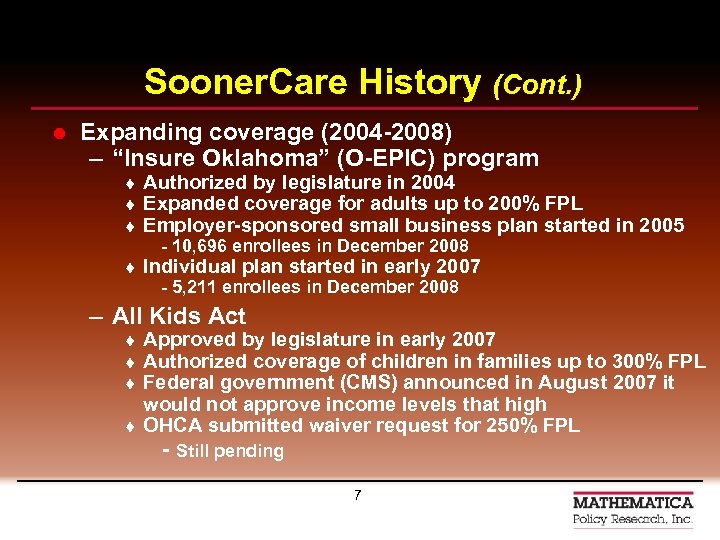 Sooner. Care History (Cont. ) l Expanding coverage (2004 -2008) – “Insure Oklahoma” (O-EPIC) program t t t Authorized by legislature in 2004 Expanded coverage for adults up to 200% FPL Employer-sponsored small business plan started in 2005 - 10, 696 enrollees in December 2008 t Individual plan started in early 2007 - 5, 211 enrollees in December 2008 – All Kids Act t t Approved by legislature in early 2007 Authorized coverage of children in families up to 300% FPL Federal government (CMS) announced in August 2007 it would not approve income levels that high OHCA submitted waiver request for 250% FPL - Still pending 7
 Major Findings l Access l Quality l Costs 8
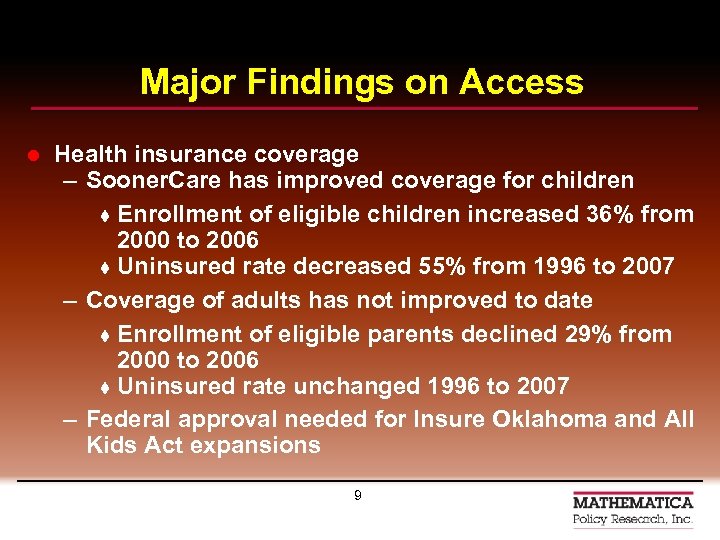 Major Findings on Access l Health insurance coverage – Sooner. Care has improved coverage for children t Enrollment of eligible children increased 36% from 2000 to 2006 t Uninsured rate decreased 55% from 1996 to 2007 – Coverage of adults has not improved to date t Enrollment of eligible parents declined 29% from 2000 to 2006 t Uninsured rate unchanged 1996 to 2007 – Federal approval needed for Insure Oklahoma and All Kids Act expansions 9
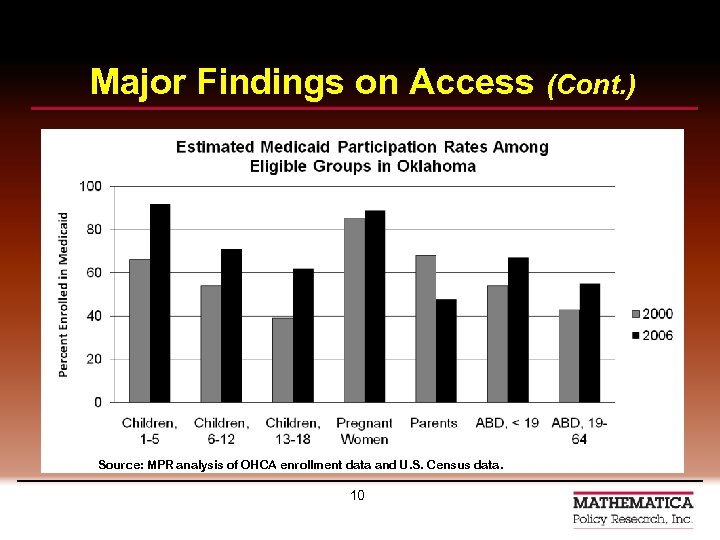 Major Findings on Access (Cont. ) Source: MPR analysis of OHCA enrollment data and U. S. Census data. 10
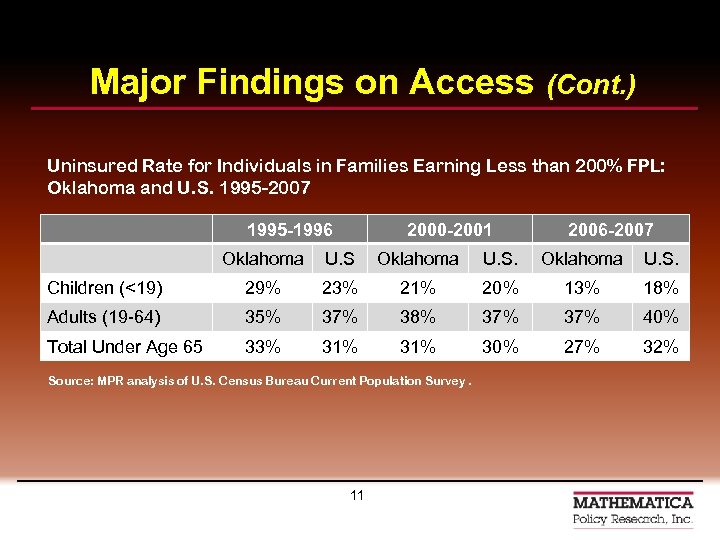 Major Findings on Access (Cont. ) Uninsured Rate for Individuals in Families Earning Less than 200% FPL: Oklahoma and U. S. 1995 -2007 1995 -1996 2000 -2001 2006 -2007 Oklahoma U. S. Children (<19) 29% 23% 21% 20% 13% 18% Adults (19 -64) 35% 37% 38% 37% 40% Total Under Age 65 33% 31% 30% 27% 32% Source: MPR analysis of U. S. Census Bureau Current Population Survey. 11
 Major Findings on Access (Cont. ) l Physician participation in Sooner. Care Choice – 37% of primary care physicians in Oklahoma were Sooner. Care Choice PCPs in 2006 t 90% of all MDs (specialists and PCPs) had contracts with Sooner. Care Choice – Annual visits per enrollee rose about 90% between 1997 and 2007 t Most PCPs saw patients at least once in 2007 – Total number of Sooner. Care Choice PCP contracts rose from 414 in 1997 to 595 in 2007 t More contracts with provider groups since 2004 12
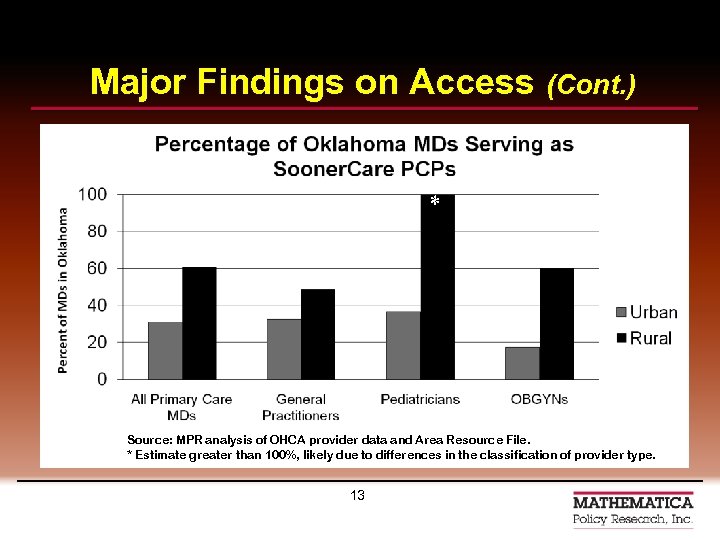 Major Findings on Access (Cont. ) * Source: MPR analysis of OHCA provider data and Area Resource File. * Estimate greater than 100%, likely due to differences in the classification of provider type. 13
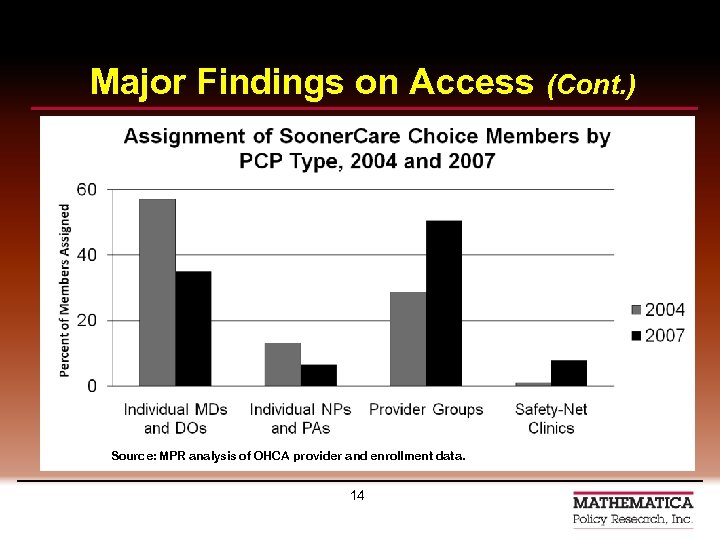 Major Findings on Access (Cont. ) Source: MPR analysis of OHCA provider and enrollment data. 14
 Major Findings on Access (Cont. ) l Emergency room (ER) visits – Sooner. Care Choice ER visits dropped from 80 per 1000 months of enrollment in 2004 to 76 in 2007 t National Medicaid ER use rose during this period – 1. 2 ER visits for every Sooner. Care Choice office visit in 2003, but only 0. 7 in 2007 t Decrease concentrated among PCPs whose patients had most ER visits t OHCA focus on high ER users appears effective 15
 Major Findings on Access (Cont. ) l Preventable hospitalizations – Overall rate dropped among adults from 2003 to 2006 t 24% drop in urban areas and 15% in rural areas – Rates generally unchanged for children, but rose for stomach problems in urban areas and dropped for asthma in rural areas – Sooner. Care Choice has performed as effectively as Plus for most types of preventable hospitalizations – Reducing preventable hospitalizations by half would save at least $8 million a year t Additional savings possible from reduced ER use 16
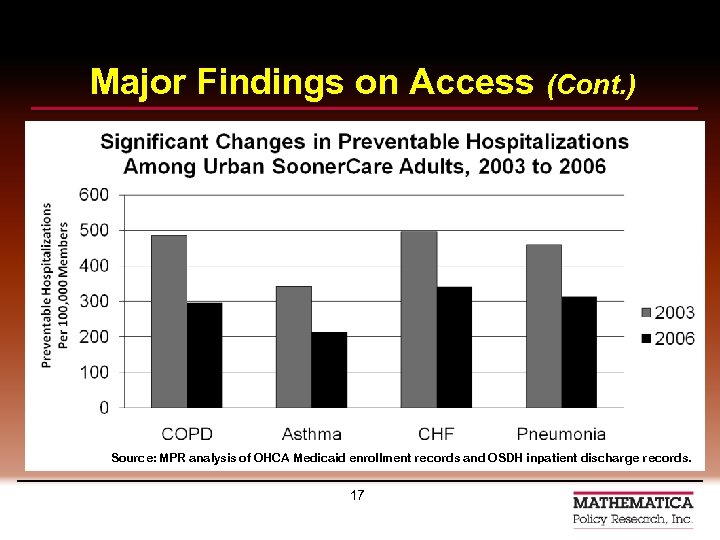 Major Findings on Access (Cont. ) Source: MPR analysis of OHCA Medicaid enrollment records and OSDH inpatient discharge records. 17
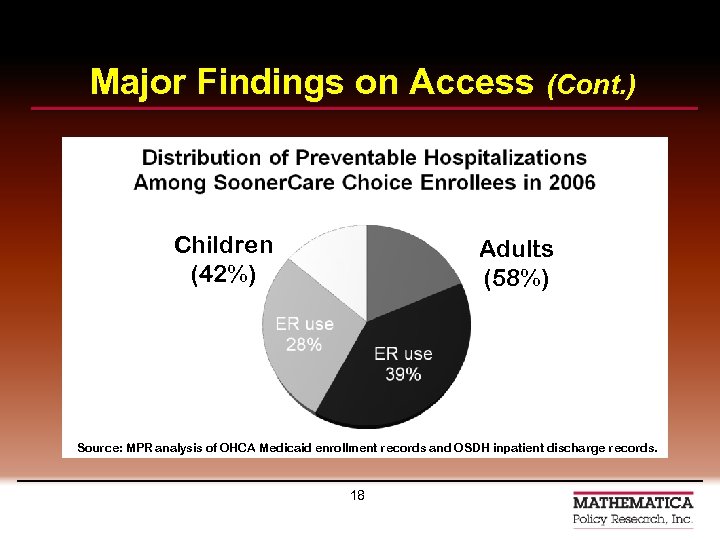 Major Findings on Access (Cont. ) Children (42%) Adults (58%) Source: MPR analysis of OHCA Medicaid enrollment records and OSDH inpatient discharge records. 18
 Major Findings on Quality l Process of care measures (HEDIS) – OHCA tracks 19 measures for Sooner. Care Choice t Ambulatory care visits, tests, screenings, appropriate asthma medications – All measures showed improvement through 2007 – 5 of 19 met or exceeded national Medicaid benchmarks t Relatively high bar for PCCM programs HEDIS = Healthcare Effectiveness Data and Information Set 19
 Major Findings on Quality (Cont. ) l Beneficiary satisfaction (CAHPS and ECHO) – Satisfaction between 2003 and 2007 was high for measures most relevant to PCCM programs – Below national CAHPS benchmarks in 2005 and 2006, but by small margins – Behavioral health care satisfaction (ECHO) has been high CAHPS = Consumer Assessment of Healthcare Providers and Systems ECHO = Experience of Care and Health Outcomes Survey 20
 Major Findings on Cost l Medicaid costs per member in Oklahoma were below the national average between 1996 and 2005 – Costs for those in managed care (children and non-disabled adults) were especially low l Medicaid accounted for a smaller share of the state budget in Oklahoma between 1996 and 2005 than the national average and 19 comparison states – Medicaid accounted for 6. 5% of state expenditures in 1996 and 10% in 2006 – National average rose from 12. 5% to nearly 14% during the same period 21
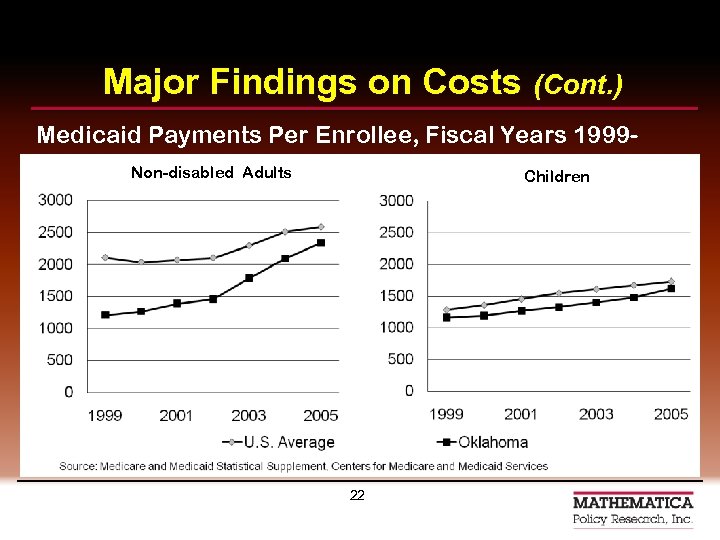 Major Findings on Costs (Cont. ) Medicaid Payments Per Enrollee, Fiscal Years 19992005 Non-disabled Adults Children 22
 OHCA Role and Performance l OHCA is unusual among state Medicaid agencies – One of only seven stand-alone Medicaid agencies (AL, AZ, CO, FL, KS, MS, OK) – One of only two Medicaid agencies with external governing board (KS, OK) – Separate personnel and salary system – Experience and tenure of top leadership t Two-thirds of top executive staff have been with OHCA since 1995, and over one-third of all supervisory staff 23
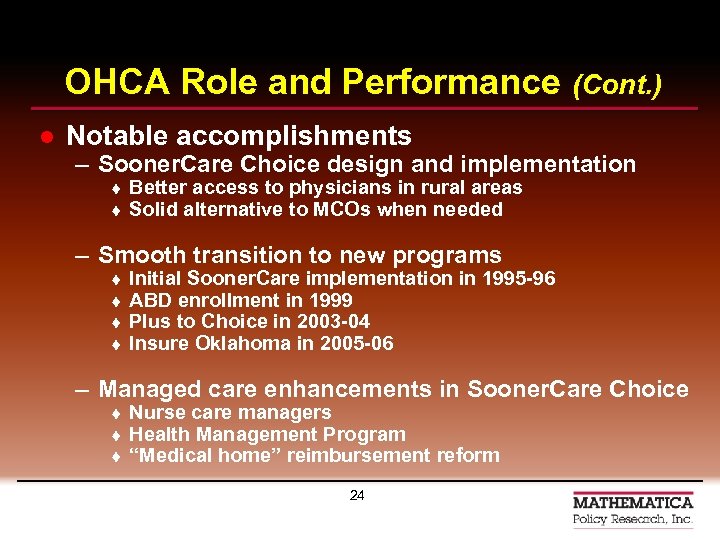 OHCA Role and Performance (Cont. ) l Notable accomplishments – Sooner. Care Choice design and implementation t t Better access to physicians in rural areas Solid alternative to MCOs when needed – Smooth transition to new programs t t Initial Sooner. Care implementation in 1995 -96 ABD enrollment in 1999 Plus to Choice in 2003 -04 Insure Oklahoma in 2005 -06 – Managed care enhancements in Sooner. Care Choice t t t Nurse care managers Health Management Program “Medical home” reimbursement reform 24
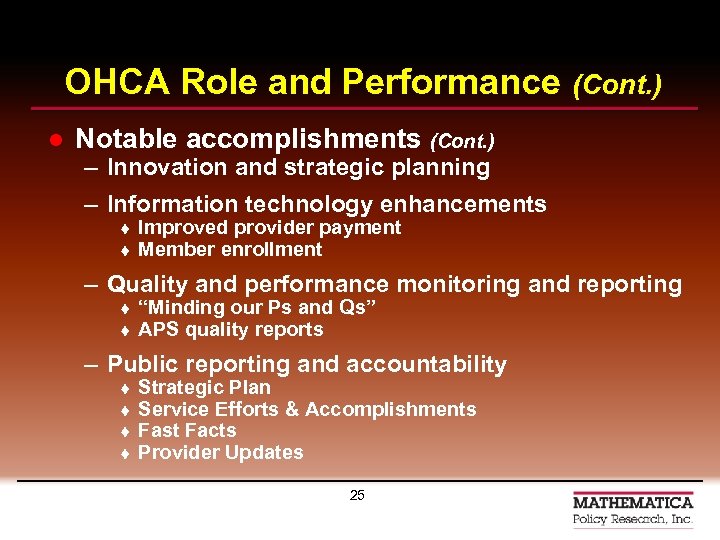 OHCA Role and Performance (Cont. ) l Notable accomplishments (Cont. ) – Innovation and strategic planning – Information technology enhancements t t Improved provider payment Member enrollment – Quality and performance monitoring and reporting t t “Minding our Ps and Qs” APS quality reports – Public reporting and accountability t t Strategic Plan Service Efforts & Accomplishments Fast Facts Provider Updates 25
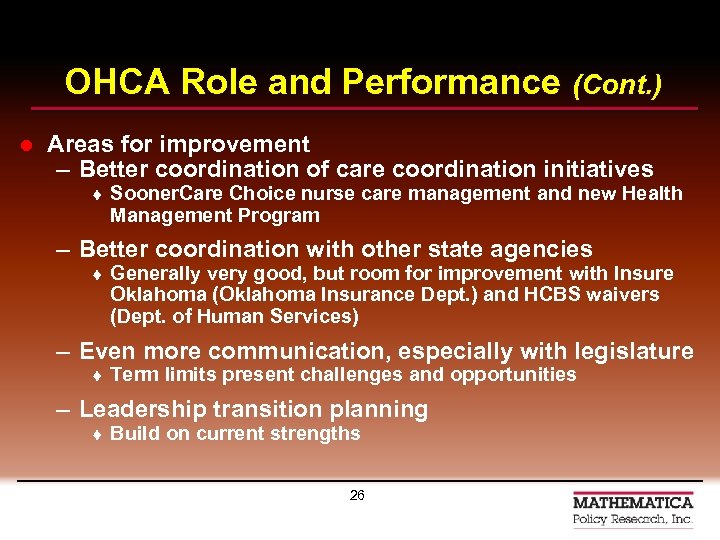 OHCA Role and Performance (Cont. ) l Areas for improvement – Better coordination of care coordination initiatives t Sooner. Care Choice nurse care management and new Health Management Program – Better coordination with other state agencies t Generally very good, but room for improvement with Insure Oklahoma (Oklahoma Insurance Dept. ) and HCBS waivers (Dept. of Human Services) – Even more communication, especially with legislature t Term limits present challenges and opportunities – Leadership transition planning t Build on current strengths 26
 Lessons and Implications for Other States l Program design and management l Agency management l Relationships with External Stakeholders 27
 Lessons and Implications for Other States l Program design and management – With sufficient resources and leadership, Medicaid agencies can manage costs and care as well as MCOs – Models from other states can be guides, but must be adapted to contexts of individual states t Health Management Program, “medical home” reforms – Performance measurement is needed to support management decisions t Data partnerships with other agencies can help – Focusing on providers as clients can improve participation – Concerted outreach efforts are needed to increase enrollment of Medicaid-eligible populations 28
 Lessons and Implications for Other States (Cont. ) l Agency management – Change is always disruptive, but adequate resources and leadership can smooth transitions t Sooner. Care Plus to Choice transition is a textbook example – Managing managed care programs requires major investments in infrastructure, staffing, monitoring, and reporting – Skilled and experienced in-house staff are needed to work successfully with outside contractors (EDS, APS) – Strategic planning is needed to take advantage of windows of opportunity that can open and close quickly t Physician reimbursement increases in 2004 -2005, Insure Oklahoma, Health Management Program – Changing circumstances provide new opportunities t “Medical home” reimbursement reforms 29
 Lessons and Implications for Other States (Cont. ) l Relationships with external stakeholders – Effective and continuous communication is key t Array of OHCA reports provides important underpinning – Stakeholder consultation should be targeted to build engagement and support t t Annual strategic planning retreat with OHCA Board - Open to the public Medical Advisory Committee (MAC) - Required by federal regulations Medical Advisory Task Force (MAT) - Medical home advice Sooner. Care Tribal Consultations - Improve Sooner. Care for Native Americans 30
 Conclusion l Oklahoma’s Sooner. Care 1115 waiver program has demonstrated how to innovate within the constraints and opportunities that the state context provides – History, politics, economics, demographics, fiscal resources, and leadership are all important l OHCA provides a solid model for other states of how to design, implement, manage, and improve Medicaid managed care programs over time – Borrow from other states, but adapt to your needs and opportunities – Leadership, resources, good data, and good management are needed to make it work 31