


 Скачать презентацию Sooner Care Choice Oklahoma s PCCM Program January 2008
2db622c28a736f9ab4d936d0b862d7ea.ppt
- Количество слайдов: 53
 Sooner. Care Choice: Oklahoma’s PCCM Program January 2008
 Sooner. Care Program 1995 - 2003 • Sooner. Care Plus – Managed Care Organization (MCO) – Full Risk – Expanded benefits • Sooner. Care Choice – Primary Care Case Management (PCCM) – Partial Risk – Some adult limits
 Objectives • Improve access to preventive services, primary care and early prenatal care • Alignment with Primary care provider • Expand the rural provider network • Budget predictability
 What Happened? • Based on estimates from actuaries, the Legislature appropriated base rate increase of 13. 6% for the MCOs for CY 04 • Final actuarial certified rate was 19. 1% increase • Agency bid MCO rate at 13. 6% increase as funded for CY 04 • 2 of 3 MCOs accepted bid • State left with only one plan in each of three service areas
 Alternatives • Pay higher rates to MCOs by reducing eligibility; or • Revise existing 1115 waiver to seek approval for operating MCO program with only one plan in each area; or • Revise existing 1115 waiver to operate a single statewide PCCM program
 Ongoing Debate: Equity between the Two Programs • Program equity – comparability of benefit packages • Provider equity – federal requirement of actuarially certified rates resulted in funding MCO rates first, leaving fee-for-service providers last in consideration for increased funding • Program cost – would statewide PCCM model result in less costly service delivery system than MCOs?
 Agency Analysis of Statewide PCCM Program • Better use of agency resources – both staff and money • Equality of benefits to all enrollees • Equality in provider rate structure • Level playing field for future benefit structure and appropriated rate increases • Solid alternative service delivery structure • Comparable quality program indicators
 Managed Care Transition • Board voted 11 -7 -03 to eliminate MCO program effective 12 -31 -03 • Transition of nearly 200, 000 enrollees to Fee-for-Service, then to PCCM program in 4 months • Formed interagency transition team • Aggressive enrollee outreach campaign • Provider contracting to extend network statewide • Expanded care management & program supports
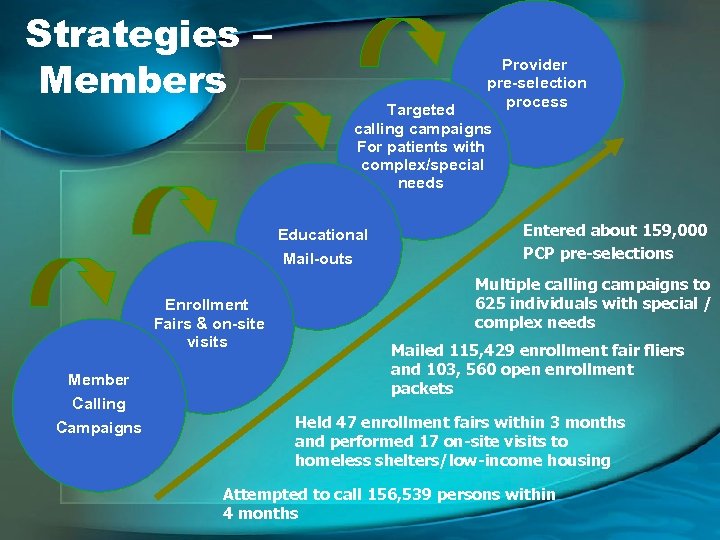 Strategies – Members Provider pre-selection process Targeted calling campaigns For patients with complex/special needs Educational Mail-outs Enrollment Fairs & on-site visits Member Calling Campaigns Entered about 159, 000 PCP pre-selections Multiple calling campaigns to 625 individuals with special / complex needs Mailed 115, 429 enrollment fair fliers and 103, 560 open enrollment packets Held 47 enrollment fairs within 3 months and performed 17 on-site visits to homeless shelters/low-income housing Attempted to call 156, 539 persons within 4 months
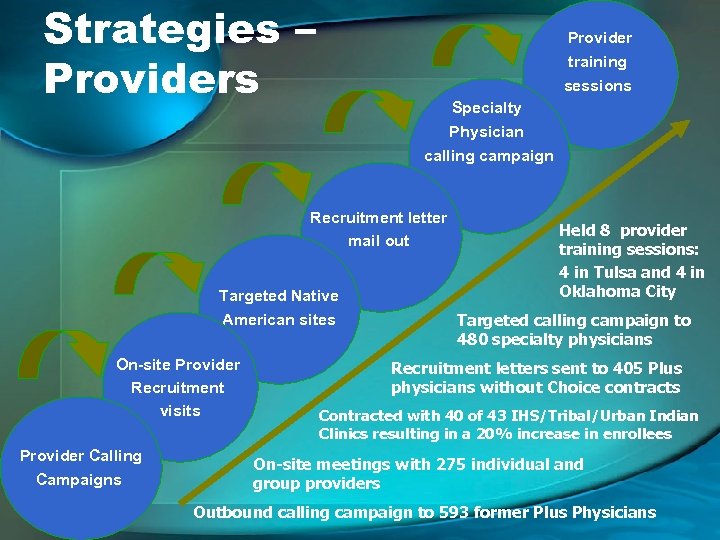 Strategies – Providers Provider training sessions Specialty Physician calling campaign Recruitment letter mail out Targeted Native American sites On-site Provider Recruitment visits Provider Calling Campaigns Held 8 provider training sessions: 4 in Tulsa and 4 in Oklahoma City Targeted calling campaign to 480 specialty physicians Recruitment letters sent to 405 Plus physicians without Choice contracts Contracted with 40 of 43 IHS/Tribal/Urban Indian Clinics resulting in a 20% increase in enrollees On-site meetings with 275 individual and group providers Outbound calling campaign to 593 former Plus Physicians
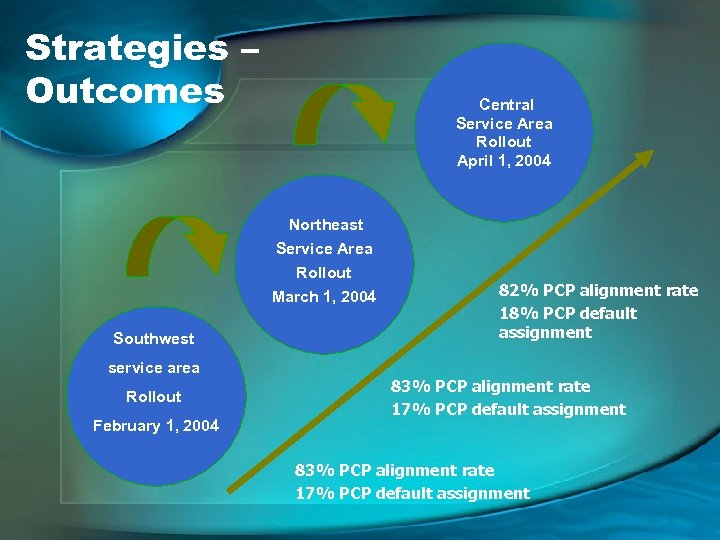 Strategies – Outcomes Central Service Area Rollout April 1, 2004 Northeast Service Area Rollout March 1, 2004 Southwest service area Rollout February 1, 2004 82% PCP alignment rate 18% PCP default assignment 83% PCP alignment rate 17% PCP default assignment
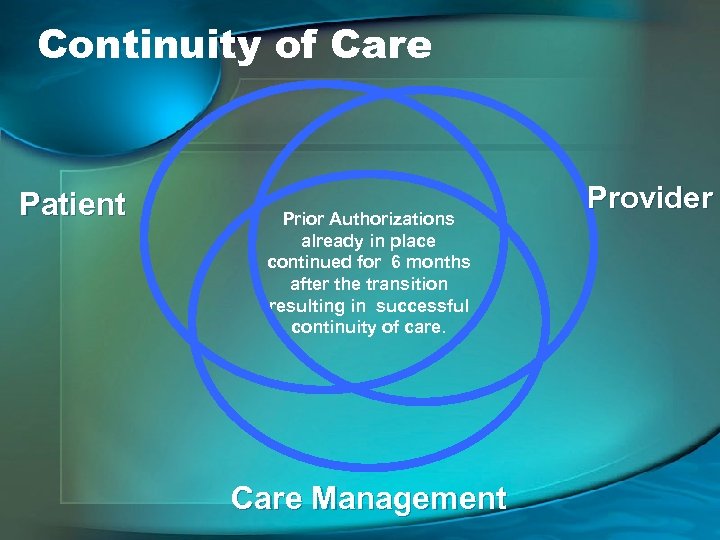 Continuity of Care Patient Prior Authorizations already in place continued for 6 months after the transition resulting in successful continuity of care. Care Management Provider
 Strategies – Administrative • Agency wide determination of additional in-house FTE required: costs estimated to include salaries, benefits and operating expenses • Agency wide review of all contracted services, including fiscal agent, quality improvement organization, enrollment broker and transportation broker to determine the marginal increase required
 Results Jan-June 2004 • Budget reduced by $23. 9 million for medical payouts • Budget reduced by $24. 8 million for cash flow gain • Budget increased by $6. 9 million for estimated administrative costs • Revenues decreased by $37. 5 million, including federal funds • Agency saved the projected $4. 3 million in state dollars for SFY 04
 Results SFY 2005 • Expenditure reduction of $85. 5 million • Revenue reduction of $81. 6 million • Achieved overall savings of $3. 9 million
 Sooner. Care Choice Today • • • Statewide serving 77 counties 405, 709 members enrolled Mandatory enrollment 185% FPL Exclusions – – – Dual eligibles Waiver members Children in State or Tribal Custody, or subsidized adoption HMO members Institutionalized members
 Sooner. Care Choice Contracting • Contract directly with individual and group Providers • MD, DO, PA & ARNP • Indian/Tribal/Urban Indian Clinic Case Management only
 Sooner. Care Choice Provider Network • 1, 239 Providers at 586 sites in 75 of 77 counties • 50 I/T/U clinic contracts • 45 -mile, 45 -minute access standard • >1. 184 million member capacity
 Sooner. Care Choice Payment Methodologies • Actuarially-certified statewide rates • Partially-capitated and case management payment structure for 9 age/sex cells • 2008 rates – TANF/BCC/SCHIP blended rate: $18. 21 PMPM – ABD/TEFRA blended rate: $24. 14 PMPM • CM component of rate is $2 to $3 PMPM • I/T/U CM cap payment of $2 to $3 PMPM
 Capitated Benefit Package Primary and Preventive Care • Medically necessary office visits to the PCP with no co-pay • Well child screenings (EPSDT) • Injections, immunizations • Limited CLIA waived lab services • Basic family planning services • Case management including referrals
 Non-Capitated Benefits FFS reimbursement policies/program limits • Hospital coverage • Prescriptions (adults limited to 6 monthly; up to 3 brand name) • Specialty Care (adults limited to four visits monthly) • Medically necessary transportation • Specified self-referral services
 Sooner. Care Choice Program Components • Annual member handbook and benefits update • Annual provider directory • Select primary care provider • Default assignment if no selection made • Can change PCP up to 4 times per year
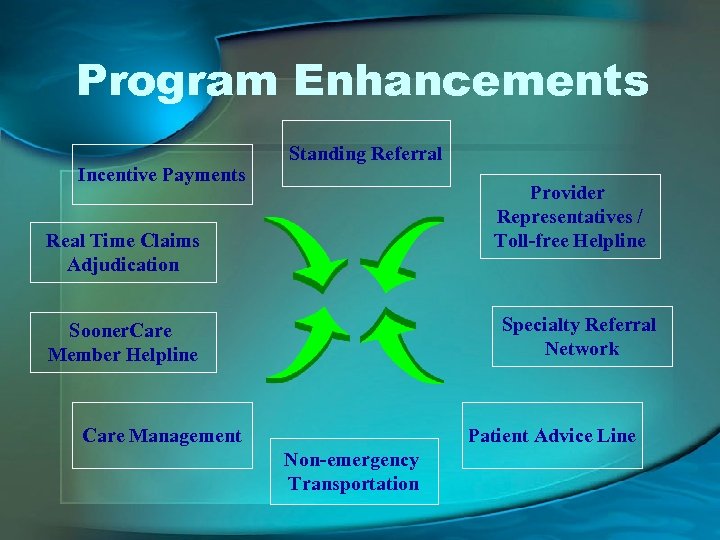 Program Enhancements Incentive Payments Standing Referral Provider Representatives / Toll-free Helpline Real Time Claims Adjudication Specialty Referral Network Sooner. Care Member Helpline Care Management Patient Advice Line Non-emergency Transportation
 In-house Provider Support • • • 32 FTEs with 22 Provider Reps Program, policy and claims education Coordinate access to care issues PCP recruitment and retention Monitor PCP and Specialty network
 In-house Care Management • • 38 FTEs; manage 5, 000 cases monthly 33 nurses with average caseload of 187 2 social services coordinators Handled some 116, 000 telephone calls July 2006 -June 2007 • Utilize web-based clinical case management system
 Care Management Population & Services • In-home assessments using standardized evaluation tool for all children with private duty nursing • Women eligible for Breast & Cervical Cancer Treatment Program • TEFRA eligible children • High-risk pregnancy • Organ transplant candidates/recipients • Out-of-state care coordination • Monthly staffing with large provider groups
 Quality & Compliance Activities • • PCP on-site audits QAPI monitoring ER utilization program Provider profiling – ER Utilization – Breast and Cervical Cancer Screening Rates – EPSDT Screens
 Quality & Compliance Activities • CAHPS • HEDIS • Encounter data validation and quality improvement • Agency-wide Quality Assurance Committee • Focused studies/performance improvement projects
 P 4 P in Oklahoma • In 1997, Oklahoma implemented a provider incentive to increase EPSDT compliance. • In 2006, Oklahoma’s EPSDT visits for the -15 months age group were above the National Medicaid mean. • Added a targeted incentive to increase specific immunizations in children. 0
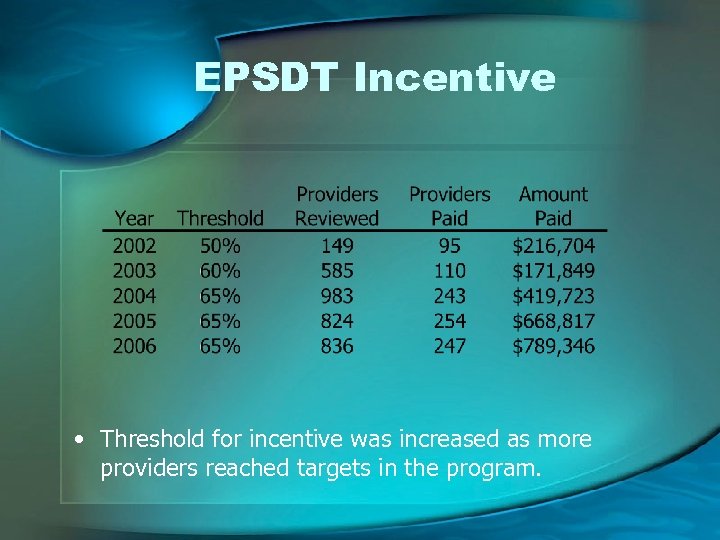 EPSDT Incentive • Threshold for incentive was increased as more providers reached targets in the program.
 Targeted Immunization Incentive • Review of children’s immunizations showed that most children were not receiving the 4 th DTa. P. • In 2002, Oklahoma started an incentive for providers that administered a 4 th DTa. P to children prior to age 2.
 DTa. P Results • In 2006, 117 providers received an incentive payment for providing the 4 th DTa. P. • In 2006, 3, 140 children received the 4 th DTAP as compared to 922 before the incentive program (2001).
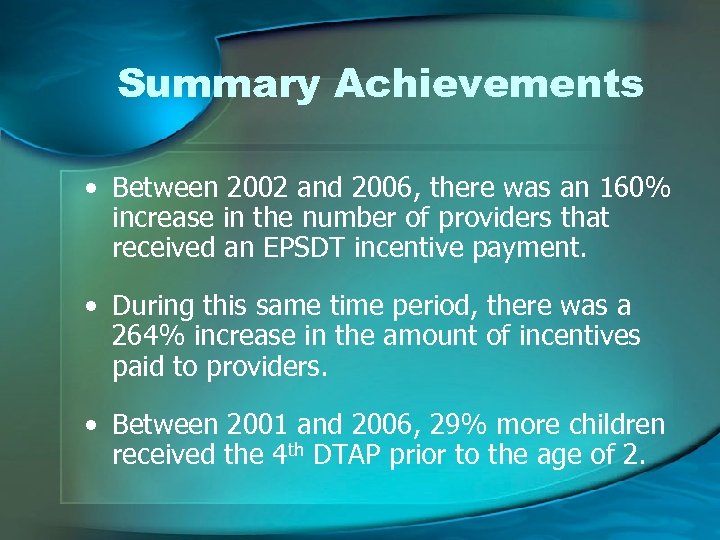 Summary Achievements • Between 2002 and 2006, there was an 160% increase in the number of providers that received an EPSDT incentive payment. • During this same time period, there was a 264% increase in the amount of incentives paid to providers. • Between 2001 and 2006, 29% more children received the 4 th DTAP prior to the age of 2.
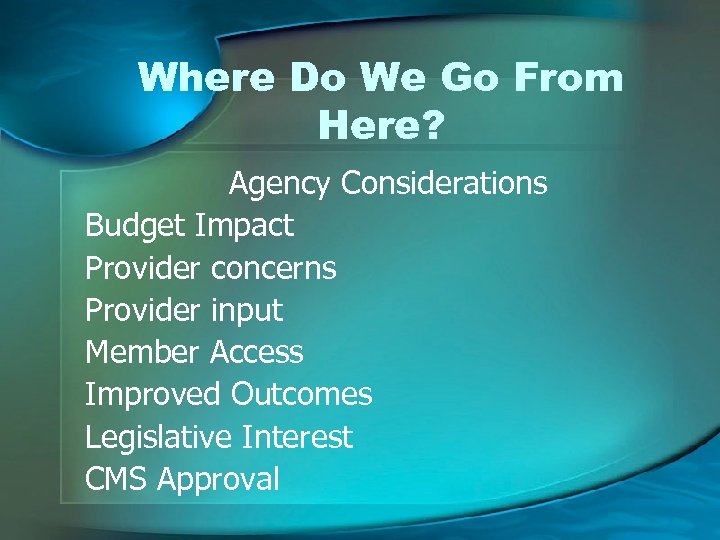 Where Do We Go From Here? Agency Considerations Budget Impact Provider concerns Provider input Member Access Improved Outcomes Legislative Interest CMS Approval
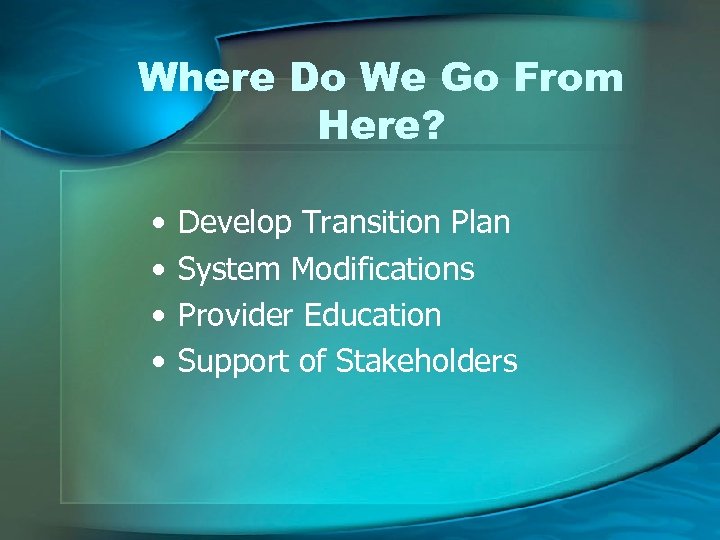 Where Do We Go From Here? • • Develop Transition Plan System Modifications Provider Education Support of Stakeholders
 Medical Home Model The American Academy of Pediatrics (AAP) introduced the medical home concept in 1967, as a way to enhance the care of children with special needs.
 Medical Home Model In March 2007 the AAP, AAFP, ACP, and AOA, representing approximately 333, 000 physicians, developed the following joint principles to describe the characteristics of the PC-MH.
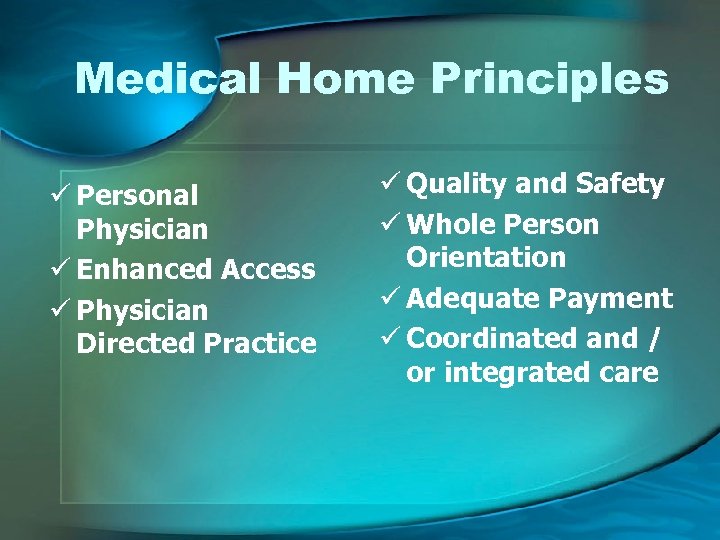 Medical Home Principles ü Personal Physician ü Enhanced Access ü Physician Directed Practice ü Quality and Safety ü Whole Person Orientation ü Adequate Payment ü Coordinated and / or integrated care
 Enhanced Access The medical home model is generating much interest nationally as the “new” model of care and potential payment. ⌂ Medicare ⌂ Private payers ⌂ Large self-insured employers ⌂ Patient-centered primary care collaborative ⌂ State Government
 North Carolina Model Community Care of NC (CCNC) CCNC provides care to more than 750, 000 Medicaid recipients in North Carolina, relying heavily on patient-centered medical homes, population health management, case management services and community-based networks to deliver care. Since its inception in 1999, the program has saved North Carolina nearly a half a billion dollars, becoming a driver of quality initiatives in the state in the process. Since 1999, CCNC has grown to encompass 15 networks, 3, 500 primary care physicians and 1, 000 medical homes.
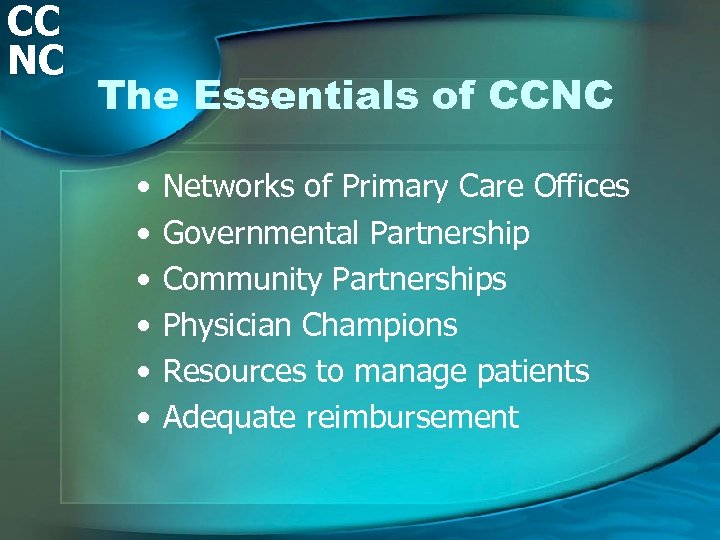 CC NC The Essentials of CCNC • • • Networks of Primary Care Offices Governmental Partnership Community Partnerships Physician Champions Resources to manage patients Adequate reimbursement
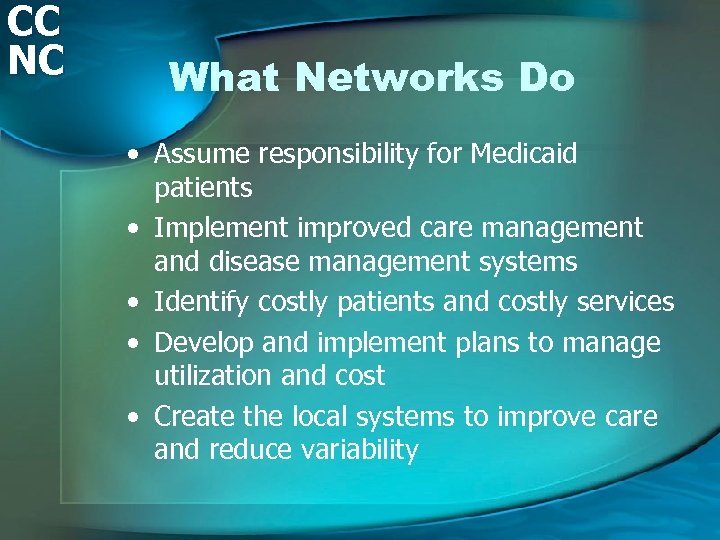 CC NC What Networks Do • Assume responsibility for Medicaid patients • Implement improved care management and disease management systems • Identify costly patients and costly services • Develop and implement plans to manage utilization and cost • Create the local systems to improve care and reduce variability
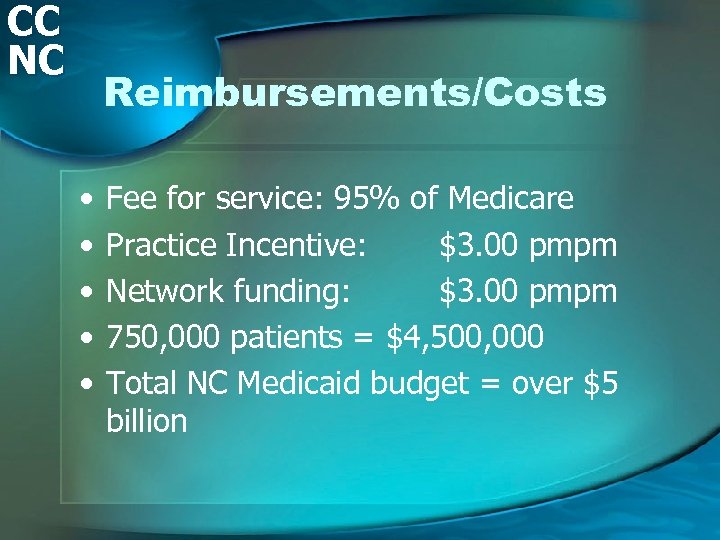 CC NC Reimbursements/Costs • • • Fee for service: 95% of Medicare Practice Incentive: $3. 00 pmpm Network funding: $3. 00 pmpm 750, 000 patients = $4, 500, 000 Total NC Medicaid budget = over $5 billion
 Alabama Model More than 420, 000 Alabamians currently participate in Patient 1 st, a primary care case management (PCCM) program operated by the Alabama Medicaid Agency. The present program was approved by the Centers for Medicare and Medicaid Services (CMS) in August 2004 and includes expanded technology and tools to help doctors and other health professionals better manage the increasing cost of health care while promoting better care for Medicaid patients.
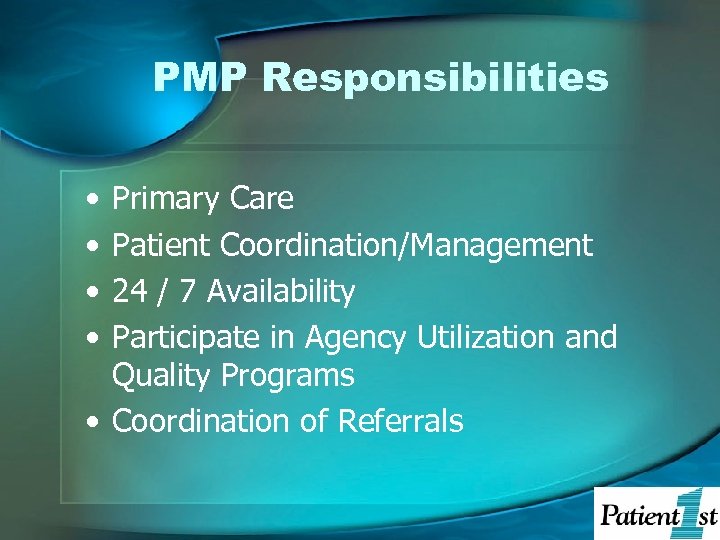 PMP Responsibilities • • Primary Care Patient Coordination/Management 24 / 7 Availability Participate in Agency Utilization and Quality Programs • Coordination of Referrals
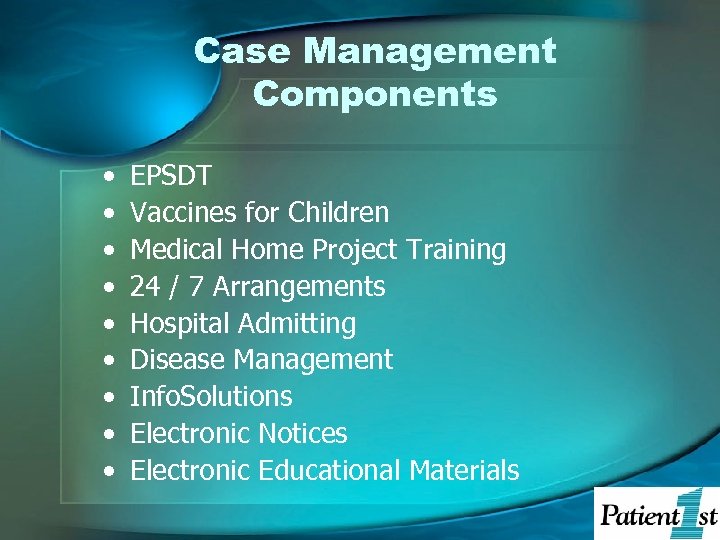 Case Management Components • • • EPSDT Vaccines for Children Medical Home Project Training 24 / 7 Arrangements Hospital Admitting Disease Management Info. Solutions Electronic Notices Electronic Educational Materials
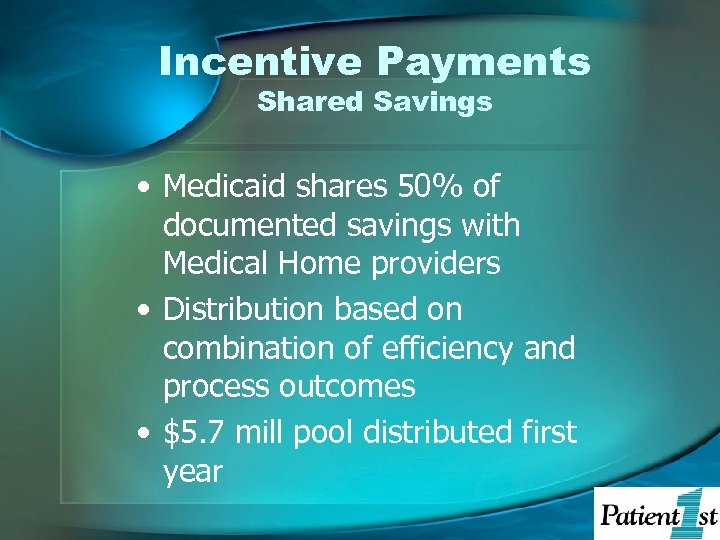 Incentive Payments Shared Savings • Medicaid shares 50% of documented savings with Medical Home providers • Distribution based on combination of efficiency and process outcomes • $5. 7 mill pool distributed first year
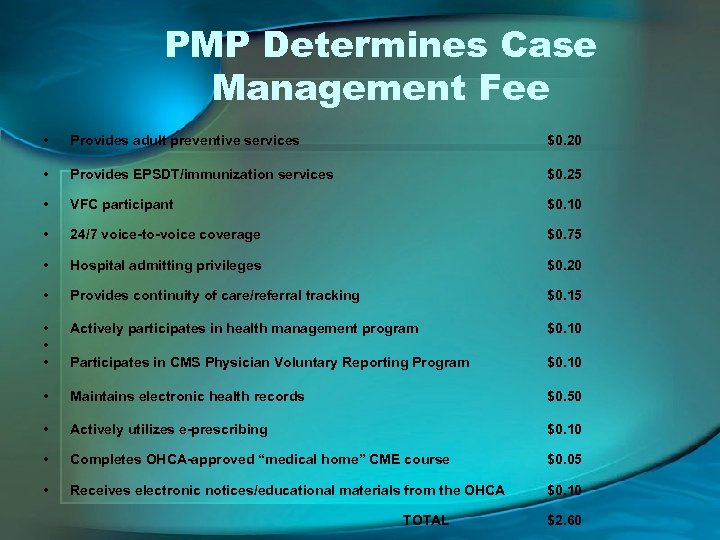 PMP Determines Case Management Fee • Provides adult preventive services $0. 20 • Provides EPSDT/immunization services $0. 25 • VFC participant $0. 10 • 24/7 voice-to-voice coverage $0. 75 • Hospital admitting privileges $0. 20 • Provides continuity of care/referral tracking $0. 15 • • • Actively participates in health management program $0. 10 Participates in CMS Physician Voluntary Reporting Program $0. 10 • Maintains electronic health records $0. 50 • Actively utilizes e-prescribing $0. 10 • Completes OHCA-approved “medical home” CME course $0. 05 • Receives electronic notices/educational materials from the OHCA $0. 10 TOTAL $2. 60
 Reimbursement • Case Management Fee – PMP determines based on self declared components • Office Care – Fee for service • Incentive payments – PMP will share in any savings
 Evaluation of NCCC and Alabama Patient First • Research both programs • Site visit of NCCC model for additional information. • Development of agency work group to evaluate the different options available. • Update to Medical Advisory Taskforce for provider inputs and recommendations. • Informed Child Health Advisory Taskforce and Peri-Natal Taskforce for additional input
 Re-design Option FFS and variable Case Management component based on criteria selfdesignated by provider (similar to Alabama model)
 How would you build your Medical Home? 1. What of our current system works now and what would you like to see change? 2. What do you think are the most important components to stress? 3. How do we reimburse for this?
 • Oklahoma Health Care Authority www. okhca. org • Lynn Mitchell, MD, MPH State Medicaid Director Lynn. mitchell@okhca. org • Rebecca Pasternik-Ikard Director, Sooner. Care Program Operations Becky. pasternik-ikard@okhca. org • Melody Anthony Director, Provider Services Melody. anthony@okhca. org • Melinda Jones Director, Waiver Development & Reporting Melinda. jones@okhca. org Thank you!