


 Скачать презентацию Soon after the end of World War II
3efd791cb02b3beb44d55e5612ee8267.ppt
- Количество слайдов: 87
 Soon after the end of World War II, problems between the West and the Soviet Union. Soviets: strip Germany of all industrial plant—ship to USSR Stalin in 1946: Communism and capitalism are incompatible; another war is inevitable.
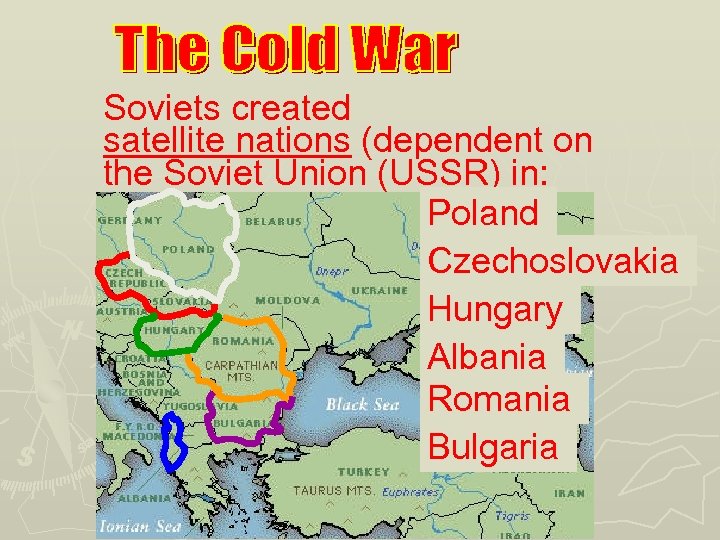 Soviets created satellite nations (dependent on the Soviet Union (USSR) in: Poland Czechoslovakia Hungary Albania Romania Bulgaria
 February 1945—Yalta Conference (in Soviet Union) Churchill Roosevelt Stalin Agreed to form the United Nations, Soviet Union would enter war against Japan, and division of Europe into zones after the war.
 June 1945, United Nations created. U. S. joins USSR & 48 other nations. San Francisco; later New York General Assembly and 11 member Security Council. 5 Permanent Security Council members: U. S. , USSR, Great Britain, France, Nationalist China. Each had veto power.
 July 1945, Truman, Stalin, and Churchill (later Clement Attlee) meet at Potsdam, near Berlin, Germany Truman informs other Big 3 members about bomb and they design postwar Germany
 China erupts into major civil war in 1949 Communists under Mao-Zedong Defeat U. S. -backed Nationalists under Chiang Kai-Shek (Jiang Jieshi)
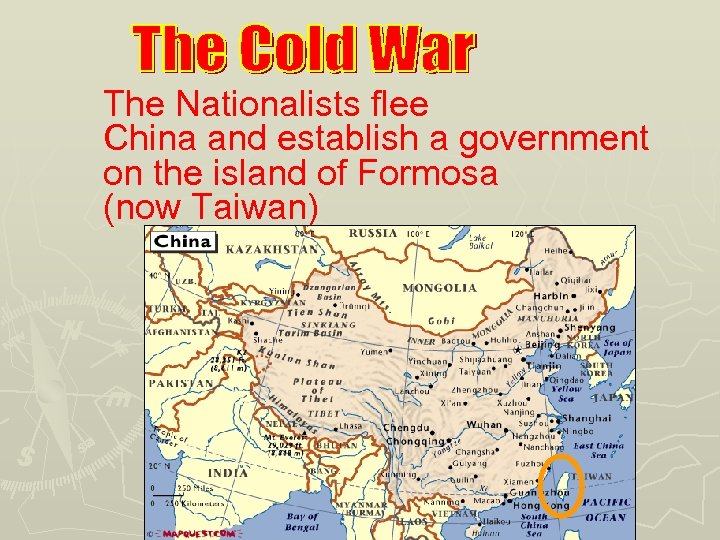 The Nationalists flee China and establish a government on the island of Formosa (now Taiwan)
 U. S. President Harry Truman: Policy of Containment Winston Churchill: Fulton, MO, March 1946: “From Stettin in the Baltic to Trieste in the Adriatic, an iron curtain has descended across the continent (of Europe). ”
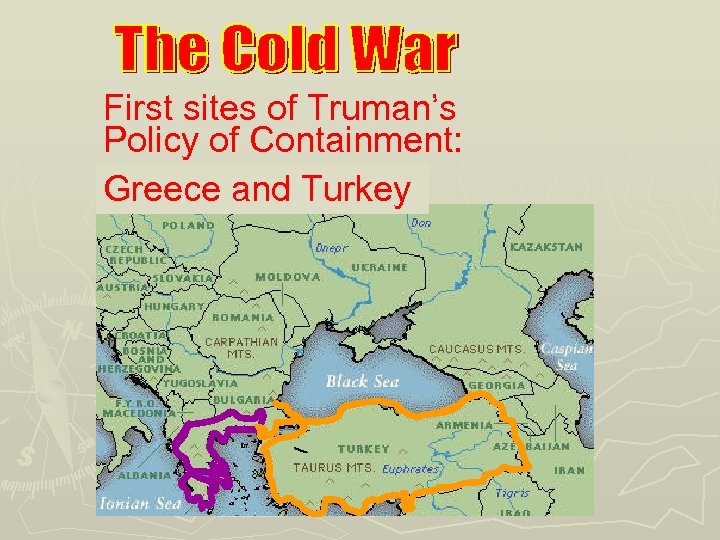 First sites of Truman’s Policy of Containment: Greece and Turkey
 The Truman Doctrine: “The U. S. should support free peoples throughout the world who were resisting takeovers by ‘armed minorities’ or ‘outside pressures. ’” U. S. sent $400 million in aid to Greece & Turkey, 1947 -1950, because they rejected Communism.
 Dean Acheson and George Kennan: the Domino Theory If one nation fell to Communism, surrounding nations would fall
 The Marshall Plan Truman names General George C. Marshall as Secretary of State 1947: The U. S. should provide aid to all European nations that need it. This move “is not against any country or doctrine, but against hunger, poverty, desperation, and chaos. ” $12. 5 billion
 National Security Act of 1947 üCreated the Department of Defense üCreated the U. S. Air Force üCreated the National Security Council üCreated the Joint Chiefs of Staff üCreated the Central Intelligence Agency
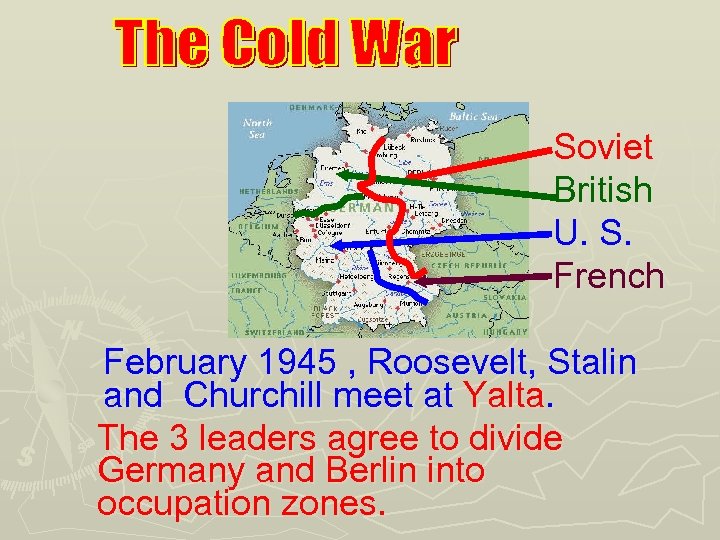 Soviet British U. S. French February 1945 , Roosevelt, Stalin and Churchill meet at Yalta. The 3 leaders agree to divide Germany and Berlin into occupation zones.
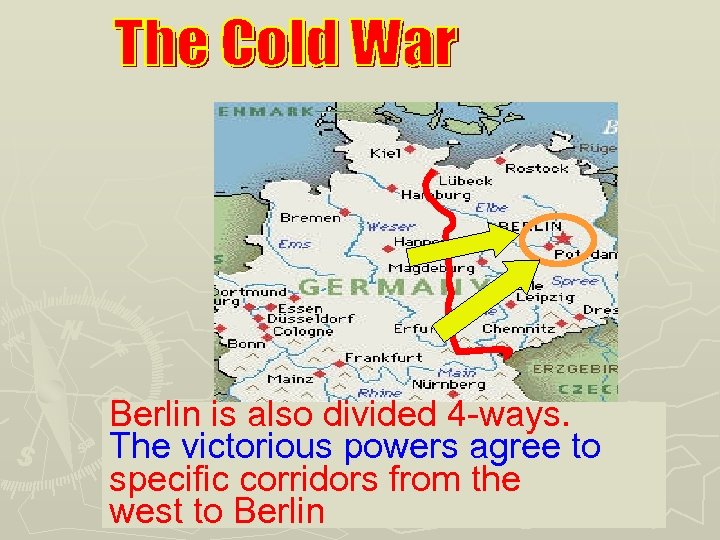 Berlin is also divided 4 -ways. The victorious powers agree to specific corridors from the west to Berlin
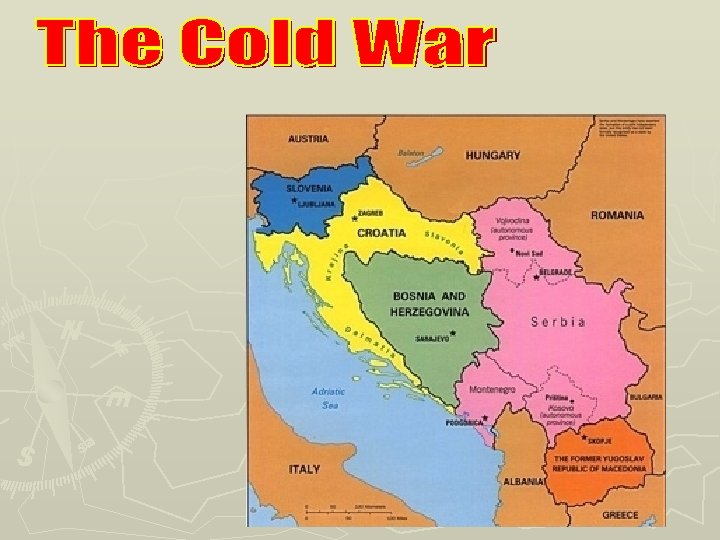
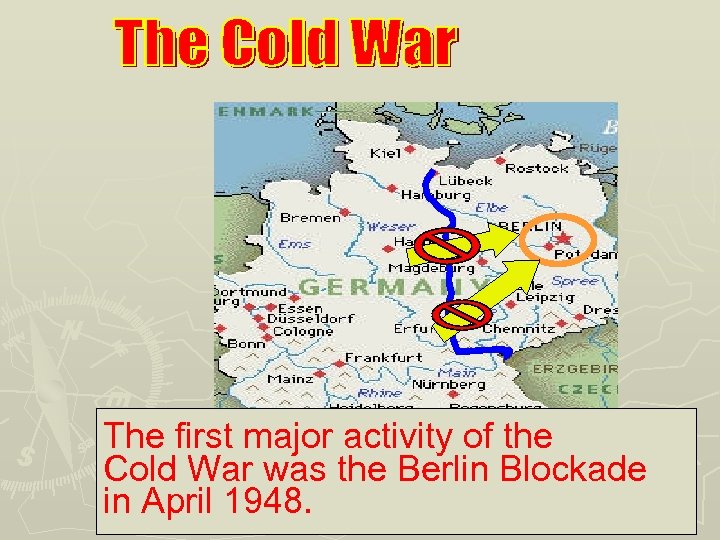 The first major activity of the Cold War was the Berlin Blockade in April 1948.
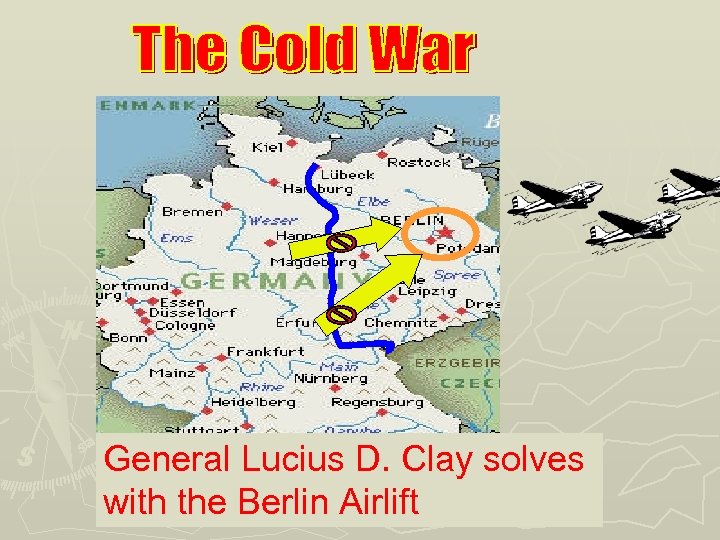 General Lucius D. Clay solves with the Berlin Airlift
 North Atlantic Treaty--1949 North Atlantic Treaty Organization (NATO)-- a military organization to meet any attack on any NATO country Soviets respond 1955 with Warsaw Pact
 The Army and Navy discharged millions of people within a few months of the end of World War II To help care for returning service people, Congress had passed the G. I. Bill of Rights in 1944
 The G. I. Bill Guaranteed a year’s unemployment benefits while discharged G. I. s looked for work. Provided money for education Provided low-interest, federally guaranteed loans for houses, businesses and farms
 Returning service people also began to rebuild lives High divorce rate in the late 1940 s Expanding women’s roles Many men had changed Many other families moved to the suburbs The war had caused the economy to recover; people began to again buy luxury goods
 The Fair Deal 21 -point domestic program Expanded Social Security benefits Increased minimum wage $. 40 to $. 65/hr Full employment through federal spending Republicans win control of Congress in 1946 Reduce government spending and chip away at New Deal reforms Turned down most of Fair Deal
 Labor-Management Relations Act of 1947 (The Taft-Hartley Act) Anti-union initiative by conservatives Closed shop illegal Union shop (must join a union after hiring) allowed but permitted states to pass “Right to Work” laws that could prohibit union shops Unions outraged: Slave Labor Law
 The Election of 1948 Harry S. Truman Became president 1945 Honorable, direct, down-to-earth, selfconfident “The Buck Stops Here” Decisive—accepted full responsibility for actions
 1947: Brooklyn Dodgers, general manager Branch Rickey hires Jackie Robinson as the first African. American major league baseball player
 The Election of 1948 Truman supported civil rights for minorities Asked Congress to take action: Anti-lynching laws Elimination of poll taxes Commission to assure fairness in hiring Congress refused
 The Election of 1948 July 1948: Executive Order integrating the armed forces Also ended discrimination in the hiring of government employees First president to effectively deal with race relations
 The Election of 1948 Truman is nominated by Democrats, but there is a huge split in the Democratic Party Southern Democrats, or “Dixiecrats, ” who want to protect the Southern way of life, nominate former Democrat, Governor Strom Thurmond of South Carolina
 The Election of 1948 Former liberal Democrats form a new Progressive Party and nominate former FDR Vice President Henry Wallace for President Major split in the Democratic Party similar to split in Republican Party in 1912
 The Election of 1948 Republicans nominate popular New York Governor Thomas E. Dewey huge lead in the polls but Truman conducts aggressive “whistle stop” campaign
 Domestic Successes 1. Congress raised minimum wage from $. 40 to $. 75 2. Expansion of Social Security System benefits by 75% Passed national Housing Act of 1949: 810, 000 low-income housing units and long-term rent subsidies
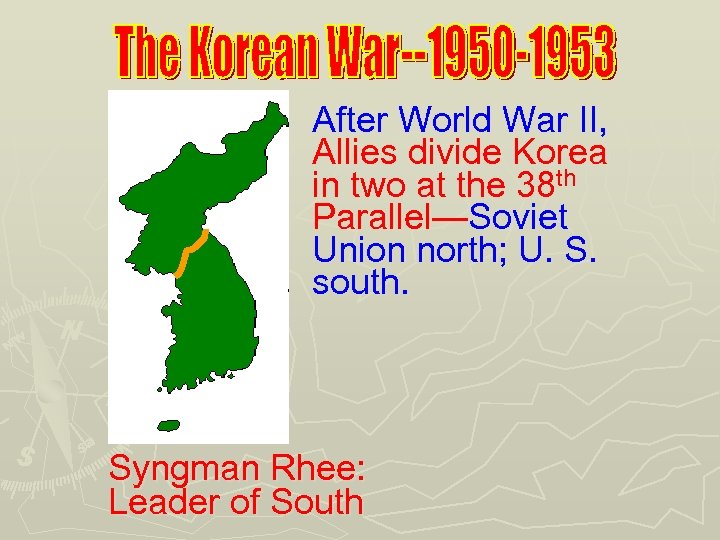 After World War II, Allies divide Korea in two at the 38 th Parallel—Soviet Union north; U. S. south. Syngman Rhee: Leader of South
 North Korean leader: Kim Il-Sung June 25, 1950, North Korean troops, using Soviet weapons and equipment invade South Korea North Koreans tear through the South Korean forces; take the South Korean capital of Seoul in 2 days.
 Syngman Rhee appeals to the United Nations for help. President Truman agrees to send U. S. troops Eventually 16 nations send troops in the first U. N. military action in history; but most are from U. S.
 Supreme Allied Commander: General Douglas Mac. Arthur First troops in are U. S. troops from Japan under LTC Brad Smith
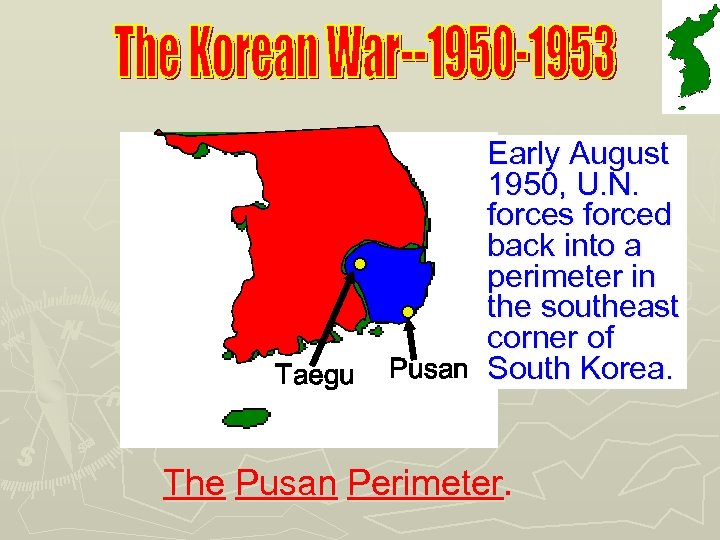 Taegu Early August 1950, U. N. forces forced back into a perimeter in the southeast corner of Pusan South Korea. The Pusan Perimeter.
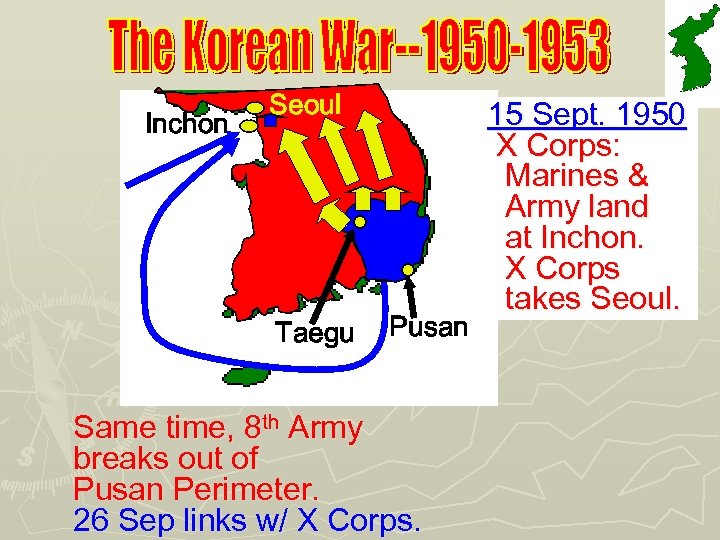 Inchon Seoul Taegu Pusan Same time, 8 th Army breaks out of Pusan Perimeter. 26 Sep links w/ X Corps. 15 Sept. 1950 X Corps: Marines & Army land at Inchon. X Corps takes Seoul.
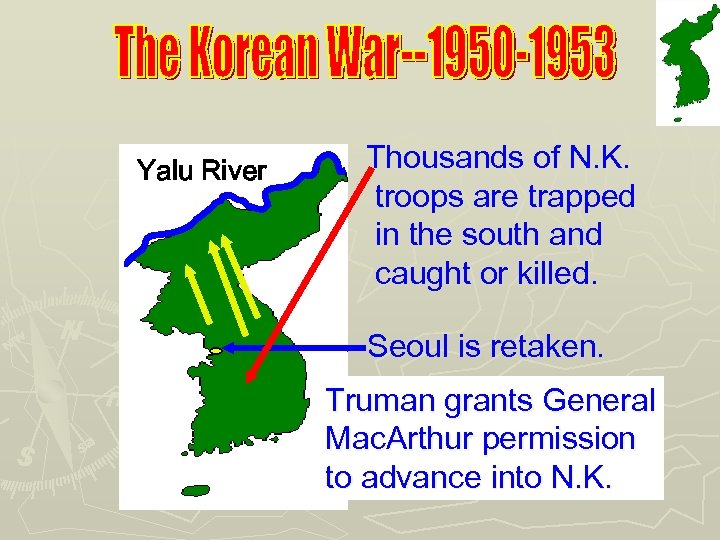 Yalu River Thousands of N. K. troops are trapped in the south and caught or killed. Seoul is retaken. Truman grants General Mac. Arthur permission to advance into N. K.
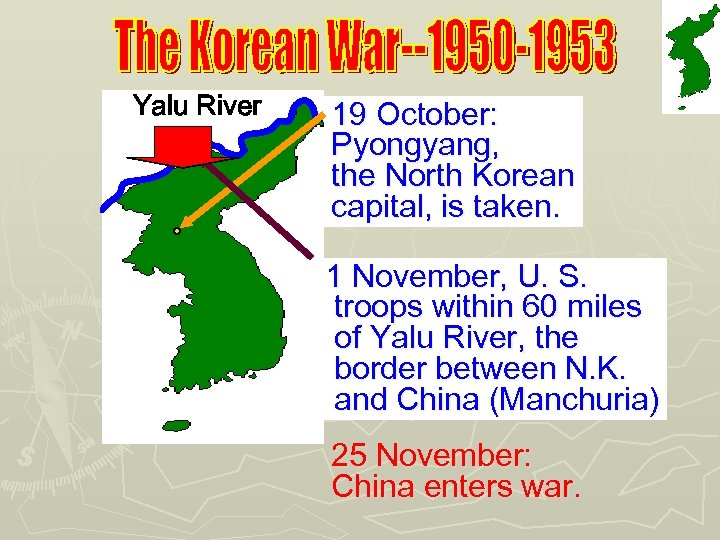 Yalu River 19 October: Pyongyang, the North Korean capital, is taken. 1 November, U. S. troops within 60 miles of Yalu River, the border between N. K. and China (Manchuria) 25 November: China enters war.
 U. N. troops retreat. Bloody fighting at the Chosin Reservoir U. N. troops retreat to South Korea; Chinese troops retake Seoul Jan. 4, 1951
 Truman next refuses Mac. Arthur’s request to attack China, using atomic bombs. Meanwhile, the U. S. 8 th Army, under General Matthew B. Ridgway counterattacks, re-takes Seoul and drives the Chinese & North Koreans north of 38 th Parallel
 After re-taking Seoul, Mac. Arthur urges full-scale war against China. Truman refuses; Mac. Arthur vents his concerns with media April 11, 1951, Truman fires Mac. Arthur; gives U. N. Commander-in-Chief position to Ridgway.
 July 1951, truce talks begin while fighting continues. Thousands of casualties during peace talks. Finally, agree to an armistice in July 1953. It is still in effect.
 Railroad Workers’ Strike of 1951 Truman ordered the government to seize control of the railroads No effect on union demands Workers got most of what they demanded Nation-wide Steel Strike of 1952 Truman seized steel mills citing powers as Commander-in-Chief Supreme Court ruled (6 -3) Truman had exceeded his authority Long, costly strike followed
 House Un-American Activities Committee (HUAC) Focused on the movie industry The Hollywood 10 Blacklisting
 Richard Nixon and Alger Hiss Whittaker Chambers
 Ethel and Julius Rosenberg
 Roy Cohen Senator Joseph Mc. Carthy (R, WI) Edward R. Murrow CBS News
 After his victory in 1948, Truman’s popularity sinks to all time low: 23% in 1951 Problems with Korean War, Mc. Carthyism, and loyalty of government workers. 1952: Truman decides not to run for re-election; Democrats nominate Governor Adlai E. Stevenson of Illinois
 1952 Election Republicans nominate retired General of the Army Dwight D. Eisenhower for President and California Senator Richard M. Nixon for Vice President
 1952 Election During the campaign, Nixon is accused of illegally skimming funds. In reply, Nixon goes on national television, (58 million people) on September 23, 1952, to give the now famous “Checkers Speech” First use of television by a political candidate
 Behind the political campaign slogan of “I like Ike, ” Eisenhower wins the 1952 election. Effective, behind the scenes president Ended Korean War Brought Alaska and Hawaii into the Union as 49 th and 50 th states
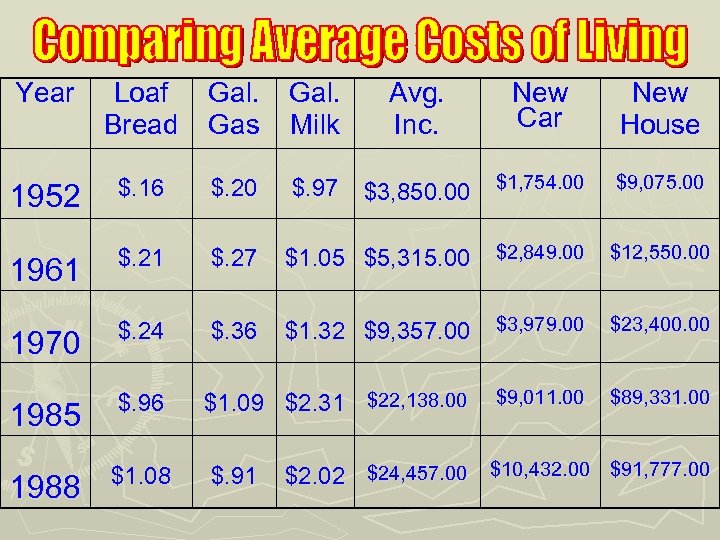 Year Loaf Bread Gal. Gas Gal. Milk Avg. Inc. New Car New House 1952 $. 16 $. 20 $. 97 $3, 850. 00 $1, 754. 00 $9, 075. 00 1961 $. 27 $1. 05 $5, 315. 00 $2, 849. 00 $12, 550. 00 1970 $. 24 $. 36 $1. 32 $9, 357. 00 $3, 979. 00 $23, 400. 00 1985 $. 96 $1. 09 $2. 31 $22, 138. 00 $9, 011. 00 $89, 331. 00 1988 $1. 08 $. 91 $2. 02 $24, 457. 00 $10, 432. 00 $91, 777. 00
 1950 s: U. S. produced most of its own oil Therefore gasoline was inexpensive Leading to more cars in the U. S.
 Eisenhower had noted the excellent German autobahn system during the later stages of WWII. 1956, Eisenhower signs the Interstate Highway Act—authorizing 41, 000 miles of nation-wide expressways
 With improved highways, Americans “took to the roads”— Americans became mobile, leading to new business opportunities. 1955, Walt Disney creates Disneyland
 1950 s: increases in air and noise pollution and automobile accidents With expanse of the suburbs, economic gap between inner city (urban) and suburban dwellers widened With more money in economy, manufacturers incorporated planned obsolescence—products not built to last as long because Americans wanted newer and better items
 1950: Diner’s Club issues the nation’s first credit card American Express follows in 1958 American private debt rises from $73 billion to $179 billion in the 1950 s Prompting this surge in spending was a boom in advertising—the Advertising Age
 The 1950 s were the main years of the Baby Boom 1957: one baby born in the U. S. every 7 seconds (4, 254, 784) Many parents follow the advice of Dr. Benjamin Spock regarding child rearing: Common Sense Book of Baby And Child Care
 American leisure significantly affected by the emergence of television in the 1950 s News shows were faster with people able to see, as well as hear, what was happening in the world First great TV journalist: Edward R. Murrow of CBS News
 One of the key scientific discoveries of the 1950 s: Dr. Jonas Salk finds a cure for the terrible disease poliomyelitis Also, women, once again, became housewives; although many were frustrated
 Sputnik • Soviet Satellite 1957 • First man-made satellite • Americans feared Soviets had achieved superiority in technology • Led to more funding for math & science education
 The Space Race April 12, 1961, Soviet Cosmonaut, Yuri A. Gagarin became the first human in space, orbiting the Earth 188 miles above the planet’s surface for 108 minutes The Soviets had scored another major victory in the Space Race
 Kennedy responds with leadership: in an address to a joint session of Congress: “(the United States) should commit itself to achieving the goal, before this decade is out, of landing a man on the moon and returning him safely to Earth. ” Makes Vice President Johnson the chairman of the National Space Council
 May 1961, Navy Commander Alan B. Shepard becomes the first American in space. 15 minute sub-orbital flight in Freedom 7. Mercury Program Late 1961, Virgil I. “Gus” Grissom, in Liberty Bell 7, completes a second sub-orbital flight.
 February 20, 1962, Marine Corps Colonel John Glenn becomes the first American to orbit the earth. Later becomes a U. S. Senator from Ohio, then becomes the oldest human to travel in space (on the Space Shuttle).
 Three more Mercury astronauts, Malcolm Scott Carpenter, Walter Schirra, and Le. Roy Gordon Cooper also orbit the earth.
 The Mercury program is followed by the Gemini program—two people in one space capsule. Highlights include space walks and rendezvous in space. The Gemini program is followed by the Apollo program, culminating with 5 successful landings on the moon.
 The Golden Age of TV The most famous comedy show (situation comedy) of the 1950 s: I Love Lucy starring the husband wife team of Desi Arnaz and Lucille Ball, along with Vivienne Vance and William Frawley
 Children’s shows included Saturday shows such as Howdy Doody and weekday afternoon shows such as the Mickey Mouse Club
 Afternoons also became a time for teenage TV with Dick Clark’s American Bandstand
 The 1950 s were also the age of the prime time quiz show, until a cheating scandal on The $64, 000. 00 Question caused people to question the validity of TV quiz, or game, shows Did the producers give Charles Van Doren answers?
 General Agreement on Tariffs and Trade 1947 Purpose: Expand international trade by a mutual reduction of tariffs
 World War II set the stage for the Civil Rights Movement New demand for African-American, Latino and female workers 700, 000 African-Americans served in the military; many in combat During the war, civil rights groups actively campaigned for African. American voting rights and challenged Jim Crow laws
 Roosevelt: Executive Order prohibiting racial discrimination by federal agencies and by all companies engaged in war work. 1948: Truman signed an Executive Order integrating the armed forces.
 1938: attorney (and future first African-American Supreme Court Justice) Thurgood Marshall begins a 23 -year civil rights legal struggle National Association for The Advancement of Colored People (NAACP) Won 29 of 32 Supreme Court cases
 Marshall’s most stunning victory: May 17, 1954: Brown v. Board of Education of Topeka, KS Oliver Brown, father of Linda Brown, sued the Topeka Board of Education for violating Linda’s rights by denying her admission to an all-white elementary school 4 -blocks from her house. Rather, the Board forced Linda to attend an all-Black school 21 blocks away.
 The Warren Court, led by Chief Justice Earl Warren, unanimously decided in favor of Brown (represented by Marshall), thereby striking down Plessy v Ferguson and all segregation as unconstitutional. The Brown decision immediately affected 12 million schoolchildren in 21 states
 1955: Supreme Court handed down a second Brown ruling: ordered district courts to implement school desegregation “with all deliberate speed. ” President Eisenhower and Congress did not enforce. Eisenhower believed you could not force desegregation on people. Congressional “Southern Manifesto: ” Southern Democrats denounced the Brown decision and called on the states to resist it “by all lawful means. ”
 September 1957: Arkansas Governor Orval Faubus ordered the Arkansas National Guard to turn away nine African-American students who had volunteered to integrate Little Rock’s Central High School. That afternoon, a federal judge ordered Faubus to let the students into Central High
 Eisenhower federalized the Arkansas National Guard and sent in 1, 000 members of the 101 st Airborne Division (Hooah!) to enforce the judge’s order
 Later, Faubus closed Central High to prevent continued integration Congress, under the leadership of Senator Lyndon B. Johnson, passed the Civil Rights Act of 1957, giving the Attorney General of the United States greater power over school desegregation.
 December 1, 1955, seamstress Rosa Parks refused to give up her seat to a white man on a Montgomery, Alabama public bus Parks passively accepts arrest for violating the Jim Crow law. News spreads across the nation
 Led by 26 -year-old Dr. Martin Luther King, Jr. , African. Americans peacefully boycott Montgomery city buses for 381 days December 1956: Supreme Court outlawed bus segregation, in response to lawsuit filed by boycotters. Dec. 21—Dr. King rides in front seat of Montgomery bus.
 Dr. King patterned his form of nonviolent civil disobedience after writings of Henry David Thoreau, A. Philip Randolph, and Mohandas Gandhi 1957, King forms the Southern Christian Leadership Conference (SCLC) to promote civil rights protests in the South. 1960, Ella Baker starts the Student Nonviolent Coordinating Committee (SNCC) to try to motivate student protests
 1961—Freedom Riders take bus caravan from Washington, D. C. to the South Anniston, Alabama, one bus is firebombed Other freedom riders are attacked by a white mob and beaten—police refuse to intervene