


 Скачать презентацию Some UK and international work in progress Jonathan
ad1c0279d8ff9417ed185ae5113fcef9.ppt
- Количество слайдов: 12
 Some UK and international work in progress Jonathan Haskel Imperial College Business School, London Financial support form EU FP 7 Programme NBER, 4 th Dec 2008 Useful and Needed Research on Measuring Economic Activity in Markets for Ideas Innovation and Other Intangibles
 UK-based work in progress • Implementing CHS method – Industry level work • IO tables + EUKLEMS data – Cross-country project • EU FP 7 funded • Use CHS method for intang, EUKLEMS for tang – Demand for a UK “innovation index” • Innovation accounting • TFPG + share-weighted intang asset stock growth • More data to enhance CHS method – Design • Apply software method to estimate in-house using design occupations outside the design sector – Extended R&D survey (with ONS) • Pilot extended survey to current CIS respondents • Ask for – data on intangibles – data on life lengths, following Israeli study » Development » Transition to production » Use in production • To do (in my view) on Nakamura/CHS research agenda – Organisational capital/managerial time use : Italian study – Financial services
 Extended R&D survey • Included in the sample frame if – responded to the BERD/Community Innovation Survey (CIS), – confirmed they had undertaken R&D, – indicated on the CIS form that they were willing to be contacted further • 20 companies – – – grouped geographically, six sectors, semistructured interview; 18 face to face and 2 telephone. Mostly with technical person i. e. respondent to Innovs survey.
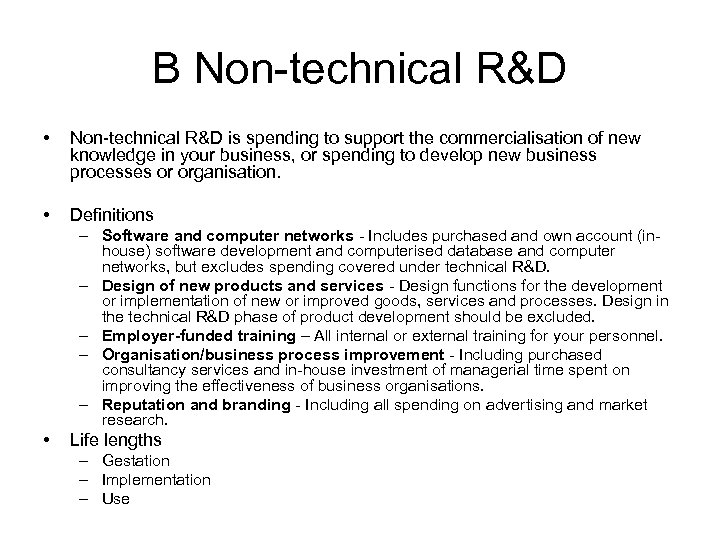
 Attempt to distinguish between types of R&D • “These questionnaires are about R&D that is both technical and non-technical. Here are some definitions and examples to help: – a. Technical R&D is defined as original investigation to acquire new knowledge in order to resolve scientific or technological uncertainty. – b. Non-technical R&D is work to support the commercialisation of new knowledge in the business and/or changes in the process and organisation in the business itself • Example
 Example • “Example. Consider the steps in the sale of a new DVD player. – 1. An improved mechanism for the laser that reads the DVD. This is technical R&D (i. e. R&D resolves scientific or technological uncertainty). – 2. Pre-production market research. Non-technical R&D (i. e. nontechnical since it is not trying to resolve scientific or technological uncertainties). – 3. New software to improve the working of the DVD. Nontechnical R&D. – 4. Advertising and branding spend to support the product. Nontechnical R&D – 5. New business process to change the way the product is produced and sold. Non-technical R&D. ”
 Technical R&D questions • 1) What categories of Technical R&D projects go on in your business? (…basic …applied …experimental development) • 2) proportions of spend in these groups • 3) how much did you spend? • 4) share of spending giving rise to patents • 5) Proportion of technically based knowledge in your business that is new in the past financial year comes from – in the business in UK, in the business outside UK, licencesed, freely available • 6)-8) licence production, location of R&D in UK/outside, knowledge used at home/abroad • 9) life lengths….
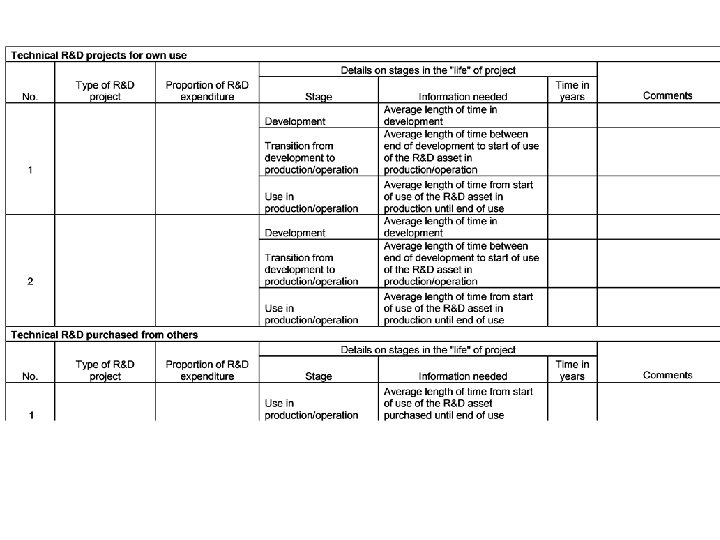
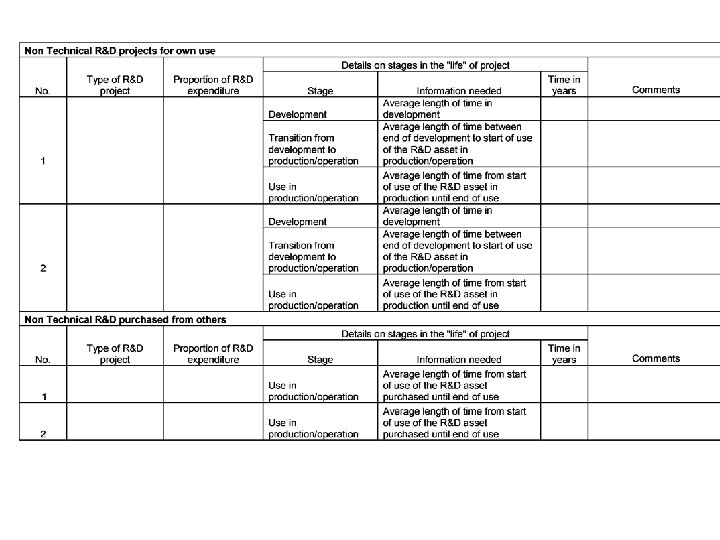
 Life lengths question • “ 9) The table below attempts to better understand time lapses from starting a specific technical R&D project, to developing a usable concept, to moving into production, through to the point where it no longer provides competitive advantage. • Description – i) Development: Gestation period- length of period of production of R&D (time lag between the start and completion of R&D projects) – ii) Transition: Application period - length of time passing between the end of the R&D phase of the project and the start of the use of the R&D in commercial production – iii) Use: Length of the period that the R&D is used in commercial production • Using the table below, please select at most three technical R&D projects and fill out the time lapses. In the case of purchased R&D please just fill out the use row”
 B Non-technical R&D • Non-technical R&D is spending to support the commercialisation of new knowledge in your business, or spending to develop new business processes or organisation. • Definitions – Software and computer networks - Includes purchased and own account (inhouse) software development and computerised database and computer networks, but excludes spending covered under technical R&D. – Design of new products and services - Design functions for the development or implementation of new or improved goods, services and processes. Design in the technical R&D phase of product development should be excluded. – Employer-funded training – All internal or external training for your personnel. – Organisation/business process improvement - Including purchased consultancy services and in-house investment of managerial time spent on improving the effectiveness of business organisations. – Reputation and branding - Including all spending on advertising and market research. • Life lengths – Gestation – Implementation – Use
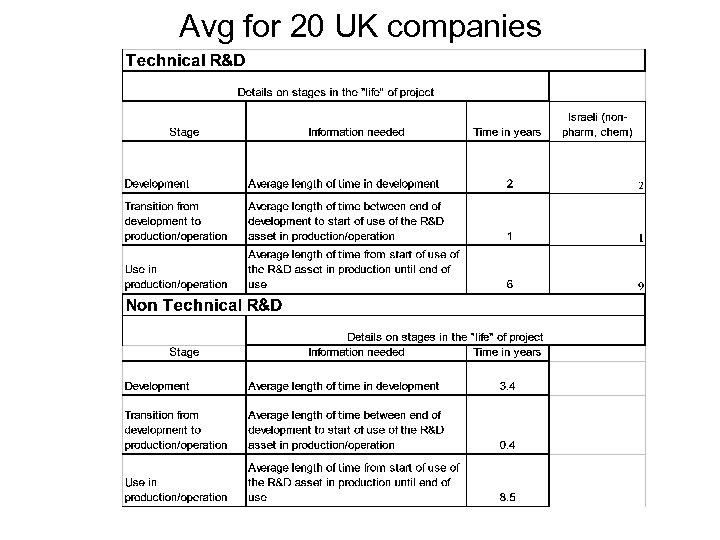 Avg for 20 UK companies
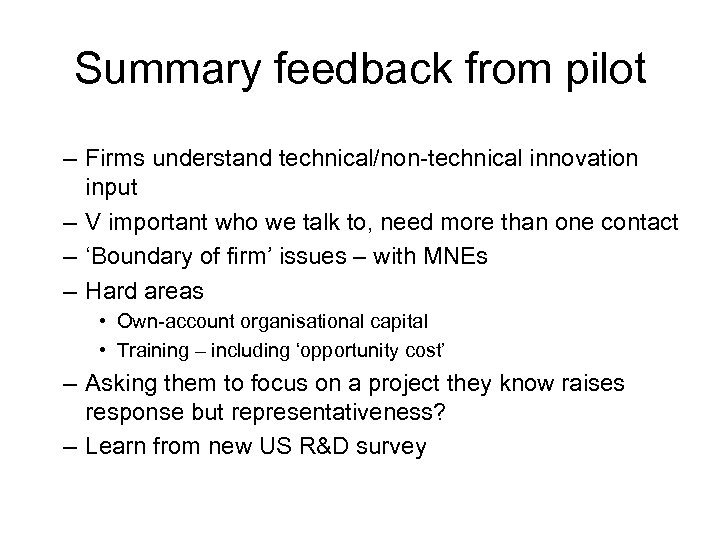 Summary feedback from pilot – Firms understand technical/non-technical innovation input – V important who we talk to, need more than one contact – ‘Boundary of firm’ issues – with MNEs – Hard areas • Own-account organisational capital • Training – including ‘opportunity cost’ – Asking them to focus on a project they know raises response but representativeness? – Learn from new US R&D survey