


 Скачать презентацию Some Lessons from The Great Inflation and Disinflation
28a39722f9909936a9f9f62a644cb756.ppt
- Количество слайдов: 38
 Some Lessons from The Great Inflation and Disinflation Peter Hooper Chief Economist Deutsche Bank Securities Peter. hooper@db. com 1 212 250 -7352 Torsten Slok Senior Economist Deutsche Bank Securities Torsten. slok@db. com 1 212 250 -2155 DISCLAIMER AND ANALYST CERTIFICATION ARE LOCATED ON THE LAST PAGE
 Outline • Quantifying trends and volatilities of inflation. • Implications of inflation stabilization. • Causes of the great inflation and disinflation. • Could it happen again, and if so, why? 2
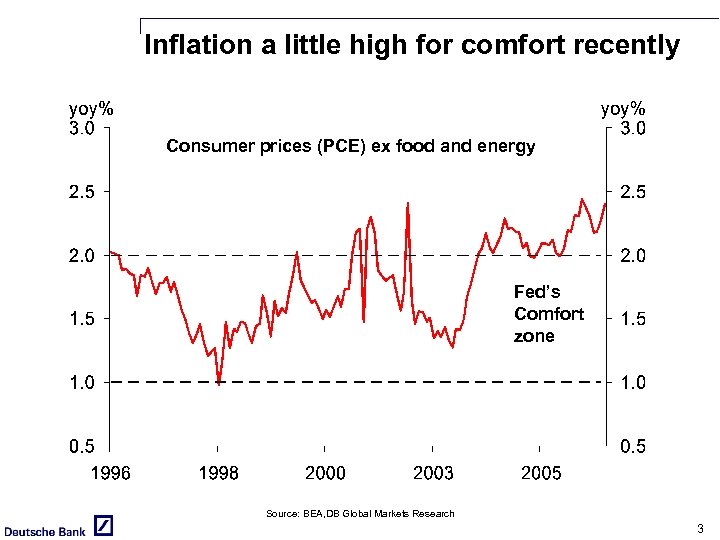 Inflation a little high for comfort recently Consumer prices (PCE) ex food and energy Fed’s Comfort zone Source: BEA, DB Global Markets Research 3
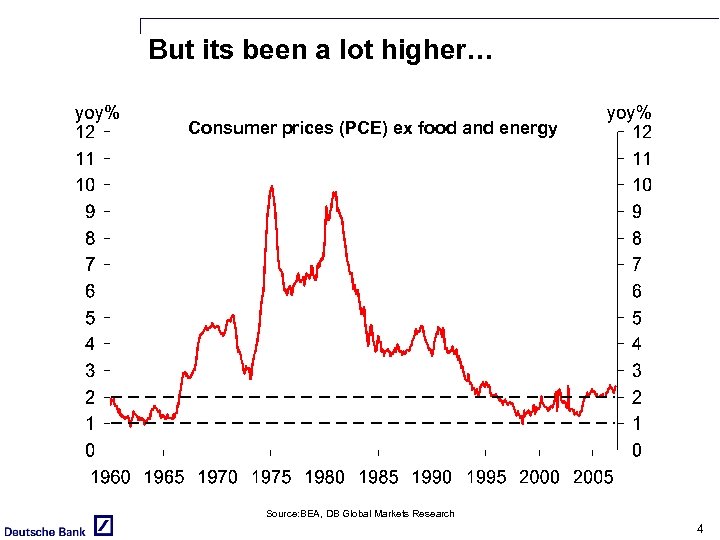 But its been a lot higher… Consumer prices (PCE) ex food and energy Source: BEA, DB Global Markets Research 4
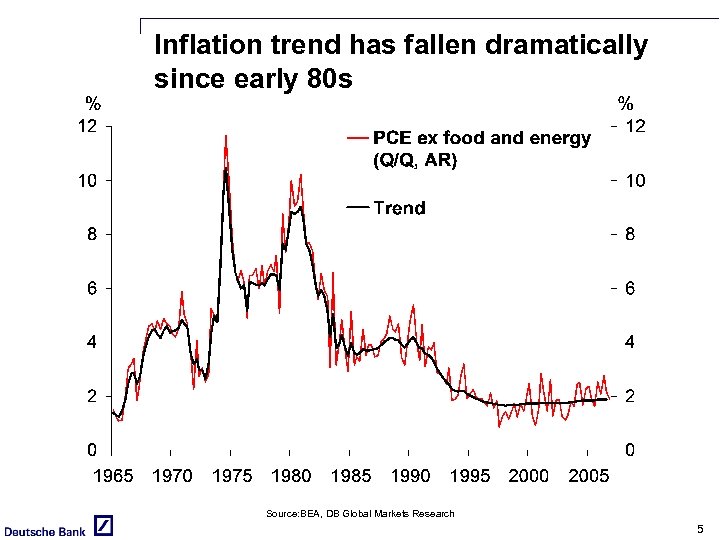 Inflation trend has fallen dramatically since early 80 s Source: BEA, DB Global Markets Research 5
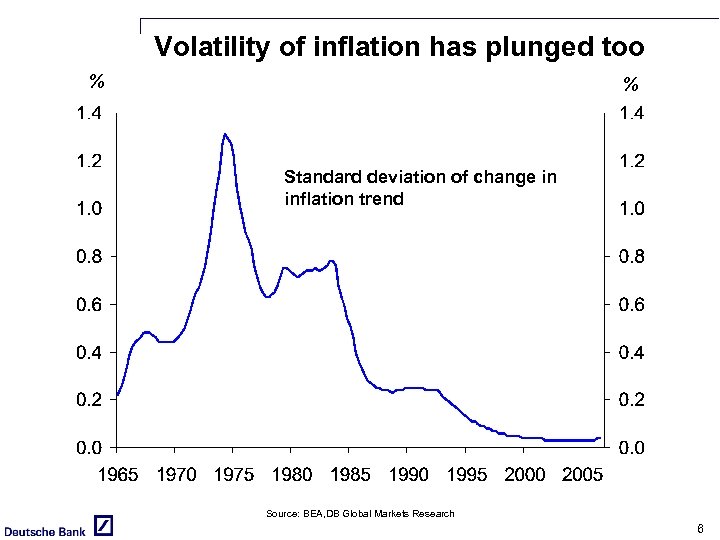 Volatility of inflation has plunged too % % Standard deviation of change in inflation trend Source: BEA, DB Global Markets Research 6
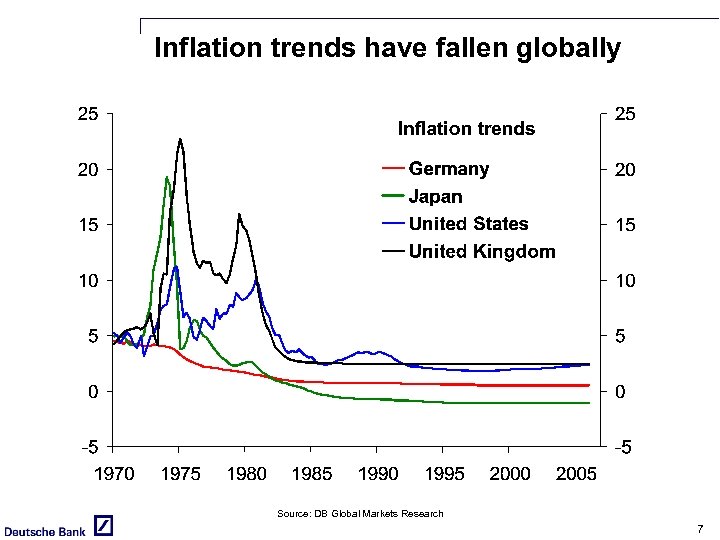 Inflation trends have fallen globally Source: DB Global Markets Research 7
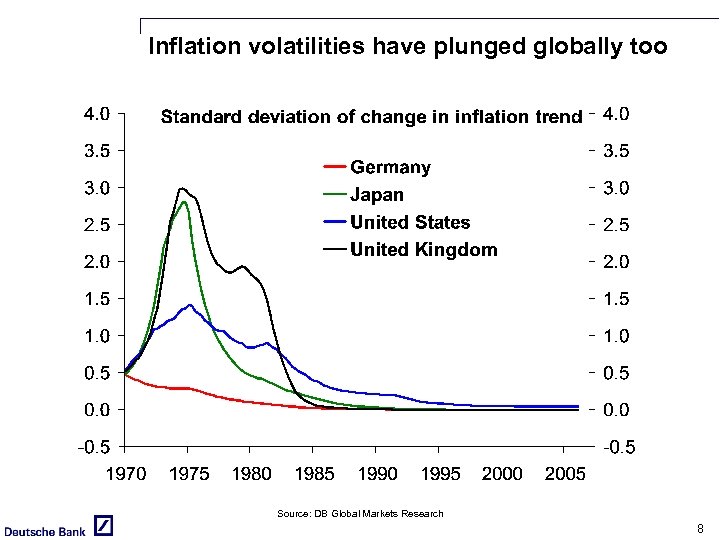 Inflation volatilities have plunged globally too Source: DB Global Markets Research 8
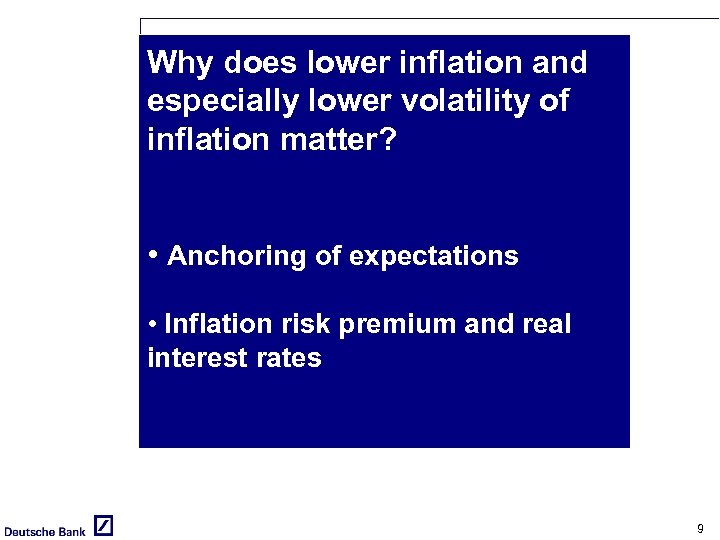 Why does lower inflation and especially lower volatility of inflation matter? • Anchoring of expectations • Inflation risk premium and real interest rates 9
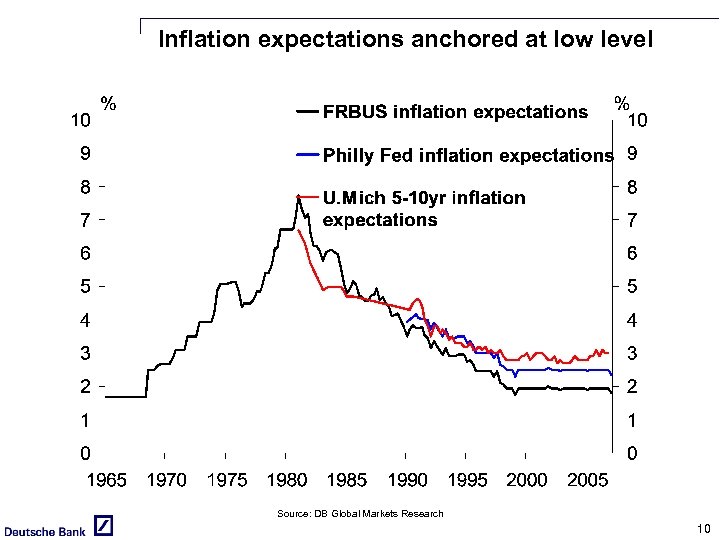 Inflation expectations anchored at low level Source: DB Global Markets Research 10
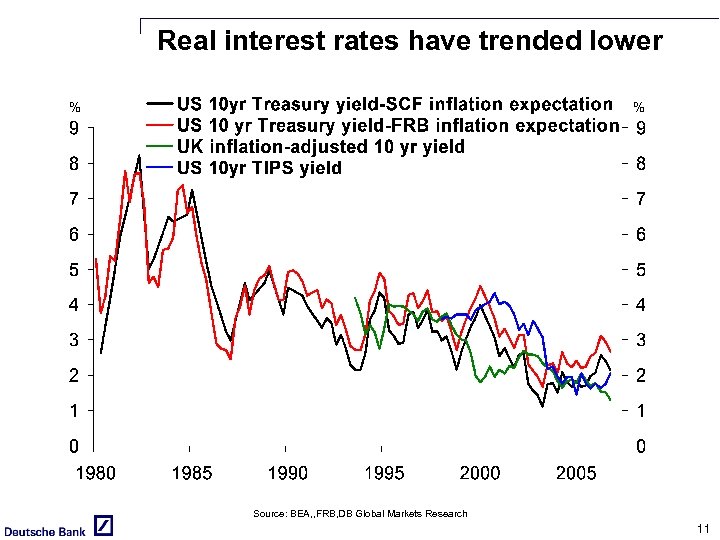 Real interest rates have trended lower Source: BEA, , FRB, DB Global Markets Research 11
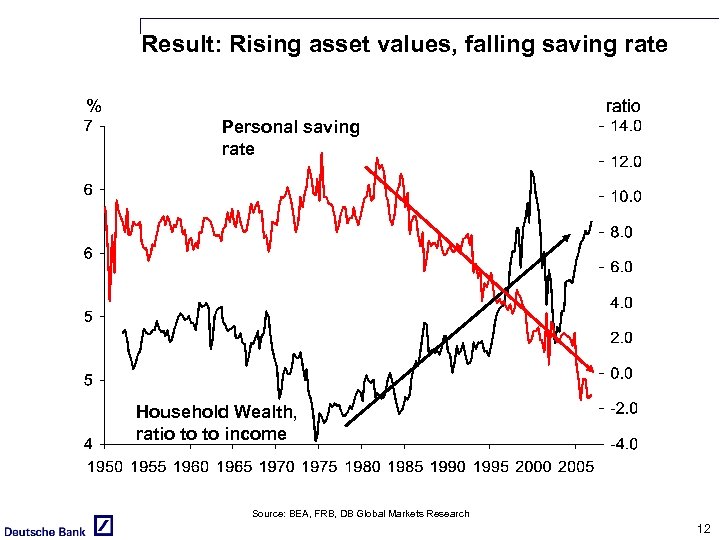 Result: Rising asset values, falling saving rate Personal saving rate Household Wealth, ratio to to income Source: BEA, FRB, DB Global Markets Research 12
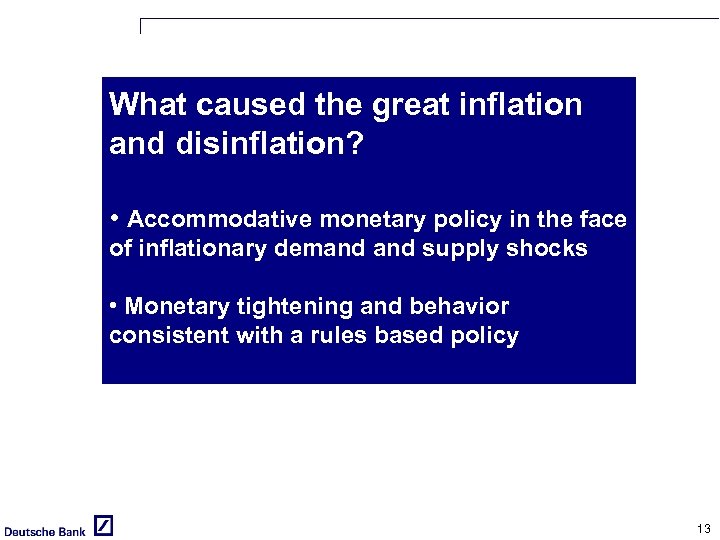 What caused the great inflation and disinflation? • Accommodative monetary policy in the face of inflationary demand supply shocks • Monetary tightening and behavior consistent with a rules based policy 13
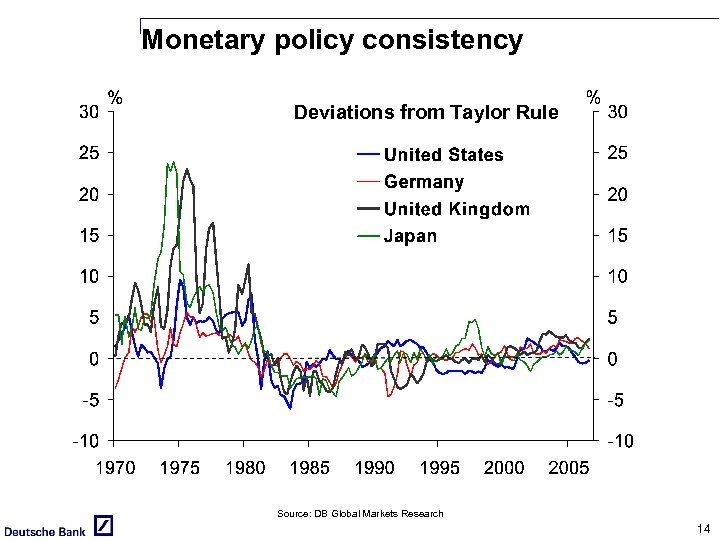 Monetary policy consistency Deviations from Taylor Rule Source: DB Global Markets Research 14
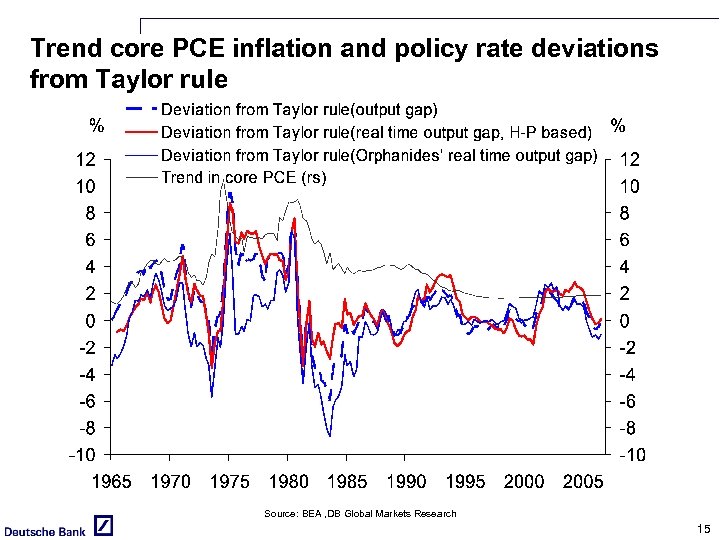 Trend core PCE inflation and policy rate deviations from Taylor rule Source: BEA , DB Global Markets Research 15
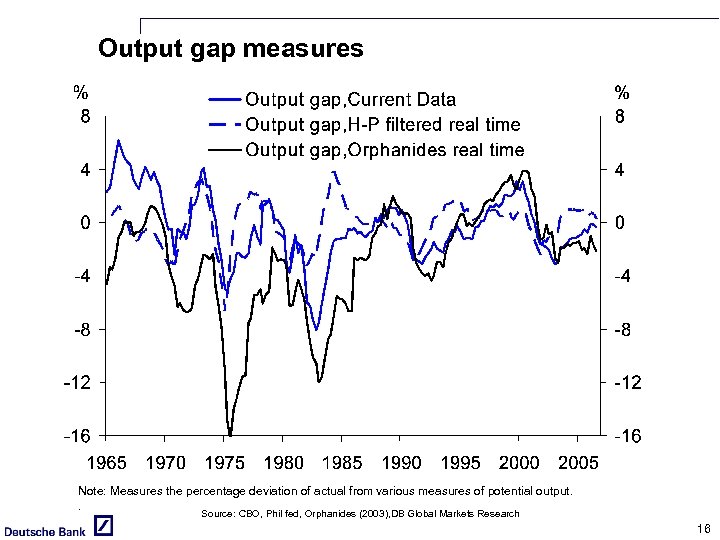 Output gap measures Note: Measures the percentage deviation of actual from various measures of potential output. . Source: CBO, Phil fed, Orphanides (2003), DB Global Markets Research 16
 What could cause inflation trend and volatility to rise again? • Politics • Demographics • Global factors 17
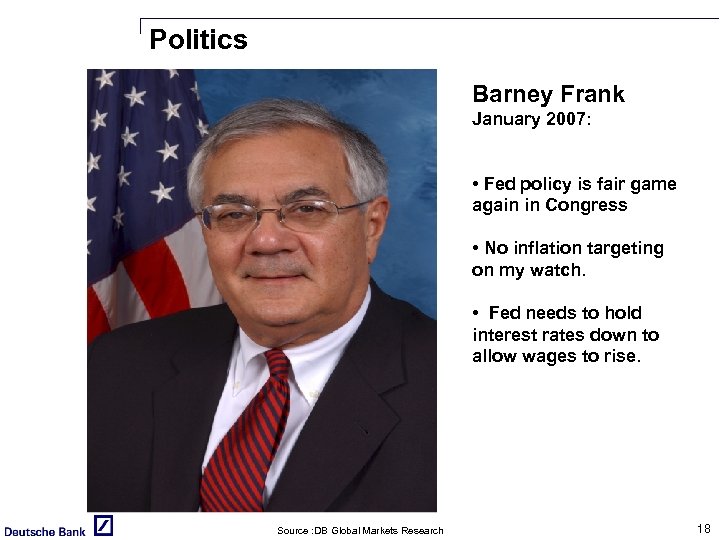 Politics Barney Frank January 2007: • Fed policy is fair game again in Congress • No inflation targeting on my watch. • Fed needs to hold interest rates down to allow wages to rise. Source : DB Global Markets Research 18
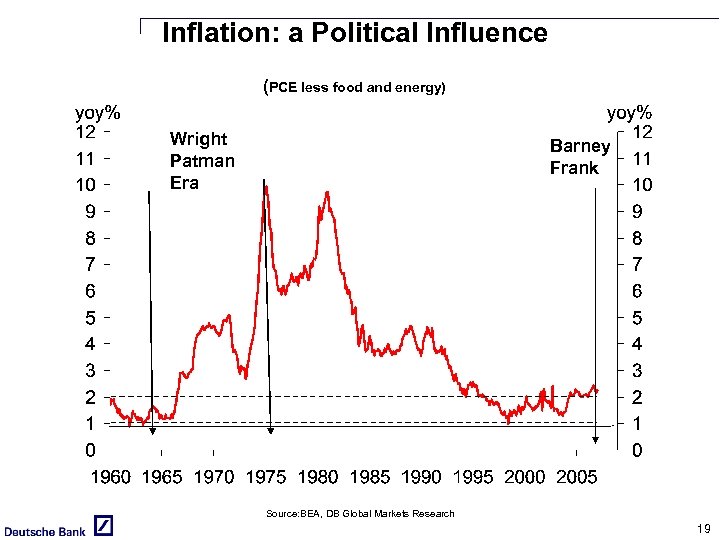 Inflation: a Political Influence (PCE less food and energy) Wright Patman Era Barney Frank Source: BEA, DB Global Markets Research 19
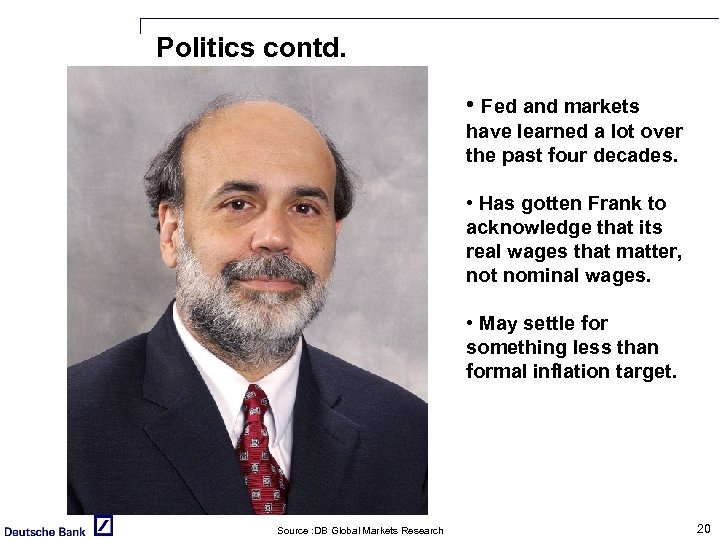 Politics contd. • Fed and markets have learned a lot over the past four decades. • Has gotten Frank to acknowledge that its real wages that matter, not nominal wages. • May settle for something less than formal inflation target. Source : DB Global Markets Research 20
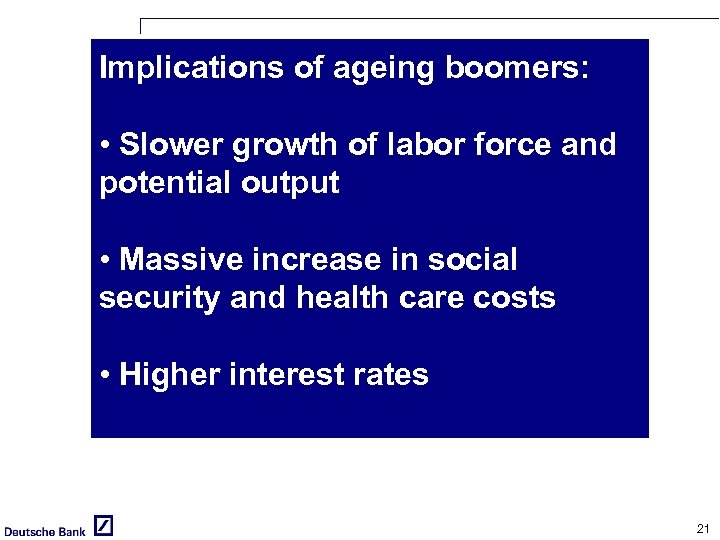 Implications of ageing boomers: • Slower growth of labor force and potential output • Massive increase in social security and health care costs • Higher interest rates 21
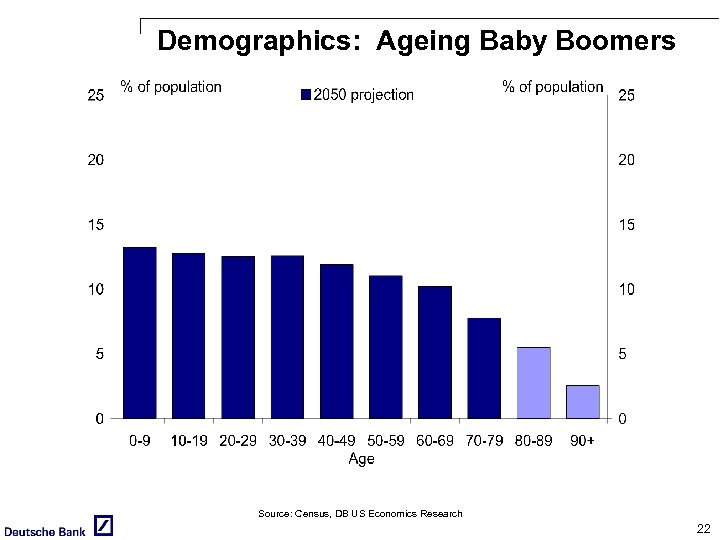 Demographics: Ageing Baby Boomers Source: Census, DB US Economics Research 22
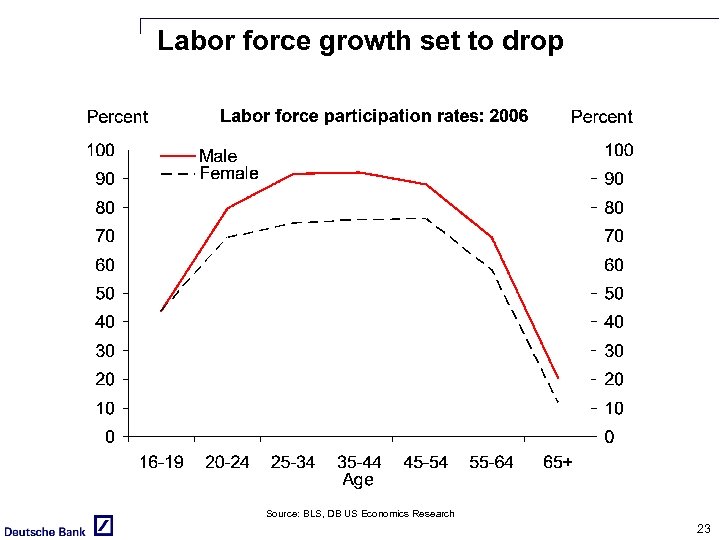 Labor force growth set to drop Source: BLS, DB US Economics Research 23
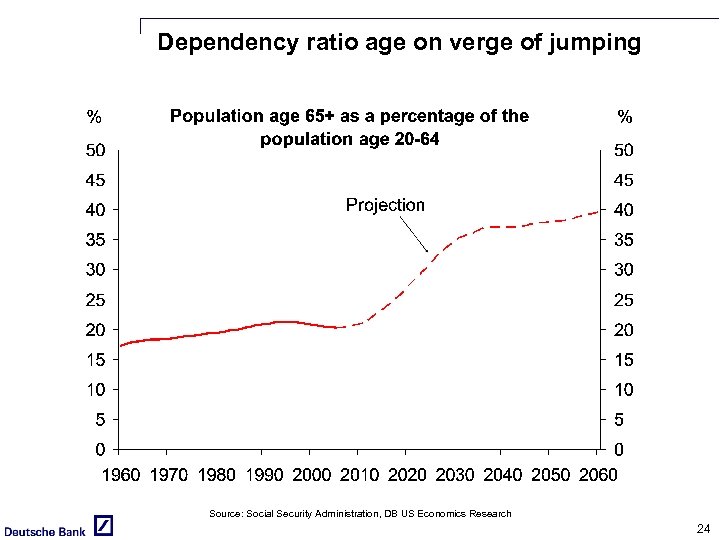 Dependency ratio age on verge of jumping Source: Social Security Administration, DB US Economics Research 24
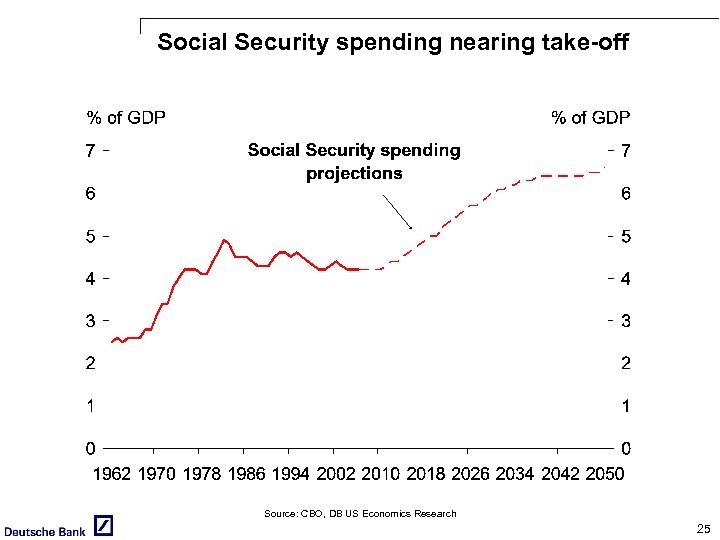 Social Security spending nearing take-off Source: CBO, DB US Economics Research 25
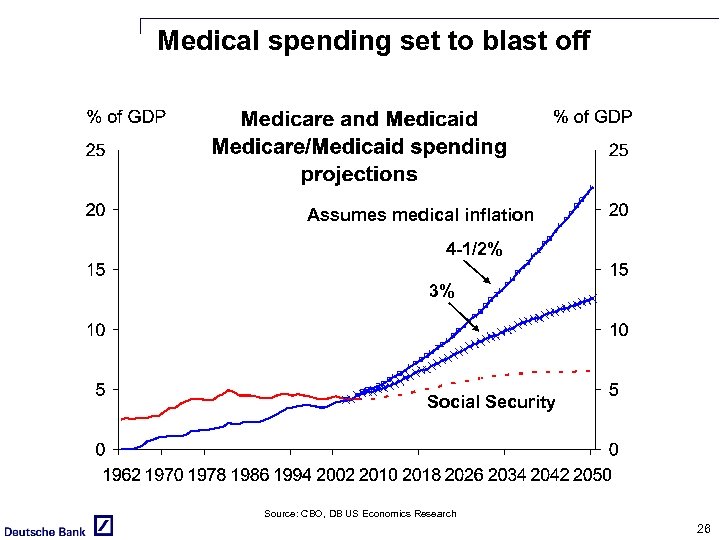 Medical spending set to blast off Assumes medical inflation 4 -1/2% 3% Social Security Source: CBO, DB US Economics Research 26
 Global factors could cause inflation trend and volatility to rise again 27
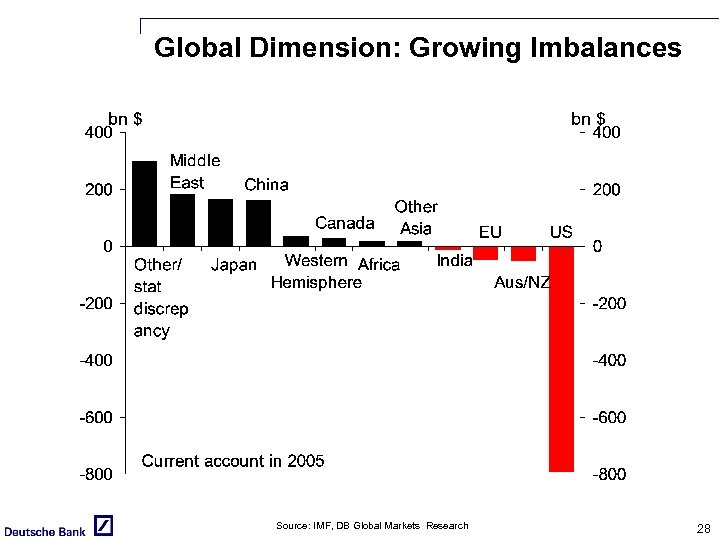 Global Dimension: Growing Imbalances Source: IMF, DB Global Markets Research 28
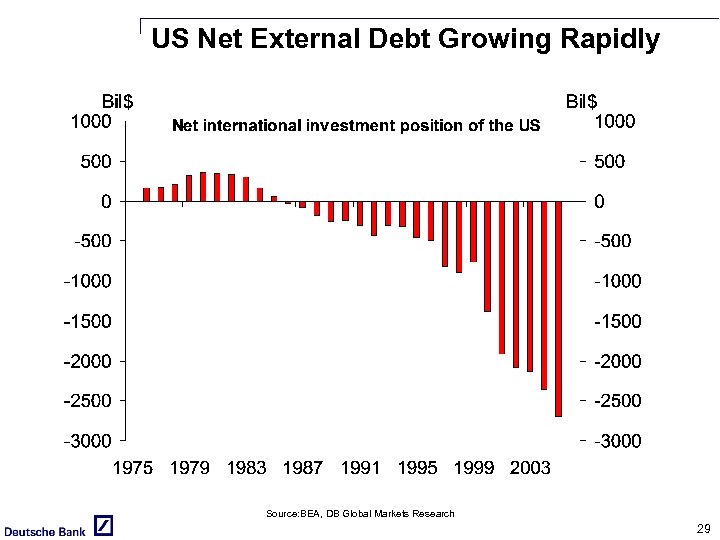 US Net External Debt Growing Rapidly Source: BEA, DB Global Markets Research 29
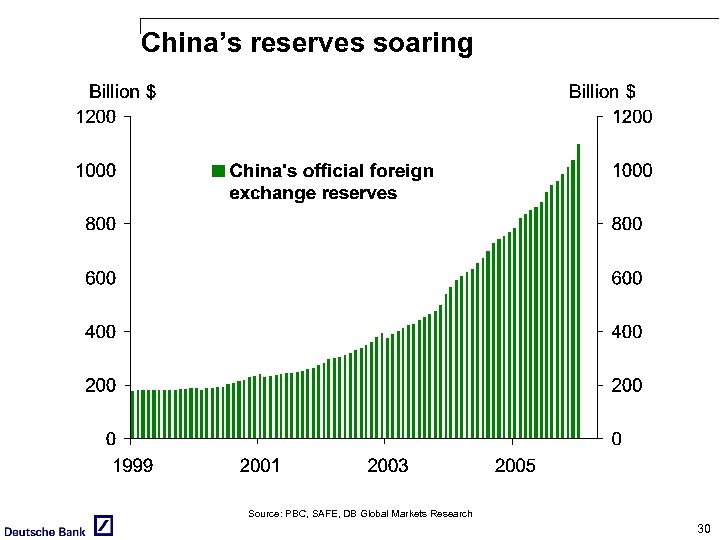 China’s reserves soaring Source: PBC, SAFE, DB Global Markets Research 30
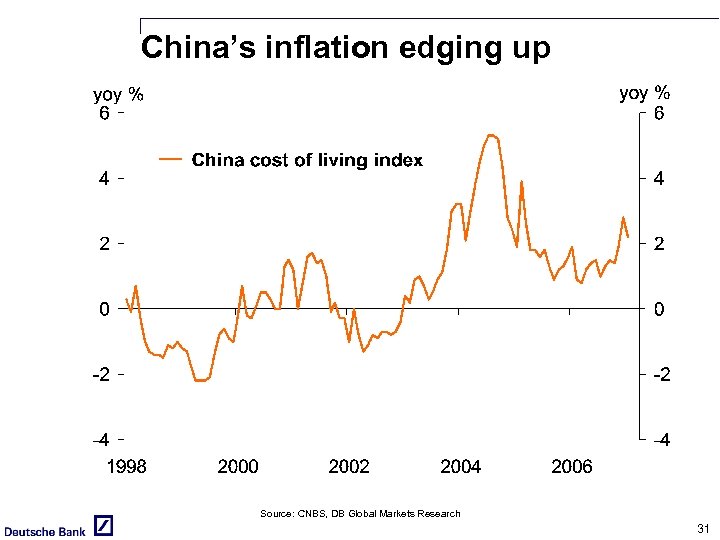 China’s inflation edging up Source: CNBS, DB Global Markets Research 31
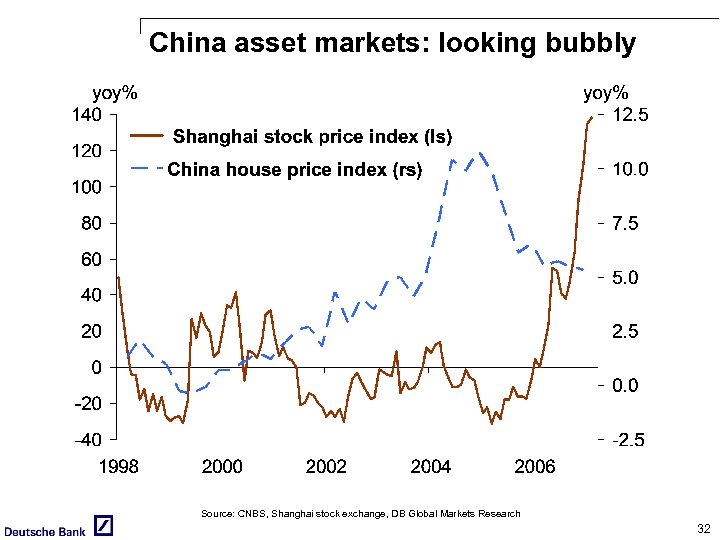 China asset markets: looking bubbly Source: CNBS, Shanghai stock exchange, DB Global Markets Research 32
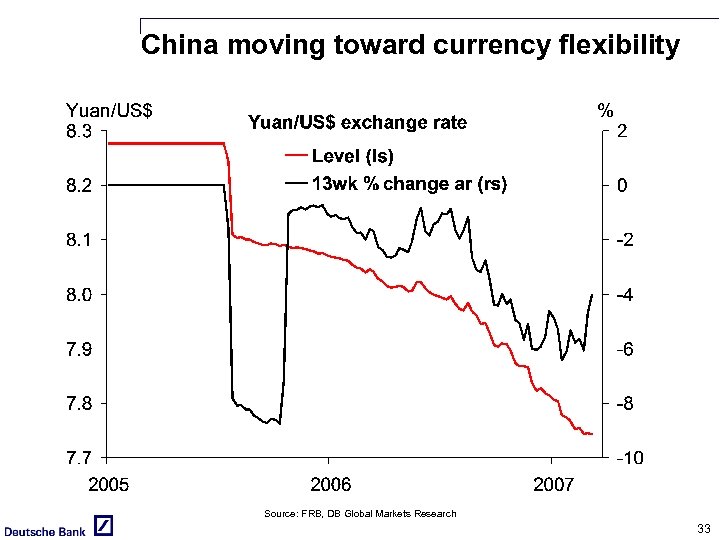 China moving toward currency flexibility Source: FRB, DB Global Markets Research 33
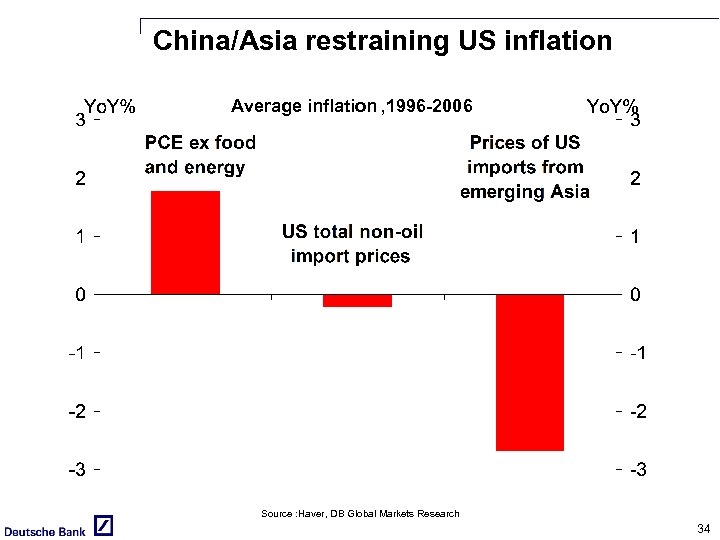 China/Asia restraining US inflation Average inflation , 1996 -2006 Source : Haver, DB Global Markets Research 34
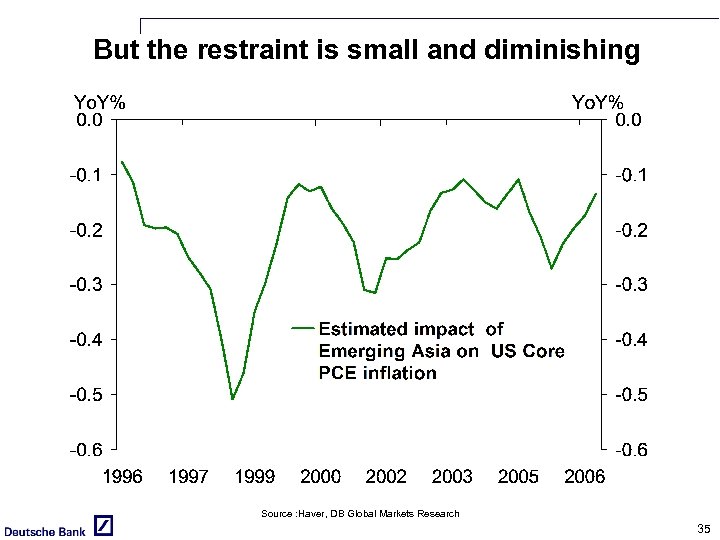 But the restraint is small and diminishing Source : Haver, DB Global Markets Research 35
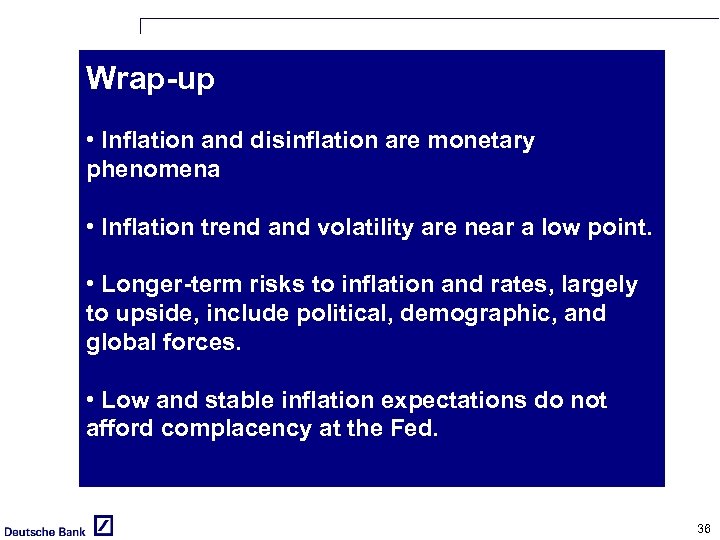 Wrap-up • Inflation and disinflation are monetary phenomena • Inflation trend and volatility are near a low point. • Longer-term risks to inflation and rates, largely to upside, include political, demographic, and global forces. • Low and stable inflation expectations do not afford complacency at the Fed. 36
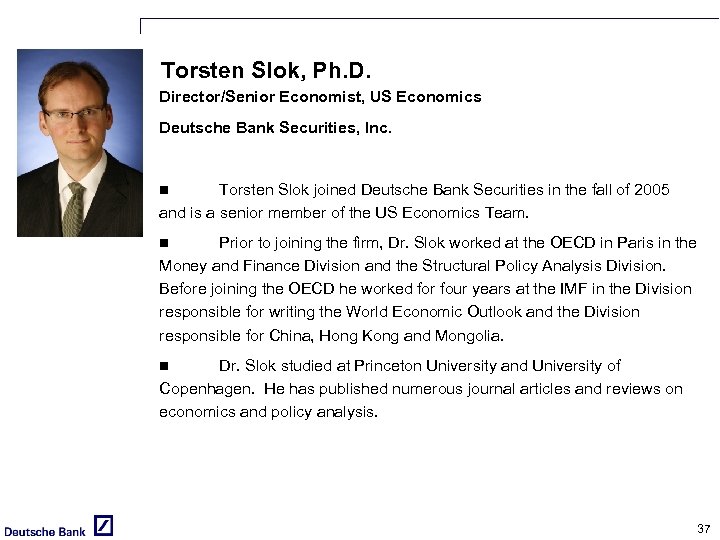 Torsten Slok, Ph. D. Director/Senior Economist, US Economics Deutsche Bank Securities, Inc. Torsten Slok joined Deutsche Bank Securities in the fall of 2005 and is a senior member of the US Economics Team. n Prior to joining the firm, Dr. Slok worked at the OECD in Paris in the Money and Finance Division and the Structural Policy Analysis Division. Before joining the OECD he worked for four years at the IMF in the Division responsible for writing the World Economic Outlook and the Division responsible for China, Hong Kong and Mongolia. n Dr. Slok studied at Princeton University and University of Copenhagen. He has published numerous journal articles and reviews on economics and policy analysis. n 37
 Analyst Certification The views expressed in this report accurately reflect the personal views of the undersigned lead analyst(s). In addition, the undersigned lead analyst(s) has not and will not receive any compensation for providing a specific recommendation or view in this report. Torsten Slok The information and opinions in this report were prepared by Deutsche Bank AG or one of its affiliates (collectively “Deutsche Bank”). The information herein is believed by Deutsche Bank to be reliable and has been obtained from public sources believed to be reliable. With the exception of information about Deutsche Bank, Deutsche Bank makes no representation as to the accuracy or completeness of such information. This published research report may be considered by Deutsche Bank when Deutsche Bank is deciding to buy or sell proprietary positions in the securities mentioned in this report. For select companies, Deutsche Bank equity research analysts may identify shorter-term opportunities that are consistent or inconsistent with Deutsche Bank's existing, longer-term Buy or Sell recommendations. This information is made available on the SOLAR stock list, which can be found at http: //gm. db. com. Deutsche Bank may trade for its own account as a result of the short term trading suggestions of analysts and may also engage in securities transactions in a manner inconsistent with this research report and with respect to securities covered by this report, will sell to or buy from customers on a principal basis. Disclosures of conflicts of interest, if any, are discussed at the end of the text of this report or on the Deutsche Bank website at http: //gm. db. com. Opinions, estimates and projections in this report constitute the current judgement of the author as of the date of this report. They do not necessarily reflect the opinions of Deutsche Bank and are subject to change without notice. Deutsche Bank has no obligation to update, modify or amend this report or to otherwise notify a reader thereof in the event that any matter stated herein, or any opinion, projection, forecast or estimate set forth herein, changes or subsequently becomes inaccurate, except if research on the subject company is withdrawn. Prices and availability of financial instruments also are subject to change without notice. This report is provided for informational purposes only. It is not to be construed as an offer to buy or sell or a solicitation of an offer to buy or sell any financial instruments or to participate in any particular trading strategy in any jurisdiction or as an advertisement of any financial instruments. The financial instruments discussed in this report may not be suitable for all investors and investors must make their own investment decisions using their own independent advisors as they believe necessary and based upon their specific financial situations and investment objectives. If a financial instrument is denominated in a currency other than an investor’s currency, a change in exchange rates may adversely affect the price or value of, or the income derived from, the financial instrument, and such investor effectively assumes currency risk. In addition, income from an investment may fluctuate and the price or value of financial instruments described in this report, either directly or indirectly, may rise or fall. Furthermore, past performance is not necessarily indicative of future results. Unless governing law provides otherwise, all transactions should be executed through the Deutsche Bank entity in the investor’s home jurisdiction. In the U. S. this report is approved and/or distributed by Deutsche Bank Securities Inc. , a member of the NYSE, the NASD, NFA and SIPC. In Germany this report is approved and/or communicated by Deutsche Bank AG Frankfurt authorised by Bundesanstalt für Finanzdienstleistungsaufsicht. In the United Kingdom this report is approved and/or communicated by Deutsche Bank AG London, a member of the London Stock Exchange and regulated by the Financial Services Authority for the conduct of investment business in the UK and authorised by Bundesanstalt für Finanzdienstleistungsaufsicht (Ba. Fin). This report is distributed in Hong Kong by Deutsche Bank AG, Hong Kong Branch, in Korea by Deutsche Securities Korea Co. and in Singapore by Deutsche Bank AG, Singapore Branch. In Japan this report is approved and/or distributed by Deutsche Securities Inc. The information contained in this report does not constitute the provision of investment advice. In Australia, retail clients should obtain a copy of a Product Disclosure Statement (PDS) relating to any financial product referred to in this report and consider the PDS before making any decision about whether to acquire the product. Deutsche Bank AG Johannesburg is incorporated in the Federal Republic of Germany (Branch Register Number in South Africa: 1998/003298/10) Additional information relative to securities, other financial products or issuers discussed in this report is available upon request. This report may not be reproduced, distributed or published by any person for any purpose without Deutsche Bank's prior written consent. Please cite source when quoting. Copyright © 2007 Deutsche Bank AG 38