


 Скачать презентацию Some general concepts and the French experience
cb8a2f25aaf16f9db682ab2fb70e95d6.ppt
- Количество слайдов: 19
 Some general concepts and the French experience on social responsibility and sustainable development Cristian Brodhag Interministerial delegates for sustainable development, FRANCE ISO/TMB/WG SR : ISO 26000 Plenary meeting May 15 -19, 2006, Lisbon see on brodhag. org
 intégration difficulties Rio Negro Amazon Rio Solimoes
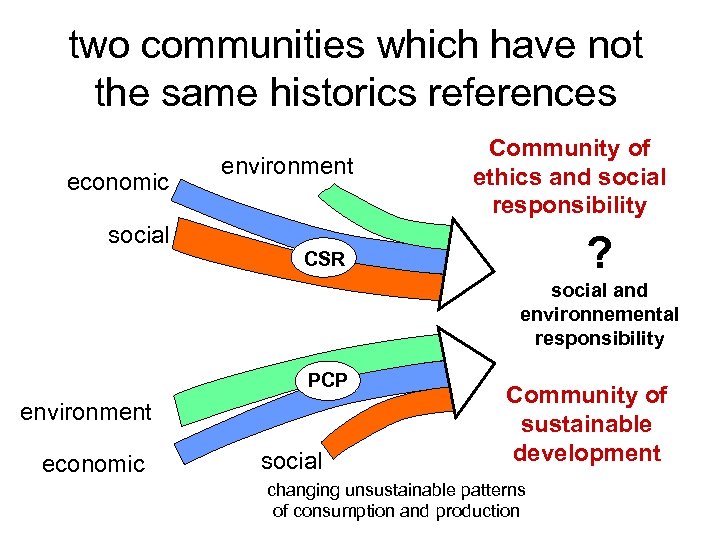 two communities which have not the same historics references economic social environment Community of ethics and social responsibility ? CSR social and environnemental responsibility PCP environment economic social Community of sustainable development changing unsustainable patterns of consumption and production
 European view of CSR • A common European understanding of what CSR means has emerged on the basis of the Commission definition of CSR as a concept whereby companies integrate social and environmental concerns in their business operations and in their interaction with their stakeholders on a voluntary basis. • In its contribution to the March 2005 Spring Council, the Commission recognised that “voluntary business initiatives, in the form of corporate social responsibility (CSR) practices, can play a key role in contributing to sustainable development while enhancing Europe’s innovative potential and competitiveness”. • In the Social Agenda, the Commission announced that it would, in cooperation with Member States and stakeholders, present initiatives to further enhance the development and transparency of CSR. • In « Implementing the partnership for growth and jobs : making Europe a pole of excellence on corporate social responsibility » , Communication from the Commission to the European Parliament, the Council and the European economic and social committee
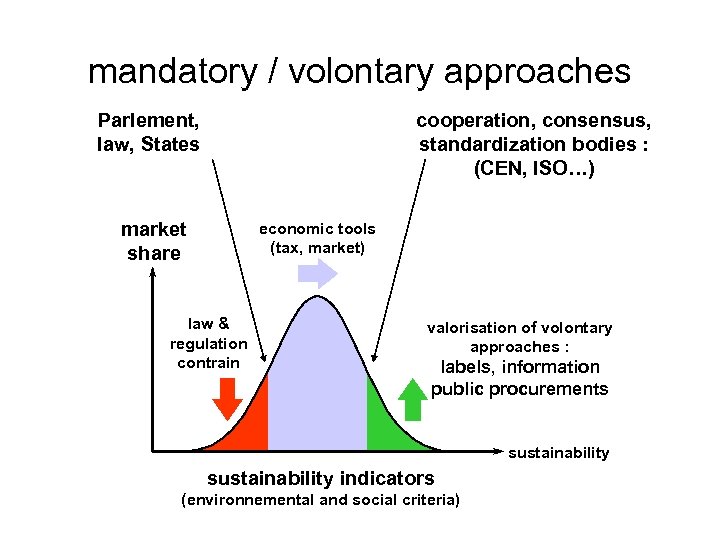 mandatory / volontary approaches Parlement, law, States cooperation, consensus, standardization bodies : (CEN, ISO…) market share economic tools (tax, market) law & regulation contrain valorisation of volontary approaches : labels, information public procurements sustainability indicators (environnemental and social criteria)
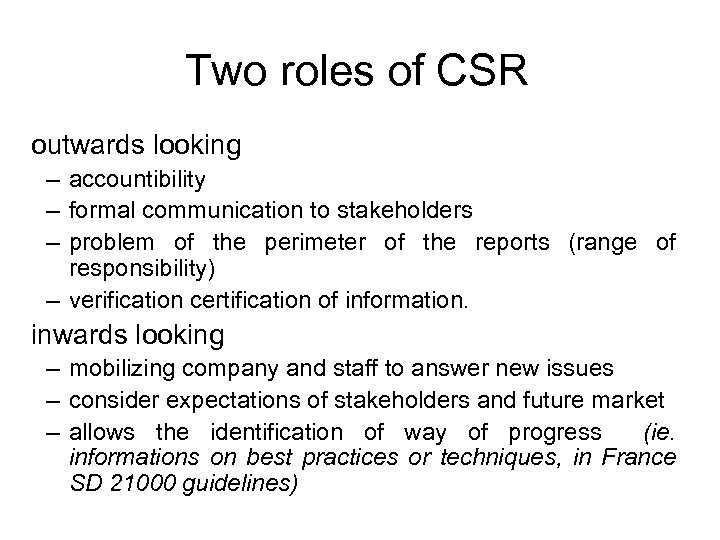 Two roles of CSR outwards looking – accountibility – formal communication to stakeholders – problem of the perimeter of the reports (range of responsibility) – verification certification of information. inwards looking – mobilizing company and staff to answer new issues – consider expectations of stakeholders and future market – allows the identification of way of progress (ie. informations on best practices or techniques, in France SD 21000 guidelines)
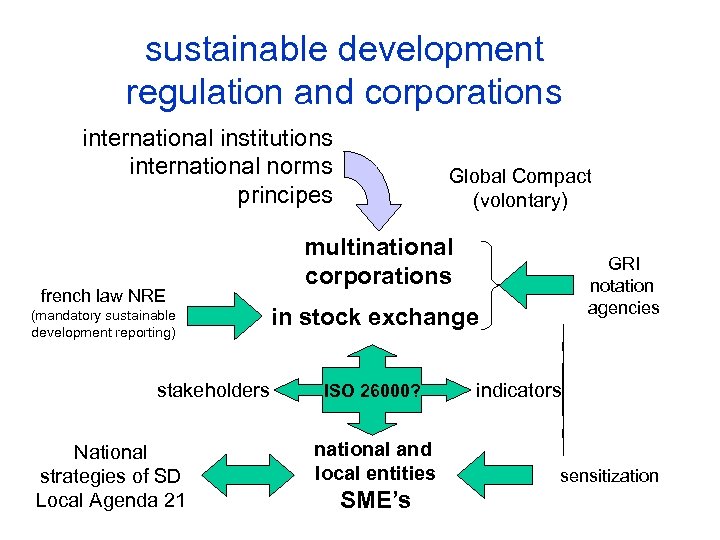 sustainable development regulation and corporations international institutions international norms principes french law NRE (mandatory sustainable development reporting) stakeholders National strategies of SD Local Agenda 21 Global Compact (volontary) multinational corporations GRI notation agencies in stock exchange ISO 26000? national and local entities SME’s indicators sensitization
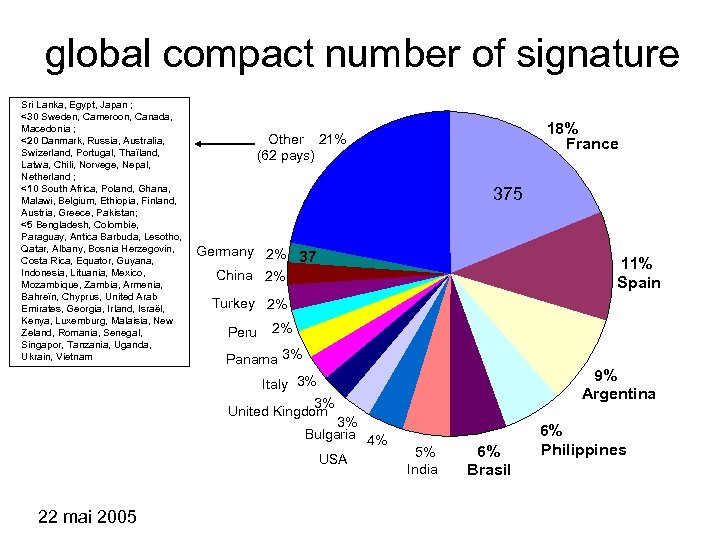 global compact number of signature Sri Lanka, Egypt, Japan ; <30 Sweden, Cameroon, Canada, Macedonia ; <20 Danmark, Russia, Australia, Swizerland, Portugal, Thaïland, Latwa, Chili, Norvege, Nepal, Netherland ; <10 South Africa, Poland, Ghana, Malawi, Belgium, Ethiopia, Finland, Austria, Greece, Pakistan; <5 Bengladesh, Colombie, Paraguay, Antica Barbuda, Lesotho, Qatar, Albany, Bosnia Herzegovin, Costa Rica, Equator, Guyana, Indonesia, Lituania, Mexico, Mozambique, Zambia, Armenia, Bahreïn, Chyprus, United Arab Emirates, Georgia, Irland, Israël, Kenya, Luxemburg, Malaisia, New Zeland, Romania, Senegal, Singapor, Tanzania, Uganda, Ukrain, Vietnam 18% France Other 21% (62 pays) 375 Germany 2% 37 China 2% 11% Spain Turkey 2% Peru 2% Panama 3% 9% Argentina Italy 3% 3% United Kingdom 3% Bulgaria 4% USA 22 mai 2005 5% India 6% Brasil 6% Philippines
 Legislative framework on corporate governance and sustainable development : NRE law • Law n° 2001 -420 of May 15, 2001 on the new economic regulations (J. O. of May 16, 2001) on corporate governance and sustainable development • Various subjects are treated and it is difficult to have an overall picture owing to the fact that the majority of the articles bring amendments to other texts: commercial law, monetary and financial codes, code of consumption, codes of insurances, penal code and General tax code. • Treated topics: organization of the authorities of regulation, modernization of the fight against the money bleaching, reforms code of cinematographic industry and installation of the capacities within companies.
 Role of french guidelines SD 21000 • identify principal stakes, stakeholders and stakeholders’ expectation • design a strategic vision on sustainable development • define an action plan including external partnerships • implemented in around two hundred SMEs (results on 80)
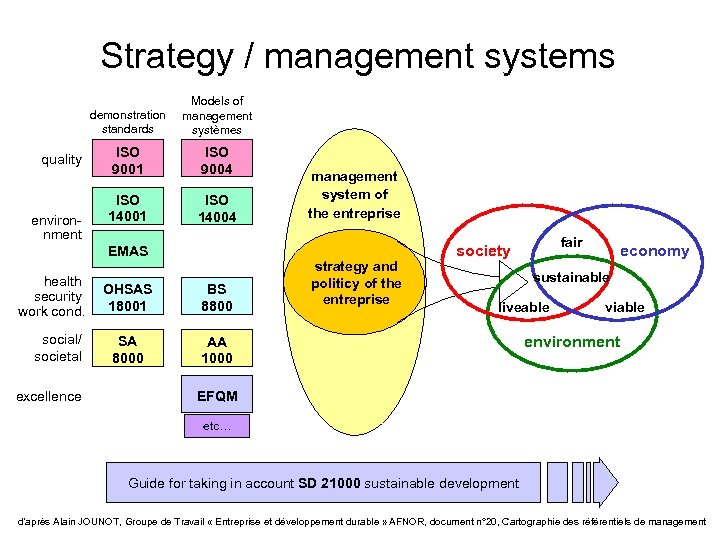 Strategy / management systems demonstration standards quality environ- nment Models of management systèmes ISO 9001 ISO 9004 ISO 14001 ISO 14004 EMAS health security work cond. social/ societal excellence OHSAS 18001 BS 8800 SA 8000 management system of the entreprise strategy and politicy of the entreprise fair society economy sustainable AA 1000 liveable viable environment EFQM etc… Guide for taking in account SD 21000 sustainable development d’après Alain JOUNOT, Groupe de Travail « Entreprise et développement durable » AFNOR, document n° 20, Cartographie des référentiels de management
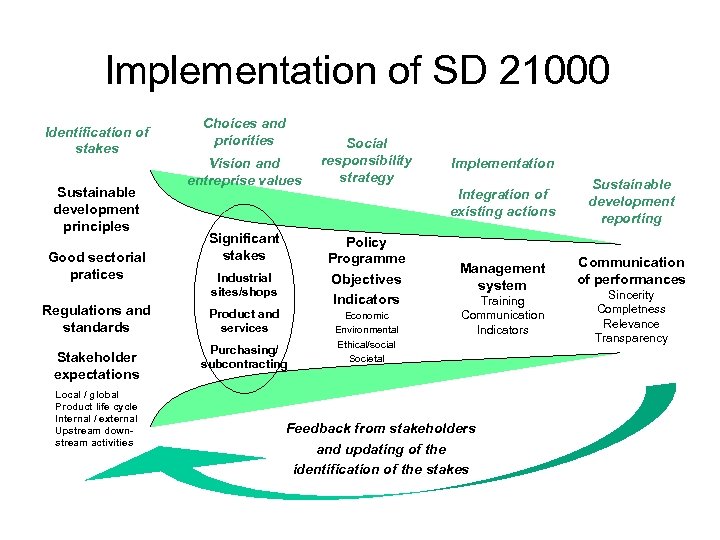 Implementation of SD 21000 Identification of stakes Sustainable development principles Good sectorial pratices Regulations and standards Stakeholder expectations Local / global Product life cycle Internal / external Upstream down- stream activities Choices and priorities Vision and entreprise values Significant stakes Social responsibility strategy Integration of existing actions Policy Programme Objectives Indicators Industrial sites/shops Product and services Purchasing/ subcontracting Implementation Economic Environmental Ethical/social Societal Sustainable development reporting Management system Communication of performances Training Communication Indicators Feedback from stakeholders and updating of the identification of the stakes Sincerity Completness Relevance Transparency
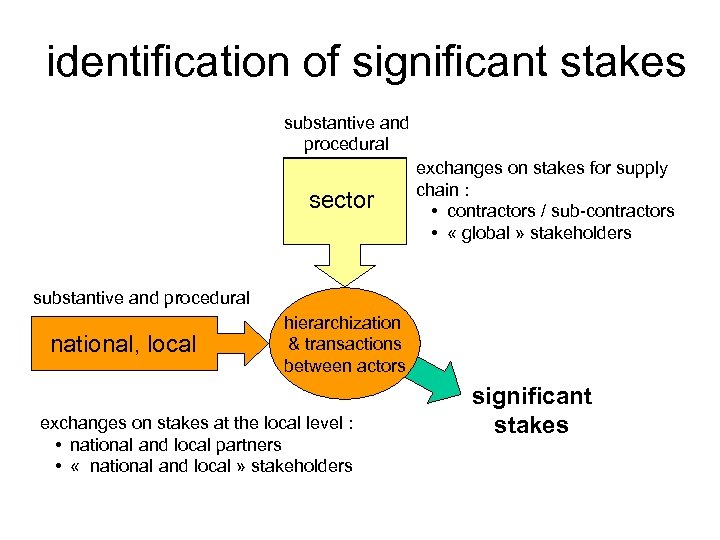 identification of significant stakes substantive and procedural sector exchanges on stakes for supply chain : • contractors / sub-contractors • « global » stakeholders substantive and procedural national, local hierarchization & transactions between actors exchanges on stakes at the local level : • national and local partners • « national and local » stakeholders significant stakes
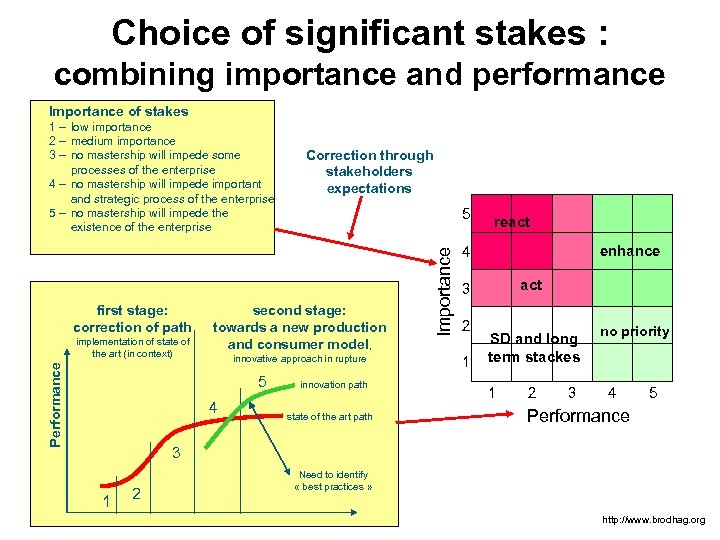 Choice of significant stakes : combining importance and performance Importance of stakes first stage: correction of path Performance implementation of state of the art (in context) Correction through stakeholders expectations 5 second stage: towards a new production and consumer model, innovative approach in rupture 5 4 innovation path state of the art path Importance 1 – low importance 2 – medium importance 3 – no mastership will impede some processes of the enterprise 4 – no mastership will impede important and strategic process of the enterprise 5 – no mastership will impede the existence of the enterprise react enhance 4 act 3 2 1 SD and long term stackes 1 2 3 no priority 4 5 Performance 3 1 2 Need to identify « best practices » http: //www. brodhag. org
 Stakes # indicators • Avoid a “carpet bombing” of information, to many information kills information. • To work on the significant stakes with tools allowing the adaptation of their hierarchisation and the levels of performance in the context with stakeholders involvement (SD 21000). • Quantitative indicators and qualitative information on mechanism: according to the stakes and contexts' one has either or others. SD 21000 approach propose to use a single scale of performance (1 to 5 : 3 is state of the art, 4 innovative approaches and 5 excellence). • It is a “universal” notation that can be openly discused in different context
 four key elements of any CSR strategy and management system • Values and Principles for CSR – the guiding principles shaping an organisation’s overall approach to CSR and orientating its decisionmaking processes; • CSR Management Process – an overall organisation process linking together values and principles for CSR, CSR Management Tools and the organisation’s core strategy, policies and procedures; • CSR Management Tools – a number of management tools helping the organisation to address specific issues and ‘themes’ linked with CSR performance, e. g. stakeholder engagement, reporting etc. ; and • Assurance – procedures of internal audit (self-governed by the organisation) and external verification (provided by independent third parties) aimed to raise the credibility of the system.
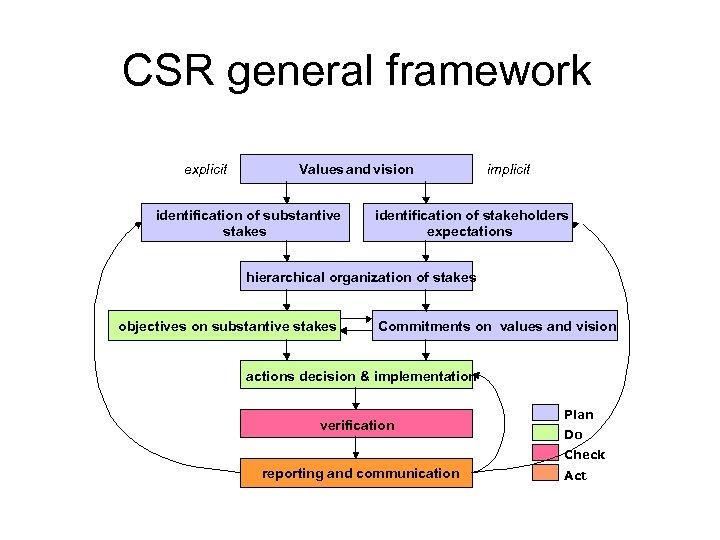 CSR general framework explicit Values and vision identification of substantive stakes implicit identification of stakeholders expectations hierarchical organization of stakes objectives on substantive stakes Commitments on values and vision commitments values visions actions decision & implementation verification Plan Do Check reporting and communication Act
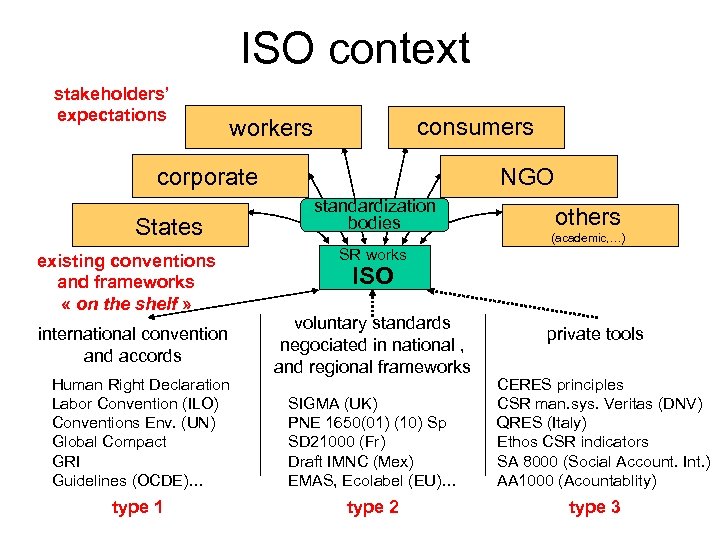 ISO context stakeholders’ expectations consumers workers corporate States existing conventions and frameworks « on the shelf » international convention and accords Human Right Declaration Labor Convention (ILO) Conventions Env. (UN) Global Compact GRI Guidelines (OCDE)… type 1 NGO standardization bodies others (academic, …) SR works ISO voluntary standards negociated in national , and regional frameworks SIGMA (UK) PNE 1650(01) (10) Sp SD 21000 (Fr) Draft IMNC (Mex) EMAS, Ecolabel (EU)… type 2 private tools CERES principles CSR man. sys. Veritas (DNV) QRES (Italy) Ethos CSR indicators SA 8000 (Social Account. Int. ) AA 1000 (Acountablity) type 3
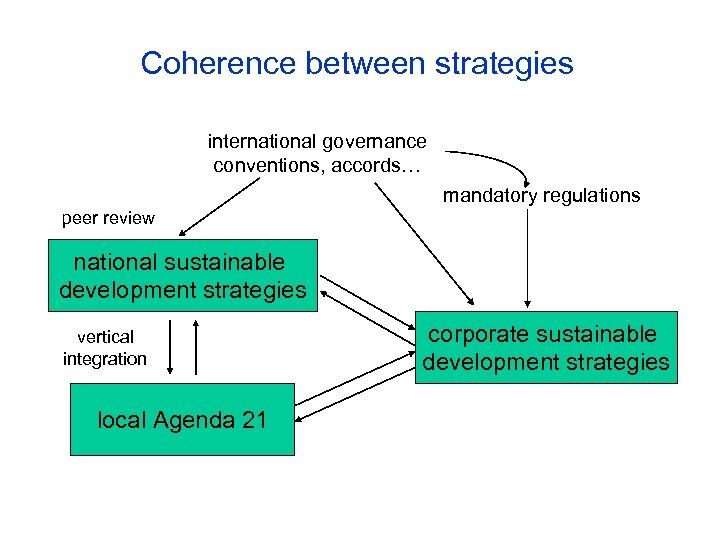 Coherence between strategies international governance conventions, accords… mandatory regulations peer review national sustainable development strategies vertical integration local Agenda 21 corporate sustainable development strategies