 Скачать презентацию Some Facts about Israel Population 7 8 million
f8aa649c6d9b9672e25997a6e6f57256.ppt
- Количество слайдов: 19



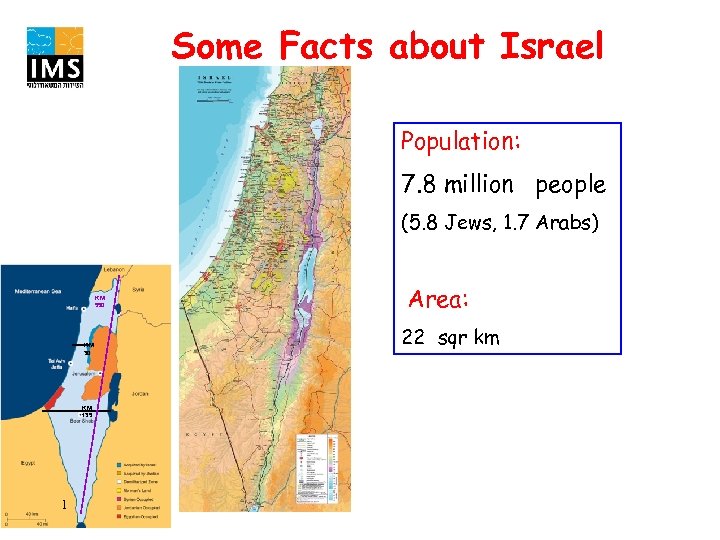
Some Facts about Israel Population: 7. 8 million people (5. 8 Jews, 1. 7 Arabs) KM 550 ~KM 30 KM 135 1 Area: 22 sqr km
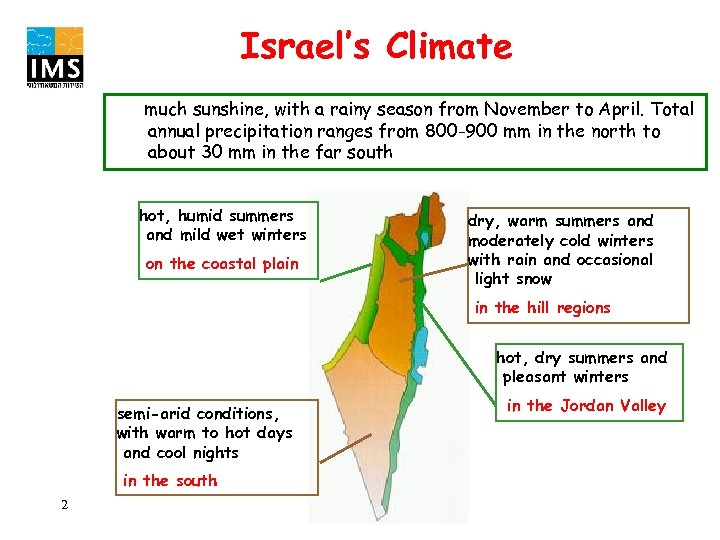
Israel’s Climate much sunshine, with a rainy season from November to April. Total annual precipitation ranges from 800 -900 mm in the north to about 30 mm in the far south hot, humid summers and mild wet winters on the coastal plain dry, warm summers and moderately cold winters with rain and occasional light snow in the hill regions hot, dry summers and pleasant winters semi-arid conditions, with warm to hot days and cool nights in the south 2 in the Jordan Valley
Israel Meteorological Service Identity Card The Israel Meteorological Service was founded in 1936 Since 1948 under supervision of the Ministry of Transport recently as an independent subsidiary In 1962 moved to the present location in Bet-Dagan 3
Israel Meteorological Service 2010 -2011 4
Changes affecting Plan and Processes • After a very long period we have completed in the mid of 2010 a small but very influential re-organizationreducing the number of people in a shift (computer technicians and observers). • The “goodies” for retiring were so compelling that the “wave swept away” 23 employees in 6 month. (about a quarter of the organization). The new situation – although draw us a little back, created new opportunities. 5
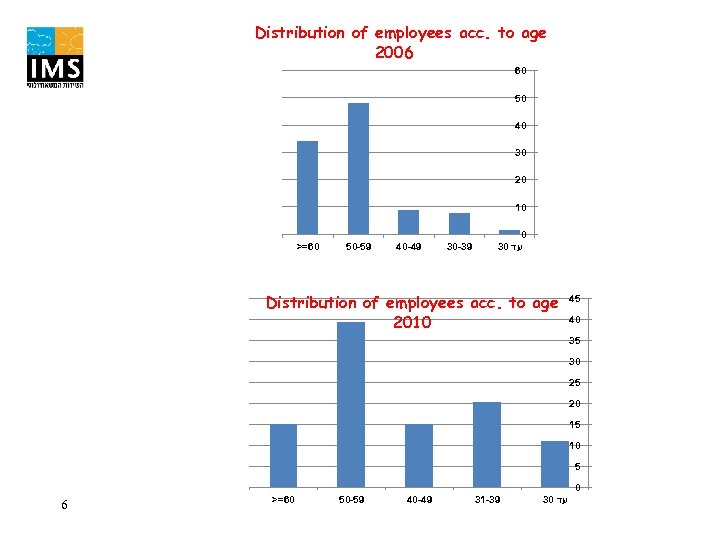
Distribution of employees acc. to age 2006 60 50 40 30 20 10 >=60 50 -59 40 -49 30 -39 0 30 עד Distribution of employees acc. to age 2010 45 40 35 30 25 20 15 10 5 0 6 >=60 50 -59 40 -49 31 -39 30 עד
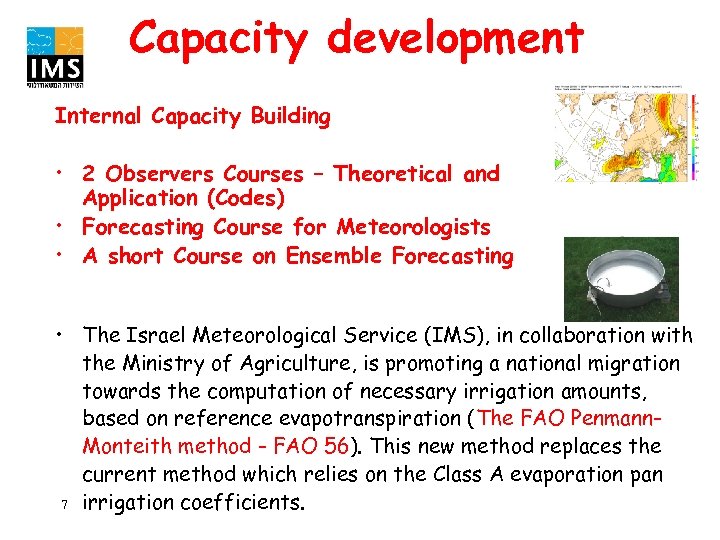
Capacity development Internal Capacity Building • 2 Observers Courses – Theoretical and Application (Codes) • Forecasting Course for Meteorologists • A short Course on Ensemble Forecasting • The Israel Meteorological Service (IMS), in collaboration with the Ministry of Agriculture, is promoting a national migration towards the computation of necessary irrigation amounts, based on reference evapotranspiration (The FAO Penmann. Monteith method - FAO 56). This new method replaces the current method which relies on the Class A evaporation pan 7 irrigation coefficients.
Capacity development • RTC: Three international workshops in cooperation with MASHAV v The Application of Meteorological Information to Renewable Energy and Green Building v Operation of Meteorological and Agrometeorological Station Networks – Conventional and Automatic - Transition from Manual to Automatic Stations- In the Russian language (especially for RA VI) v Climate Change and Agriculture 56 participants from 31 countries took part in these workshops. 8
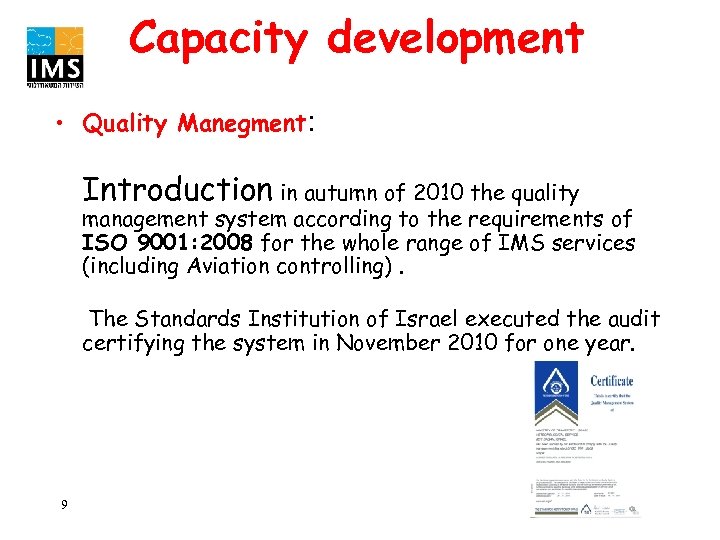
Capacity development • Quality Manegment: Introduction in autumn of 2010 the quality management system according to the requirements of ISO 9001: 2008 for the whole range of IMS services (including Aviation controlling). The Standards Institution of Israel executed the audit certifying the system in November 2010 for one year. 9
Aviation • On 4/2011 the Israeli parliament (Knesset) finalized the approval of the new Israeli Flight Law. In this law the supervising and licensing status of the IMS was stated: Designated Meteorological Authority) • • • 10 (IMS is The Every “Weather reporting facility” in the airdrome must be approved by the IMS (after consultation with the CAA). “Weather reporting facility” – any facility used to measure, forecast or report meteorological data for civil aviation. Operating a “Weather reporting facility” which was not approved is a criminal offense. The IMS inspectorate stuff is given the right of free entry to the airports, free inspection of equipment and documents. Following this legislation, a set of procedures was written by the IMS aviation meteorology department which will be incorporated into the Israel Airport Authority (IAA) tender for the provision of meteorological observations and stations maintenance at the airports.
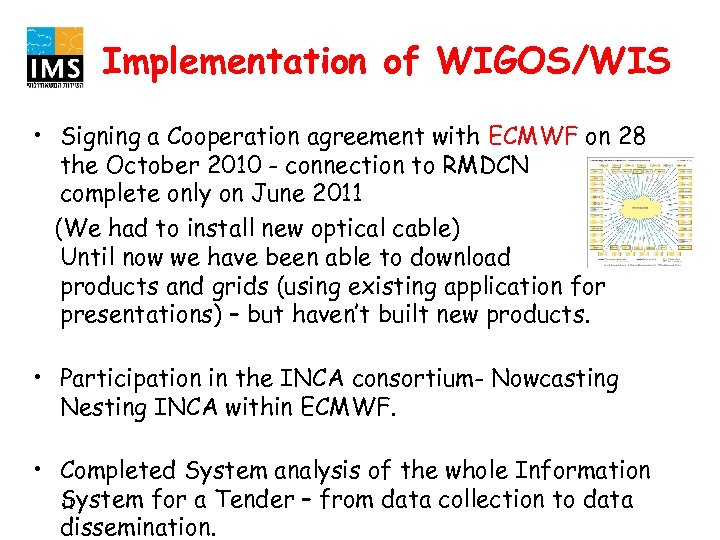
Implementation of WIGOS/WIS • Signing a Cooperation agreement with ECMWF on 28 the October 2010 - connection to RMDCN complete only on June 2011 (We had to install new optical cable) Until now we have been able to download products and grids (using existing application for presentations) – but haven’t built new products. • Participation in the INCA consortium- Nowcasting Nesting INCA within ECMWF. • Completed System analysis of the whole Information System for a Tender – from data collection to data 11 dissemination.
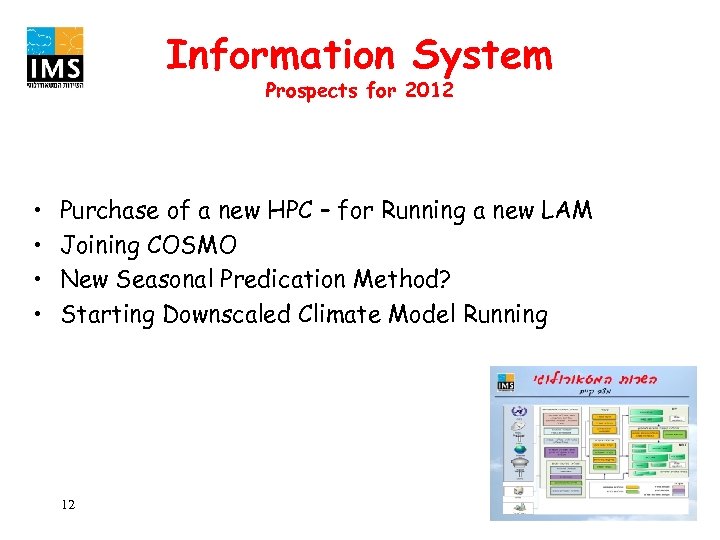
Information System Prospects for 2012 • • Purchase of a new HPC – for Running a new LAM Joining COSMO New Seasonal Predication Method? Starting Downscaled Climate Model Running 12
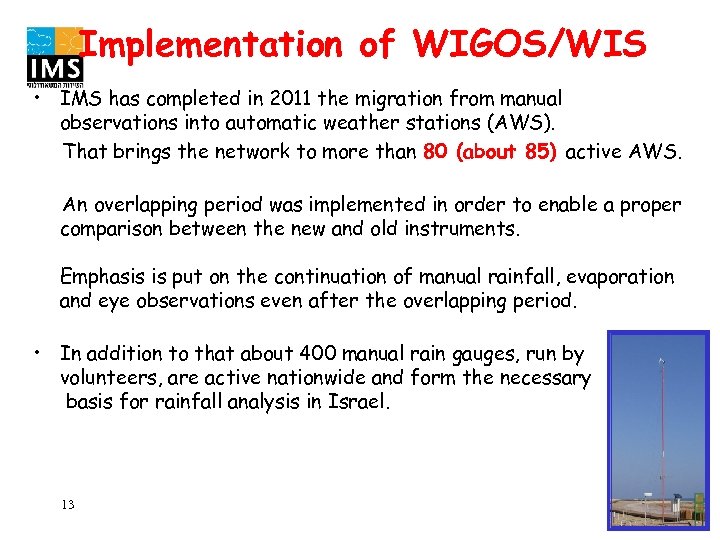
Implementation of WIGOS/WIS • IMS has completed in 2011 the migration from manual observations into automatic weather stations (AWS). That brings the network to more than 80 (about 85) active AWS. An overlapping period was implemented in order to enable a proper comparison between the new and old instruments. Emphasis is put on the continuation of manual rainfall, evaporation and eye observations even after the overlapping period. • In addition to that about 400 manual rain gauges, run by volunteers, are active nationwide and form the necessary basis for rainfall analysis in Israel. 13
Global Framework for Climate Services Preparation of a Climatic Atlas for Engineers and Architects in collaboration with the Ministry of Infrastructure - for the period 1995 -2009 for : • • Temperature Relative Humidity • Precipitation • Solar Radiation (shorter period) Until now we have completed – Precipitation Tables and Maps and Temperature Tables. 14
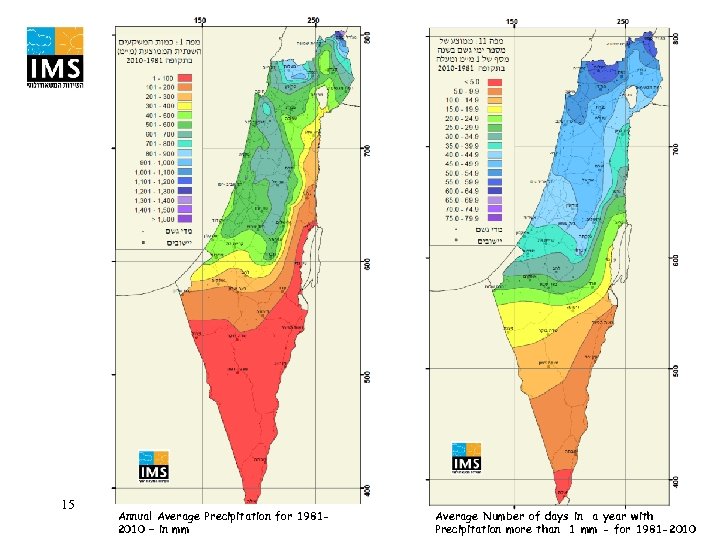
15 Annual Average Precipitation for 19812010 – in mm Average Number of days in a year with Precipitation more than 1 mm - for 1981 -2010
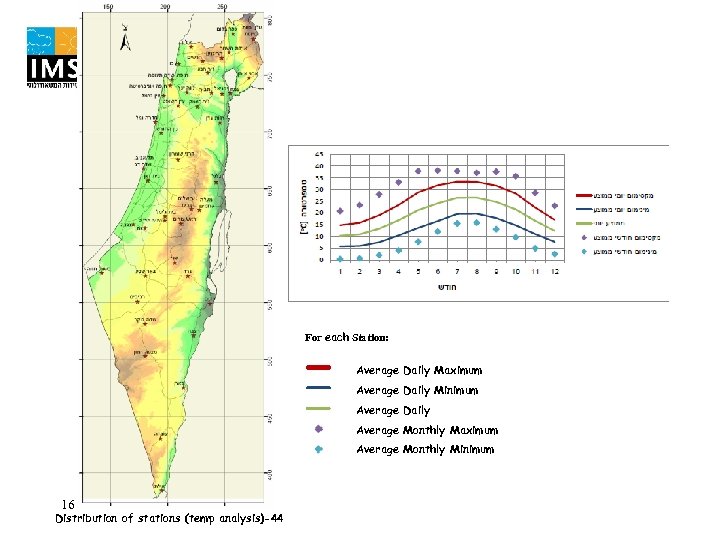
For each Station: Average Daily Maximum Average Daily Minimum Average Daily Average Monthly Maximum Average Monthly Minimum 16 Distribution of stations (temp analysis)-44
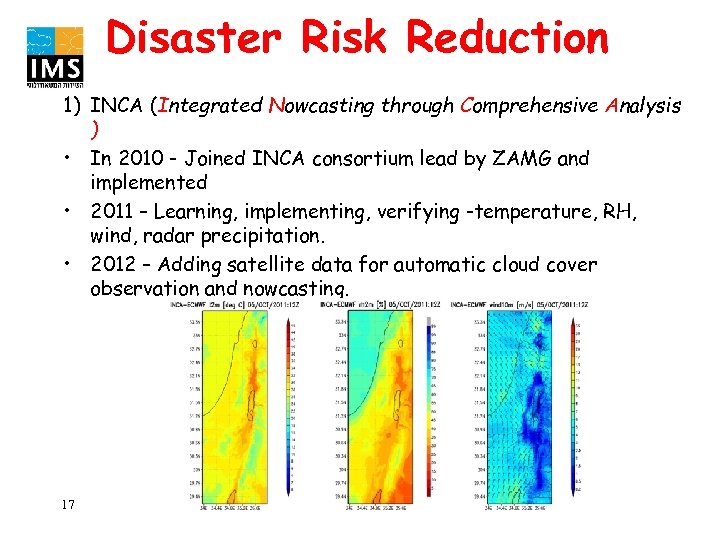
Disaster Risk Reduction 1) INCA (Integrated Nowcasting through Comprehensive Analysis ) • In 2010 - Joined INCA consortium lead by ZAMG and implemented • 2011 – Learning, implementing, verifying -temperature, RH, wind, radar precipitation. • 2012 – Adding satellite data for automatic cloud cover observation and nowcasting. 17
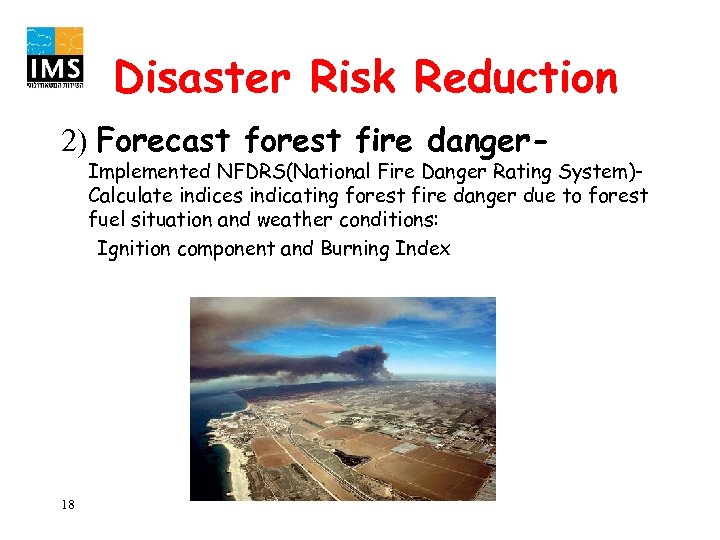
Disaster Risk Reduction 2) Forecast forest fire danger- Implemented NFDRS(National Fire Danger Rating System)Calculate indices indicating forest fire danger due to forest fuel situation and weather conditions: Ignition component and Burning Index 18
New ERA - 2012 We are on a verge of a new era a budget without income - Free Access to Database (Website) - Providing Public Goods – Only Alerts and Warnings * Public * Forecast for Aviation * Forecast for Maritime * Agricultural Community • More climatic information – e. g. extreme events probabilities , Wind distribution etc. 19
Скачать презентацию Some Facts about Israel Population 7 8 million
f8aa649c6d9b9672e25997a6e6f57256.ppt