


 Скачать презентацию Some desired design features of Australia s policy response
26c1799dcf32fe9370bcebc5dc706635.ppt
- Количество слайдов: 18
 Some desired design features of Australia’s policy response to the greenhouse challenge Australian Industry Greenhouse Network Rod Sims Director, Port Jackson Partners Limited; and Expert Adviser to the MPCCC 23 March, 2011 Parliament House, Canberra
 SUMMARY MESSAGES 1. Australia has a difficult challenge in reaching the around 25% against BAU emission reduction target by 2020 (and this target has bipartisan support) 2. A market-based approach should be the dominant policy mechanism to reach this challenging target 3. The design of the market mechanism is key; much will depend on aligning our actions with international efforts 23 March 2011 Port Jackson Partners Limited 2
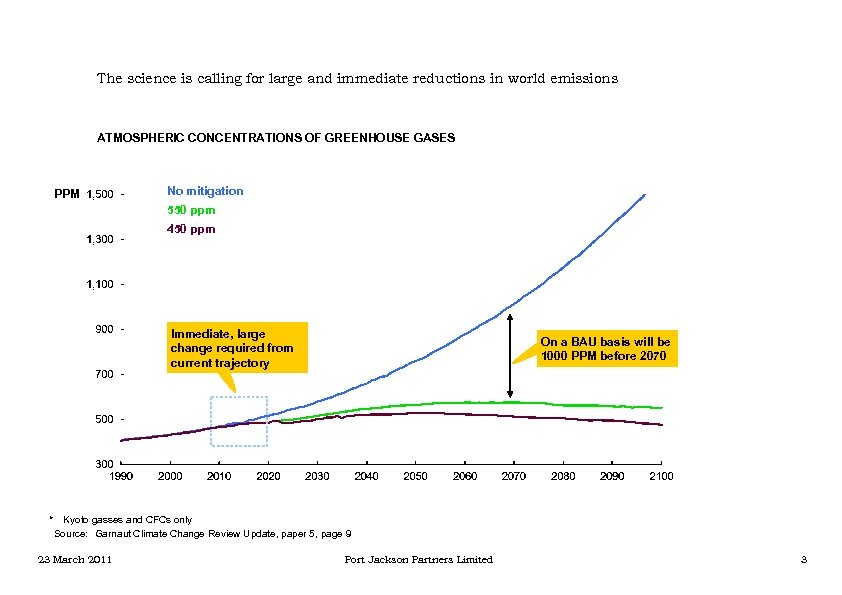 The science is calling for large and immediate reductions in world emissions ATMOSPHERIC CONCENTRATIONS OF GREENHOUSE GASES PPM No mitigation 550 ppm 450 ppm Immediate, large change required from current trajectory * On a BAU basis will be 1000 PPM before 2070 Kyoto gasses and CFCs only Source: Garnaut Climate Change Review Update, paper 5, page 9 23 March 2011 Port Jackson Partners Limited 3
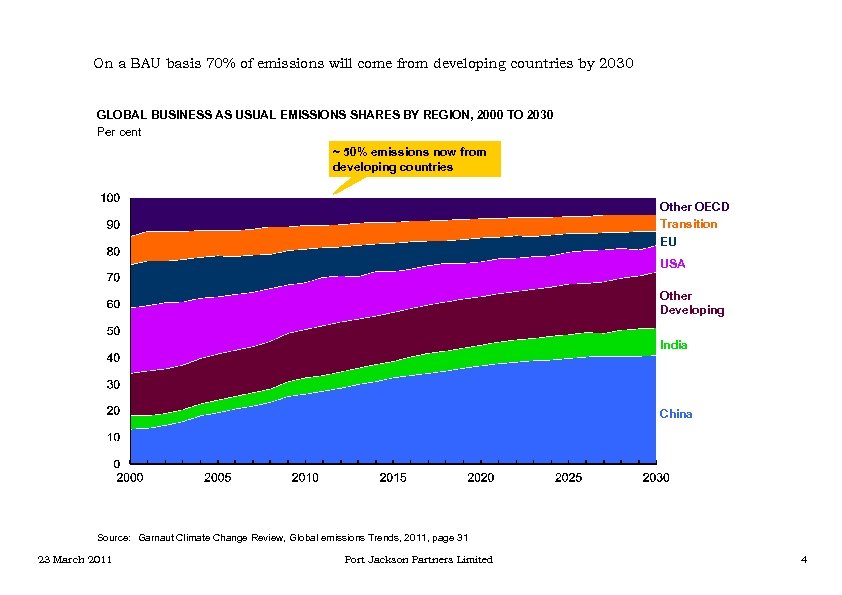 On a BAU basis 70% of emissions will come from developing countries by 2030 GLOBAL BUSINESS AS USUAL EMISSIONS SHARES BY REGION, 2000 TO 2030 Per cent ~ 50% emissions now from developing countries Other OECD Transition EU USA Other Developing India China Source: Garnaut Climate Change Review, Global emissions Trends, 2011, page 31 23 March 2011 Port Jackson Partners Limited 4
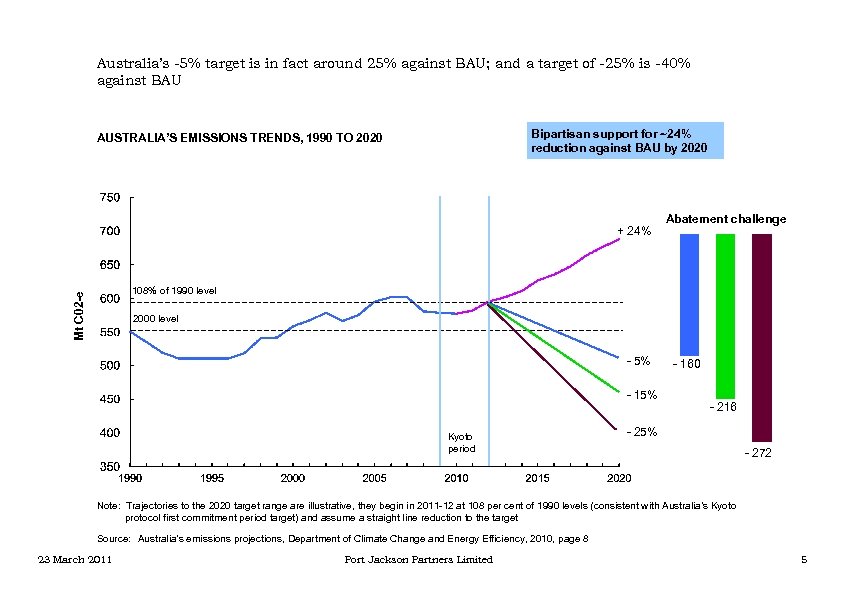 Australia’s -5% target is in fact around 25% against BAU; and a target of -25% is -40% against BAU Bipartisan support for ~24% reduction against BAU by 2020 AUSTRALIA’S EMISSIONS TRENDS, 1990 TO 2020 + 24% Abatement challenge Mt C 02 -e 108% of 1990 level 2000 level - 5% - 15% Kyoto period - 160 - 216 - 25% - 272 Note: Trajectories to the 2020 target range are illustrative, they begin in 2011 -12 at 108 per cent of 1990 levels (consistent with Australia’s Kyoto protocol first commitment period target) and assume a straight line reduction to the target Source: Australia’s emissions projections, Department of Climate Change and Energy Efficiency, 2010, page 8 23 March 2011 Port Jackson Partners Limited 5
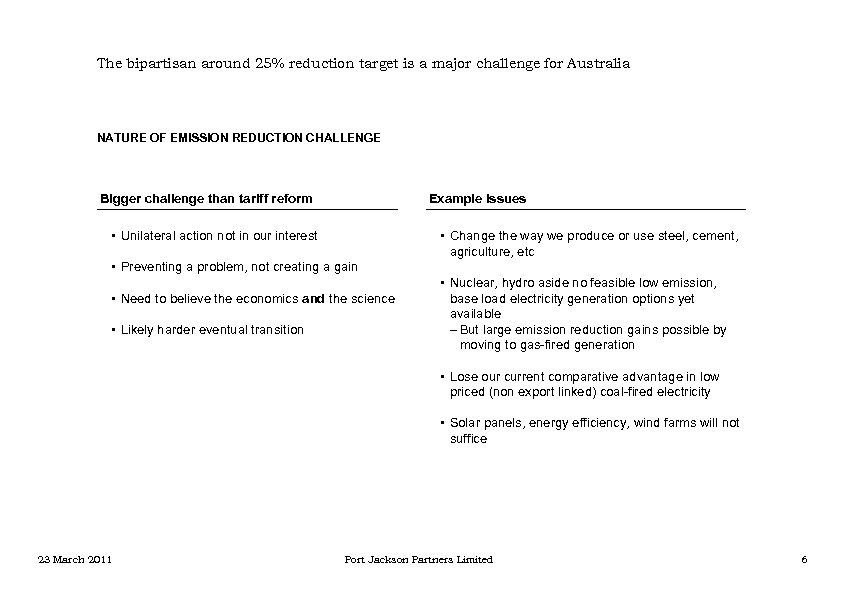 The bipartisan around 25% reduction target is a major challenge for Australia NATURE OF EMISSION REDUCTION CHALLENGE Bigger challenge than tariff reform Example issues • Unilateral action not in our interest • Change the way we produce or use steel, cement, agriculture, etc • Preventing a problem, not creating a gain • Need to believe the economics and the science • Likely harder eventual transition • Nuclear, hydro aside no feasible low emission, base load electricity generation options yet available – But large emission reduction gains possible by moving to gas-fired generation • Lose our current comparative advantage in low priced (non export linked) coal-fired electricity • Solar panels, energy efficiency, wind farms will not suffice 23 March 2011 Port Jackson Partners Limited 6
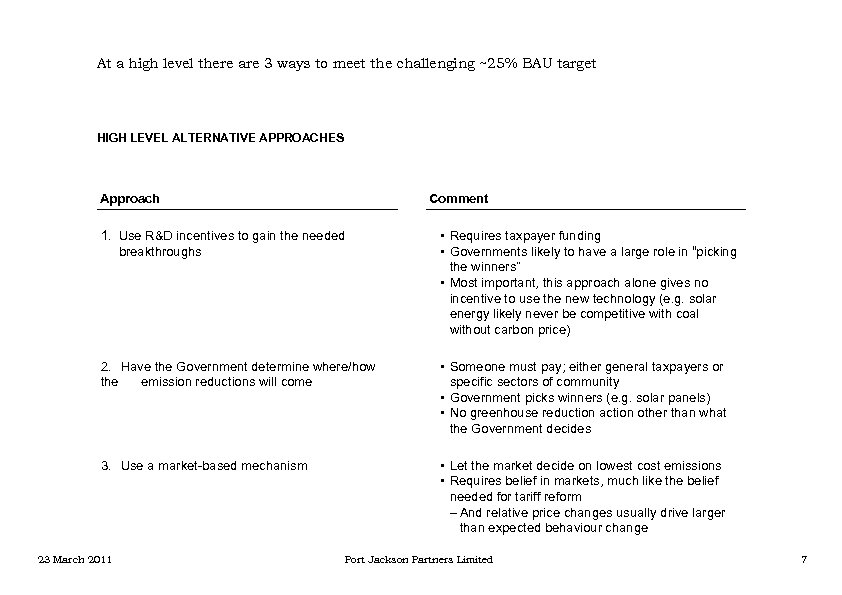 At a high level there are 3 ways to meet the challenging ~25% BAU target HIGH LEVEL ALTERNATIVE APPROACHES Approach Comment 1. Use R&D incentives to gain the needed breakthroughs • Requires taxpayer funding • Governments likely to have a large role in “picking the winners” • Most important, this approach alone gives no incentive to use the new technology (e. g. solar energy likely never be competitive with coal without carbon price) 2. Have the Government determine where/how the emission reductions will come • Someone must pay; either general taxpayers or specific sectors of community • Government picks winners (e. g. solar panels) • No greenhouse reduction action other than what the Government decides 3. Use a market-based mechanism • Let the market decide on lowest cost emissions • Requires belief in markets, much like the belief needed for tariff reform – And relative price changes usually drive larger than expected behaviour change 23 March 2011 Port Jackson Partners Limited 7
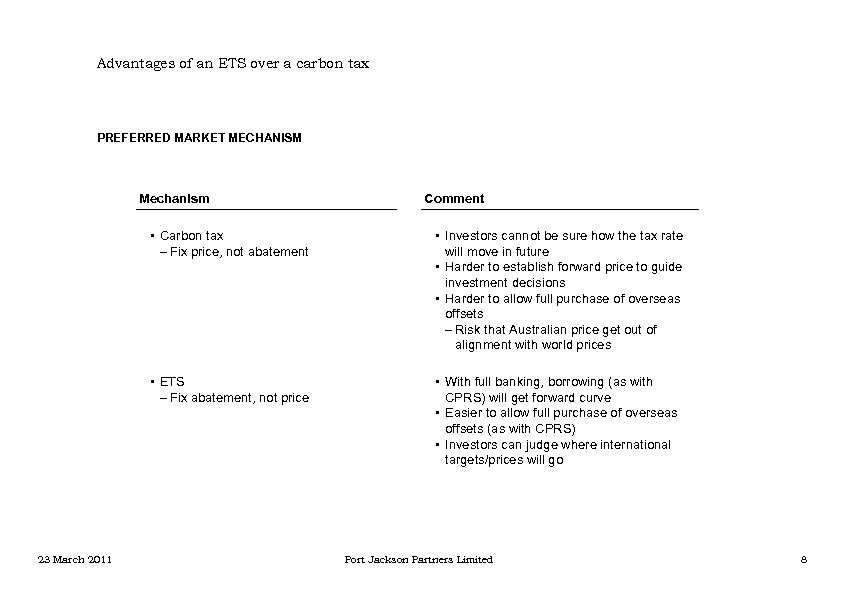 Advantages of an ETS over a carbon tax PREFERRED MARKET MECHANISM Mechanism Comment • Carbon tax – Fix price, not abatement • ETS – Fix abatement, not price 23 March 2011 • Investors cannot be sure how the tax rate will move in future • Harder to establish forward price to guide investment decisions • Harder to allow full purchase of overseas offsets – Risk that Australian price get out of alignment with world prices • With full banking, borrowing (as with CPRS) will get forward curve • Easier to allow full purchase of overseas offsets (as with CPRS) • Investors can judge where international targets/prices will go Port Jackson Partners Limited 8
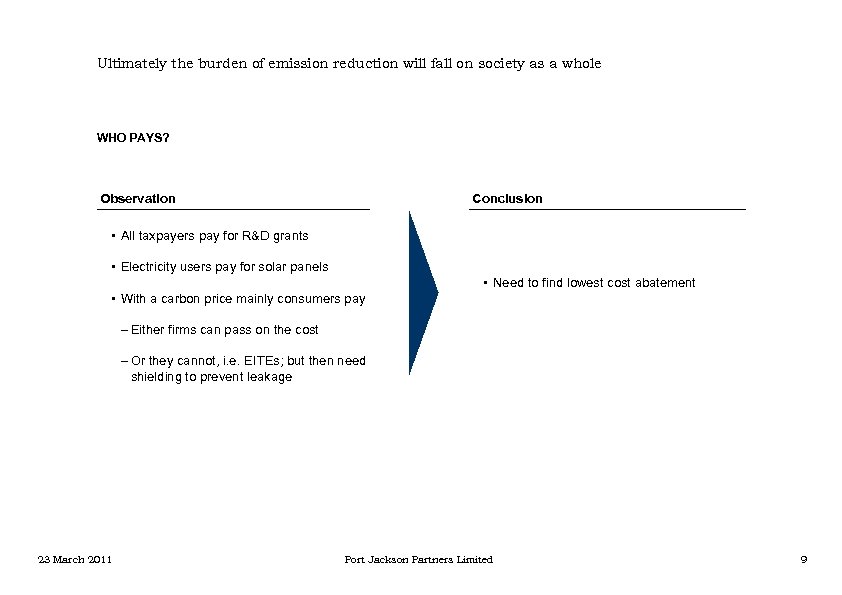 Ultimately the burden of emission reduction will fall on society as a whole WHO PAYS? Observation Conclusion • All taxpayers pay for R&D grants • Electricity users pay for solar panels • Need to find lowest cost abatement • With a carbon price mainly consumers pay – Either firms can pass on the cost – Or they cannot, i. e. EITEs; but then need shielding to prevent leakage 23 March 2011 Port Jackson Partners Limited 9
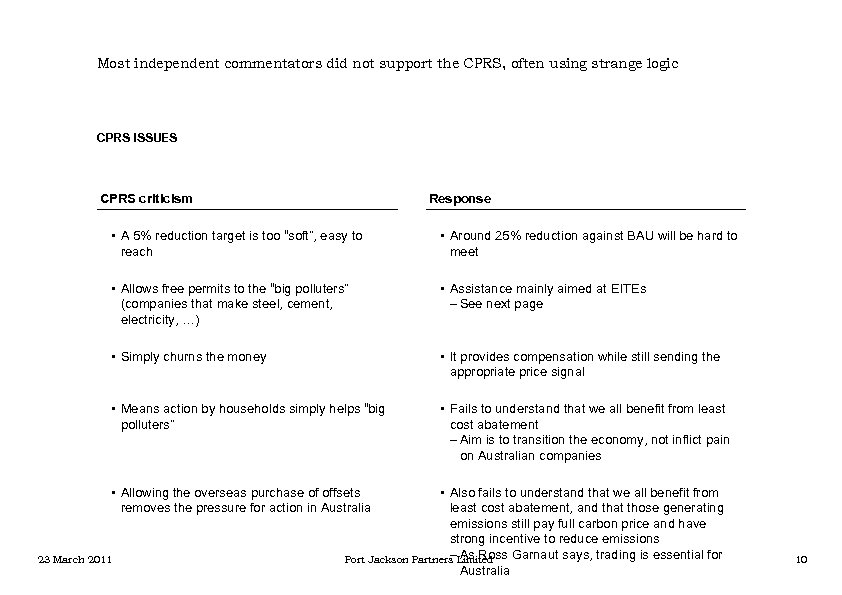 Most independent commentators did not support the CPRS, often using strange logic CPRS ISSUES CPRS criticism Response • A 5% reduction target is too “soft”, easy to reach • Around 25% reduction against BAU will be hard to meet • Allows free permits to the “big polluters” (companies that make steel, cement, electricity, …) • Assistance mainly aimed at EITEs – See next page • Simply churns the money • It provides compensation while still sending the appropriate price signal • Means action by households simply helps “big polluters” • Fails to understand that we all benefit from least cost abatement – Aim is to transition the economy, not inflict pain on Australian companies • Allowing the overseas purchase of offsets removes the pressure for action in Australia 23 March 2011 • Also fails to understand that we all benefit from least cost abatement, and that those generating emissions still pay full carbon price and have strong incentive to reduce emissions – As Ross Garnaut says, trading is essential for Port Jackson Partners Limited Australia 10
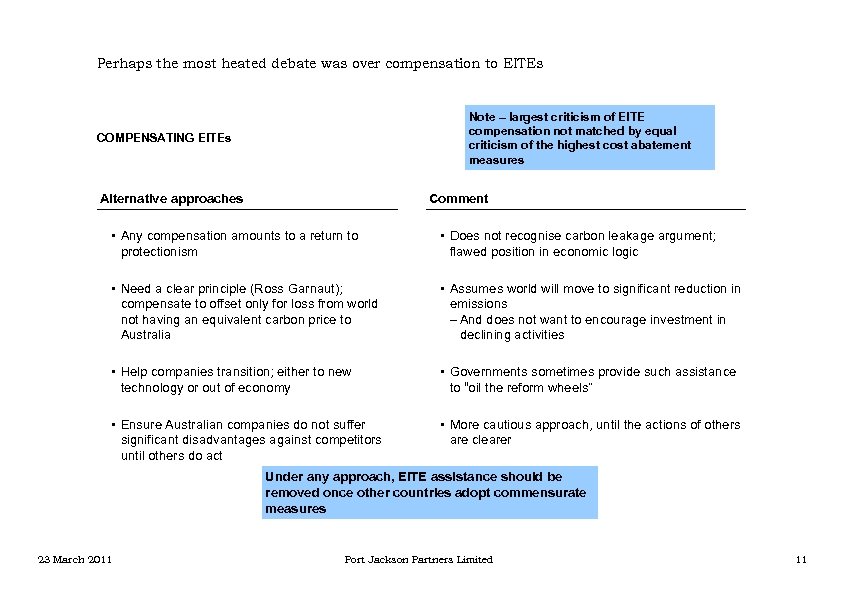 Perhaps the most heated debate was over compensation to EITEs Note – largest criticism of EITE compensation not matched by equal criticism of the highest cost abatement measures COMPENSATING EITEs Alternative approaches Comment • Any compensation amounts to a return to protectionism • Does not recognise carbon leakage argument; flawed position in economic logic • Need a clear principle (Ross Garnaut); compensate to offset only for loss from world not having an equivalent carbon price to Australia • Assumes world will move to significant reduction in emissions – And does not want to encourage investment in declining activities • Help companies transition; either to new technology or out of economy • Governments sometimes provide such assistance to “oil the reform wheels” • Ensure Australian companies do not suffer significant disadvantages against competitors until others do act • More cautious approach, until the actions of others are clearer Under any approach, EITE assistance should be removed once other countries adopt commensurate measures 23 March 2011 Port Jackson Partners Limited 11
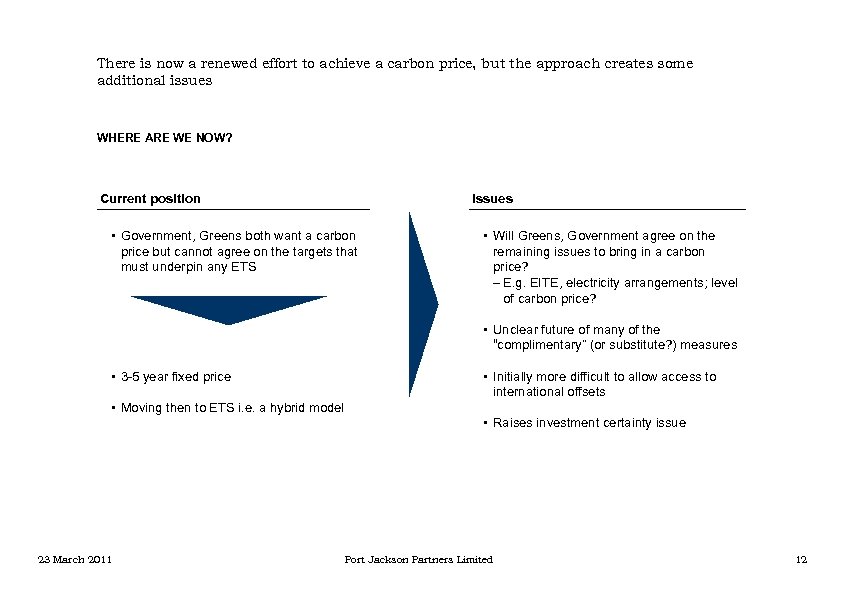 There is now a renewed effort to achieve a carbon price, but the approach creates some additional issues WHERE ARE WE NOW? Current position Issues • Government, Greens both want a carbon price but cannot agree on the targets that must underpin any ETS • Will Greens, Government agree on the remaining issues to bring in a carbon price? – E. g. EITE, electricity arrangements; level of carbon price? • Unclear future of many of the “complimentary” (or substitute? ) measures • 3 -5 year fixed price • Initially more difficult to allow access to international offsets • Moving then to ETS i. e. a hybrid model • Raises investment certainty issue 23 March 2011 Port Jackson Partners Limited 12
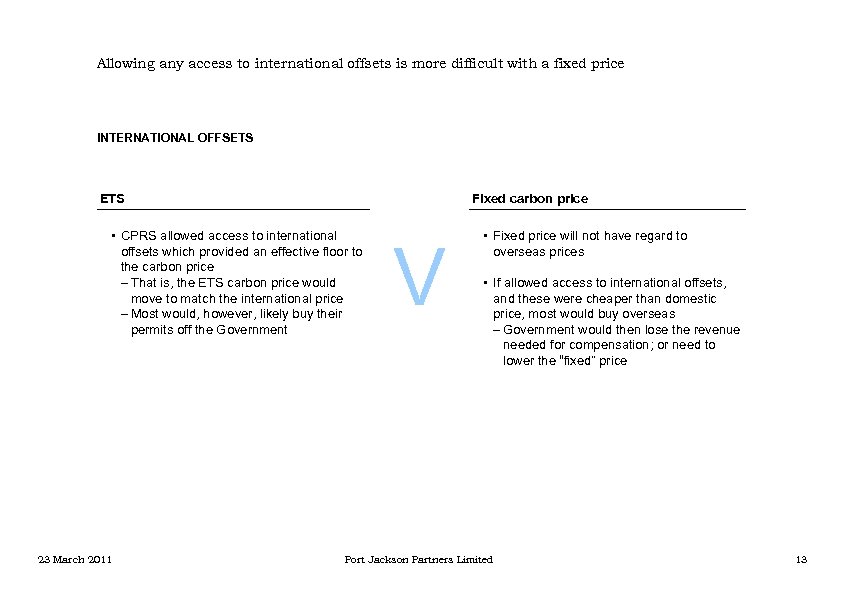 Allowing any access to international offsets is more difficult with a fixed price INTERNATIONAL OFFSETS Fixed carbon price • CPRS allowed access to international offsets which provided an effective floor to the carbon price – That is, the ETS carbon price would move to match the international price – Most would, however, likely buy their permits off the Government 23 March 2011 V • Fixed price will not have regard to overseas prices • If allowed access to international offsets, and these were cheaper than domestic price, most would buy overseas – Government would then lose the revenue needed for compensation; or need to lower the “fixed” price Port Jackson Partners Limited 13
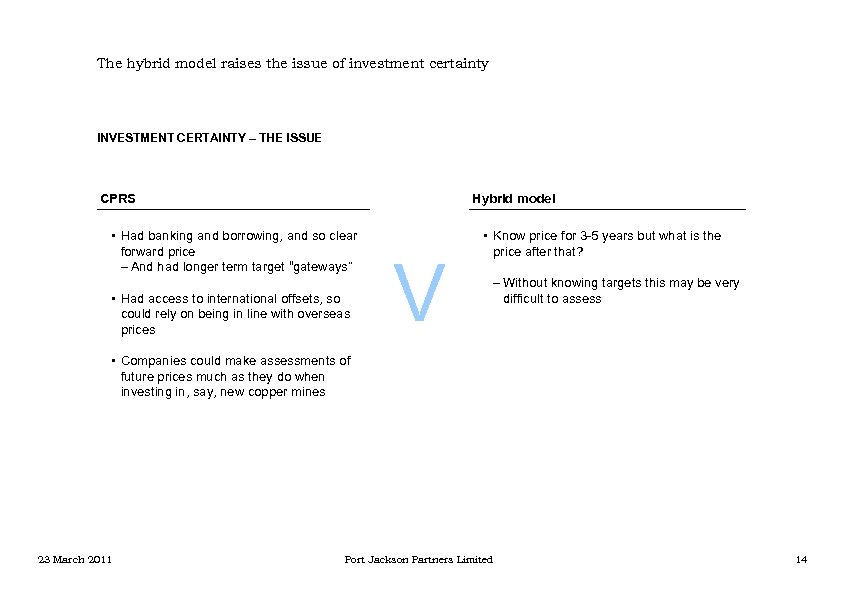 The hybrid model raises the issue of investment certainty INVESTMENT CERTAINTY – THE ISSUE CPRS Hybrid model • Had banking and borrowing, and so clear forward price – And had longer term target “gateways” • Had access to international offsets, so could rely on being in line with overseas prices V • Know price for 3 -5 years but what is the price after that? – Without knowing targets this may be very difficult to assess • Companies could make assessments of future prices much as they do when investing in, say, new copper mines 23 March 2011 Port Jackson Partners Limited 14
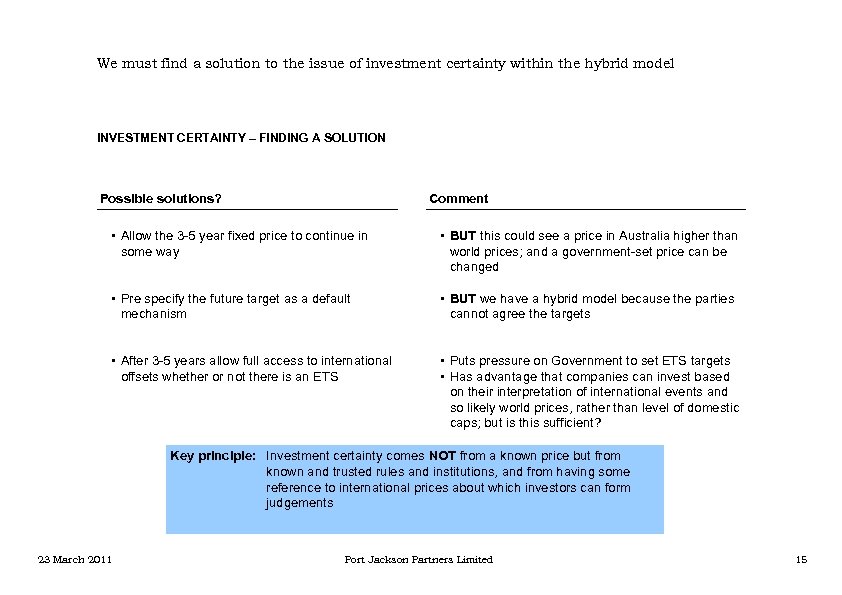 We must find a solution to the issue of investment certainty within the hybrid model INVESTMENT CERTAINTY – FINDING A SOLUTION Possible solutions? Comment • Allow the 3 -5 year fixed price to continue in some way • BUT this could see a price in Australia higher than world prices; and a government-set price can be changed • Pre specify the future target as a default mechanism • BUT we have a hybrid model because the parties cannot agree the targets • After 3 -5 years allow full access to international offsets whether or not there is an ETS • Puts pressure on Government to set ETS targets • Has advantage that companies can invest based on their interpretation of international events and so likely world prices, rather than level of domestic caps; but is this sufficient? Key principle: Investment certainty comes NOT from a known price but from known and trusted rules and institutions, and from having some reference to international prices about which investors can form judgements 23 March 2011 Port Jackson Partners Limited 15
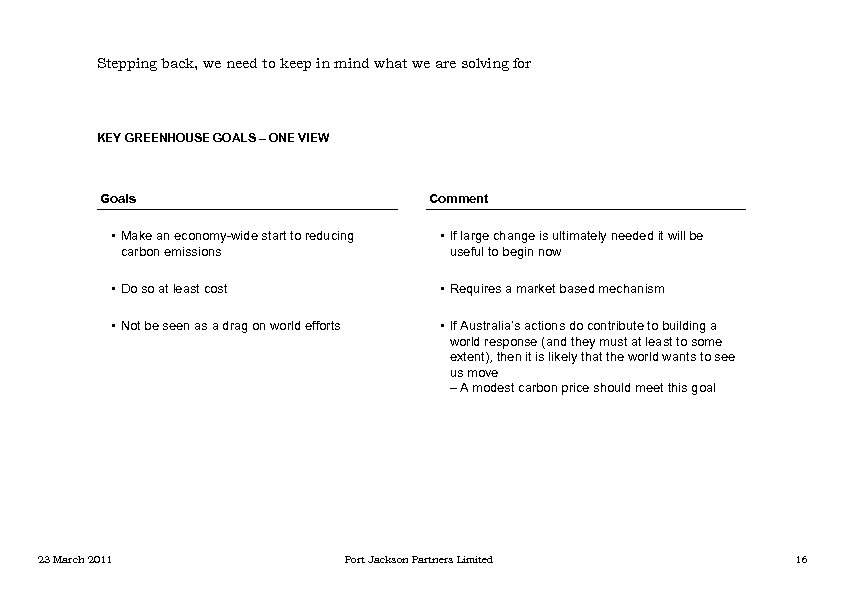 Stepping back, we need to keep in mind what we are solving for KEY GREENHOUSE GOALS – ONE VIEW Goals Comment • Make an economy-wide start to reducing carbon emissions • If large change is ultimately needed it will be useful to begin now • Do so at least cost • Requires a market based mechanism • Not be seen as a drag on world efforts • If Australia’s actions do contribute to building a world response (and they must at least to some extent), then it is likely that the world wants to see us move – A modest carbon price should meet this goal 23 March 2011 Port Jackson Partners Limited 16
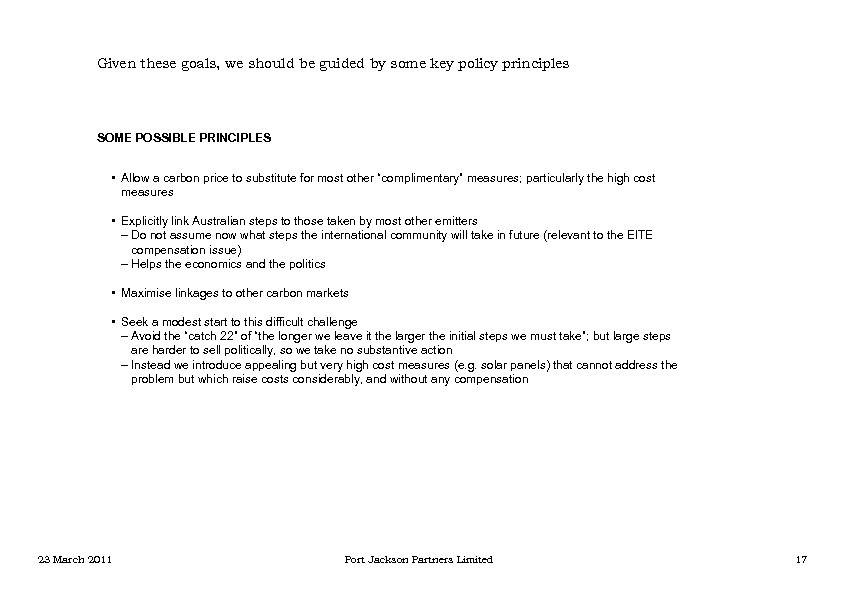 Given these goals, we should be guided by some key policy principles SOME POSSIBLE PRINCIPLES • Allow a carbon price to substitute for most other “complimentary” measures; particularly the high cost measures • Explicitly link Australian steps to those taken by most other emitters – Do not assume now what steps the international community will take in future (relevant to the EITE compensation issue) – Helps the economics and the politics • Maximise linkages to other carbon markets • Seek a modest start to this difficult challenge – Avoid the “catch 22” of “the longer we leave it the larger the initial steps we must take”; but large steps are harder to sell politically, so we take no substantive action – Instead we introduce appealing but very high cost measures (e. g. solar panels) that cannot address the problem but which raise costs considerably, and without any compensation 23 March 2011 Port Jackson Partners Limited 17
 SUMMARY MESSAGES 1. Australia has a difficult challenge in reaching the around 25% against BAU emission reduction target by 2020 (and this target has bipartisan support) 2. A market-based approach should be the dominant policy mechanism to reach this challenging target 3. The design of the market mechanism is key; much will depend on aligning our actions with international efforts 23 March 2011 Port Jackson Partners Limited 18