 Скачать презентацию Somali-Bantu Refugee Women s Beliefs About Preventative Healthcare and
ab8c3c2e88c8f8d4122a9dc9047c2342.ppt
- Количество слайдов: 38



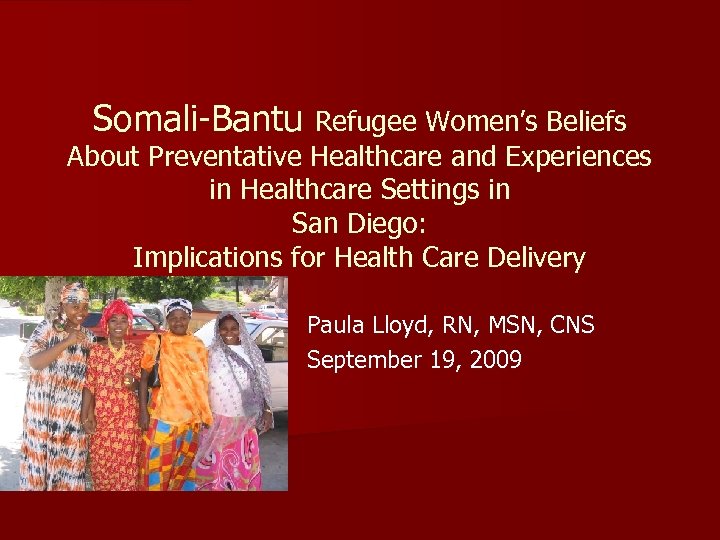
Somali-Bantu Refugee Women’s Beliefs About Preventative Healthcare and Experiences in Healthcare Settings in San Diego: Implications for Health Care Delivery Paula Lloyd, RN, MSN, CNS September 19, 2009

A “grandmother” tells “grandchildren” the story of their Somali-Bantu origins…. n Where “we” came from n How “we” came to be in Somalia
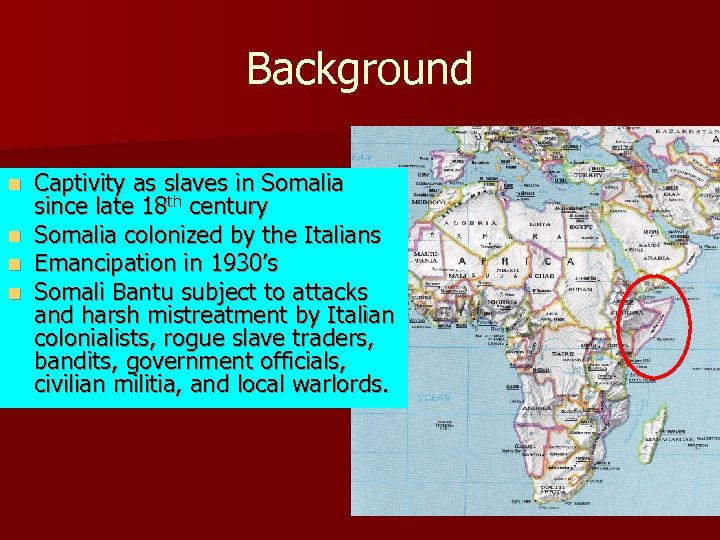
Background n n Captivity as slaves in Somalia since late 18 th century Somalia colonized by the Italians Emancipation in 1930’s Somali Bantu subject to attacks and harsh mistreatment by Italian colonialists, rogue slave traders, bandits, government officials, civilian militia, and local warlords.
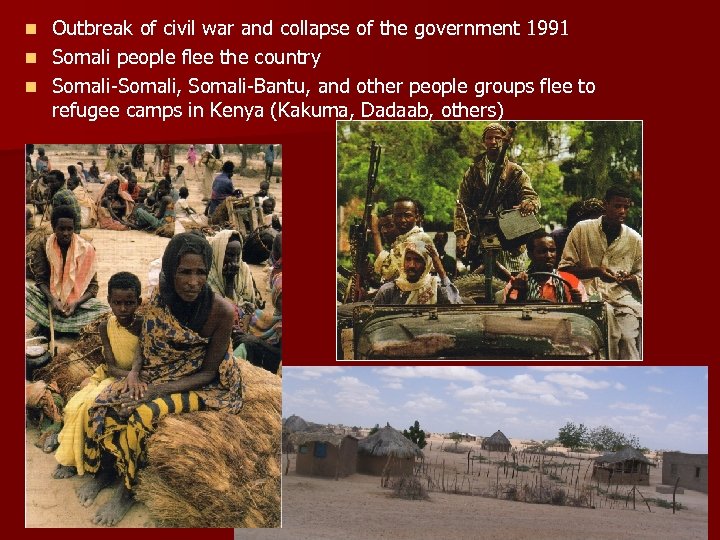
Outbreak of civil war and collapse of the government 1991 n Somali people flee the country n Somali-Somali, Somali-Bantu, and other people groups flee to refugee camps in Kenya (Kakuma, Dadaab, others) n
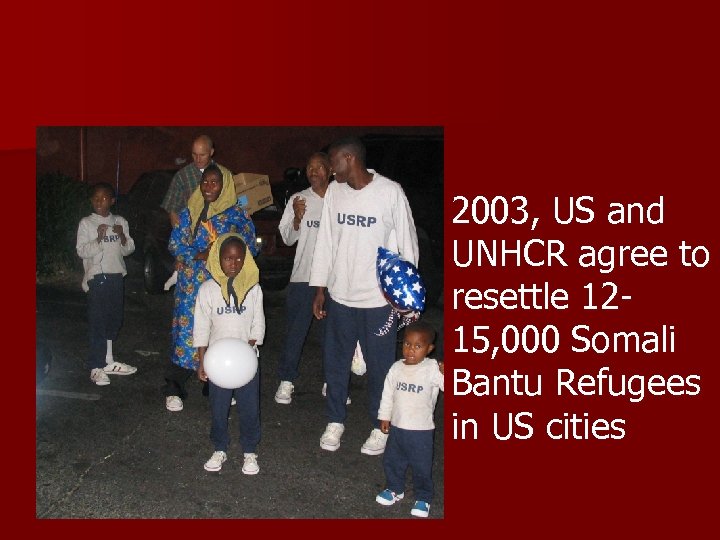
2003, US and UNHCR agree to resettle 1215, 000 Somali Bantu Refugees in US cities
Background (continued) n San Diego County Health and Human Services statistics report 9/17/07 states 1, 238 refugees from Somalia between 2002 and 2006. (report does not distinguish between Somali-Somali and Somali-Bantu) Organization “Somali-Bantu Community of San Diego” (established 2005) estimates 500 Somali. Bantu adults in San Diego October 2007. n Currently, many Somali-Bantu are leaving San Diego for other US cities to find jobs and cheaper housing. n
The Problem is… Though the Somali-Bantu share some common problems with other refugee groups, they have unique history, beliefs and background that influence their health, contributing to healthcare disparities. n Communication impedance beyond language alone: related to divide in basic worldview, health beliefs, health understanding, and health literacy. n Scant published research literature about the health beliefs and experience of the Somali-Bantu. n Therefore, research is needed to increase culturally relevant health communication, increase equity of care, and improve health care outcomes. n
Significance to medicine/nursing n The real challenge of providing safe, ethical, culturally congurent care to an increasingly diverse patient population; each with their own criteria of health/illness, when to seek care, and differing expectations for that care (specifically a significant population of Somali-Bantu). n Culturally competent care improves communication and increases patient satisfaction, improves compliance and improves health outcomes (IOM, 2001; George, 2002). n Knowledge of patient’s worldview on health, and provision of culturally relevant care is important for moral/ethical reasons: autonomy, self determination, informed decision making, beneficence, nursing code of ethics.
Purpose of the study n Explore the understanding and health beliefs of the Somali-Bantu refugee women about preventative healthcare and their experience in American healthcare settings to illumine their specific health beliefs for health care professionals to improve understanding and healthcare outcomes.
Methodology n Leininger n Qualitative – Content Analysis § “fracture” the data, finding relationships, themes, and reintegrate themes in relationship, conveying the results of the findings in such a way to bring meaning and understanding to the study phenomenon. § Rigor: credibility, dependability, confirmability and transferability. Add to this, meaning in context and repatternancy
Design Process n Entrée to community – Role of the elders – Friendships n Key informants n Interpreter and translator processes n Setting and Sample
Setting and Sample n Sample inclusion criteria: – Over 18, born in Somalia and ethnic Bantu, experience in American healthcare, willing to share beliefs and experience n Demographics – – – Age range: 21 yrs to 58 yrs. Marital status: 1 widow, 2 divorced, 5 married Children: all have living children, number range from 1 to 7 kids. Widow had no living children- 5 babies died in infancy – Years in refugee camp: 7 -15 years – Years in the US: all 5 years or less
A sample of the Semi-structured Interview Questions n What does good health mean to you? n How do you stay strong and healthy? n What causes people to get sick? n How can American HCP give better care to their Somali-Bantu patients? n What do you know about TB, hypertension and immunizations?
So, what did the interviews reveal? n What is good health? – Absence of sickness or pain – No cough or sickness, “you feel strong and happy, not mad, and (health) means you don’t think a lot also. ” – Go to doctor and you get medicine – Allah gives health and illness
What causes illness? n Behavioral Causes: – I don’t know – Poor personal hygiene and dirty living environment (6) – “Thinking too much” (7) – Poor handwashing (1) – Smoking and drinking alcohol (3) – Having sex with people not your spouse (2) – “Working too hard” causes TB, hypertension and other diseases (3 -common) – No food, or dirty food (6)
What causes illness? n Spiritual Causes – Allah’s will- “we beg to Allah for health” (4) – “majini” (3) – Name to big for child (2 -common) n Environmental Causes – Public hygiene (2) – No clean food and water (6) – Some idea of contagion (4) – Malaria (1), fever
Beliefs about Preventative Healthcare n n n Though the women worried about diseases such as HIV, STDs, TB, to name a few, they said that they would not go to the doctor to find out if they had any of these diseases. They would not go to the MD to do a test to find out if they had a disease, for disease prevention. Many women stated that they only go to the doctor when they or their family is sick. Will go for prenatal visits. Will take their children for well visits to be sure that they are growing and developing. Heavy reliance on doctor office and school officials to tell them what to do, when to return, etc.
Beliefs and Understanding about Tuberculosis Causation: – Heavy labor – Some understanding of the element of contagion from coughing or sharing eating utensils (so noted by 4/8 people) – Most participants stated they had heard about it, but have not had it and do not know. n Symptoms: – Coughing, chest pain, weight loss. One mentioned coughing up blood. n Treatment: – In Africa, prior to war, would isolate sick person in the jungle where they would improve or die. Since war, must live together. – In America, the women opine, people do not die of TB because here there is medicine. – One mentioned that she was asymptomatic with TB and received 6 months of treatment prior to coming to the US. n
Beliefs and Understanding about hypertension “Most Somali-Bantu don’t know about it” (6) n Causation: n – Most stated they had heard about it but do not know much about it. – Hypertension comes from working very hard (3), and thinking too much. (6) n Symptoms: – Headache, body feels like its burning, get angry, dizzy – “Go to the doctor and he can tell you if you have it. ”
Beliefs and Understanding about immunizations n All had heard of and experienced immunizations in preparation for trip to USA. n Only half the interviewed women knew and verbalized that the purpose of the immunizations was to protect against disease (“to keep disease from coming to you”). n Will take the children for immunizations when prompted by the care provider
Experience in American healthcare settings n Overall, healthcare experience has been positive, and women satisfied with their care (though there have been situations producing patient undue anxiety, and poor health outcomes). All compare their experience here with total lack of care in Africa. n Will go to MD for prenatal care, birth control, or illness. Rarely for screenings/preventative care. n Fear of hospitalizations, surgery, C-sections. n
What do American Healthcare providers (HCP) need to know about their Somali. Bantu patients? n General situation: – Every participant stated that they are distinct from the Somali-Somali, speaking a different language; appropriate translator is of prime importance for understanding. n Their past influences their present worlview and adaptation: § § Profound lack of basics for survival lack of any modernity/technology Second-class citizens War-torn country in Africa; adapt to lifeways in America
What do American HCP need to Know about their Somali-Bantu patients? n Customs: – “mitia gosha”: cutting, burning, herbal remedies of the area – “ma jini” – These practices diminishing, but are important aspects of healing in the past – Female needs female HCP – Birth control generally acceptable – Tradition of female circumcision for reasons of health, tradition, womanhood
What do American HCP need to Know about their Somali-Bantu patients? n Religion: – Part of the animist beliefs underneath the overlay of Islam is the spiritual practices of “ma jini” – Islam and medical care: § Ritual month of fasting (Ramadan) impacts normal schedule of work, family life. § health of nursing mothers, young or old, people following medical treatment.
What are the characteristics of a good/helpful HCP? n General: – Want HCP that genuinely listens to them. – Helpful to have HCP explain and teach. – Want HCP who is patient and kind. – 6/8 said waiting too long in the waiting room is common and discourages future visits (interesting interpretations of reasons for the wait). n Specific: – Need HCP to recognize that they are different. – The nurse is the most important one in the office.
Implications for Healthcare delivery n For Nursing/medical Practice: – Build on the women’s statements of the import of personal and environmental cleanliness, especially as it pertains to their medical condition. – Recommend methods and products for cleaning self and home. – When speaking with Somali-Bantu, the HCP cannot assume the same frame of reference: must start with the very basics of A&P etc. – Written instructions are not helpful. For care instructions and teaching, need creative ways to prompt memory, eg, use pictures where possible.
Implications for Healthcare delivery n For nursing/medical practice: – Besides their own condition, the Somali-Bantu patient needs instruction about the basics of the healthcare system, OTC meds, self care and informed consent – HCP may need to negotiate a treatment plan that fits their cultural values (eg knee surgery) Working towards having a method of obtaining quality interpretation services would vastly improve trust in relationship and patient care outcomes Nurses are in an excellent position to give education to the patients about preventative health care. Making appointments for such screenings when they come in for appointments for other reasons.
Implications for healthcare delivery n Reality of supernatural forces, both positive and negative, are part of the health/illness worldview of the Somali-Bantu. This may obfuscate medical diagnosis and treatment.
Implications for Healthcare delivery n Nursing/healthcare Administration: – Provide in-service training on cultural competence for staff and HCP. – Develop patient education programs and materials relevant for, and at an appropriate level for the Somali-Bantu and other immigrant groups. – Find funding streams for the development and retention of appropriate translators who are able to communicate in Kzigua. n Rationale for these actions
Implications for Healthcare delivery n Nursing/medical education: – Nursing and medical students need, as a part of their curriculum and coursework, to be educated about how to become culturally competent. – Curricula should include skills by which to do a cultural assessment of a patient, and learning to find reliable resources to learn more about their specific area of interest. – Important at the undergrad and graduate level. – Research continues to be needed in this area.
Closing Comments n Small sample size – Saturation reached in responses to the scope of study questions – Results not broadly generalizable – Some other confirmatory results
Closing comments (continued) n In the words of one participant, “I agree. . It is true that it is important to tell the American doctor and nurse about all our situation, our culture, everything. We appreciate that you made it and you are giving us interview and to learn about our culture. I appreciate that. It is very important to us, and Thank you. ”
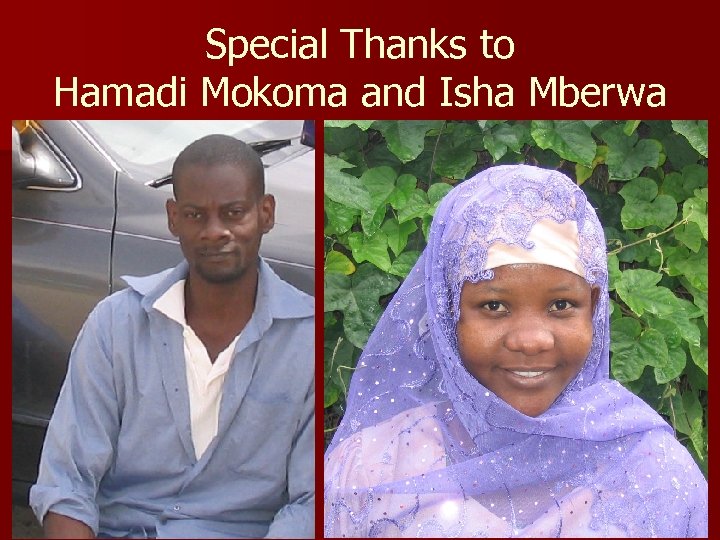
Special Thanks to Hamadi Mokoma and Isha Mberwa
References American Nurses Association, ANA Position statements, Ethics and Human Rights Position Statements: Cultural diversity in nursing practice (1991). Retrieved October 18, 2006. http: //www. nursingworld. org/readroom/position/ethics/etcldv. htm American Nurse’s Association (2005). Silver Spring, MD. ANA’s Health care agenda 2005. Retrieved December 4, 2007 at http: //www. nursingworld. org/Main. Menu. Categories/Healthcareand. Policy. Issues/HS/H ealthcare. Agenda. aspx. Brouwer, K. C. , Rodwell, T. (2007) Assessment of community member attitudes towards health needs of refugees in San Diego. International Health & Cross-Cultural Medical department at University of California, San Diego, and Count of San Diego Health and Human Services agency (CSDHHSA). Received November 8, 2007 from CSDHHSA.
References (continued) Carroll, J. , Epstein, R. , Fiscella, K. , Volpe, E. , Diaz, K. , & Omar, S. (April, 2007). Knowledg and Beliefs about health promotion and preventative health care among Somali women in the United States. Health Care for Women International, 28, 360380. Retrieved November 29, 2007, from MEDLINE database. de la Cruz, O. , Jumale, H. , Krause, C. , Madisa, H. , Pan, A. , (2008) Somali-Bantu Community of San Diego health needs assessment findings. San Diego: Somali. Bantu Community of San Diego. Donnelly, P. L. (2000). Ethics and Cross-Cultural Nursing. Journal of Transcultural Nursing, 11 (2), 119 -126. Retrieved October 12, 2007 from Sage Publications.
References (continued) George, J. (2002). Theory of culture care diversity and universality: Madeline M. Leininger. In J. George (Ed. ), Nursing theories the base for professional nursing practice (5 th Ed). (pp. 490 -511). Upper Saddle River, New Jersey: Prentice Hall. Institute of Medicine, (IOM) Committee on Quality Of health Care in America. (2001). Crossing the quality chasm: A new health system for the twenty-first century. Washington, D. C. National Academy Press. Roter, D. , & Makoul, G. (2000). Healthy People 2010 Objective 11 -6 Healthcare Providers Communication skills. Retreived October 31, 2007 from http: //www. odphp. osophs. dhhs. gov/projects/Health. Comm/objective 6. htm Roter, D. L. , Rudd, R. E. , & Comings, J. (1998). Patient Literacy A Barrier to Quality Care. Journal Of General Internal Medicine, 13(12), 850 -854. Retrieved October 8, 2007 from Blackwell-Synergy.
U. S. Department of State. Fact sheet, Bureau of Population, Refugees and Migration. Washington, D. C. February 5, 2003. Somali-Bantu Refugees. Accessed October 15, 2007. http: //www. state. gov/g/prm/rls/fs/2003/17270. htm U. S. Department of Health and Human Services Offices of Disease Prevention and Health Promotion (2000). Healthy People 2010. Health Communication, section 11. Retrieved October 21, 2007 from http: //www. healthypeople. gov/document/html/volume 1/11 healthcom. htm Van Lehman, D. , & Eno, O. (2003). Cultural Profile No. 16. The Somali-Bantu: Their history and culture. Developed under agreement for the US Department of State, published by the Center for Applied Linguistics.
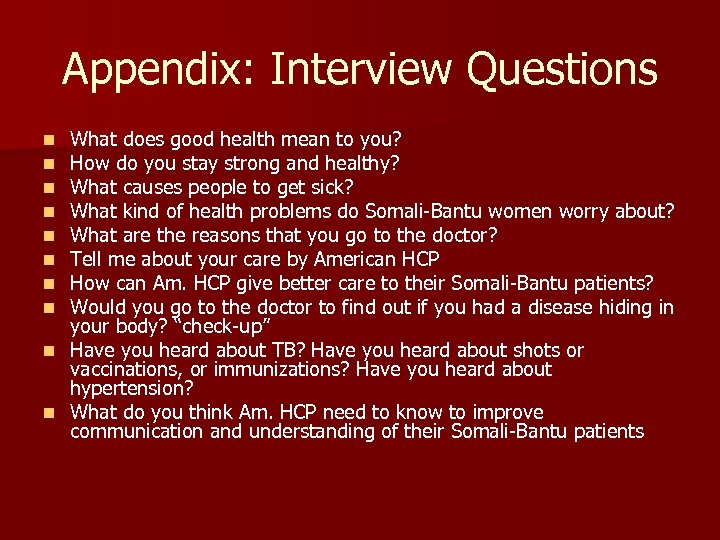
Appendix: Interview Questions What does good health mean to you? How do you stay strong and healthy? What causes people to get sick? What kind of health problems do Somali-Bantu women worry about? What are the reasons that you go to the doctor? Tell me about your care by American HCP How can Am. HCP give better care to their Somali-Bantu patients? Would you go to the doctor to find out if you had a disease hiding in your body? “check-up” n Have you heard about TB? Have you heard about shots or vaccinations, or immunizations? Have you heard about hypertension? n What do you think Am. HCP need to know to improve communication and understanding of their Somali-Bantu patients n n n n
Скачать презентацию Somali-Bantu Refugee Women s Beliefs About Preventative Healthcare and
ab8c3c2e88c8f8d4122a9dc9047c2342.ppt