


 Скачать презентацию Solving the Proton Spin Crisis My Work and
396c2ac3140356af1adc8b5df22f045d.ppt
- Количество слайдов: 35
 Solving the Proton Spin Crisis My Work (and Life!) as a Graduate Student on the Experiment Christine Aidala Columbia University December 2003 Christine Aidala, Columbia University, December 2003
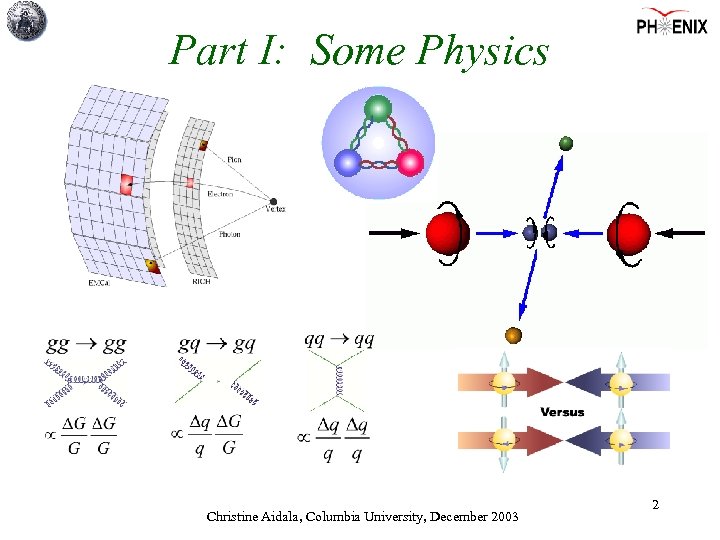 Part I: Some Physics Christine Aidala, Columbia University, December 2003 2
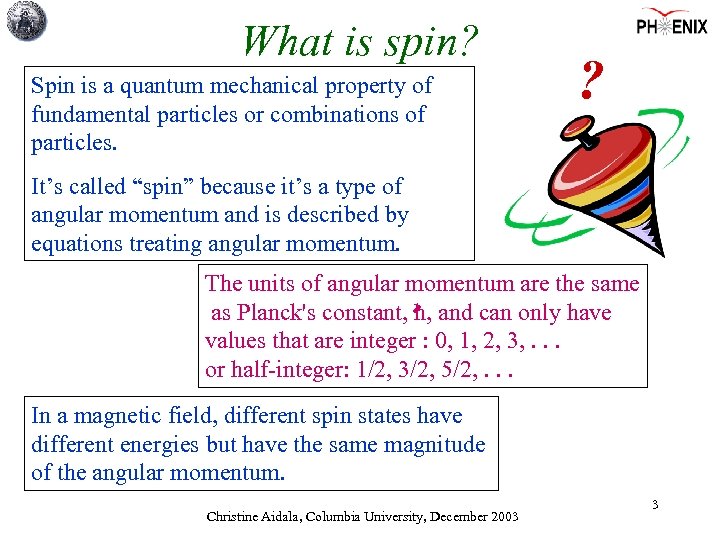 What is spin? Spin is a quantum mechanical property of fundamental particles or combinations of particles. ? It’s called “spin” because it’s a type of angular momentum and is described by equations treating angular momentum. The units of angular momentum are the same as Planck's constant, h, and can only have values that are integer : 0, 1, 2, 3, . . . or half-integer: 1/2, 3/2, 5/2, . . . In a magnetic field, different spin states have different energies but have the same magnitude of the angular momentum. Christine Aidala, Columbia University, December 2003 3
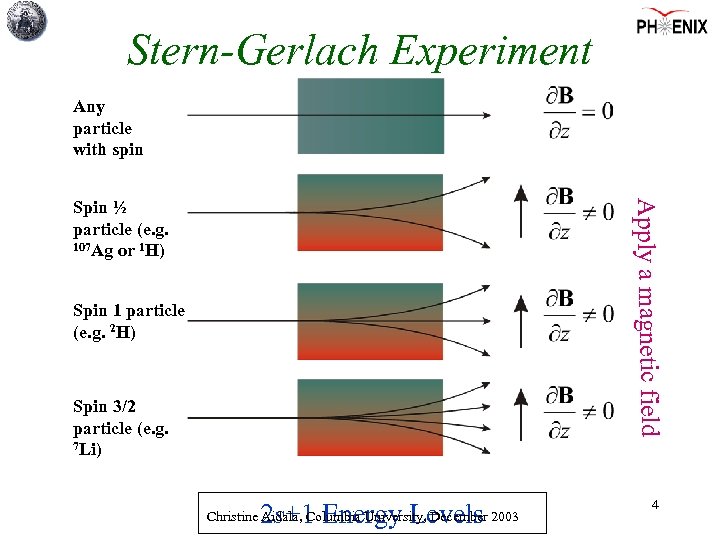 Stern-Gerlach Experiment Any particle with spin Apply a magnetic field Spin ½ particle (e. g. 107 Ag or 1 H) Spin 1 particle (e. g. 2 H) Spin 3/2 particle (e. g. 7 Li) 2 s+1 Energy Levels Christine Aidala, Columbia University, December 2003 4
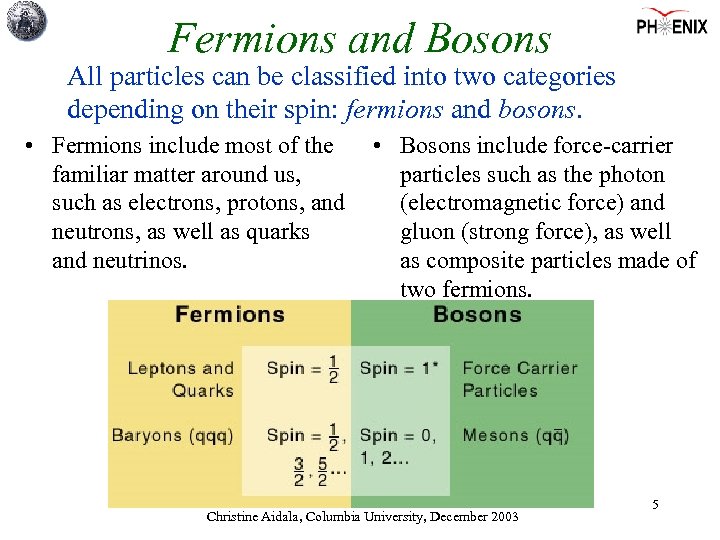 Fermions and Bosons All particles can be classified into two categories depending on their spin: fermions and bosons. • Fermions include most of the familiar matter around us, such as electrons, protons, and neutrons, as well as quarks and neutrinos. • Bosons include force-carrier particles such as the photon (electromagnetic force) and gluon (strong force), as well as composite particles made of two fermions. Christine Aidala, Columbia University, December 2003 5
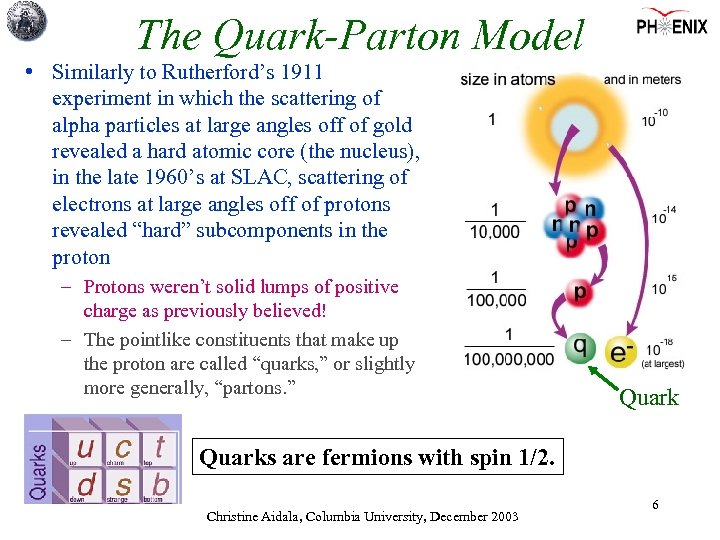 The Quark-Parton Model • Similarly to Rutherford’s 1911 experiment in which the scattering of alpha particles at large angles off of gold revealed a hard atomic core (the nucleus), in the late 1960’s at SLAC, scattering of electrons at large angles off of protons revealed “hard” subcomponents in the proton – Protons weren’t solid lumps of positive charge as previously believed! – The pointlike constituents that make up the proton are called “quarks, ” or slightly more generally, “partons. ” Quarks are fermions with spin 1/2. Christine Aidala, Columbia University, December 2003 6
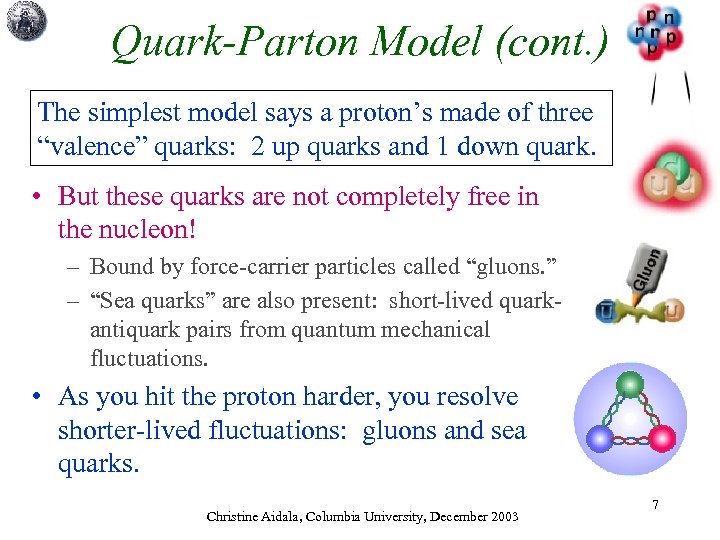 Quark-Parton Model (cont. ) The simplest model says a proton’s made of three “valence” quarks: 2 up quarks and 1 down quark. • But these quarks are not completely free in the nucleon! – Bound by force-carrier particles called “gluons. ” – “Sea quarks” are also present: short-lived quarkantiquark pairs from quantum mechanical fluctuations. • As you hit the proton harder, you resolve shorter-lived fluctuations: gluons and sea quarks. Christine Aidala, Columbia University, December 2003 7
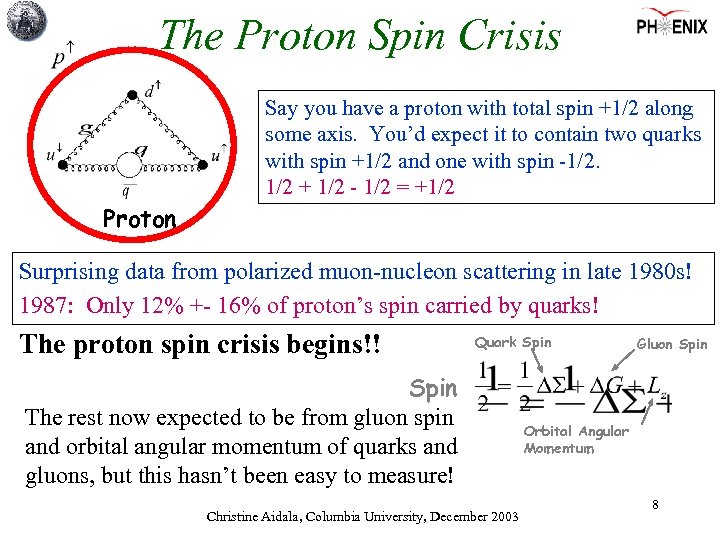 The Proton Spin Crisis Say you have a proton with total spin +1/2 along some axis. You’d expect it to contain two quarks with spin +1/2 and one with spin -1/2. 1/2 + 1/2 - 1/2 = +1/2 Proton Surprising data from polarized muon-nucleon scattering in late 1980 s! 1987: Only 12% +- 16% of proton’s spin carried by quarks! The proton spin crisis begins!! Quark Spin The rest now expected to be from gluon spin and orbital angular momentum of quarks and gluons, but this hasn’t been easy to measure! Christine Aidala, Columbia University, December 2003 Gluon Spin Orbital Angular Momentum 8
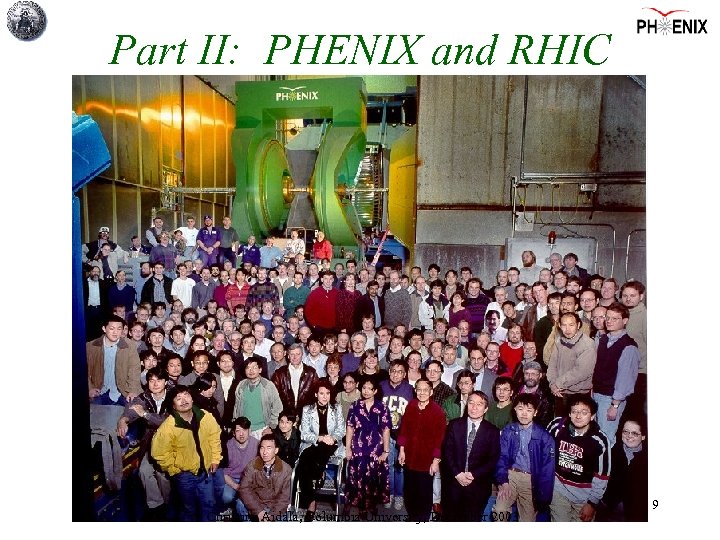 Part II: PHENIX and RHIC Christine Aidala, Columbia University, December 2003 9
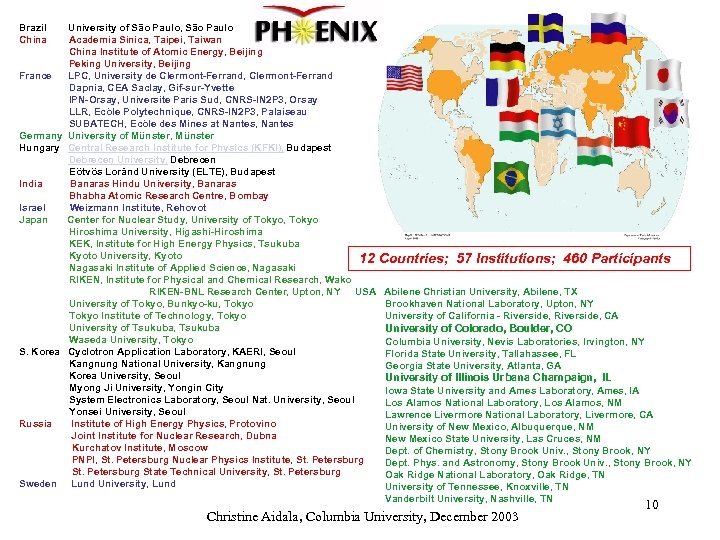 Brazil China University of São Paulo, São Paulo Academia Sinica, Taipei, Taiwan China Institute of Atomic Energy, Beijing Peking University, Beijing France LPC, University de Clermont-Ferrand, Clermont-Ferrand Dapnia, CEA Saclay, Gif-sur-Yvette IPN-Orsay, Universite Paris Sud, CNRS-IN 2 P 3, Orsay LLR, Ecòle Polytechnique, CNRS-IN 2 P 3, Palaiseau SUBATECH, Ecòle des Mines at Nantes, Nantes Germany University of Münster, Münster Hungary Central Research Institute for Physics (KFKI), Budapest Debrecen University, Debrecen Eötvös Loránd University (ELTE), Budapest India Banaras Hindu University, Banaras Bhabha Atomic Research Centre, Bombay Israel Weizmann Institute, Rehovot Japan Center for Nuclear Study, University of Tokyo, Tokyo Hiroshima University, Higashi-Hiroshima KEK, Institute for High Energy Physics, Tsukuba Kyoto University, Kyoto 12 Countries; 57 Institutions; 460 Participants Nagasaki Institute of Applied Science, Nagasaki RIKEN, Institute for Physical and Chemical Research, Wako RIKEN-BNL Research Center, Upton, NY USA Abilene Christian University, Abilene, TX Brookhaven National Laboratory, Upton, NY University of Tokyo, Bunkyo-ku, Tokyo University of California - Riverside, CA Tokyo Institute of Technology, Tokyo University of Tsukuba, Tsukuba University of Colorado, Boulder, CO Waseda University, Tokyo Columbia University, Nevis Laboratories, Irvington, NY S. Korea Cyclotron Application Laboratory, KAERI, Seoul Florida State University, Tallahassee, FL Kangnung National University, Kangnung Georgia State University, Atlanta, GA Korea University, Seoul University of Illinois Urbana Champaign, IL Myong Ji University, Yongin City Iowa State University and Ames Laboratory, Ames, IA System Electronics Laboratory, Seoul Nat. University, Seoul Los Alamos National Laboratory, Los Alamos, NM Yonsei University, Seoul Lawrence Livermore National Laboratory, Livermore, CA Russia Institute of High Energy Physics, Protovino University of New Mexico, Albuquerque, NM Joint Institute for Nuclear Research, Dubna New Mexico State University, Las Cruces, NM Kurchatov Institute, Moscow Dept. of Chemistry, Stony Brook Univ. , Stony Brook, NY PNPI, St. Petersburg Nuclear Physics Institute, St. Petersburg Dept. Phys. and Astronomy, Stony Brook Univ. , Stony Brook, NY St. Petersburg State Technical University, St. Petersburg Oak Ridge National Laboratory, Oak Ridge, TN Sweden Lund University, Lund University of Tennessee, Knoxville, TN Vanderbilt University, Nashville, TN Christine Aidala, Columbia University, December 2003 10
 The Relativistic Heavy Ion Collider • Primarily designed to collide heavy ions • Main design purpose: search and discovery mission for quark-gluon plasma, state of matter believed to have existed 10 millionths of a second after the Big Bang. • Most versatile collider in the world! Au-Au, polarized(!) p-p, other combinations. . . – asymmetric species possible due to independent rings with separate steering magnets • First polarized proton collider in world! Special magnets and other equipment installed to measure and maintain polarization. Christine Aidala, Columbia University, December 2003 11
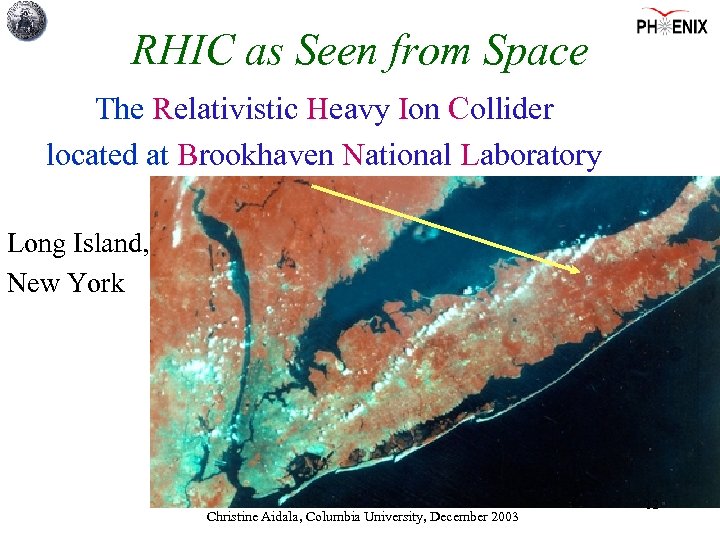 RHIC as Seen from Space The Relativistic Heavy Ion Collider located at Brookhaven National Laboratory Long Island, New York Christine Aidala, Columbia University, December 2003 12
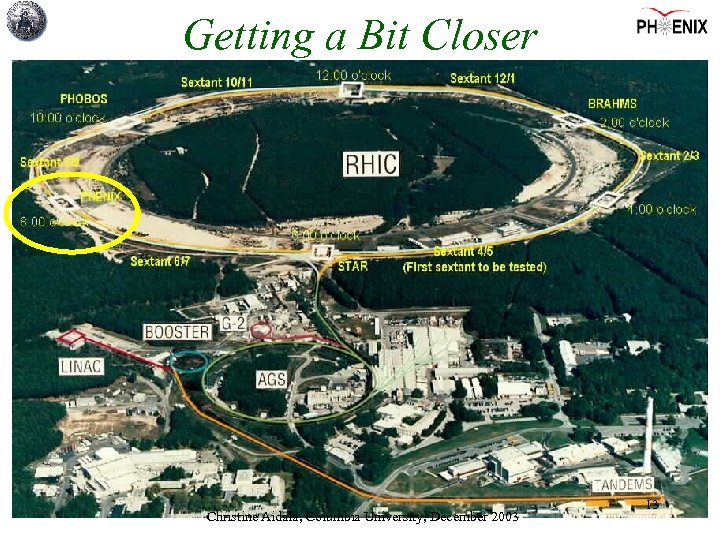 Getting a Bit Closer Christine Aidala, Columbia University, December 2003 13
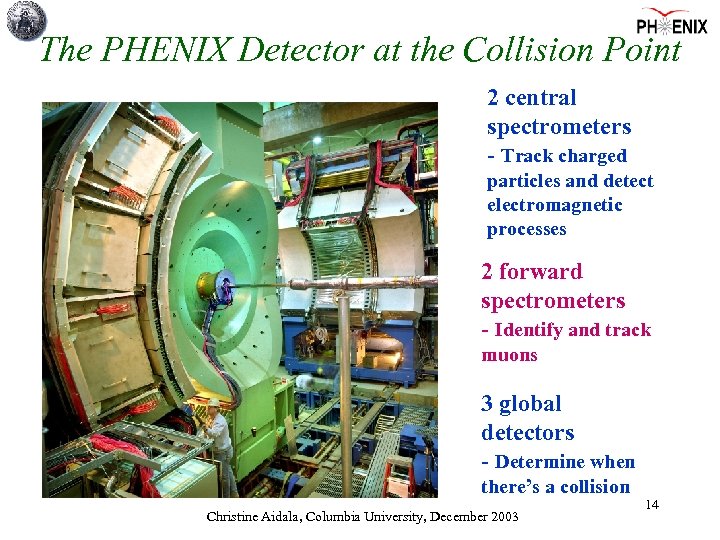 The PHENIX Detector at the Collision Point 2 central spectrometers - Track charged particles and detect electromagnetic processes 2 forward spectrometers - Identify and track muons 3 global detectors - Determine when there’s a collision Christine Aidala, Columbia University, December 2003 14
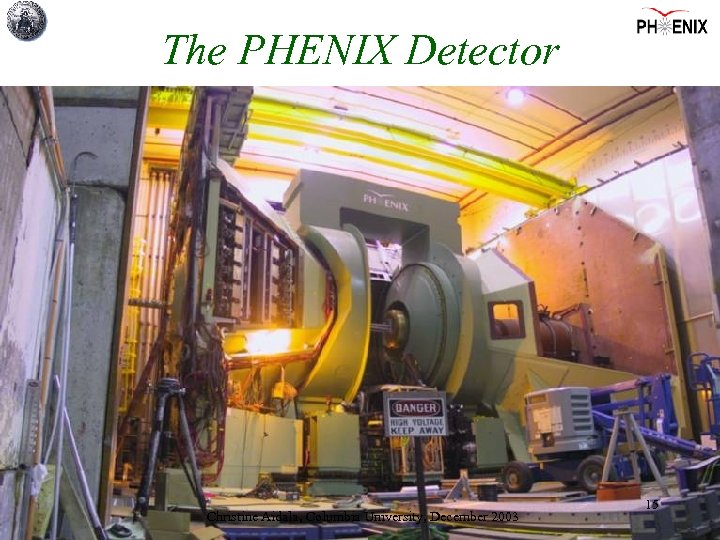 The PHENIX Detector Christine Aidala, Columbia University, December 2003 15
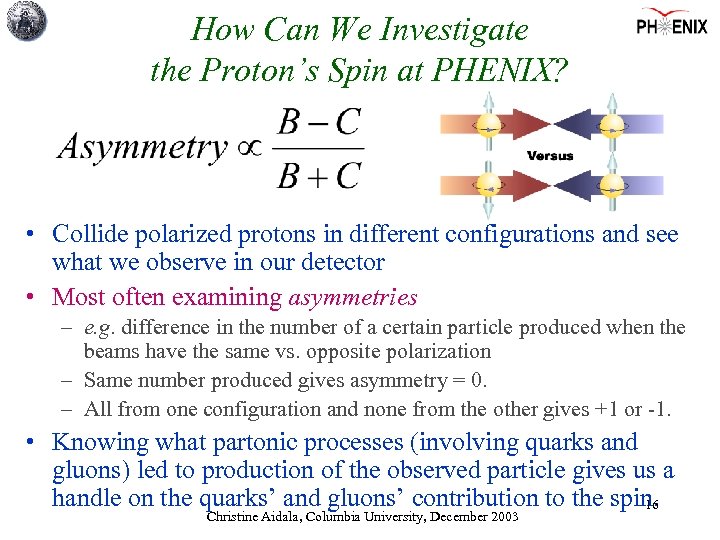 How Can We Investigate the Proton’s Spin at PHENIX? • Collide polarized protons in different configurations and see what we observe in our detector • Most often examining asymmetries – e. g. difference in the number of a certain particle produced when the beams have the same vs. opposite polarization – Same number produced gives asymmetry = 0. – All from one configuration and none from the other gives +1 or -1. • Knowing what partonic processes (involving quarks and gluons) led to production of the observed particle gives us a handle on the quarks’ and gluons’ contribution to the spin. 16 Christine Aidala, Columbia University, December 2003
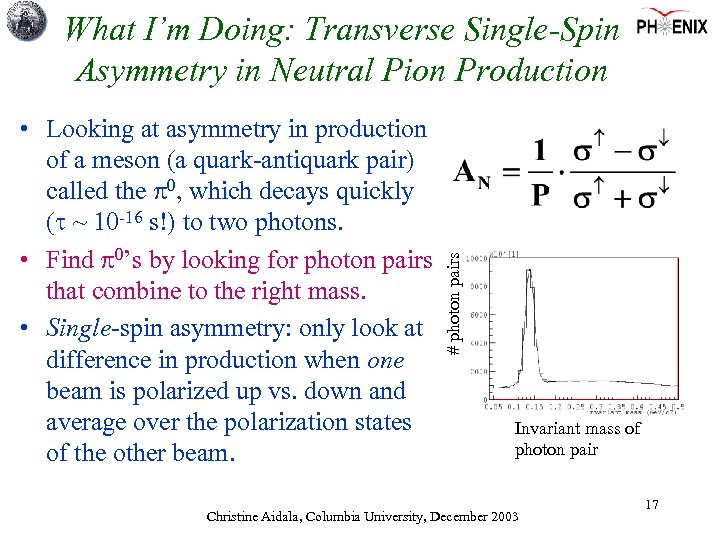 • Looking at asymmetry in production of a meson (a quark-antiquark pair) called the p 0, which decays quickly (t ~ 10 -16 s!) to two photons. • Find p 0’s by looking for photon pairs that combine to the right mass. • Single-spin asymmetry: only look at difference in production when one beam is polarized up vs. down and average over the polarization states of the other beam. # photon pairs What I’m Doing: Transverse Single-Spin Asymmetry in Neutral Pion Production Invariant mass of photon pair Christine Aidala, Columbia University, December 2003 17
 Part III: Being a Graduate Student Christine Aidala, Columbia University, December 2003 18
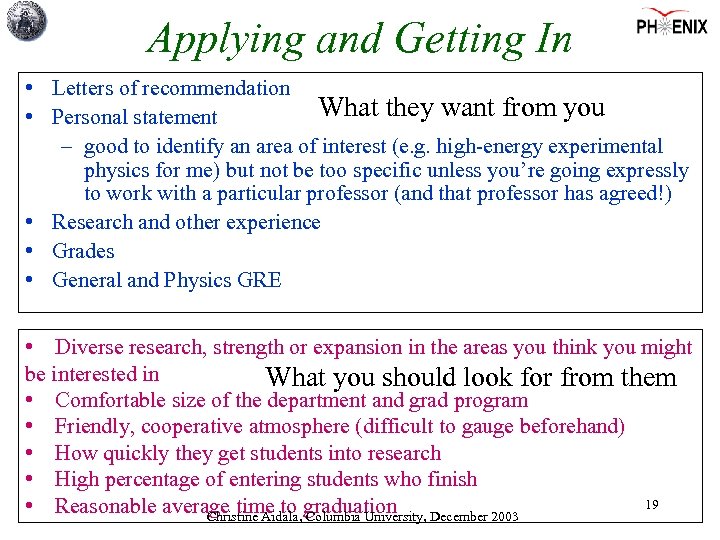 Applying and Getting In • Letters of recommendation What they want from you • Personal statement – good to identify an area of interest (e. g. high-energy experimental physics for me) but not be too specific unless you’re going expressly to work with a particular professor (and that professor has agreed!) • Research and other experience • Grades • General and Physics GRE • Diverse research, strength or expansion in the areas you think you might be interested in What you should look for from them • Comfortable size of the department and grad program • Friendly, cooperative atmosphere (difficult to gauge beforehand) • How quickly they get students into research • High percentage of entering students who finish 19 • Reasonable average time to graduation December 2003 Christine Aidala, Columbia University,
 Experiences I had as an undergrad • Research every summer, senior project – – – REU Locally in a lab at my university Summer student at Brookhaven National Lab Summer student at CERN in Geneva, Switzerland Senior project Also did research with a group from my (first) graduate institution the summer before starting there • Conferences CEU • Organizing Society of Physics Students events • Visiting grad schools spring break junior year Christine Aidala, Columbia University, December 2003 20
 The first couple years of grad school • • Classes Teaching assistant or perhaps research assistant Research over the summer--important! Financial support – everyone fully supported in Ph. D. programs, including international students! • Tuition covered and get a stipend as well (~$20, 000) – TA, RA, fellowship (e. g. NSF) – Master’s programs often have no financial support Christine Aidala, Columbia University, December 2003 21
 Qualifying Exams • Nearly every Ph. D. program requires you to pass some kind of “qualifying” or “candidacy” exam before you’re “promoted to candidacy” for the doctorate • Timing, format, and scope of the exam depends on the program, but generally speaking, you have to pass by the beginning of the third year, and the exam is supposed to cover more or less everything you’ve ever learned in physics(!) • Can be intimidating (I certainly thought so), but I also have to admit that the comprehensive review also did me a lot of good • Find out ahead of time what percentage of students typically pass-you probably don’t want a school that “weeds out” students via their qualifying exam Christine Aidala, Columbia University, December 2003 22
 Choosing a research group/advisor • You’re going to be working • Theory vs. experiment with these people for the next • What area of physics few years--you’d better like • Large vs. small local group, them! And be comfortable large vs. small collaboration working with them. – Talk to older students in the • Travel or relocation involved? group!! • How independent do you want • Even if the group expects you to to be? be independent, push to get a – i. e. is a super-busy advisor strong introduction/orientation right for you? in the first couple months – e. g. suggest a journal club, schedule regular discussions with advanced students, . . . Christine Aidala, Columbia University, December 2003 23
 A few years of full-time research • Often start spring of second year or summer after • First year of research mostly non-thesis work – Experimentalists: hardware or software – Theorists: lots of reading! • Then want to identify a specific thesis topic to spend another two or three years on – Not as intimidating as I originally imagined! There’s usually a set of physics topics that the group is interested in, and you’ll choose and develop one of these, rather than having to come up with a completely new, brilliant physics question that’s never been addressed before. Christine Aidala, Columbia University, December 2003 24
 What can you do with a graduate degree in physics, anyway? • • Academic research at university or national lab Industrial research Medical physics--quickly expanding field! Teach – quite respectable salaries for Master’s or Ph. D. teaching high school (need education qualifications, though) • Scientific policy – program for grad students to spend time in Washington exists • • • Forensic physics--law enforcement and investigation Scientific journalism Scientific outreach and education for the public Software and programming Finance, statistics Not by any means a complete 25 list! Christine Aidala, Columbia University, December 2003
 Do I have a personal life? Well, that’s a matter of opinion of course, but. . . • Go out to dinner in NYC once a week with students/ postdocs in my group after our weekly journal club • Play ultimate at BNL twice a week May-October • Take Japanese lessons for the fun of it--every Friday at BNL • Have a wonderfully patient husband (met at CERN!) who graciously puts up with my busy lifestyle • Together we have friends and colleagues over for dinner relatively often or invite them out for other activities • We also find time (and money!) for occasional three-day weekend trips and at least one long “vacation” a year to see his family in Italy. Christine Aidala, Columbia University, December. . All in all, I’m certainly not complaining 2003. 26
 The path I took to end up here Probably not something you’d want to emulate, but it might be good to know you can stray from the straight and narrow. • • • Yale ‘ 95 -‘ 99, Bachelor’s in physics, music U. of Chicago ‘ 99 -‘ 00 (grad school) Milan, Italy ‘ 00 -‘ 01 (teaching English and music) BNL ‘ 01 -‘ 02 (research job) Columbia ‘ 02 -present (grad school once again) Christine Aidala, Columbia University, December 2003 27
 + Physics = ? • Personally, never any problems as a woman in physics • Bothered me a bit that half of my funding at BNL for “minorities” in science • Much more conscious instead of my age (at BNL) and having gone through the less math- and physics-focused American education system (in classes) • Tend to look at advantages of being one of few women – People remember you better – Can play a different social role • Number of women in physics increasing slowly but surely Christine Aidala, Columbia University, December 2003 28
 Final words • Being a physicist involves more than physics – People skills, presentation skills, computing skills, writing skills, organization and leadership skills, . . . • A degree in physics isn’t just for physicists Graduating from college and finding yourself a “freshman” in life again can be daunting. Take advantage of the resources around you, and assume people are interested in you until you find out otherwise! Feel free to contact me in the future! caidala@bnl. gov Christine Aidala, Columbia University, December 2003 29
 Extra Slides Christine Aidala, Columbia University, December 2003 30
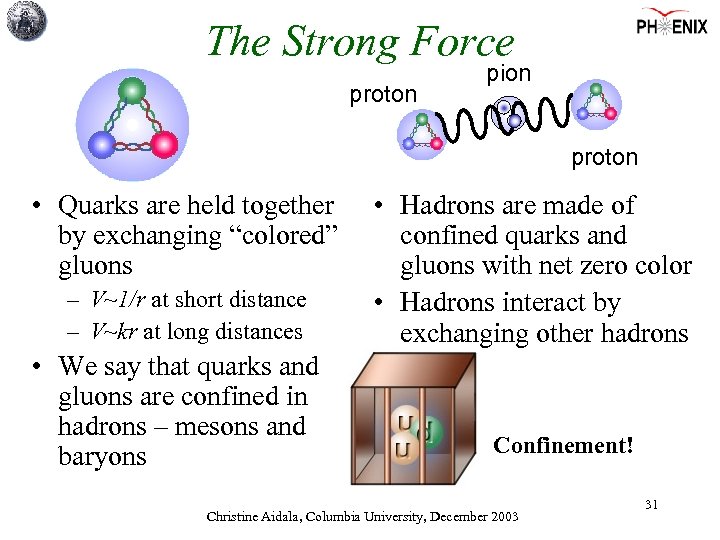 The Strong Force proton pion proton • Quarks are held together by exchanging “colored” gluons – V~1/r at short distance – V~kr at long distances • We say that quarks and gluons are confined in hadrons – mesons and baryons • Hadrons are made of confined quarks and gluons with net zero color • Hadrons interact by exchanging other hadrons Confinement! Christine Aidala, Columbia University, December 2003 31
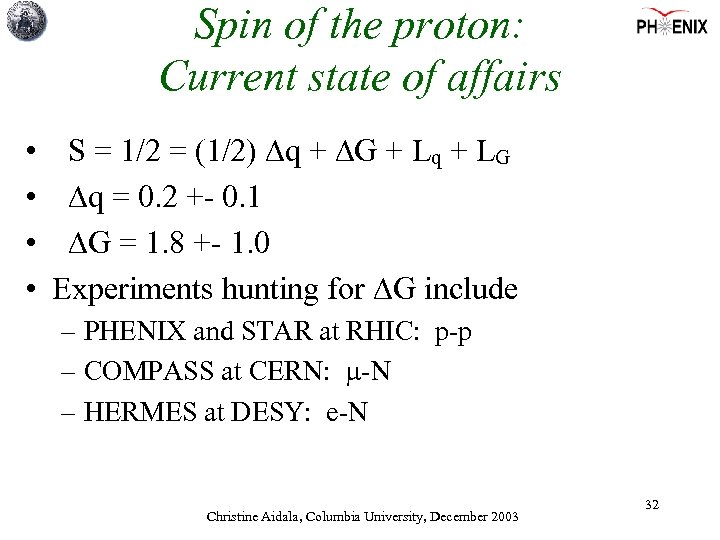 Spin of the proton: Current state of affairs • • S = 1/2 = (1/2) Dq + DG + Lq + LG Dq = 0. 2 +- 0. 1 DG = 1. 8 +- 1. 0 Experiments hunting for DG include – PHENIX and STAR at RHIC: p-p – COMPASS at CERN: m-N – HERMES at DESY: e-N Christine Aidala, Columbia University, December 2003 32
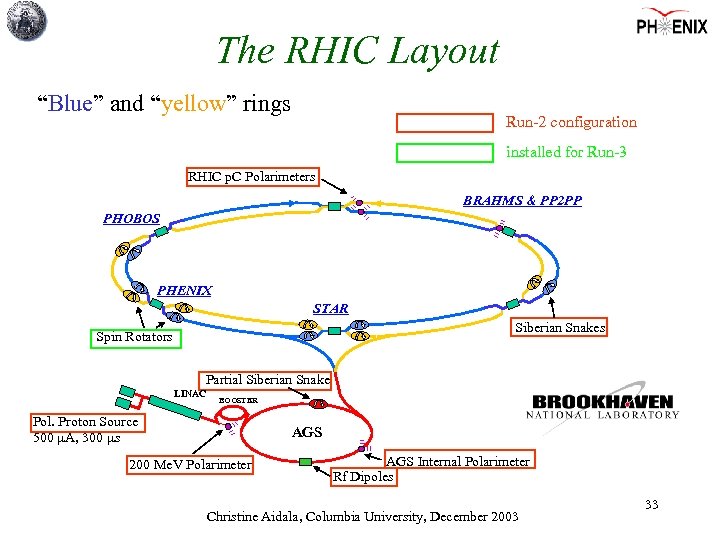 The RHIC Layout “Blue” and “yellow” rings Run-2 configuration installed for Run-3 RHIC p. C Polarimeters BRAHMS & PP 2 PP PHOBOS PHENIX STAR Siberian Snakes Spin Rotators Partial Siberian Snake LINAC BOOSTER Pol. Proton Source 500 m. A, 300 ms AGS 200 Me. V Polarimeter AGS Internal Polarimeter Rf Dipoles Christine Aidala, Columbia University, December 2003 33
 Dealing with busy people • Schedule regular, fixed meetings, ideally around something that can’t be moved (e. g. a professor’s lecture) • Ask explicitly what the best way to contact them is • If it’s someone who has specific responsibilities with respect to you, do your best to be honest if you’re dissatisfied and feel they’re not meeting (your expectation of) those responsibilities • Give positive feedback as well--sometimes we students need to help in “training” our professors! Christine Aidala, Columbia University, December 2003 34
 Other difficult-to-deal-with advisor traits to watch out for • Unrealistic expectations about how long it’ll take you to do something • Too many branching suggestions of diminishing importance • Not paying attention to details of what you’re doing Christine Aidala, Columbia University, December 2003 35