 Скачать презентацию Solving for x s and why s Bringing Cognitive Science
ec99f4f337ff088e9daa694f832cd946.ppt
- Количество слайдов: 38



Solving for x’s and why’s: Bringing Cognitive Science into the Math Classroom South Dakota Laptop Institute 2007 Kevin Judd Western Regional Vice President Carnegie Learning, Inc. ® Carnegie Learning | www. carnegielearning. com
Learning by Doing “We learn by doing – that is the thing. For though you think you know it, you have no certainty until you try. ” - Sophocles, 270 B. C. Carnegie Learning | www. carnegielearning. com
Sources How People Learn and How Students Learn from the National Research Council – John Bransford § Larry Lowery from Lawrence Lab at Berkeley and FOSS § Al Corbett, John Anderson and Steve Ritter at Carnegie Mellon University § The Teaching Gap by James Stigler and James Weisert. § Carnegie Learning | www. carnegielearning. com
“How People Learn” research § Learners use what they already know to construct new understandings. How People Learn: Brain, Mind, Experience and School Bransford, J. D. , Brown, A. L. & Cooking, R. R. (Eds) 1999, National Academy Press. Carnegie Learning | www. carnegielearning. com
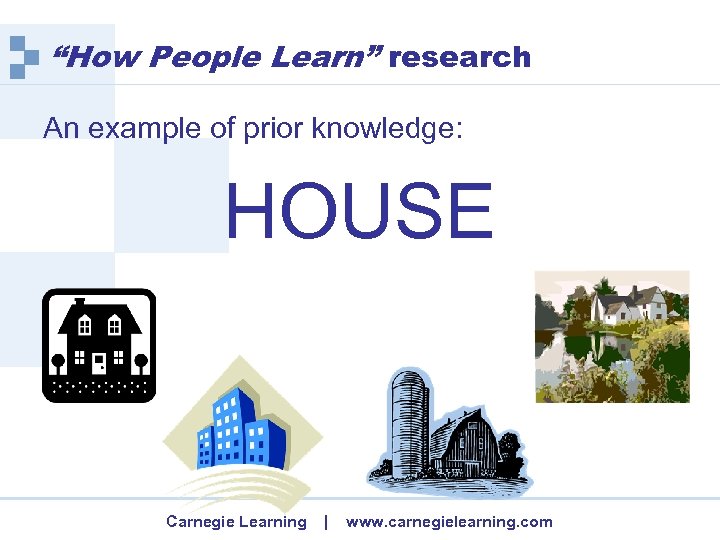
“How People Learn” research An example of prior knowledge: HOUSE Carnegie Learning | www. carnegielearning. com
“How People Learn” research § Learning with understanding is enhanced when new knowledge is built on the major concepts of a discipline. How People Learn: Brain, Mind, Experience and School Bransford, J. D. , Brown, A. L. & Cooking, R. R. (Eds) 1999, National Academy Press. Carnegie Learning | www. carnegielearning. com
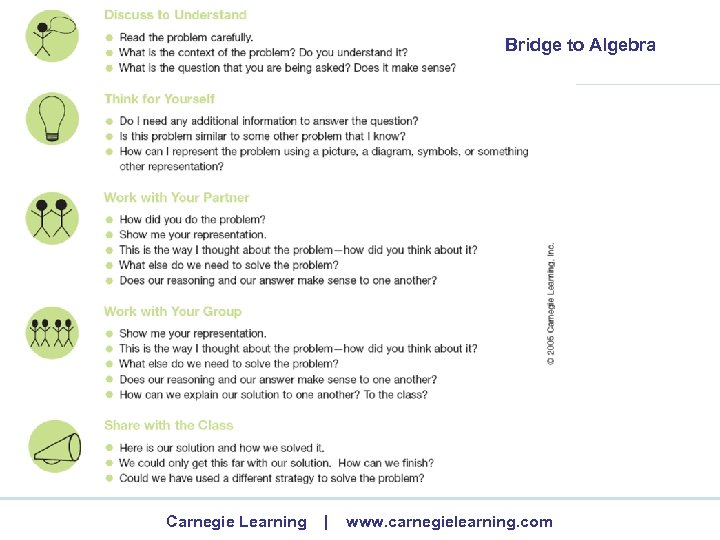
“How People Learn” research § Learners take control of their learning with metacognitive strategies. • Write a sentence describing how you found these answers. • You will be expected to share your answers with the class. • Explain to your partner how you got your answer Carnegie Learning | www. carnegielearning. com
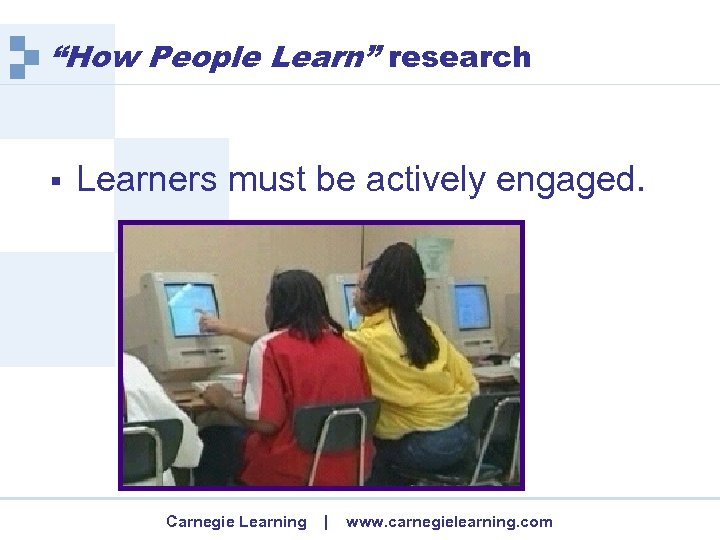
“How People Learn” research § Learners must be actively engaged. Carnegie Learning | www. carnegielearning. com
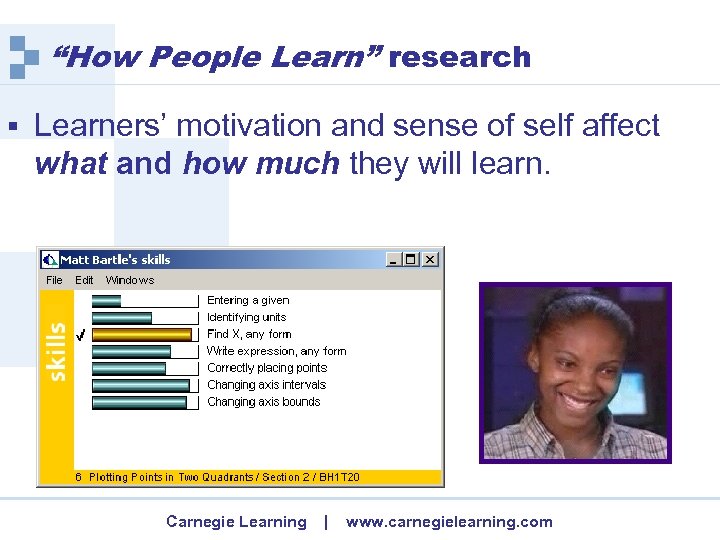
“How People Learn” research § Learners’ motivation and sense of self affect what and how much they will learn. Carnegie Learning | www. carnegielearning. com
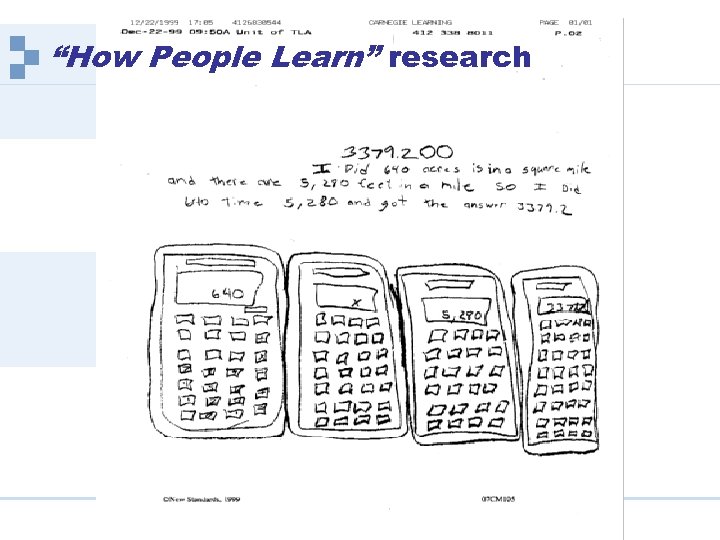
“How People Learn” research § Learners utilize different approaches, strategies and styles based upon individual learning opportunities and prior experiences. How People Learn: Brain, Mind, Experience and School Bransford, J. D. , Brown, A. L. & Cooking, R. R. (Eds) 1999, National Academy Press. Carnegie Learning | www. carnegielearning. com
“How People Learn” research Carnegie Learning | www. carnegielearning. com
“How People Learn” research § Learners cement learning through the use of distributive practice (vs. mass practice). How People Learn: Brain, Mind, Experience and School Bransford, J. D. , Brown, A. L. & Cooking, R. R. (Eds) 1999, National Academy Press. Carnegie Learning | www. carnegielearning. com
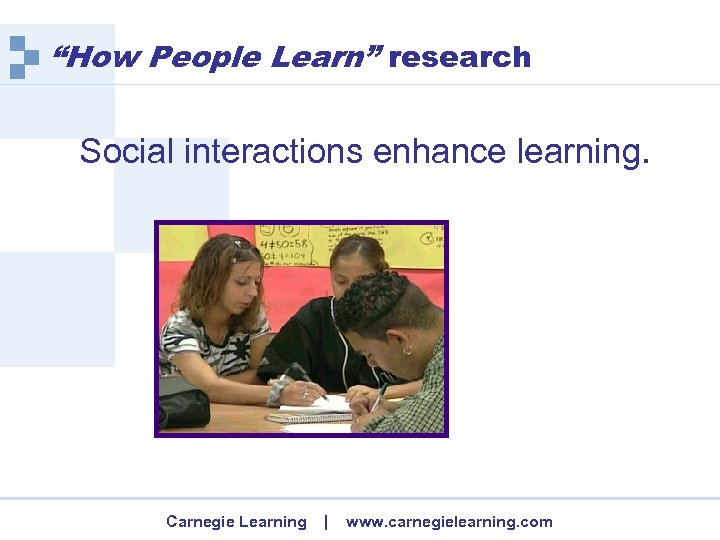
“How People Learn” research Social interactions enhance learning. Carnegie Learning | www. carnegielearning. com
“How People Learn” research § Learning is situated in activity and is shaped by the context and culture in which it occurs. How People Learn: Brain, Mind, Experience and School Bransford, J. D. , Brown, A. L. & Cooking, R. R. (Eds) 1999, National Academy Press. Carnegie Learning | www. carnegielearning. com
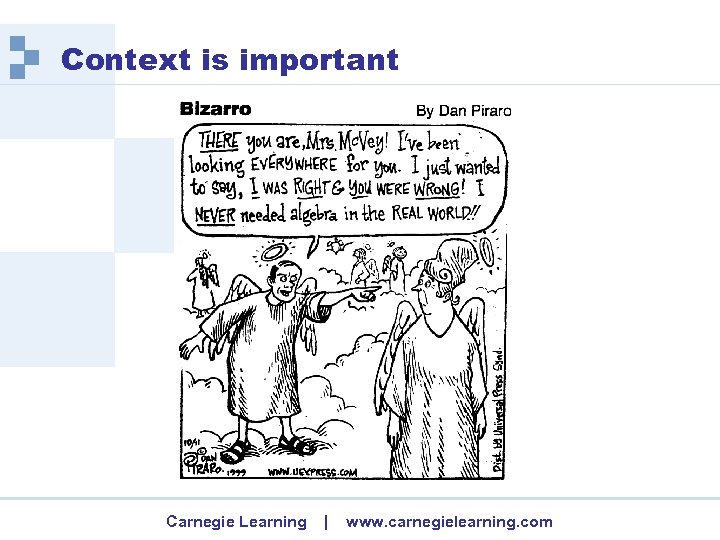
Context is important Carnegie Learning | www. carnegielearning. com
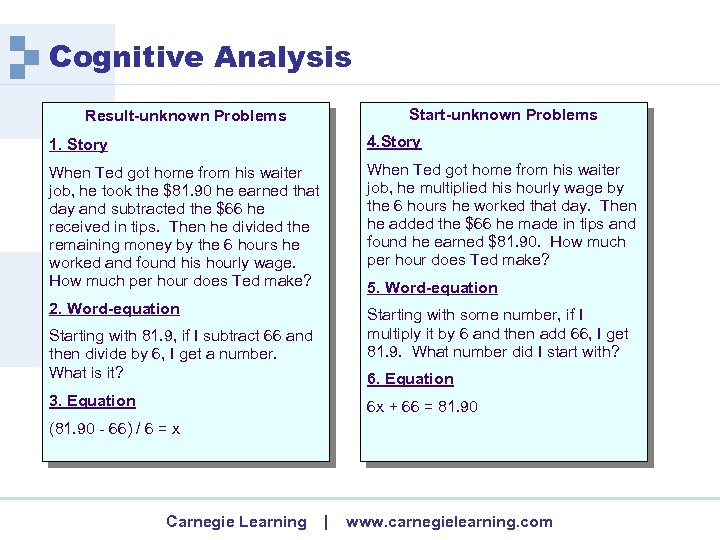
Cognitive Analysis Start-unknown Problems Result-unknown Problems 1. Story 4. Story When Ted got home from his waiter job, he took the $81. 90 he earned that day and subtracted the $66 he received in tips. Then he divided the remaining money by the 6 hours he worked and found his hourly wage. How much per hour does Ted make? When Ted got home from his waiter job, he multiplied his hourly wage by the 6 hours he worked that day. Then he added the $66 he made in tips and found he earned $81. 90. How much per hour does Ted make? 2. Word-equation Starting with some number, if I multiply it by 6 and then add 66, I get 81. 9. What number did I start with? 5. Word-equation Starting with 81. 9, if I subtract 66 and then divide by 6, I get a number. What is it? 6. Equation 3. Equation 6 x + 66 = 81. 90 (81. 90 - 66) / 6 = x Carnegie Learning | www. carnegielearning. com
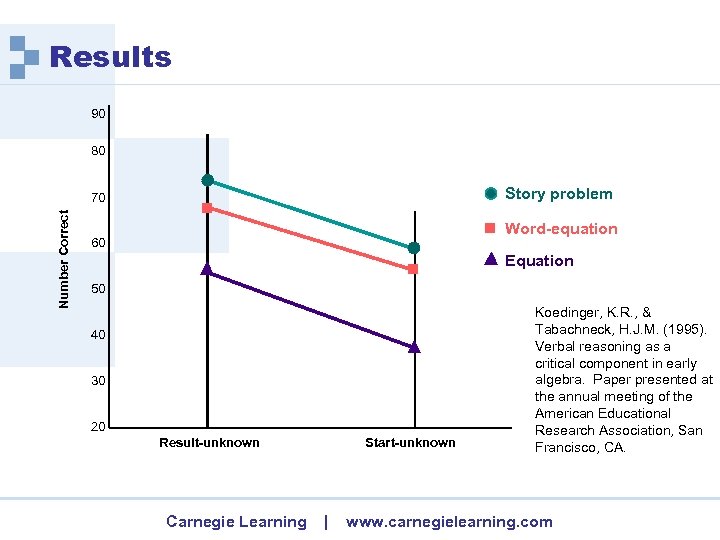
Results 90 80 Story problem Number Correct 70 Word-equation 60 Equation 50 40 30 20 Result-unknown Carnegie Learning Start-unknown | Koedinger, K. R. , & Tabachneck, H. J. M. (1995). Verbal reasoning as a critical component in early algebra. Paper presented at the annual meeting of the American Educational Research Association, San Francisco, CA. www. carnegielearning. com
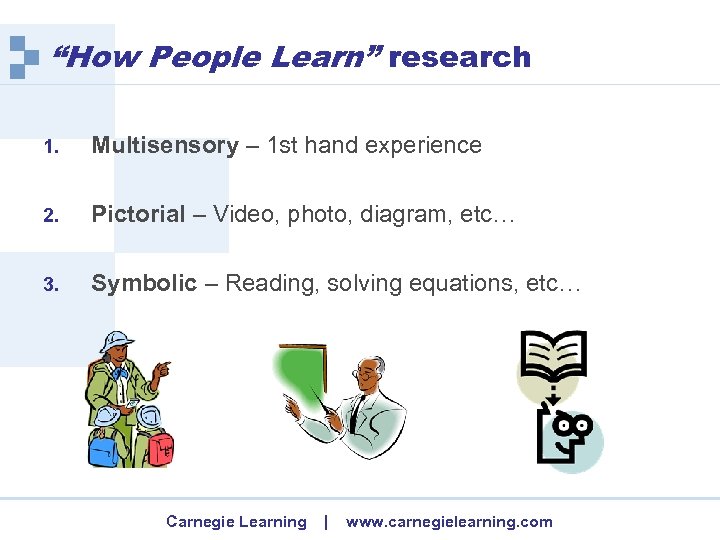
“How People Learn” research 1. Multisensory – 1 st hand experience 2. Pictorial – Video, photo, diagram, etc… 3. Symbolic – Reading, solving equations, etc… Carnegie Learning | www. carnegielearning. com
“How People Learn” research Skills or Subjects? ? ? § Skills: Examples - piano, multiplication tables, reading § Generally learned by practice. § § Subjects: Examples – social studies, art, mathematics § Generally learned by rehearsals. § Carnegie Learning | www. carnegielearning. com
Expert – Novice studies § § § § Experts recognize relationships better. Experts generalize better. Experts notice details better. Experts have a tremendous amount of prior knowledge in the area of their expertise. Experts are not more intelligent. All people can become experts. Experts often can not explain their expertise to novices (Expert Blind Spot). Carnegie Learning | www. carnegielearning. com
What’s important to learn? Carnegie Learning | www. carnegielearning. com
Teaching Math– the current state § Typical class Warm-up, check homework § Demonstrate a procedure with definitions § Students practice the procedure § Homework § 80% of the mathematics concepts are only stated not developed § 95% of seatwork engaged in practicing routine procedures § Carnegie Learning | www. carnegielearning. com
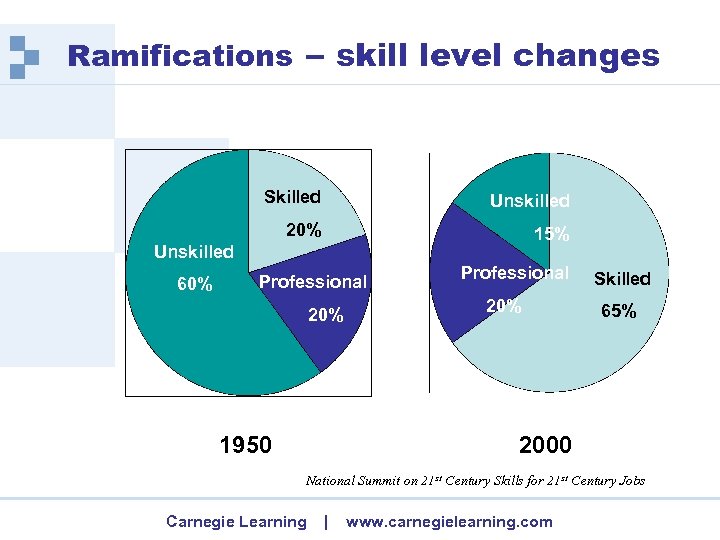
Ramifications – skill level changes Skilled Unskilled 20% 15% Unskilled 60% Professional 20% 1950 Professional 20% Skilled 65% 2000 National Summit on 21 st Century Skills for 21 st Century Jobs Carnegie Learning | www. carnegielearning. com
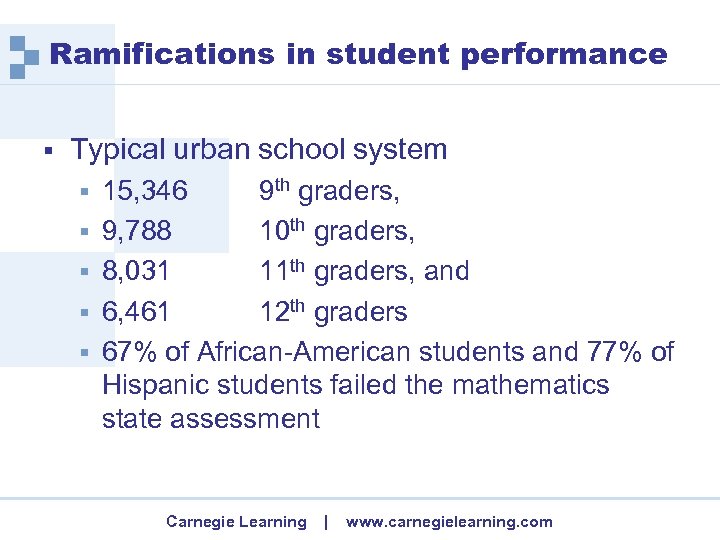
Ramifications in student performance § Typical urban school system § § § 15, 346 9 th graders, 9, 788 10 th graders, 8, 031 11 th graders, and 6, 461 12 th graders 67% of African-American students and 77% of Hispanic students failed the mathematics state assessment Carnegie Learning | www. carnegielearning. com
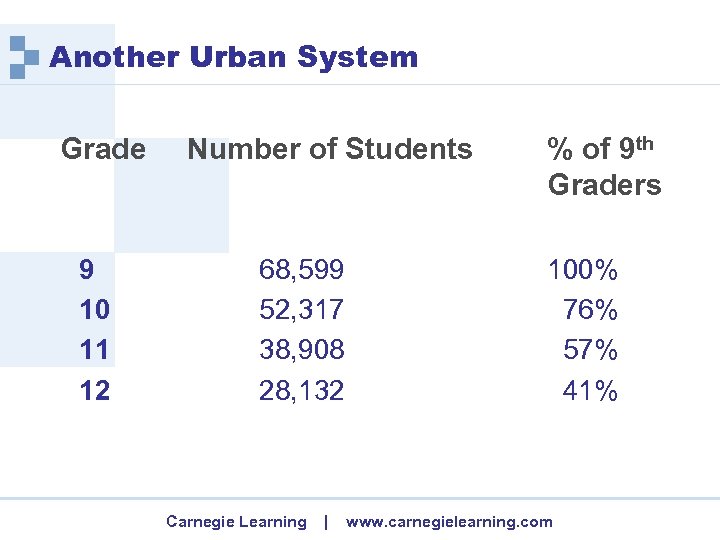
Another Urban System Grade 9 10 11 12 Number of Students 68, 599 52, 317 38, 908 28, 132 Carnegie Learning | % of 9 th Graders 100% 76% 57% 41% www. carnegielearning. com
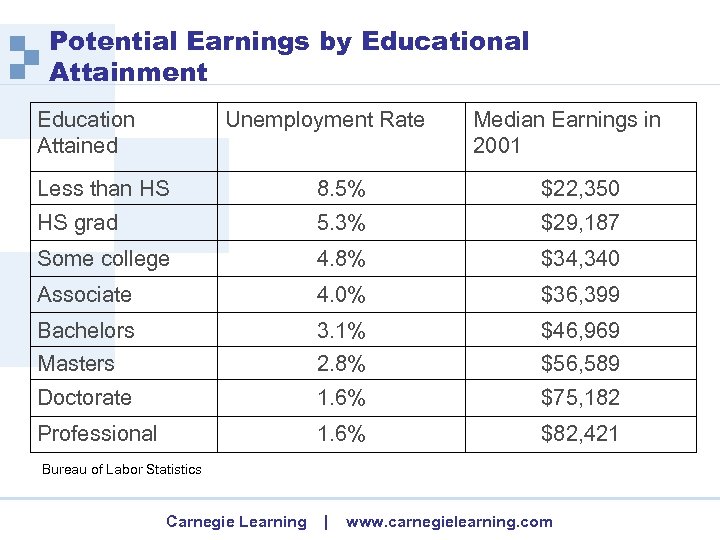
Potential Earnings by Educational Attainment Education Attained Unemployment Rate Median Earnings in 2001 Less than HS 8. 5% $22, 350 HS grad 5. 3% $29, 187 Some college 4. 8% $34, 340 Associate 4. 0% $36, 399 Bachelors 3. 1% $46, 969 Masters 2. 8% $56, 589 Doctorate 1. 6% $75, 182 Professional 1. 6% $82, 421 Bureau of Labor Statistics Carnegie Learning | www. carnegielearning. com
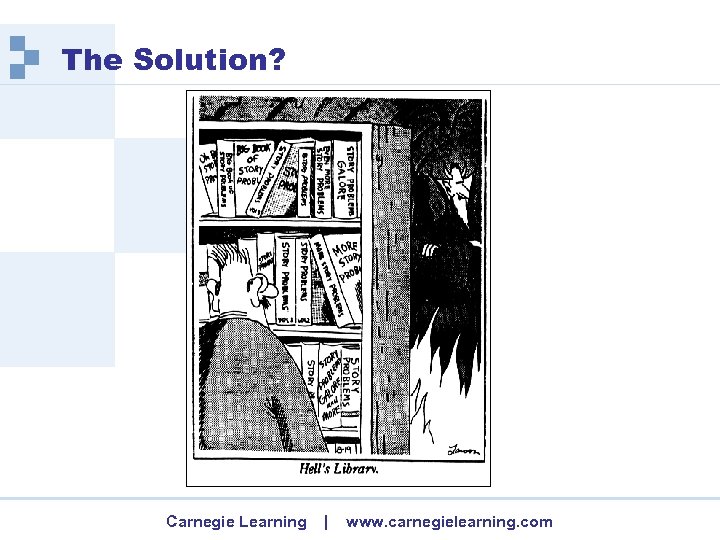
The Solution? Carnegie Learning | www. carnegielearning. com
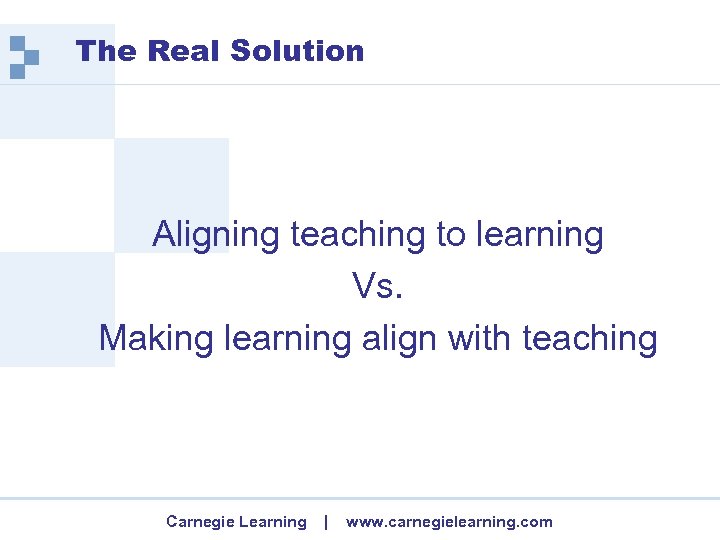
The Real Solution Aligning teaching to learning Vs. Making learning align with teaching Carnegie Learning | www. carnegielearning. com
The Real Solution Solving problems to learn mathematics Vs. Learning procedures to solve problems Carnegie Learning | www. carnegielearning. com
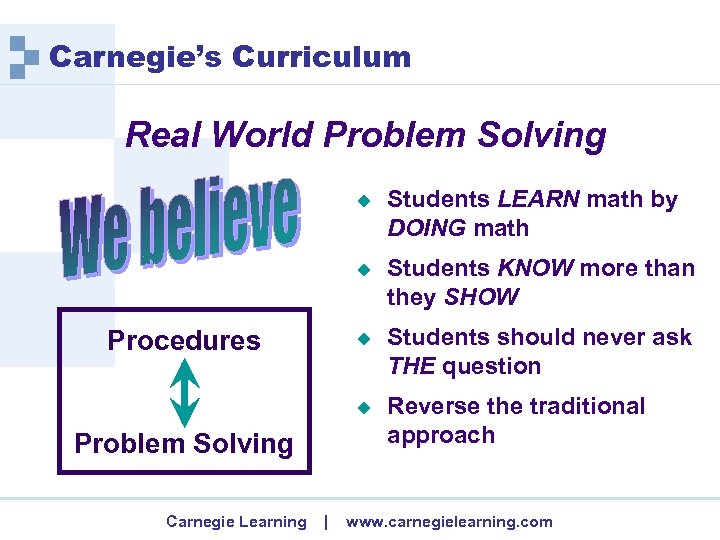
Carnegie’s Curriculum Real World Problem Solving u u Carnegie Learning | Students should never ask THE question u Problem Solving Students KNOW more than they SHOW u Procedures Students LEARN math by DOING math Reverse the traditional approach www. carnegielearning. com

Classroom Curriculum Real World Problem Solving Classroom – 3 days per week (60%) Collaborative learning § Conversations about mathematics § Writing about mathematics § Student presentations § Carnegie Learning | www. carnegielearning. com
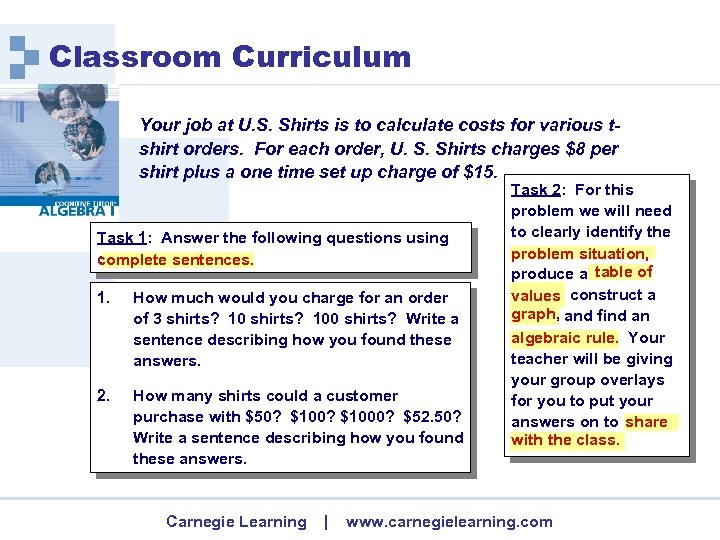
Classroom Curriculum Your job at U. S. Shirts is to calculate costs for various tshirt orders. For each order, U. S. Shirts charges $8 per shirt plus a one time set up charge of $15. Task 1: Answer the following questions using complete sentences. 1. How much would you charge for an order of 3 shirts? 100 shirts? Write a sentence describing how you found these answers. 2. How many shirts could a customer purchase with $50? $1000? $52. 50? Write a sentence describing how you found these answers. Carnegie Learning | Task 2: For this problem we will need to clearly identify the problem situation, table of produce a table of values, construct a values graph, and find an algebraic rule. Your teacher will be giving your group overlays for you to put your answers on to share with the class. www. carnegielearning. com
Bridge to Algebra Carnegie Learning | www. carnegielearning. com
Computer Curriculum Real World Problem Solving Computer Lab – 2 days per week (40%) Students discovering mathematics § Coaching by intelligent Tutor § One-on-one student-Tutor relationship § Teacher spends time with students who need it most § Carnegie Learning | www. carnegielearning. com

Computer Curriculum Carnegie Learning | www. carnegielearning. com
Five “Dos” to help students learn § § § Do make students “do the math” Do let students struggle Do use word walls Do create student work walls Do provide students with ample classroom time to do presentations of their solutions Carnegie Learning | www. carnegielearning. com
Five “Don’ts” to help students learn § § § Don’t give students answers – always answer a question with a question Don’t make assumptions about levels of difficulty or levels of ease Don’t help students “set up” problem solving tasks Don’t keep students from working together - allow students to assist each other Don’t let students give short answers - require students to write all answers in complete sentences Carnegie Learning | www. carnegielearning. com
Thank you! Kevin Judd kjudd@carnegielearning. com 1 -888 -851 -7094 x 477 Carnegie Learning | www. carnegielearning. com
Скачать презентацию Solving for x s and why s Bringing Cognitive Science
ec99f4f337ff088e9daa694f832cd946.ppt