 Скачать презентацию Solvers for Systems of Nonlinear Algebraic Equations Where
cd70427f31cf2cea3d31de5f6637bb68.ppt
- Количество слайдов: 44




Solvers for Systems of Nonlinear Algebraic Equations; Where are we TODAY? Marcin Paprzycki Oklahoma State University with Deborah Dent, Anna Kucaba-Piętal and Ludomir Laudański
Presentation Plan • Introduction • Problem description • Search for the ultimate solver • algorithms and solvers • test problems • method • small problems • large problems • Original problem revisited
Background (1) • Work originated in early 1990’s • Computer simulation of the behavior of airplanes under action of atmospheric gusts • Two possible approaches • method of harmonic (S. O. Rice) • method of filtration (N. Wiener and independently Y. A. Kchin) • Method of filtration used in original study
Background (2) • Result system of nonlinear algebraic equations • central/computational/difficult part of the problem • “independent” of other parts (well-defined and self-contained) • no preexisting knowledge about the solution • no simple way to suggest a starting vector • no simple way to reduce the “search area”
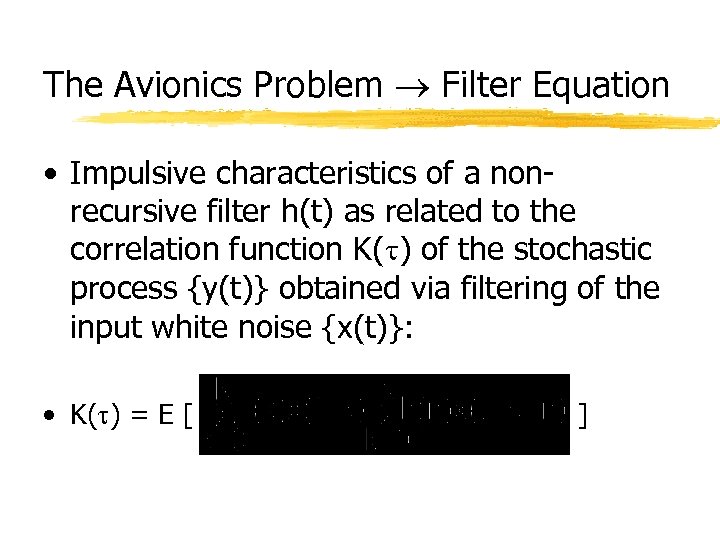
The Avionics Problem Filter Equation • Impulsive characteristics of a nonrecursive filter h(t) as related to the correlation function K( ) of the stochastic process {y(t)} obtained via filtering of the input white noise {x(t)}: • K( ) = E [ ]
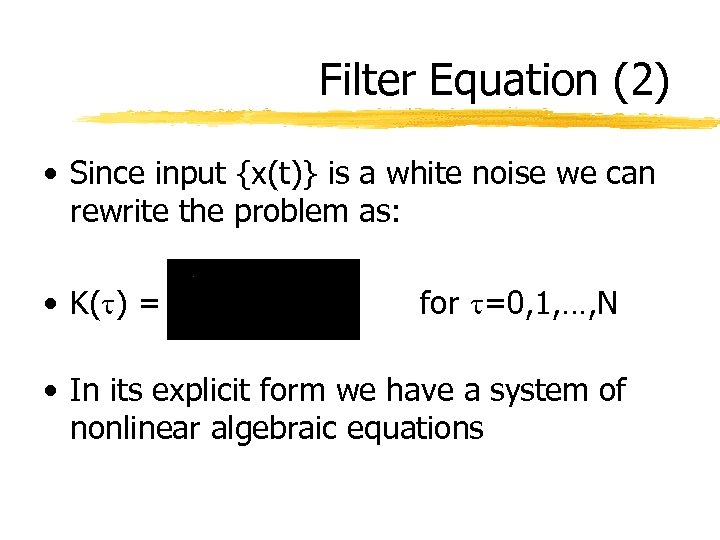
Filter Equation (2) • Since input {x(t)} is a white noise we can rewrite the problem as: • K( ) = for =0, 1, …, N • In its explicit form we have a system of nonlinear algebraic equations
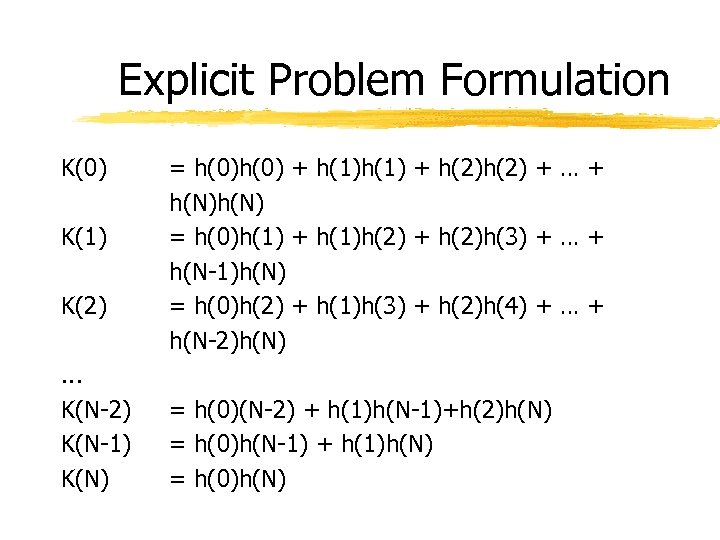
Explicit Problem Formulation K(0) K(1) K(2) . . . K(N-2) K(N-1) K(N) = h(0) + h(1) + h(2) + … + h(N) = h(0)h(1) + h(1)h(2) + h(2)h(3) + … + h(N-1)h(N) = h(0)h(2) + h(1)h(3) + h(2)h(4) + … + h(N-2)h(N) = h(0)(N-2) + h(1)h(N-1)+h(2)h(N) = h(0)h(N-1) + h(1)h(N) = h(0)h(N)
Initial Work (1) • Requirements for success (engineering-estimate) • minimum N = 512 • potentially N = 1024 (? ) • reached N = 64 using modified Powell’s Method (1994) • Encountered problems • computer hardware • for N = 64 solution time 10 minutes on a PC-486 • robustness of solution methods
Initial Work (2) • Research re-started questions: • how to solve the system for very (? ) large N? • how to select the starting vector? • Search directions • to find (an) ultimate solver(s) • use modern hardware

Back to the Basics • System of N nonlinear algebraic equations • Large number of algorithms and implemented solvers • iterative methods • How to find the best? • use existing/agreed on test problems • compare performance • NAÏVE!
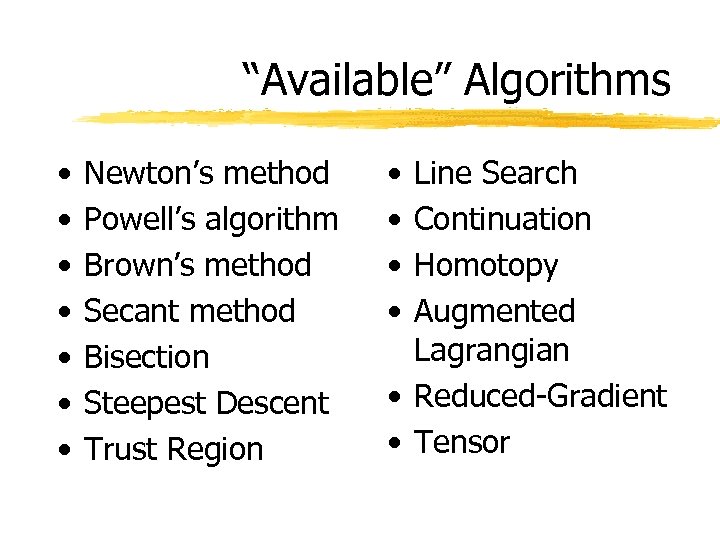
“Available” Algorithms • • Newton’s method Powell’s algorithm Brown’s method Secant method Bisection Steepest Descent Trust Region • • Line Search Continuation Homotopy Augmented Lagrangian • Reduced-Gradient • Tensor
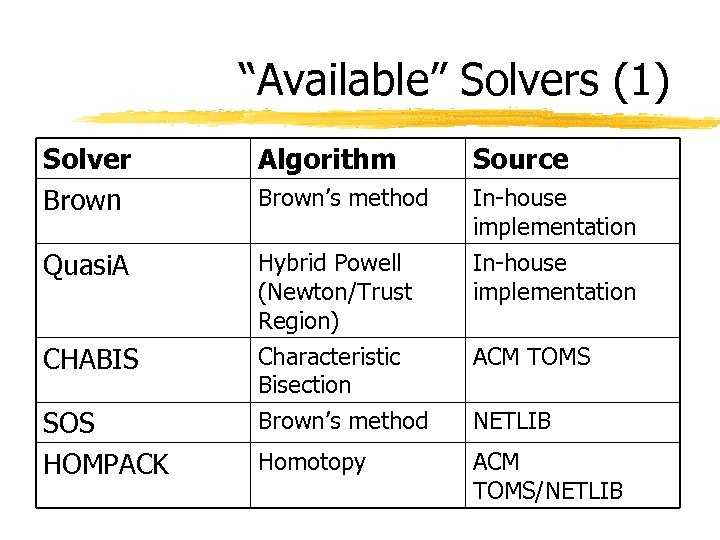
“Available” Solvers (1) Solver Brown Algorithm Source Brown’s method In-house implementation Quasi. A Hybrid Powell (Newton/Trust Region) In-house implementation CHABIS Characteristic Bisection Brown’s method ACM TOMS Homotopy ACM TOMS/NETLIB SOS HOMPACK NETLIB
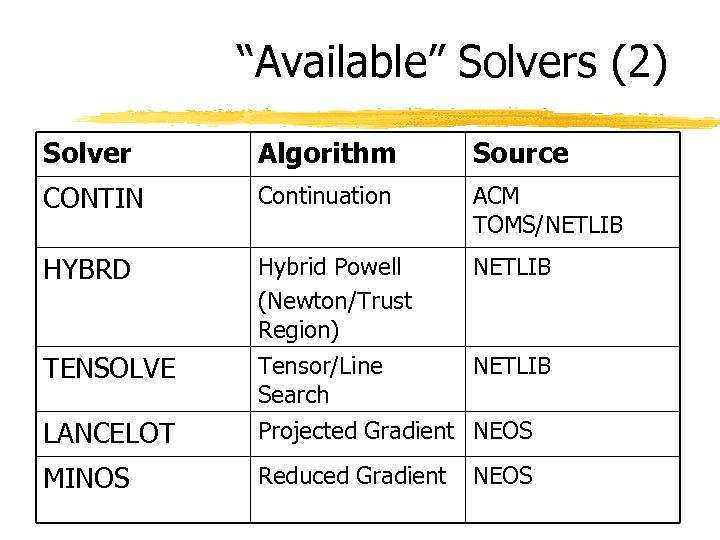
“Available” Solvers (2) Solver Algorithm Source CONTIN Continuation ACM TOMS/NETLIB HYBRD Hybrid Powell (Newton/Trust Region) NETLIB TENSOLVE LANCELOT Tensor/Line NETLIB Search Projected Gradient NEOS MINOS Reduced Gradient NEOS
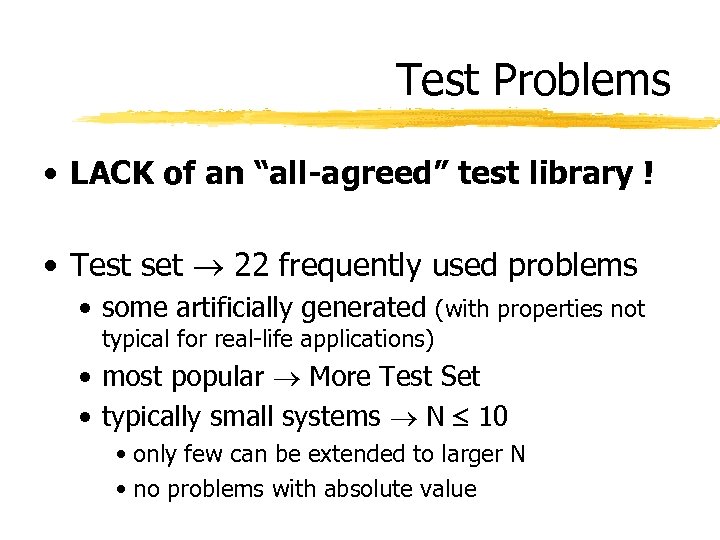
Test Problems • LACK of an “all-agreed” test library ! • Test set 22 frequently used problems • some artificially generated (with properties not typical for real-life applications) • most popular More Test Set • typically small systems N 10 • only few can be extended to larger N • no problems with absolute value
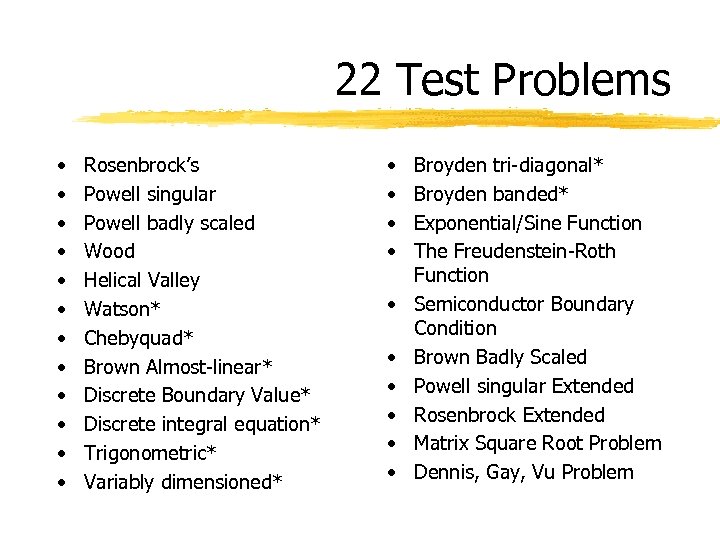
22 Test Problems • • • Rosenbrock’s Powell singular Powell badly scaled Wood Helical Valley Watson* Chebyquad* Brown Almost-linear* Discrete Boundary Value* Discrete integral equation* Trigonometric* Variably dimensioned* • • • Broyden tri-diagonal* Broyden banded* Exponential/Sine Function The Freudenstein-Roth Function Semiconductor Boundary Condition Brown Badly Scaled Powell singular Extended Rosenbrock Extended Matrix Square Root Problem Dennis, Gay, Vu Problem
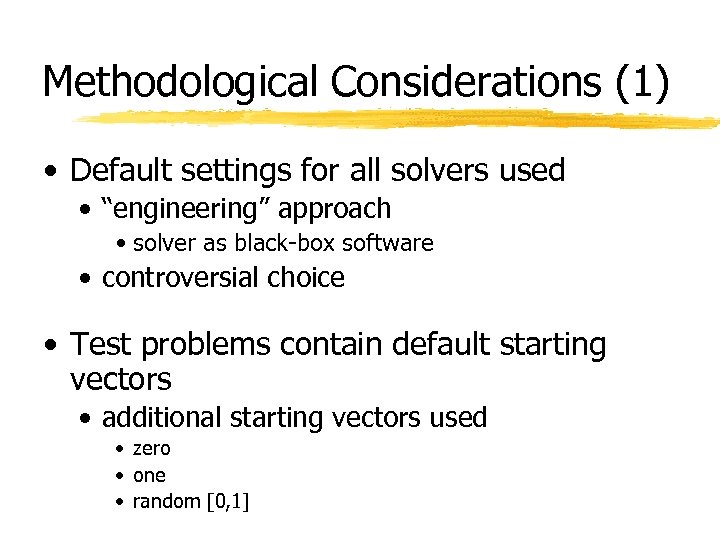
Methodological Considerations (1) • Default settings for all solvers used • “engineering” approach • solver as black-box software • controversial choice • Test problems contain default starting vectors • additional starting vectors used • zero • one • random [0, 1]
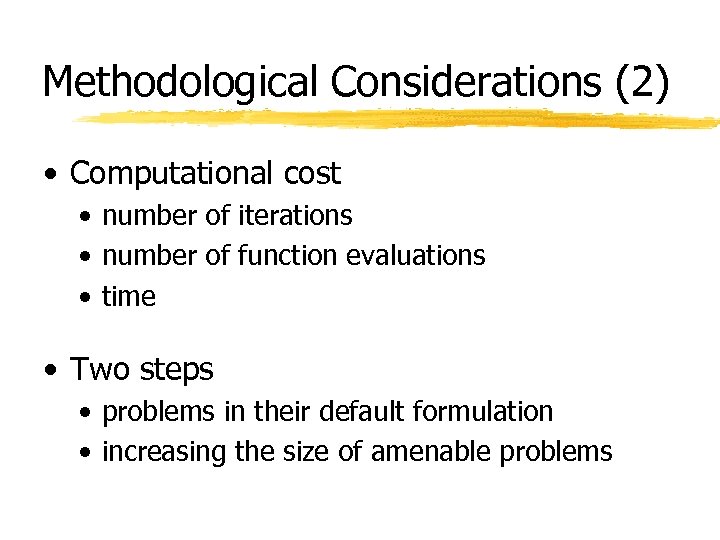
Methodological Considerations (2) • Computational cost • number of iterations • number of function evaluations • time • Two steps • problems in their default formulation • increasing the size of amenable problems
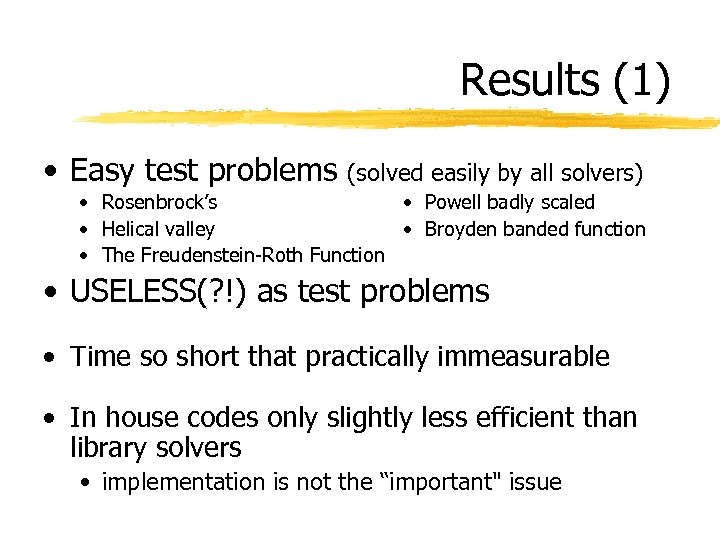
Results (1) • Easy test problems (solved easily by all solvers) • Rosenbrock’s • Powell badly scaled • Helical valley • Broyden banded function • The Freudenstein-Roth Function • USELESS(? !) as test problems • Time so short that practically immeasurable • In house codes only slightly less efficient than library solvers • implementation is not the “important" issue
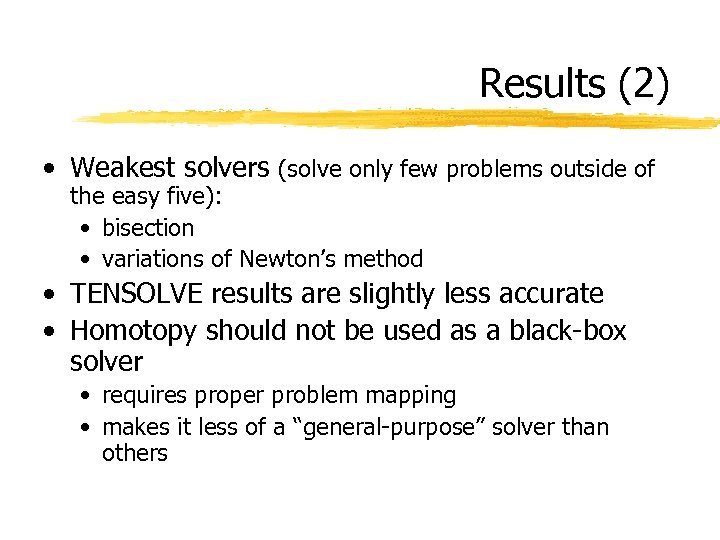
Results (2) • Weakest solvers (solve only few problems outside of the easy five): • bisection • variations of Newton’s method • TENSOLVE results are slightly less accurate • Homotopy should not be used as a black-box solver • requires proper problem mapping • makes it less of a “general-purpose” solver than others
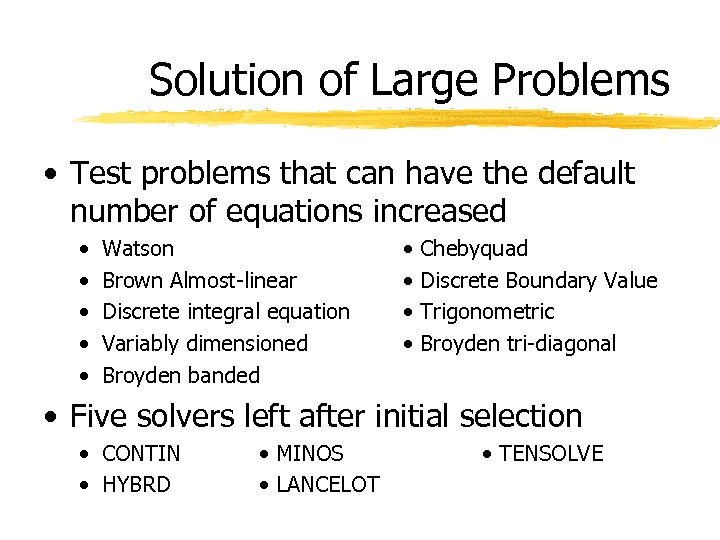
Solution of Large Problems • Test problems that can have the default number of equations increased • • • Watson Brown Almost-linear Discrete integral equation Variably dimensioned Broyden banded • Chebyquad • Discrete Boundary Value • Trigonometric • Broyden tri-diagonal • Five solvers left after initial selection • CONTIN • HYBRD • MINOS • LANCELOT • TENSOLVE
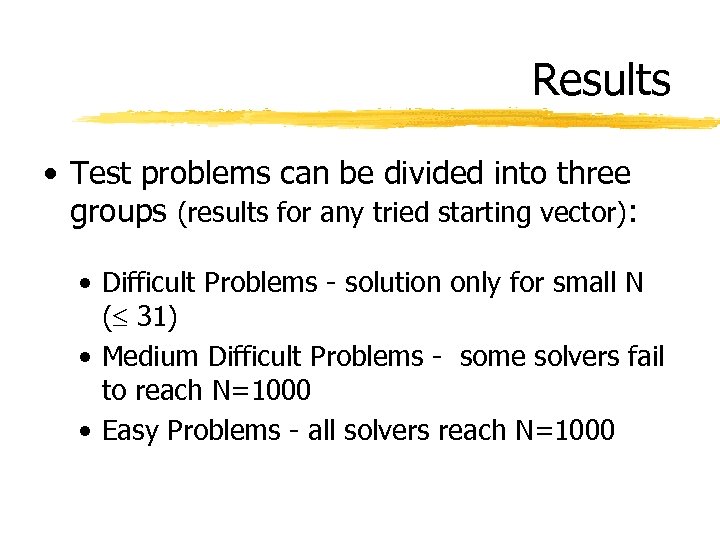
Results • Test problems can be divided into three groups (results for any tried starting vector): • Difficult Problems - solution only for small N ( 31) • Medium Difficult Problems - some solvers fail to reach N=1000 • Easy Problems - all solvers reach N=1000
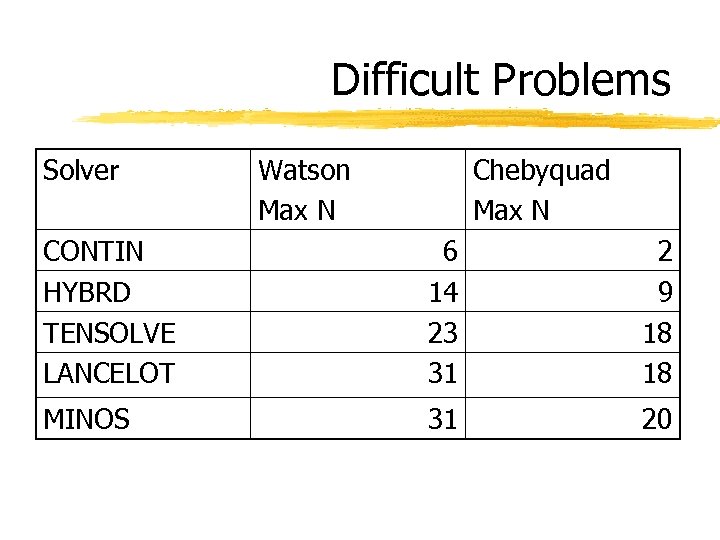
Difficult Problems Solver Watson Max N Chebyquad Max N CONTIN HYBRD TENSOLVE LANCELOT 6 14 23 31 2 9 18 18 MINOS 31 20
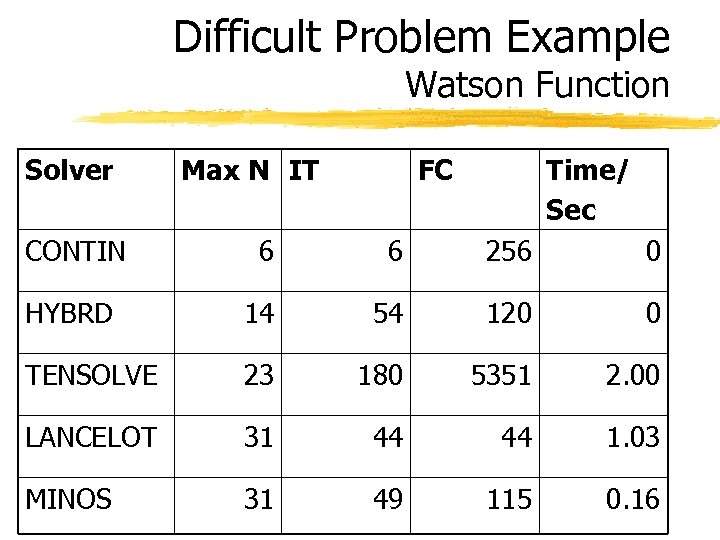
Difficult Problem Example Watson Function Solver Max N IT FC Time/ Sec CONTIN 6 6 256 0 HYBRD 14 54 120 0 TENSOLVE 23 180 5351 2. 00 LANCELOT 31 44 44 1. 03 MINOS 31 49 115 0. 16
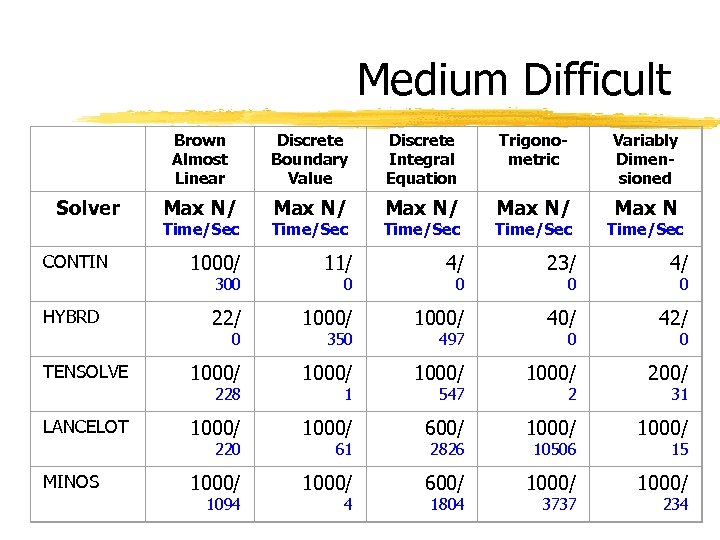
Medium Difficult Brown Almost Linear Discrete Boundary Value Discrete Integral Equation Trigonometric Variably Dimensioned Solver Max N/ Max N CONTIN Time/Sec 23/ 4/ 22/ 1000/ 40/ 42/ 1000/ 200/ 1000/ 600/ 1000/ 220 MINOS Time/Sec 4/ 228 LANCELOT Time/Sec 11/ 0 TENSOLVE Time/Sec 1000/ 300 HYBRD Time/Sec 1094 0 350 1 61 4 0 497 547 2826 1804 0 0 2 10506 3737 0 0 31 15 234
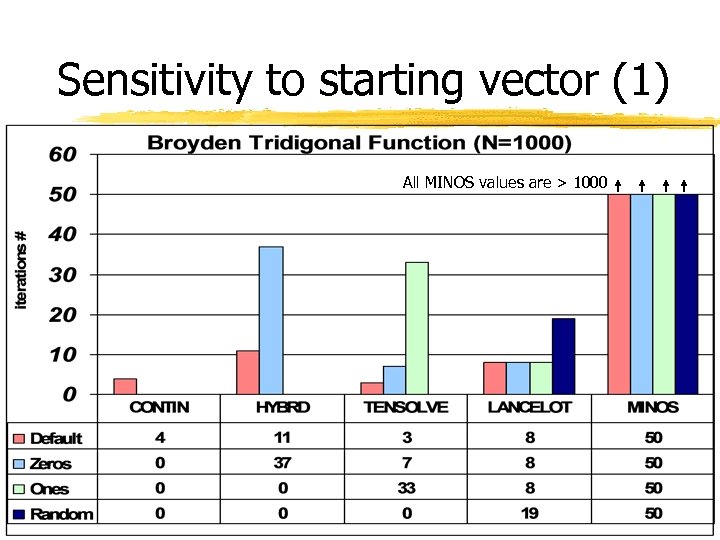
Sensitivity to starting vector (1) All MINOS values are > 1000
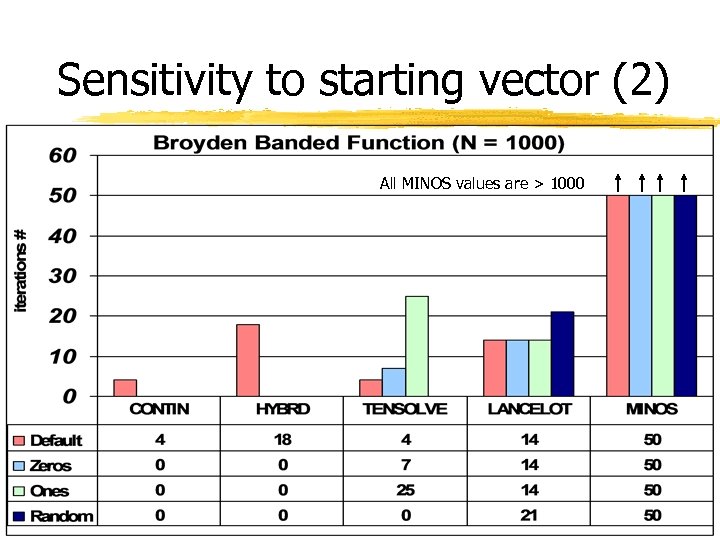
Sensitivity to starting vector (2) All MINOS values are > 1000
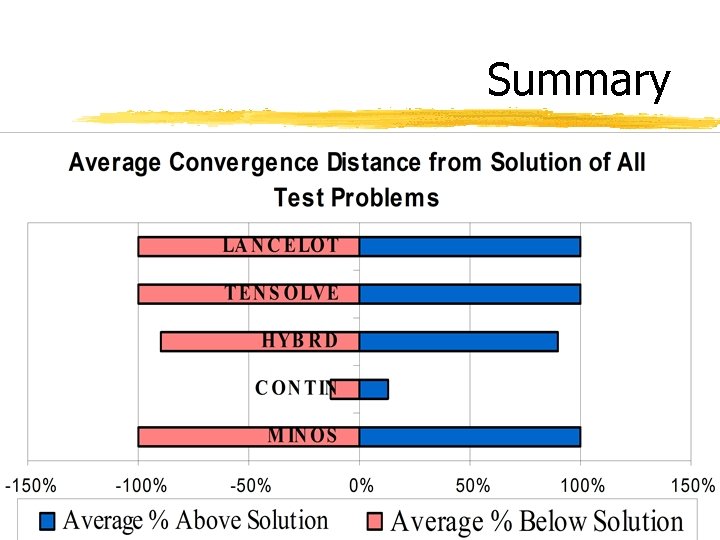
Summary
Observations (1) • Solvability of the problem depends on interaction between • problem • solver • starting vector • Problems not solvable using one solver with one starting vector may be solvable by another solver, or when a different starting vector is used
Observations (2) • How to detect true lack of solution to the problem? (A. Grievank, Rousse 2000) • Of the solvers tested, TENSOLVE, LANCELOT, and MINOS are most robust followed by HYBRD • CONTIN and HYBRD converge best with “default” • TENSOLVE converges best with “one” • LANCELOT and MINOS converges best with “zero”
Observations (3) • Six popular test problems: • Rosenbrock’s • Helical valley • The Freudenstein-Roth function • Powell badly scaled • Broyden banded function • Broyden tridiagonal are “easily solvable” by more robust solvers provide no useful information for performance measuring • Watson and Chebyquad seem to be very hard to solve can be recommended as real benchmarks for the robustness of new solvers • New test problems needed(? )
Original Problem Revisited • Four most robust solvers found earlier to be used: • • HYBRD TENSOLVE LANCELOT MINOS • Other solvers tried and similar behavior/weakness as for the test problems observed
Initial Numerical Test • Example used in original papers has solutions expressed by integers; for example • For N=2: • K(1) = 34 and K(2) = 5 • Basic solution: h(1) = 5 and h(2) = 3 • For N=4: • K(1)=30, K(2) = 20, K(3) = 11, and K(4)=4 • Basic solution: h(1)=1, h(2)=2, h(3)=3, h(4)=4 • alternate solution(!) • h(1)≈1. 65, h(3≈1. 58, h(3) ≈4. 35, h(4) ≈2. 24
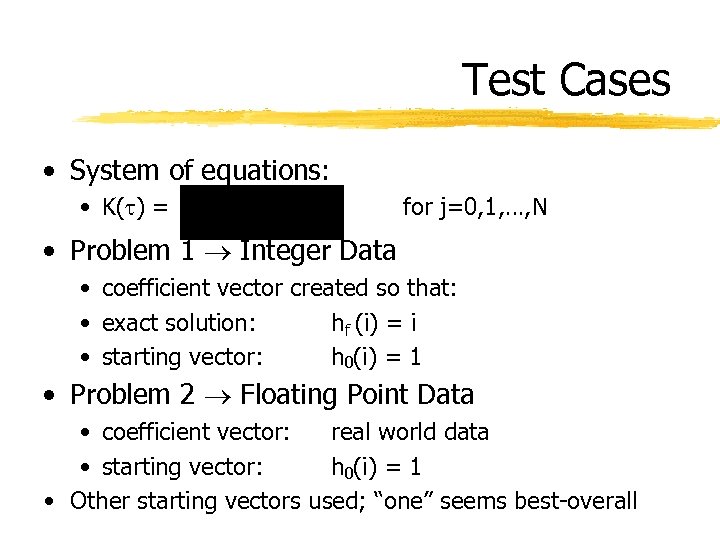
Test Cases • System of equations: • K( ) = for j=0, 1, …, N • Problem 1 Integer Data • coefficient vector created so that: • exact solution: hf (i) = i • starting vector: h 0(i) = 1 • Problem 2 Floating Point Data • coefficient vector: real world data • starting vector: h 0(i) = 1 • Other starting vectors used; “one” seems best-overall
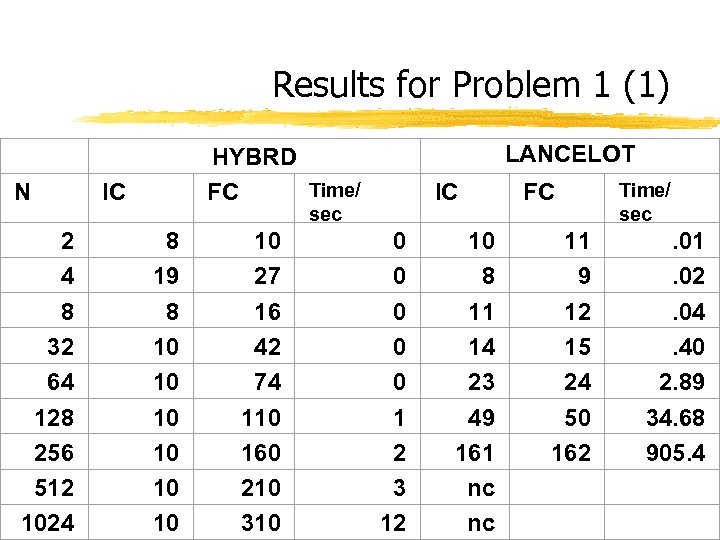
Results for Problem 1 (1) N 2 4 8 32 64 128 256 512 1024 LANCELOT HYBRD Time/ FC IC IC sec 8 19 8 10 10 27 16 42 74 110 160 210 310 0 0 1 2 3 12 10 8 11 14 23 49 161 nc nc FC 11 9 12 15 24 50 162 Time/ sec . 01. 02. 04. 40 2. 89 34. 68 905. 4
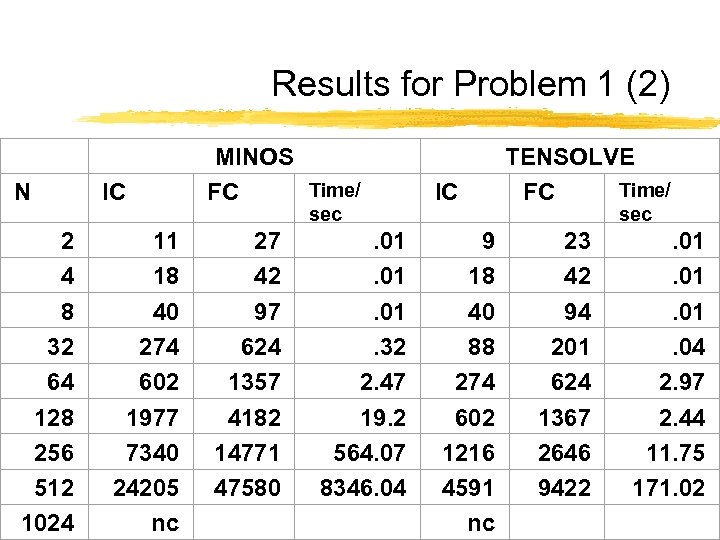
Results for Problem 1 (2) N 2 4 8 32 64 128 256 512 1024 IC 11 18 40 274 602 1977 7340 24205 nc MINOS Time/ FC IC 27 42 97 624 1357 4182 14771 47580 9 18 40 88 274 602 1216 4591 nc sec . 01. 01. 32 2. 47 19. 2 564. 07 8346. 04 TENSOLVE Time/ FC sec 23 42 94 201 624 1367 2646 9422 . 01. 01. 04 2. 97 2. 44 11. 75 171. 02
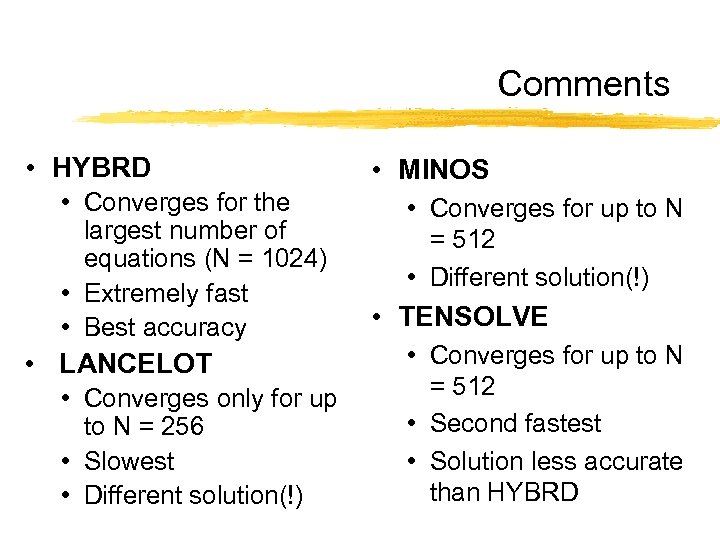
Comments • HYBRD • Converges for the largest number of equations (N = 1024) • Extremely fast • Best accuracy • LANCELOT • Converges only for up to N = 256 • Slowest • Different solution(!) • MINOS • Converges for up to N = 512 • Different solution(!) • TENSOLVE • Converges for up to N = 512 • Second fastest • Solution less accurate than HYBRD
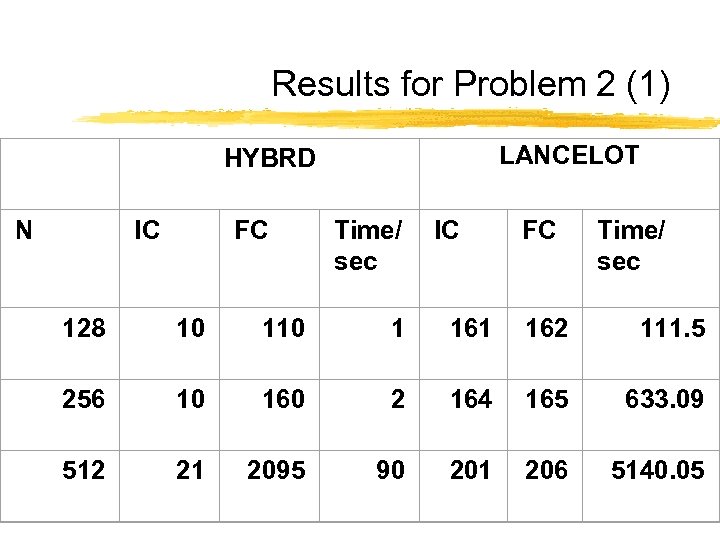
Results for Problem 2 (1) N LANCELOT HYBRD IC FC Time/ sec 128 10 1 161 162 111. 5 256 10 160 2 164 165 633. 09 512 21 2095 90 201 206 5140. 05
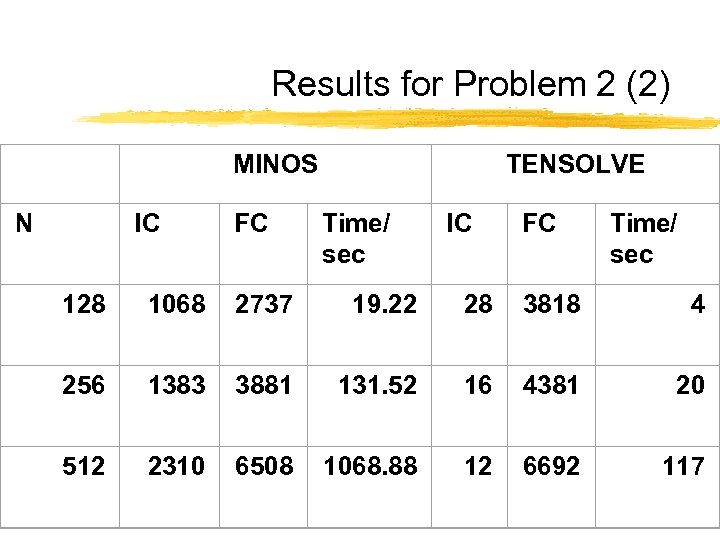
Results for Problem 2 (2) MINOS N IC FC TENSOLVE Time/ sec IC FC Time/ sec 128 1068 2737 19. 22 28 3818 4 256 1383 3881 131. 52 16 4381 20 512 2310 6508 1068. 88 12 6692 117
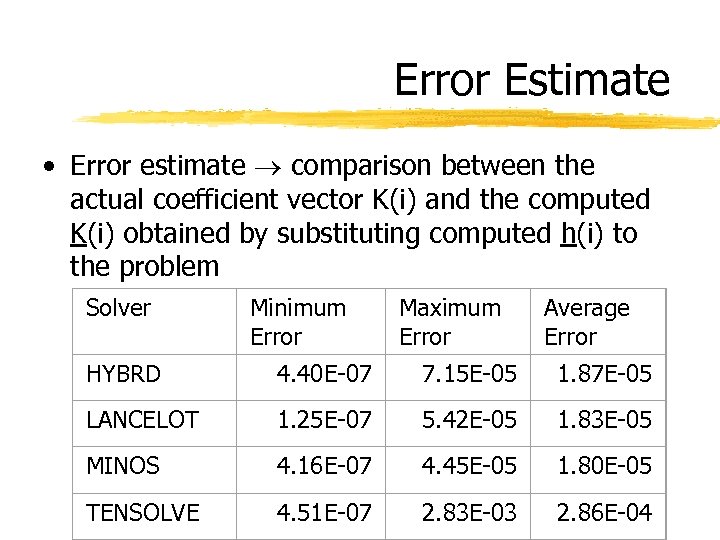
Error Estimate • Error estimate comparison between the actual coefficient vector K(i) and the computed K(i) obtained by substituting computed h(i) to the problem Solver Minimum Error Maximum Error Average Error HYBRD 4. 40 E-07 7. 15 E-05 1. 87 E-05 LANCELOT 1. 25 E-07 5. 42 E-05 1. 83 E-05 MINOS 4. 16 E-07 4. 45 E-05 1. 80 E-05 TENSOLVE 4. 51 E-07 2. 83 E-03 2. 86 E-04
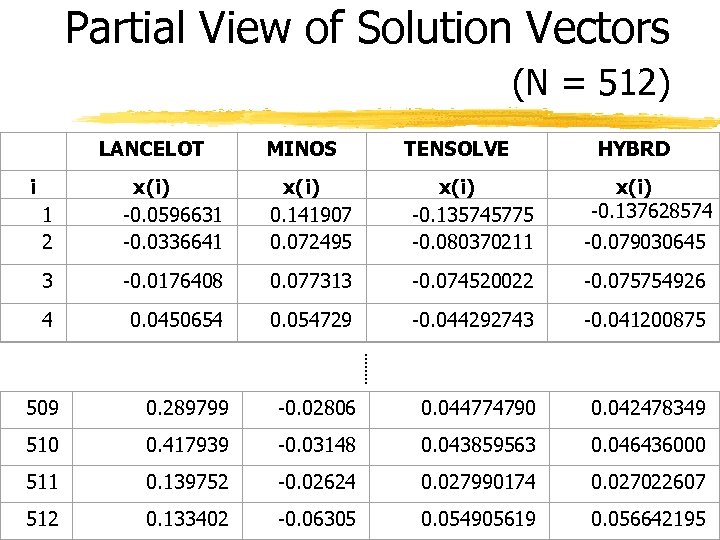
Partial View of Solution Vectors (N = 512) LANCELOT MINOS TENSOLVE 1 2 x(i) -0. 0596631 -0. 0336641 x(i) 0. 141907 0. 072495 x(i) -0. 135745775 -0. 080370211 -0. 079030645 3 -0. 0176408 0. 077313 -0. 074520022 -0. 075754926 4 0. 0450654 0. 054729 -0. 044292743 -0. 041200875 509 0. 289799 -0. 02806 0. 044774790 0. 042478349 510 0. 417939 -0. 03148 0. 043859563 0. 046436000 511 0. 139752 -0. 02624 0. 027990174 0. 027022607 512 0. 133402 -0. 06305 0. 054905619 0. 056642195 i HYBRD x(i) -0. 137628574
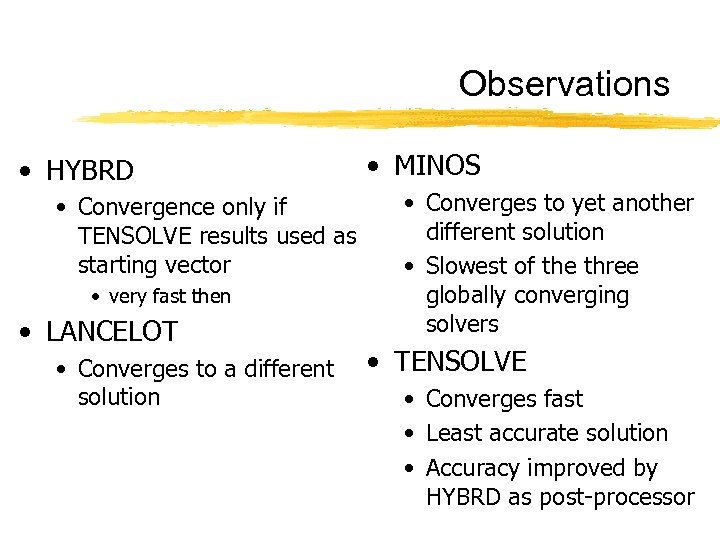
Observations • HYBRD • Convergence only if TENSOLVE results used as starting vector • very fast then • LANCELOT • Converges to a different solution • MINOS • Converges to yet another different solution • Slowest of the three globally converging solvers • TENSOLVE • Converges fast • Least accurate solution • Accuracy improved by HYBRD as post-processor
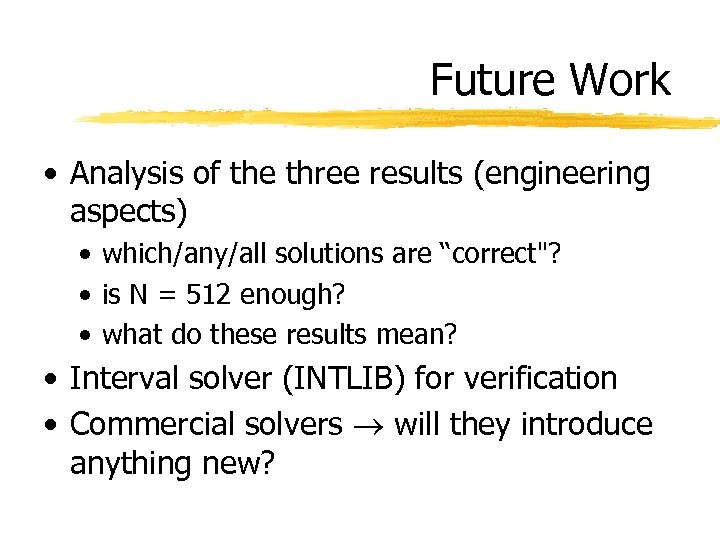
Future Work • Analysis of the three results (engineering aspects) • which/any/all solutions are “correct"? • is N = 512 enough? • what do these results mean? • Interval solver (INTLIB) for verification • Commercial solvers will they introduce anything new?
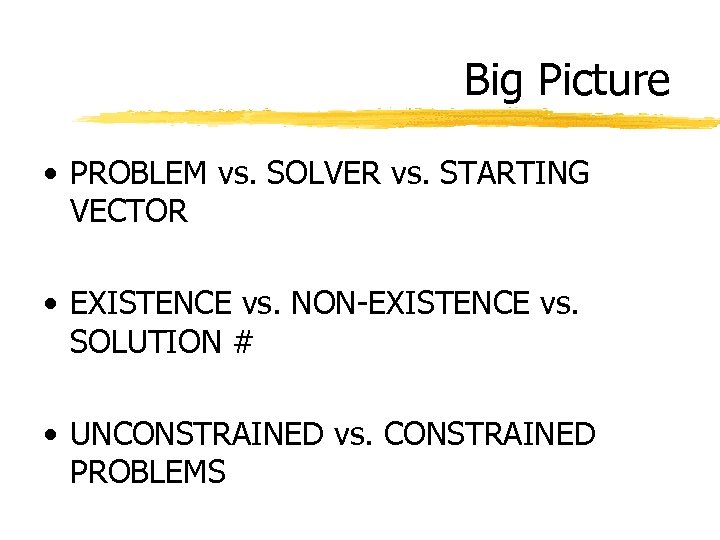
Big Picture • PROBLEM vs. SOLVER vs. STARTING VECTOR • EXISTENCE vs. NON-EXISTENCE vs. SOLUTION # • UNCONSTRAINED vs. CONSTRAINED PROBLEMS

THANK YOU! QUESTIONS?
Скачать презентацию Solvers for Systems of Nonlinear Algebraic Equations Where
cd70427f31cf2cea3d31de5f6637bb68.ppt