 Скачать презентацию Solutions for Multilingual Literature by XSL Formatter 6
35cd125bb914b8854755f13956c57417.ppt
- Количество слайдов: 20



Solutions for Multilingual Literature by XSL Formatter 6, 800 known languages
Agenda The Problem! l Example of multilingual formatting l Some of the issues/complexities l Considerations in putting together a solution l
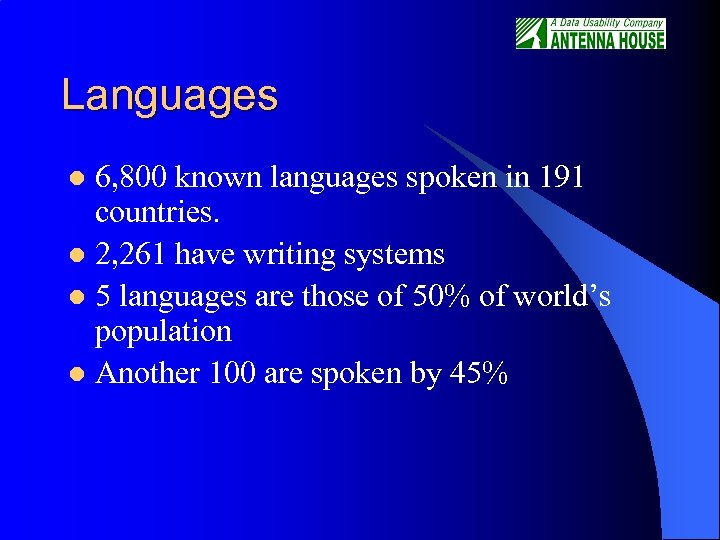
Languages 6, 800 known languages spoken in 191 countries. l 2, 261 have writing systems l 5 languages are those of 50% of world’s population l Another 100 are spoken by 45% l
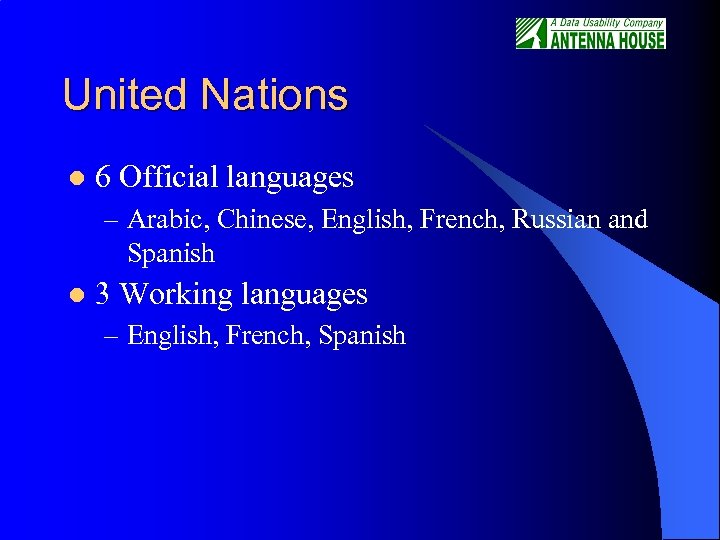
United Nations l 6 Official languages – Arabic, Chinese, English, French, Russian and Spanish l 3 Working languages – English, French, Spanish
EU Languages l 11 Official Languages – Spanish (11%), Danish (1%), German (24%), Greek (3%), English (16%), French (16%), Italian (16%), Dutch (6%), Portuguese (3%), Finnish (1%), Swedish (2%)
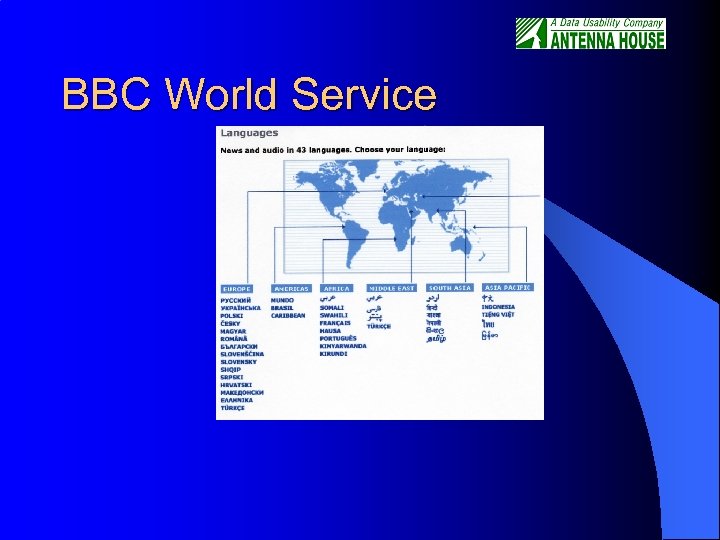
BBC World Service
Why worry? “THE WEB!” l Global economy and the web has greatly simplified doing business internationally which has lead to the need to produce instructions, operation, maintenance and service documentation in multiple languages. l Look around the hotel! l Look at the attendees! l
Why worry? (continued) You can’t always deal in just one language. l Delays can lead to shorter time to sell l Delays in delivery l There is a need today to have parallel processing of documentation in all languages l
Antenna House Has sold Formatter in over 20 different countries. l This week I’ve communicated with people in 12 countries. (6 different languages and 5 forms of English) l
Example of multilingual Antenna House’s XSL Formatter l BIDI (bi-directional) l Vertical l English, Japanese, Hebrew, Arabic, Thai, Traditional Chinese, Simplified Chinese, and Korean (8 different writing systems) l
Problems and Challenges l How to create source – What character encoding? The first criteria is that computers have to be able to handle the character encoding. l 80 s and 90 s this was a serious limitation. l Unicode overcomes this limitation. l – V 3. 2 handles over 300 languages. Unicode provides writing direction, line breaking properties and other specifications.
(cont. ) What operating system? l Fonts l – Without fonts characters can neither be printed or displayed. – Consideration includes source, quality, copyrights, can they be imbedded in output?
XML and XSL make it possible to solve the problem of multilingual publishing.
XML has adopted Unicode encoding schema. l Being able to have external files linked to a main file enables storing the text portion of different languages into separate files. l
XSL – designed for global languages Offers means to specify writing direction l Typesetting rules for each language can be specified using object and properties in XSL. l
Issues l Glyph Substitution – Change depending on whether you are writing horizontally or vertically – Arabic change depending on whether it is beginning, middle or end of word l Punctuation – Japanese, complicated rules governed by where punctuation is in a line
Line Breaks Dependent on language l Multilingual must implement by language l – Kinsoku characters in Japanese, cannot begin or end a line – Japanese and Chinese break between any character – Thai breaks between word, but no word space
Line Breaks (cont. ) English and other European languages can be hyphenated, but rules of hyphenation vary by languages. l Variants of the same language can have different rules. l With some languages when a word is hyphenated the spelling changes, when unhypenated the spelling reverts. l
Summary Multilingual publishing is here. l “Typesetting rules for each language can be specified using object and properties in XSL. ” l
Where to Get More Information l www. antennahouse. com
Скачать презентацию Solutions for Multilingual Literature by XSL Formatter 6
35cd125bb914b8854755f13956c57417.ppt