 Скачать презентацию Solar Flares of 28 October 2003 and 20
c8b2391bba87b441ae6e142e0f74930a.ppt
- Количество слайдов: 30



Solar Flares of 28 October 2003 and 20 January 2005: Some Implications of Gamma-Ray Data © 2009 Leonty Miroshnichenko (IZMIRAN) N. V. Pushkov Institute of Terrestrial Magnetism, Ionosphere and Radio Wave Propagation (IZMIRAN), Russian Academy of Sciences (RAS) 9 th RHESSI Workshop, September 1 -5, 2009, Genoa, Italy
Dedication… • "150 Años de la Observación de una Ráfaga Solar por Richard Carrington“: • 1 September 1859
Solar Neutrons and Gamma Rays • Physical implications of solar gammaray and neutron data: • Neutron capture line; • EDE - Effect of Density Enhancement under the flare site; • 3 He/1 H ratio in the Sun’s photosphere
On behalf of the team: • E. V. Troitskaia, I. V. Arkhangelskaja, L. I. Miroshnichenko, and A. I. Arkhangelsky: 2009. Study of the 28 October 2003 and 20 January 2005 solar flares by means of 2. 223 Me. V gamma-emission line. - Adv. Space Res. , v. 43, No. 4, p. 547 -552. • I. V. Arkhangelskaja, A. I. Arkhangelsky, E. V. Troitskaya, L. I. Miroshnichenko: 2009. The investigation of powerful solar flare characteristics by analysis of excited states of 12 C and various neutron capture lines. - Adv. Space Res. , v. 43, No. 4, p. 594 -599.
Part I: Neutron capture line with CORONAS-F and INTEGRAL: • Effect of Density Enhancement under the flare site
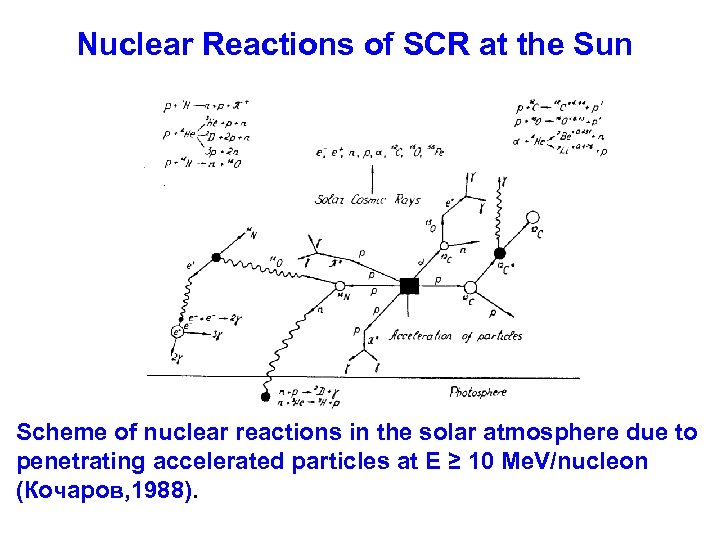
Nuclear Reactions of SCR at the Sun Scheme of nuclear reactions in the solar atmosphere due to penetrating accelerated particles at E ≥ 10 Мe. V/nucleon (Кочаров, 1988).
Flare Neutrons and He-3 • • • In cosmology it is considered that primary stable isotope of 3 He has been produced in the process of nuclear synthesis at the early stage of the Universe evolution, and its abundance imposes some certain restrictions on the cosmological models. It is impossible to determine the abundance of 3 He at the Sun spectroscopically, so of exceptional importance are indirect estimates of the ratio 3 He/1 Н, e. g. , by the data on the flare gamma-line of 2. 223 Me. V (neutron capture line). Flare neutrons are captured in the photosphere by hydrogen nuclei (1 Н). As a result, there are produced a deuterium 2 H (stable isotope of hydrogen) and gamma-quantum of 2. 223 Me. V (this radiation is called sometimes as deuterium line): • • • 1 H + n → 2 H + γ (2. 223 Мe. V) (1) Neutrons are also captured by 3 He nuclei, with a subsequent production of tritium 3 H (radioactive isotope of hydrogen): • 3 He + n → 1 H + 3 H (2)
He-3 and line of 2. 223 Me. V • In the reaction (2) the neutrons are captured without production of gamma-emission (radiationless capture). In turn, the resulting tritium undergoes to β-decay with a half-life time of 4500± 8 days (12. 32 years), and then the 3 He nuclei are produced again and so on. As a result, a number on neutrons that take part in the generation of 2. 223 Me. V line in the photosphere, as well as a flux density of this emission are strongly dependent of the number density of 3 He nuclei in the solar atmosphere. • In fact, cross-sections of the reactions (1) and (2) are equal, respectively, to 2. 2 10^(-30)/β см^2 and 3. 7 10^(-26)/β см^2, where β is a neutron velocity in the units of light speed. Thus, if the ratio 3 He/1 H in the region of capture is ~ 5× 10^(-5) (this is comparable with observed one in the solar wind), then the numbers of neutrons captured on 1 H and 3 He nuclei become comparable between them. • Moreover, the 3 He/1 H ratio affects not only final flux density of the 2. 223 Me. V line, but also a delay in the formation of its time profile. In turn, these peculiarities allow to estimate the 3 He/1 H ratio for a given flare (Table 1). • Neutron captures by other nuclei are not very important because of their small number densities in the solar atmosphere.
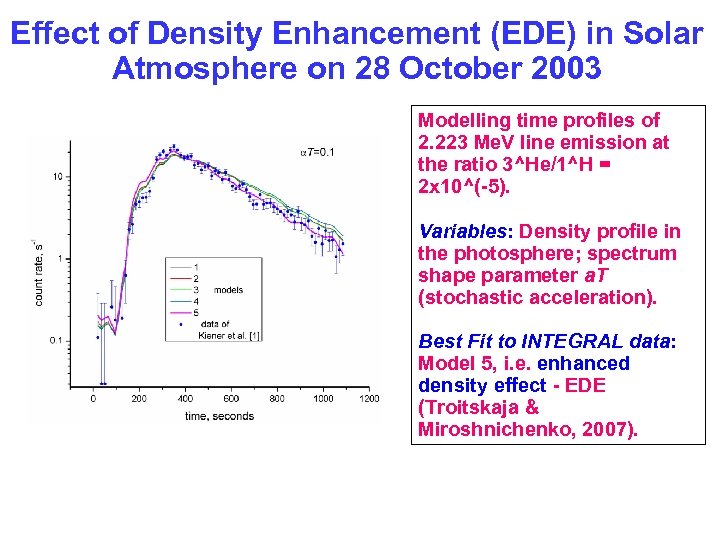
Effect of Density Enhancement (EDE) in Solar Atmosphere on 28 October 2003 Modelling time profiles of 2. 223 Me. V line emission at the ratio 3^He/1^H = 2 x 10^(-5). Variables: Density profile in the photosphere; spectrum shape parameter a. T (stochastic acceleration). Best Fit to INTEGRAL data: Model 5, i. e. enhanced density effect - EDE (Troitskaja & Miroshnichenko, 2007).
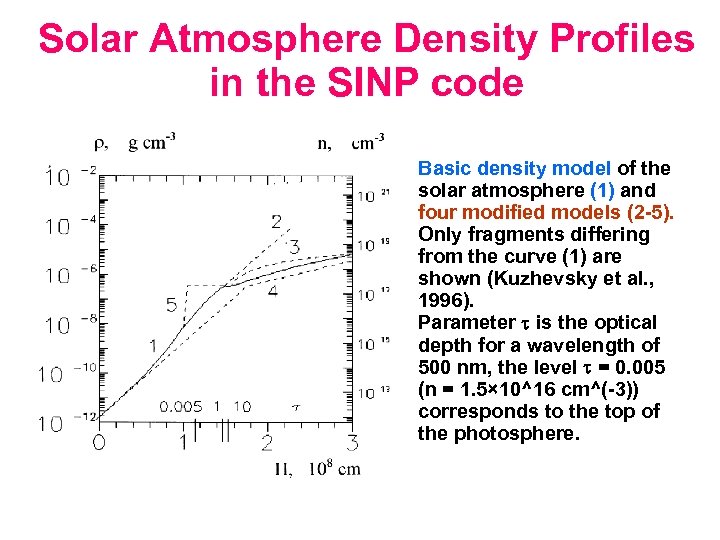
Solar Atmosphere Density Profiles in the SINP code Basic density model of the solar atmosphere (1) and four modified models (2 -5). Only fragments differing from the curve (1) are shown (Kuzhevsky et al. , 1996). Parameter is the optical depth for a wavelength of 500 nm, the level = 0. 005 (n = 1. 5× 10^16 cm^(-3)) corresponds to the top of the photosphere.
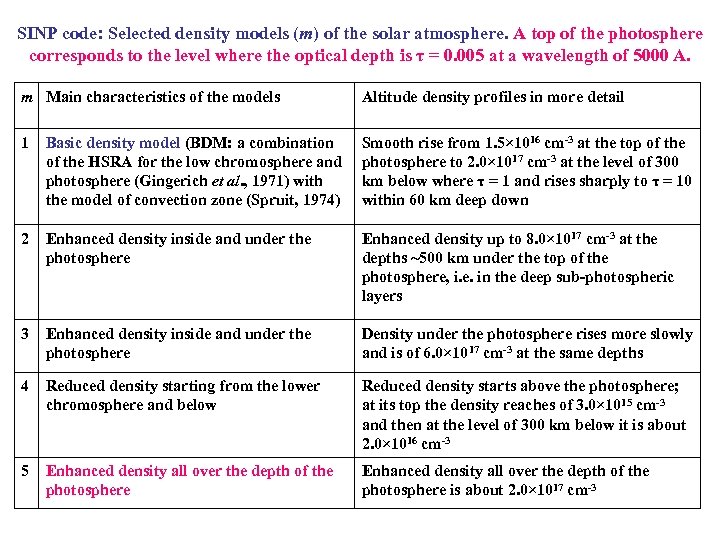
SINP code: Selected density models (m) of the solar atmosphere. A top of the photosphere corresponds to the level where the optical depth is τ = 0. 005 at a wavelength of 5000 A. m Main characteristics of the models Altitude density profiles in more detail 1 Basic density model (BDM: a combination of the HSRA for the low chromosphere and photosphere (Gingerich et al. , 1971) with the model of convection zone (Spruit, 1974) Smooth rise from 1. 5× 1016 cm-3 at the top of the photosphere to 2. 0× 1017 cm-3 at the level of 300 km below where τ = 1 and rises sharply to τ = 10 within 60 km deep down 2 Enhanced density inside and under the photosphere Enhanced density up to 8. 0× 1017 cm-3 at the depths ~500 km under the top of the photosphere, i. e. in the deep sub-photospheric layers 3 Enhanced density inside and under the photosphere Density under the photosphere rises more slowly and is of 6. 0× 1017 cm-3 at the same depths 4 Reduced density starting from the lower chromosphere and below Reduced density starts above the photosphere; at its top the density reaches of 3. 0× 1015 cm-3 and then at the level of 300 km below it is about 2. 0× 1016 cm-3 5 Enhanced density all over the depth of the photosphere is about 2. 0× 1017 cm-3
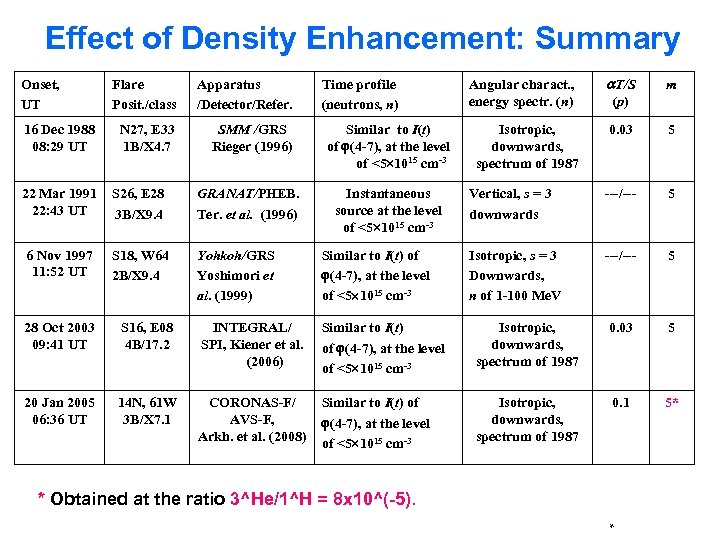
Effect of Density Enhancement: Summary Onset, UT 16 Dec 1988 08: 29 UT Flare Posit. /class Apparatus /Detector/Refer. Time profile (neutrons, n) N 27, E 33 1 B/X 4. 7 SMM /GRS Rieger (1996) Similar to I(t) of (4 -7), at the level of <5 1015 cm-3 Instantaneous source at the level of <5 1015 cm-3 22 Mar 1991 22: 43 UT S 26, E 28 3 B/X 9. 4 GRANAT/PHEB. Ter. et al. (1996) 6 Nov 1997 11: 52 UT S 18, W 64 2 B/X 9. 4 Yohkoh/GRS Yoshimori et al. (1999) Similar to I(t) of (4 -7), at the level of <5 1015 cm-3 Angular charact. , energy spectr. (n) Т/S Isotropic, downwards, spectrum of 1987 0. 03 5 Vertical, s = 3 downwards ---/--- 5 Isotropic, s = 3 Downwards, n of 1 -100 Me. V ---/--- 5 m (p) 28 Oct 2003 09: 41 UT S 16, E 08 4 B/17. 2 INTEGRAL/ SPI, Kiener et al. (2006) Similar to I(t) of (4 -7), at the level of <5 1015 cm-3 Isotropic, downwards, spectrum of 1987 0. 03 5 20 Jan 2005 06: 36 UT 14 N, 61 W 3 B/X 7. 1 CORONAS-F/ AVS-F, Arkh. et al. (2008) Similar to I(t) of (4 -7), at the level of <5 1015 cm-3 Isotropic, downwards, spectrum of 1987 0. 1 5* * Obtained at the ratio 3^He/1^H = 8 x 10^(-5). *
Part II: Estimates of He-3 Abundance in the Photosphere • Flare of 20 January 2005: • Enhancement of He-3 abundance in the photosphere?
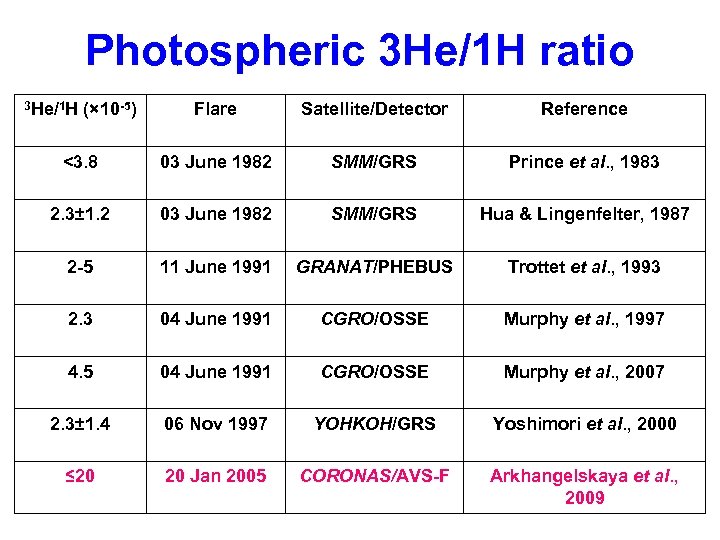
Photospheric 3 He/1 H ratio 3 He/1 H (× 10 -5) Flare Satellite/Detector Reference <3. 8 03 June 1982 SMM/GRS Prince et al. , 1983 2. 3± 1. 2 03 June 1982 SMM/GRS Hua & Lingenfelter, 1987 2 -5 11 June 1991 GRANAT/PHEBUS Trottet et al. , 1993 2. 3 04 June 1991 CGRO/OSSE Murphy et al. , 1997 4. 5 04 June 1991 CGRO/OSSE Murphy et al. , 2007 2. 3± 1. 4 06 Nov 1997 YOHKOH/GRS Yoshimori et al. , 2000 ≤ 20 20 Jan 2005 CORONAS/AVS-F Arkhangelskaya et al. , 2009
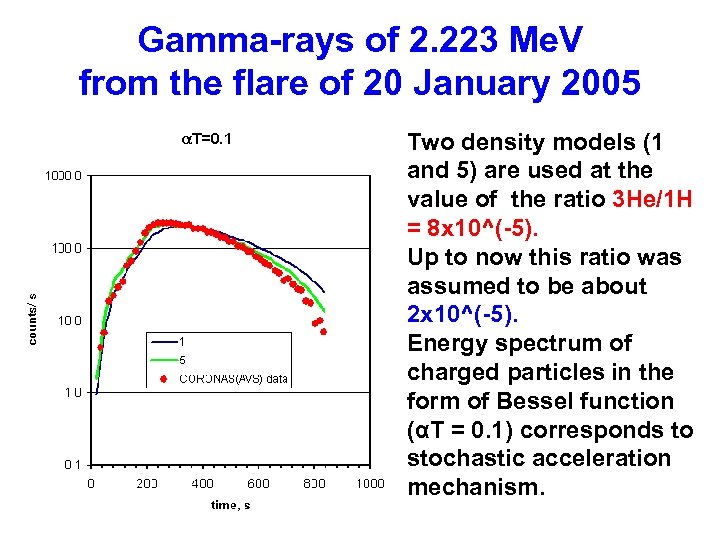
Gamma-rays of 2. 223 Me. V from the flare of 20 January 2005 Two density models (1 and 5) are used at the value of the ratio 3 He/1 H = 8 x 10^(-5). Up to now this ratio was assumed to be about 2 x 10^(-5). Energy spectrum of charged particles in the form of Bessel function (αT = 0. 1) corresponds to stochastic acceleration mechanism.
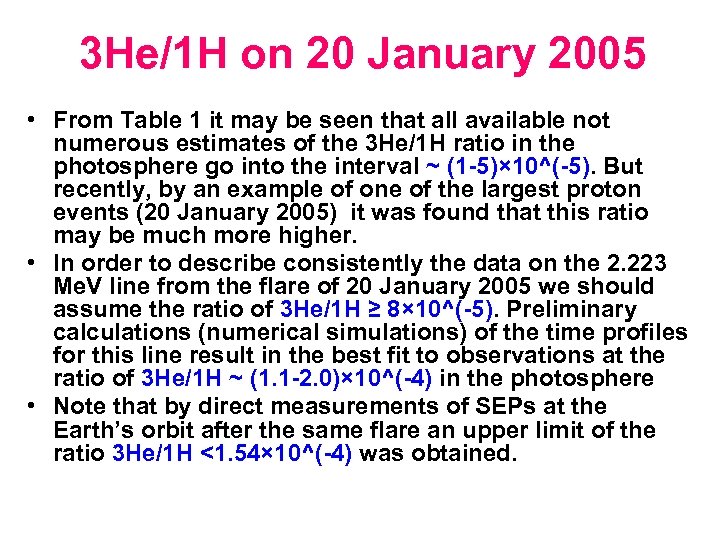
3 He/1 H on 20 January 2005 • From Table 1 it may be seen that all available not numerous estimates of the 3 He/1 H ratio in the photosphere go into the interval ~ (1 -5)× 10^(-5). But recently, by an example of one of the largest proton events (20 January 2005) it was found that this ratio may be much more higher. • In order to describe consistently the data on the 2. 223 Me. V line from the flare of 20 January 2005 we should assume the ratio of 3 He/1 H ≥ 8× 10^(-5). Preliminary calculations (numerical simulations) of the time profiles for this line result in the best fit to observations at the ratio of 3 He/1 H ~ (1. 1 -2. 0)× 10^(-4) in the photosphere • Note that by direct measurements of SEPs at the Earth’s orbit after the same flare an upper limit of the ratio 3 He/1 H <1. 54× 10^(-4) was obtained.
3 He/1 H Ratio: Theory and Observations 1. The observed enhancements of the 3^He/4^He ratio from the normal coronal value of 5 x 10^(-4) to 0. 1 -10 may be due to resonant acceleration of He-3 ions by electromagnetic ion-cyclotron waves (Fisk, 1978; Temerin & Roth; Litvinenko, 1996). 2. There also the other facts indicative of enhanced abundance of 3 He in the flare of 20 January 2005: CORONAS-F (AVS) measurements, data on gamma emission in the range of 15 -21 Me. V, neutron capture line on 3 He nuclei at 20. 58 Me. V.
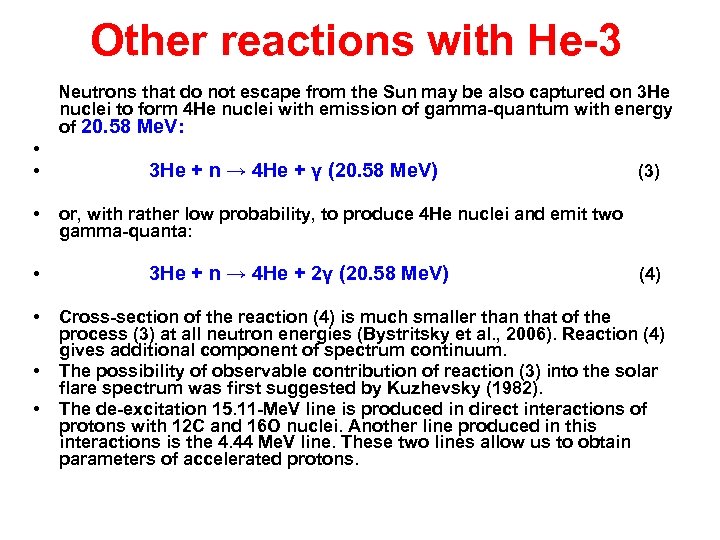
Other reactions with He-3 Neutrons that do not escape from the Sun may be also captured on 3 He nuclei to form 4 He nuclei with emission of gamma-quantum with energy of 20. 58 Мe. V: • 3 He + n → 4 He + γ (20. 58 Мe. V) (3) • or, with rather low probability, to produce 4 He nuclei and emit two gamma-quanta: • 3 He + n → 4 He + 2γ (20. 58 Мe. V) (4) • Cross-section of the reaction (4) is much smaller than that of the process (3) at all neutron energies (Bystritsky et al. , 2006). Reaction (4) gives additional component of spectrum continuum. The possibility of observable contribution of reaction (3) into the solar flare spectrum was first suggested by Kuzhevsky (1982). The de-excitation 15. 11 -Me. V line is produced in direct interactions of protons with 12 C and 16 O nuclei. Another line produced in this interactions is the 4. 44 Me. V line. These two lines allow us to obtain parameters of accelerated protons. • •
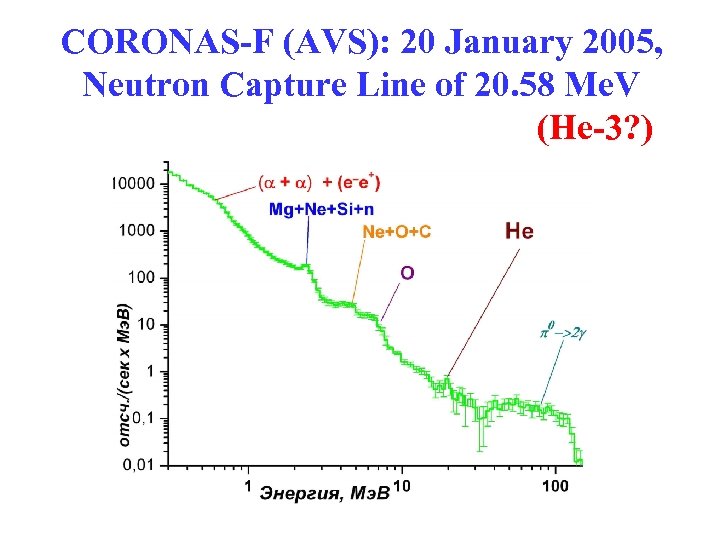
CORONAS-F (AVS): 20 January 2005, Neutron Capture Line of 20. 58 Me. V (He-3? )
EDE and He-3 at the Sun • These findings may have important implications on the understanding of solar atmospheric dynamics, solar flare and solar wind particle acceleration and Galactic chemical evolution. • Cosmological aspect of He-3 studies.
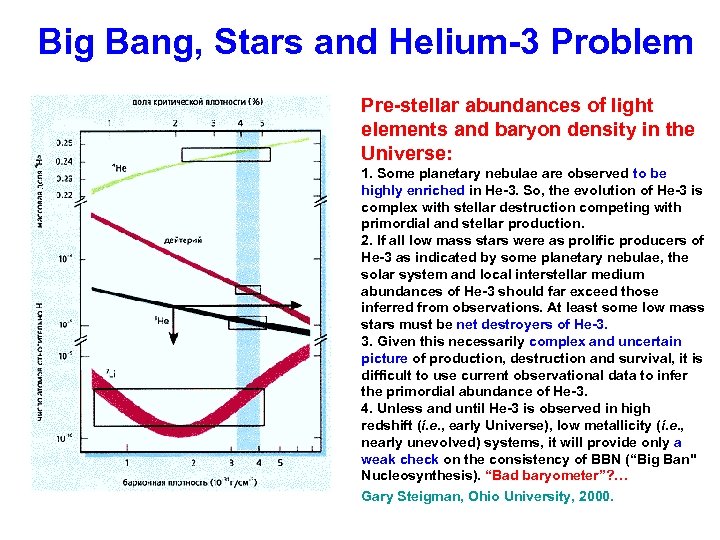
Big Bang, Stars and Helium-3 Problem Pre-stellar abundances of light elements and baryon density in the Universe: 1. Some planetary nebulae are observed to be highly enriched in He-3. So, the evolution of He-3 is complex with stellar destruction competing with primordial and stellar production. 2. If all low mass stars were as prolific producers of He-3 as indicated by some planetary nebulae, the solar system and local interstellar medium abundances of He-3 should far exceed those inferred from observations. At least some low mass stars must be net destroyers of He-3. 3. Given this necessarily complex and uncertain picture of production, destruction and survival, it is difficult to use current observational data to infer the primordial abundance of He-3. 4. Unless and until He-3 is observed in high redshift (i. e. , early Universe), low metallicity (i. e. , nearly unevolved) systems, it will provide only a weak check on the consistency of BBN (“Big Ban'' Nucleosynthesis). “Bad baryometer”? … Gary Steigman, Ohio University, 2000.
Research Team: 2000 -2009 SINP MSU: B. M. Kuzhevsky, L. I. Miroshnichenko, E. V. Troitskaya et al. IZMIRAN: L. I. Miroshnichenko et al. Purple Mountain Observatory (Nanjing, China): W. Q. Gan, Yu. P. Li et al. Moscow Engineering and Physical Institute: I. V. Arkhangelskaja, A. I. Arkhangelsky Support: RFBR Grants 01 -02 -17994 -а (2001 -2002), 02 -02 -39032 ГФЕН_а (2002 -2004), 05 -02 -39011 -ГФЕН_а (2005 -2007), 08 -02 -92208 ГФЕН_а (2009 - 2010), OFN-16, SS-8499. 2006. 2.
SINP code: Method/Calculation Model • The propagation of neutrons in the solar matter and 2. 223 Me. V line production are calculated using the Monte-Carlo simulation, with due account for the models of vertical density profile of the solar plasma. We make allowance for: (1) neutron deceleration in elastic collisions with hydrogen nuclei, with due account for the energy and angular dependencies of crosssections for np-scattering; (2) possible escape of energetic neutrons from the Sun; (3) gravitational neutron-Sun interaction; (4) thermal motion of decelerated neutrons; (5) neutron decay; (6) neutron captures by hydrogen 1^H with the production of deuterium 2^H and gamma-quantum of 2. 223 Me. V; (7) non-radiative neutron absorption on 3^He; (8) gammaray absorption in the solar atmosphere depending on the central angle of solar flare; (9) time profile of the initial neutron production; (10) initial neutron spectra; and (11) altitude dependence of the ambient matter density. • Basic ideas and development of the SINP code (1988 -2001): Kuzhevsky & Troitskaia, 1989; Kuzhevsky et al. , 1991; 1996; Troitskaia & Kuzhevsky, 2001; Kuzhevsky et al. , 2005. • Modification of the code (2002): Troitskaia et al. , 2003, 2007.
SINP code: Assumptions/Limitations • Two important assumptions have been used in our calculations: • 1) the relative abundance of 3^He/1^H is about 2 10^-5 (e. g. , Hua and Lingenfelter, 1987; Yoshimori, Shiozawa, and Suga, 1999) and • 2) time history of the initial neutron production is analogous (similar) to that of the total fluence of 12^C+16^O nuclear de-excitation lines in the energy range of 4. 1 -6. 4 Me. V. • For the first time, the latter assumption seems to be empirically substantiated and applied by Prince et al. (1983). A theoretical treatment of this assumption has been accomplished by Kuzhevskij and Kogan-Laskina (1990).
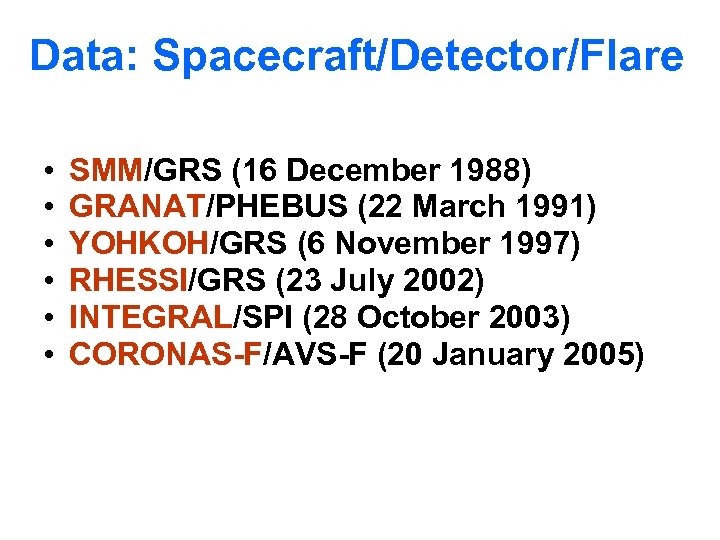
Data: Spacecraft/Detector/Flare • • • SMM/GRS (16 December 1988) GRANAT/PHEBUS (22 March 1991) YOHKOH/GRS (6 November 1997) RHESSI/GRS (23 July 2002) INTEGRAL/SPI (28 October 2003) CORONAS-F/AVS-F (20 January 2005)
“Main Conclusion”: • “IGNORANTIA • EST • NON • ARGUMENTUM”
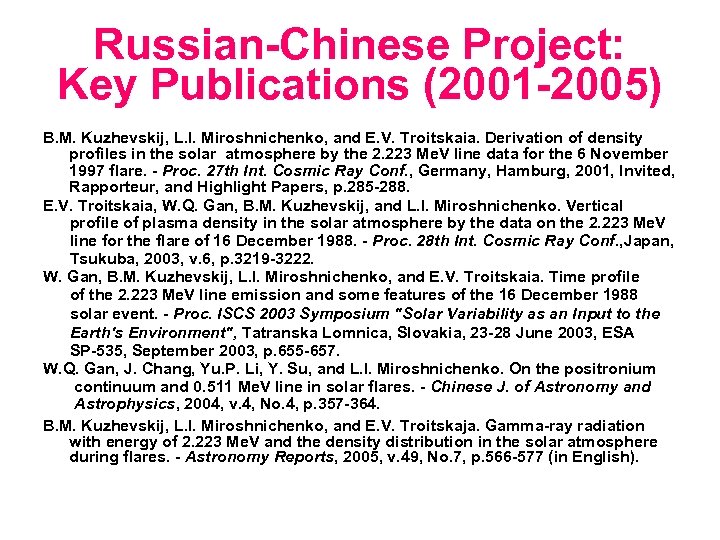
Russian-Chinese Project: Key Publications (2001 -2005) B. M. Kuzhevskij, L. I. Miroshnichenko, and E. V. Troitskaia. Derivation of density profiles in the solar atmosphere by the 2. 223 Me. V line data for the 6 November 1997 flare. - Proc. 27 th Int. Cosmic Ray Conf. , Germany, Hamburg, 2001, Invited, Rapporteur, and Highlight Papers, p. 285 -288. E. V. Troitskaia, W. Q. Gan, B. M. Kuzhevskij, and L. I. Miroshnichenko. Vertical profile of plasma density in the solar atmosphere by the data on the 2. 223 Me. V line for the flare of 16 December 1988. - Proc. 28 th Int. Cosmic Ray Conf. , Japan, Tsukuba, 2003, v. 6, p. 3219 -3222. W. Gan, B. M. Kuzhevskij, L. I. Miroshnichenko, and E. V. Troitskaia. Time profile of the 2. 223 Me. V line emission and some features of the 16 December 1988 solar event. - Proc. ISCS 2003 Symposium "Solar Variability as an Input to the Earth's Environment", Tatranska Lomnica, Slovakia, 23 -28 June 2003, ESA SP-535, September 2003, p. 655 -657. W. Q. Gan, J. Chang, Yu. P. Li, Y. Su, and L. I. Miroshnichenko. On the positronium continuum and 0. 511 Me. V line in solar flares. - Chinese J. of Astronomy and Astrophysics, 2004, v. 4, No. 4, p. 357 -364. B. M. Kuzhevskij, L. I. Miroshnichenko, and E. V. Troitskaja. Gamma-ray radiation with energy of 2. 223 Me. V and the density distribution in the solar atmosphere during flares. - Astronomy Reports, 2005, v. 49, No. 7, p. 566 -577 (in English).
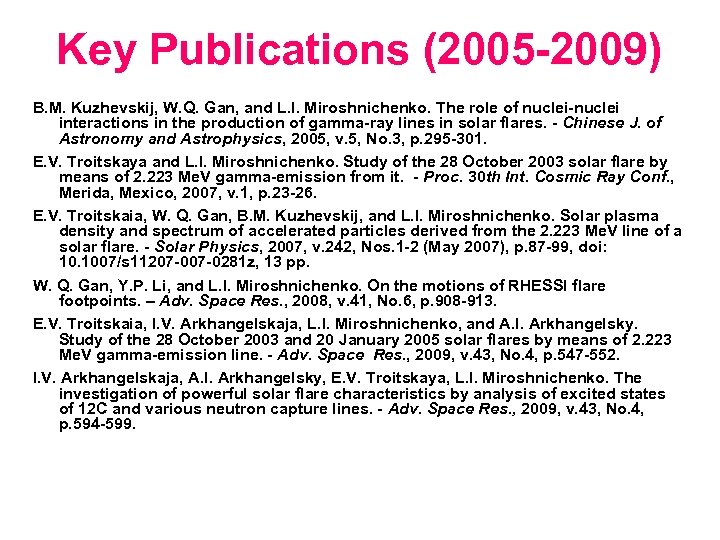
Key Publications (2005 -2009) B. M. Kuzhevskij, W. Q. Gan, and L. I. Miroshnichenko. The role of nuclei-nuclei interactions in the production of gamma-ray lines in solar flares. - Chinese J. of Astronomy and Astrophysics, 2005, v. 5, No. 3, p. 295 -301. E. V. Troitskaya and L. I. Miroshnichenko. Study of the 28 October 2003 solar flare by means of 2. 223 Me. V gamma-emission from it. - Proc. 30 th Int. Cosmic Ray Conf. , Merida, Mexico, 2007, v. 1, p. 23 -26. E. V. Troitskaia, W. Q. Gan, B. M. Kuzhevskij, and L. I. Miroshnichenko. Solar plasma density and spectrum of accelerated particles derived from the 2. 223 Me. V line of a solar flare. - Solar Physics, 2007, v. 242, Nos. 1 -2 (May 2007), p. 87 -99, doi: 10. 1007/s 11207 -0281 z, 13 pp. W. Q. Gan, Y. P. Li, and L. I. Miroshnichenko. On the motions of RHESSI flare footpoints. – Adv. Space Res. , 2008, v. 41, No. 6, p. 908 -913. E. V. Troitskaia, I. V. Arkhangelskaja, L. I. Miroshnichenko, and A. I. Arkhangelsky. Study of the 28 October 2003 and 20 January 2005 solar flares by means of 2. 223 Me. V gamma-emission line. - Adv. Space Res. , 2009, v. 43, No. 4, p. 547 -552. I. V. Arkhangelskaja, A. I. Arkhangelsky, E. V. Troitskaya, L. I. Miroshnichenko. The investigation of powerful solar flare characteristics by analysis of excited states of 12 C and various neutron capture lines. - Adv. Space Res. , 2009, v. 43, No. 4, p. 594 -599.
Contact information: • Dr. LEONTY I. MIROSHNICHENKO • Department of Physics of Solar-Terrestrial Relations • N. V. Pushkov Institute IZMIRAN, Troitsk, Moscow Region, PB 142190, RUSSIA • Phone: 007(496)751 -02 -82; 007(496)751 -09 -26; 007(496)751 -23 -61 • Fax: 007(496)751 -01 -24 • E-mail: leonty@izmiran. troitsk. ru, leonty@izmiran. ru

¡MUCHAS GRACIAS!
Скачать презентацию Solar Flares of 28 October 2003 and 20
c8b2391bba87b441ae6e142e0f74930a.ppt