 Скачать презентацию Solar Dynamics Observatory System Concept Review Helioseismic and
423bf5b389365b76b8efa6cbd86adde4.ppt
- Количество слайдов: 55



Solar Dynamics Observatory System Concept Review Helioseismic and Magnetic Imager Presenters: P. Scherrer R. Bush L. Springer Stanford University Hansen Experimental Physics Laboratory Stanford, CA SDO System Requirements Review/System Concept Review (SRR/SCR) – April 8 -10, 2003 Lockheed Martin Space Systems Company Advanced Technology Center Solar & Astrophysics Laboratory Palo Alto, CA Page 1
HMI Investigation Plan – 1 The primary scientific objectives of the Helioseismic and Magnetic Imager investigation are to improve understanding of the interior sources and mechanisms of solar variability and the relationship of these internal physical processes to surface magnetic field structure and activity. The specific scientific objectives of the HMI investigation are to measure and study these interlinked processes: • Convection-zone dynamics and the solar dynamo; • Origin and evolution of sunspots, active regions and complexes of activity; • Sources and drivers of solar magnetic activity and disturbances; • Links between the internal processes and dynamics of the corona and heliosphere; • Precursors of solar disturbances for space-weather forecasts. SDO System Requirements Review/System Concept Review (SRR/SCR) – April 8 -10, 2003 Page 2
HMI Investigation Plan - 2 To accomplish these science goals the HMI instrument makes measurements of: • Full-disk Doppler velocity, line-of-sight magnetic flux, and continuum images with resolution better than 1. 5 arc-sec at least every 50 seconds. The Dopplergrams are maps of the motion of the solar photosphere. They are made from a sequence of filtergrams. They are used to make helioseismic inferences of the solar interior structure and dynamics. • Full-disk vector magnetic images of the solar magnetic field with resolution better than 1. 5 arc-sec at least every 10 minutes. The magnetograms are made from a sequence of measurements of the polarization in a spectral line. • The sequences of filtergrams must be 99. 99% complete 95% of the time The HMI Investigation includes the HMI Instrument, significant data processing, data archiving and export, data analysis for the science investigation, and E/PO. SDO System Requirements Review/System Concept Review (SRR/SCR) – April 8 -10, 2003 Page 3
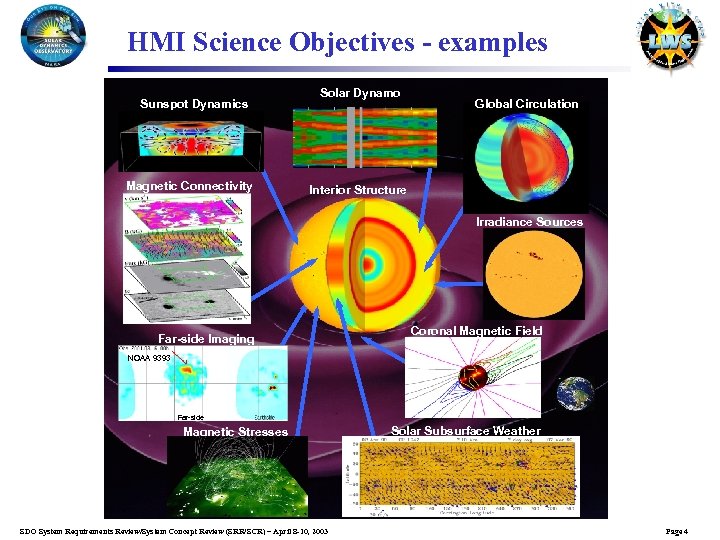
HMI Science Objectives - examples Sunspot Dynamics Magnetic Connectivity Solar Dynamo Global Circulation Interior Structure Irradiance Sources Far-side Imaging Coronal Magnetic Field NOAA 9393 Far-side Magnetic Stresses SDO System Requirements Review/System Concept Review (SRR/SCR) – April 8 -10, 2003 Solar Subsurface Weather Page 4
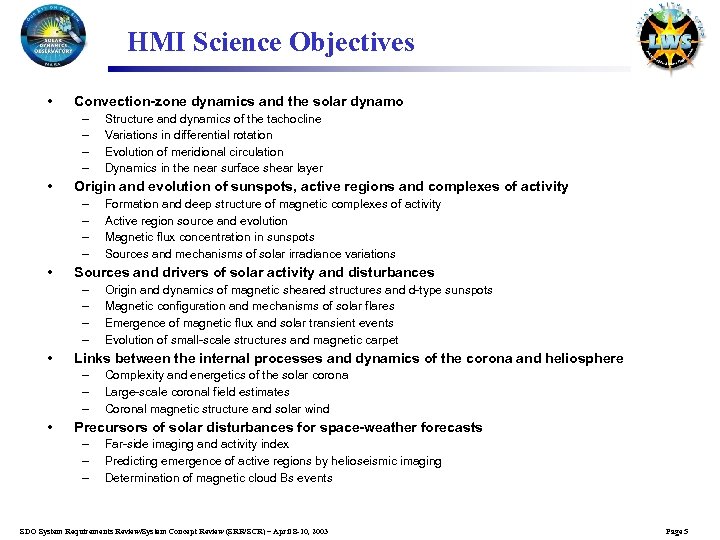
HMI Science Objectives • Convection-zone dynamics and the solar dynamo – – • Origin and evolution of sunspots, active regions and complexes of activity – – • Origin and dynamics of magnetic sheared structures and d-type sunspots Magnetic configuration and mechanisms of solar flares Emergence of magnetic flux and solar transient events Evolution of small-scale structures and magnetic carpet Links between the internal processes and dynamics of the corona and heliosphere – – – • Formation and deep structure of magnetic complexes of activity Active region source and evolution Magnetic flux concentration in sunspots Sources and mechanisms of solar irradiance variations Sources and drivers of solar activity and disturbances – – • Structure and dynamics of the tachocline Variations in differential rotation Evolution of meridional circulation Dynamics in the near surface shear layer Complexity and energetics of the solar corona Large-scale coronal field estimates Coronal magnetic structure and solar wind Precursors of solar disturbances for space-weather forecasts – – – Far-side imaging and activity index Predicting emergence of active regions by helioseismic imaging Determination of magnetic cloud Bs events SDO System Requirements Review/System Concept Review (SRR/SCR) – April 8 -10, 2003 Page 5
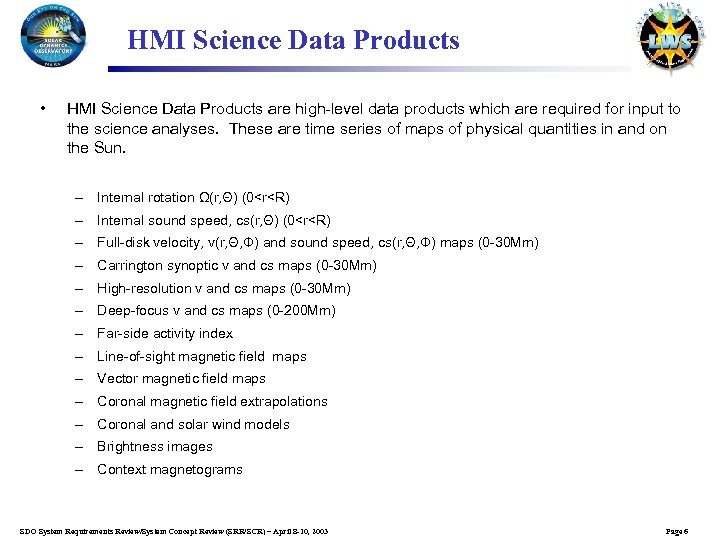
HMI Science Data Products • HMI Science Data Products are high-level data products which are required for input to the science analyses. These are time series of maps of physical quantities in and on the Sun. – Internal rotation Ω(r, Θ) (0<r<R) – Internal sound speed, cs(r, Θ) (0<r<R) – Full-disk velocity, v(r, Θ, Φ) and sound speed, cs(r, Θ, Φ) maps (0 -30 Mm) – Carrington synoptic v and cs maps (0 -30 Mm) – High-resolution v and cs maps (0 -30 Mm) – Deep-focus v and cs maps (0 -200 Mm) – Far-side activity index – Line-of-sight magnetic field maps – Vector magnetic field maps – Coronal magnetic field extrapolations – Coronal and solar wind models – Brightness images – Context magnetograms SDO System Requirements Review/System Concept Review (SRR/SCR) – April 8 -10, 2003 Page 6
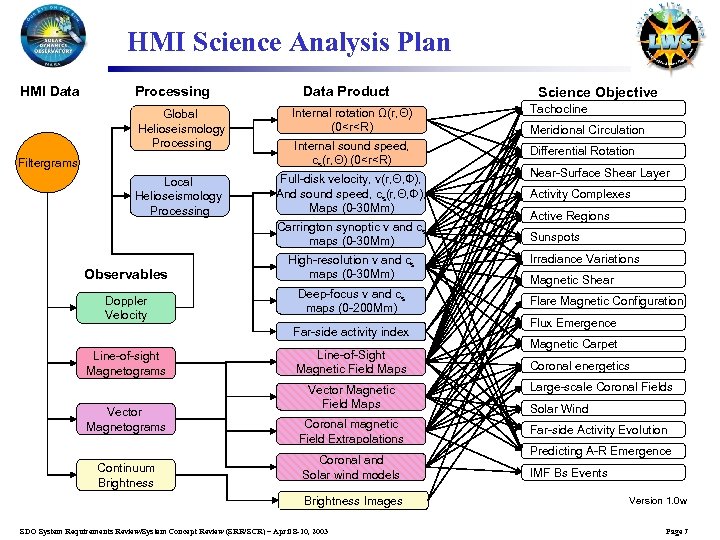
HMI Science Analysis Plan HMI Data Processing Data Product Science Objective Tachocline Global Helioseismology Processing Internal rotation Ω(r, Θ) (0<r<R) Internal sound speed, cs(r, Θ) (0<r<R) Differential Rotation Local Helioseismology Processing Full-disk velocity, v(r, Θ, Φ), And sound speed, cs(r, Θ, Φ), Maps (0 -30 Mm) Activity Complexes Filtergrams Carrington synoptic v and cs maps (0 -30 Mm) Observables Doppler Velocity High-resolution v and cs maps (0 -30 Mm) Deep-focus v and cs maps (0 -200 Mm) Far-side activity index Line-of-sight Magnetograms Vector Magnetograms Continuum Brightness Line-of-Sight Magnetic Field Maps Meridional Circulation Near-Surface Shear Layer Active Regions Sunspots Irradiance Variations Magnetic Shear Flare Magnetic Configuration Flux Emergence Magnetic Carpet Coronal energetics Vector Magnetic Field Maps Large-scale Coronal Fields Coronal magnetic Field Extrapolations Far-side Activity Evolution Coronal and Solar wind models Brightness Images SDO System Requirements Review/System Concept Review (SRR/SCR) – April 8 -10, 2003 Solar Wind Predicting A-R Emergence IMF Bs Events Version 1. 0 w Page 7
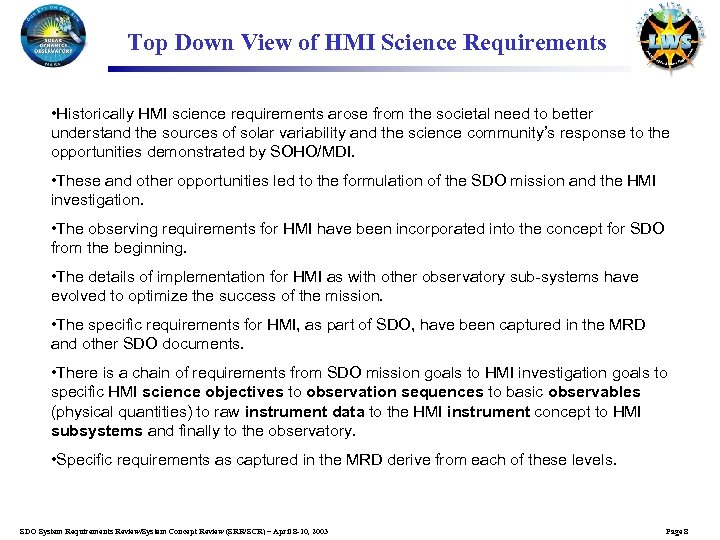
Top Down View of HMI Science Requirements • Historically HMI science requirements arose from the societal need to better understand the sources of solar variability and the science community’s response to the opportunities demonstrated by SOHO/MDI. • These and other opportunities led to the formulation of the SDO mission and the HMI investigation. • The observing requirements for HMI have been incorporated into the concept for SDO from the beginning. • The details of implementation for HMI as with other observatory sub-systems have evolved to optimize the success of the mission. • The specific requirements for HMI, as part of SDO, have been captured in the MRD and other SDO documents. • There is a chain of requirements from SDO mission goals to HMI investigation goals to specific HMI science objectives to observation sequences to basic observables (physical quantities) to raw instrument data to the HMI instrument concept to HMI subsystems and finally to the observatory. • Specific requirements as captured in the MRD derive from each of these levels. SDO System Requirements Review/System Concept Review (SRR/SCR) – April 8 -10, 2003 Page 8
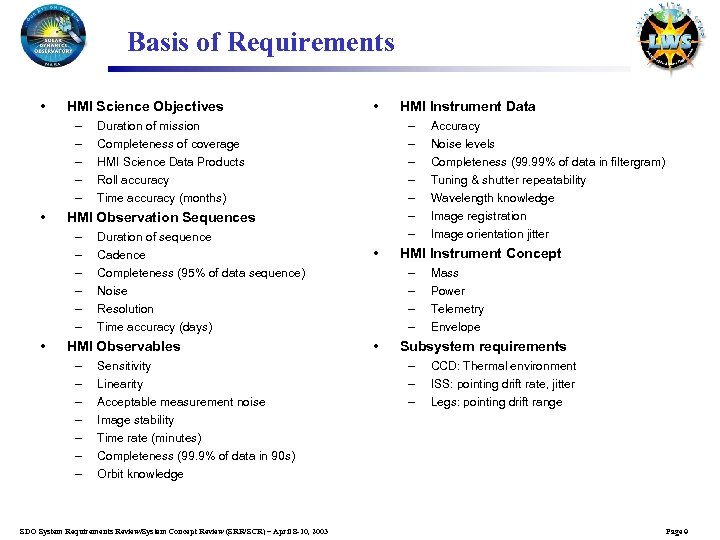
Basis of Requirements • HMI Science Objectives – – – • Duration of sequence Cadence Completeness (95% of data sequence) Noise Resolution Time accuracy (days) HMI Observables – – – – Sensitivity Linearity Acceptable measurement noise Image stability Time rate (minutes) Completeness (99. 9% of data in 90 s) Orbit knowledge SDO System Requirements Review/System Concept Review (SRR/SCR) – April 8 -10, 2003 HMI Instrument Data – – – – Duration of mission Completeness of coverage HMI Science Data Products Roll accuracy Time accuracy (months) HMI Observation Sequences – – – • • • HMI Instrument Concept – – • Accuracy Noise levels Completeness (99. 99% of data in filtergram) Tuning & shutter repeatability Wavelength knowledge Image registration Image orientation jitter Mass Power Telemetry Envelope Subsystem requirements – – – CCD: Thermal environment ISS: pointing drift rate, jitter Legs: pointing drift range Page 9
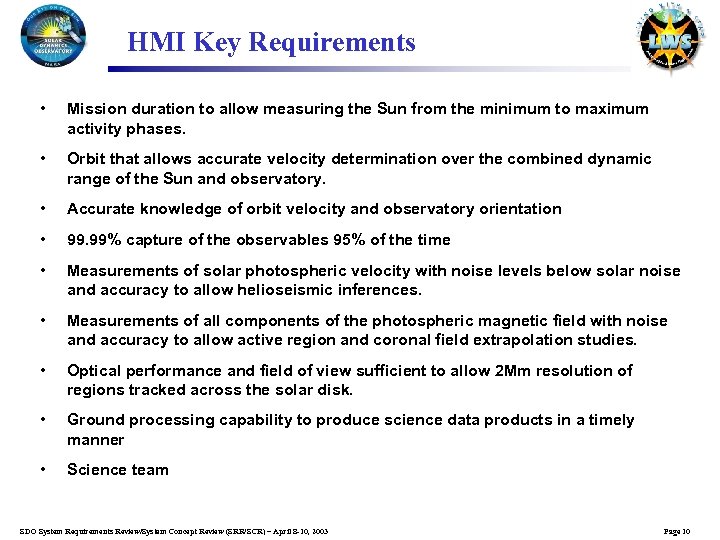
HMI Key Requirements • Mission duration to allow measuring the Sun from the minimum to maximum activity phases. • Orbit that allows accurate velocity determination over the combined dynamic range of the Sun and observatory. • Accurate knowledge of orbit velocity and observatory orientation • 99. 99% capture of the observables 95% of the time • Measurements of solar photospheric velocity with noise levels below solar noise and accuracy to allow helioseismic inferences. • Measurements of all components of the photospheric magnetic field with noise and accuracy to allow active region and coronal field extrapolation studies. • Optical performance and field of view sufficient to allow 2 Mm resolution of regions tracked across the solar disk. • Ground processing capability to produce science data products in a timely manner • Science team SDO System Requirements Review/System Concept Review (SRR/SCR) – April 8 -10, 2003 Page 10
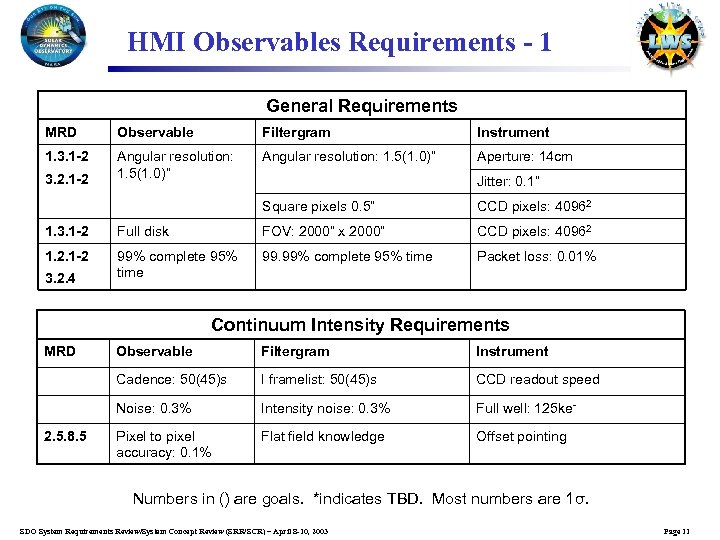
HMI Observables Requirements - 1 General Requirements MRD Observable Filtergram Instrument 1. 3. 1 -2 Angular resolution: 1. 5(1. 0)” Aperture: 14 cm 3. 2. 1 -2 Jitter: 0. 1” Square pixels 0. 5” CCD pixels: 40962 1. 3. 1 -2 Full disk FOV: 2000” x 2000” CCD pixels: 40962 1. 2. 1 -2 99% complete 95% time 99. 99% complete 95% time Packet loss: 0. 01% 3. 2. 4 Continuum Intensity Requirements MRD Filtergram Instrument Cadence: 50(45)s I framelist: 50(45)s CCD readout speed Noise: 0. 3% 2. 5. 8. 5 Observable Intensity noise: 0. 3% Full well: 125 ke- Pixel to pixel accuracy: 0. 1% Flat field knowledge Offset pointing Numbers in () are goals. *indicates TBD. Most numbers are 1σ. SDO System Requirements Review/System Concept Review (SRR/SCR) – April 8 -10, 2003 Page 11
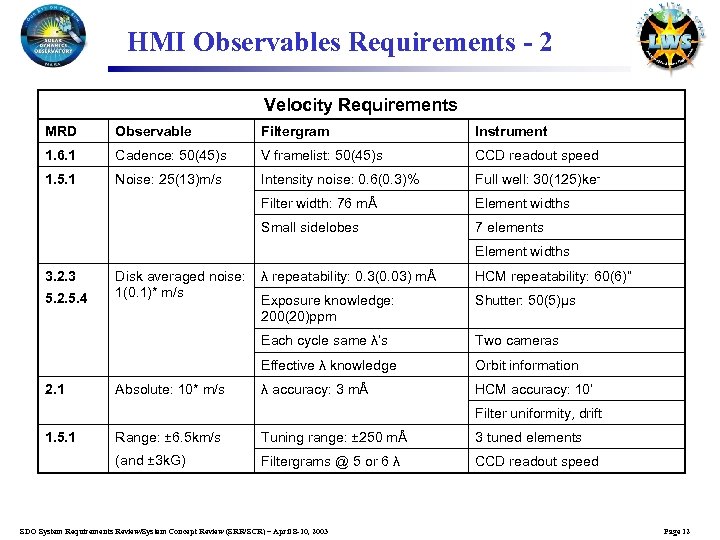
HMI Observables Requirements - 2 Velocity Requirements MRD Observable Filtergram Instrument 1. 6. 1 Cadence: 50(45)s V framelist: 50(45)s CCD readout speed 1. 5. 1 Noise: 25(13)m/s Intensity noise: 0. 6(0. 3)% Full well: 30(125)ke- Filter width: 76 mÅ Element widths Small sidelobes 7 elements Element widths 3. 2. 3 Absolute: 10* m/s HCM repeatability: 60(6)” Exposure knowledge: 200(20)ppm Shutter: 50(5)μs Two cameras Effective λ knowledge 2. 1 λ repeatability: 0. 3(0. 03) mÅ Each cycle same λ’s 5. 2. 5. 4 Disk averaged noise: 1(0. 1)* m/s Orbit information λ accuracy: 3 mÅ HCM accuracy: 10’ Filter uniformity, drift 1. 5. 1 Range: ± 6. 5 km/s Tuning range: ± 250 mÅ 3 tuned elements (and ± 3 k. G) Filtergrams @ 5 or 6 λ CCD readout speed SDO System Requirements Review/System Concept Review (SRR/SCR) – April 8 -10, 2003 Page 12
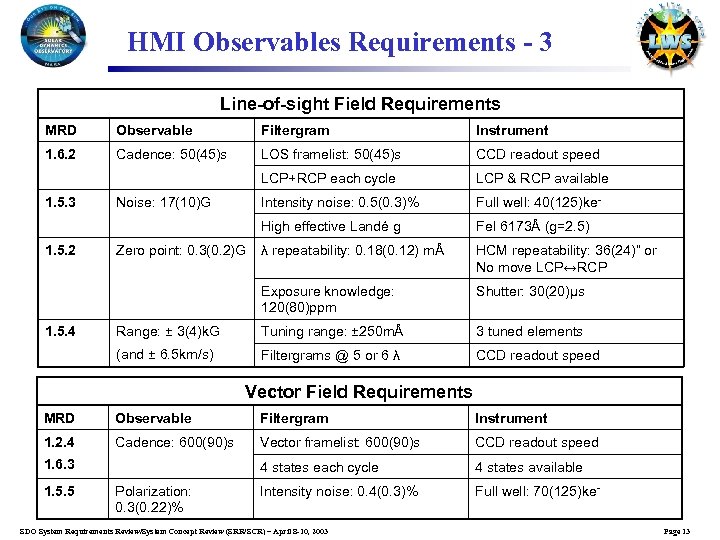
HMI Observables Requirements - 3 Line-of-sight Field Requirements MRD Observable Filtergram Instrument 1. 6. 2 Cadence: 50(45)s LOS framelist: 50(45)s CCD readout speed LCP+RCP each cycle LCP & RCP available Intensity noise: 0. 5(0. 3)% Full well: 40(125)ke- High effective Landé g Fe. I 6173Å (g=2. 5) λ repeatability: 0. 18(0. 12) mÅ HCM repeatability: 36(24)” or No move LCP↔RCP Exposure knowledge: 120(80)ppm Shutter: 30(20)μs Range: ± 3(4)k. G Tuning range: ± 250 mÅ 3 tuned elements (and ± 6. 5 km/s) Filtergrams @ 5 or 6 λ CCD readout speed 1. 5. 3 1. 5. 2 1. 5. 4 Noise: 17(10)G Zero point: 0. 3(0. 2)G Vector Field Requirements MRD Observable Filtergram Instrument 1. 2. 4 Cadence: 600(90)s Vector framelist: 600(90)s CCD readout speed 4 states each cycle 4 states available Intensity noise: 0. 4(0. 3)% Full well: 70(125)ke- 1. 6. 3 1. 5. 5 Polarization: 0. 3(0. 22)% SDO System Requirements Review/System Concept Review (SRR/SCR) – April 8 -10, 2003 Page 13
HMI Instrument Concept • The HMI instrument is an evolution of the successful Michelson Doppler Imager instrument which has been operating on the SOHO spacecraft for over seven years. • The raw HMI observables are filtergrams of the full solar disk taken with a narrow band (~ 0. 1 A bandpass) tunable filter in multiple polarizations. • The primary science observables are Dopplergrams, line-of-sight magnetograms, vector magnetograms and continuum images computed from a series of filtergrams. • Some of the key instrument design drivers include maintaining uniform image quality and performance through detailed optical and thermal design and rigorous testing. • The vector magnetic field measurements are best decoupled from the helioseismology measurements, and a two camera design results to maintain image cadence and separate the two primary data streams. SDO System Requirements Review/System Concept Review (SRR/SCR) – April 8 -10, 2003 Page 14
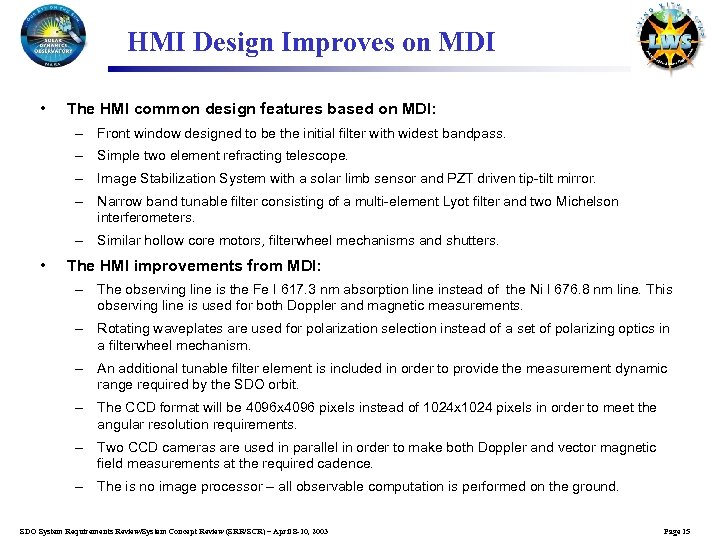
HMI Design Improves on MDI • The HMI common design features based on MDI: – Front window designed to be the initial filter with widest bandpass. – Simple two element refracting telescope. – Image Stabilization System with a solar limb sensor and PZT driven tip-tilt mirror. – Narrow band tunable filter consisting of a multi-element Lyot filter and two Michelson interferometers. – Similar hollow core motors, filterwheel mechanisms and shutters. • The HMI improvements from MDI: – The observing line is the Fe I 617. 3 nm absorption line instead of the Ni I 676. 8 nm line. This observing line is used for both Doppler and magnetic measurements. – Rotating waveplates are used for polarization selection instead of a set of polarizing optics in a filterwheel mechanism. – An additional tunable filter element is included in order to provide the measurement dynamic range required by the SDO orbit. – The CCD format will be 4096 x 4096 pixels instead of 1024 x 1024 pixels in order to meet the angular resolution requirements. – Two CCD cameras are used in parallel in order to make both Doppler and vector magnetic field measurements at the required cadence. – The is no image processor – all observable computation is performed on the ground. SDO System Requirements Review/System Concept Review (SRR/SCR) – April 8 -10, 2003 Page 15
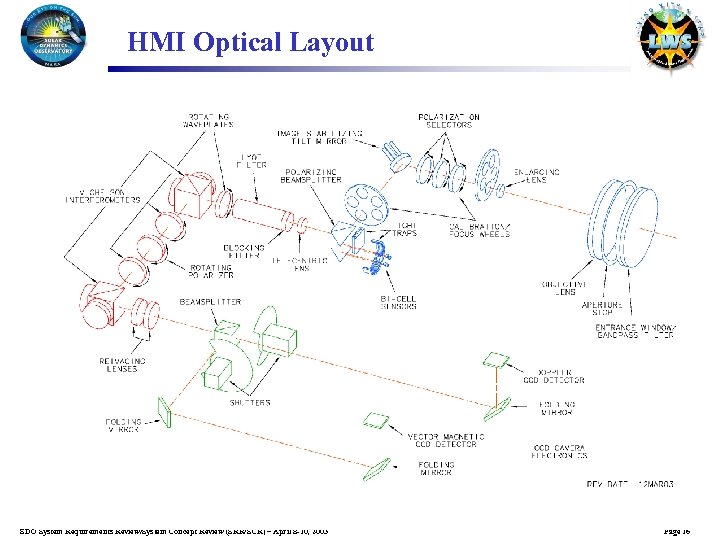
HMI Optical Layout SDO System Requirements Review/System Concept Review (SRR/SCR) – April 8 -10, 2003 Page 16
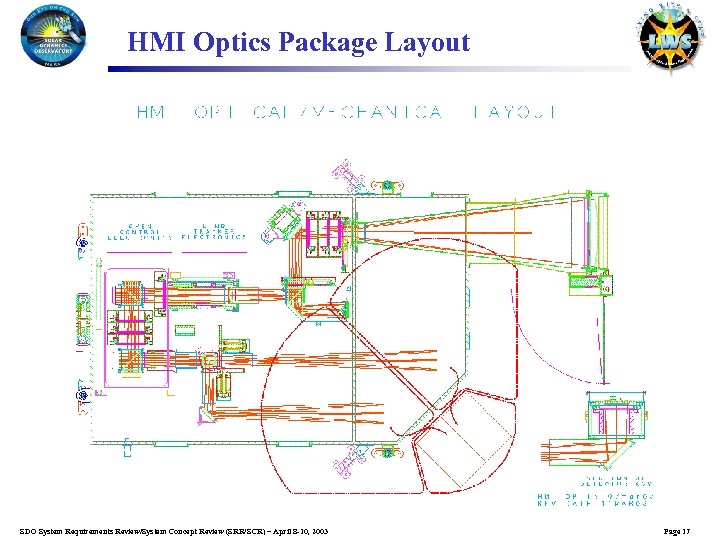
HMI Optics Package Layout SDO System Requirements Review/System Concept Review (SRR/SCR) – April 8 -10, 2003 Page 17
HMI Subsystems • Optics Package Structure – • Optics Subsystem – • The CCD camera subsystem includes 4 Kx 4 K CCDs and the camera electronics box(es) HMI Electronics Subsystem – • The mechanisms subsystem includes shutters, hollow-core motors, calibration/focus wheels, alignment mechanism, and the aperture door CCD Camera Subsystem – • Consists of active mirror, limb sensor, precision digital & analog control electronics It actively stabilizes the image reducing the effects of jitter Mechanisms Subsystem – • Controls the temperature of the optics pkg. , the filter oven, CCDs, and the front window. Implements the decontamination heating of the CCD. Image Stabilization Subsystem – – • The filter subsystem includes all the filters and Michelsons Provides the ability to select the wavelenght to image Thermal Subsystem – – • Includes all the optical elements except the filters Filter subsystem – – • The optic package structure subsystem includes the optics package structure, the mounts for the various optical components and the legs that mount the optics package to the spacecraft. Provides conditioned power and control for all HMI subsystems as well as HMI C&DH hardware Software Subsystem – The software subsystem includes the C&DH interface to the spacecraft and controls all of the other HMI subsystems SDO System Requirements Review/System Concept Review (SRR/SCR) – April 8 -10, 2003 Page 18
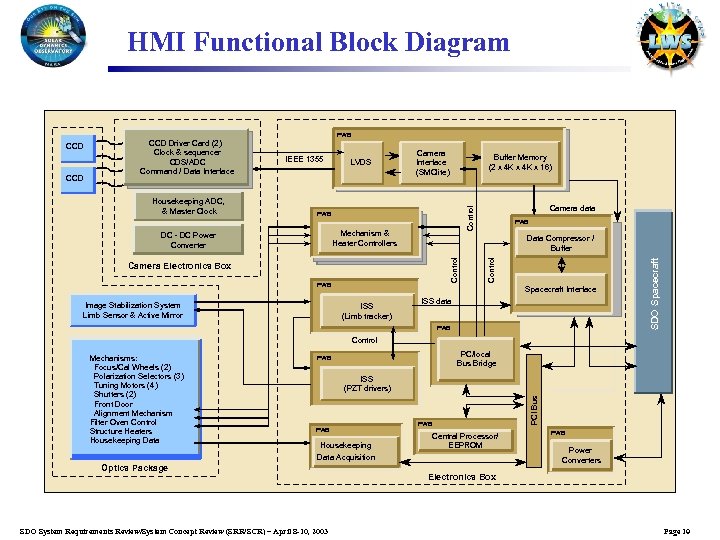
HMI Functional Block Diagram PWB Camera interface Interface (SMClite) ( SMClite ) PWB Mechanism & & Mechanism heater controllers Heater Controllers Camera Electronics Box PWB Camera data PWB Data compressor / Data Compressor & Buffer AEC Buffer memory Spacecraft Interface ISS (Limb tracker) Image Stabilization System Limb Sensor & Active Mirror Buffer memory Buffer Memory (2 x 4 K x 16) (2 x 4 Kx 16) ISS data PWB Control PC/local bus bridge/ Bus Bridge EEPROM PWB ISS (PZT drivers) PWB Housekeeping Data Acquisition data acquisition Optics Package SDO System Requirements Review/System Concept Review (SRR/SCR) – April 8 -10, 2003 PWB Central Processor/ Central processor EEPROM PCI Bus Mechanisms: Focus/Cal Wheels (2) Polarization Selectors (3) Tuning Motors (4) Shutters (2) Front Door Alignment Mechanism Filter Oven Control Structure Heaters Housekeeping Data SDOSDO Spacecraft DC DC - DC Power - DC power Converter converter LVDS Control Housekeeping ADC, & Master Clock & master clock IEEE 1355 Control CCD Driver Card (2) Clock & sequencer CDS/ADC Command / Data Interface Control CCD PWB Power Converters converters Electronics Box Page 19
Optics Subsystem • 1 arc-sec diffraction limited image at the sensor – Requires 14 cm aperture – Requires 4096 x 4096 pixel sensor • Solar disk at the sensor 4. 9 cm – For sensor with 12 um pixels • Focus adjustment system with ± 3 (TBC) depth of focus range and 16 steps • Provide calibration mode that images the pupil on the sensor • Provide beam splitter to divide the telescope beam between the filter oven and the limb tracker • Provide telecentric beam through the Lyot filter • Provide beam splitter to feed the output of the filter subsystem to two sensors • Minimize scattered light on the sensor SDO System Requirements Review/System Concept Review (SRR/SCR) – April 8 -10, 2003 Page 20
Filter subsystem • Central wavelength 6173Å Fe I line • Reject 99% of solar heat load from the OP interior • Total bandwidth 76 mÅ FWHM • Tunable range 500 mÅ • Very high stability and repeatability required (to be quantified) • The required bandwidth obtained by cascading filters as follows – Front window 50Å – Blocker 8Å – Lyot filter (5 element 1: 2: 4: 8: 16) 306 mÅ – Wide Michelson 172 mÅ – Narrow Michelson 86 mÅ • Tuning range requires use of three co-tuned elements – Narrowest Lyot element – Wide Michelson – Narrow Michelson SDO System Requirements Review/System Concept Review (SRR/SCR) – April 8 -10, 2003 Page 21
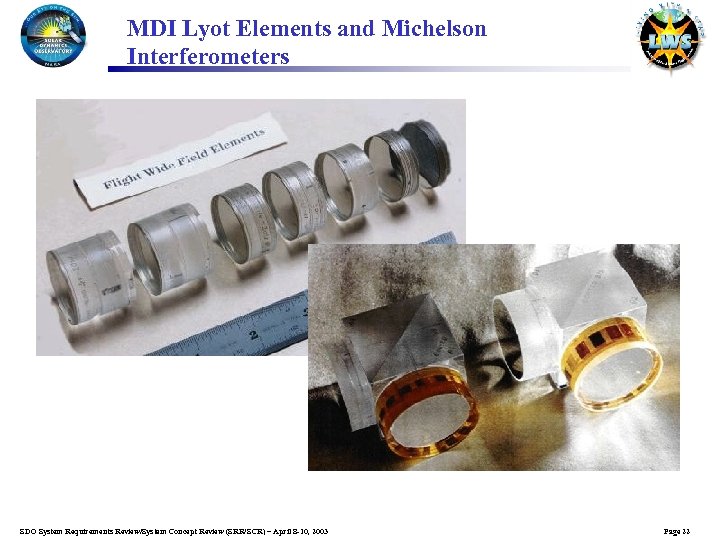
MDI Lyot Elements and Michelson Interferometers SDO System Requirements Review/System Concept Review (SRR/SCR) – April 8 -10, 2003 Page 22
Thermal Subsystem • Optics package thermal control – Operating temperature range 15 to 25 °C – Active control to ± 0. 5 °C – Control loop in software • Filter oven – Operating temperature range 35 ± 4 °C – Temperature accuracy 0. 5 °C – Temperature stability 0. 01 °C /hour – Changes in internal temperature gradients as small as possible – Dedicated analog control loop in controlled thermal environment • Sensor (CCD detector) thermal control – Operating – 100 °C to – 30 °C – Stability over an orbit xx °C? – Decontamination mode raise CCD to 20 to 40 °C (may need to be wider because of unregulated power) • Front window thermal control – Minimize radial gradients – Return to normal operating temperature within 60 minutes of eclipse exit SDO System Requirements Review/System Concept Review (SRR/SCR) – April 8 -10, 2003 Page 23
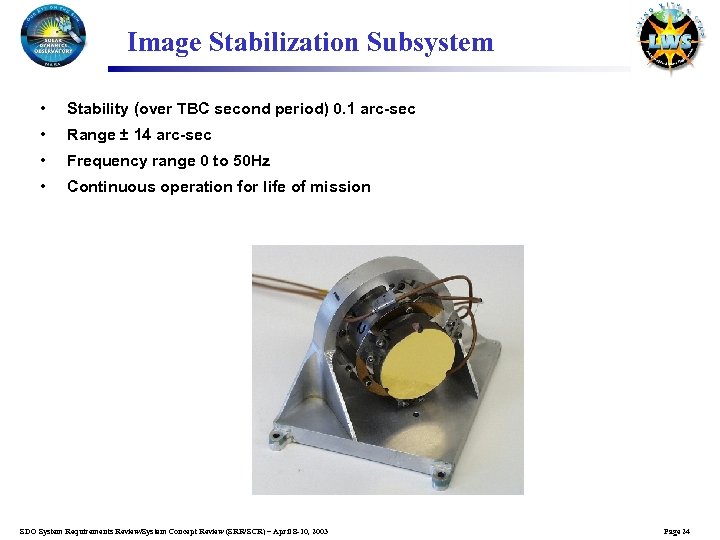
Image Stabilization Subsystem • Stability (over TBC second period) 0. 1 arc-sec • Range ± 14 arc-sec • Frequency range 0 to 50 Hz • Continuous operation for life of mission SDO System Requirements Review/System Concept Review (SRR/SCR) – April 8 -10, 2003 Page 24
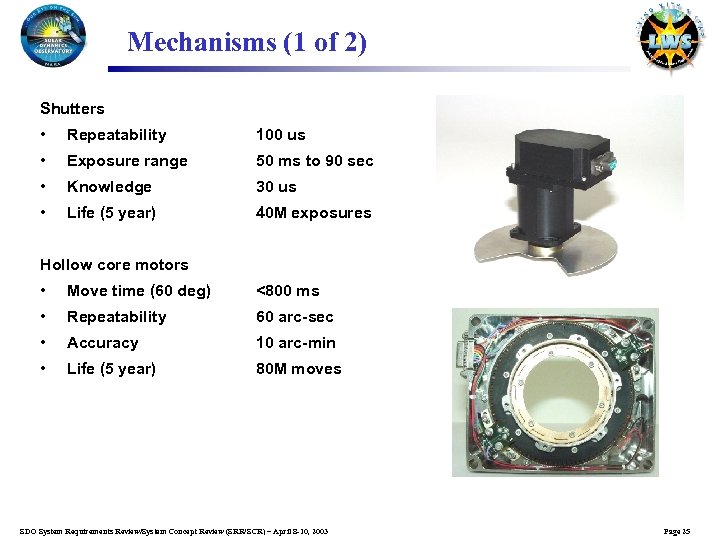
Mechanisms (1 of 2) Shutters • Repeatability 100 us • Exposure range 50 ms to 90 sec • Knowledge 30 us • Life (5 year) 40 M exposures Hollow core motors • Move time (60 deg) <800 ms • Repeatability 60 arc-sec • Accuracy 10 arc-min • Life (5 year) 80 M moves SDO System Requirements Review/System Concept Review (SRR/SCR) – April 8 -10, 2003 Page 25
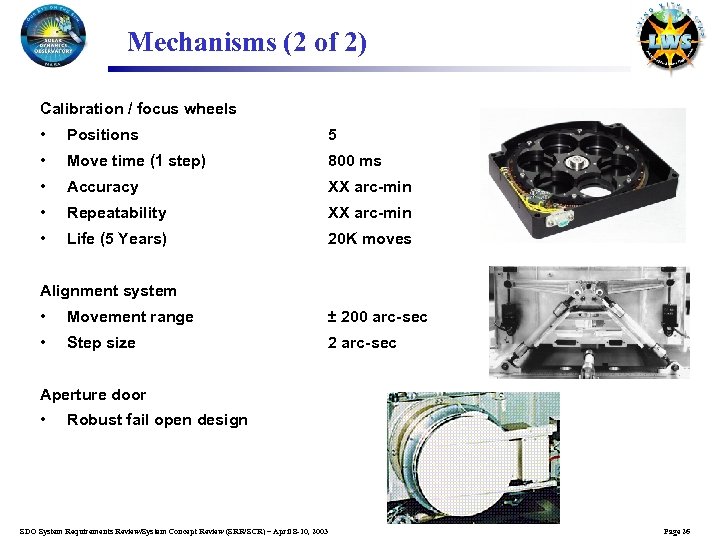
Mechanisms (2 of 2) Calibration / focus wheels • Positions 5 • Move time (1 step) 800 ms • Accuracy XX arc-min • Repeatability XX arc-min • Life (5 Years) 20 K moves Alignment system • Movement range ± 200 arc-sec • Step size 2 arc-sec Aperture door • Robust fail open design SDO System Requirements Review/System Concept Review (SRR/SCR) – April 8 -10, 2003 Page 26
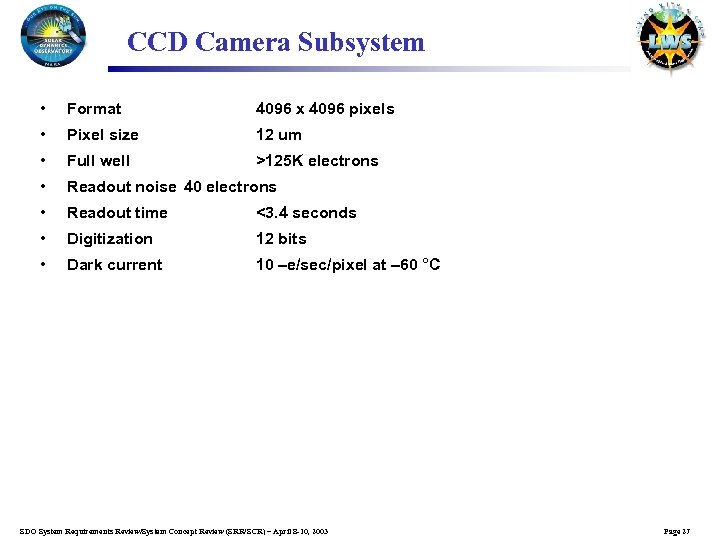
CCD Camera Subsystem • Format 4096 x 4096 pixels • Pixel size 12 um • Full well >125 K electrons • Readout noise 40 electrons • Readout time <3. 4 seconds • Digitization 12 bits • Dark current 10 –e/sec/pixel at – 60 °C SDO System Requirements Review/System Concept Review (SRR/SCR) – April 8 -10, 2003 Page 27
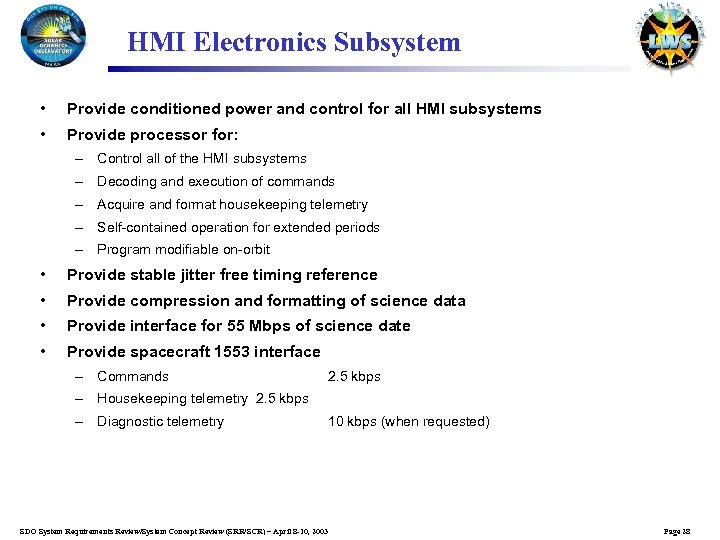
HMI Electronics Subsystem • Provide conditioned power and control for all HMI subsystems • Provide processor for: – Control all of the HMI subsystems – Decoding and execution of commands – Acquire and format housekeeping telemetry – Self-contained operation for extended periods – Program modifiable on-orbit • Provide stable jitter free timing reference • Provide compression and formatting of science data • Provide interface for 55 Mbps of science date • Provide spacecraft 1553 interface – Commands 2. 5 kbps – Housekeeping telemetry 2. 5 kbps – Diagnostic telemetry 10 kbps (when requested) SDO System Requirements Review/System Concept Review (SRR/SCR) – April 8 -10, 2003 Page 28
HMI Operations Concept • The goal of HMI operations is to achieve a uniform high quality data set of solar Dopplergrams and magnetograms. • A single “Prime Observing Sequence” will run continuously taking interleaved images from both cameras. The intent is to maintain this observing sequence for the entire SDO mission. • Short calibration sequences are run on a periodic basis (daily or weekly) in order to monitor instrument performance parameters such as focus, filter tuning and polarization. • Every six months, coordinated spacecraft maneuvers are performed to determine the end-to-end instrument flat-field images and measure solar shape variations. • HMI commanding requirements will be minimal except to update internal timelines for calibration activities and configuration for eclipses. • After instrument commissioning, it is anticipated that a single daily command load will be sufficient. SDO System Requirements Review/System Concept Review (SRR/SCR) – April 8 -10, 2003 Page 29
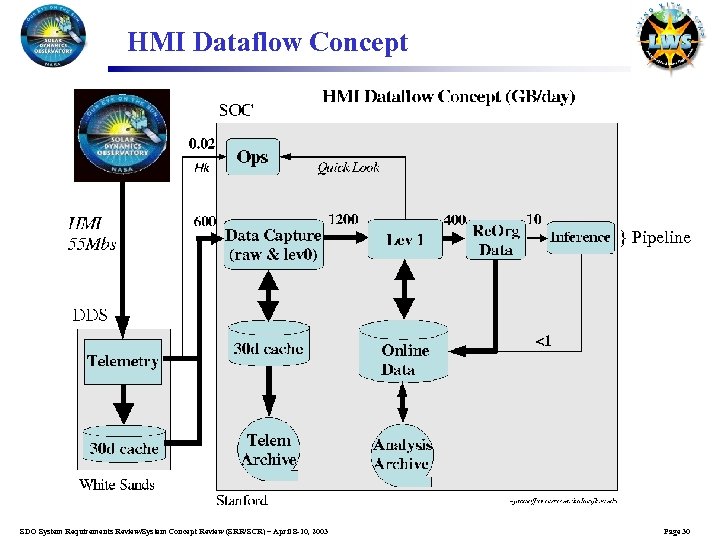
HMI Dataflow Concept } Pipeline SDO System Requirements Review/System Concept Review (SRR/SCR) – April 8 -10, 2003 Page 30
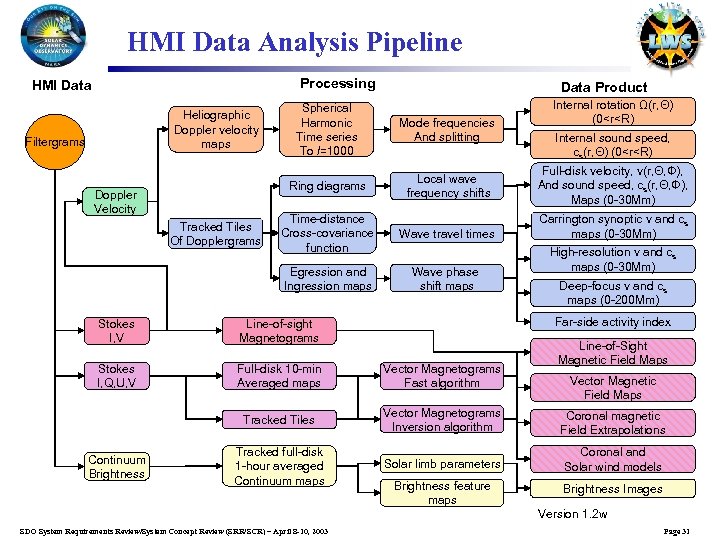
HMI Data Analysis Pipeline Processing HMI Data Doppler Velocity Spherical Harmonic Time series To l=1000 Mode frequencies And splitting Ring diagrams Heliographic Doppler velocity maps Filtergrams Data Product Local wave frequency shifts Time-distance Cross-covariance function Wave travel times Egression and Ingression maps Tracked Tiles Of Dopplergrams Wave phase shift maps Internal rotation Ω(r, Θ) (0<r<R) Internal sound speed, cs(r, Θ) (0<r<R) Full-disk velocity, v(r, Θ, Φ), And sound speed, cs(r, Θ, Φ), Maps (0 -30 Mm) Carrington synoptic v and cs maps (0 -30 Mm) High-resolution v and cs maps (0 -30 Mm) Deep-focus v and cs maps (0 -200 Mm) Far-side activity index Stokes I, V Line-of-sight Magnetograms Stokes I, Q, U, V Full-disk 10 -min Averaged maps Vector Magnetograms Fast algorithm Tracked Tiles Vector Magnetograms Inversion algorithm Coronal magnetic Field Extrapolations Tracked full-disk 1 -hour averaged Continuum maps Solar limb parameters Coronal and Solar wind models Brightness feature maps Brightness Images Continuum Brightness Line-of-Sight Magnetic Field Maps Vector Magnetic Field Maps Version 1. 2 w SDO System Requirements Review/System Concept Review (SRR/SCR) – April 8 -10, 2003 Page 31
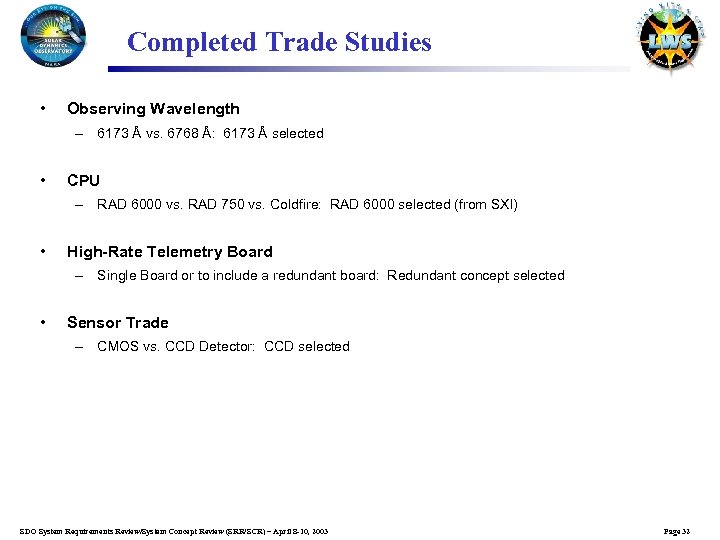
Completed Trade Studies • Observing Wavelength – 6173 Å vs. 6768 Å: 6173 Å selected • CPU – RAD 6000 vs. RAD 750 vs. Coldfire: RAD 6000 selected (from SXI) • High-Rate Telemetry Board – Single Board or to include a redundant board: Redundant concept selected • Sensor Trade – CMOS vs. CCD Detector: CCD selected SDO System Requirements Review/System Concept Review (SRR/SCR) – April 8 -10, 2003 Page 32
Trade Studies In Progress • Inclusion of redundant mechanisms in HMI Optic Package – Increased reliability vs. Increased cost & mass – Have allocated volume to not preclude additional mechanisms • Inclusion of redundant power supply in HMI Electronics Box – Increased reliability versus Increased cost and mass – Just started this trade • Camera Subsystem - evaluating two options – Build in-house an evolution of a Solar-B FPP Camera – Procure from RAL an evolution of a SECCHI Camera • CCD Configuration – Evaluating operation in front side or back side illuminated mode SDO System Requirements Review/System Concept Review (SRR/SCR) – April 8 -10, 2003 Page 33
HMI CCD and Camera Electronics • Baseline CCD vendor is E 2 V – Specification drafted - includes capabilities that allow more optimal camera electronics design and requires less power – SHARP and HMI to use identical CCDs – E 2 V to be given a design phase contract ASAP • Two principal paths for development of camera electronics – Develop cameras in-house => evolution of the Solar-B FPP FG camera – Procure cameras from RAL => evolution of the SECCHI camera • Key Considerations for decision on approach – Schedule => very critical – Cost => RAL approach less expensive if already doing SHARPP cameras – Performance => both “good enough” but RAL better • Recommendations if camera electronics are procured from RAL – Baseline same camera for SHARPP and HMI – Have separate RAL subcontracts from LMSAL and NRL – Continue to study FPP-option through Phase A • Recommendation if camera electronics are developed in house – Do not provide cameras for SHARPP – Keep informed on RAL-for SHARPP camera status and vice versa SDO System Requirements Review/System Concept Review (SRR/SCR) – April 8 -10, 2003 Page 34
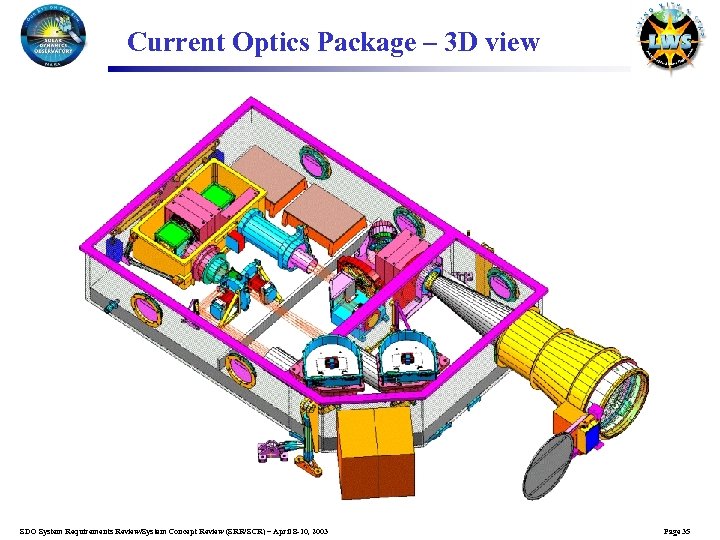
Current Optics Package – 3 D view SDO System Requirements Review/System Concept Review (SRR/SCR) – April 8 -10, 2003 Page 35
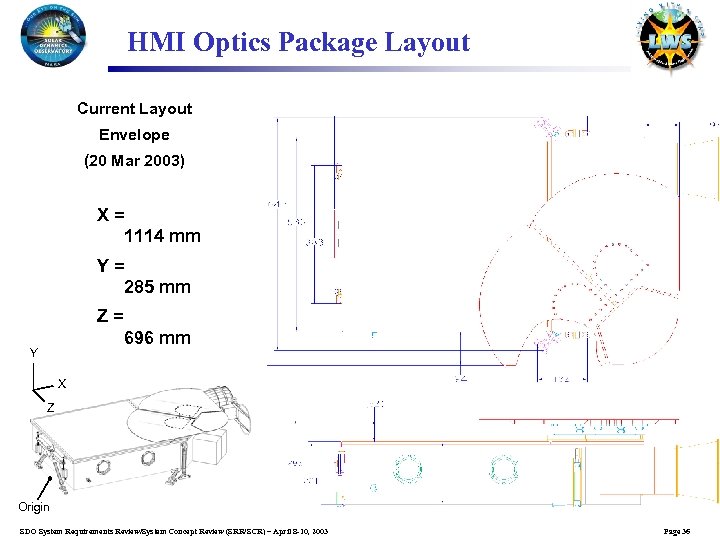
HMI Optics Package Layout Current Layout Envelope (20 Mar 2003) X= 1114 mm Y= 285 mm Z= 696 mm Y X Z Origin SDO System Requirements Review/System Concept Review (SRR/SCR) – April 8 -10, 2003 Page 36
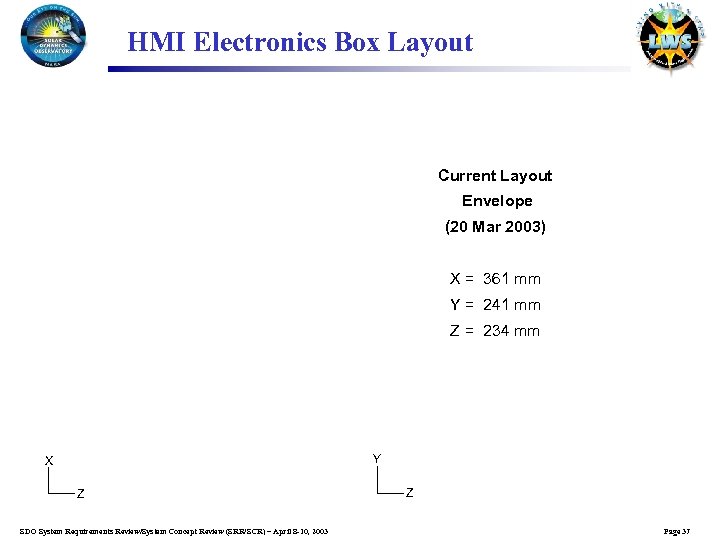
HMI Electronics Box Layout Current Layout Envelope (20 Mar 2003) X = 361 mm Y = 241 mm Z = 234 mm Y X Z SDO System Requirements Review/System Concept Review (SRR/SCR) – April 8 -10, 2003 Z Page 37
HMI Resources – Mass Estimates • Mass – no margin included 20 Mar 2003 – Optics Package (OP, w/LMSAL-CEB): – HMI Electronics Box (HEB): – Harness: • 35. 3 kg (TBC) 15. 0 kg (TBC) 3. 0 kg (TBC) OP Assumptions – Includes mass of redundant mechanisms in OP – Includes larger OP for additional mechanisms, and ease of integration and alignment – 1. 5 kg mass reduction in OP possible if RAL CEBs are substituted • HEB Assumptions – Includes additional compression/high speed bus interface boards – Includes thinned walls to account for spacecraft shielding – 1 kg mass reduction in HEB power supply possible if RAL CEBs are substituted – Does not include redundant power converters • Harness Assumptions – Harness mass presumes a length of 2 meters SDO System Requirements Review/System Concept Review (SRR/SCR) – April 8 -10, 2003 Page 38
HMI Resources – Inertias & CGs • OP 20 Mar 2003 – Ixx: 1. 00 kg-m 2 (TBC) – Iyy: 4. 30 kg-m 2 (TBC) – Izz: 3. 48 kg-m 2 (TBC) – these estimates are about the CG along OP axes so are therefore NOT principal axes, i. e. there also some small inertia products – CG (x, y, z) = 487 mm, 145 mm, 21 mm (TBC) • HEB 20 Mar 2003 – Ixx: 0. 79 kg-m 2 (TBC) – Iyy: 0. 22 kg-m 2 (TBC) – Izz: 0. 97 kg-m 2 (TBC) – these estimates presume the HEB is symmetrical about the center vertical axis so these are about principal axes through the CG, i. e. there are no inertia products – CG (x, y, z) = 180 mm, 110 mm, 98 mm (TBC) SDO System Requirements Review/System Concept Review (SRR/SCR) – April 8 -10, 2003 Page 39
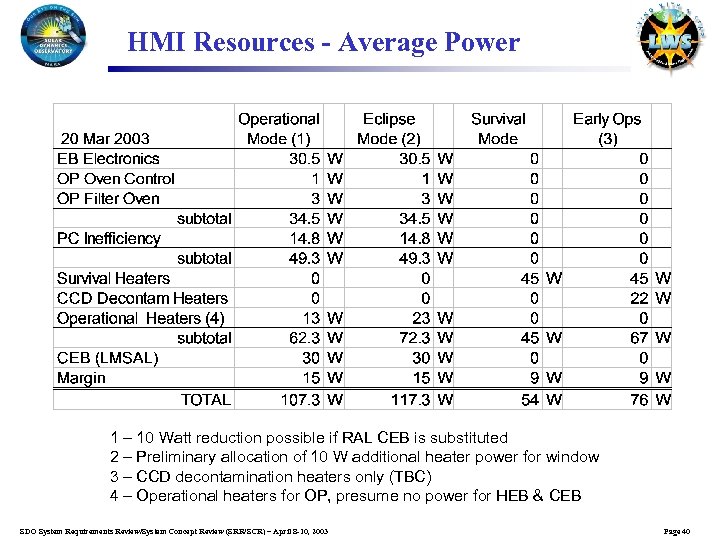
HMI Resources - Average Power 1 – 10 Watt reduction possible if RAL CEB is substituted 2 – Preliminary allocation of 10 W additional heater power for window 3 – CCD decontamination heaters only (TBC) 4 – Operational heaters for OP, presume no power for HEB & CEB SDO System Requirements Review/System Concept Review (SRR/SCR) – April 8 -10, 2003 Page 40
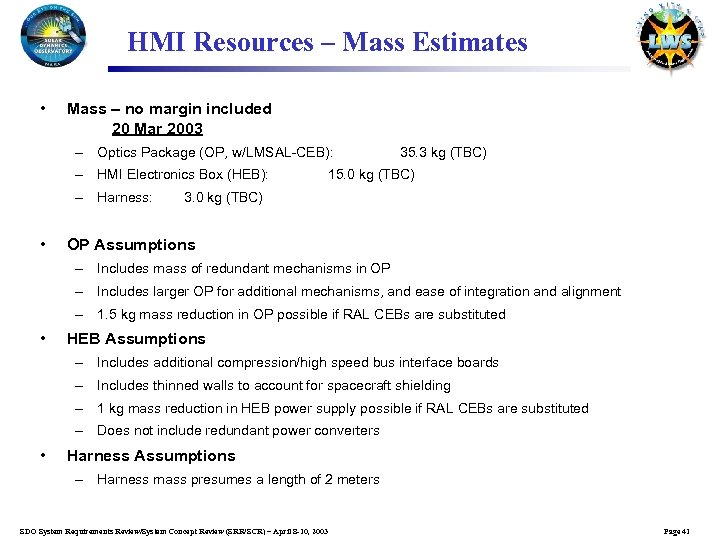
HMI Resources – Mass Estimates • Mass – no margin included 20 Mar 2003 – Optics Package (OP, w/LMSAL-CEB): – HMI Electronics Box (HEB): – Harness: • 35. 3 kg (TBC) 15. 0 kg (TBC) 3. 0 kg (TBC) OP Assumptions – Includes mass of redundant mechanisms in OP – Includes larger OP for additional mechanisms, and ease of integration and alignment – 1. 5 kg mass reduction in OP possible if RAL CEBs are substituted • HEB Assumptions – Includes additional compression/high speed bus interface boards – Includes thinned walls to account for spacecraft shielding – 1 kg mass reduction in HEB power supply possible if RAL CEBs are substituted – Does not include redundant power converters • Harness Assumptions – Harness mass presumes a length of 2 meters SDO System Requirements Review/System Concept Review (SRR/SCR) – April 8 -10, 2003 Page 41
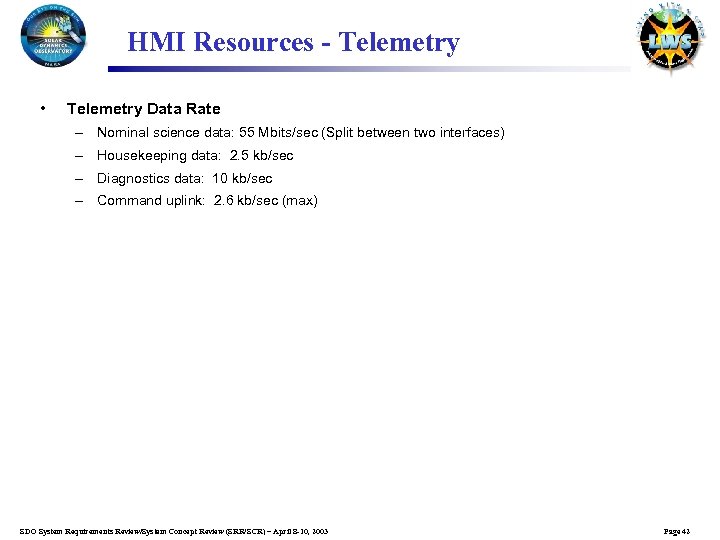
HMI Resources - Telemetry • Telemetry Data Rate – Nominal science data: 55 Mbits/sec (Split between two interfaces) – Housekeeping data: 2. 5 kb/sec – Diagnostics data: 10 kb/sec – Command uplink: 2. 6 kb/sec (max) SDO System Requirements Review/System Concept Review (SRR/SCR) – April 8 -10, 2003 Page 42
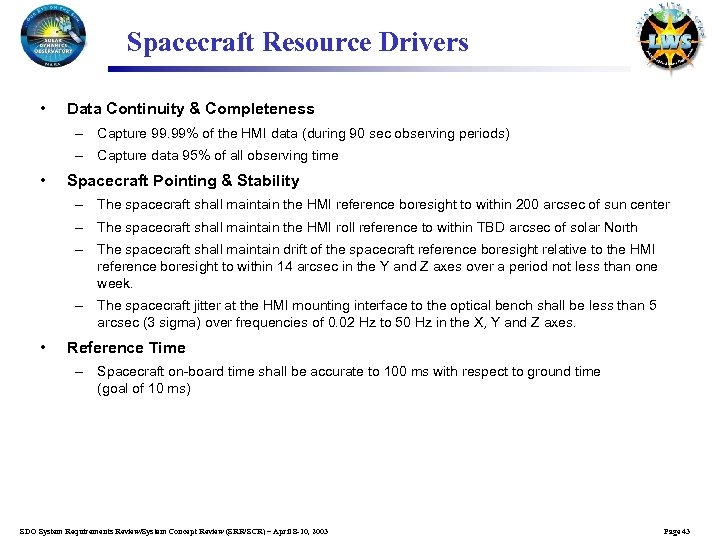
Spacecraft Resource Drivers • Data Continuity & Completeness – Capture 99. 99% of the HMI data (during 90 sec observing periods) – Capture data 95% of all observing time • Spacecraft Pointing & Stability – The spacecraft shall maintain the HMI reference boresight to within 200 arcsec of sun center – The spacecraft shall maintain the HMI roll reference to within TBD arcsec of solar North – The spacecraft shall maintain drift of the spacecraft reference boresight relative to the HMI reference boresight to within 14 arcsec in the Y and Z axes over a period not less than one week. – The spacecraft jitter at the HMI mounting interface to the optical bench shall be less than 5 arcsec (3 sigma) over frequencies of 0. 02 Hz to 50 Hz in the X, Y and Z axes. • Reference Time – Spacecraft on-board time shall be accurate to 100 ms with respect to ground time (goal of 10 ms) SDO System Requirements Review/System Concept Review (SRR/SCR) – April 8 -10, 2003 Page 43
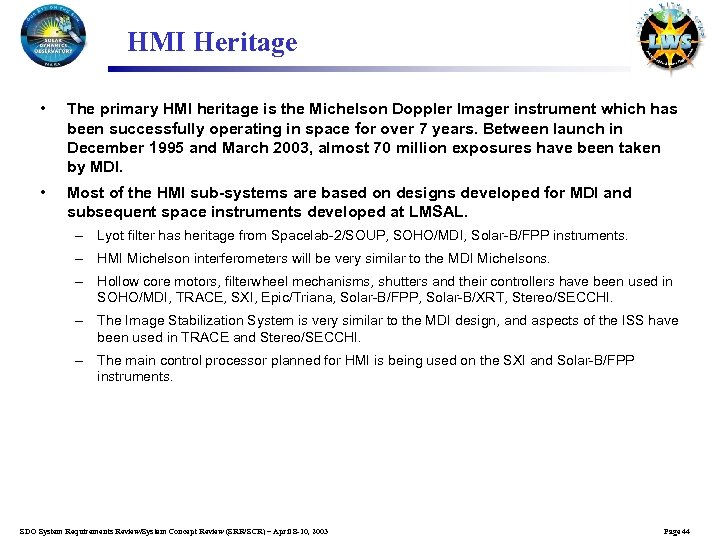
HMI Heritage • The primary HMI heritage is the Michelson Doppler Imager instrument which has been successfully operating in space for over 7 years. Between launch in December 1995 and March 2003, almost 70 million exposures have been taken by MDI. • Most of the HMI sub-systems are based on designs developed for MDI and subsequent space instruments developed at LMSAL. – Lyot filter has heritage from Spacelab-2/SOUP, SOHO/MDI, Solar-B/FPP instruments. – HMI Michelson interferometers will be very similar to the MDI Michelsons. – Hollow core motors, filterwheel mechanisms, shutters and their controllers have been used in SOHO/MDI, TRACE, SXI, Epic/Triana, Solar-B/FPP, Solar-B/XRT, Stereo/SECCHI. – The Image Stabilization System is very similar to the MDI design, and aspects of the ISS have been used in TRACE and Stereo/SECCHI. – The main control processor planned for HMI is being used on the SXI and Solar-B/FPP instruments. SDO System Requirements Review/System Concept Review (SRR/SCR) – April 8 -10, 2003 Page 44
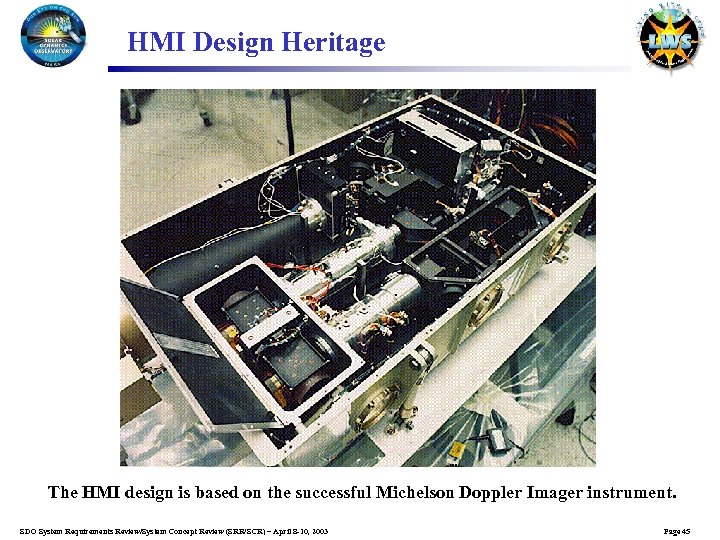
HMI Design Heritage The HMI design is based on the successful Michelson Doppler Imager instrument. SDO System Requirements Review/System Concept Review (SRR/SCR) – April 8 -10, 2003 Page 45
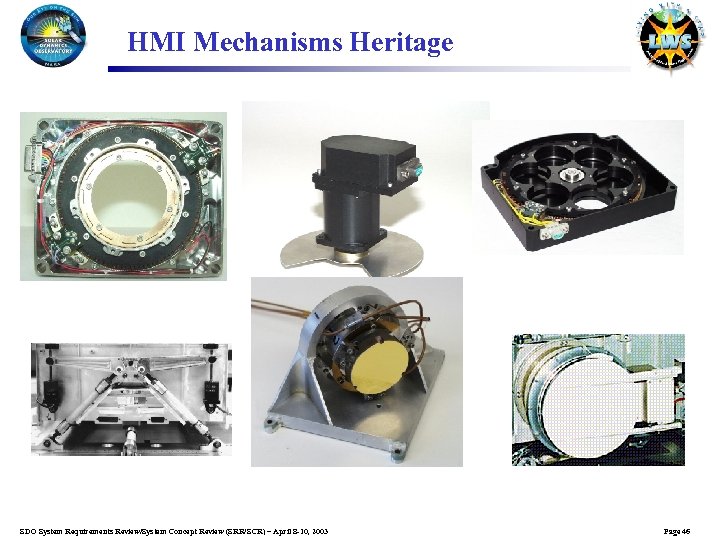
HMI Mechanisms Heritage SDO System Requirements Review/System Concept Review (SRR/SCR) – April 8 -10, 2003 Page 46
HMI Technology Readiness Level SDO System Requirements Review/System Concept Review (SRR/SCR) – April 8 -10, 2003 Page 47
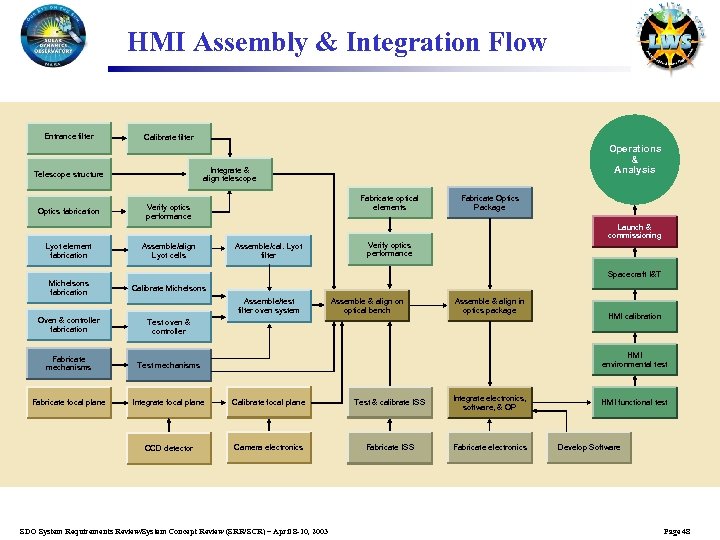
HMI Assembly & Integration Flow Entrance filter Calibrate filter Integrate & align telescope Telescope structure Optics fabrication Operations & Analysis Fabricate optical elements Verify optics performance Fabricate Optics Package Launch & commissioning Lyot element fabrication Assemble/align Lyot cells Michelsons fabrication Assemble/cal. Lyot filter Verify optics performance Calibrate Michelsons Spacecraft I&T Assemble/test filter oven system Assemble & align on optical bench Assemble & align in optics package Oven & controller fabrication Test oven & controller Fabricate mechanisms Test mechanisms Fabricate focal plane Integrate focal plane Calibrate focal plane Test & calibrate ISS Integrate electronics, software, & OP CCD detector Camera electronics Fabricate ISS Fabricate electronics HMI calibration HMI environmental test SDO System Requirements Review/System Concept Review (SRR/SCR) – April 8 -10, 2003 HMI functional test Develop Software Page 48
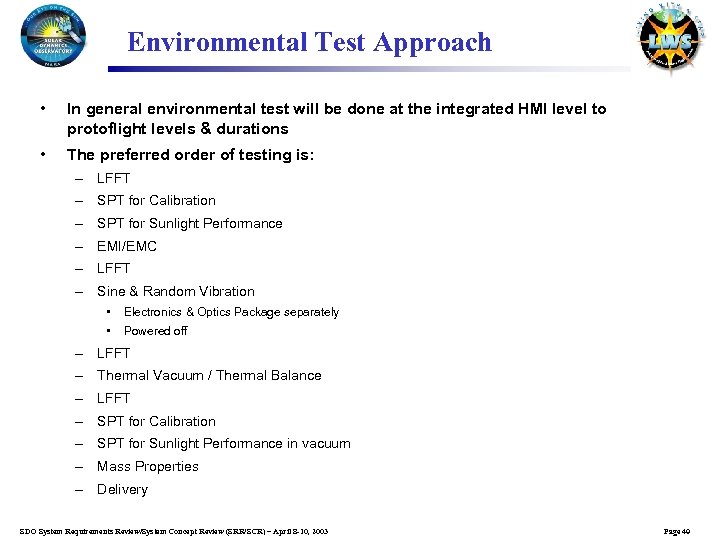
Environmental Test Approach • In general environmental test will be done at the integrated HMI level to protoflight levels & durations • The preferred order of testing is: – LFFT – SPT for Calibration – SPT for Sunlight Performance – EMI/EMC – LFFT – Sine & Random Vibration • Electronics & Optics Package separately • Powered off – LFFT – Thermal Vacuum / Thermal Balance – LFFT – SPT for Calibration – SPT for Sunlight Performance in vacuum – Mass Properties – Delivery SDO System Requirements Review/System Concept Review (SRR/SCR) – April 8 -10, 2003 Page 49
Instrument Calibration Approach • Critical subsystems will be calibrated at LMSAL prior to integration these include – The CCD cameras – The Michelsons – The Lyot filter – Mechanisms – Other optical elements • The completed HMI will be calibrated at LMSAL using lasers, the stimulus telescope and the Sun • The completed HMI will be calibrated at LMSAL in vacuum using both the stimulus telescope and the Sun SDO System Requirements Review/System Concept Review (SRR/SCR) – April 8 -10, 2003 Page 50
Functional Test Approach • HMI will use a structured test approach so that the test at each point in the program can be appropriate to the need and consistent test results can be obtained • The tests will be controlled by STOL procedures running in the EGSE and will use released test procedures • The Aliveness test will run in less than 30 minutes and will do a quick test of the major subsystems • The Short Form Functional Test (SFFT) will run in a few hours and will test all subsystems but will not test all modes or paths. It will not require the stimulus telescope • The Long Form Functional Test (LFFT) will run in about 8 hours and will attempt to cover all paths and major modes. The SFFT is a subset of the LFFT. The LFFT will require the use of the stimulus telescope • Special Performance Tests (SPT) are tests that measure a specific aspect of the HMI performance. These are detailed test that require the stimulus telescope or other special setups. They are used only a few times in the program SDO System Requirements Review/System Concept Review (SRR/SCR) – April 8 -10, 2003 Page 51
HMI Functional Test on Observatory • SFFT / LFFT / SPT are derived from Instrument level tests • We assume that GSFC will provide an interface to the HMI EGSE so the same EGSE system can be used to test HMI after integration onto the spacecraft • We will use the HMI stimulus telescope to verify HMI calibration while HMI is mounted on the spacecraft • We recommend the inclusion of a spacecraft level jitter compatibility test SDO System Requirements Review/System Concept Review (SRR/SCR) – April 8 -10, 2003 Page 52
Schedule and Critical Path SDO System Requirements Review/System Concept Review (SRR/SCR) – April 8 -10, 2003 Page 53
Risks Assessment – Instrument Development • Filter performance: – The Lyot filter and Michelson interferometers are the heart of the HMI instrument. Although we have previously built these filters for the MDI instrument, there are relatively few vendors with the specialized skills necessary for their fabrication. We are working aggressively to develop detailed filter specifications and identify potential vendors. • Mechanisms longevity : – Although the hollow core motor and shutter planned for HMI have significant flight heritage, the required number of mechanism moves is of concern. Lifetests of the hollow core motors and shutters are planned to validate their performance for the planned SDO mission duration. • Thermal performance: – The thermal stability of the HMI instrument is critical to achieving it’s ultimate performance. Detailed thermal modeling and subsystem thermal testing will be used to optimize thermal design. SDO System Requirements Review/System Concept Review (SRR/SCR) – April 8 -10, 2003 Page 54
Risks Assessment - Programmatic • HMI camera electronics has potential schedule/cost impact: – Obtaining SECHHI derived camera electronics from the Rutherford Appleton Laboratory in the UK is a viable option for HMI, but the development schedule is not know in detail. If this option is chosen, we feel it is best that we obtain the camera electronics directly from RAL. – A modified Solar-B/FPP camera electronics developed by LMSAL will also meet the HMI requirements. This option has less schedule risk, but costs and camera power and mass are higher than the RAL camera. • Timely negotiation of HMI Product Assurance Implementation Plan SDO System Requirements Review/System Concept Review (SRR/SCR) – April 8 -10, 2003 Page 55
Скачать презентацию Solar Dynamics Observatory System Concept Review Helioseismic and
423bf5b389365b76b8efa6cbd86adde4.ppt