


 Скачать презентацию SOL VUS 2 VUS 3 Where did
b1e65a971ef54680fdb9c1dfe4017782.ppt
- Количество слайдов: 16
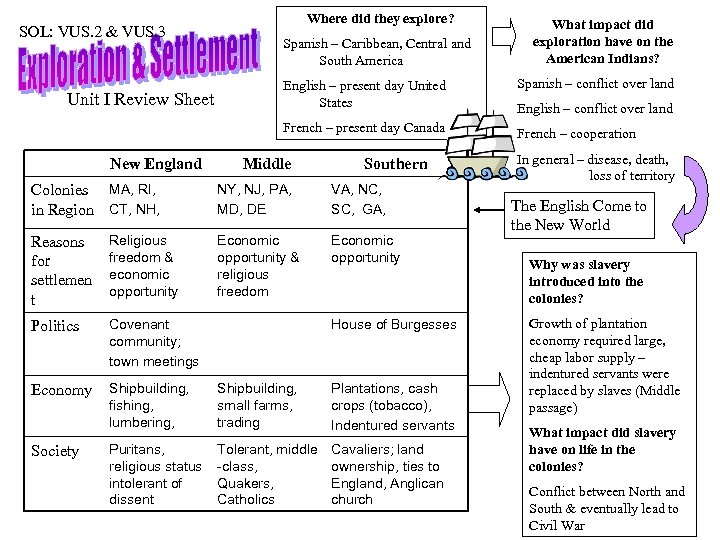 SOL: VUS. 2 & VUS. 3 Where did they explore? Spanish – Caribbean, Central and South America What impact did exploration have on the American Indians? New England Colonies MA, RI, in Region CT, NH, Spanish – conflict over land French – present day Canada Unit I Review Sheet English – present day United States French – cooperation Middle Southern NY, NJ, PA, MD, DE VA, NC, SC, GA, Economic opportunity & religious freedom Economic opportunity Reasons for settlemen t Religious freedom & economic opportunity Politics Covenant community; town meetings Economy Shipbuilding, fishing, lumbering, Shipbuilding, small farms, trading Plantations, cash crops (tobacco), Indentured servants Puritans, religious status intolerant of dissent Tolerant, middle -class, Quakers, Catholics Cavaliers; land ownership, ties to England, Anglican church Society House of Burgesses English – conflict over land In general – disease, death, loss of territory The English Come to the New World Why was slavery introduced into the colonies? Growth of plantation economy required large, cheap labor supply – indentured servants were replaced by slaves (Middle passage) What impact did slavery have on life in the colonies? Conflict between North and South & eventually lead to Civil War
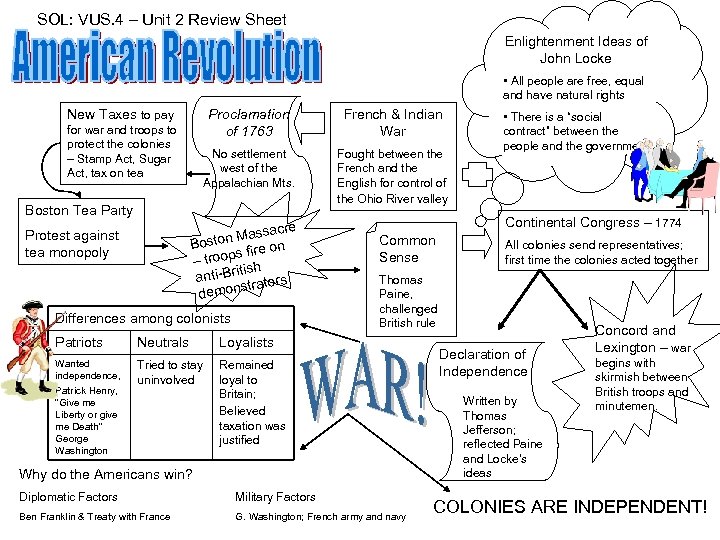 SOL: VUS. 4 – Unit 2 Review Sheet Enlightenment Ideas of John Locke • All people are free, equal and have natural rights New Taxes to pay Proclamation of 1763 No settlement west of the Appalachian Mts. for war and troops to protect the colonies – Stamp Act, Sugar Act, tax on tea French & Indian War Fought between the French and the English for control of the Ohio River valley Boston Tea Party e assacr oston M e on B s fir – troop h itis anti-Br ators str demon Protest against tea monopoly Differences among colonists Patriots Neutrals Tried to stay uninvolved Continental Congress – 1774 Common Sense All colonies send representatives; first time the colonies acted together Thomas Paine, challenged British rule Loyalists Wanted independence, Patrick Henry, “Give me Liberty or give me Death” George Washington • There is a “social contract” between the people and the government. Remained loyal to Britain; Believed taxation was justified Why do the Americans win? Diplomatic Factors Military Factors Ben Franklin & Treaty with France G. Washington; French army and navy Declaration of Independence Written by Thomas Jefferson; reflected Paine and Locke’s ideas Concord and Lexington – war begins with skirmish between British troops and minutemen. COLONIES ARE INDEPENDENT!
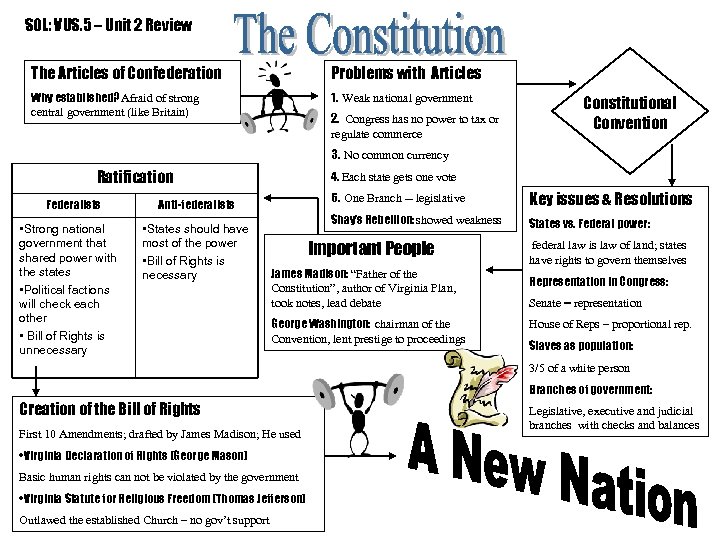 SOL: VUS. 5 – Unit 2 Review The Articles of Confederation Problems with Articles Why established? Afraid of strong central government (like Britain) 1. Weak national government 2. Congress has no power to tax or regulate commerce Constitutional Convention 3. No common currency Ratification Federalists • Strong national government that shared power with the states • Political factions will check each other • Bill of Rights is unnecessary 4. Each state gets one vote 5. One Branch -- legislative • States should have most of the power • Bill of Rights is necessary Key issues & Resolutions Shay’s Rebellion: showed weakness Anti-federalists States vs. Federal power: Important People James Madison: “Father of the Constitution”, author of Virginia Plan, took notes, lead debate George Washington: chairman of the Convention, lent prestige to proceedings federal law is law of land; states have rights to govern themselves Representation in Congress: Senate = representation House of Reps – proportional rep. Slaves as population: 3/5 of a white person Branches of government: Creation of the Bill of Rights First 10 Amendments; drafted by James Madison; He used • Virginia Declaration of Rights (George Mason) Basic human rights can not be violated by the government • Virginia Statute for Religious Freedom (Thomas Jefferson) Outlawed the established Church – no gov’t support Legislative, executive and judicial branches with checks and balances
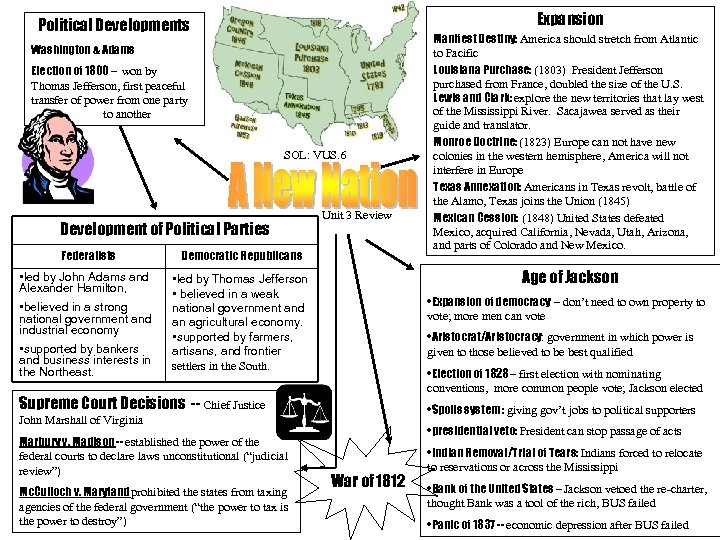 Expansion Political Developments Washington & Adams Election of 1800 – won by Thomas Jefferson, first peaceful transfer of power from one party to another SOL: VUS. 6 Development of Political Parties Federalists Democratic Republicans • led by John Adams and Alexander Hamilton, • believed in a strong national government and industrial economy • supported by bankers and business interests in the Northeast. Unit 3 Review • led by Thomas Jefferson • believed in a weak national government and an agricultural economy. • supported by farmers, artisans, and frontier settlers in the South. Age of Jackson • Expansion of democracy – don’t need to own property to vote; more men can vote • Aristocrat/Aristocracy: government in which power is given to those believed to be best qualified • Election of 1828 – first election with nominating conventions, more common people vote; Jackson elected Supreme Court Decisions -- Chief Justice • Spoils system : giving gov’t jobs to political supporters John Marshall of Virginia Marbury v. Madison -- established the power of the federal courts to declare laws unconstitutional (“judicial review”) Mc. Culloch v. Maryland prohibited the states from taxing agencies of the federal government (“the power to tax is the power to destroy”) Manifest Destiny: America should stretch from Atlantic to Pacific Louisiana Purchase: (1803) President Jefferson purchased from France, doubled the size of the U. S. Lewis and Clark: explore the new territories that lay west of the Mississippi River. Sacajawea served as their guide and translator. Monroe Doctrine: (1823) Europe can not have new colonies in the western hemisphere, America will not interfere in Europe Texas Annexation: Americans in Texas revolt, battle of the Alamo, Texas joins the Union (1845) Mexican Cession: (1848) United States defeated Mexico, acquired California, Nevada, Utah, Arizona, and parts of Colorado and New Mexico. • presidential veto: President can stop passage of acts War of 1812 • Indian Removal/Trial of Tears: Indians forced to relocate to reservations or across the Mississippi • Bank of the United States – Jackson vetoed the re-charter, thought Bank was a tool of the rich, BUS failed • Panic of 1837 -- economic depression after BUS failed
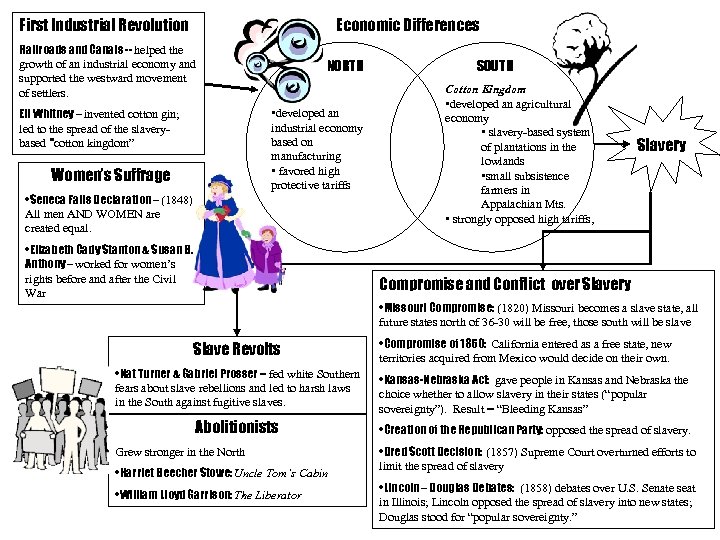 First Industrial Revolution Economic Differences Railroads and Canals -- helped the growth of an industrial economy and supported the westward movement of settlers. Eli Whitney – invented cotton gin; led to the spread of the slaverybased “cotton kingdom” Women’s Suffrage • Seneca Falls Declaration – (1848) All men AND WOMEN are created equal. NORTH • developed an industrial economy based on manufacturing • favored high protective tariffs • Elizabeth Cady Stanton & Susan B. Anthony – worked for women’s rights before and after the Civil War SOUTH Cotton Kingdom • developed an agricultural economy • slavery-based system of plantations in the lowlands • small subsistence farmers in Appalachian Mts. • strongly opposed high tariffs, Slavery Compromise and Conflict over Slavery • Missouri Compromise: (1820) Missouri becomes a slave state, all future states north of 36 -30 will be free, those south will be slave Slave Revolts • Nat Turner & Gabriel Prosser -- fed white Southern fears about slave rebellions and led to harsh laws in the South against fugitive slaves. Abolitionists Grew stronger in the North • Harriet Beecher Stowe: Uncle Tom’s Cabin • William Lloyd Garrison: The Liberator • Compromise of 1850: California entered as a free state, new territories acquired from Mexico would decide on their own. • Kansas-Nebraska Act: gave people in Kansas and Nebraska the choice whether to allow slavery in their states (“popular sovereignty”). Result = “Bleeding Kansas” • Creation of the Republican Party: opposed the spread of slavery. • Dred Scott Decision: (1857) Supreme Court overturned efforts to limit the spread of slavery • Lincoln – Douglas Debates: (1858) debates over U. S. Senate seat in Illinois; Lincoln opposed the spread of slavery into new states; Douglas stood for “popular sovereignty. ”
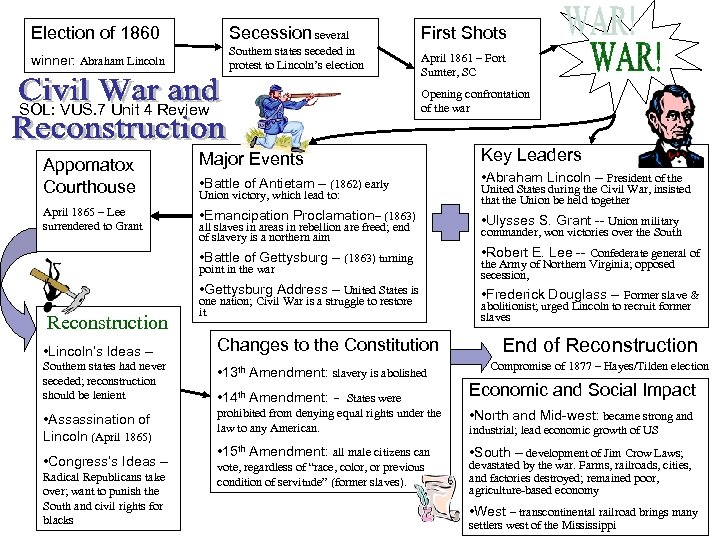 Election of 1860 Secession several winner: Abraham Lincoln Southern states seceded in protest to Lincoln’s election First Shots April 1861 – Fort Sumter, SC Opening confrontation of the war SOL: VUS. 7 Unit 4 Review Appomatox Courthouse Major Events Key Leaders • Battle of Antietam – (1862) early • Abraham Lincoln – President of the April 1865 – Lee surrendered to Grant • Emancipation Proclamation– (1863) • Ulysses S. Grant -- Union military Union victory, which lead to: all slaves in areas in rebellion are freed; end of slavery is a northern aim United States during the Civil War, insisted that the Union be held together commander, won victories over the South • Battle of Gettysburg – (1863) turning • Robert E. Lee -- Confederate general of • Gettysburg Address – United States is • Frederick Douglass -- Former slave & point in the war Reconstruction • Lincoln’s Ideas – one nation; Civil War is a struggle to restore it Changes to the Constitution the Army of Northern Virginia; opposed secession, abolitionist; urged Lincoln to recruit former slaves End of Reconstruction Compromise of 1877 – Hayes/Tilden election Southern states had never seceded; reconstruction should be lenient • 13 th Amendment: slavery is abolished • Assassination of Lincoln (April 1865) prohibited from denying equal rights under the law to any American. • North and Mid-west: became strong and • 15 th Amendment: all male citizens can • South – development of Jim Crow Laws; • Congress’s Ideas – Radical Republicans take over; want to punish the South and civil rights for blacks • 14 th Amendment: – States were vote, regardless of “race, color, or previous condition of servitude” (former slaves). Economic and Social Impact industrial; lead economic growth of US devastated by the war. Farms, railroads, cities, and factories destroyed; remained poor, agriculture-based economy • West – transcontinental railroad brings many settlers west of the Mississippi
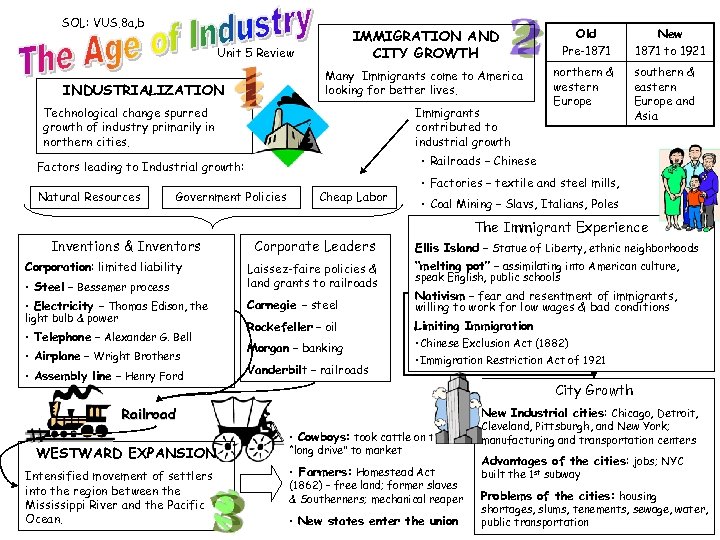 SOL: VUS. 8 a, b IMMIGRATION AND CITY GROWTH Old Pre-1871 Many Immigrants come to America looking for better lives. northern & western Europe Unit 5 Review INDUSTRIALIZATION Immigrants contributed to industrial growth Technological change spurred growth of industry primarily in northern cities. Government Policies Inventions & Inventors Corporation: limited liability Cheap Labor Corporate Leaders • Steel – Bessemer process Laissez-faire policies & land grants to railroads • Electricity – Thomas Edison, the Carnegie – steel light bulb & power • Telephone – Alexander G. Bell • Airplane – Wright Brothers • Assembly line – Henry Ford Rockefeller – oil Morgan – banking Vanderbilt – railroads • Factories – textile and steel mills, • Coal Mining – Slavs, Italians, Poles The Immigrant Experience Ellis Island – Statue of Liberty, ethnic neighborhoods “melting pot” – assimilating into American culture, speak English, public schools Nativism – fear and resentment of immigrants, willing to work for low wages & bad conditions Limiting Immigration • Chinese Exclusion Act (1882) • Immigration Restriction Act of 1921 City Growth Railroad WESTWARD EXPANSION Intensified movement of settlers into the region between the Mississippi River and the Pacific Ocean. southern & eastern Europe and Asia • Railroads – Chinese Factors leading to Industrial growth: Natural Resources New 1871 to 1921 New Industrial cities: Chicago, Detroit, • Cowboys: took cattle on the “long drive” to market • Farmers: Homestead Act (1862) – free land; former slaves & Southerners; mechanical reaper • New states enter the union Cleveland, Pittsburgh, and New York; manufacturing and transportation centers Advantages of the cities: jobs; NYC built the 1 st subway Problems of the cities: housing shortages, slums, tenements, sewage, water, public transportation
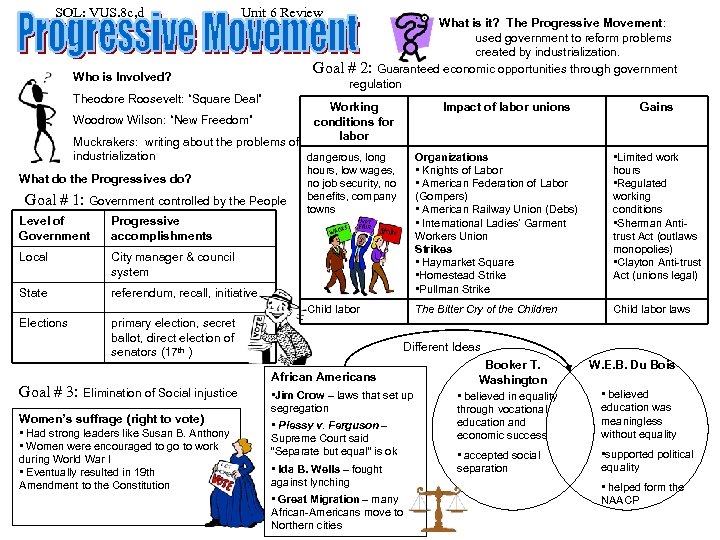 SOL: VUS. 8 c, d Unit 6 Review What is it? The Progressive Movement: used government to reform problems created by industrialization. Goal # 2: Guaranteed economic opportunities through government regulation Who is Involved? Theodore Roosevelt: “Square Deal” Working conditions for labor Woodrow Wilson: “New Freedom” Impact of labor unions Muckrakers: writing about the problems of industrialization dangerous, long What do the Progressives do? Goal # 1: Government controlled by the People Level of Government Progressive accomplishments Local primary election, secret ballot, direct election of senators (17 th ) Child labor Goal # 3: Elimination of Social injustice Women’s suffrage (right to vote) • Had strong leaders like Susan B. Anthony • Women were encouraged to go to work during World War I • Eventually resulted in 19 th Amendment to the Constitution • Limited work hours • Regulated working conditions • Sherman Antitrust Act (outlaws monopolies) • Clayton Anti-trust Act (unions legal) The Bitter Cry of the Children referendum, recall, initiative Elections Organizations • Knights of Labor • American Federation of Labor (Gompers) • American Railway Union (Debs) • International Ladies’ Garment Workers Union Strikes • Haymarket Square • Homestead Strike • Pullman Strike hours, low wages, no job security, no benefits, company towns City manager & council system State Gains Child labor laws Different Ideas African Americans • Jim Crow – laws that set up segregation • Plessy v. Ferguson – Supreme Court said “Separate but equal” is ok • Ida B. Wells – fought against lynching • Great Migration – many African-Americans move to Northern cities Booker T. Washington W. E. B. Du Bois • believed in equality through vocational education and economic success • believed education was meaningless without equality • accepted social separation • supported political equality • helped form the NAACP
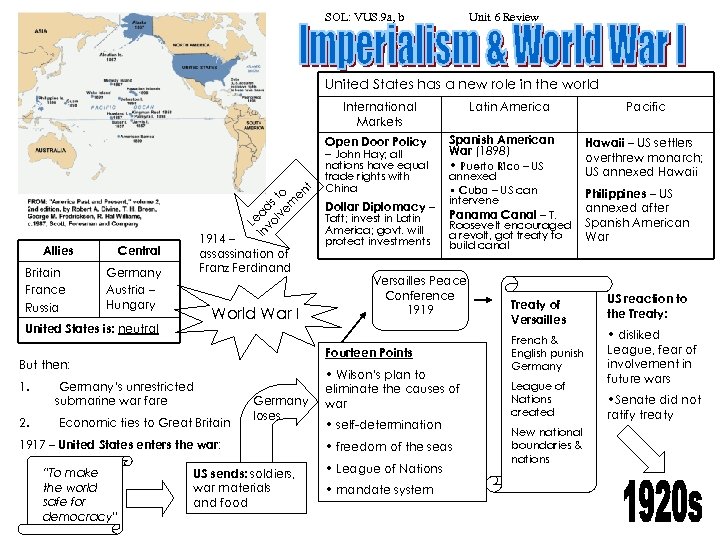 SOL: VUS. 9 a, b Unit 6 Review United States has a new role in the world International Markets in Le a vo ds lv to em en t Open Door Policy – John Hay; all Allies Britain France Russia 1914 – assassination of Franz Ferdinand Central Germany Austria – Hungary World War I United States is: neutral Dollar Diplomacy – Taft; invest in Latin America; govt. will protect investments 1. Germany’s unrestricted submarine war fare 2. Economic ties to Great Britain Germany loses 1917 – United States enters the war: US sends: soldiers, war materials and food Hawaii – US settlers overthrew monarch; US annexed Hawaii Panama Canal – T. Philippines – US annexed after Spanish American War annexed • Cuba – US can intervene Roosevelt encouraged a revolt, got treaty to build canal Versailles Peace Conference 1919 • Wilson’s plan to eliminate the causes of war • self-determination • freedom of the seas • League of Nations • mandate system Pacific Spanish American War (1898) • Puerto Rico – US Fourteen Points But then: “To make the world safe for democracy” nations have equal trade rights with China Latin America Treaty of Versailles French & English punish Germany League of Nations created New national boundaries & nations US reaction to the Treaty: • disliked League, fear of involvement in future wars • Senate did not ratify treaty
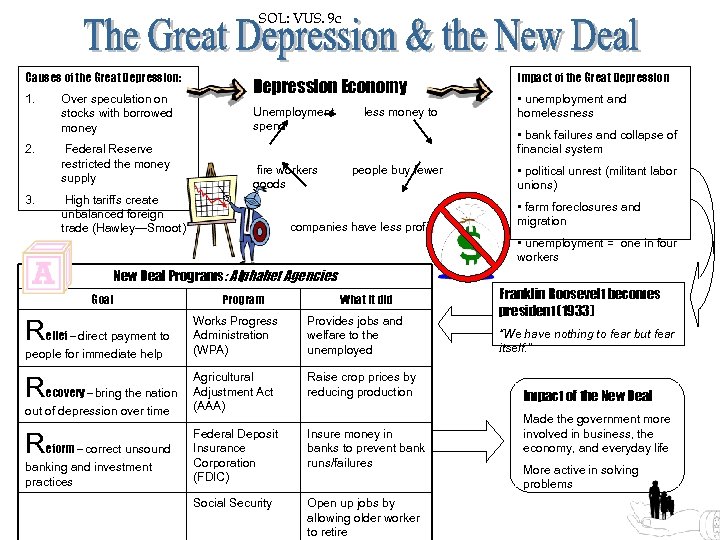 SOL: VUS. 9 c Causes of the Great Depression: 1. 2. 3. Over speculation on stocks with borrowed money Federal Reserve restricted the money supply Depression Economy Unemployment spend fire workers goods High tariffs create unbalanced foreign trade (Hawley—Smoot) less money to Impact of the Great Depression • unemployment and homelessness • bank failures and collapse of financial system people buy fewer companies have less profit • political unrest (militant labor unions) • farm foreclosures and migration • unemployment = one in four workers New Deal Programs: Alphabet Agencies Goal Relief – direct payment to people for immediate help Recovery – bring the nation out of depression over time Reform – correct unsound banking and investment practices Program What it did Works Progress Administration (WPA) Provides jobs and welfare to the unemployed Agricultural Adjustment Act (AAA) Raise crop prices by reducing production Federal Deposit Insurance Corporation (FDIC) Insure money in banks to prevent bank runs/failures Social Security Open up jobs by allowing older worker to retire Franklin Roosevelt becomes president (1933) “We have nothing to fear but fear itself. ” Impact of the New Deal Made the government more involved in business, the economy, and everyday life More active in solving problems
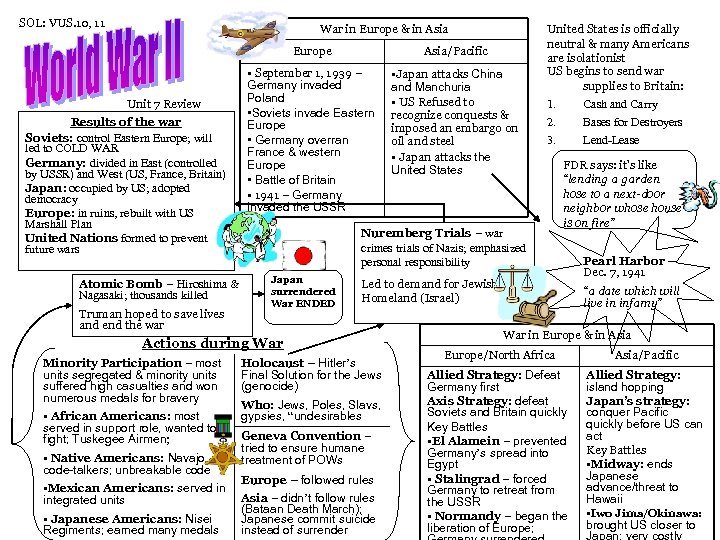 SOL: VUS. 10, 11 War in Europe & in Asia Europe • September 1, 1939 – Germany invaded Poland • Soviets invade Eastern Europe • Germany overran France & western Europe • Battle of Britain • 1941 – Germany invaded the USSR Unit 7 Review Results of the war Soviets: control Eastern Europe; will led to COLD WAR Germany: divided in East (controlled by USSR) and West (US, France, Britain) Japan: occupied by US; adopted democracy Europe: in ruins, rebuilt with US Marshall Plan United Nations formed to prevent future wars • Japan attacks China and Manchuria • US Refused to recognize conquests & imposed an embargo on oil and steel • Japan attacks the United States Japan surrendered War ENDED • African Americans: most served in support role, wanted to fight; Tuskegee Airmen; • Native Americans: Navajo code-talkers; unbreakable code • Mexican Americans: served in integrated units • Japanese Americans: Nisei Regiments; earned many medals Cash and Carry Bases for Destroyers Lend-Lease FDR says: it’s like “lending a garden hose to a next-door neighbor whose house is on fire” Led to demand for Jewish Homeland (Israel) Actions during War Minority Participation – most units segregated & minority units suffered high casualties and won numerous medals for bravery 1. 2. 3. Nuremberg Trials – war crimes trials of Nazis; emphasized personal responsibility Atomic Bomb – Hiroshima & Nagasaki; thousands killed Truman hoped to save lives and end the war Asia/Pacific United States is officially neutral & many Americans are isolationist US begins to send war supplies to Britain: Holocaust – Hitler’s Final Solution for the Jews (genocide) Who: Jews, Poles, Slavs, gypsies, “undesirables Geneva Convention – tried to ensure humane treatment of POWs Europe – followed rules Asia – didn’t follow rules (Bataan Death March); Japanese commit suicide instead of surrender Pearl Harbor -Dec. 7, 1941 “a date which will live in infamy” War in Europe & in Asia Europe/North Africa Asia/Pacific Allied Strategy: Defeat Germany first Axis Strategy: defeat Soviets and Britain quickly Key Battles • El Alamein – prevented Germany’s spread into Egypt • Stalingrad – forced Germany to retreat from the USSR • Normandy – began the liberation of Europe; Allied Strategy: island hopping Japan’s strategy: conquer Pacific quickly before US can act Key Battles • Midway: ends Japanese advance/threat to Hawaii • Iwo Jima/Okinawa: brought US closer to
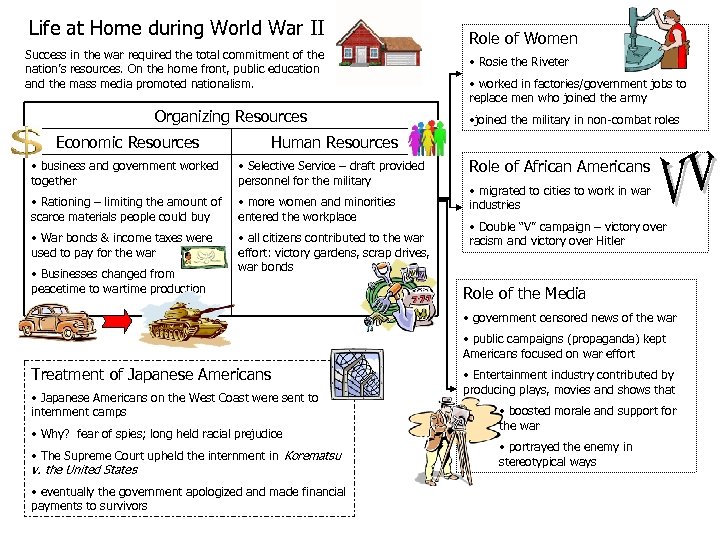 Life at Home during World War II Success in the war required the total commitment of the nation’s resources. On the home front, public education and the mass media promoted nationalism. Organizing Resources Economic Resources • Selective Service – draft provided personnel for the military • Rationing – limiting the amount of scarce materials people could buy • more women and minorities entered the workplace • War bonds & income taxes were used to pay for the war • all citizens contributed to the war effort: victory gardens, scrap drives, war bonds • Rosie the Riveter • worked in factories/government jobs to replace men who joined the army • joined the military in non-combat roles Human Resources • business and government worked together Role of Women • Businesses changed from peacetime to wartime production Role of African Americans • migrated to cities to work in war industries • Double “V” campaign – victory over racism and victory over Hitler Role of the Media • government censored news of the war • public campaigns (propaganda) kept Americans focused on war effort Treatment of Japanese Americans • Japanese Americans on the West Coast were sent to internment camps • Why? fear of spies; long held racial prejudice • The Supreme Court upheld the internment in Korematsu v. the United States • eventually the government apologized and made financial payments to survivors • Entertainment industry contributed by producing plays, movies and shows that • boosted morale and support for the war • portrayed the enemy in stereotypical ways
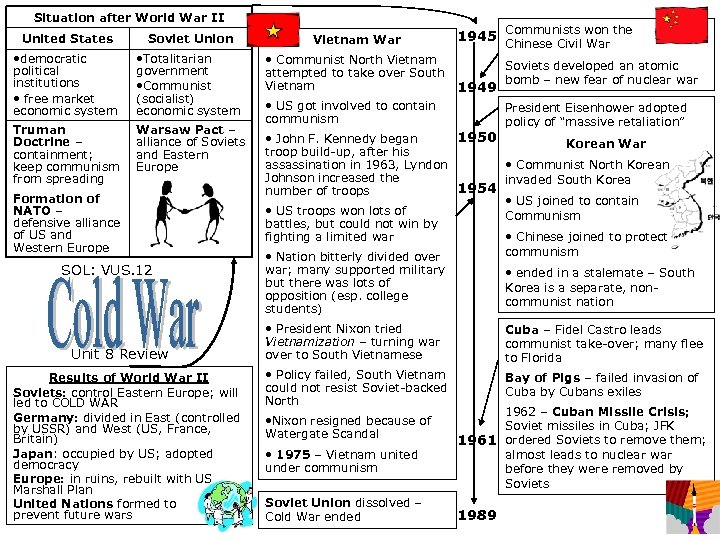 Situation after World War II United States Soviet Union Vietnam War • democratic political institutions • free market economic system • Totalitarian government • Communist (socialist) economic system • Communist North Vietnam attempted to take over South Vietnam Truman Doctrine – containment; keep communism from spreading Warsaw Pact – alliance of Soviets and Eastern Europe Formation of NATO – defensive alliance of US and Western Europe SOL: VUS. 12 Unit 8 Review Results of World War II Soviets: control Eastern Europe; will led to COLD WAR Germany: divided in East (controlled by USSR) and West (US, France, Britain) Japan: occupied by US; adopted democracy Europe: in ruins, rebuilt with US Marshall Plan United Nations formed to prevent future wars Communists won the 1945 Chinese Civil War 1949 • US got involved to contain communism Soviets developed an atomic bomb – new fear of nuclear war President Eisenhower adopted policy of “massive retaliation” 1950 • John F. Kennedy began Korean War troop build-up, after his • Communist North Korean assassination in 1963, Lyndon Johnson increased the invaded South Korea 1954 number of troops • US joined to contain • US troops won lots of Communism battles, but could not win by • Chinese joined to protect fighting a limited war communism • Nation bitterly divided over war; many supported military but there was lots of opposition (esp. college students) • ended in a stalemate – South Korea is a separate, noncommunist nation • President Nixon tried Vietnamization – turning war over to South Vietnamese Cuba – Fidel Castro leads communist take-over; many flee to Florida • Policy failed, South Vietnam could not resist Soviet-backed North Bay of Pigs – failed invasion of Cuba by Cubans exiles • Nixon resigned because of Watergate Scandal • 1975 – Vietnam united under communism Soviet Union dissolved – Cold War ended 1962 – Cuban Missile Crisis; Soviet missiles in Cuba; JFK 1961 ordered Soviets to remove them; almost leads to nuclear war before they were removed by Soviets 1989
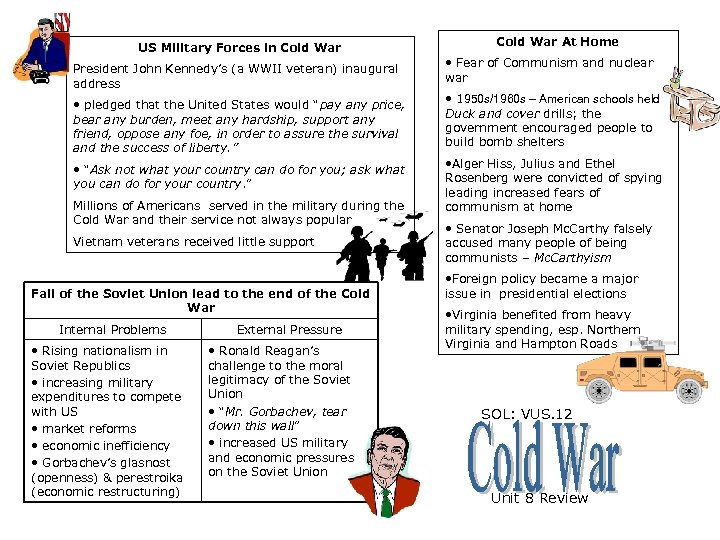 US Military Forces in Cold War At Home President John Kennedy’s (a WWII veteran) inaugural address • Fear of Communism and nuclear war • pledged that the United States would “pay any price, bear any burden, meet any hardship, support any friend, oppose any foe, in order to assure the survival and the success of liberty. ” • 1950 s/1960 s – American schools held Duck and cover drills; the government encouraged people to build bomb shelters • “Ask not what your country can do for you; ask what you can do for your country. ” • Alger Hiss, Julius and Ethel Rosenberg were convicted of spying leading increased fears of communism at home Millions of Americans served in the military during the Cold War and their service not always popular Vietnam veterans received little support Fall of the Soviet Union lead to the end of the Cold War Internal Problems • Rising nationalism in Soviet Republics • increasing military expenditures to compete with US • market reforms • economic inefficiency • Gorbachev’s glasnost (openness) & perestroika (economic restructuring) External Pressure • Ronald Reagan’s challenge to the moral legitimacy of the Soviet Union • “Mr. Gorbachev, tear down this wall” • increased US military and economic pressures on the Soviet Union • Senator Joseph Mc. Carthy falsely accused many people of being communists – Mc. Carthyism • Foreign policy became a major issue in presidential elections • Virginia benefited from heavy military spending, esp. Northern Virginia and Hampton Roads SOL: VUS. 12 Unit 8 Review
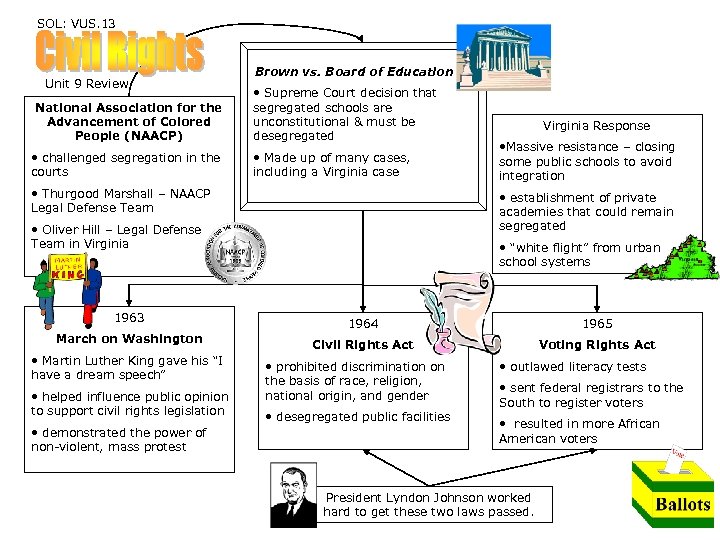 SOL: VUS. 13 Unit 9 Review National Association for the Advancement of Colored People (NAACP) • challenged segregation in the courts Brown vs. Board of Education • Supreme Court decision that segregated schools are unconstitutional & must be desegregated • Made up of many cases, including a Virginia case • Thurgood Marshall – NAACP Legal Defense Team Virginia Response • Massive resistance – closing some public schools to avoid integration • establishment of private academies that could remain segregated • Oliver Hill – Legal Defense Team in Virginia • “white flight” from urban school systems 1963 1964 1965 March on Washington Civil Rights Act Voting Rights Act • Martin Luther King gave his “I have a dream speech” • helped influence public opinion to support civil rights legislation • demonstrated the power of non-violent, mass protest • prohibited discrimination on the basis of race, religion, national origin, and gender • desegregated public facilities • outlawed literacy tests • sent federal registrars to the South to register voters • resulted in more African American voters President Lyndon Johnson worked hard to get these two laws passed.
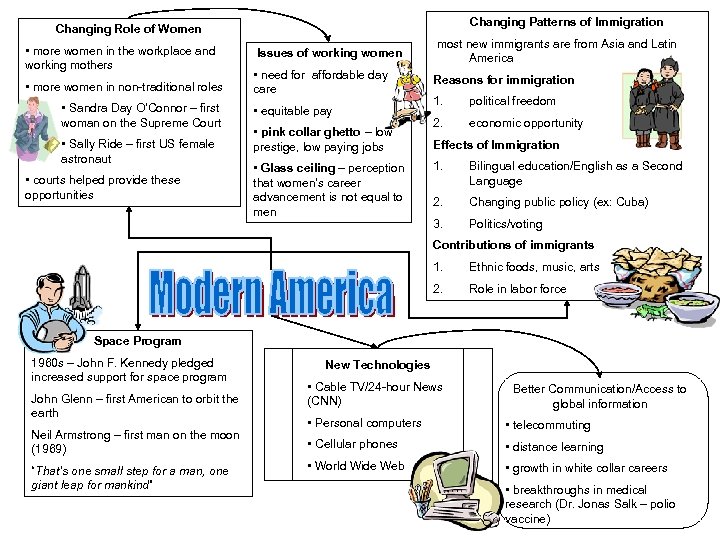 Changing Patterns of Immigration Changing Role of Women • more women in the workplace and working mothers • more women in non-traditional roles • Sandra Day O’Connor – first woman on the Supreme Court • Sally Ride – first US female astronaut • courts helped provide these opportunities Issues of working women most new immigrants are from Asia and Latin America • need for affordable day care Reasons for immigration • equitable pay • pink collar ghetto – low prestige, low paying jobs • Glass ceiling – perception that women’s career advancement is not equal to men 1. political freedom 2. economic opportunity Effects of Immigration 1. Bilingual education/English as a Second Language 2. Changing public policy (ex: Cuba) 3. Politics/voting Contributions of immigrants 1. Ethnic foods, music, arts 2. Role in labor force Space Program 1960 s – John F. Kennedy pledged increased support for space program John Glenn – first American to orbit the earth Neil Armstrong – first man on the moon (1969) “That’s one small step for a man, one giant leap for mankind” New Technologies • Cable TV/24 -hour News (CNN) Better Communication/Access to global information • Personal computers • telecommuting • Cellular phones • distance learning • World Wide Web • growth in white collar careers • breakthroughs in medical research (Dr. Jonas Salk – polio vaccine)