


 Скачать презентацию Soil Moisture Active and Passive SMAP Mission A
cd8422d587bc118a9b1df82b6f4e168c.ppt
- Количество слайдов: 24
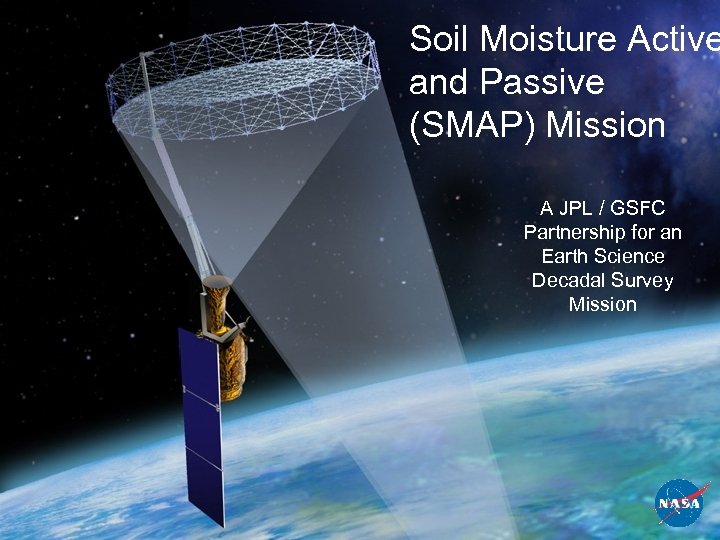 Soil Moisture Active and Passive (SMAP) Mission A JPL / GSFC Partnership for an Earth Science Decadal Survey Mission September, 2008 NAFE Workshop, Melbourne, Australia Peggy O’Neill, NASA / GSFC / 614. 3
 Outline • SMAP science – why do we care about soil moisture & FT • NRC Decadal Survey impetus • SMAP science objectives • Mission & instrument concept • SMAP science products & synergy September, 2008 NAFE Workshop, Melbourne, Australia Peggy O’Neill, NASA / GSFC / 614. 3
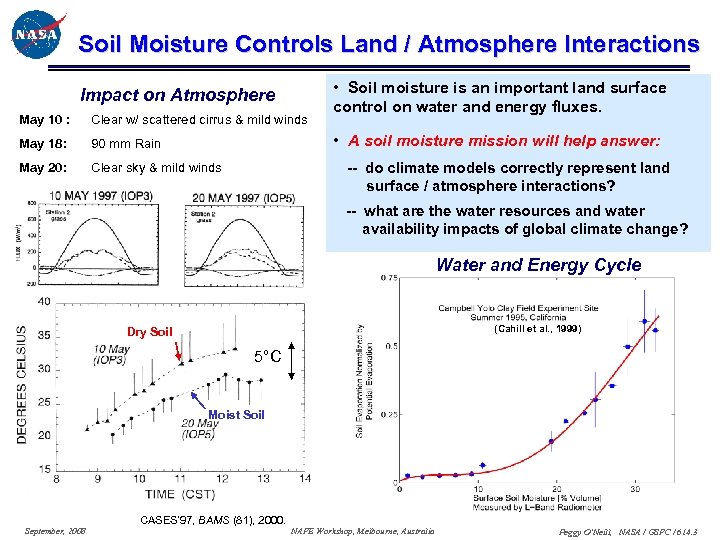 Soil Moisture Controls Land / Atmosphere Interactions Impact on Atmosphere May 10 : Clear w/ scattered cirrus & mild winds May 18: 90 mm Rain May 20: Clear sky & mild winds • Soil moisture is an important land surface control on water and energy fluxes. • A soil moisture mission will help answer: -- do climate models correctly represent land surface / atmosphere interactions? -- what are the water resources and water availability impacts of global climate change? Water and Energy Cycle (Cahill et al. , 1999) Dry Soil 5°C Moist Soil September, 2008 CASES’ 97, BAMS (81), 2000. NAFE Workshop, Melbourne, Australia Peggy O’Neill, NASA / GSFC / 614. 3
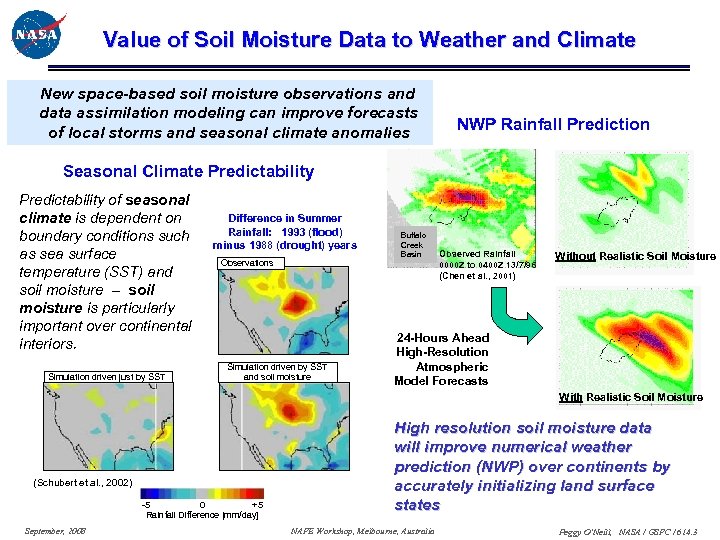 Value of Soil Moisture Data to Weather and Climate New space-based soil moisture observations and data assimilation modeling can improve forecasts of local storms and seasonal climate anomalies NWP Rainfall Prediction Seasonal Climate Predictability of seasonal climate is dependent on boundary conditions such as sea surface temperature (SST) and soil moisture – soil moisture is particularly important over continental interiors. Simulation driven just by SST Difference in Summer Rainfall: 1993 (flood) minus 1988 (drought) years Observations Simulation driven by SST and soil moisture Buffalo Creek Basin Observed Rainfall 0000 Z to 0400 Z 13/7/96 (Chen et al. , 2001) Without Realistic Soil Moisture 24 -Hours Ahead High-Resolution Atmospheric Model Forecasts With Realistic Soil Moisture (Schubert et al. , 2002) -5 0 +5 Rainfall Difference [mm/day] September, 2008 High resolution soil moisture data will improve numerical weather prediction (NWP) over continents by accurately initializing land surface states NAFE Workshop, Melbourne, Australia Peggy O’Neill, NASA / GSFC / 614. 3
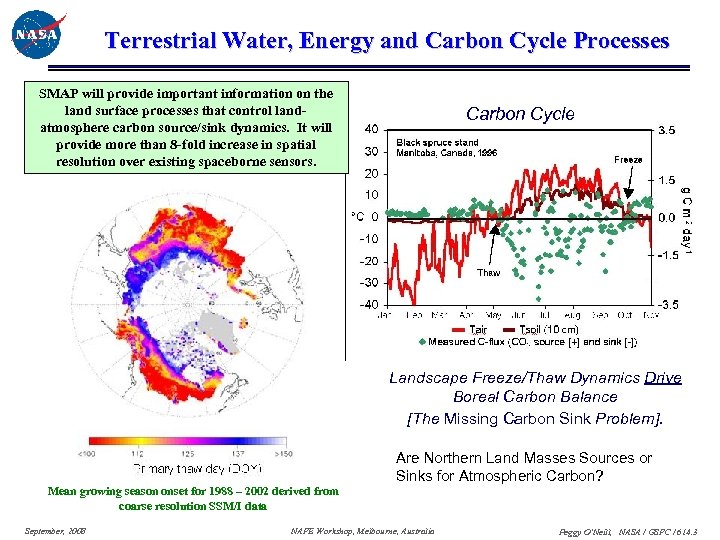 Terrestrial Water, Energy and Carbon Cycle Processes SMAP will provide important information on the land surface processes that control landatmosphere carbon source/sink dynamics. It will provide more than 8 -fold increase in spatial resolution over existing spaceborne sensors. Carbon Cycle Landscape Freeze/Thaw Dynamics Drive Boreal Carbon Balance [The Missing Carbon Sink Problem]. Are Northern Land Masses Sources or Sinks for Atmospheric Carbon? Mean growing season onset for 1988 – 2002 derived from coarse resolution SSM/I data September, 2008 NAFE Workshop, Melbourne, Australia Peggy O’Neill, NASA / GSFC / 614. 3
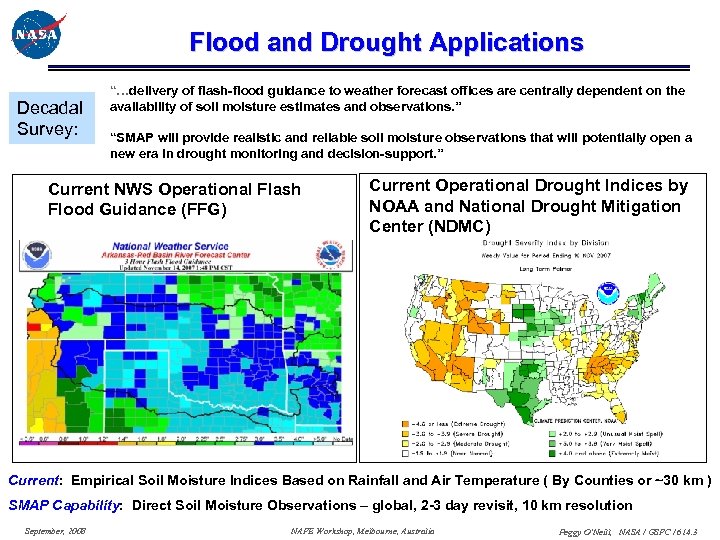 Flood and Drought Applications Decadal Survey: “…delivery of flash-flood guidance to weather forecast offices are centrally dependent on the availability of soil moisture estimates and observations. ” “SMAP will provide realistic and reliable soil moisture observations that will potentially open a new era in drought monitoring and decision-support. ” Current NWS Operational Flash Flood Guidance (FFG) Current Operational Drought Indices by NOAA and National Drought Mitigation Center (NDMC) Current: Empirical Soil Moisture Indices Based on Rainfall and Air Temperature ( By Counties or ~30 km ) SMAP Capability: Direct Soil Moisture Observations – global, 2 -3 day revisit, 10 km resolution September, 2008 NAFE Workshop, Melbourne, Australia Peggy O’Neill, NASA / GSFC / 614. 3
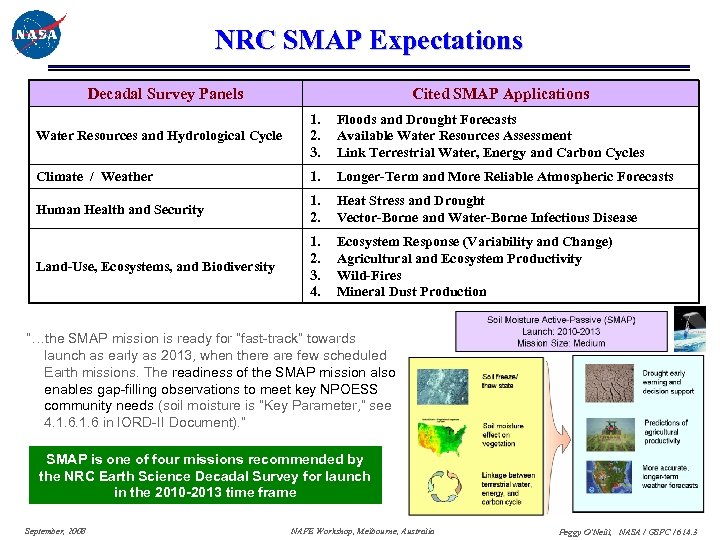 NRC SMAP Expectations Decadal Survey Panels Cited SMAP Applications Water Resources and Hydrological Cycle 1. 2. 3. Floods and Drought Forecasts Available Water Resources Assessment Link Terrestrial Water, Energy and Carbon Cycles Climate / Weather 1. Longer-Term and More Reliable Atmospheric Forecasts Human Health and Security 1. 2. Heat Stress and Drought Vector-Borne and Water-Borne Infectious Disease Land-Use, Ecosystems, and Biodiversity 1. 2. 3. 4. Ecosystem Response (Variability and Change) Agricultural and Ecosystem Productivity Wild-Fires Mineral Dust Production “…the SMAP mission is ready for “fast-track” towards launch as early as 2013, when there are few scheduled Earth missions. The readiness of the SMAP mission also enables gap-filling observations to meet key NPOESS community needs (soil moisture is “Key Parameter, ” see 4. 1. 6 in IORD-II Document). ” SMAP is one of four missions recommended by the NRC Earth Science Decadal Survey for launch in the 2010 -2013 time frame September, 2008 NAFE Workshop, Melbourne, Australia Peggy O’Neill, NASA / GSFC / 614. 3
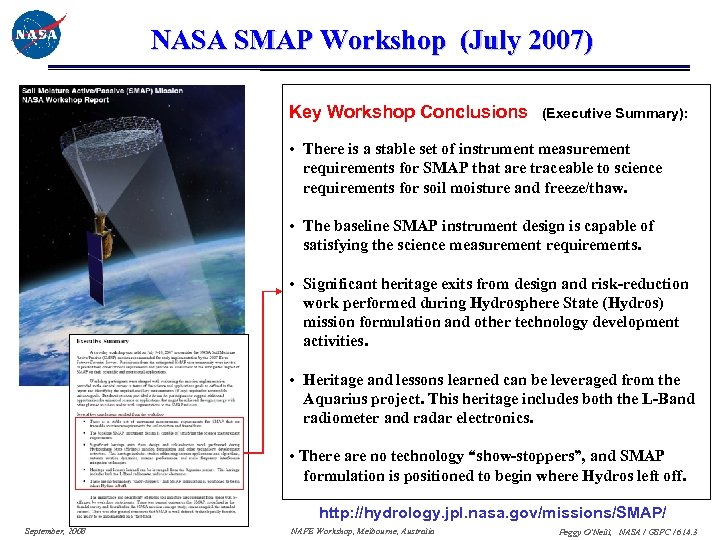 NASA SMAP Workshop (July 2007) Key Workshop Conclusions (Executive Summary): • There is a stable set of instrument measurement requirements for SMAP that are traceable to science requirements for soil moisture and freeze/thaw. • The baseline SMAP instrument design is capable of satisfying the science measurement requirements. • Significant heritage exits from design and risk-reduction work performed during Hydrosphere State (Hydros) mission formulation and other technology development activities. • Heritage and lessons learned can be leveraged from the Aquarius project. This heritage includes both the L-Band radiometer and radar electronics. • There are no technology “show-stoppers”, and SMAP formulation is positioned to begin where Hydros left off. http: //hydrology. jpl. nasa. gov/missions/SMAP/ September, 2008 NAFE Workshop, Melbourne, Australia Peggy O’Neill, NASA / GSFC / 614. 3
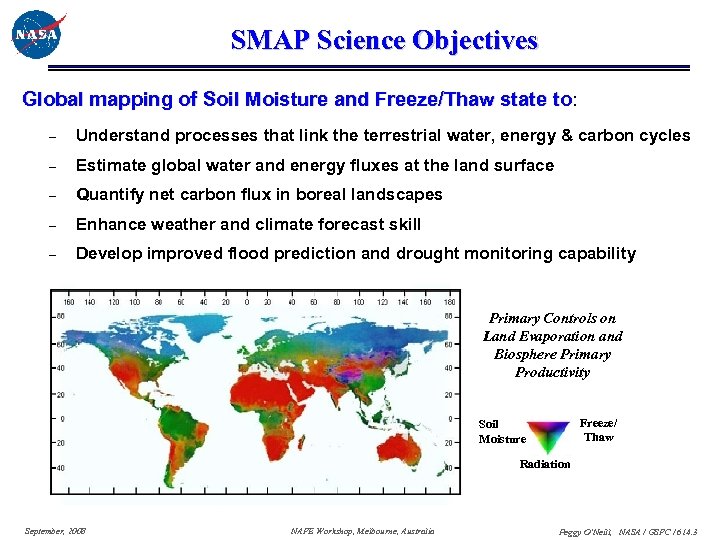 SMAP Science Objectives Global mapping of Soil Moisture and Freeze/Thaw state to: to Understand processes that link the terrestrial water, energy & carbon cycles Estimate global water and energy fluxes at the land surface Quantify net carbon flux in boreal landscapes Enhance weather and climate forecast skill Develop improved flood prediction and drought monitoring capability Primary Controls on Land Evaporation and Biosphere Primary Productivity Freeze/ Thaw Soil Moisture Radiation September, 2008 NAFE Workshop, Melbourne, Australia Peggy O’Neill, NASA / GSFC / 614. 3
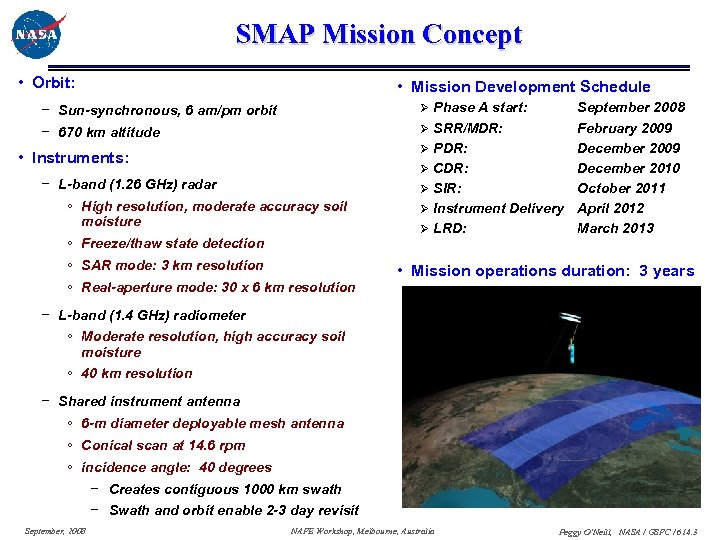 SMAP Mission Concept • Orbit: • Mission Development Schedule Ø Phase A start: − Sun-synchronous, 6 am/pm orbit − 670 km altitude • Instruments: − L-band (1. 26 GHz) radar ◦ High resolution, moderate accuracy soil moisture ◦ Freeze/thaw state detection ◦ SAR mode: 3 km resolution ◦ Real-aperture mode: 30 x 6 km resolution September 2008 Ø SRR/MDR: February 2009 Ø PDR: December 2009 Ø CDR: December 2010 Ø SIR: October 2011 Ø Instrument Delivery April 2012 Ø LRD: March 2013 • Mission operations duration: 3 years − L-band (1. 4 GHz) radiometer ◦ Moderate resolution, high accuracy soil moisture ◦ 40 km resolution − Shared instrument antenna ◦ 6 -m diameter deployable mesh antenna ◦ Conical scan at 14. 6 rpm ◦ incidence angle: 40 degrees − Creates contiguous 1000 km swath − Swath and orbit enable 2 -3 day revisit September, 2008 NAFE Workshop, Melbourne, Australia Peggy O’Neill, NASA / GSFC / 614. 3
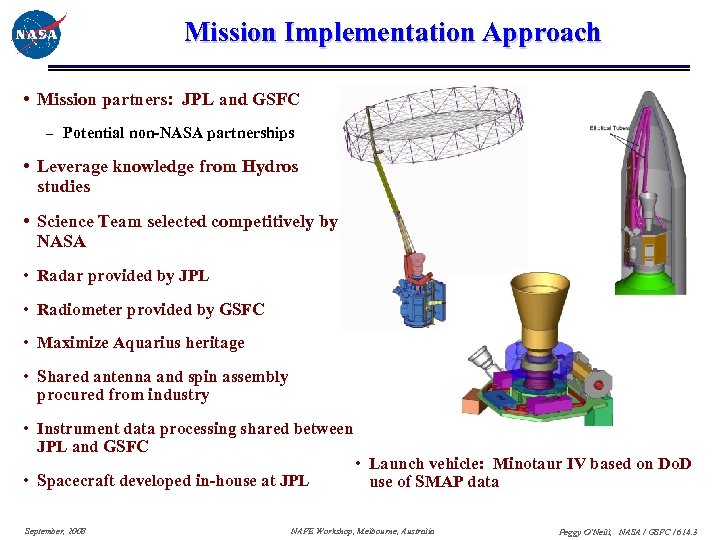 Mission Implementation Approach • Mission partners: JPL and GSFC Potential non-NASA partnerships • Leverage knowledge from Hydros studies • Science Team selected competitively by NASA • Radar provided by JPL • Radiometer provided by GSFC • Maximize Aquarius heritage • Shared antenna and spin assembly procured from industry • Instrument data processing shared between JPL and GSFC • Spacecraft developed in-house at JPL September, 2008 • Launch vehicle: Minotaur IV based on Do. D use of SMAP data NAFE Workshop, Melbourne, Australia Peggy O’Neill, NASA / GSFC / 614. 3
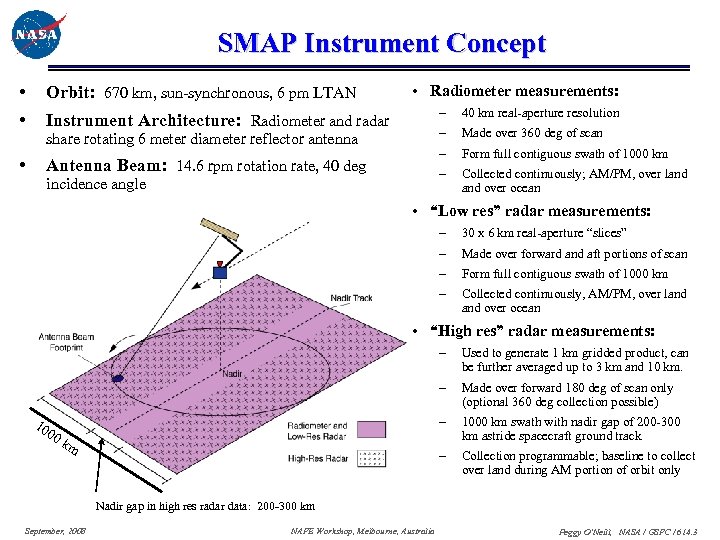 SMAP Instrument Concept • Orbit: 670 km, sun-synchronous, 6 pm LTAN • Instrument Architecture: Radiometer and radar • • Radiometer measurements: Antenna Beam: 14. 6 rpm rotation rate, 40 deg – – Form full contiguous swath of 1000 km – incidence angle Made over 360 deg of scan – share rotating 6 meter diameter reflector antenna 40 km real-aperture resolution Collected continuously; AM/PM, over land over ocean • “Low res” radar measurements: – 30 x 6 km real-aperture “slices” – Made over forward and aft portions of scan – Form full contiguous swath of 1000 km – Collected continuously, AM/PM, over land over ocean • “High res” radar measurements: – – 10 00 Made over forward 180 deg of scan only (optional 360 deg collection possible) – 1000 km swath with nadir gap of 200 -300 km astride spacecraft ground track – km Used to generate 1 km gridded product, can be further averaged up to 3 km and 10 km. Collection programmable; baseline to collect over land during AM portion of orbit only Nadir gap in high res radar data: 200 -300 km September, 2008 NAFE Workshop, Melbourne, Australia Peggy O’Neill, NASA / GSFC / 614. 3
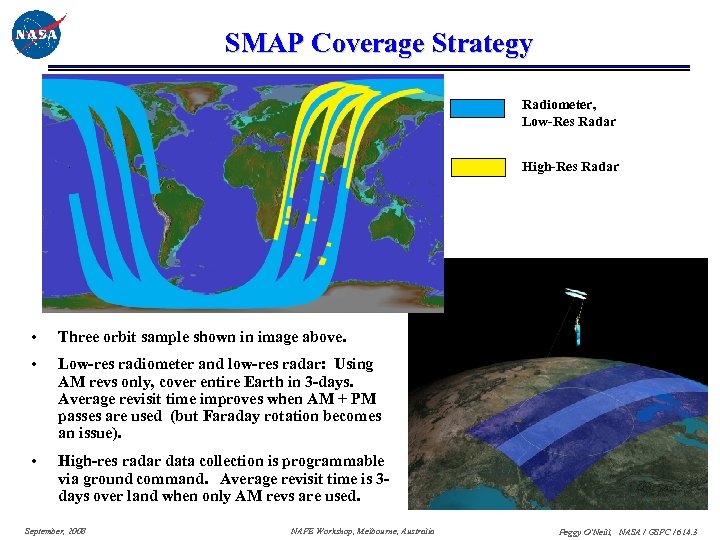 SMAP Coverage Strategy Radiometer, Low-Res Radar High-Res Radar • Three orbit sample shown in image above. • Low-res radiometer and low-res radar: Using AM revs only, cover entire Earth in 3 -days. Average revisit time improves when AM + PM passes are used (but Faraday rotation becomes an issue). • High-res radar data collection is programmable via ground command. Average revisit time is 3 days over land when only AM revs are used. September, 2008 NAFE Workshop, Melbourne, Australia Peggy O’Neill, NASA / GSFC / 614. 3
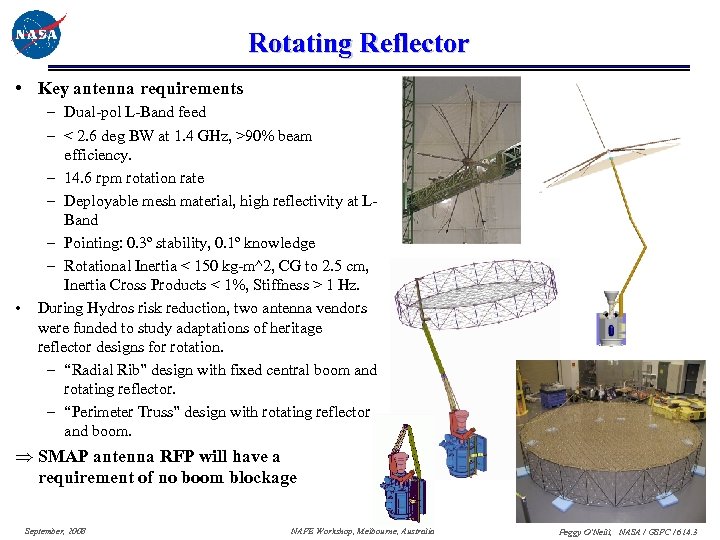 Rotating Reflector • Key antenna requirements • – Dual-pol L-Band feed – < 2. 6 deg BW at 1. 4 GHz, >90% beam efficiency. – 14. 6 rpm rotation rate – Deployable mesh material, high reflectivity at LBand – Pointing: 0. 3º stability, 0. 1º knowledge – Rotational Inertia < 150 kg-m^2, CG to 2. 5 cm, Inertia Cross Products < 1%, Stiffness > 1 Hz. During Hydros risk reduction, two antenna vendors were funded to study adaptations of heritage reflector designs for rotation. – “Radial Rib” design with fixed central boom and rotating reflector. – “Perimeter Truss” design with rotating reflector and boom. SMAP antenna RFP will have a requirement of no boom blockage September, 2008 NAFE Workshop, Melbourne, Australia Peggy O’Neill, NASA / GSFC / 614. 3
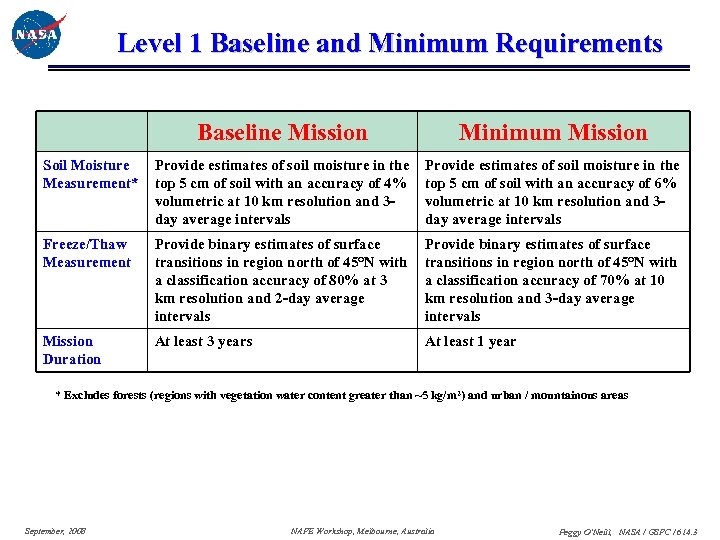 Level 1 Baseline and Minimum Requirements Baseline Mission Minimum Mission Soil Moisture Measurement* Provide estimates of soil moisture in the top 5 cm of soil with an accuracy of 4% volumetric at 10 km resolution and 3 day average intervals Provide estimates of soil moisture in the top 5 cm of soil with an accuracy of 6% volumetric at 10 km resolution and 3 day average intervals Freeze/Thaw Measurement Provide binary estimates of surface transitions in region north of 45°N with a classification accuracy of 80% at 3 km resolution and 2 -day average intervals Provide binary estimates of surface transitions in region north of 45°N with a classification accuracy of 70% at 10 km resolution and 3 -day average intervals Mission Duration At least 3 years At least 1 year * Excludes forests (regions with vegetation water content greater than ~5 kg/m 2) and urban / mountainous areas September, 2008 NAFE Workshop, Melbourne, Australia Peggy O’Neill, NASA / GSFC / 614. 3
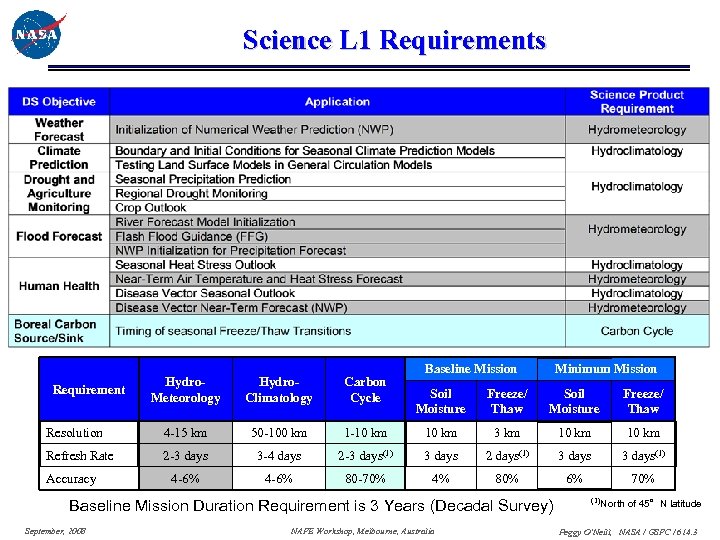 Science L 1 Requirements Hydro. Meteorology Hydro. Climatology Carbon Cycle Resolution 4 -15 km 50 -100 km Refresh Rate 2 -3 days 4 -6% Requirement Accuracy Baseline Mission Minimum Mission Soil Moisture Freeze/ Thaw 1 -10 km 3 km 10 km 3 -4 days 2 -3 days(1) 3 days 2 days(1) 3 days(1) 4 -6% 80 -70% 4% 80% 6% 70% Baseline Mission Duration Requirement is 3 Years (Decadal Survey) September, 2008 NAFE Workshop, Melbourne, Australia (1)North of 45°N latitude Peggy O’Neill, NASA / GSFC / 614. 3
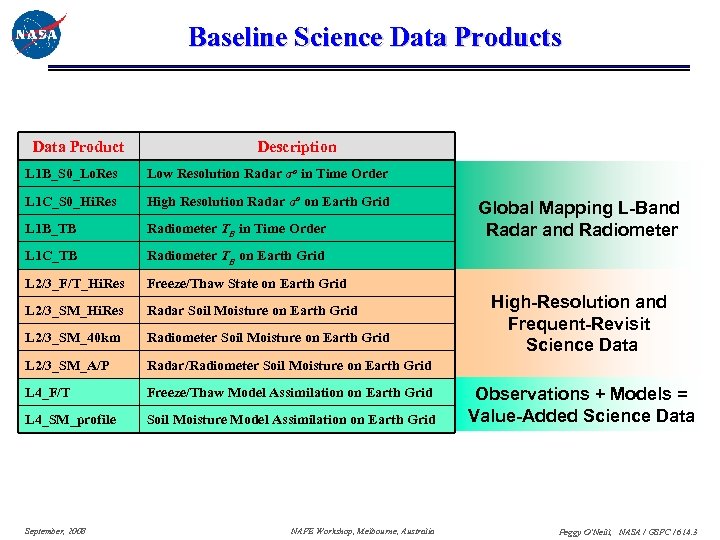 Baseline Science Data Products Data Product Description L 1 B_S 0_Lo. Res Low Resolution Radar σo in Time Order L 1 C_S 0_Hi. Res High Resolution Radar σo on Earth Grid L 1 B_TB Radiometer TB in Time Order L 1 C_TB Radiometer TB on Earth Grid L 2/3_F/T_Hi. Res Freeze/Thaw State on Earth Grid L 2/3_SM_Hi. Res Radar Soil Moisture on Earth Grid L 2/3_SM_40 km Radiometer Soil Moisture on Earth Grid L 2/3_SM_A/P Radar/Radiometer Soil Moisture on Earth Grid L 4_F/T Freeze/Thaw Model Assimilation on Earth Grid L 4_SM_profile Soil Moisture Model Assimilation on Earth Grid September, 2008 NAFE Workshop, Melbourne, Australia Global Mapping L-Band Radar and Radiometer High-Resolution and Frequent-Revisit Science Data Observations + Models = Value-Added Science Data Peggy O’Neill, NASA / GSFC / 614. 3
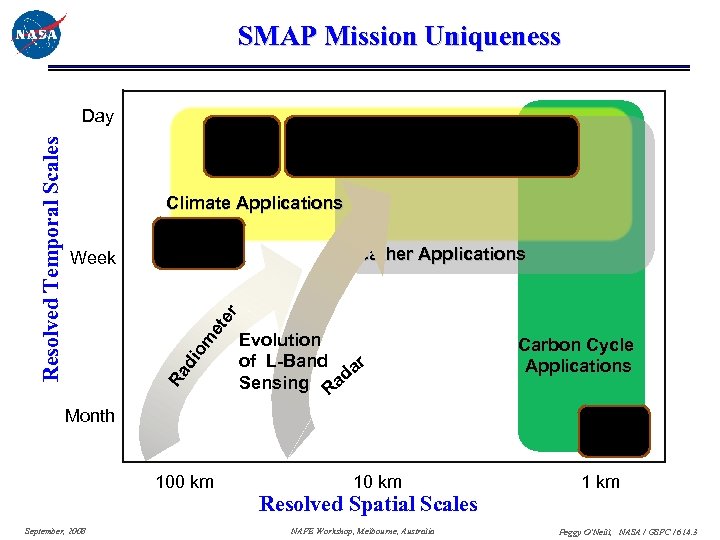 SMAP Mission Uniqueness SMOS SMAP Radar-Radiometer Climate Applications Weather Applications di om et er Week Aquarius Ra Resolved Temporal Scales Day Evolution of L-Band ar Sensing Rad Month ALOS SAR 100 km September, 2008 Carbon Cycle Applications 10 km Resolved Spatial Scales NAFE Workshop, Melbourne, Australia 1 km Peggy O’Neill, NASA / GSFC / 614. 3
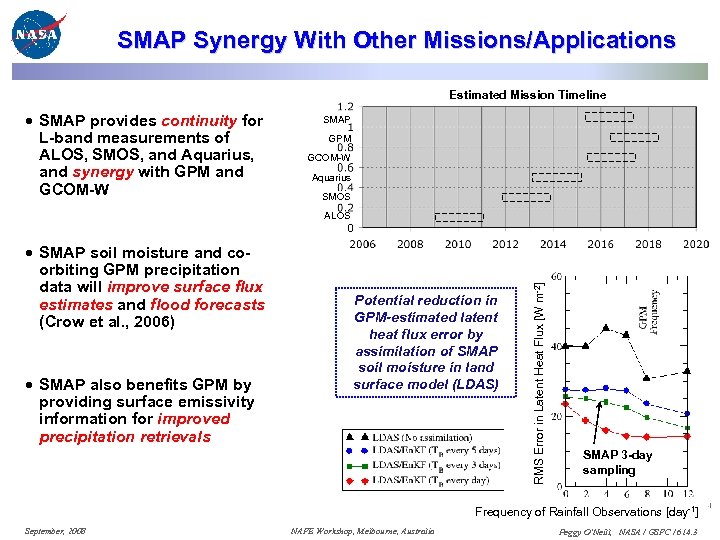 SMAP Synergy With Other Missions/Applications Estimated Mission Timeline SMAP provides continuity for L-band measurements of ALOS, SMOS, and Aquarius, and synergy with GPM and GCOM-W SMAP GPM GCOM-W Aquarius SMOS SMAP soil moisture and coorbiting GPM precipitation data will improve surface flux estimates and flood forecasts (Crow et al. , 2006) SMAP also benefits GPM by providing surface emissivity information for improved precipitation retrievals Potential reduction in GPM-estimated latent heat flux error by assimilation of SMAP soil moisture in land surface model (LDAS) RMS Error in Latent Heat Flux [W m-2] ALOS SMAP 3 -day sampling Frequency of Rainfall Observations [day-1] September, 2008 NAFE Workshop, Melbourne, Australia Peggy O’Neill, NASA / GSFC / 614. 3
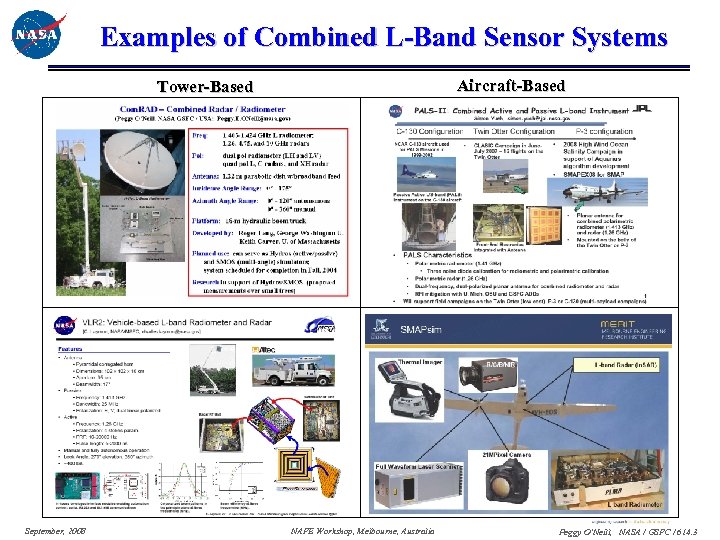 Examples of Combined L-Band Sensor Systems Aircraft-Based Tower-Based September, 2008 NAFE Workshop, Melbourne, Australia Peggy O’Neill, NASA / GSFC / 614. 3
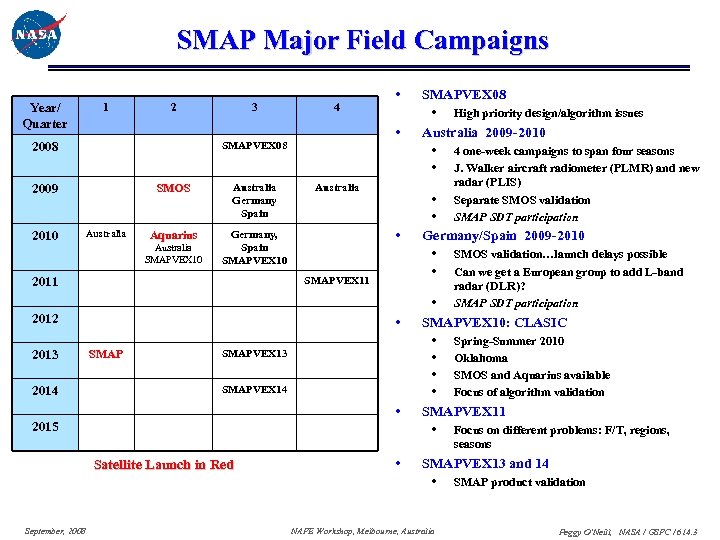 SMAP Major Field Campaigns Year/ Quarter 1 2 SMOS 2009 Australia Germany Spain Aquarius • SMAPVEX 13 SMAPVEX 14 • 2015 • • Germany/Spain 2009 -2010 • SMOS validation…launch delays possible • Can we get a European group to add L-band radar (DLR)? SMAP SDT participation • SMAPVEX 08 • High priority design/algorithm issues Australia 2009 -2010 • 4 one-week campaigns to span four seasons • J. Walker aircraft radiometer (PLMR) and new radar (PLIS) Separate SMOS validation SMAP SDT participation Australia SMAPVEX 11 2012 2014 • • Germany, Spain SMAPVEX 10 Australia SMAPVEX 10 2011 2013 4 SMAPVEX 08 2010 3 • SMAPVEX 10: CLASIC • Spring-Summer 2010 • Oklahoma • SMOS and Aquarius available • Focus of algorithm validation SMAPVEX 11 • Focus on different problems: F/T, regions, seasons Satellite Launch in Red September, 2008 • SMAPVEX 13 and 14 • SMAP product validation NAFE Workshop, Melbourne, Australia Peggy O’Neill, NASA / GSFC / 614. 3
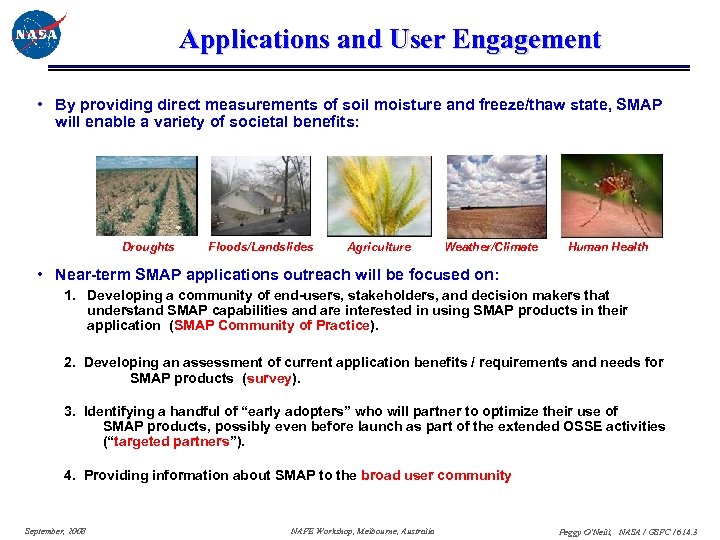 Applications and User Engagement • By providing direct measurements of soil moisture and freeze/thaw state, SMAP will enable a variety of societal benefits: Droughts Floods/Landslides Agriculture Weather/Climate Human Health • Near-term SMAP applications outreach will be focused on: 1. Developing a community of end-users, stakeholders, and decision makers that understand SMAP capabilities and are interested in using SMAP products in their application (SMAP Community of Practice). 2. Developing an assessment of current application benefits / requirements and needs for SMAP products (survey). 3. Identifying a handful of “early adopters” who will partner to optimize their use of SMAP products, possibly even before launch as part of the extended OSSE activities (“targeted partners”). 4. Providing information about SMAP to the broad user community September, 2008 NAFE Workshop, Melbourne, Australia Peggy O’Neill, NASA / GSFC / 614. 3
 September, 2008 NAFE Workshop, Melbourne, Australia Peggy O’Neill, NASA / GSFC / 614. 3
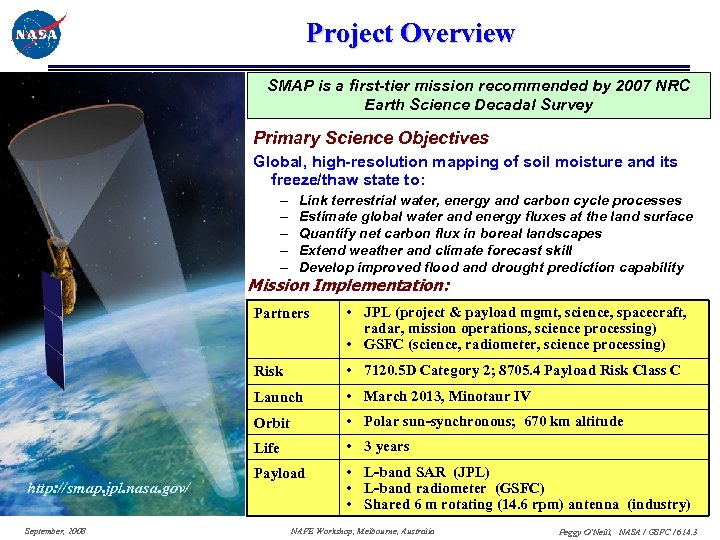 Project Overview SMAP is a first-tier mission recommended by 2007 NRC Earth Science Decadal Survey Primary Science Objectives Global, high-resolution mapping of soil moisture and its freeze/thaw state to: Link terrestrial water, energy and carbon cycle processes Estimate global water and energy fluxes at the land surface Quantify net carbon flux in boreal landscapes Extend weather and climate forecast skill Develop improved flood and drought prediction capability Mission Implementation: Partners Risk • March 2013, Minotaur IV Orbit • Polar sun-synchronous; 670 km altitude Life September, 2008 • 7120. 5 D Category 2; 8705. 4 Payload Risk Class C Launch http: //smap. jpl. nasa. gov/ • JPL (project & payload mgmt, science, spacecraft, radar, mission operations, science processing) • GSFC (science, radiometer, science processing) • 3 years Payload • L-band SAR (JPL) • L-band radiometer (GSFC) • Shared 6 m rotating (14. 6 rpm) antenna (industry) NAFE Workshop, Melbourne, Australia Peggy O’Neill, NASA / GSFC / 614. 3